Disclosure: topratedkitchenware.com is reader-supported. When you buy through links on our site, we may earn an affiliate commission from Amazon and other retailers, at no extra cost to you.
Where to buy
The best retrofitting for old toilets starts with models that respect what an old house already has: a standard flange position, tired shut-off valves, floors that are not perfectly level, and bathrooms smaller than modern codes assume. All six picks below are sold through Amazon, where you can confirm the configuration on the current listing before ordering:
- IDEALHOUSE ADA 17 Inch Elongated Toilet — Check on Amazon
- American Standard Cadet PRO Right Height Elongated Toilet
- HOROW T0338W One Piece Toilet, ADA Chair Height
- DeerValley Compact One Piece Toilet
- BayRoll One Piece Round Toilet, ADA Chair Height
- Casta Diva Elongated One Piece Toilet, 17 Inch Comfort Height
Read the full guide ↓ for the pre-purchase inspection an old bathroom demands, the retrofit problems each pick solves, and the situations where no new toilet is the right first move.
Retrofitting a toilet into an old home is a different job from choosing a toilet for a new one. The new-build buyer shops features; the old-house buyer shops compatibility first — with a flange set who-knows-where by a long-retired plumber, with cast-iron or even lead-era drainwork below the floor, with a supply valve that has not turned in twenty years, and with a room whose dimensions were decided before elongated bowls and chair heights existed. The best retrofitting for old toilets therefore means models that install on the standard 12-inch rough-in most older homes were actually built with, that tolerate imperfect floors, that replace thirsty vintage fixtures with modern consumption, and that solve the old bathroom’s real problems: a seat too low for aging knees, a footprint too big for the room, a flush that wastes water the septic system must absorb.
One boundary must be stated before the picks, because honesty here saves a returned toilet: every model in this shortlist is built for a 12-inch rough-in, which covers the large majority of older American homes. If your measurement comes back at 10 or 14 inches, stop — those homes need a purpose-built rough-in model, and no amount of retrofit enthusiasm makes a 12-inch toilet fit a 10-inch flange position. Measure first, using the method in the how-to section, and let the number admit you to this shortlist or send you to the specialist shelf.
There is also a sequencing insight that experienced renovators pass on and first-timers learn expensively: the toilet is the last fixture to install in a bathroom refresh, not the first. Flooring, wall finishes, and vanity work all go more easily in a room whose floor flange is capped and empty, and a new toilet installed early becomes an obstacle that gets painted around, leaned on, and occasionally cracked by a dropped tool. Order the fixture early — porcelain delivery is not instant, and the carton gives you the dry-fit measurements — but set it at the end, onto finished floors, as the room’s final act.
Within that boundary, the six picks divide the old-house briefs between them: a mainstream comfort-height upgrade, a classic brand-continuity replacement, a full modern one-piece transformation, two compact designs for small vintage bathrooms — one of them genuinely round-fronted, the shape old bathrooms were plumbed around — and a compact elongated option for rooms that can spare a little more depth.
Key Takeaways
- Measure the rough-in before anything else: all six picks fit the standard 12-inch rough-in; 10-inch and 14-inch homes need specialist models outside this shortlist.
- The IDEALHOUSE is the default retrofit: ADA 17-inch height, siphonic jet at 1.28 GPF, easy-clean porcelain, standard rough-in — the modern specification on the old house’s existing plumbing.
- The BayRoll is the only true round-front pick here, and its compact skirted design with a stated MaP 1000-gram rating suits the small bathrooms old homes are full of.
- Replacing a vintage 3.5-to-7-gallon toilet with any 1.28 GPF pick is the largest single water saving available in most old homes.
- Budget attention for the unglamorous parts: flange condition, shut-off valve, floor soundness, and a fresh wax ring decide whether the retrofit succeeds.
- Sequence the toilet last in any wider bathroom refresh: order it early for delivery and dry-fit measurements, but set it onto finished floors as the room’s final act, so it is never painted around, leaned on, or put in the path of dropped tools.
- The American Standard Cadet PRO offers brand continuity and a full-volume 1.6 GPF flush for old, long, or marginal drain runs.
In this guide
Quick Picks
| Pick | Badge | Flush | Seat height | Format |
|---|---|---|---|---|
| IDEALHOUSE ADA 17 Inch Elongated | Best Overall Retrofit | Siphonic jet, 1.28 GPF | 17 inch | Two-piece |
| American Standard Cadet PRO Right Height | Best Classic Replacement | Single flush, 1.6 GPF | Right Height | Two-piece |
| HOROW T0338W One Piece | Best Modern Upgrade | Dual flush 1.1/1.6 GPF, MaP 1000g | 17.3 inch | One-piece skirted |
| DeerValley Compact One Piece | Best for Small Old Bathrooms | Dual flush 1.1/1.6 GPF | Standard height | One-piece skirted |
| BayRoll Round One Piece | Best Round-Front Fit | Dual flush 0.9/1.28 GPF, MaP 1000g | 17 inch | One-piece skirted, round |
| Casta Diva Elongated One Piece | Best Compact Elongated | Dual flush 1.1/1.6 GPF | 17 inch | One-piece |
Read the badges as old-house problems: height for the knees, brand continuity for the drain line, transformation for the full renovation, compact footprints for the vintage floor plan, and a round front for the room that was never built for an elongated bowl.
How These Picks Were Chosen
Every model was verified against its Amazon listing data on 2026-11-20, and the spec boxes use only stated attributes: format, bowl shape, flush system and volume, seat height, rough-in where the listing states it, and any stated test figure. The BayRoll’s and the HOROW T0338W’s MaP 1000-gram ratings are reported as listing claims. The Cadet PRO’s verified title data does not state a rough-in; because the retrofit brief turns on fit, that gap is flagged in its review rather than papered over, and the buyer is directed to confirm the configuration on the listing.
Selection favored retrofit virtues over showroom virtues: standard rough-in fit, tolerance-friendly two-piece or manageable one-piece formats, modern consumption to replace vintage water use, compact variants for small old rooms, one true round-front model, and one legacy-brand option whose parts ecosystem suits houses that are maintained for generations. Excluded: wall-hung and rear-outlet designs for floor-flange homes, and any model whose fit could not be established from its listing data. This is a research-led guide, not a hands-on test series; the retrofit judgments are drawn from the documented specifications and from the standard practice of residential replacement work. Readers whose old house also needs its drain line assessed will find the line-treatment discussion in Best Root Killer For Toilets relevant where roots are the suspected problem.
The 6 Best Retrofitting for Old Toilets

IDEALHOUSE ADA Compliant 17 Inch Elongated Toilet
Badge: Best Overall Retrofit
Strengths
- The complete modern specification on the old house’s existing plumbing: ADA 17-inch height, siphonic jet, 1.28 GPF, standard 12-inch rough-in.
- Easy-clean white porcelain — a genuine mercy in an old bathroom whose vintage fixture has decades of mineral history.
- Two-piece format is forgiving on imperfect floors and light enough to maneuver in a small room; soft-close seat included.
Trade-offs
- Elongated bowl needs its extra depth verified against the old room’s door swing and clearances.
- No MaP figure stated in the verified listing.
- Newer brand; parts depth is probable rather than generational.
Spec box
- Brand: IDEALHOUSE
- Configuration: Two-piece ceramic, elongated bowl
- Flush: Siphonic jet, 1.28 GPF water-saving
- Seat height: 17 inch, ADA compliant comfort height
- Rough-in: 12 inch
- Seat: Soft-close included
- Finish: Easy-clean white porcelain
The typical old-house toilet project is not a renovation; it is a rescue. The vintage fixture runs, stains, or rocks, its seat is a generation too low for the household’s knees, and the owners want the modern specification — chair height, efficient flush, quiet seat — without touching the plumbing in the floor. The IDEALHOUSE is built precisely on that intersection: it lands on the same 12-inch rough-in the old toilet used, delivers its water savings through a siphonic jet rather than a starved washdown, and brings the seat up to the ADA-aligned height that makes the replacement feel like an upgrade instead of a repair.
Its two-piece format is a quiet retrofit virtue. Old bathrooms are small and their floors are rarely perfect; a bowl that can be set and shimmed separately from its tank is easier to level on a floor with a century of character, and lighter to carry up a narrow stair. The honest limits are the elongated footprint, which must be checked against the room, and the absence of a published MaP figure. For the mainstream old-house brief, neither displaces it from the top of this list.
Best for: the standard old-house upgrade, aging-in-place projects / Not suited for: very small rooms that cannot take an elongated bowl

American Standard Cadet PRO Right Height Elongated Toilet
Badge: Best Classic Replacement
Strengths
- Brand continuity for old homes already plumbed with American Standard: familiar format, ubiquitous parts, universal plumber knowledge.
- A full 1.6 GPF flush, which suits the long, flat, or scaled drain runs that old houses often hide.
- Right Height elongated two-piece — the most conventional modern replacement specification in the industry.
Trade-offs
- Uses more water than every other pick here; on a vintage toilet’s replacement the saving versus the original is still large, but the 1.28 GPF picks save more.
- Verified title data states no rough-in or seat inclusion — confirm the exact configuration on the listing before ordering, which matters doubly on a retrofit.
- No named rinse or glaze technology.
Spec box
- Brand: American Standard
- Configuration: Two-piece, elongated bowl
- Flush: 1.6 GPF
- Height: Right Height
- Model: 215AA004.020 Cadet PRO
- Color: White
Old houses reward continuity. The Cadet PRO is the replacement a plumber suggests when the drain line is cast iron, the run to the stack is long, and the household’s priority is a toilet that behaves exactly as expected for the next thirty years. Its full-volume flush is sometimes characterized as old-fashioned; in an old house it is better understood as matched to the plumbing — vintage drain lines were sized and sloped for generous water, and a full 1.6-gallon flush still represents a dramatic saving over the 3.5-to-7-gallon fixtures these homes are retiring.
The retrofit-specific caution is documentation: with no rough-in stated in the verified title data, the buyer must confirm the configuration on the listing page and against their own flange measurement before ordering. Do that, and the Cadet PRO is the lowest-drama replacement in this guide — the one whose parts will be on a shelf in any town the house outlives. Households weighing owner reports on legacy models can consult the survey in Best Reviewed Toilets as a second source.
Best for: plumber-led retrofits, long or marginal drain runs, brand continuity / Not suited for: maximum water savings
HOROW T0338W One Piece Toilet, ADA Chair Height
Badge: Best Modern Upgrade
Strengths
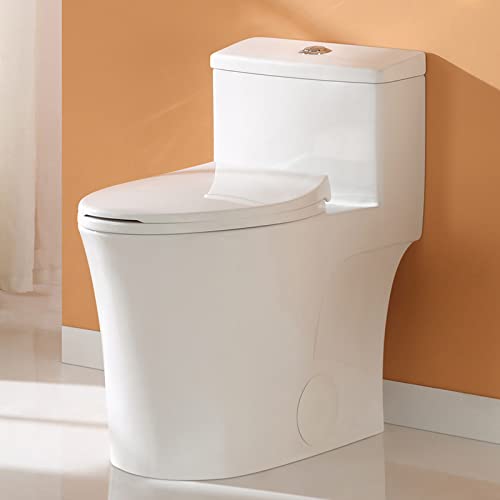
- A complete transformation in one fixture: skirted one-piece silhouette, dual flush, 17.3-inch ADA chair height, stated MaP 1000-gram full flush.
- Compact skirted design keeps the footprint old-bathroom-friendly while eliminating the trapway contours that collect a century of dust.
- Standard 12-inch rough-in, so the modernization happens entirely above the floor.
Trade-offs
- One-piece weight demands a two-person set — plan the carry through an old house’s stairs and turns.
- Single-casting service limits: no separate tank replacement.
- Elongated bowl in a compact body still needs its front clearance checked.
Spec box
- Brand: HOROW
- Configuration: One-piece, elongated bowl, compact skirted design
- Flush: Dual flush 1.1/1.6 GPF, MaP 1000g rating stated in listing
- Seat height: 17.3 inch, ADA chair height
- Rough-in: 12 inch
- Finish: White, easy-clean positioning
Some retrofits are repairs; this one is a renovation in a single fixture. The T0338W replaces everything the vintage toilet was — low, thirsty, contour-trapped, stained — with the current state of the art: a smooth skirted casting that wipes clean in seconds, a dual flush whose full mode carries the strongest documented bulk-removal figure in this guide, and chair height that brings an old bathroom into ADA-aligned territory. That it achieves all of this on the standard rough-in, without moving a single pipe, is the essence of a good retrofit: maximum change above the floor, zero change below it.
The cautions are logistical. The fixture is heavy, old staircases are narrow, and the set onto the flange is a two-person job with a hidden-bolt skirt that rewards patience. The dual flush also asks the household to use two buttons as intended. For an old house being genuinely renovated rather than merely repaired, those are acceptable terms, and the result is the most modern bathroom in this guide. Its bowl-rinse behavior is the subject the cluster’s Best Rinsing Toilets coverage explores for readers who want that layer in depth.
Best for: full old-bathroom renovations, design-led upgrades / Not suited for: solo installers or minimal-intervention repairs

DeerValley Compact One Piece Toilet
Badge: Best for Small Old Bathrooms
Strengths
- Compact skirted one-piece designed for small bathrooms — the room type old houses have in abundance.
- Dual flush at 1.1/1.6 GPF, positioned as powerful and quiet; old bathrooms often adjoin bedrooms, where quiet is a feature.
- Standard seat height suits mixed households, and the 12-inch rough-in fits the standard vintage flange position.
Trade-offs
- Standard height does not deliver the chair-height upgrade many retrofit projects are seeking.
- No MaP figure stated in the verified listing.
- One-piece weight and single-casting service limits.
Spec box
- Brand: DeerValley
- Configuration: One-piece, compact skirted design
- Flush: Dual flush 1.1/1.6 GPF, powerful and quiet positioning
- Seat height: Standard seat height
- Rough-in: 12 inch
- Positioned for: Small bathrooms
Old houses concentrate their plumbing in small rooms, and the DeerValley is the pick shaped for them. Its compact skirted body takes less visual and physical space than a conventional fixture, its smooth base cleans without the brush-work an exposed trapway demands in a tight corner, and its dual flush modernizes consumption from vintage gallons to a 1.1-gallon light mode. Standard seat height, often read as a limitation, is in context a fit: the small second bathroom in an old house is frequently the children’s or guests’ room, where standard height serves more users honestly.
Choose it for the room it names, and look elsewhere for a chair-height primary-bathroom retrofit. Its listing states no MaP figure, so its clearing case rests on its dual-flush design and positioning rather than a published score. For the old house whose small bathroom needs modernization without enlargement, it is the most sympathetic fixture in this guide.
Best for: small vintage bathrooms, guest and children’s rooms / Not suited for: chair-height primary retrofits

BayRoll One Piece Round Toilet, ADA Chair Height
Badge: Best Round-Front Fit
Strengths
- A genuine round-front bowl — the shape old bathrooms were dimensioned for — in a modern fully skirted one-piece design.
- Dual flush at an efficient 0.9/1.28 GPF with a stated MaP 1000-gram rating: the strongest documented efficiency-power pairing in this guide.
- 17-inch ADA chair height and a soft-close seat, on a standard 12-inch rough-in.
Trade-offs
- Round bowl offers less sitting area than the elongated models — the deliberate trade for its shorter footprint.
- One-piece weight requires a two-person installation.
- Chair height plus a compact room still requires the door-swing check every retrofit deserves.
Spec box
- Brand: BAYROLL
- Configuration: One-piece, round bowl, fully skirted
- Flush: Dual flush 0.9/1.28 GPF, MaP 1000g rating stated in listing
- Seat height: 17 inch, ADA chair height
- Rough-in: 12 inch
- Seat: Soft-close included
The BayRoll solves the retrofit problem the other picks route around: the old bathroom whose dimensions simply will not accept an elongated bowl. Vintage bathrooms were plumbed and partitioned around round fronts, and forcing two extra inches of porcelain into them produces knees against doors and doors against bowls. The BayRoll keeps the round footprint and modernizes everything else — a skirted one-piece exterior, chair height for aging knees, a soft-close seat, and a dual flush whose 0.9-gallon light mode is the most frugal in this guide while its full mode carries a stated maximum MaP rating. It is the rare retrofit that asks the old house for nothing.
Its trade is inherent to the shape: a round bowl is a smaller seat, and tall adults who fit the room may still prefer an elongated model if the clearance can be found. Measure the door swing honestly; if an elongated bowl genuinely fits, the Casta Diva below is the alternative. If it does not, the BayRoll is not a compromise but the correct answer, and the wider round-bowl field is compared in Best Reviewed Round Toilets and in the comfort-focused Best Round Bowl Comfort Toilets guide.
Best for: small old bathrooms, round-front replacements, water-frugal households / Not suited for: users who strongly prefer an elongated seat

Casta Diva Elongated One Piece Toilet, 17 Inch Comfort Height
Badge: Best Compact Elongated
Strengths
- Elongated comfort in a compact one-piece body — the middle path between the BayRoll’s round fit and a full-size fixture.
- 17-inch comfort chair height with dual flush at 1.1/1.6 GPF, described in the listing as high-efficiency.
- Standard 12-inch rough-in and a standard white bowl that suits period bathrooms visually.
Trade-offs
- No MaP figure stated in the verified listing.
- Compact elongated still needs more depth than the round BayRoll — measure before assuming it fits a tight room.
- One-piece weight and single-casting service considerations apply.
Spec box
- Brand: CASTA DIVA
- Configuration: One-piece, elongated bowl, compact design
- Flush: Dual flush 1.1/1.6 GPF, high-efficiency positioning
- Seat height: 17 inch comfort chair height
- Rough-in: 12 inch
- Color: White
The Casta Diva exists for the old bathroom in between: too tight for a full-size elongated fixture, roomy enough that a round front would waste the space. Its compact one-piece body keeps the elongated sitting area that most adults prefer, sets it at the 17-inch comfort height that modernizes an old room’s ergonomics, and runs a dual flush that spends 1.1 gallons on liquid waste and reserves 1.6 for solids. In a period home, its smooth white silhouette also sits more gracefully against vintage tile and trim than a heavily contoured modern design.
Its honest limits are a missing MaP figure — its clearing case is design-level, not test-documented — and the need to verify that “compact elongated” truly fits the specific room, since compact is a relative term. Buyers who want the documented end of the compact spectrum should take the BayRoll; buyers whose rooms can accept the elongated shape will find the Casta Diva the more comfortable daily fixture.
Best for: mid-size old bathrooms, elongated comfort in a compact body / Not suited for: the tightest rooms or test-figure shoppers
Comparison Table
| Pick | Flush | GPF | Height | Format | Retrofit strength | Link |
|---|---|---|---|---|---|---|
| IDEALHOUSE 17 Inch | Siphonic jet | 1.28 | 17 inch | Two-piece | Modern spec on existing plumbing | Check on Amazon |
| American Standard Cadet PRO | Single flush | 1.6 | Right Height | Two-piece | Brand continuity, full volume | Check on Amazon |
| HOROW T0338W | Dual flush | 1.1/1.6 | 17.3 inch | One-piece skirted | Full modern transformation | Check on Amazon |
| DeerValley Compact | Dual flush | 1.1/1.6 | Standard | One-piece skirted | Small-room modernization | Check on Amazon |
| BayRoll Round | Dual flush | 0.9/1.28 | 17 inch | One-piece skirted, round | True round fit, MaP 1000g | Check on Amazon |
| Casta Diva | Dual flush | 1.1/1.6 | 17 inch | One-piece | Compact elongated comfort | Check on Amazon |
How to Choose a Toilet for an Old House
Begin below the floor, not above it. The rough-in measurement — finished wall to flange bolt centers — admits or excludes every model, and in an old house it must be taken rather than assumed, because the 12-inch standard coexisted with 10- and 14-inch installations for decades. Next, the flange itself: its material, height relative to the finished floor, and soundness decide whether the new toilet seals, and a retrofit budget that ignores a flange repair is a plan for a callback. Third, the floor: old bathrooms accumulate water history around the base, and a soft or uneven floor must be repaired or at least shimmed honestly, because no toilet sits well on rot.
Above the floor, match the fixture to the room’s era and the household’s future. Round-front for rooms dimensioned around it, compact designs for small footprints, elongated only where the depth and door swing honestly allow. Chair height is the modernization most old-house owners are actually seeking — the vintage toilet’s low seat is the daily discomfort — and the picks here deliver it in every format. Water is the final calculation: replacing a vintage fixture with a 1.28 GPF or dual-flush model transforms the house’s consumption and its septic load, while a house on a long or marginal drain run may rationally keep the Cadet PRO’s fuller volume as insurance. Choose with the house’s plumbing character in mind, and the retrofit will outlast the renovation around it.
How to Retrofit a Toilet in an Old Home, Step by Step
- Measure the rough-in from the finished wall to the flange bolt centers, and confirm it is 12 inches before ordering any pick in this guide.
- Test the shut-off valve a week early. If it will not close fully or weeps when turned, plan its replacement into the same job — old valves are the most common cause of a retrofit going sideways.
- Shut off the water, flush, sponge the old fixture dry, disconnect the supply, and unbolt the base. Expect corroded nuts; penetrating oil and patience outperform force on vintage hardware.
- Lift the old toilet off and plug the drain immediately. Then read the flange like a report: cracks, a flange sitting below floor level after years of flooring build-up, or a rotted subfloor ring each get repaired now, with a repair ring, spacer, or carpentry as required.
- Dry-fit the new bowl. Old floors are rarely flat; find the shim points before the wax ring is committed.
- Fit a fresh wax ring, set the bowl in one motion, and snug the bolts evenly. On skirted one-piece models, work with a helper and check the concealed fasteners by feel.
- Mount the tank on two-piece models, fit a new supply line — never reuse the old one on a retrofit — open the valve, and set the tank level to its marked line.
- Flush repeatedly and inspect: base perimeter, tank bolts, supply connections, and the floor below if it is accessible. Caulk the base front and sides only, leaving the rear open so a future leak reveals itself.
The three problems that define old-house work:
- Problem: the flange is lower than the finished floor after decades of new flooring layers → use a flange spacer or an extra-thick wax ring made for the purpose; a standard ring on a recessed flange is a slow leak with good manners.
- Problem: the new toilet rocks despite correct bolting → the floor, not the toilet, is out of plane; shim at the base contact points and trim the shims flush, rather than overtightening bolts into porcelain.
- Problem: several fixtures in the house drain slowly, and the new toilet inherits the blame → the drain line is the fault, not the fixture; on older properties, root intrusion is a common cause, and the treatment options are covered in the root-killer guidance linked from the research section above, with a camera inspection as the definitive check.
What a Retrofit Really Saves: Water, Septic Load, and Money
The arithmetic of replacing a vintage toilet is the most lopsided in home improvement. A pre-1990s toilet commonly uses 3.5 gallons per flush, and earlier models considerably more; the picks in this guide use 1.28 gallons or less on their full flush, and the dual-flush models spend as little as 0.9 to 1.1 gallons on the liquid flushes that dominate a household’s count. In a family bathroom, the replacement therefore cuts toilet water use by well over half from the day it is installed, with no change in household behavior — and unlike most efficiency upgrades, it does so while improving the fixture’s height, seat, and appearance at the same time. It is the rare retrofit whose payback arrives monthly on the water bill while its comfort dividend arrives daily.
On a septic system the saving is structural as well as financial. Every gallon not flushed is a gallon the tank and drain field do not process, and septic capacity is one of the hard limits on an older rural home’s bathroom count and resale. A retrofit that halves the toilet load can be the difference between a system that copes and one that needs premature pumping or worse. Even the Cadet PRO’s 1.6 gallons — this guide’s most conservative figure — represents a major reduction from a vintage fixture, which is why the honest framing is not “efficient versus wasteful” but “how much of the available saving does this house’s plumbing let you take.”
Preserving Period Character While Modernizing
Owners of genuinely historic homes face a version of the retrofit question with an aesthetic clause: the bathroom’s period fabric — hex tile, a clawfoot tub, original trim — should survive the toilet’s modernization. The workable principles are simple. Keep the fixture white and visually quiet; the smooth one-piece silhouettes in this guide, particularly the compact DeerValley and Casta Diva, sit more gently in a period room than heavily sculpted modern designs. Keep the footprint honest to the room’s original layout rather than enlarging the bathroom’s plumbing plan. And keep the modernization where it belongs — in the height, the flush, the seat, and the consumption — rather than in styling that argues with the house.
What should not be preserved is a genuinely failing vintage fixture out of sentiment. A toilet that runs, leaks at the base, or threatens the floor structure is damaging the period fabric it decorates, and a well-chosen modern replacement in a quiet design protects the room better than the original does. Where the vintage fixture is sound and significant, some owners keep it in a secondary bathroom and modernize the primary — a compromise this guide’s range of compact and standard-height picks is well shaped to serve.
Old-House Plumbing Eras: What Is Likely Under Your Floor
A retrofit goes better when you know which era of plumbing you are working with, because each era has its characteristic surprises. Pre-war homes were commonly drained in cast iron with lead bends at the toilet connection — durable, quiet, and heavy, with joints that can outlast the house; the surprises are scale build-up narrowing the line and flange heights set for flooring that has since been replaced twice. Mid-century homes mixed cast iron stacks with copper or galvanized supply, and their characteristic surprise is the shut-off valve and supply line, which age less gracefully than the drains. Homes from the 1970s onward introduced plastic drain lines and the first generations of low-consumption fixtures; their surprises are less about the pipes and more about early low-flow toilets that flushed badly enough to convince a generation that efficiency meant weakness.
None of this changes the picks in this guide — all six are floor-mounted gravity toilets that connect to any sound flange — but it changes the inspection list. Cast-iron-era homes: check the flange height against today’s floor and the line for scale. Mid-century homes: test the valve and plan a supply line. Late-century homes: expect an easy swap and spend the saved effort on the height and format upgrade the household actually wants. In every era, the toilet itself is the newest and most standardized component in the system, which is precisely why replacing it is the highest-value intervention an old bathroom offers.
The Retrofit Budget: Where the Money Actually Goes
Homeowners budgeting a toilet retrofit tend to price the fixture and forget the constellation of small costs around it, then meet them one by one at the hardware store. The honest list is short: a wax ring (or a spacer and ring where the flange is recessed), a new supply line, possibly a replacement shut-off valve, flange repair parts if the inspection demands them, shims, caulk, and the disposal route for the old fixture. Individually trivial, together they are the difference between a project priced as a product and a project priced as a job — and the fixture choices in this guide interact with that list. The two-piece models are lighter to handle alone; the one-piece models save the tank-assembly step but ask for a second pair of hands; the models with seats included remove a separate purchase that value comparisons often forget to count.
The other budget line is contingency, and old houses argue for it more than any other setting. A flange that crumbles on removal, a floor that proves soft at one corner, a valve that must be replaced on a line that drains slowly — each is a modest cost and a schedule event, and a retrofit planned with a small reserve for them finishes calmly where an exactly-priced one finishes in a second weekend. Set against the water savings the replacement delivers every single day, and the decade-plus service life of any pick in this guide, the whole constellation remains one of the cheapest genuine upgrades an old home can be given.
When the Right Retrofit Move Is Not a Toilet (Yet)
A retrofit guide earns its credibility by naming the cases where a new toilet is the second job, not the first. If the floor around the base is soft or discolored, the first job is carpentry and leak forensics: a toilet set onto rot will rock, break its seal, and continue the damage under a prettier fixture. If the bathroom’s drains gurgle, smell, or run slowly across several fixtures, the first job is the line — a camera inspection costs less than a misdiagnosed replacement and tells you whether you are facing scale, a sag, or roots. If the rough-in measures 10 or 14 inches, the first job is choosing from the specialist models built for those positions, or pricing a flange relocation with open eyes. And if the shut-off valve cannot close, the first job is the valve, because every later step depends on it.
None of these detours cancels the retrofit; each of them sequences it. The pattern to notice is that all four are cheap to discover before the new toilet is ordered and expensive to discover after — which is why this guide’s how-to section front-loads measurement and inspection, and why the most valuable tool in an old-house toilet project is the week of looking that precedes the day of lifting.
Common Buying Mistakes
- Assuming an old house has a 12-inch rough-in without measuring — the costliest sentence in retrofit work.
- Ordering an elongated toilet for a bathroom dimensioned around a round front, then living with the door conflict.
- Reusing the old supply line, wax ring, or a shut-off valve that has not turned in decades.
- Bolting through a rocking fit on an uneven old floor instead of shimming, and cracking the base for the lesson.
- Ignoring a recessed or damaged flange because the new toilet “will cover it” — it will, until it leaks.
- Modernizing the fixture while leaving a drain line problem undiagnosed, then blaming the new toilet for the old line’s behavior.
- Installing the new toilet first in a wider bathroom refresh, then painting around it and working over it for a week — the fixture should be ordered early but set last, onto the finished floor, when nothing remains that can be dropped on it.
Final Recommendation
The default old-house retrofit is the IDEALHOUSE 17-inch: it puts the complete modern specification — ADA height, jetted efficient flush, easy-clean porcelain — onto the existing 12-inch rough-in with the least drama. Where the room is small or the original bowl was round, take the BayRoll round one-piece instead and let the house keep its dimensions. Full renovations should consider the HOROW T0338W’s transformation, brand-continuity projects the Cadet PRO, and the in-between rooms the Casta Diva or the compact DeerValley.
Frequently Asked Questions
How do I know if my old home has a 10-inch or 12-inch rough-in?
Measure from the finished wall behind the toilet to the center of the bolt caps on either side of the base. Twelve inches admits every pick in this guide; ten inches requires a purpose-built model outside this shortlist. Measure to the bolts rather than the baseboard, and measure twice — in an old house, this number is the whole project.
Can I replace a round-front toilet with an elongated one?
Only if the room allows it. An elongated bowl projects roughly two inches further than a round front, so check the clearance in front of the bowl and the door’s swing path. Where the space is not there, a modern round-front model like the BayRoll in this guide modernizes everything except the footprint.
Is it worth replacing a working vintage toilet?
Usually, yes, on water alone: a vintage fixture can use three to five times the water of the 1.28 GPF picks here, and the replacement typically adds chair height, a soft-close seat, and a better rinse in the same project. The exception is a genuinely significant historic fixture in sound condition, which some owners retain in a secondary bathroom.
What is the most common hidden problem in an old-toilet retrofit?
The flange and the floor around it. Decades of small leaks can leave the flange corroded or the subfloor soft, and neither is visible until the old toilet comes off. Inspect both before the new fixture is set, repair what you find, and never solve a rocking fit by overtightening the bolts.
Should I replace the shut-off valve during a retrofit?
If it does not close completely, turns with difficulty, or shows corrosion, yes — the toilet is already off and the water is already shut down at the house, which is the one moment the valve swap is easy. A new quarter-turn ball valve is the standard modern replacement and removes a whole class of future emergencies.
Will a modern low-flow toilet work on old cast-iron drains?
Generally yes, and the picks here were chosen with that in mind: engineered jets and, in two cases, stated maximum MaP ratings provide the clearing energy, while the drain itself simply receives the water. Houses with very long or nearly flat runs are the exception that justifies the Cadet PRO’s fuller 1.6-gallon flush. If several fixtures drain slowly, have the line inspected — that is a drain problem, not a toilet problem.
How much height will I gain replacing a vintage toilet?
Usually two to four inches of seat height, which is more significant than it sounds. Vintage toilets were commonly built around a 14-to-15-inch rim; the chair-height picks in this guide sit at 17 to 17.3 inches. That difference is the margin between pushing up from a low seat with your arms and standing with your legs — the improvement aging-in-place retrofits are actually buying, delivered as a side effect of a fixture you were replacing anyway.
What happens to the old toilet?
Plan the exit before the entrance. Municipal bulk-waste pickup, a transfer-station trip, and retailer haul-away on delivery are the usual routes; a porcelain toilet is heavy and awkward, and some jurisdictions exclude it from ordinary trash. A vintage fixture in sound condition occasionally finds a second life through architectural salvage, particularly in period patterns — worth a phone call before the dump run if the house is genuinely historic.
Do I need a plumber for a toilet retrofit?
A confident homeowner with basic tools can perform a like-for-like swap, and this guide’s steps describe the job. Call a plumber when the flange is broken or recessed beyond a spacer’s help, the floor is soft, the shut-off valve must be replaced on a line you cannot fully drain, or the rough-in turns out to be a size that requires moving the flange.