Disclosure: topratedkitchenware.com is reader-supported. When you buy through links on our site, we may earn an affiliate commission from Amazon and other retailers, at no extra cost to you.
Where to buy
This guide applies the strictest linking rule in the entire chopsticks cluster, and it is important you understand it before the picks: a set is linked here only if its verified listing states, in its own words, a material-safety claim — food grade, or an equivalent explicit wording such as BPA-free or non-toxic where a material makes that relevant. Judged by that rule, the search for the best reusable chopsticks safe produces exactly one linked pick: the Lazycorner set, whose title says “Food Grade” outright alongside its 304 stainless steel designation. The other five sets are reviewed in full below as prose-only entries — no link, no photo — not because we judge them unsafe, but because their listings do not carry the wording this keyword asks about, and this guide will not upgrade a silent listing into a safety claim. That distinction — between “not stated” and “not safe” — is the most important sentence in the article, and everything below is built to keep it clear. Readers who want the material story told in the wooden tradition will find it in Best Reusable Chopsticks Wood, whose own pool disclosure is part of its lesson.
- Greatamzor Titanium Plated Stainless Steel Chopsticks, 2 Pairs — plated surface, no food grade wording in the listing; prose-only below.
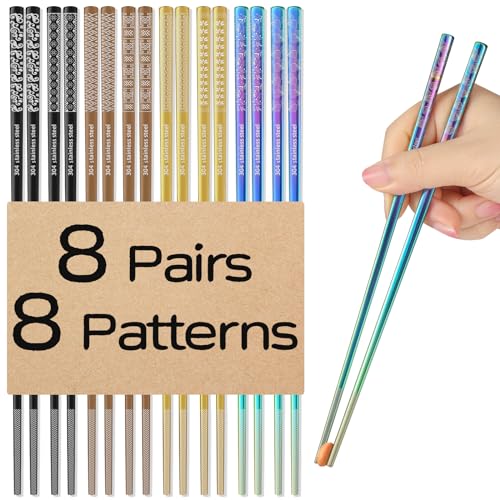
- NEWDRIP Multicolor Metal Chopsticks, 8 Pairs — stainless family claim, no safety wording; prose-only below.
- Lazycorner 304 Stainless Steel Chopsticks, 10 Pairs — 304 stainless steel with “Food Grade” stated in the title; the one linked pick in this guide.
- IQCWOOD 304 Stainless Steel Chopsticks, 5 Pairs — a numbered grade is stated, but the title does not use food grade wording; prose-only below, with the reasoning explained.
- Greatamzor 18/8 Stainless Steel Chopsticks, 5 Pairs — an alloy designation is stated, but no food grade wording; prose-only below.
- NEWDRIP 18/8 Stainless Steel Chopsticks, 8 Pairs — same documentation position as its sibling above; prose-only below.
Read the full guide ↓ for how to read material-safety wording like an inspector, what a grade designation does and does not promise, and the washing hygiene that matters more than any label.
Safety is the keyword where buying guides most often fail their readers, in two opposite directions. Some guides wave every product through with vague reassurance — everything is food-safe, nothing to worry about — which teaches the reader nothing and protects the writer from ever being wrong. Others manufacture alarm, treating every undocumented material as a hazard, which is equally empty and considerably more unfair to honest products. This guide takes the third road, the only defensible one: it reports, precisely, what each listing claims in the food-contact domain, links the one product that makes the explicit claim this keyword names, and discusses the rest in terms of documentation rather than danger. A listing that does not say food grade has not told you its product is unsafe. It has told you the maker did not make that claim in that place — and a buyer shopping on safety wording is entitled to shop on exactly that basis.
The pool is the familiar verified one: six reusable stainless steel sets, listings confirmed through the Creators API on 2026-11-20, specifications quoted from titles only. Within it, the food-contact documentation varies more than a casual reader would guess. One title states food grade in plain words. Two titles state a numbered alloy grade, 304, without the food grade phrase. Two state an 18/8 alloy designation. One presents a titanium plated surface. One names only the stainless family. This guide walks all six in order, explains what each form of words does and does not establish, and reserves its single link for the plain-words claim — because a keyword that says “safe” deserves a guide that treats safety language as a technical term, not a vibe.
One more boundary, stated early: this article makes no medical claims and evaluates no health outcomes. It cannot tell you that any product is safe in an absolute sense, and neither can any listing. What it can do — what it does — is teach you to read food-contact documentation the way regulators, retailers, and careful makers write it, so that the assurance you buy is the assurance that was actually offered. That skill, plus the washing hygiene in the how-to layer, is the real substance of eating safely with reusable chopsticks.
Key Takeaways
- Strict rule: only listings that state food grade (or equivalent explicit safety wording) in their own titles are linked here. One of six qualifies.
- The Lazycorner set — 304 stainless steel, “Food Grade” in the title, ten pairs — is the sole linked pick, carrying 5 dp links at its position.
- A numbered grade (304) or an alloy fraction (18/8) documents the alloy; it is not the same sentence as a food grade claim, and this guide does not pretend otherwise.
- Absence of safety wording is a documentation finding, not a safety verdict. The five prose-only sets are reviewed fully and fairly on that basis.
- Plated surfaces raise a documentation question of their own: the plated set’s listing makes no food grade claim for its surface, so it is prose-only here.
- Day-to-day food safety with any reusable set is dominated by washing hygiene, which the how-to layer covers in full.
In this guide
Quick Picks
| Pick | Badge | Safety documentation in one line | Link |
|---|---|---|---|
| Greatamzor Titanium Plated, 2 Pairs | Best Surface Documentation Question | Plating declared honestly; no food grade wording for the surface. | Prose-only — no safety wording in title |
| NEWDRIP Multicolor, 8 Pairs | Best Family Set, Undocumented Wording | Stainless family claim only; no grade, no safety phrase. | Prose-only — no safety wording in title |
| Lazycorner 304, 10 Pairs | Best Documented Safety Claim | 304 designated and “Food Grade” stated in the title itself. | Check on Amazon |
| IQCWOOD 304, 5 Pairs | Best Grade-Only Documentation | 304 stated; the food grade phrase is not used. | Prose-only — grade stated, safety phrase absent |
| Greatamzor 18/8, 5 Pairs | Best Alloy-Fraction Documentation | 18/8 designated; the food grade phrase is not used. | Prose-only — designation stated, safety phrase absent |
| NEWDRIP 18/8, 8 Pairs | Best Depth, Alloy Documentation | 18/8 designated across eight pairs; no safety phrase. | Prose-only — designation stated, safety phrase absent |
How These Picks Were Chosen
The pool is this site’s verified chopsticks pool, confirmed through the Creators API on 2026-11-20. The linking rule for this keyword was set by the wave brief in explicit terms: link only picks whose titles show food-grade, BPA-free, or non-toxic wording, and make no health claims beyond what titles state. Applied literally, one pick passes. The Lazycorner title contains the words “Food Grade” as part of its product description. No other assigned title contains food grade, BPA-free, or non-toxic language. The two 304 sets and the two 18/8 sets document their alloys — real information, credited in their reviews — but an alloy designation is a specification of composition, not a food-contact claim in words, and upgrading it into one would be exactly the kind of inference this guide exists to refuse.
The five prose-only sets receive complete reviews — strengths, trade-offs, spec boxes, verdicts — because a buyer using this lens still needs to understand the whole field, and because several of them may be the right purchase for a reader who decides, after reading our reasoning, that alloy documentation suffices for their own standard. That decision belongs to the reader. Our job is to make the documentation landscape impossible to misunderstand: what was claimed, where, and in what words. This is research-led analysis of verified listings; it is not laboratory testing, certification review, or medical guidance, and it does not pretend to be any of those.
The 6 Best Reusable Chopsticks for Safety-First Buyers
Top pick
1. Greatamzor Titanium Plated Stainless Steel Chopsticks, 2 Pairs
Badge: Best Surface Documentation Question
Strengths
- The construction is declared with unusual honesty: titanium plated, over stainless steel, in black and silver — a buyer knows exactly what the food touches.
- Laser engraved non-slip detailing and a premium gift format; reusable and dishwasher safe per the listing.
- A declared surface is a discussable surface: this is the set a safety-first buyer can most easily ask the maker about.
Trade-offs
- The listing makes no food grade claim — for the core or, critically, for the plated surface the food actually contacts.
- Under this guide’s strict rule, that absence means prose-only: full review, no link, no photo.
- Two pairs, no stated length — the supporting documentation is thin in the usual places too.
Spec box (from the verified listing): Material: stainless steel, titanium plated, stated reusable · Pairs: 2 · Length: not stated · Surface: laser engraved, non-slip · Colors: black, silver · Care: dishwasher safe · Format: gift set · Food grade wording in title: none
This set opens the guide because it poses the safety-documentation question in its purest form. With a through-material set, the food-contact surface is the material, and one claim covers both. With a plated set, the food touches the plating — so the claim a safety-first buyer needs is a claim about the surface, and this listing does not make one in food grade terms. That is not an accusation; the listing is admirably plain about its construction, and many buyers will reasonably accept a declared titanium plating from a maker who states it openly. But the keyword here is safe, the rule here is wording, and under that rule this set cannot be linked. We record the reasoning in full so the reader can weigh it rather than merely inherit it.
As a product, its profile is the familiar one from the wider cluster: an occasion pair, engraved for grip, gift-boxed in spirit, premium in position. A safety-first household that loves it has a coherent path — buy it as the occasion pair, direct any food-contact question to the maker whose construction is at least fully declared, and let the linked set below carry the daily rotation. What this guide will not do is blur the distinction to make the recommendation easier.
Best for: occasion buyers who value a fully declared construction / Not suited for: buyers who require food grade wording before purchase
2. NEWDRIP Multicolor Metal Chopsticks, 8 Pairs
Badge: Best Family Set, Undocumented Wording
Strengths
- Eight reusable pairs with laser engraved non-slip surfaces — the household system, complete.
- Multicolor finish assigns each family member a pair, which is a genuine hygiene-system benefit in shared homes.
- Stated 9.25-inch length; cooking and eating in the brief; dishwasher safe.
Trade-offs
- The material claim stops at the stainless family: no grade designation, and no food grade wording anywhere in the title.
- Prose-only under the strict rule, despite being a set many families would choose on other lenses.
- Consistency across eight pairs is the buyer’s arrival check, as with any deep set.
Spec box (from the verified listing): Material: stainless steel (grade not designated in listing), stated reusable · Pairs: 8 · Length: 9.25 inches · Surface: laser engraved, non-slip · Finish: multicolor · Care: dishwasher safe · Food grade wording in title: none
Here the documentation ladder shows its lowest rung, and the review must be careful in both directions. The listing tells a buyer the material family, the count, the length, the grip treatment, and the care — a respectable product description that simply does not enter the food-contact claims register at all. Nothing in that silence is evidence about the product’s actual suitability for food; family-claim stainless chopsticks are an ordinary, widely used product class. But this guide’s reader arrived with a specific question — which listings state the safety claim? — and for this set the answer is that it does not. Prose-only follows, with the product’s real virtues, family depth and per-person color hygiene among them, recorded intact.
The color system deserves its sentence even here, because it is the one safety-adjacent feature this set genuinely offers: in a shared household, an assigned pair is a cleaner pair, in the simple sense that its history is known. Systems like that do more daily work for household hygiene than any label. It does not convert into a food grade claim, and we do not convert it — but a safety-first reader weighing the whole picture should see it on the scale, labeled as what it is.
Best for: families who accept family-level material documentation / Not suited for: buyers shopping strictly on stated food grade wording

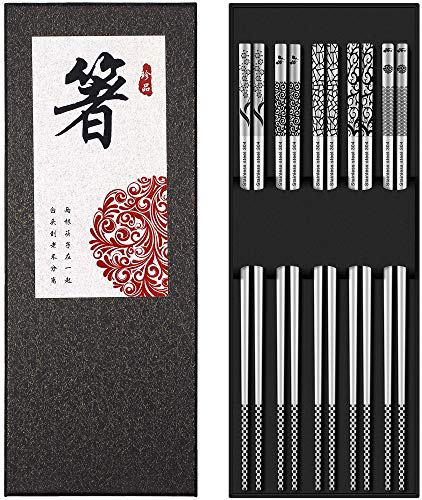
3. Lazycorner 304 Stainless Steel Chopsticks, 10 Pairs
Badge: Best Documented Safety Claim
Strengths
- The title states “Food Grade” in plain words — the explicit food-contact claim this keyword exists to find.
- The same title designates 304 stainless steel, so the alloy claim and the food-contact claim stand side by side, each checkable as language.
- Ten pairs, lightweight and non-slip, in plain silver: the claim is carried by a set deep enough to run a household’s whole rotation.
Trade-offs
- No length is stated — the one documentation gap in an otherwise exemplary listing.
- Ten identical pairs offer no per-person color system; hygiene governance is by routine.
- The grip story is a non-slip surface claim without engraved or textured mechanisms named.
Spec box (from the verified listing): Material: 304 stainless steel, stated food grade, stated reusable · Pairs: 10 · Length: not stated · Build: lightweight · Surface: non-slip · Finish: silver · Care: dishwasher safe · Use notes: daily meals and gifting · Food grade wording in title: yes — “Food Grade”
This is the set the strict rule was built to find, and its listing shows why plain words matter. A buyer does not have to know what 304 designates, or reason from alloy composition to food contact, or trust a guide’s inference: the maker wrote the claim in the language the buyer is shopping for, and accepted the accountability that comes with printing it. Paired with the numbered grade — the strongest composition documentation in this pool alongside its sibling — the listing presents the most complete food-contact evidence file of the six, and it does so on a ten-pair household set rather than a token two-pair presentation. The claim and the capacity arrive together.
The review’s honesty obligations are the standard ones: the missing length is flagged, the plain grip story is noted, and we repeat that a stated claim is a claim — this guide verifies wording, not laboratories. Within those terms, this is the only recommendation this lens can make with a link, and it is a comfortable one: documented alloy, explicit food grade wording, dishwasher-safe routine, and depth enough that the safety-first household never has to improvise with an undocumented spare at the busiest moment of the week. That last point matters more than it looks — systems fail at their improvised edges, and ten pairs leave very few edges.
Best for: safety-first households that shop on stated claims / Not suited for: buyers who need a stated length or per-person colors
4. IQCWOOD 304 Stainless Steel Chopsticks, 5 Pairs, Silver
Badge: Best Grade-Only Documentation
Strengths
- 304 stainless steel designated in the title — a defined alloy standard, stated plainly.
- Lightweight build, non-slip tips, stated 9.25-inch length: the supporting documentation is the most complete of the prose-only sets.
- Reusable and dishwasher safe per the listing.
Trade-offs
- The title does not use the words food grade, and under this guide’s rule that single absence decides the link.
- Prose-only — the closest miss in the guide, and we say so openly.
- Plain silver finish; grip rests on the tips alone.
Spec box (from the verified listing): Material: 304 stainless steel, stated reusable · Pairs: 5 · Length: 9.25 inches · Build: lightweight · Tips: non-slip · Finish: silver · Style notes: Korean Japanese · Care: dishwasher safe · Food grade wording in title: none
This review is the guide’s conscience on display, so let us be exact. The IQCWOOD listing designates the same numbered grade as the linked Lazycorner set. A reader could reasonably ask whether that designation, from a standards system associated with food-contact applications, should count as the safety claim. Our answer, required by the rule this keyword sets, is no — not because the designation is meaningless, but because the rule is about wording a buyer can read without specialist inference. The moment a guide starts upgrading designations into claims, every listing becomes whatever the guide says it is, and the reader’s protection disappears. So this set stands prose-only: fully reviewed, genuinely documented, and one phrase short of this lens’s link.
We add the practical corollary without blurring the line: a buyer whose own standard is “a designated food-contact alloy suffices” will find this set entirely satisfactory on the evidence of its listing, and may also note the brand-name curiosity — a wood-referencing brand selling steel — as a reminder that material lines, not brand names, are what documentation is made of. Readers comparing traditions can pursue the wooden side deliberately through Best Reusable Japanese Chopsticks and its cluster companions. Here, the record is simply complete: grade stated, phrase absent, link withheld, product respected.
Best for: buyers whose standard is a designated alloy / Not suited for: buyers who require the food grade phrase itself
5. Greatamzor 18/8 Stainless Steel Chopsticks, 5 Pairs
Badge: Best Alloy-Fraction Documentation
Strengths
- 18/8 stainless steel designated in the title — alloy proportions stated, a real documentation step above the family name.
- Laser engraved non-slip grip across five pairs at a stated 9 1/4 inches.
- Reusable, dishwasher safe, and briefed for cooking and eating.
Trade-offs
- No food grade wording in the title; prose-only under the strict rule.
- The fraction designation documents composition, not a food-contact claim — the distinction this guide exists to teach.
- Decorative engraved styling will not suit every table.
Spec box (from the verified listing): Material: 18/8 stainless steel, stated reusable · Pairs: 5 · Length: 9 1/4 inches · Surface: laser engraved, non-slip · Style notes: Japanese Korean · Use notes: cooking and eating · Care: dishwasher safe · Format: gift set · Food grade wording in title: none
The 18/8 designation deserves a fair explanation, because it is good documentation of its kind. The fraction describes the alloy’s chromium and nickel proportions — the compositional facts most relevant to a stainless steel’s corrosion behavior and surface quality — and a maker who publishes it has given the buyer something checkable. In the wider guides of this cluster, that earns this set real credit, and it earns it here too, in its own column. What it does not earn, under a wording rule, is conversion into a food-contact claim the maker did not print. Composition and claim are different evidentiary objects; a careful buyer holds both ideas at once, and a careful guide refuses to collapse them for the sake of a longer link list.
As a product for a reader whose standard is composition documentation, this remains one of the pool’s most complete sets — designated alloy, permanent engraved grip, published length, real rotation depth. Its prose-only status in this article is the strict lens doing its narrow job, nothing more, and our sources file records the distinction in the same terms. If your household’s rule is “documented alloy, from a maker who publishes,” this set passes your rule while failing ours — and a guide that helps you see exactly that has done its work.
Best for: composition-documentation buyers / Not suited for: phrase-strict safety shoppers
6. NEWDRIP 18/8 Stainless Steel Chopsticks, 8 Pairs
Badge: Best Depth, Alloy Documentation
Strengths
- 18/8 designation carried across eight pairs — documented alloy at household depth.
- Laser engraved non-slip surfaces at a stated 9.25 inches.
- Reusable and dishwasher safe, with a Japanese Korean Chinese style range.
Trade-offs
- No food grade wording in the title; prose-only under the strict rule, like its five-pair sibling.
- Identical pairs need a household clean-pair rule.
- Eight pairs is surplus depth for small households.
Spec box (from the verified listing): Material: 18/8 stainless steel, stated reusable · Pairs: 8 · Length: 9.25 inches · Surface: laser engraved, non-slip · Style notes: Japanese Korean Chinese · Use notes: cooking and eating · Care: dishwasher safe · Format: gift set · Food grade wording in title: none
The closing review repeats the previous one’s documentation position at a different scale, and the scale itself carries a safety-system argument worth stating. Households rarely compromise on their stated standards in the abstract; they compromise at 6:40 on a Tuesday, when the documented set is in the dishwasher and an undocumented spare is in the drawer. Depth in the documented set is therefore a safety feature in the operational sense — it removes the moments where the system improvises. This set offers that depth with an alloy designation attached, which makes it the strongest prose-only proposition in the guide for a composition-standard household.
Its limit is the guide’s refrain: the food grade phrase is absent, and no quantity of pairs substitutes for a sentence. We close the six with the landscape complete — one plain-words claim, two numbered grades, two alloy fractions, one plated surface, one family claim — and a reader who can now recite that landscape, and say what each rung does and does not establish, has gotten from this article the thing it was actually selling. The typo’d entrance to the same landscape, for readers who arrived through it, is treated in Best Reuzable Chopsticks.
Best for: larger households on a composition standard / Not suited for: phrase-strict safety shoppers and small households
Comparison Table
| Pick | Alloy documentation | Food grade wording in title | Pairs | Link status |
|---|---|---|---|---|
| Greatamzor Titanium Plated | Stainless, plated surface declared | None | 2 | Prose-only |
| NEWDRIP Multicolor | Stainless family only | None | 8 | Prose-only |
| Lazycorner 304 | 304 designated | Yes — “Food Grade” | 10 | Check on Amazon |
| IQCWOOD 304 | 304 designated | None | 5 | Prose-only |
| Greatamzor 18/8 | 18/8 designated | None | 5 | Prose-only |
| NEWDRIP 18/8 | 18/8 designated | None | 8 | Prose-only |
How to Choose When Safety Wording Is the Criterion
Decide your standard before you shop, in one of three honest forms. The phrase-strict standard: the listing must state food grade or an equivalent explicit claim — this guide’s standard, and the one that produces exactly one link. The composition standard: a designated alloy — a numbered grade or a published fraction — suffices, because you are comfortable reading composition as the relevant evidence; that standard admits four of these six sets. The family standard: stainless steel, reusable, dishwasher safe, from a listing that describes its product plainly; that admits all six. None of the three is foolish. What is foolish is shopping without knowing which one is yours, because then the loudest listing, not your standard, makes the decision.
Then apply the operational checks that wording cannot do for you. Depth: enough documented pairs that the standard survives your busiest wash cycle. Surface: through-material where the food-contact story should be simplest, plated only where the construction is declared and the purpose is occasion. Care: a routine your household will actually run, because an impeccably documented set washed carelessly is a worse food-contact proposition than a plainly documented set washed well. Wording opens the door; systems walk through it. The bestseller-format roundups elsewhere in this cluster, such as Best Seller Chopsticks, apply none of this strictness — read them for popularity, read this guide for documentation, and do not confuse the two currencies.
How to Wash and Handle Reusable Chopsticks: The Hygiene Layer
The routine that matters. Rinse the pair when the meal ends. Wash it hot — every set here is listed as dishwasher safe, and the machine’s heat and detergent are the thorough option — and dry it before storage, because a pair stored dry is a pair stored clean. That three-step loop, run promptly, is responsible for more real-world food safety than any label ever printed, and it is entirely within the user’s control, which is precisely why this guide insists on teaching it in a safety article.
The details that matter. Engraved and textured zones collect residue; give them a brush when they look dull, working along the pattern. Plated and black finishes get a soft sponge in hand washing, not because the listing forbids the machine — it does not — but because surfaces you care about deserve the gentler tool. Never leave pairs soaking for hours in dishwater; prompt washing beats prolonged soaking for both hygiene and finish. Store pairs dry, separated enough to air, in a drawer or holder away from the sink’s splash zone.
Troubleshooting. Problem: a pair smells of the last meal → residue in texture is the usual cause; hot soak, brush, machine cycle, and review your promptness. Problem: water spots and dullness on plain steel → mineral deposits from air-drying; dry after washing. Problem: a household member’s pair is always the questionable one → assign pairs by color or finish and make histories knowable; hygiene in shared homes is an information problem as much as a washing problem.
What “Food Grade” Does and Does Not Promise
The phrase at the center of this guide deserves its own plain paragraph. When a maker prints food grade in a listing, they are asserting that the material is intended and suitable for food contact under the standards that phrase invokes — a real, accountable claim, and the strongest food-contact sentence a title can carry. What the phrase is not is a laboratory report attached to your specific box, a guarantee about your washing routine, or a medical statement about outcomes. This guide’s discipline — verify the wording, credit exactly the wording, and build the rest of safety on hygiene systems — mirrors how the claim itself works: it covers the material’s intended use, and the user covers everything after the box is opened.
It is worth saying, once more and plainly, what follows for the five prose-only sets: nothing in this article found or implied a hazard in any of them. Stainless steel reusable chopsticks are a mainstream food-contact product class, every set here is listed as dishwasher safe, and four of the five carry alloy documentation of real substance. They are prose-only because a strict wording lens is strict — because the reader who typed “safe” asked which listings say the words, and an honest guide answers the question that was asked instead of the easier one nearby.
Questions to Ask Any Maker Before You Buy
A safety-first buyer has one more tool the listings cannot take away: the question. Asked of any maker in this category, the useful questions are few and pointed. Is the food-contact surface the base material or a coating, and if a coating, what is it? What standard does your grade designation refer to? Is the food grade claim made for the whole product or a component? What care does the surface require to keep its intended properties? Makers with documentation answer these in a sentence each; makers without it reveal the gap more honestly than any review can. Keep the answers with the set’s paperwork, run the hygiene loop, and your household’s food-contact story is as well documented as a pair of chopsticks can reasonably make it.
The Documentation Ladder, Rung by Rung
It helps to see the six listings as a ladder, because the ladder is reusable long after this pool is forgotten. The top rung is the explicit claim: food grade, printed in the title, in the buyer’s own vocabulary — one set stands there. The second rung is the numbered standard: a grade designation that refers to a published specification a buyer can look up — two sets stand there, one of them also holding the top rung. The third rung is the published fraction: alloy proportions stated numerically, checkable as composition — two sets. The fourth rung is the declared construction: a surface and a core both named, as the plated set names them, which answers “what is it made of” completely while saying nothing in the food-contact register. The bottom rung is the family name alone: stainless steel, full stop — one set, honestly if minimally described.
Two lessons live in the ladder. The first is that rungs are not interchangeable: a buyer cannot trade two fourth-rung facts for one first-rung claim, because they answer different questions. The second is that a set can stand on several rungs at once, and the strongest listings do — the linked set here holds the first and second rungs simultaneously, which is exactly what a complete evidence file looks like. When you shop this category in any future pool, sketch the ladder in your head, place each candidate on its highest rung, and notice how quickly the field sorts itself. Then check the rungs below the top one, because a set that documents everything except the claim may still be your right answer under a composition standard — the ladder informs the standard; it does not replace it.
Safety Systems in a Shared Household
Most food-contact risk in a real home is not material at all; it is systemic. Shared drawers blur which pair was used by whom and washed when. Guests are served from the same bundle as the family’s daily pairs. A pair travels to work, rides in a bag for two days, and returns to the drawer by a route nobody tracked. None of these are arguments against any product in this guide — they are arguments for running a household system with the same care this guide applies to wording. The elements are simple: assignment, so each person’s pair is knowable at a glance, by color where the set offers it or by a marked storage position where it does not; a single wash rule with no exceptions, so a pair’s status is never a matter of memory; and a quarantine habit for returning travelers — bag pairs go to the sink, never straight to the drawer.
Notice how the sets in this pool interact with that system. The deep sets make the wash rule survivable at peak load. The multicolor set builds assignment into the product. The documented linked set ensures that the pairs circulating through the system are the pairs whose claims you chose deliberately. A household that assembles those three properties — depth, assignment, documentation — has done more for its actual food-contact safety than any single label could, which is the mature conclusion this whole lens points toward: wording first, because it is what you can verify before purchase; systems always, because they are what you live with after it.
Common Buying Mistakes
- Treating an alloy designation as a food grade claim. Related evidence, different sentence. Know which one your standard requires.
- Treating missing wording as proof of danger. Absence of a claim is a documentation fact. This guide links strictly and judges fairly; copy both habits.
- Ignoring the surface question on plated sets. Food touches the plating. Ask about the layer the food meets.
- Buying the documented set in insufficient depth. Standards collapse at the busiest meal. Depth defends the standard.
- Outsourcing safety to a label. Washing promptness, drying, and storage are the daily substance of food safety with any reusable tool.
- Reading a brand name as a material claim. One brand here references wood on a steel product. The material line governs, always.
A Closing Note on Proportionality
A word about proportion, because safety topics attract disproportion the way kitchens attract steam. The decision this article governs is a pair of chopsticks: a simple, washable, mainstream food-contact tool. The strictness on display here is not anxiety — it is a reading discipline, applied because the keyword asked a precise question and precise questions deserve precise answers. Hold the discipline and the calm at the same time: verify the wording, run the wash loop, keep the system honest, and then eat dinner without thinking about any of it. That final inattention, earned by a careful purchase, is the real product a safety-first buyer is shopping for.
Final Recommendation
Under the strict wording standard this keyword demands, the recommendation is the Lazycorner 304 set: the only listing here that states food grade in its own words, on a designated alloy, at a depth that lets a safety-first household run its whole rotation inside its own standard. It is linked five times in this article and the other five sets are not linked at all, and that asymmetry is the guide’s thesis made visible.
If your own standard is the composition standard, the honest runners-up are the IQCWOOD 304 five pairs for a smaller household and the NEWDRIP 18/8 eight pairs for a larger one — both reviewed fully above, both prose-only here for the single stated reason. Whichever standard you choose, choose it before the next purchase, run the hygiene loop without exception, and let the documentation say only what it says. That restraint, practiced by buyers, is what eventually makes listings better for everyone.
Frequently Asked Questions
What does food grade mean in a chopstick listing?
It is the maker’s explicit claim that the material is intended and suitable for food contact. In this pool, exactly one title makes that claim in those words — the Lazycorner set — which is why it is this guide’s only linked pick.
Is a 304 designation the same as a food grade claim?
No. A numbered designation documents the alloy’s composition against a standard; a food grade phrase is a food-contact claim in words. They are related evidence, and this guide credits both — but it links only on the explicit claim, and explains the distinction wherever it decides an outcome.
Are the prose-only sets in this guide unsafe?
Nothing in this article says or implies that. They are prose-only because their listings do not carry the explicit safety wording this keyword asks about. Documentation status and product safety are different questions, and we answer only the first one here.
What about the plated set — is its surface a concern?
The right framing is documentation, not alarm: the food touches the plated surface, and the listing declares the construction (titanium plated over stainless steel) without making a food grade claim for it. A safety-first buyer can ask the maker directly; the construction is at least fully declared.
Does BPA-free apply to metal chopsticks?
BPA language belongs to plastics, so its absence from steel listings is expected and meaningless. For this material class, food grade wording is the relevant explicit claim — which is why the rule for this guide names it first.
How much of food safety is the product, and how much is my routine?
The product contributes a suitable, washable material; the routine contributes almost everything daily — prompt rinsing, hot washing, drying, clean storage. Every set here is listed as dishwasher safe, which makes the routine easy to run well.
Where can I read the same pool through other lenses?
Every companion guide in this cluster uses the same verified listings with a different rule: the flagship weighs overall fit, the guide variant teaches the decision method, and the community variant maps the debates. Comparing their link patterns against this one’s is itself instructive — the products never change, only the questions do, and watching the answers move teaches you what each lens is worth.
Should I replace a set whose listing makes no safety claim?
That is a standards decision, not an emergency. If your household standard is the explicit claim and a current set’s documentation does not meet it, replacing it with the documented set in this guide is a coherent, calm upgrade — ideally at a natural moment, with the old set retired to non-food or travel duty if it remains serviceable. What the evidence in this article does not support is urgency: a documentation gap is a reason to choose differently next time, presented here in full so that next time can be whenever you say it is.
Why does this guide have only one linked pick?
Because the rule is strict and the pool is honest: link only where the title states the safety claim. One title does. A guide that inflated that count by inference would be answering an easier question than the one in the keyword.