Disclosure: topratedkitchenware.com is reader-supported. When you buy through links on our site, we may earn an affiliate commission from Amazon and other retailers, at no extra cost to you.
Where to buy
If you are shopping for the best safest microwaves you can put on a family counter, start with the six verified picks below. Each name links to its Amazon listing so you can check the latest price on Amazon, confirm exactly which safety features that listing names, and compare the current finish and included accessories before you decide. Safety features are easy to exaggerate in marketing copy, so this guide only credits a pick with a feature when the verified listing title states it — a child safety lock, a push-button door, a cooking sensor — and says so plainly when a listing does not name one.
- TOSHIBA Countertop Microwave Oven with Inverter Technology, 1.6 Cu.Ft, Black Stainless Steel — Best Overall. Check on Amazon for the current listing details.
- Panasonic Countertop Microwave Oven, 1.2 Cu. Ft., 1250W, Stainless Steel – NN-SN67QS — Best Sensor Cooking. Check on Amazon for the current listing details.
- TOSHIBA Countertop Microwave Oven, 1.2 Cu.Ft, 1000W, Stainless Steel — Best Easy-Clean Interior. Check on Amazon for the current listing details.
- Chefman Countertop Microwave Oven 0.7 Cu. Ft., 700 Watts, Black — Best Child Lock for Small Spaces. Check on Amazon for the current listing details.
- BLACK+DECKER Countertop Microwave Oven, 0.9 Cu.Ft, 900W, Stainless Steel — Best Push-Button Door. Check on Amazon for the current listing details.
- TOSHIBA Microwave Oven, 0.9 Cu.Ft, 900W, Black Stainless Steel — Best for Apartments. Check on Amazon for the current listing details.
Read the full guide ↓ for what “safe” can and cannot mean for a microwave, which of these picks carry a named child lock, and how to set any countertop microwave up so it stays uneventful for years.
Ask ten parents what they mean by the best safest microwaves and you will hear the same short list of worries: a toddler who can reach the door, a teenager reheating soup at midnight, a door that feels flimsy, a machine that runs food far past done because nobody was watching it. Notice what is not really on that list — exotic fears about the technology itself. Every microwave legally sold in the United States has to meet the same federal leakage standard and has to stop generating microwaves the moment its door opens, and those baseline protections are built into all six machines here, not just the expensive ones. What actually separates one model from another, in safety terms, is the layer of features on top of that baseline: child safety locks that stop small hands from starting the oven, door mechanisms that latch positively and feel solid, cooking sensors that shut the cycle down when food is done instead of scorching it, interiors that clean easily so old splatter does not smoke, and quiet modes that keep a sleeping household asleep. That feature layer is what this guide ranks, and it ranks it strictly from what each verified listing actually states.
That honesty matters, because three of the six picks below name a child safety lock or child lock directly in their listing, and three do not. The three that do not are still included — they earn their places through sensor cooking, easy-clean cavities and family-size capacity — but you will never see this guide claim a lock for a model whose listing does not mention one. If a lock is your non-negotiable feature, the Chefman, the BLACK+DECKER and the smaller Toshiba are your shortlist, and the detailed reviews say exactly why. If your household is all adults and your real concern is food cooked properly without supervision, the sensor models move to the top. Either way, you will know precisely which safety story you are buying, and readers who are still comparing the wider field can cross-check this shortlist against our broader look at the Best Selection Of Microwaves before they settle on a size class.
Key Takeaways
- Baseline protection is universal: every microwave sold legally in the US must meet the same federal leakage limit and cut power when the door opens, so no model here is ranked on radiation claims — the differences are in locks, doors, sensors and cleanability.
- Three picks state a child safety lock or child lock in their verified listing: the Chefman 0.7 cu ft, the BLACK+DECKER 0.9 cu ft and the Toshiba 0.9 cu ft. The other three listings do not name a lock, and this guide does not pretend otherwise.
- Sensor cooking is a genuine safety-adjacent feature: the Toshiba and Panasonic sensor models stop when food is done rather than running a guessed timer into scorching territory.
- An easy-clean interior is a safety feature in disguise — dried splatter is what smokes, sparks and smells in a neglected cavity.
- Placement and habits protect a household more than any single feature: clearance for vents, a stable counter, and never running the oven empty.
- The BLACK+DECKER’s push-button door is the easiest door here for small hands to fail at and for arthritic hands to succeed with — no handle to yank.
In this guide
Quick Picks
| Pick | Badge | Capacity | Power | Safety feature stated in the listing |
|---|---|---|---|---|
| TOSHIBA 1.6 Cu.Ft Inverter Microwave | Best Overall | 1.6 cu ft | 1250W | Smart sensor cooking, auto defrost |
| Panasonic 1.2 Cu. Ft. Microwave NN-SN67QS | Best Sensor Cooking | 1.2 cu ft | 1250W | Genius Sensor, inverter power |
| TOSHIBA 1.2 Cu.Ft Countertop Microwave | Best Easy-Clean Interior | 1.2 cu ft | 1000W | Smart humidity sensor, easy clean interior |
| Chefman 0.7 Cu. Ft. Countertop Microwave | Best Child Lock for Small Spaces | 0.7 cu ft | 700W | Child safety lock, mute button |
| BLACK+DECKER 0.9 Cu.Ft Countertop Microwave | Best Push-Button Door | 0.9 cu ft | 900W | Child safety lock, push-button door |
| TOSHIBA 0.9 Cu.Ft Microwave Oven | Best for Apartments | 0.9 cu ft | 900W | Child lock, LED lighting, mute function |
Read the badge column together with the last column, because that pairing is the whole point of this guide. A pick can be an excellent microwave and a mediocre answer to a safety-first brief at the same time: the big Toshiba, for example, is the strongest all-round cooker here, but if your deciding feature is a lock, the little Chefman outranks it for your household even though it is the smallest and least powerful machine on the list. Households that are also watching seasonal pricing while they compare safety features may want to keep an eye on the Best Sales On Microwaves as well — a lock-equipped model is a better buy at a discount than a lock-free model at full price, every time.
How These Picks Were Chosen
We built this shortlist from verified Amazon listings for current countertop microwaves, then re-read every listing title specifically for safety-relevant language. A pick could earn a safety claim in this guide in exactly one way: the words had to be in the verified listing. “Child Safety Lock” and “Child Lock” appear in three listings. “Push-Button Door” appears in one. Sensor systems — Toshiba’s Smart Sensor and Smart Humidity Sensor, Panasonic’s Genius Sensor — appear in three, and they count here because a sensor that ends the cycle when food is ready removes the most common cause of microwave incidents in ordinary kitchens, which is food left cooking far too long on a guessed timer. “Easy Clean Interior” appears in one listing and counts because residue build-up is a real, mundane hazard. Anything a listing did not state, we did not claim: where a model has no named lock, the review says so in plain words.
We also applied a filter of honesty about what cannot be ranked. There is no verified per-model leakage data in these listings, and no basis for declaring one of these ovens lower-emission than another, so this guide makes no such claim for any pick. All six are conventional countertop microwaves from established brands, sold through normal US retail channels, and all six sit under the same federal requirements for door interlocks and leakage limits that apply to every microwave on the American market. Our comparisons therefore stay on the ground where evidence exists: stated locks, stated door designs, stated sensors, stated interior finishes, capacity and power, and the everyday handling qualities — weight of the door, clarity of the controls, audibility of the alerts — that decide whether a machine gets used carefully or carelessly. This is a research-led guide built from listing data and category knowledge, not a lab report, and it does not pretend to be one.
Finally, we weighted the picks for the households that actually search for a safest microwave: families with children under six, grandparents setting up a simpler kitchen, apartment dwellers cooking in shared spaces, and anyone whose previous microwave scared them once — a sparking container, a door that stopped latching cleanly, a cycle that ran on after the food was charcoal. Those experiences point at locks, doors, sensors and cleaning, which is exactly where this guide spends its words. Shoppers whose priority is a brand-specific lock design can also browse the brand roundups such as Best Samsung Microwaves to see how different manufacturers name and implement the same basic features.
The 6 Best Safest Microwaves, Reviewed in Detail
The six reviews below follow the Quick Picks order. Each one states what the listing itself claims, separates the stated safety features from the ones a listing leaves unnamed, and gives a plain verdict. Where a review says a feature is not named in the listing, that is a prompt to check the manufacturer’s full specification before buying if that feature matters to you — listings are sometimes abbreviated — but this guide will not fill the gap with a guess.

TOSHIBA Countertop Microwave Oven with Inverter Technology, 1.6 Cu.Ft
Badge: Best Overall
Strengths
- Smart Sensor cooking ends the cycle when the food is actually done, which removes the classic overcook-until-it-smokes failure mode.
- Inverter power delivers genuinely low power levels for gentle jobs, so delicate food is not blasted in on-off bursts.
- The 13.6 inch turntable and 1.6 cu ft cavity take a family casserole with room around it, so dishes sit stable instead of wedged.
Trade-offs
- The verified listing does not name a child safety lock, so households whose top priority is a lock should look at the three lock-equipped picks below.
- At 1.6 cu ft this is the largest footprint here; small counters will feel it.
- 1250W is fast, and fast means a distracted cook’s mistake escalates quickly — the sensor mitigates this, it does not abolish it.
Key specs: Capacity 1.6 cu ft; Power 1250W; Inverter technology; Smart Sensor; Auto defrost; Turntable 13.6 inch; Finish: black stainless steel.
This big Toshiba leads the list because the most common microwave safety story in a real kitchen is not dramatic at all: it is food forgotten on a long timer, drying out, smoking, and setting off alarms — or a frozen block defrosted so unevenly that part of it sits warm for far too long. The Smart Sensor attacks the first problem directly by reading the steam coming off the food and ending the cycle at doneness rather than at a guessed minute count, and inverter-based auto defrost attacks the second by holding a genuinely low, steady power instead of pulsing full power on and off. For a family that reheats leftovers daily, those two systems quietly prevent more bad outcomes than any single latch.
The size deserves a safety word of its own. A 1.6 cu ft cavity with a 13.6 inch turntable means the dishes families actually use — a full dinner plate, a medium casserole with handles, a large mixing bowl — sit flat and centred with clearance around them. Food that fits properly is food nobody has to tilt, wedge or balance, and nobody has to reach awkwardly past a hot rim to extract. The honest limitation is the one stated above: the listing for this model does not name a child lock. In a household with a determined toddler, that absence is a real deciding factor, and no amount of sensor cleverness substitutes for a lock you can engage. Treat this as the best pick for households of older children and adults who want cooking that supervises itself, and check the current listing on Amazon in case the specification has been updated.
Best for: families who want sensor-supervised cooking at family size / Not suited for: households that require a named child lock
Check on Amazon for the current listing, the full feature list and delivery options.

Panasonic Countertop Microwave Oven, 1.2 Cu. Ft., 1250W – NN-SN67QS
Badge: Best Sensor Cooking
Strengths
- The Genius Sensor is Panasonic’s mature sensor platform, adjusting time and power as food cooks rather than after it has already gone too far.
- Inverter technology keeps low-power cooking truly low, which is gentler on everything from melting butter to defrosting chicken.
- 1250W in a 1.2 cu ft cavity is quick, so food spends less total time in the danger pattern of half-cooked, left standing, reheated again.
Trade-offs
- As with the big Toshiba, the verified listing does not name a child safety lock.
- Sensor menus reward a short learning curve; impatient users who override them with manual max-power timers give up the benefit.
- The stainless finish needs a wipe-down routine to keep fingerprints from building up around the door area everyone touches.
Key specs: Capacity 1.2 cu ft; Power 1250W; Inverter technology with Genius Sensor; Finish: stainless steel; Model NN-SN67QS.
Panasonic has built its microwave reputation on inverter power longer than anyone, and the NN-SN67QS is the pick here for cooks whose safety concern is really about control. A conventional microwave at “50 percent power” is actually blasting at full power half the time and resting the other half, which is why edges overcook while centres stay cold — and cold spots in reheated food are a food-handling problem, not just a texture problem. The inverter holds a true, continuous lower output, and the Genius Sensor watches the food’s progress and adjusts as it goes. Reheated leftovers come up to temperature evenly, which is precisely what you want when the food in question is yesterday’s chicken.
The 1.2 cu ft size is the other quiet virtue: large enough for a dinner plate and most family side dishes, small enough that the machine does not invite the “just shove the huge dish in” behaviour that leads to spills of very hot food. The limitations mirror the Toshiba’s. No child lock is named in the verified listing, and the sensor only helps if you use it — the household that cooks everything on a manual ten-minute timer will get none of this model’s protective benefit. For sensor-led, even cooking in a mid-size footprint, though, this is the most accomplished machine in the six, and households comparing it against the lock-equipped models should decide honestly which risk their kitchen actually presents: unsupervised small children, or unsupervised timers.
Best for: cooks who reheat leftovers often and want even, sensor-guided results / Not suited for: buyers who need a stated child lock
Check on Amazon for the current listing, the full feature list and delivery options.

TOSHIBA Countertop Microwave Oven, 1.2 Cu.Ft, 1000W, Stainless Steel
Badge: Best Easy-Clean Interior
Strengths
- The easy clean interior is stated in the listing, and a cavity that wipes clean is a cavity without smoking, sparking residue build-up.
- The smart humidity sensor reads steam from the food and adjusts cooking, trimming the overcook risk on everyday reheats.
- Mute function and ECO mode cover the household-peace and standby-power corners of everyday use.
Trade-offs
- The verified listing does not name a child safety lock, despite the otherwise family-friendly feature set.
- Twelve auto menus is generous, but menu-driven cooking still depends on choosing roughly the right programme.
- At 1000W it is a step slower than the 1250W pair above, so big frozen meals take a little longer.
Key specs: Capacity 1.2 cu ft; Power 1000W; Smart humidity sensor; 12 auto menus; Mute function; ECO mode; Easy clean interior; Finish: stainless steel.
Ask a fire-safety officer about microwave incidents and, alongside the metal-in-the-cavity stories, you will hear about grease and food residue: the splatter that was never wiped, carbonising a little more with every cycle until it smokes or chars. That is why an easy clean interior earns a headline place in a safety guide. This Toshiba’s listing states the easy-clean cavity outright, pairs it with a humidity sensor that keeps everyday reheating honest, and wraps both in the most familiar family format in the category — 1.2 cu ft and 1000W, the size and power that most packaged-food instructions quietly assume. It is the pick for the household whose last microwave was not dangerous, exactly, just grubby, smoky and faintly worrying by year three.
The supporting features pull in the same direction. The mute function means the midnight reheat does not involve a parent sprinting to silence beeps with a sleeping baby in the next room — a small thing that changes behaviour for the better. ECO mode trims standby draw. The honest gap, again, is the lock: the listing does not name one. If your household’s risk profile is “mess and overcooking” rather than “toddler at the door”, this is arguably the most sensible buy of the six; if it is the toddler, keep reading, because the next three picks all state a lock in their listings and were chosen for exactly that reason.
Best for: families whose main worry is residue, smoke and overcooked food / Not suited for: buyers who need a stated child lock
Check on Amazon for the current listing, the full feature list and delivery options.

Chefman Countertop Microwave Oven 0.7 Cu. Ft., 700 Watts, Black
Badge: Best Child Lock for Small Spaces
Strengths
- Child safety lock is stated in the listing — the headline feature for households with small, curious hands.
- At 0.7 cu ft and 700W it is the smallest, gentlest machine here, well matched to single servings, bottles of soup and small plates.
- The mute button keeps night-time use quiet, and one-touch express cook keeps the controls simple for older children who are allowed to use it.
Trade-offs
- 700W cooks noticeably slower than the 1000W-plus models; packaged meals need time added, and the lock does not help anyone remember to add it.
- The compact cavity will not take a full-size dinner plate comfortably or any family-size dish.
- Ten power levels and six presets are plenty for basics, but there is no sensor cooking to supervise the result.
Key specs: Capacity 0.7 cu ft; Power 700W; 10 power levels; 6 cooking presets with one-touch express cook; Child safety lock; Mute button; Finish: black.
This is the pick the safety-first shopper with a toddler should read first. The Chefman’s listing states a child safety lock in plain words, and in a small, simple machine the lock is easy to make a habit of: engage it when the kitchen is in play mode, release it when an adult cooks. The rest of the design supports that household pattern. The cavity is small, which in this context is a feature — portions are single servings, nothing enormous and scalding is being manoeuvred out of it, and the 700W output heats those small portions thoroughly without the violence a 1250W machine can do to a little bowl of soup. The mute button rounds out the family picture, because a microwave that can be used quietly after bedtime is a microwave that gets used considerately.
The limitations are the honest physics of the format. At 700W, frozen meals and dense leftovers take meaningfully longer, and the cook-time conversion is on you — undercooked food served because the packet assumed a stronger oven is a genuine, if unglamorous, safety issue, so add time in small increments and check the centre of the food. The cavity also rules out family cooking entirely. But judged on the brief in its title — a lock-equipped, simple, small microwave for a household managing small children in a small kitchen — the Chefman is the most direct answer in this line-up, and it is no accident that shoppers comparing it often also browse the Best Seling Microwaves Countertop to see how it stacks up against the other compact countertop staples.
Best for: parents who want a stated child lock in a compact, simple machine / Not suited for: family-size cooking or impatient reheating
Check on Amazon for the current listing, the full feature list and delivery options.
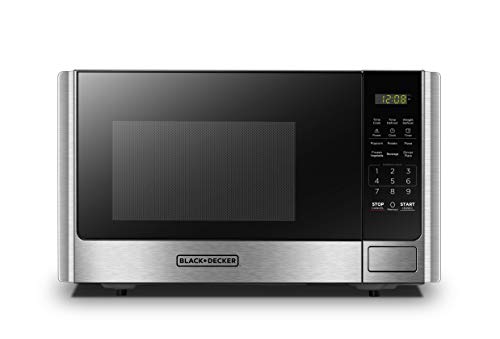
BLACK+DECKER Countertop Microwave Oven, 0.9 Cu.Ft, 900W, Stainless Steel
Badge: Best Push-Button Door
Strengths
- Child safety lock stated in the listing, paired with a push-button door — there is no handle for a small child to hang off or yank open mid-cycle.
- The push-button release is also the easiest door here for older users and anyone with limited grip strength.
- 900W and 0.9 cu ft is a genuinely useful step up from the mini class for plates and leftovers.
Trade-offs
- No sensor cooking is named in the listing, so timing judgement stays with the cook.
- Six auto cook presets cover the basics but not the wider menu libraries of the Toshiba models.
- The stainless front will show small fingerprints exactly where everyone presses the door button.
Key specs: Capacity 0.9 cu ft; Power 900W; 10 power levels; Push-button door; Child safety lock; 6 auto cook presets; Finish: stainless steel.
Door design is the underrated half of microwave safety, and this BLACK+DECKER is the only pick whose listing calls its door out: a push-button release instead of a pull handle. Think about who defeats a microwave door. A toddler does it by grabbing the handle and leaning backwards with their whole weight. A push-button door removes that move entirely — small fingers pressing a button while the child lock is engaged get nothing, and even with the lock off, the door pops open a controlled amount rather than swinging wide with a hot dish behind it. Now think about who else the design serves: a grandparent with arthritic hands, for whom a stiff pull handle is a daily struggle, can open this door with one press. The same feature guards one generation and enables the other, which is why it headlines this review.
Around that door sits a sensible mid-compact package: 0.9 cu ft swallows a dinner plate, 900W reheats at a respectable pace, ten power levels give proper control for softer jobs, and the six auto cook presets cover the standard rotation. The listing names no sensor, so this is a machine for cooks who are comfortable judging times — or for households where the adults do the cooking and the lock does the guarding. In the context of this guide it is the most complete physical-safety package of the six: stated lock, stated button door, manageable size, mainstream power. Households shopping during a promotion may also find this class of model featured among the Best Sale On Microwaves At Walmart style roundups, but wherever you buy it, the door and lock combination is the reason to choose it.
Best for: multigenerational households — stated lock for the young, button door for the old / Not suited for: cooks who want sensor-guided timing
Check on Amazon for the current listing, the full feature list and delivery options.

TOSHIBA Microwave Oven, 0.9 Cu.Ft, 900W, Black Stainless Steel
Badge: Best for Apartments
Strengths
- Child lock stated in the listing — the third lock-equipped pick, and the one with the most grown-up feature set of the three.
- LED interior lighting means you can actually see the food’s state through the door, which encourages checking rather than guessing.
- Mute function plus a 10.6 inch removable turntable that lifts out for proper washing, keeping the small cavity genuinely clean.
Trade-offs
- Six auto menus is a modest library; keen cooks will run manual times for anything unusual.
- 900W is fine for one or two people but will feel slow cycling through a family’s worth of plates.
- No sensor cooking is named in the listing, so reheating quality depends on the cook’s judgement.
Key specs: Capacity 0.9 cu ft; Power 900W; 6 auto menus; Mute function; Child lock; LED lighting; Turntable 10.6 inch removable; Finish: black stainless steel.
The third lock-equipped pick takes a different route to the same brief. Where the Chefman is the toddler-first mini and the BLACK+DECKER is the door-design pick, this Toshiba is the apartment all-rounder whose listing happens to state a child lock alongside a set of features aimed at shared and compact living: a mute function for thin walls, LED lighting so you can see whether the soup is about to boil over instead of discovering it afterwards, and a removable turntable that makes the weekly clean a two-minute job rather than a archaeological dig. Its listing describes it as perfect for apartment use, and for once the marketing phrase and the safety brief point the same way — small households, close neighbours, food cooked in single portions under the cook’s eye.
In a shared flat or a first apartment with a visiting niece or nephew, the stated child lock covers the occasional small visitor while the rest of the package covers the daily reality. The limits are capacity and pace: 0.9 cu ft and 900W serve one or two people well and a family poorly, and there is no sensor to fall back on. But as the most feature-complete of the lock-equipped three, it is the natural recommendation when the lock is a must-have and the household is small. That combination — lock, mute, light, easy cleaning — is also a useful checklist to carry into any wider search, including the door-design comparisons collected under Best Sealed Microwaves, where how a door closes and latches is the whole topic.
Best for: apartment households that want a stated child lock plus mute and LED lighting / Not suited for: families cooking multiple plates in sequence
Check on Amazon for the current listing, the full feature list and delivery options.
Comparison Table
| Pick | Capacity | Power | Lock stated? | Sensor stated? | Standout | Link |
|---|---|---|---|---|---|---|
| TOSHIBA 1.6 Cu.Ft Inverter | 1.6 cu ft | 1250W | Not named in listing | Smart Sensor | Family size, inverter defrost | Check on Amazon |
| Panasonic NN-SN67QS | 1.2 cu ft | 1250W | Not named in listing | Genius Sensor | Even inverter reheating | Check on Amazon |
| TOSHIBA 1.2 Cu.Ft Stainless | 1.2 cu ft | 1000W | Not named in listing | Humidity sensor | Easy clean interior | Check on Amazon |
| Chefman 0.7 Cu. Ft. | 0.7 cu ft | 700W | Yes — child safety lock | No | Smallest lock-equipped pick | Check on Amazon |
| BLACK+DECKER 0.9 Cu.Ft | 0.9 cu ft | 900W | Yes — child safety lock | No | Push-button door | Check on Amazon |
| TOSHIBA 0.9 Cu.Ft | 0.9 cu ft | 900W | Yes — child lock | No | LED lighting, mute | Check on Amazon |
The “Lock stated?” column is the most honest column in this guide, and it is worth pausing on. It does not say the top three machines are unsafe — every model here carries the standard door interlocks and meets the same federal requirements as every other microwave on the US market. It says their verified listings do not name a child lock, so a buyer for whom that feature is decisive cannot confirm it from the listing alone. Read the table that way — as a map of what is stated, not a league table of danger — and it will steer you to the right pick for your household’s actual risks.
How to Choose the Safest Microwave for Your Household
Start by naming your household’s real risk, because “safest” means different things at different kitchen counters. If there are children under six in the home — or visiting often enough to matter — the deciding feature is a child lock, stated in the listing, and your shortlist is the three lock-equipped picks above. Test your commitment honestly: a lock only protects when it is engaged, so choose the model whose lock routine you will actually perform every time, which usually means the simplest machine in the room. If the household is adults and older children, the risk profile flips: the dangers become overcooked, smoking food, unevenly reheated leftovers and a grubby cavity, and the sensor-equipped, easy-clean models protect against those far better than a lock nobody needs.
Next, think about the door, because the door is the part of a microwave that every safety system depends on. The interlocks that cut power when the door opens are universal and mandatory, but the door’s design decides how the machine behaves in daily hands. A push-button door, like the BLACK+DECKER’s, opens a controlled crack and offers no handle to haul on. A conventional handle door is fine for adults and gives a firm, positive pull. Either way, what you are checking at buying time is that the door closes with a solid, aligned latch — and what you are committing to afterwards is keeping the latch area clean, because crumbs and grease around the door seal are the mundane enemy of a good closure. A door that ever fails to latch cleanly is a door to stop using until it is serviced; no feature on any list outranks that rule.
Size and power are safety decisions too, in a quiet way. A cavity that fits your dishes flat — plate centred on the turntable, casserole with clearance — prevents the tilting, wedging and scalding spills that come from forcing oversize cookware into an undersize box. Power should match your patience and your habits: very high wattage in careless hands escalates mistakes quickly, while very low wattage tempts people to serve food that never quite got hot in the middle. For most family kitchens the 1000W to 1250W band with a sensor is the forgiving middle; for single servings, the gentler compacts are honestly easier to live with safely. Finally, weigh cleanability. An interior you can wipe in seconds — ideally with a removable turntable — is an interior that stays clean, and a clean cavity is the one that never smokes, never sparks on carbonised residue and never flavours tonight’s dinner with last month’s curry.
How to Set Up and Use a Countertop Microwave Safely
Placement comes first. Put the microwave on a flat, stable counter at a height where hot dishes travel the shortest, steadiest path to a landing surface — for most households that means the main counter, not a high shelf and not a wobbly cart. Leave the clearance the vents need on the sides and top; a machine that cannot breathe runs hot and ages fast. Keep the cord short, untangled and away from the hob, plug directly into a wall outlet rather than a power strip, and position the oven so the door opens without swinging over a walkway where a child or a pet passes at dish height.
Then build the small habits that do the real protective work. Engage the child lock whenever the kitchen is in play mode, not just when you remember. Never run the oven empty — the energy has nowhere to go and the cavity pays for it. Use microwave-safe containers only, vent lids and film so steam escapes in a controlled way, and treat every covered dish as a steam source when you open it: lift the far edge first, away from your face and hands. Stir or rotate food midway through reheating and let it stand for a minute afterwards, because microwave heating is uneven and the standing time is when temperatures equalise — that pause is a food-safety step, not a serving suggestion. Wipe the cavity and the door seal area weekly, or after any boil-over, whichever comes first.
Troubleshooting, in the pattern that matters:
Problem: the oven will not start and the display shows a lock or “L” indicator → the child lock is engaged; follow the model’s button-hold sequence to release it rather than forcing the door.
Problem: food sparks or a blue flash appears inside → stop the cycle immediately; the usual causes are metal trim on a dish, foil, or heavy carbonised residue on the cavity wall, all of which are solved by removing the cause and cleaning, never by re-running to see if it happens again.
Problem: the door needs a slam or a jiggle to latch → stop using the oven and arrange service; the interlock system depends on precise latch alignment, and a door that does not close cleanly is the one fault that retires a microwave on the spot.
What “Safe” Can and Cannot Mean for a Microwave
It is worth one clear section on the question behind this search, because the internet answers it badly in both directions. Microwave ovens cook with non-ionising radio-frequency energy, and every model sold in the United States — from the smallest compact here to the largest family machine — must comply with the same federal performance standard that limits leakage to a small fraction of the level associated with any heating effect, and must carry interlocks that stop energy production the instant the door opens. Those requirements are not a premium feature. They are the licence to sell the product at all, which is why this guide refuses to rank these six machines on emissions: there is no verified per-model leakage data in their listings, and inventing a ranking would be exactly the kind of false precision that misleads buyers.
What legitimately differs, and what you can act on, is condition and behaviour. A microwave with a damaged door, bent hinges or a latch that has been forced is a microwave to retire, whatever its age or brand. A microwave used with metal inside, run empty, or left with a carbonised cavity is being operated outside the conditions its safety systems assume. And a microwave whose small users can start it unsupervised is a household-management problem with a known fix — the lock-equipped picks above. Hold those three ideas and you have the honest content of “safest” for this category: buy a sound machine from a normal retail channel, keep its door and cavity in good order, control who can start it, and let sensors and sensible power levels smooth out the everyday cooking. Everything beyond that is marketing, in whichever direction it points.
Common Buying Mistakes
The first mistake is paying for a safety story instead of a safety feature: glossy language about advanced protection that never names a lock, a door design or a sensor you can verify. If the listing does not state it, treat it as absent. The second is buying the lock and never engaging it — a surprisingly common outcome when the lock sequence is buried in a menu, so favour models where locking is a simple, memorable action. The third is sizing by headline capacity alone and discovering that the family casserole only fits at a tilt; measure your largest dish, not your hopes. The fourth is placing the new oven where the old one went without checking vent clearance, especially when upgrading to a larger, more powerful model. The fifth is ignoring the cavity: buyers compare wattage and presets for an hour and never ask how the interior cleans, then live with a smoking, splattered box for years. And the sixth is assuming a more expensive microwave is a safer one — the three lock-equipped picks here include the two smallest, simplest machines in the line-up, which tells you everything about how loosely price and protection are connected in this category.
Final Recommendation
If your household includes small children, make the decision on the lock and be done: the Chefman 0.7 Cu. Ft. is the compact, simple, lock-equipped answer for small kitchens and single servings, while the BLACK+DECKER 0.9 Cu.Ft adds a push-button door and a step up in size and power for families who cook a little more. If your household is older and your real risks are overcooking and uneven reheating, the TOSHIBA 1.6 Cu.Ft Inverter is the strongest overall pick, with the Panasonic close behind for sensor-led cooks in a smaller footprint, the easy-clean Toshiba as the hygiene-first middle option, and the little Toshiba as the apartment all-rounder with a lock. None of these machines needs a safety myth to justify it — each earns its place on features its listing actually states, matched to a household risk you can name.
Frequently Asked Questions
Does a child lock stop a microwave door from being opened?
A child lock primarily disables the controls so the oven cannot be started accidentally; the door itself is guarded by the standard latch and interlock system fitted to every microwave, which cuts power the moment the door opens. Used together — lock engaged, door in good condition — they cover both halves of the small-child problem: the oven cannot be started by little fingers, and opening the door stops any running cycle instantly.
Are inverter microwaves safer than conventional ones?
Not in any regulatory sense — both types meet the same federal standards and carry the same door interlocks. Where an inverter helps is cooking control: it delivers true low power continuously instead of pulsing full power, so defrosting and gentle reheating are more even, with fewer scorching hot spots beside cold centres. That is a food-quality and food-handling benefit, and this guide credits it as such, not as an emissions claim.
Is it safe to stand in front of a running microwave?
Every microwave sold legally in the US must keep leakage far below the federal limit, and leakage falls off extremely quickly with distance in any case. The practical guidance is about condition rather than distance: a sound door, clean seals and intact hinges are what the standard assumes. If a door is damaged or stops latching cleanly, stop using the oven and have it serviced or replaced — that rule matters more than where you stand.
Why does this guide not rank these microwaves by radiation?
Because there is no verified per-model leakage data in the listings to rank them by, and all six sit under the same federal leakage standard. A ranking invented without measurements would be false precision. What can be ranked honestly — locks, door designs, sensors, cleanability — is ranked, in detail, above.
What should I do if my microwave sparks?
Stop the cycle and unplug the oven. Check for the usual causes: metal or metallic-trimmed dishes, foil, a damaged waveguide cover, or heavy carbonised food residue on the cavity walls. Remove the cause, clean the interior thoroughly, and test with a mug of water. If sparking recurs with a plain load in a clean cavity, retire the oven — repeated sparking is a service-or-replace fault, not a quirk.
How often should I clean the inside of a microwave?
Wipe splashes as they happen when you can, and give the cavity, turntable and door-seal area a proper clean weekly in a busy household. The steam from a microwaved bowl of water with a little lemon loosens most residue. Regular cleaning is not cosmetic: dried, carbonised splatter is what smokes and can spark, so a clean cavity is a genuine part of safe operation.
Can a microwave with a child lock still be opened by a determined toddler?
The lock stops the oven being started; it is not a physical door bolt, and a strong child pulling a handle door may still open it — which is why the interlock cuts power the instant the door moves. Households wanting the strongest physical answer should pair the lock with the push-button door design of the BLACK+DECKER pick, which removes the pull-handle move entirely, and keep the counter edge clear of stools that turn toddlers into counter-height climbers.


