Disclosure: topratedkitchenware.com is reader-supported. When you buy through links on our site, we may earn an affiliate commission from Amazon and other retailers, at no extra cost to you.
Where to buy
This guide to the best selling rice cookers japan shoppers have made famous starts from the standard Japan set for the whole category: computerized control, patient cooking, and rice treated as the center of the meal rather than a side dish. Two of the six verified picks below are from Zojirushi, the Japanese specialist whose Neuro Fuzzy and Micom models define that standard, and they lead this selection. The other four are the high-selling alternatives most often bought alongside them, included so you can see exactly what the Japanese approach adds and what it costs. Each name links to its Amazon listing, where you can check the latest price on Amazon before you decide.
- Zojirushi NS-ZCC10 Neuro Fuzzy Rice Cooker and Warmer
- Zojirushi NS-TSC10 5.5 Cup Micom Rice Cooker and Warmer
- Dash Mini Rice Cooker, 2-Cup, Ceramic Nonstick Pot
- BLACK+DECKER 16-Cup Rice Cooker, RC516
- Aroma Housewares ARC-363-1NGB Rice Cooker, Steamer, Multicooker
- Aroma Housewares 20 Cup Cooked Digital Rice Cooker, Slow Cooker, Food Steamer
Read the full guide ↓ for why Japanese rice cookers earned their reputation, how fuzzy logic actually works, and the import-versus-local question every Japan-focused shopper should settle before buying.
Looking for the best selling rice cookers japan is really a search for a philosophy of rice. In Japan, rice is not the plain backdrop to a meal; it is the meal’s foundation, served at breakfast, packed into lunch boxes, and judged with a seriousness that other food cultures reserve for bread or wine. That cultural weight produced an appliance industry unlike any other: specialist makers, decades of refinement, and control technology — fuzzy logic, microcomputer management, sophisticated keep-warm systems — developed to make a pot of short-grain rice come out glossy, distinct, and sweet, every single time. When shoppers elsewhere say they want a Japanese rice cooker, this is what they mean: not a country-of-origin label, but a standard of consistency.
This selection is built around that standard honestly. The two Zojirushi models are the genuine article from the category’s defining Japanese brand, and they are reviewed first and in most depth. The Dash, BLACK+DECKER, and Aroma models are not Japanese cookers and this guide does not pretend otherwise; they are the popular alternatives that share shelf space with the Japanese leaders, and they are here because many shoppers cross-shop them and deserve a clear account of what they give up and what they keep. If your priority is the Japanese standard itself, the first two reviews are your shortlist. If your priority is capacity, simplicity, or a personal-size pot, the alternatives may serve you better, and the comparison will show you precisely where the lines fall.
One more distinction matters before the reviews. There is a difference between a Japanese-brand cooker made for your local market and a cooker made for sale inside Japan, with Japan’s voltage, plug, and Japanese-language controls. This guide’s picks are models sold through normal US retail channels, which is the route we recommend for almost everyone: full local compatibility and support. The import question is discussed in its own section below, because Japan-focused shoppers ask it constantly, and the answer saves money and frustration.
Key Takeaways
- The Japanese standard in this category means computerized, adaptive cooking: Zojirushi’s Neuro Fuzzy NS-ZCC10 and Micom NS-TSC10 are the two picks that deliver it.
- Fuzzy logic matters most for short-grain and sushi-style rice, brown rice, and batch-to-batch consistency — the exact qualities Japanese rice culture prizes.
- The Dash Mini, BLACK+DECKER RC516, and two Aroma models are popular non-Japanese alternatives covering personal, family, and multicooker needs; they are simpler and more capacity-led.
- Buy Japanese-brand models made for your own market rather than importing a Japan-market unit, unless you are prepared for voltage, plug, and language differences.
- Automatic keep-warm and delay timers, listed on both Zojirushi models, are core to the Japanese approach of rice ready exactly when the meal is.
- For the broader cross-category picture, see our general guide to the Best Simple Rice Cookers.
In this guide
Quick Picks
| Pick | Badge | Capacity (as listed) | Standout trait | Link |
|---|---|---|---|---|
| Zojirushi NS-ZCC10 Neuro Fuzzy | Best Japanese Standard | Neuro Fuzzy format, white | Fuzzy logic, auto keep-warm, delay timer | Check on Amazon |
| Zojirushi NS-TSC10 Micom | Best Japanese Mid-Size | 5.5 cup, 1.0 L | Micom control, LCD controls, delay timer | Check on Amazon |
| Dash Mini Rice Cooker | Best Compact Alternative | 2-cup cooked, 1 cup uncooked | Ceramic nonstick pot, keep warm, cooks grains | Check on Amazon |
| BLACK+DECKER 16-Cup RC516 | Best Capacity Alternative | 16-cup cooked, 8-cup uncooked | One touch, steaming basket, removable bowl | Check on Amazon |
| Aroma ARC-363-1NGB | Best Value Steamer Alternative | 3 uncooked / 6 cups cooked | Rice cooker, steamer, and multicooker in one | Check on Amazon |
| Aroma 20 Cup Cooked Digital | Best Multicooker Alternative | 20 cup cooked, 10 cup uncooked | Rice, slow cook, and steam, digital controls | Check on Amazon |
The badges state the honest structure of this guide: two Japanese-standard picks and four alternatives, each alternative leading its own niche. Nothing here is a bad cooker; the question is whether the niche or the standard matters more to your kitchen.
How These Picks Were Chosen
We assembled this pool from verified listings and then read it through a Japan-focused lens. The first test was authenticity of approach: does the model embody the computerized, adaptive cooking that Japanese makers pioneered? Only the two Zojirushi models pass that test in full, and the guide says so plainly. The second test was relevance: the remaining picks are the models shoppers most plausibly compare against the Japanese leaders — a personal mini, a family-capacity one-touch machine, a value steamer-multicooker, and a large digital multicooker — so the trade-offs can be shown concretely rather than asserted.
Every specification in the reviews comes from each model’s own confirmed listing. Where a listing does not claim a feature, we do not claim it either; notably, we do not credit any model here with induction heating or pressure cooking, because none of the verified listings in this pool state those technologies. This is research-led guidance without hands-on testing claims, and its discipline is what makes the Japan comparison trustworthy: the Japanese standard is praised for exactly what its listings confirm, and the alternatives are credited for exactly what theirs confirm.
The 6 Best Selling Rice Cookers Japan Shoppers Set the Standard With
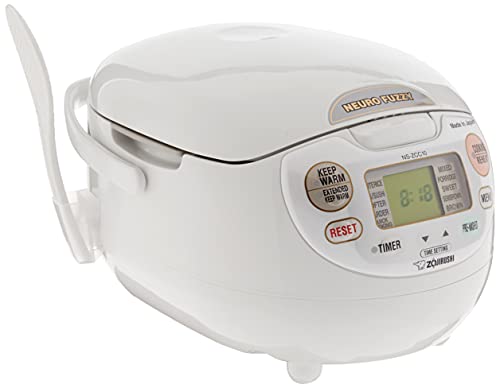
Zojirushi NS-ZCC10 Neuro Fuzzy Rice Cooker and Warmer
Badge: Best Japanese Standard
Strengths
- Neuro Fuzzy logic adapts the cook to conditions, the signature technology of the Japanese premium tier.
- Automatic keep-warm and delay timer support the Japanese pattern of rice ready precisely at mealtime.
- From Zojirushi, the specialist brand most associated with Japanese rice cooker excellence.
Trade-offs
- Premium-tier positioning compared with every alternative in this guide.
- Computerized control involves more settings than a one-touch cooker.
- White finish only, per the confirmed listing.
Mini spec box
- Control: Neuro Fuzzy logic
- Functions: rice cooker and warmer
- Keep warm: automatic
- Timer: delay timer
- Color: white
This is the machine most people are picturing when they search with Japan in the query. Zojirushi’s Neuro Fuzzy system treats cooking as a process to be managed, not a timer to be endured: the cooker monitors how the rice is progressing and makes the small corrections that a fixed program cannot. With short-grain rice, the difference shows up as grains that are tender through, glossy on the surface, and distinct from one another rather than merged into a single mass. With brown rice, it shows up as fully cooked centers without a scorched base. Neither result is magic; both are what decades of Japanese specialization in a single appliance category look like when they reach your counter.
The supporting features complete the philosophy. Automatic keep-warm exists because Japanese meals are built around rice being ready when the rest of the food is, and the delay timer exists because the morning routine of loading the cooker is a real ritual in rice-centered households. Who should buy it? Anyone whose rice is daily, whose grains include short-grain and brown varieties, and who wants the cooker to remove variability from the equation. Its limitation is simply that it is a premium, control-rich appliance pointed at people who care about rice; a household that cooks a pot of long-grain twice a month is buying capability it will never taste.
Best for: daily rice households wanting the authentic Japanese standard / Not suited for: occasional rice cooks or strict-budget shoppers

Zojirushi NS-TSC10 5.5 Cup Micom Rice Cooker and Warmer
Badge: Best Japanese Mid-Size
Strengths
- Micom control brings Japanese computerized cooking to a 5.5-cup, 1.0 L size suited to smaller households.
- LCD controls make settings and timer state clear at a glance.
- Delay timer fits the load-in-the-morning routine.
Trade-offs
- Mid-size capacity will not serve large gatherings alone.
- Premium tier relative to the simple alternatives below.
- Micom is a step behind the flagship’s fuzzy logic in adaptiveness.
Mini spec box
- Capacity: 5.5 cup, 1.0 L
- Control: Micom (microcomputer)
- Display: LCD controls
- Timer: delay timer
If the NS-ZCC10 is the flagship, the NS-TSC10 is the same philosophy fitted to a smaller household’s reality. Its 5.5-cup, one-liter format is the size Japanese urban kitchens themselves favor, where rice is cooked fresh in modest amounts rather than in banquet batches. The micom control manages the cook with the same brand discipline, and the LCD controls are arguably the clearest interface in this entire guide, a small daily pleasure that should not be underestimated in an appliance used twice a day.
Choose this model when your household is one to three people, your rice is frequent, and you want the Japanese standard without the flagship’s scale or price tier. The delay timer makes it a natural for workday routines. Its honest limitation is headroom: a dinner party will outgrow it, and cooks who want the most adaptive control system Zojirushi offers in this pool should step up to the Neuro Fuzzy model. For the solo and couple households that make up so much of Japan’s own rice-cooking population, though, this is the most authentically proportioned pick in the guide, a point our Best Simple Rice Cookers guide echoes from the simplicity angle.
Best for: one-to-three-person households wanting Japanese precision at home scale / Not suited for: large families or party-size batches

Dash Mini Rice Cooker, 2-Cup, Ceramic Nonstick Pot
Badge: Best Compact Alternative
Strengths
- Personal 2-cup cooked format cooks a single serving properly instead of a tiny batch lost in a big pot.
- Removable ceramic nonstick pot rinses clean in seconds and doubles as a serving bowl.
- Keep warm function plus oatmeal, quinoa, and grain cooking stretch a tiny machine’s usefulness.
Trade-offs
- Not a Japanese cooker and no computerized control; the cook is a basic cycle.
- Capacity is strictly one to two people.
- No delay timer in the confirmed specification.
Mini spec box
- Capacity: 2-cup cooked (1 cup uncooked)
- Pot: removable ceramic nonstick
- Functions: rice, oatmeal, quinoa and grains, keep warm
- Color: black
The Dash Mini earns its place in a Japan-themed guide by serving the same household shape that dominates Japanese cities: one person, small kitchen, rice cooked fresh in a small amount. What it does not offer is Japanese cooking technology. Its cycle is basic, and short-grain rice from the Dash will be good rather than exemplary. What it offers instead is proportion and simplicity: a pot sized to its job, a ceramic nonstick surface that cleans instantly, and enough grain versatility for breakfast oatmeal and lunchtime quinoa.
Think of it as the entry point for the solo cook who likes the Japanese pattern of fresh, small, frequent rice cooking but is not ready to fund the flagship tier. Many such cooks later upgrade to the NS-TSC10 and keep the Dash for travel, the office, or a dorm room. Its limitation is the mirror of its virtue: it cannot grow with you, and it makes no attempt at the adaptive cooking that defines the top of this guide.
Best for: solo cooks and tiny kitchens following a small-batch, fresh-rice pattern / Not suited for: anyone seeking Japanese computerized cooking or family capacity

BLACK+DECKER 16-Cup Rice Cooker, RC516
Badge: Best Capacity Alternative
Strengths
- 16-cup cooked (8-cup uncooked) capacity serves families and gatherings in one cycle.
- Steaming basket adds a vegetable, dumpling, or seafood tray above the rice.
- One-touch operation and removable non-stick bowl keep a large machine simple to run and wash.
Trade-offs
- Basic control: no fuzzy logic or micom adaptation for delicate grains.
- Large footprint, and small batches cook poorly in a pot this size.
- Plain white rice is its home territory; specialty grains get a basic treatment.
Mini spec box
- Capacity: 16-cup cooked (8-cup uncooked)
- Operation: one touch
- Inner bowl: removable, non-stick
- Included: steaming basket
- Model: RC516
The RC516 represents the opposite pole from the Japanese standard: where Zojirushi optimizes the quality of each batch, this machine optimizes the quantity per batch, and for many households that is the correct optimization. Sixteen cups of cooked rice with a steaming basket above it is a family dinner or a celebration spread from a single press of a switch, and the removable bowl keeps the aftermath manageable. Extended families, meal preppers, and hosts will find more daily value here than in any refinement of the cooking curve.
Its presence in this guide is also a useful honesty check. If your rice is long-grain, served in volume, and eaten with strongly flavored dishes, the gap between this machine’s output and the flagship’s narrows considerably at the table. The gap widens again with plain short-grain rice served on its own, where the Japanese standard exists precisely to be tasted. Buy the RC516 for scale and the steamer, and buy it knowing exactly which axis you chose, a trade-off we also map in our Best Shrimp Steam Cookers guide for basket-steamed seafood meals.
Best for: families, hosts, and meal prep where volume leads / Not suited for: short-grain purists or tiny-batch cooking

Aroma Housewares ARC-363-1NGB Rice Cooker, Steamer, Multicooker
Badge: Best Value Steamer Alternative
Strengths
- Three roles in one compact unit: rice cooker, steamer, and multicooker.
- 3 uncooked / 6 cups cooked size is right for small households’ daily rice.
- Black finish and compact footprint suit modern small kitchens.
Trade-offs
- Basic cooking control, without the Japanese computerized refinement.
- Mid-small capacity caps its usefulness for gatherings.
- Versatility is breadth, not depth: each role is handled simply.
Mini spec box
- Capacity: 3 uncooked / 6 cups cooked
- Functions: rice cooker, steamer, multicooker
- Range: 2–6 cups
- Color: black
Aroma’s compact multicooker is the value answer in this selection: a small machine that cooks the rice, steams above or alongside it, and generally multicooks its way through a small household’s week. For a couple whose rice is one element of varied meals rather than the ceremonial center, that breadth is genuinely useful, and the 2-to-6-cup working range matches real daily quantities better than oversized pots do.
Measured against the Japanese standard, what you give up is control sophistication and the last degree of consistency; what you keep is money, space, and a steamer function the Zojirushi listings here do not claim. That is a rational trade for many kitchens, and this guide’s job is to make it a conscious one. If, after reading the flagship reviews, you find you care more about a steamed dinner’s convenience than about the rice’s gloss, this is your pick, and our Best Shrimp Cookers guide shows the steamer side of machines like this at work.
Best for: small households wanting rice plus steaming at a value tier / Not suited for: buyers seeking Japanese fuzzy-logic refinement

Aroma Housewares 20 Cup Cooked Digital Rice Cooker, Slow Cooker, Food Steamer
Badge: Best Multicooker Alternative
Strengths
- Three appliances in one: digital rice cooker, slow cooker, and food steamer.
- 20-cup cooked (10-cup uncooked) capacity, the largest in this guide.
- Digital controls and stainless steel exterior give it a more finished feel than basic models.
Trade-offs
- Digital is not the same as fuzzy logic: control is programmed, not adaptive in the Japanese sense.
- Very large for small households; small rice batches are not its strength.
- Rice shares a design with slow cooking and steaming rather than being the sole focus.
Mini spec box
- Capacity: 20 cup cooked (10 cup uncooked)
- Functions: digital rice cooker, slow cooker, food steamer
- Exterior: stainless steel
- Model: ARC-150SB
The largest machine in this guide is also the most versatile, and its review is the right place to clarify a confusion the Japan keyword creates. Digital controls look like computerized cooking, and in a limited sense they are: programs, timers, and precise settings. Japanese fuzzy logic is a further step, in which the cooker responds to the cook’s progress rather than only executing a program. The Aroma gives you the first, in a big, capable, three-role machine; the Zojirushi models give you the second, in rice-dedicated machines. Neither is a trick, but they are not the same purchase.
For a household that slow cooks on Sunday, steams midweek, and cooks rice in family quantities throughout, this Aroma may be the most useful single appliance in the entire selection, Japanese standard or not. Its limitation for this guide’s theme is focus: rice is one of its jobs, not its vocation. Choose it for breadth at scale, and choose the flagships when rice itself is the point, a distinction the Best Selling Slow Cookers guide approaches from the slow-cooking side.
Best for: large households wanting rice, slow cooking, and steaming in one digital unit / Not suited for: small-batch rice or fuzzy-logic seekers
Comparison Table
| Model | Capacity | Control type | Japanese standard? | Link |
|---|---|---|---|---|
| Zojirushi NS-ZCC10 | Neuro Fuzzy format | Fuzzy logic | Yes — flagship | Check on Amazon |
| Zojirushi NS-TSC10 | 5.5 cup, 1.0 L | Micom, LCD | Yes — mid-size | Check on Amazon |
| Dash Mini | 2-cup cooked | Basic, keep warm | No — compact alternative | Check on Amazon |
| BLACK+DECKER RC516 | 16-cup cooked | One touch | No — capacity alternative | Check on Amazon |
| Aroma ARC-363-1NGB | 6 cups cooked | Basic multicooker | No — value steamer alternative | Check on Amazon |
| Aroma ARC-150SB | 20 cup cooked | Digital programs | No — multicooker alternative | Check on Amazon |
How to Choose a Japanese-Style Rice Cooker
Decide first whether you are buying the standard or an alternative, because that decision organizes all the others. Buying the standard means computerized control from a specialist maker, and in this pool it means one of the two Zojirushi models. Between them, size decides: the NS-TSC10’s 5.5-cup format for smaller households, the NS-ZCC10’s flagship fuzzy logic for those who want the most adaptive system and cook a wider rotation of grains. Buying an alternative means naming your real priority — personal size, family volume, steaming, or multi-role versatility — and taking the model that leads that niche, accepting a basic or programmed cook for rice.
Second, match the cooker to your grains. Short-grain and sushi rice, brown rice, and mixed grains are where Japanese control technology pays; long-grain rice under a curry is where it matters least. Third, value the time features honestly: delay timers and graceful keep-warm are not garnish in rice-centered households, they are the difference between rice that waits for dinner and dinner that waits for rice. Fourth, buy for your own market. A Japanese-brand model sold locally gives you the cooking standard with local voltage, plug, instructions, and support. Finally, size the pot to your usual batch, because even the finest fuzzy logic cannot make two cups of rice cook beautifully in a vessel built for sixteen, a sizing principle our Best Simple Pressure Cookers guide applies to a different appliance with the same logic.
How to Cook Japanese-Style Rice at Home
- Measure the rice with the cup supplied with the cooker and rinse it gently, changing the water until it runs mostly clear, to remove surface starch.
- Add water to the pot’s marking for the amount and type of rice; Japanese-style cooking is calibrated to those markings, so trust them over generic ratios.
- Let the rice soak in its cooking water briefly before starting, which hydrates the grains and is a traditional step for short-grain rice.
- Start the appropriate program and leave the lid closed for the entire cycle; the computerized cookers in this guide manage the process themselves.
- When the cycle ends, rest the rice with the lid closed so surface moisture redistributes, then fluff with a paddle in a cutting, folding motion to keep grains distinct.
- Serve promptly, or hold on keep-warm for the span of the meal rather than for hours.
Care for the machine the way Japanese households care for theirs: wash the inner pot gently to protect its surface, clean the lid and steam vent where starch collects, and wipe the exterior rather than immersing anything electrical. A cooker treated this way is a decade-long appliance, which is part of why the premium tier’s arithmetic works out for daily users.
Troubleshooting
Problem: short-grain rice comes out mushy → too much water or insufficient rinsing left excess starch; measure to the pot’s markings and rinse until the water is mostly clear.
Problem: brown rice has chalky centers → it needed the longer, managed cook; use the computerized models’ appropriate program and allow the soaking step rather than shortening the process.
Problem: rice held for guests dries at the edges → the hold ran too long; use the delay timer to finish near serving time instead of holding finished rice for an extended period.
Why Japan Perfected the Rice Cooker
The short history is that postwar Japan electrified rice cooking earlier and more completely than anywhere else, and then kept refining it for a population that eats rice at a frequency few other countries match. Specialist makers competed on the quality of a single pot of rice, and that competition produced the technologies in this guide: microcomputer control in the NS-TSC10’s generation, fuzzy logic in the NS-ZCC10’s, and keep-warm systems designed around the assumption that rice might be served at two meals in a day. The result is that “Japanese rice cooker” became a quality designation in the same way that certain other countries’ names attach to knives, watches, or wine.
Understanding that history helps you shop without superstition. The standard is real, but it is specific: it is about control, consistency, and grains cooked plainly and judged on their own merits. It does not make a Japanese-standard cooker the right tool for every job, as the capacity and multicooker alternatives in this guide demonstrate. It makes it the right tool for the job it was perfected for, which is a pot of rice worth eating by itself, with nothing on it, any day of the year.
Importing from Japan Versus Buying the Local Model
Japan-focused shoppers often consider ordering a cooker made for the Japanese domestic market, imagining a superior machine unavailable elsewhere. Resist the impulse until you have counted the costs. A Japan-market appliance is built for Japan’s electrical system and plugs, and its controls and documentation are in Japanese; using it elsewhere can require a voltage converter, which is a significant additional purchase for a heating appliance, and warranty support generally does not travel with it. Meanwhile, the Japanese brands’ export models — the category this guide’s Zojirushi picks belong to — carry the same cooking philosophy and control technology in versions made for your market.
There are narrow exceptions: collectors, households already equipped for Japanese appliances, and cooks who read Japanese and want a specific domestic model. For everyone else, the local model is the rational expression of the same desire. You get the standard, the support, and a machine that plugs into your wall, which is, in the end, what best-selling success in Japan itself is built on: the right cooker, in the right kitchen, used every day without friction. Readers weighing the lectin-focused pressure-cooking route popularized by some wellness authors can compare approaches in our Best Simple Pressure Cookers Dr Gundry guide.
The Grains of Japan: What You Will Actually Cook
A Japan-focused cooker earns its premium on a specific set of grains, and it helps to name them. Short-grain white rice is the centerpiece: the polished, plump grains served plain at Japanese meals, where the cooker’s job is to deliver them glossy, slightly springy, and separate enough to pick up with chopsticks while still holding together. This is the hardest plain-rice test there is, because there is no sauce to hide behind, and it is the test the fuzzy-logic flagship in this guide was built to pass. Sushi rice begins from the same short-grain base, seasoned after cooking, and it depends on the grains emerging distinct and intact so the seasoning coats rather than soaks; a cooker that mashes the bottom layer makes poor sushi rice no matter how good the vinegar blend is.
Brown rice, increasingly common in Japanese home cooking as elsewhere, is the second test, and in some ways the sterner one. Its bran coat resists water, so the cook must be long and managed; rushed brown rice is chalky, and neglected brown rice scorches. The computerized models’ ability to sustain a patient, adjusted cook is the practical reason brown-rice households gravitate to the Japanese standard. Mixed-grain rice — white rice blended with barley, millet, or other grains in the style popular in Japanese homes — is the third test, because each component hydrates at its own rate and the cooker must land them all at doneness together. Add porridge-style rice for breakfast or for feeding someone recovering from illness, a staple use in Japanese households, and you have the full repertoire the standard was designed around. If that repertoire resembles your week, the flagship reviews above are speaking to you directly. If your week is jasmine rice under a stir-fry, the alternatives will serve you honestly and for less, and there is no virtue in pretending otherwise.
Keep-Warm Culture: Rice Ready When Life Is
It is impossible to understand the Japanese rice cooker without understanding keep-warm, because in a rice-centered household the cooker is not an appliance that runs and is emptied; it is a reservoir that holds the day’s rice at readiness. Breakfast rice, the lunch box packed from the same batch, and the evening serving may all come from one morning cook, and the warmer’s job is to keep that rice pleasant across the day. This is why both Zojirushi models in this guide list automatic keep-warm so prominently, and why the delay timer pairs with it: the timer finishes the cook near the first meal, and the warmer carries the rice to the later ones.
Export-market households use these features differently, and that is fine. A delay timer set for the evening commute and a warmer that bridges the gap between the first and last person at the table reproduce the same logic at a smaller scale. What matters is recognizing that these are not decorative features bolted onto a simple pot; they are half of the Japanese design brief. When you compare the flagships against the alternatives in this guide, count the time machinery as part of the standard you are paying for, and ask whether your household’s rhythm — staggered dinners, packed lunches, breakfast rice — will actually use it. Households that will use it daily tend to find the premium easy to justify. Households that serve rice the moment it cooks can honestly bank the savings and take a simpler machine.
Reading a Japanese Cooker’s Specification Without Being Misled
Japan-themed shopping attracts vague language, so it is worth learning to read a specification the way this guide read its pool. The meaningful words are the control words: fuzzy logic and micom (microcomputer) describe how the cooker thinks, and they are the terms that separate the standard from the alternatives. The word digital, by contrast, describes the interface and the programming, not the adaptiveness; a digital cooker can be excellent, as the Aroma in this guide is at its own job, without being a Japanese-standard machine. Capacity words need the same care, because a 5.5-cup micom cooker and a 20-cup multicooker are not rivals at all until a shopper mistakes the numbers for a ranking.
Equally important is what a specification does not say. None of the verified listings in this pool claim induction heating or pressure cooking, technologies that exist elsewhere in the Japanese market at higher tiers. A shopper who wants those should look for them stated explicitly in a listing, not assume that a premium brand’s name implies them in every model. This discipline — crediting exactly what is confirmed and nothing more — is what keeps a themed guide honest, and it is the same discipline that let this page praise the Zojirushi models strongly: their confirmed control systems, keep-warm, and timers genuinely are the standard, with no embellishment required. Apply the same reading to any cooker you consider beyond this page, and marketing language will lose most of its power over you.
Finally, remember that a specification is a promise about a machine, not about a meal. The rinse, the soak, the water measured to the pot’s own markings, and the rest before fluffing remain the cook’s contribution, in Tokyo as much as anywhere else. The Japanese standard pairs an unusually capable machine with an unusually attentive method, and shoppers who adopt both halves of that pairing are the ones whose rice changes noticeably. Those who adopt only the machine still gain consistency; those who adopt only the method still gain better rice from the cooker they already own. The guide’s picks give you the machine half, in two authentic sizes and four honest alternatives.
What Best-Selling Means in Japan Itself
It is worth pausing on the phrase best selling, because in Japan’s own market the cookers that dominate share traits that explain the standard better than any advertisement. They are, overwhelmingly, mid-size machines for daily fresh cooking rather than giant pots for weekly batches, reflecting kitchens where rice is cooked often and eaten promptly. They emphasize keep-warm quality, because rice may be served across a day. And they come from a small set of specialist makers whose names are synonymous with the category, competing on incremental refinements of the cooking curve year after year. The export shopper cannot buy that exact market, but can buy its logic: right-sized capacity, serious warming, specialist control. That logic is precisely how the two Zojirushi picks in this guide were chosen to lead, and why the alternatives were judged on whether they serve a different, clearly named need rather than on whether they imitate the standard cheaply. A best seller, in the Japanese sense, is a machine a household replaces with the same maker’s newer model a decade later — loyalty earned one unremarkable, perfect pot of rice at a time.
A Short Word on Price Tiers in This Guide
Without naming figures, the tiers in this selection arrange themselves clearly. The alternatives occupy the accessible tiers, with the Dash Mini and the Aroma models asking the least commitment and the big BLACK+DECKER asking for capacity money rather than technology money. The Japanese standard occupies the premium tier, and its price buys control systems, time machinery, and specialist build rather than size. Shoppers should decide which currency they are spending — capacity or control — before comparing across the tiers, because a large cheap cooker and a small premium one are not expensive and cheap versions of each other. They are different instruments, and this guide’s comparison table is organized to keep that truth visible at a glance.
Common Buying Mistakes
- Assuming any digital rice cooker offers Japanese-style fuzzy logic, when programmed digital control and adaptive fuzzy logic are different things.
- Importing a Japan-market model without accounting for voltage, plug, language, and warranty consequences.
- Buying the flagship for a household that cooks plain long-grain rice occasionally, then concluding the category is overrated.
- Ignoring capacity fit: even premium control cooks small batches poorly in an oversized pot.
- Judging short-grain rice by the first batch before learning the rinse, soak, and rest steps the style depends on.
Final Recommendation
For the shopper this keyword describes, the first choice is the Zojirushi NS-ZCC10 Neuro Fuzzy: it is the fullest expression of the Japanese standard in this pool, with adaptive fuzzy logic, automatic keep-warm, and a delay timer in one specialist machine. Smaller households should take the same standard in a right-sized form with the Zojirushi NS-TSC10, whose micom control and LCD clarity suit daily cooking for one to three people.
If your honest priority is volume, steaming, or multi-role value rather than the standard itself, the alternatives are reviewed above without apology, and the Aroma 20 Cup Cooked Digital leads them for sheer versatility at scale. Whichever you choose, buy the version made for your market, size it to your usual batch, and learn the rinse-soak-rest routine; the Japanese standard is as much a method as a machine, and the cooks who get the most from these cookers are the ones who adopt both.
Frequently Asked Questions
What makes a Japanese rice cooker different from a regular one?
Computerized, adaptive control and a design culture built around rice as the center of the meal. Models like the Zojirushi picks here monitor and adjust the cook, handle short-grain and brown rice with particular care, and pair that with keep-warm and delay-timer systems designed for daily, scheduled use.
Are all the cookers in this guide Japanese?
No, and the guide labels them honestly. The two Zojirushi models represent the Japanese standard. The Dash, BLACK+DECKER, and Aroma models are popular alternatives included for capacity, size, and versatility comparisons, each leading a niche the Japanese flagships do not target.
Should I import a rice cooker from Japan?
For most shoppers, no. Japan-market models are built for Japan’s voltage and plugs, carry Japanese controls and documentation, and generally lack local warranty support. Japanese brands sell export versions with the same cooking approach made for your market, which is the route this guide’s picks represent.
Is fuzzy logic noticeably better than micom control?
Fuzzy logic is the more adaptive system, responding to the cook’s progress with finer corrections, which shows most with varied grains and inconsistent conditions. Micom control, as in the NS-TSC10, is still computerized and precise, and in a right-sized household the difference may be smaller than the size and interface advantages.
Which grains benefit most from a Japanese-standard cooker?
Short-grain and sushi-style rice, brown rice, and mixed grains benefit most, because their cooking windows are less forgiving. Plain long-grain rice is the most forgiving grain and the one where simpler cookers compete most closely.
How do I get glossy, distinct short-grain rice?
Rinse until the water runs mostly clear, measure water to the pot’s own markings, soak briefly, cook on the appropriate program without lifting the lid, rest with the lid closed, and fluff with a folding motion. The method and the machine work together; neither fully substitutes for the other.
How long do the Zojirushi models hold rice on keep warm?
Both list automatic keep-warm designed for the span of a meal and the staggered serving that rice-centered households practice. As with any cooker, quality is best within a reasonable holding window; for longer gaps, the delay timer’s approach of finishing the cook near serving time gives a fresher result than holding finished rice for many hours.
Do Japanese-standard cookers need special rice?
No. They cook ordinary rice better through control, and they shine with short-grain and brown rice that are widely available. Using the rice varieties the standard was designed around will show the largest difference, but the consistency benefits apply to whatever rice your household already buys.
Can a Japanese-standard cooker replace a slow cooker or steamer?
Not on the evidence of these listings: the Zojirushi picks are rice cookers and warmers. If slow cooking and steaming are core needs, the Aroma multicooker alternative in this guide covers those roles, at the cost of the rice-specific refinement.


