Disclosure: topratedkitchenware.com is reader-supported. When you buy through links on our site, we may earn an affiliate commission from Amazon and other retailers, at no extra cost to you.
Where to buy
All six picks below are countertop models sold through Amazon, and every one of them earned its place by being easy to operate rather than by piling on features. Start with the name links if you already know your size class, or read the full guide first and come back — the detailed reviews explain exactly which controls each model asks you to learn, and which ones it quietly handles for you.
- Chefman Countertop Microwave Oven 0.7 Cu. Ft., 700 Watts — Black
- BLACK+DECKER Countertop Microwave Oven, 0.9 Cu.Ft, 900W, Stainless Steel
- TOSHIBA Microwave Oven, 0.9 Cu.Ft, 900W, Black Stainless Steel
- TOSHIBA Countertop Microwave Oven, 1.2 Cu.Ft, 1000W, Stainless Steel
- Panasonic Countertop Microwave Oven, 1.2 Cu. Ft., 1250W, Inverter Technology with Genius Sensor, Stainless Steel — NN-SN67QS
- TOSHIBA Countertop Microwave Oven with Inverter Technology, 1.6 Cu.Ft, Black Stainless Steel
Read the full guide ↓
If you have ever stood in front of a microwave pressing buttons in the wrong order while your coffee went cold, you already understand what this guide is for. The best simple microwaves are not the ones with the longest feature lists; they are the ones where reheating a plate, softening butter, or defrosting chicken takes one or two obvious presses and no manual. This roundup judges six countertop models on exactly that standard: how few decisions stand between you and hot food.
Simple, in this guide, has a specific meaning, and it is worth stating plainly before any rankings. A simple microwave is one where the everyday jobs — reheating, defrosting, cooking a frozen meal, making popcorn — can be started from a clearly labeled preset or a one-touch express key, where the power level is easy to change when a recipe asks for it, and where nothing essential hides inside a menu system. By that definition, a model with a humidity or genius sensor can actually be simpler than a bare-bones model, because the sensor removes the guesswork of choosing a time. What disqualifies a model here is not capability; it is friction — nested menus, cryptic codes, and controls you have to re-learn every month. Every pick below keeps its basic path short, and the reviews say honestly where each one adds a step.
The six models span three size classes. The Chefman at 0.7 cu ft is the small, single-person option. The two 0.9 cu ft models from BLACK+DECKER and Toshiba suit couples and small apartments. The two 1.2 cu ft models and the big 1.6 cu ft Toshiba serve families who reheat full dinner plates and casserole dishes. Power runs from 700 watts in the little Chefman to 1250 watts in the two inverter models, and the reviews explain what that means in plain reheating terms rather than treating wattage as a score. If counter space is your tightest constraint, the companion roundup of Best Small 10 Countertop Microwaves applies this same ease-of-use thinking to the compact class specifically.
Key Takeaways
- Simple means a short path to hot food: one-touch express keys, clearly named presets, and power levels you can change without opening a manual.
- The Chefman 0.7 cu ft is the simplest overall package for one or two people; the BLACK+DECKER 0.9 cu ft is the simplest full-duty option for everyday family reheating.
- Sensor models are not automatically complicated — the Toshiba and Panasonic sensor ovens remove time-guessing, which is the most common source of microwave frustration.
- Wattage changes speed, not simplicity: 700W models simply need longer times, while 1000W and above match the timings printed on most packaged foods.
- A mute function and a child safety lock sound minor until you live with beeping at midnight or a curious toddler; four of the six picks offer one or both.
- Buy the size that fits your largest regular dish; every other simplicity feature matters less than not fighting the door with a casserole.
In this guide
Quick Picks
| Pick | Badge | Capacity | Power | Why it is simple | Link |
|---|---|---|---|---|---|
| Chefman Countertop Microwave Oven 0.7 Cu. Ft. | Best Overall | 0.7 cu ft | 700 watts | One-touch express cook and six presets cover nearly everything a small household reheats | Check on Amazon |
| BLACK+DECKER Countertop Microwave Oven, 0.9 Cu.Ft | Best for Most Kitchens | 0.9 cu ft | 900W | Six auto cook presets, ten power levels, and a push-button door that opens with full hands | Check on Amazon |
| TOSHIBA Microwave Oven, 0.9 Cu.Ft | Best for Apartments and Quiet Hours | 0.9 cu ft | 900W | Six auto menus plus a mute function and LED lighting in a footprint made for apartments | Check on Amazon |
| TOSHIBA Countertop Microwave Oven, 1.2 Cu.Ft | Best Mid-Size Simple | 1.2 cu ft | 1000W | A humidity sensor judges doneness so you stop programming times for leftovers | Check on Amazon |
| Panasonic Countertop Microwave Oven NN-SN67QS | Best Sensor-Assisted Simple | 1.2 cu ft | 1250W | Genius Sensor reheating and inverter power remove both the timing and the hot-spot guesswork | Check on Amazon |
| TOSHIBA Countertop Microwave Oven with Inverter Technology, 1.6 Cu.Ft | Best Large but Simple | 1.6 cu ft | 1250W | Family capacity with sensor cooking and auto defrost doing the thinking | Check on Amazon |
How These Picks Were Chosen
This is a research-led guide, not a hands-on laboratory test, and it does not pretend otherwise. Each candidate was checked against its verified Amazon listing data — capacity, wattage, the exact control features named in the product title, and the functions a buyer can confirm before ordering. Models were then ranked through the simplicity lens described above: the number of steps to start the five most common jobs, whether express or one-touch starting exists, whether a sensor can take over timing decisions, and whether the extras that remain are genuinely useful rather than decorative.
Two honesty rules shaped the list. First, no specification appears in this article unless the verified listing states it — if a title does not give a turntable size or a dimension, the review does not invent one. Second, complexity was judged by what the controls demand of you, not by how advanced the technology sounds. Inverter power delivery, for example, is sophisticated engineering that makes life simpler, because food heats more evenly at reduced power instead of cycling on and off. A long list of auto menus cuts both ways: twelve menus is helpful if they are labeled with foods you actually cook, and clutter if they are not, and the reviews say which way each model leans.
Shoppers comparing installation styles rather than countertop simplicity may also want the over-range models collected under Best Microhood Microwaves, which trade counter space for a vent hood combination. Everyone else — dorm rooms, first apartments, family kitchens, office break rooms — will find their answer in the six countertop models below.
The 6 Best Simple Microwaves — Detailed Reviews

Chefman Countertop Microwave Oven 0.7 Cu. Ft., 700 Watts — Black
Badge: Best Overall
Strengths
- One-touch express cook starts the most common reheats with a single press
- Six cooking presets cover the everyday list without menu-diving
- Mute button silences beeps for dorms, nurseries, and late-night snacks
Trade-offs
- 700 watts is the slowest pace in this roundup; packaged-food times need extending
- 0.7 cu ft will not swallow a large dinner plate or a big mixing bowl
- Ten power levels still require a manual time entry for non-preset jobs
Mini spec box: Capacity 0.7 cu ft · Power 700 watts · 10 power levels · 6 cooking presets with one-touch express cook · Child safety lock · Mute button · Finish: Black
The Chefman earns Best Overall in a simplicity contest because it understands the assignment: most people, most days, press one button and walk away. The one-touch express cook is the feature that matters. Instead of keying in a time for a mug of soup or a plate of leftovers, you touch the express control and the oven starts immediately, and the six cooking presets handle the named jobs — the frozen meals, popcorn, and reheats that make up nearly all real microwave use. Ten power levels sit behind those shortcuts for the moments a recipe genuinely asks for half power, but nothing forces you to use them.
At 0.7 cu ft and 700 watts, this is deliberately a small person’s microwave. It suits a dorm room, a single apartment, an office desk corner, or a second oven for a teenager’s snacks. The honest limitation is pace and space: 700 watts reheats perfectly well, but it takes noticeably longer than the 1000W class, and the timings printed on frozen meals assume roughly that higher power, so you will add time and check. The cavity also sets a hard ceiling — a standard mug, a bowl, a small plate, yes; a family casserole, no. Within its class, though, the control story is the cleanest here, and the mute button is a small mercy anyone in shared housing will appreciate within a week. The child safety lock rounds out a package clearly designed for real shared spaces rather than a spec-sheet contest.
Best for: singles, students, and small households who mostly reheat and want one-press operation / Not suited for: families reheating large plates or anyone who cooks full meals in the microwave daily
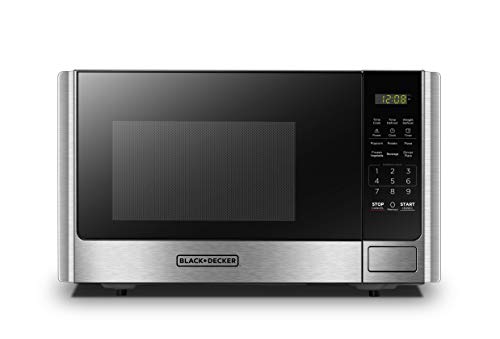
BLACK+DECKER Countertop Microwave Oven, 0.9 Cu.Ft, 900W, Stainless Steel
Badge: Best for Most Kitchens
Strengths
- Push-button door opens with an elbow or a full hand — no handle to grip
- Six auto cook presets map to the foods households actually reheat
- 900W is close enough to packaged-food timings that most labels work as printed
Trade-offs
- No sensor cooking, so reheating times remain your judgment call
- No mute function is named in the listing for quiet-hours use
- 0.9 cu ft fits dinner plates but not the largest casserole dishes
Mini spec box: Capacity 0.9 cu ft · Power 900W · 10 power levels · 6 auto cook presets · Push-button door · Child safety lock · Finish: Stainless Steel
If the Chefman is the specialist for one, this BLACK+DECKER is the generalist for everyone else. The 0.9 cu ft cavity is the smallest size that still behaves like a full kitchen microwave: dinner plates fit, a quart of soup reheats without sloshing against the walls, and 900 watts keeps you close to the instructions on the box. Simplicity here is mechanical as much as electronic. The push-button door deserves more credit than it usually gets — when your hands are holding a hot dish or a squirming toddler, pressing a button with the heel of your hand beats fumbling for a handle, and it is one of those features you notice every single day.
The control panel keeps the deal straightforward: six auto cook presets for the routine jobs, ten power levels when a recipe asks, and a child safety lock for households that need it. There is no sensor to judge doneness for you, which is this model’s honest trade-off — you are the sensor, and a plate of pasta may need a stir and a second short burst. For many buyers that is a fair exchange for a panel with nothing to learn. Readers who want the sensor to take over that judgment should look at the two Toshiba sensor models below; readers who want the fewest possible decisions should stay right here.
Best for: couples and small families who want a no-learning-curve everyday oven / Not suited for: buyers who specifically want sensor reheating or a mute function

TOSHIBA Microwave Oven, 0.9 Cu.Ft, 900W, Black Stainless Steel
Badge: Best for Apartments and Quiet Hours
Strengths
- Mute function keeps late-night reheating quiet in thin-walled apartments
- Six auto menus keep the daily jobs to a press or two
- LED lighting makes it easy to check food without opening the door
Trade-offs
- No sensor, so times are manual for anything off the preset list
- 900W still trails the 1000W class slightly on packaged-meal timings
- Black stainless shows a different fingerprint pattern than plain black finishes
Mini spec box: Capacity 0.9 cu ft · Power 900W · 6 auto menus · Mute function · Child lock · LED lighting · 10.6 inch removable turntable · Finish: Black Stainless Steel
Toshiba positions this 0.9 cu ft model explicitly for apartments, and the simplicity story matches the setting. Six auto menus cover the standard rotation, the mute function handles the social problem every apartment dweller knows — the 11 p.m. reheat that announces itself to the whole unit — and LED interior lighting lets you check whether the cheese has melted without opening the door and restarting your mental timer. The 10.6 inch removable turntable comes out for washing, which matters more in a small kitchen where the microwave doubles as a everyday workhorse.
Operation is the classic keypad pattern: choose a menu or key a time, set power if needed, press start. Nothing about that is hard, but nothing automates your judgment either, and that is the honest contrast with its bigger Toshiba sibling below. Choose this model when your space is compact and your hours are irregular; choose the 1.2 cu ft Toshiba when you want the oven itself to decide when leftovers are done. Either way, the footprint discussion in Best Microwave Ovens Countertop Microwaves is worth a look if your counter depth is genuinely tight.
Best for: apartment dwellers, shift workers, and anyone reheating at odd hours / Not suited for: large households or buyers who want sensor automation

TOSHIBA Countertop Microwave Oven, 1.2 Cu.Ft, 1000W, Stainless Steel
Badge: Best Mid-Size Simple
Strengths
- Smart humidity sensor judges reheating so you stop guessing times
- 1000W matches the power most packaged-food instructions assume
- Mute function and ECO mode cover quiet hours and standby waste
Trade-offs
- Twelve auto menus is a longer list to scan than the six-preset panels above
- Sensor results vary with covered versus uncovered dishes; a learning week is normal
- 1.2 cu ft needs noticeably more counter than the 0.9 cu ft models
Mini spec box: Capacity 1.2 cu ft · Power 1000W · Smart humidity sensor · 12 auto menus · Mute function · ECO mode · Easy clean interior · Finish: Stainless Steel
This is the pick for people who find choosing a time to be the annoying part. Toshiba’s smart humidity sensor watches the steam food releases and ends the cycle when the food is ready, which converts the most common microwave task — reheating leftovers of unknown weight and starting temperature — into a single menu selection. That is a deeper kind of simple than a short button path: the oven absorbs the decision entirely. The easy clean interior supports the same philosophy on the maintenance side, because a cavity that wipes down quickly is a cavity that actually gets wiped down.
The counterweight is the menu list itself. Twelve auto menus means more scanning before you press, and a first-time user will spend a minute reading the panel that a six-preset model would not demand. The fair summary is that this Toshiba is simplest on the second week’s use, once your three regular menus are memorized, while the smaller models are simplest on day one. At 1000W it also matches the reference power for most frozen meal instructions, removing the mental arithmetic the 700W and 900W models ask for. Households graduating from a compact oven usually land here, and few regret it.
Best for: families who reheat varied leftovers and hate guessing times / Not suited for: minimalists who want the shortest possible button list on day one

Panasonic Countertop Microwave Oven, 1.2 Cu. Ft., 1250W, Inverter Technology with Genius Sensor, Stainless Steel — NN-SN67QS
Badge: Best Sensor-Assisted Simple
Strengths
- Genius Sensor reheating removes both the time and the weight entry
- Inverter delivery holds low power steadily, so softening and defrosting stop being a guessing game
- 1250W is the joint-fastest pace in this roundup for impatient households
Trade-offs
- The most technology in the group; buyers wanting purely manual controls should look above
- Sensor cycles ask you to trust the oven, which takes adjustment if you like exact times
- Full 1.2 cu ft footprint with family-size counter demands
Mini spec box: Capacity 1.2 cu ft · Power 1250W · Inverter technology · Genius Sensor · Finish: Stainless Steel · Model: NN-SN67QS
Panasonic’s pitch is that the simplest microwave is the one that watches the food for you. The Genius Sensor handles reheating by detecting steam, and the inverter system changes what low power means: instead of blasting and resting, the oven delivers a steady reduced output, so defrosting chicken does not cook its edges and melting butter does not explode it across the cavity. Both features reduce the number of interventions a cook makes — fewer pauses, fewer stirs, fewer rescue operations — and intervention count is as honest a simplicity metric as button count.
Where does it ask more of you? Trust. A sensor cycle ends when the oven decides, and cooks who have spent years keying exact times sometimes find that surrender uncomfortable for the first few uses. The panel also carries more capability than the compact models, even if the daily path stays short. Buyers researching the higher-power class specifically will find this model again in the Best Microwaves 1250 Watts coverage, and it earns its place there on speed as well as sense. For this guide’s purpose, it is the pick when your definition of simple is “the oven should just handle it.”
Best for: cooks who defrost and reheat constantly and want the oven to judge doneness / Not suited for: strict manual-control traditionalists or very small counters

TOSHIBA Countertop Microwave Oven with Inverter Technology, 1.6 Cu.Ft, Black Stainless Steel
Badge: Best Large but Simple
Strengths
- 1.6 cu ft cavity and 13.6 inch turntable take family casseroles without a wrestling match
- Smart sensor and auto defrost keep the big oven’s daily operation to a few presses
- Inverter power at 1250W reheats large portions evenly instead of in hot and cold patches
Trade-offs
- The largest counter footprint here; measure before you fall in love
- More oven than a single person will ever use
- Sensor and inverter systems mean more to learn than a basic six-preset panel
Mini spec box: Capacity 1.6 cu ft · Power 1250W · Inverter technology · Smart sensor · Auto defrost · 13.6 inch turntable · Finish: Black Stainless Steel
Big microwaves have a reputation for complexity because family models are where manufacturers pile on features. This Toshiba resists that pattern better than most: the headline systems are a smart sensor for reheating, auto defrost, and inverter power delivery — three technologies that each remove a chore rather than add a menu. The 13.6 inch turntable turns a family-size dish properly, and 1250 watts of inverter power means a large portion reheats through instead of scorching at the edges while the middle stays cold, which is the failure mode that sends people back to the oven.
The simplicity caveat is real estate and restraint. A 1.6 cu ft countertop oven dominates a small kitchen, and a household of one will never use its capacity. It is also, inevitably, a step up in panel complexity from the Chefman or the BLACK+DECKER — not difficult, but not nothing. Families who cook in batches, reheat full meals for several people, or host regularly will find the trade worthwhile. Before ordering any model in this size class, it is worth reading how long-term coverage is handled in the Best Mfg Warranty On Microwaves guide, because a family workhorse is exactly the appliance you want supported for years.
Best for: families of four or more, batch cookers, and big-dish reheating / Not suited for: small kitchens, single users, or anyone short on counter depth
Comparison Table
| Pick | Capacity | Power | Simplicity shortcut | Sensor | Link |
|---|---|---|---|---|---|
| Chefman 0.7 Cu. Ft. | 0.7 cu ft | 700 watts | One-touch express cook, 6 presets | No | Check on Amazon |
| BLACK+DECKER 0.9 Cu.Ft | 0.9 cu ft | 900W | 6 auto cook presets, push-button door | No | Check on Amazon |
| TOSHIBA 0.9 Cu.Ft | 0.9 cu ft | 900W | 6 auto menus, mute function | No | Check on Amazon |
| TOSHIBA 1.2 Cu.Ft Stainless | 1.2 cu ft | 1000W | Humidity sensor ends time-guessing | Yes — humidity | Check on Amazon |
| Panasonic NN-SN67QS | 1.2 cu ft | 1250W | Genius Sensor plus steady inverter power | Yes — Genius Sensor | Check on Amazon |
| TOSHIBA 1.6 Cu.Ft Inverter | 1.6 cu ft | 1250W | Smart sensor, auto defrost, family size | Yes — smart sensor | Check on Amazon |
How to Choose a Simple Microwave
Start with the jobs, not the oven. Write down the five things your household microwaves most: for most people that list is reheating leftovers, defrosting meat, cooking a frozen meal, softening or melting ingredients, and popcorn or a hot drink. A simple microwave is the one whose panel turns your five jobs into the fewest presses. If your list is dominated by reheating, a sensor model removes the most thought. If your list is mostly frozen meals with printed instructions, a straightforward 1000W keypad model matches those instructions with zero translation. If your list is one person’s mug-and-bowl rotation, express keys beat everything.
Size comes second, and it is a dish question, not a people question. Measure your largest regular plate or casserole across its widest point, handles included, and make sure the cavity and turntable clear it — the two turntable sizes stated in this guide are 10.6 inches on the apartment Toshiba and 13.6 inches on the big Toshiba, which tells you the class difference plainly. Capacity labels translate roughly as follows: 0.7 cu ft for mugs, bowls, and small plates; 0.9 cu ft for full dinner plates; 1.2 cu ft for plates plus mid-size casseroles; 1.6 cu ft for family dishes. Buying one class up from your current frustration is sensible; buying two classes up usually just donates counter space.
Power third. Packaged foods in the United States are typically timed for ovens around 1000 to 1100 watts, so a 1000W model follows box directions literally, a 900W model needs a small addition, and a 700W model needs a meaningful one — the rough conversion is to add about a fifth to a third more time at 700W and check earlier rather than later. Shoppers who have settled on that higher-power class specifically can compare the models collected as Best Microwaves 1100 Watt, where the same listings are judged on speed and capacity rather than simplicity. Inverter models complicate the math pleasantly: their advantage is not raw speed but steady low power, which is why defrosting and melting behave better on the Panasonic and the big Toshiba.
Finally, weigh the two quiet features honestly. A mute function costs nothing to ignore and saves real irritation in open-plan homes, dorms, and nurseries. A child safety lock matters in exactly the households that already know they need it. Neither should outrank size and controls, but between two otherwise equal finalists, they are the right tiebreakers.
How to Use a Simple Microwave Well: Setup, Daily Routine, and Cleaning
Setup takes ten minutes and pays back for years. Place the oven on a level counter with the clearance the manual specifies around the vents, plug it directly into a wall outlet rather than a power strip, set the clock (several models will not start some cycles until the clock is set, which confuses many new owners), and run a cup of water for a minute to confirm everything works and to clear any new-appliance smell. Peel protective film from the panel and door, and if your model has a mute function, decide now whether your household is a beeps-on or beeps-off home.
The daily routine that keeps a simple microwave simple is mostly about covers and stirring. Cover food with a microwave-safe lid or plate to hold steam and stop splatter; stir or rotate food halfway through manual cycles, because even good ovens heat unevenly in dense foods; and let food stand for a minute after the cycle, since cooking continues and temperatures even out during the stand. For defrosting, use the preset or auto defrost where fitted, separate pieces as soon as they loosen, and cook thawed food promptly. For sensor reheating, follow the one rule sensors depend on: cover the dish as the manual directs, because the sensor reads steam, and an uncovered dish gives it nothing to read.
Cleaning is the maintenance task that decides how long the oven stays pleasant. Wipe splatters weekly with a damp cloth; for dried-on food, heat a bowl of water with a slice of lemon for a few minutes and let the steam loosen everything before wiping. Wash the removable turntable in the sink — the apartment Toshiba’s 10.6 inch plate and the big model’s 13.6 inch plate both lift out — and never run the oven empty, which stresses the magnetron for no benefit.
Troubleshooting, in the pattern most owners actually need it. Problem: food heats unevenly with cold centers → reduce portion depth, stir or rearrange halfway, and add standing time before serving. Problem: the oven runs but nothing heats → check that the door is fully latched and that you have not accidentally set a delayed or timer-only mode; if the turntable and light work but no heat follows, stop and arrange service rather than experimenting. Problem: sparking or arcing inside the cavity → stop the cycle immediately, remove any metal trim, twist ties, or damaged cookware, and inspect the cavity walls for paint damage before using it again. Problem: the panel ignores presses → confirm the child lock is not engaged; on the models here that lock is a feature, and it catches out at least one person in every household.
What “Simple” Really Means: A Short History of Microwave Controls
The first home microwaves had a dial and a prayer. You turned the timer, the oven hummed, and doneness was a matter of experience. Dial controls still have devoted fans because they offer literally one decision, but they disappeared from mainstream countertop models for practical reasons: a dial cannot run a defrost program, cannot stage a power level, and cannot tell a sensor when to stop. The keypad generation that replaced it swung too far the other way, loading panels with dozens of single-purpose buttons that most owners never touched.
The six models in this guide represent where the pendulum settled. The compact Chefman and BLACK+DECKER keep the keypad but discipline it — a short preset list, an express start, power levels in reserve. The sensor Toshibas and the Panasonic go a step further and argue, persuasively, that the simplest interface is the one that asks the fewest questions: select the food, and the oven measures its way to done. Neither philosophy is wrong. They serve different cooks, which is why this guide ranks by household rather than crowning a single philosophy, and why the honest question to ask in the store is not “which panel has least on it” but “which panel matches the five jobs I actually do.”
Simple Controls for Every Generation: Kids, Guests, and Grandparents
A microwave earns the word simple at the margins: the guest reheating tea at midnight, the grandparent who did not grow up with keypads, the ten-year-old making a first supervised snack. Three design traits decide those moments. First, a start path that works without instruction — express keys and clearly named presets pass this test, coded menus fail it. Second, legible labeling: auto menus named after foods beat numbered program codes every time, which is why the named six-menu panels in this guide score well for shared households. Third, forgiving defaults: a child safety lock that prevents accidental starts, a mute that keeps a mistake quiet, and a door — like the BLACK+DECKER’s push-button design — that opens without grip strength.
If your household includes an older relative who struggles with modern panels, the practical setup helps as much as the model choice. Program nothing, configure nothing; instead, agree on the two buttons that household actually uses — for most, the express start and the popcorn or reheat preset — and put a small note inside a nearby cupboard door listing them. Sensor models earn a special mention here: “press Reheat and wait” is the easiest instruction set ever printed, and it is the strongest argument for the Toshiba and Panasonic models in multi-generation homes, even though their panels look busier at first glance.
Power Levels Without the Confusion: The One Setting Worth Learning
Every pick in this guide offers multiple power levels — ten on the Chefman and the BLACK+DECKER — and this is the one place where a simple microwave asks a small amount of learning in exchange for much better food. Power level does not change the oven’s maximum output; it changes how that output is delivered over time. On a conventional oven, half power means the magnetron cycles on and off so that, averaged across the cycle, food receives about half the energy. On the two inverter models, half power is delivered as a genuine, steady half-strength output, which is gentler still. Either way, the purpose is the same: delicate jobs should not be blasted.
Four everyday jobs repay the tiny effort. Defrosting at low power — or with the auto defrost fitted to the big Toshiba — thaws the center of a chicken breast before the edges begin to cook. Melting butter and chocolate at half power prevents the spattering and seizing that full power causes in seconds. Softening ice cream or cream cheese takes a short, low burst rather than a melted puddle. And reheating dense leftovers at a reduced setting, for a little longer, heats the middle through instead of cremating the rim. None of this requires memorizing a chart: the working rule is simply that the more delicate or dense the food, the lower the power and the longer the patience.
Everything else can stay on full power without apology. Drinks, soups, vegetables, popcorn, and frozen meals are designed for it, and the presets on these six models already encode sensible choices for their named foods. That is the real division of labor in a simple kitchen: let presets and sensors run the routine, keep one manual skill — power level — for the exceptions, and ignore the rest of the panel without guilt. A microwave used that way stays simple for a decade.
Common Buying Mistakes
The most common mistake is buying features instead of a routine. A long spec sheet feels like value in the store and becomes clutter at home if your household reheats the same six things. Judge every model against your five real jobs and let the rest go. The second mistake is the reverse: buying the smallest, plainest oven to keep things simple, then discovering that a dinner plate does not fit and every reheat becomes a transfer-and-decant project. Simplicity that fights your dishes is not simple.
Third, shoppers routinely misread wattage as quality. A 700W oven is not a bad oven; it is a slower oven, and in a dorm that trade is often correct. What matters is knowing the conversion before you buy, not after your first undercooked frozen meal. Fourth, people ignore the door. Handle versus push-button sounds trivial until you carry a hot casserole with both hands — test how a door opens in the store if you can. Fifth, buyers forget standby and sound: an oven that beeps loudly and glows all night is a small daily tax in a studio apartment, and the mute and ECO functions on several picks here exist precisely because owners complained. Finally, do not skip the warranty check on a family-size model you expect to run daily for years; the countertop category covered by Best Microwave Ovens Countertop Microwaves includes models at every durability tier, and a daily workhorse deserves the longer look.
Final Recommendation
For most readers, the answer splits cleanly by household size. One or two people in a small space: take the Chefman 0.7 Cu. Ft. and enjoy the shortest button path in the group. A typical small family that wants zero learning curve with real plates: take the BLACK+DECKER 0.9 Cu.Ft, whose push-button door and six presets disappear into daily life fastest. Households that reheat varied leftovers and are tired of guessing times should step up to the TOSHIBA 1.2 Cu.Ft with humidity sensor, and cooks who defrost constantly should consider the Panasonic’s inverter instead. The big 1.6 cu ft Toshiba is the right answer only when the dishes genuinely demand it — and when they do, nothing smaller will substitute.
Whichever you choose, check the latest price on Amazon from the links above before ordering, confirm the footprint against your counter one more time, and remember the standard this guide applied: the best simple microwave is the one you stop thinking about within a week.
Frequently Asked Questions
What makes a microwave “simple” rather than just basic?
Basic describes what a microwave lacks; simple describes how little it asks of you. A simple model turns your regular jobs into one or two obvious presses — through express keys, named presets, or a sensor that judges doneness. A merely basic model can still force you to guess times for everything, which is why a sensor Toshiba can rank as simpler than a stripped-down keypad oven.
Is 700 watts enough for everyday use?
Yes, for reheating drinks, soups, and single portions, with the understanding that everything takes longer than the times printed on packaged foods, which assume a more powerful oven. Add roughly a fifth to a third more time, check early, and stir. Where 700 watts genuinely struggles is large, dense items — a big frozen casserole will heat unevenly no matter how patient you are — which is a size problem as much as a power problem.
Do I need a sensor, or is it just another feature to break?
A humidity or genius sensor earns its keep if reheating leftovers is your main job, because leftovers are the hardest thing to time: unknown weight, unknown starting temperature, mixed density. The sensor reads steam and stops at done. If your routine is mostly timed items like frozen meals with printed instructions, a sensor adds little, and a plain preset model like the BLACK+DECKER will serve you just as happily.
Which of these is best for an older parent or grandparent?
Two answers depending on their comfort. For someone who wants to press as little as possible, a sensor model with a single reheat selection — the Toshiba 1.2 cu ft or the Panasonic — reduces the routine to one decision. For someone who trusts explicit times and dislikes automation, the BLACK+DECKER’s named presets and push-button door are the most legible. In both cases, set up the child lock only if needed, since an engaged lock is the most common cause of “the microwave stopped working” calls.
Does an inverter microwave matter for simple cooking?
It matters most at low power. A conventional oven cycles full power on and off to simulate 50 percent, which scorches edges during the on bursts; an inverter delivers steady reduced power, so defrosting, melting, and softening proceed evenly with fewer check-ins. For plain reheating at full power the difference is small, which is why inverter models here are recommended to frequent defrosters rather than to everyone.
How much counter space do these models really need?
More than the cavity size suggests: the oven body is always larger than its interior rating, and every model needs breathing room around its vents per its manual. As a class guide, 0.7 cu ft models fit dorm and desk corners, 0.9 cu ft models fit most apartment counters, 1.2 cu ft models want a full-depth family counter, and the 1.6 cu ft Toshiba should be measured twice before ordering. When in doubt, tape the footprint out on the counter with painter’s tape and live with the outline for a day.
Can a simple microwave still cook a full meal, or only reheat?
Every model here can cook — rice, vegetables, fish, and eggs all microwave genuinely well — and the preset and power-level systems support it. The honest limit is browning: no countertop microwave in this class browns or crisps, so meals that depend on a crust belong in an oven or air fryer. Within that limit, the larger sensor models make a surprisingly capable second cooker for busy weeknights.


