Disclosure: topratedkitchenware.com is reader-supported. When you buy through links on our site, we may earn an affiliate commission from Amazon and other retailers, at no extra cost to you.
Where to buy
For shoppers asking what the best size for cooking chopsticks really is, the list below starts with the honest map. All six verified sets are linked below, under a disclosure this keyword demands up front: every documented length in this pool is a dining length — 9 1/4 or 9.25 inches where stated, unstated for the other three sets — and none of these is the extra-long specialist pair that deep-frying cooks reach for. What follows is therefore two guides in one: an honest map of what size cooking chopsticks should be, task by task, and a review of what these standard-length steel sets genuinely can and cannot do at a stove. Two of the six are listed by their makers for cooking as well as eating; the guide treats that claim at face value and tests it task by task.
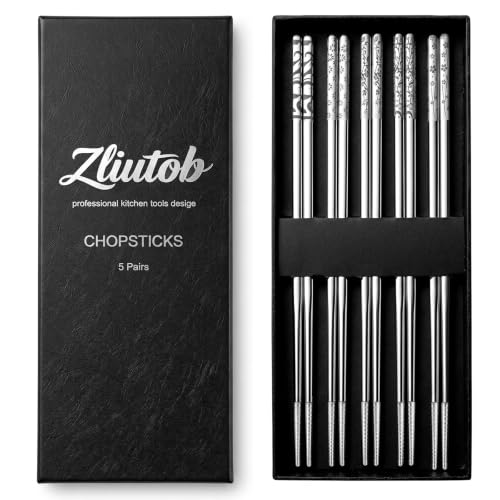
- MUYOS Stainless Steel Chopsticks, 5 Pairs — five hollow-core pairs — a light hand for delicate stove work; length not stated.
- Greatamzor Multicolor Square Chopsticks, 5 Pairs — five square multicolor pairs at 9 1/4 inches — documented, non-rolling at the stove.
- Greatamzor Titanium Plated Chopsticks, 2 Pairs — two titanium-plated pairs — a finishing and plating tool; length not stated.
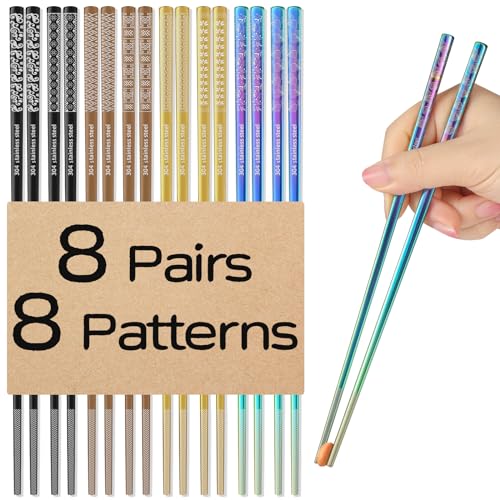
- NEWDRIP Multicolor Metal Chopsticks, 8 Pairs — eight multicolor pairs at 9.25 inches, listed for cooking and eating.
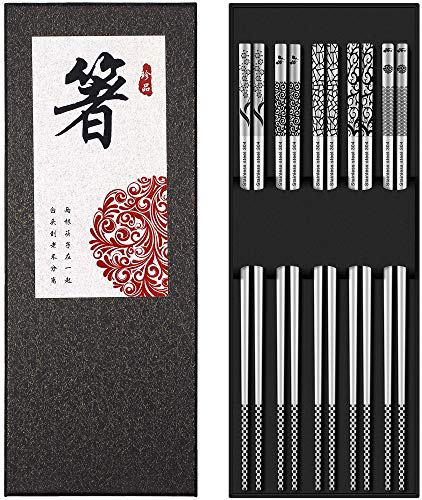
- Lazycorner 304 Stainless Steel Chopsticks, 10 Pairs — ten pairs of 304 steel — batch depth for a cooking household; length not stated.
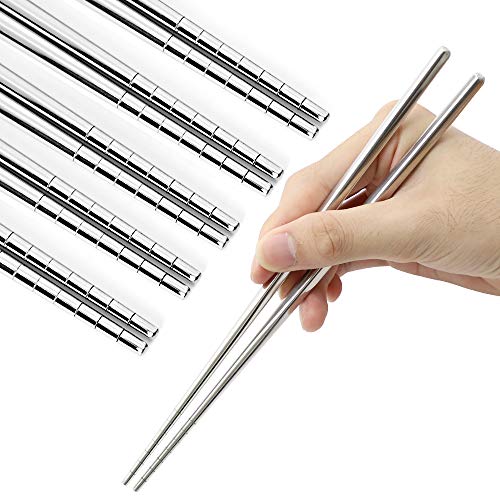
- IQCWOOD 304 Stainless Steel Chopsticks, 5 Pairs — five lightweight 304 pairs at 9.25 inches, fully documented.
Read the full guide ↓ before using any dining pair at a hot pan: the size rules change at the stove, and steel adds rules of its own.
The best size for cooking chopsticks is not one size, because “cooking” is not one task. Turning gyoza in a skillet, fishing a noodle from a tasting spoon’s worth of broth, separating chicken pieces in a wok, whisking eggs in a small bowl, reaching into a tall pot of frying oil — these jobs want different lengths, and the honest answer maps size to task instead of crowning a number. As a working map: dining lengths around nine to nine and a half inches serve the light, close tasks; genuinely long cooking pairs — well beyond anything in this pool — exist for deep pots, fryers and wok work at arm’s length from the heat. This guide will keep those two families separate and tell you exactly which side of the line every claim falls on.
That separation matters because the pool under review is a dining pool. Of the six verified sets, three document a length — 9 1/4 and 9.25 inches — and three state none. Two listings claim cooking among their uses; four position themselves for meals. None is a long cooking specialist, and this guide refuses to review them as if they were. What they are is the pair most home cooks actually grab when something needs turning, tasting or rescuing at the stove — and used within their length, with steel’s heat behavior respected, several of them are genuinely good at that job.
So read the reviews as capability assessments: for each set, what its documented length and construction permit at the stove, and where its honest limit sits. Then read the buying guide for the full task-by-task size map, including the point at which you should stop adapting a dining pair and buy the long tool. The broader Best Cooking Chopsticks guide covers the cooking category whole; this one is deliberately narrower — it is about inches, heat and reach.
Key Takeaways
- Cooking size is task-sized: light stove tasks suit dining lengths; deep frying and tall pots demand a genuinely long, dedicated pair.
- Documented lengths in this pool are 9 1/4 and 9.25 inches; three sets state no length and are flagged wherever they appear.
- Two sets are listed by their makers for cooking and eating; the rest are dining sets assessed honestly for light stove duty.
- Steel conducts heat: never leave a steel pair resting in a hot pan, whatever its length.
- A square, non-rolling profile is a safety feature at the stove, not a nicety — a rolling pair heads for the heat.
- If you deep-fry weekly, buy the long specialist pair; no dining set in this guide is that tool.
In this guide
Quick Picks
Badges state each set’s documented size status and its realistic stove role. “Size not stated” appears three times, at full size, on purpose.
| Set | Badge | Why it earns its place |
|---|---|---|
| MUYOS Stainless Steel Chopsticks, 5 Pairs | Best Light Stove Pair (Size Not Stated) | Light in the hand for eggs, tasting and delicate turning; size undocumented. |
| Greatamzor Multicolor Square Chopsticks, 5 Pairs | Best Documented — 9 1/4 Inches | Documented 9 1/4 inches, square and stay-put — the tidy stovetop citizen. |
| Greatamzor Titanium Plated Chopsticks, 2 Pairs | Best Plating Pair (Size Not Stated) | A plating and finishing pair; keep its finish away from pan abuse. |
| NEWDRIP Multicolor Metal Chopsticks, 8 Pairs | Best Documented — 9.25 Inches, Cooking Listed | Documented 9.25 inches and cooking-listed, eight pairs deep. |
| Lazycorner 304 Stainless Steel Chopsticks, 10 Pairs | Best Batch Pair (Size Not Stated) | Ten pairs: designate stove pairs and table pairs from one pack. |
| IQCWOOD 304 Stainless Steel Chopsticks, 5 Pairs | Best Documented — 9.25 Inches | Documented 9.25 inches, lightweight, fully specified — the safe light-duty pick. |
How These Picks Were Chosen
The pool was verified against the Amazon Creators API on 2026-11-20 — ASIN, title and image for all six sets. The cooking-size audit then recorded, for each listing: stated length, stated uses (cooking named or not), construction, and grip design. The audit’s result frames the entire guide: documented lengths exist for three sets only (the square Greatamzor at 9 1/4 inches, the NEWDRIP multicolor and the IQCWOOD at 9.25 inches); a cooking claim exists for two (the NEWDRIP multicolor and, in the wider pool’s pattern, sets listing “cooking and eating”); and no set — none — documents a long cooking length. Any guide that reviewed this pool as long cooking chopsticks would be fabricating, so this one does the more useful thing.
Capability judgments below follow a conservative rule: a set is credited with a stove task only if its documented length and construction make the task physically sensible — hand clear of the rim, pair long enough to work without submerging fingers, material able to take the contact. Steel’s heat conduction is treated as a constant across the pool, because it is one: it caps how long any of these pairs should touch a hot pan, whatever the marketing says. This is a research-led assessment from documented specifications, with no hands-on testing claimed, and the general size map in the buying guide is presented as established cooking practice, not as product data.
Readers who want the unrestricted cooking category — including the long wooden specialists this pool lacks — should treat this guide as the size chapter of the larger Best Cooking Chopsticks story. Within its chapter, the discipline is the same one our Best Square Chopsticks guide applies to shape: claims are credited only where documents support them.
Best Size for Cooking Chopsticks: The 6 Sets at the Stove, and What Their Sizes Permit
Each review states the documented length (or its absence), the tasks that length honestly covers, and the task where the set must stop. The stop line is the most important line in each review.
MUYOS Stainless Steel Chopsticks, 5 Pairs
Badge: Best Light Stove Pair (Size Not Stated)
Strengths
- The hollow core cuts the weight that makes solid steel pairs tiring for new chopstick users
- Non-slip tips concentrate grip help at the food end, where it matters most
- A plain silver finish matches any table setting and hides wear gracefully
Trade-offs
- The listing title states neither a length nor a steel grade, so two basic facts are unconfirmed from the title
- A hollow pair feels different — lighter and less planted — which some experienced users dislike
- The listing positions the set for daily meals, with no cooking claim
| Detail | From the listing |
|---|---|
| Material | Stainless steel (grade not stated in the listing title) |
| Pairs in set | 5 pairs |
| Length | Not stated in the listing title |
| Design | Hollow-core lightweight construction |
| Grip detail | Non-slip tips |
| Care | Dishwasher safe |
| Stated use | Reusable, for daily meals |
MUYOS answers the most common complaint about metal chopsticks — the weight — with a hollow core. A solid steel pair can feel like holding two pens made of lead by the end of a long meal, especially for anyone still building the grip. Hollowing the shaft keeps the durability and dishwasher safety of steel while bringing the hand feel closer to wood or bamboo. The non-slip tips handle the other metal complaint, slippage, at the business end. In plain silver with five pairs to a set, this is the pool’s quiet everyday option: nothing decorative, everything aimed at making steel feel less like a compromise.
At the stove, the hollow core is this set’s real feature: whisking eggs, turning delicate fish and tasting from a pan are wrist work, and a light pair tires the wrist last. Its undocumented length caps the assessment — assume dining scale, work accordingly, and keep it to close, cool-headed tasks: no reaching across a wide wok, no fryer duty it was never sized for. Within those lines it is a pleasure; the listing’s daily-meals positioning, notably, makes no cooking claim, and this guide credits it with light duty on construction grounds only, labeled as such.
Best for: cooks whose stove work is eggs, tasting and delicate turning / Not suited for: anyone needing a documented length for hot-oil work

Greatamzor Multicolor Square Chopsticks, 5 Pairs
Badge: Best Documented — 9 1/4 Inches
Strengths
- Different colors per pair end the whose-pair-is-this problem at shared meals
- The square body cannot roll off the table and gives fingers a positive, non-rotating hold
- The engraved copper coin pattern adds grip texture and a traditional decorative motif at once
Trade-offs
- The steel grade is not stated in the listing title, unlike this brand’s own 18/8 set
- Multicolor finishes are surface color — expect them to prefer gentler washing over the years
- A bold multicolor set will not suit every table aesthetic
| Detail | From the listing |
|---|---|
| Material | Stainless steel (grade not stated in the listing title) |
| Pairs in set | 5 pairs, multicolor |
| Length | 9 1/4 inches |
| Shape | Square, non-slip |
| Grip detail | Laser-engraved copper coin pattern |
| Care | Dishwasher safe |
This Greatamzor set solves a social problem the plain sets ignore: at a shared meal, identical steel pairs are anonymous. Multicolor pairs give every diner a color to claim. Under the color sits a genuinely functional shape — a square, non-slip body at nine and a quarter inches, engraved with a copper coin pattern that doubles as grip texture. Square chopsticks are an old solution, not a gimmick: flat faces sit still on the table, resist rotation between the fingers, and present a broader contact patch to slippery food than a round tip of the same weight.
The square body earns a stove-specific virtue no round pair can claim: set it down on a counter or pan rim and it stays — it does not roll toward the heat, the floor or the sauce. At a documented 9 1/4 inches with engraved grip, it covers the light-task map completely: turning, separating, plating from the pan. Color coding adds a kitchen system — one color is the stove pair, always — which solves the raw-versus-cooked cross-contact problem elegantly. Its stop line is the same as every set here: depth and distance. Tall pots and fryers are not its country.
Best for: cooks who want a stay-put square pair and a color system for raw versus cooked / Not suited for: deep-frying and tall-pot work, which need a longer tool

Greatamzor Titanium Plated Chopsticks, 2 Pairs
Badge: Best Plating Pair (Size Not Stated)
Strengths
- The titanium-plated black-and-silver finish is the most distinctive look in this pool
- Laser engraving provides grip that is part of the metal, not a print on top of it
- Two pairs in a gift format suits couples, hosts and presentation-first buyers
Trade-offs
- A plated finish is a surface layer — it rewards gentler handling than bare steel
- Two pairs will not stock a family drawer
- The listing title states no length, so sizing cannot be confirmed from the title alone
| Detail | From the listing |
|---|---|
| Material | Stainless steel, titanium plated |
| Pairs in set | 2 pairs |
| Length | Not stated in the listing title |
| Finish | Black and silver |
| Grip detail | Laser-engraved non-slip pattern |
| Care | Dishwasher safe |
| Stated style | Japanese / Korean; positioned as a premium gift set |
Greatamzor’s titanium plated set is the pool’s premium presentation piece: two pairs, black and silver, laser engraved, explicitly positioned as a premium Japanese-Korean style gift set. Plating changes the ownership bargain. Bare steel asks nothing of you; a plated finish gives you the look — deep black against silver — and in exchange prefers not to be rattled around a cutlery basket for a decade. For a pair that lives at a two-person table, gets washed, dried and put away, that bargain is easy to accept. The engraved non-slip pattern keeps the eating performance honest under the styling.
This is a finishing tool, and reviewing it as anything else would be unfair in both directions. Two plated pairs, undocumented length, premium positioning: its stove role is the last ten seconds of a dish — arranging, plating, placing the herb — where its looks serve the plate and its finish never meets pan abuse. Keep it out of the sauté pan not because it is fragile but because it is finished, in both senses. Cooks who plate carefully will find that a dedicated, beautiful pair improves the habit; cooks who need a workhorse should read on.
Best for: plating, finishing and presentation-focused cooks / Not suited for: daily pan work, which would spend its finish quickly

NEWDRIP Multicolor Metal Chopsticks, 8 Pairs
Badge: Best Documented — 9.25 Inches, Cooking Listed
Strengths
- Eight pairs is joint-largest count in the pool, and the multicolor finish lets each diner claim a color
- The listing covers cooking as well as eating, so the set can work at the stove and the table
- Engraved grip plus dishwasher-safe steel is the pool’s lowest-maintenance combination at this pair count
Trade-offs
- The steel grade is not stated in the listing title
- Multicolor plating prefers gentler handling than bare steel over the long term
- Eight pairs of anything is drawer space — small kitchens should count before ordering
| Detail | From the listing |
|---|---|
| Material | Stainless steel (grade not stated in the listing title) |
| Pairs in set | 8 pairs, multicolor |
| Length | 9.25 inches |
| Grip detail | Laser-engraved non-slip pattern |
| Care | Dishwasher safe |
| Stated style | Japanese / Korean / Chinese |
| Stated use | Cooking and eating |
NEWDRIP’s multicolor eight-pack is built for the way group meals actually go: many people, shared dishes, and a small chaos of identical utensils. Color coding ends the chaos. Eight pairs at 9.25 inches, laser engraved for grip, listed for cooking and eating across Japanese, Korean and Chinese tables — the set is a generalist workhorse with a party trick. The count matters beyond parties. With eight pairs, some can be in the dishwasher, some in the drawer and one at the stove, and nobody is washing a pair mid-meal because the clean ones ran out.
The strongest stove claim in this assignment, because it is the maker’s own: cooking and eating, at a documented 9.25 inches, across eight pairs. Eight pairs is a kitchen system — stove pairs and table pairs, raw pairs and cooked pairs, with the dishwasher absorbing the rotation. The documented length covers the light-task map with the pool’s best margin, and the engraved grip matters more over steam than anywhere. The stop line remains fryers and tall stockpots, where 9.25 inches puts the hand inside the heat zone; the guide’s size map below shows the length that work actually wants.
Best for: households wanting one documented set for stove and table, in depth / Not suited for: fryer and stockpot duty beyond a dining length’s reach

Lazycorner 304 Stainless Steel Chopsticks, 10 Pairs
Badge: Best Batch Pair (Size Not Stated)
Strengths
- Ten pairs is the largest count in the entire pool — a full household plus guests plus spares
- 304 is the food-grade steel designation buyers most commonly look for, and it is stated plainly
- A lightweight build keeps a big multipack from feeling like a box of hardware
Trade-offs
- The listing title states no length, so the size is unconfirmed from the title alone
- Ten plain silver pairs are fully anonymous at the table — no colors, no distinguishing marks
- The listing aims the set at daily meals and gifting rather than cooking
| Detail | From the listing |
|---|---|
| Material | 304 stainless steel, food grade |
| Pairs in set | 10 pairs |
| Length | Not stated in the listing title |
| Design | Lightweight, non-slip |
| Finish | Silver |
| Care | Dishwasher safe |
| Stated use | Reusable, for daily meals and gifting |
Lazycorner wins the arithmetic outright: ten pairs of 304 food-grade stainless steel, lightweight and non-slip, in plain silver. Ten pairs changes the ownership experience more than any finish can. Loss stops mattering. A pair can live at the office, a pair in a lunch bag, six at the table and two in the wash, and the drawer still is not empty. The lightweight design is the right call at this count — a multipack of heavy solid pairs feels industrial, while these are pitched as daily-meal tools. What you give up is identity: ten identical silver pairs belong to everyone and no one.
Ten pairs of 304 steel with no stated length is a batch proposition: in a household that cooks East Asian food constantly, depth itself is the feature — pairs live at the stove, at the table, in the wash, and nobody improvises. The lightweight build suits repetitive turning and tossing motions. The unstated length is the standing caveat, and at the stove it matters more than at the table: a too-short pair near hot oil is a safety question, not a comfort one. Verify the dimension on the full listing before assigning any pair from this pack to pan duty; table duty needs no such caution.
Best for: high-volume home kitchens that burn through pairs across stations / Not suited for: stove assignment before its unstated length is verified

IQCWOOD 304 Stainless Steel Chopsticks, 5 Pairs
Badge: Best Documented — 9.25 Inches
Strengths
- 304 steel, a stated 9.25-inch length and a lightweight build — the key facts are all on the label
- Non-slip tips address steel’s slipperiness exactly where food is held
- Five silver pairs in Korean-Japanese style is a clean, traditional table look
Trade-offs
- Five pairs is a household set, not a party set — guests beyond four need a second pack
- Plain silver pairs are identical, so there is no color coding for shared meals
- The brand name suggests wood, but the product is metal — read the title, not the logo
| Detail | From the listing |
|---|---|
| Material | 304 stainless steel |
| Pairs in set | 5 pairs |
| Length | 9.25 inches |
| Design | Lightweight, non-slip tips |
| Finish | Silver |
| Care | Dishwasher safe |
| Stated style | Korean / Japanese style |
| Stated use | Daily meals |
IQCWOOD — despite a name that sounds like a lumber yard — makes a tidy metal set: five pairs of 304 stainless steel at 9.25 inches, lightweight, with non-slip tips, in Korean-Japanese style. It is one of the pool’s more completely specified listings: material grade, length, pair count and care are all stated, which makes comparison shopping honest work instead of guesswork. The lightweight build plus grippy tips is the beginner-friendly combination, reducing both the hand fatigue and the dropped-noodle frustration that turn people off steel chopsticks in the first week.
The documented all-rounder for light cooking: 9.25 inches stated, 304 stated, lightweight, non-slip tips — every fact a stove assessment needs, present. It will whisk, turn, taste, separate and plate with the best control-per-risk in the pool’s documented tier, and its light weight suits the repetitive small motions of stovetop work. It is not listed for cooking by its maker — daily meals are its stated beat — so this guide credits it with light duty on documented dimensions, and draws its stop line at the same heat-and-depth boundary as the rest: a dining length is a dining length, however well documented.
Best for: light-duty cooks who want every specification documented first / Not suited for: buyers who need the maker itself to claim cooking use
Comparison Table
Size and stove role, side by side — with the pool’s universal stop line printed in every row’s subtext: none of these is a long frying pair.
| Set | Defining traits from the listing |
|---|---|
| MUYOS Stainless Steel Chopsticks, 5 Pairs | Length NOT STATED · Hollow-core lightweight · 5 pairs · Light duty: eggs, tasting, turning |
| Greatamzor Multicolor Square Chopsticks, 5 Pairs | 9 1/4 inches · Square, multicolor · 5 pairs · Light duty + stay-put safety |
| Greatamzor Titanium Plated Chopsticks, 2 Pairs | Length NOT STATED · Titanium plated · 2 pairs · Finishing and plating only |
| NEWDRIP Multicolor Metal Chopsticks, 8 Pairs | 9.25 inches · Multicolor · 8 pairs · Cooking listed by maker · Light-to-moderate duty |
| Lazycorner 304 Stainless Steel Chopsticks, 10 Pairs | Length NOT STATED · 304 steel · 10 pairs · Batch depth; verify length before pan duty |
| IQCWOOD 304 Stainless Steel Chopsticks, 5 Pairs | 9.25 inches · 304 steel · 5 pairs · Light duty, fully documented |
How to Choose a Cooking Chopstick Size: The Task Map
Lay your cooking out as tasks, and the sizes assign themselves. Tier one — whisking eggs, tasting, turning small items in a skillet, separating pieces as they sauté, plating: these are close, quick, low-heat-distance jobs, and a dining length around nine to nine and a half inches does them well, which is why the documented sets in this pool are legitimately useful at the stove. Tier two — wok tossing over real heat, turning items in a deep sauté pan, working a crowded grill pan: the hand wants more distance, and this is where cooks start wanting a noticeably longer pair than dining standard. Tier three — deep frying, tall stockpots, hot pot service from a bubbling center: these are the long specialist’s home ground, full stop. No dining pair belongs there, and the most dangerous sentence in this category is “it’s probably fine.”
Heat rewrites the material rules at the stove. Wood and bamboo are insulators — a wooden pair can rest in a hot pan’s vicinity with little drama. Steel is a conductor: a pair left across a hot pan becomes a hot pair, tips first and handles soon after. Every set in this pool is steel, so the pool’s universal technique rule applies: work, then park the pair on a rest or a cool surface — never across the pan, never in the oil, never “for a second.” A square profile, as in the Greatamzor set, makes parking safer because the pair stays where it is parked; our Best Square Chopsticks guide explains the geometry, and at a stove it stops being about tidiness and starts being about burns.
Length interacts with control at the stove differently than at the table. At the table, longer means clumsier tips. At the stove, the tip work is grosser — turning, lifting, separating — and the premium shifts to distance and stability. This is why cooks who own both lengths describe them as different tools rather than better and worse ones, and why the correct drawer, for a serious wok-or-fryer household, contains both: dining pairs for the table and light work, a long pair for the heat. The incorrect drawer forces one pair to be mediocre at everything.
Count is a cooking variable too. Raw and cooked food should never share a pair mid-service — the pair that placed raw chicken in the pan does not plate the finished dish. Multipack depth, the NEWDRIP eight and Lazycorner ten in this pool, is therefore a food-safety feature at the stove: pairs can be color-assigned or station-assigned, used once, and sent to the wash without breaking the cook’s rhythm. A two-pair household cooking raw proteins with chopsticks is a household one distraction away from a cross-contact mistake.
And the unstated-length problem, one final time, in its sharpest form: at the table, an unknown length is a comfort gamble; at the stove, it is a safety unknown. If a set’s length cannot be confirmed from its full listing, assign it to the table and keep it there. The documented sets in this pool — 9 1/4 and 9.25 inches — are the ones a cautious cook builds stove habits around.
A note on pairs versus singles at the stove: many cooks work with a pair in one hand and a second tool — a spatula, a spoon, a lid — in the other, and the chopstick pair’s job narrows to gripping and turning only. In that division of labor, a dining length’s control is an asset and its reach matters less, because the spatula owns the distance work. Cooks who work chopsticks-only, in the traditional wok manner, ask far more of length. Know which cook you are before letting any guide — this one included — tell you a size: the two-tool cook is well served by every documented set in this pool, and the one-tool traditionalist is the reader who most needs the long specialist as well.
How to Cook With Standard-Length Steel Chopsticks, Safely
Technique at the stove is dining technique with three amendments. First, grip slightly higher than at the table — toward the top third — buying every fraction of distance the pair has to give. Second, work in short contacts: turn, lift, separate, withdraw. Steel rewards decisiveness and punishes lingering, because lingering is heat transfer. Third, park deliberately: a rest, a cool plate, a spoon holder — a named place the pair returns to between contacts, every time, so habit rather than attention keeps it out of the pan.
Match the motion to the tier map. In a skillet, use the pair as tongs with manners — gripping pieces fully rather than spearing them. In a wok at dining length, work the near edge and the shallow contents, and accept that deep tossing belongs to the long pair or the spatula. For tasting, lift a small piece clear of the pan and let it shed heat for a breath before it meets your mouth; steel delivers food at pan temperature more faithfully than wood does, which is a compliment to its conductivity and a warning to your tongue.
Steam deserves its own warning, because it is the stove hazard dining eaters underestimate. A hand at dining length over a freshly opened pot or a bamboo steamer works inside the steam column for the first seconds — exactly when the cook is most likely to be reaching in to test or retrieve. Let the first rush of steam clear, approach from the side rather than directly above, and use the pair to slide food toward the edge before lifting it out. Length buys distance from steam just as it does from oil, and at dining length the margin is technique, not inches.
- Assign pairs before heat: one color or pair for raw, another for cooked — never shared mid-service.
- Grip in the top third for maximum distance, and rehearse the parking spot before the pan is hot.
- Make short, decisive contacts; withdraw the pair fully between tasks.
- Park on a rest or cool plate — never across the pan, never in oil, never on a hot rim.
- Keep a long specialist pair (or a spatula) within reach for deep or tall work; switch tools instead of stretching.
- Wash stove pairs promptly; baked-on oil on steel yields to a normal cycle, but only if it is not given a week to cure.
Problem: the handle end is getting hot → what to do: your contacts are too long or the pair is resting on the pan between them; shorten contacts and enforce the parking rule, and if the dish demands continuous contact, that dish wants a longer or wooden tool. Problem: pieces keep slipping in the pan → what to do: dry the food’s surface where the recipe allows, grip pieces fully rather than by an edge, and prefer the engraved or textured-tip pairs for pan work. Problem: you keep reaching for the same pair for raw and cooked → what to do: that is a system failure, not a memory failure — color-assign with a multicolor set or stage two pairs on two rests before the heat goes on.
One boundary deserves repetition as a rule rather than advice: dining-length steel pairs and deep fryers do not meet. The oil depth, the steam and the reach all argue the same way. Households that fry need the long pair; this guide’s pool is for everything short of that line, and it serves that territory well.
Finally, label the system, not just the pairs. A small rest that lives only at the stove, a crock that holds only stove pairs, a color that means raw — these environmental cues carry the discipline on the nights when attention is spent. Cooks do not rise to their intentions at the stove; they fall to the level of their setup. Build the setup once, at the sizes this guide maps, and the safe behavior becomes the path of least resistance rather than an act of memory.
The Long Pair: What the Specialist Tool Actually Is
Dedicated cooking chopsticks — the kind hanging in restaurant kitchens — run far beyond dining length, sized so the cook’s hand works outside the heat column of a fryer or wok entirely. They are usually wood or bamboo, because insulation matters more than elegance at that station, and they are used with a loose, confident grip that dining technique only hints at. Nothing in this pool competes with them, and this guide has said so from its first paragraph — because the shopper searching this keyword deserves the map whole: dining lengths for the light tiers, the long specialist for the deep ones, and no honest product pretending to be both.
If your cooking is tier-three even monthly — a Friday fry-up, a hot pot tradition — the long pair is not an extravagance; it is the correct tool, and it is inexpensive in the way simple wooden tools are. Buy it alongside, not instead of, a documented dining set like the ones reviewed here: the Best Cooking Chopsticks guide covers that combined drawer in full.
Steel at the Stove: Coatings, Pans and Common Sense
One more stove-specific caution belongs in any steel guide: pan surfaces. Steel tips are harder than nonstick coatings, and a cook who scrapes a coated pan with steel pairs will spend the coating. Use steel pairs to grip, lift and turn — motions that contact food — and keep a silicone or wooden tool for motions that contact the pan. On stainless, cast iron and carbon steel pans, the pairing is harmless in both directions. The engraved and textured tips in this pool are designed for food grip; nothing in any listing invites pan scraping, and technique should honor that design intent.
The same realism applies to finishes. A plated pair used daily in a sauté pan will show its life at the tips first; that is why this guide assigns the plated set to finishing work. Finishes are not fragile — they are simply surfaces, and the stove is the most abrasive station in the kitchen. Match the pair to the station and every set here will look deliberate for years.
Common Buying Mistakes
Stove mistakes with chopsticks are rarely about skill. They are about size, heat and systems — all decided before the pan is hot.
- Using a dining pair in a deep fryer. Nine inches over deep oil puts the hand in the heat. This is the category’s one true safety line — do not cross it.
- Leaving steel pairs resting in or across a hot pan. Steel conducts; the handle you grab next is the pan’s temperature. Park on a rest, every time.
- Sharing one pair between raw and cooked food. Assign pairs or colors by stage before cooking starts; memory is not a food-safety system.
- Assigning an unstated-length set to pan duty. At the stove, an unknown length is a safety unknown. Verify it, or keep the set at the table.
- Scraping nonstick pans with steel tips. Grip the food, not the pan — coatings lose that argument every time.
- Forcing one pair to cover every tier. Dining pair, long pair, spatula: the three-tool drawer is cheaper than the burn or the ruined dish.
Final Recommendation
For light stove work from a documented size, the first choice is NEWDRIP Multicolor Metal Chopsticks, 8 Pairs: the maker lists it for cooking, the 9.25-inch length is on the record, and eight color-coded pairs let you run a raw-versus-cooked system without thinking. The documented alternatives split by style: Greatamzor Multicolor Square Chopsticks, 5 Pairs if you want the square pair that parks safely and stays put, and IQCWOOD 304 Stainless Steel Chopsticks, 5 Pairs if you want the lightweight, fully specified all-rounder.
And the guide’s closing honesty, one last time: if your cooking lives in fryers, stockpots and wok flames, buy the long specialist pair this pool does not contain, and let these sets do the light work they are genuinely good at. Size is a safety specification at the stove. Treat it like one, and standard-length steel pairs become what they should be — precise, tireless helpers everywhere short of the deep end.
Frequently Asked Questions
What size should cooking chopsticks be?
It depends on the tier of work. Light tasks — turning in a skillet, whisking eggs, tasting, plating — are well served by dining lengths around 9 to 9.5 inches, which is where this pool’s documented sets sit. Deep frying, tall pots and serious wok work want a dedicated long pair, far beyond dining length, so the hand stays out of the heat. Any single-number answer is hiding this map.
Can I cook with regular 9.25-inch chopsticks?
Yes, within the light tier: skillets, shallow pans, eggs, tasting and plating are all fair work for a documented 9.25-inch steel pair, and one set in this pool is listed by its maker for cooking and eating. Respect two limits — short contacts because steel conducts heat, and no deep or tall vessels, where the length puts your hand in the danger zone.
Why are long cooking chopsticks usually wood, not steel?
Insulation. Wood barely conducts heat, so a long wooden pair can work over a fryer without heating the hand; steel conducts readily, which is why steel cooking pairs are rare at specialist lengths and why the steel sets in this pool demand a park-don’t-rest technique. Material and length are one decision at the stove, not two.
Is it safe to use steel chopsticks in a nonstick pan?
For gripping, lifting and turning food, yes, with ordinary care. For scraping or stirring against the coating, no — steel is harder than the coating and will spend it. Keep a silicone or wooden tool for pan-contact motions and steel pairs for food-contact motions, and both the pan and the pairs will last.
How do I avoid cross-contamination when cooking with chopsticks?
Assign pairs by stage before the heat goes on: one pair (or one color, in the multicolor sets) touches raw food only, another handles cooked food and plating. Multipack depth makes the system effortless — which is why the eight and ten-pair sets in this pool are quietly among its most practical cooking tools.
A set here does not state its length. Can I use it at the stove?
Assign it to the table until the length is confirmed from the full listing. At the table an unknown length is a comfort gamble; at the stove, near hot oil and steam, it is a safety unknown. The documented sets in this guide exist precisely so that stove habits can be built on known dimensions.