Disclosure: topratedkitchenware.com is reader-supported. When you buy through links on our site, we may earn an affiliate commission from Amazon and other retailers, at no extra cost to you.
Where to buy
The six sets below are the verified picks for this guide to the best size gauge for small measuring spoons — that is, to how well a spoon set covers, marks, and lets you read the small end of the measuring range. Each name links to its Amazon listing, where you can check the latest price on Amazon, confirm the exact size list, and read the newest owner feedback before you decide. On this page, the size list is the product: read each review’s spec box first.
- THLHKD 6Pcs Measuring Spoons Set, Stainless Steel
- Spring Chef Nesting Stainless Steel Measuring Spoons Set of 7 with Leveler
- Spring Chef Stainless Steel Measuring Cups and Spoons Set of 14 with Leveler
- Hudson Essentials Stainless Steel Measuring Spoons Set of 7
- U-Taste 18/8 Stainless Steel Measuring Spoons Set of 9
- THLHKD 13PCS Stainless Steel Measuring Cups and Spoons Set with Funnel
Read the full guide ↓ for what size gauge means in practice, which sets actually reach the smallest measures, and how to read a size list before you buy.
The phrase best size gauge for small measuring spoons describes a real and underserved problem, even if it phrases it unusually. Small measuring spoons live or die by their gauge — the set of sizes they cover and the clarity with which each size is marked — because at the small end of the range, everything is harder. The bowls are tiny, the markings are tinier, the difference between one size and the next is a few grains of spice, and the cost of choosing the wrong spoon is proportionally huge: mistaking a quarter teaspoon for an eighth doubles an ingredient that was chosen for its potency. A cook who measures strong spices, leavening for small bakes, concentrated flavourings, coffee additions, or supplement powders discovers quickly that the small end is not a miniature version of the large end. It is its own discipline, and it needs its own buying guide.
This guide treats size gauge as three questions. First, coverage: how far down does the set go, and which intermediate sizes does it include on the way? Second, legibility: are the sizes marked clearly enough to identify at a glance, mid-recipe, in ordinary light? Third, control: does the set give you a way — a leveler, a jar-fitting shape, a steady bowl — to make that tiny measure repeatable rather than approximate? The six verified stainless steel sets below answer those questions differently. One set in this guide lists nine sizes down to a sixteenth of a teaspoon. Another makes clear markings its headline feature. Two include levelers. The ranking weighs all three questions, because a set that covers a size you cannot identify, or identify but cannot level, has not really covered it.
A note on honesty before the picks: a spoon’s gauge is only what its listing confirms. Where a set enumerates its sizes, this guide prints them. Where a listing confirms a format and count without enumerating sizes, the review says so and sends you to the size chart rather than guessing — because guessing about sizes is precisely the failure this entire page exists to prevent. Readers arriving from the misspelled twin of this search will find the same sets examined from the typo’s angle in our companion guide to the Best Size Gouge For Small Measuring Spoons, and the two pages agree on the facts while differing in emphasis.
Key Takeaways
- Size gauge means three things together: how far down the set reaches, which intermediate sizes it includes, and how clearly each size is marked.
- The widest confirmed small range here runs from 1/16 tsp to 1 tbsp across nine spoons, including 1/3 tsp and 3/4 tsp intermediates.
- Clear markings are an accuracy feature: a small spoon you misread is a wrong measure, whatever its bowl volume.
- A leveler matters most at small sizes, where the difference between heaped and levelled is proportionally largest.
- Where a listing does not enumerate sizes, check its size chart before ordering — never assume the small end is covered.
- Check the latest price on Amazon for each pick before deciding.
In this guide
Quick Picks
- Best for Clear Markings — THLHKD 6Pcs Measuring Spoons Set: six spoons from 1/8 tsp to 1 tbsp with clear size markings stated in the listing. Check on Amazon
- Best with Leveler for Small Measures — Spring Chef Nesting Set of 7 with Leveler: rectangular spoons that fit in spice jars, plus a leveler for repeatable small measures. Check on Amazon
- Best Complete Gauge Bundle — Spring Chef Cups and Spoons Set of 14 with Leveler: fourteen pieces extending the leveler-equipped spoon design across a full cups-and-spoons bundle. Check on Amazon
- Best Classic Small Set — Hudson Essentials Set of 7: seven jar-fitting spoons in a classic format for dry or liquid ingredients. Check on Amazon
- Best Small-Size Range — U-Taste Set of 9: nine confirmed sizes from 1/16 tsp to 1 tbsp, the deepest small end in this guide. Check on Amazon
- Best Stackable Kit — THLHKD 13PCS Set with Funnel: thirteen stackable pieces, cups and spoons, stated as dishwasher safe. Check on Amazon
How These Picks Were Chosen
This is a research-led guide. Candidate sets were taken from verified listings in the measuring spoons category, then scored on the three gauge questions: confirmed size coverage with emphasis on the small end, stated marking clarity, and control features such as a leveler or a jar-fitting bowl. Sets whose listings enumerate their sizes were credited with exactly those sizes and no others. Sets whose listings confirm piece count and format without a size list were included for their other verified strengths but flagged, in their reviews and spec boxes, as requiring a size-chart check — a flag that matters more on this page than on any other, because the entire purchase is a size purchase.
No set was credited with a metric conversion, a material grade, or an accessory its verified information does not state, and no accuracy certification is claimed for any set. The ranking reflects a judgement about the small-measure job as a whole: the U-Taste set’s range is the deepest, the THLHKD six-piece set’s markings are the most explicitly addressed, and the Spring Chef sets bring levelling control that the others do not state. Which of those virtues should lead your own ranking depends on your failure mode — misreading, heaping, or simply not owning the size — and the reviews are written to let you re-rank honestly for yourself. The strictest version of this discipline, where tiny quantities are the entire task, is examined in our notes on the Best Measuring Spoons For Nootropics, and its lessons about repetition apply here unchanged.
The 6 Best Sets for Small-Measure Gauge in Detail

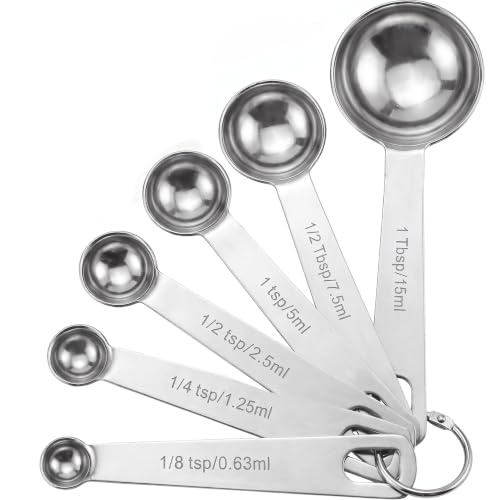
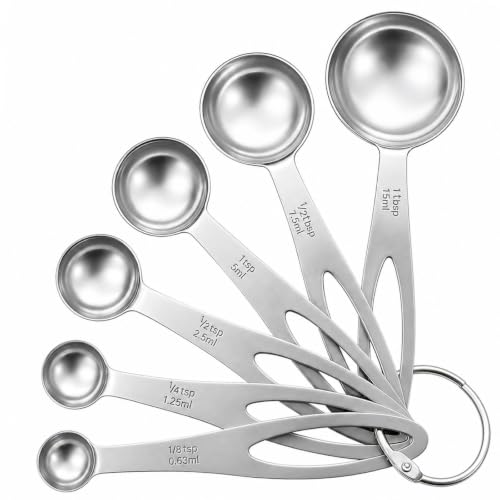
THLHKD 6Pcs Measuring Spoons Set, Stainless Steel
Badge: Best for Clear Markings
Strengths
- Clear size markings are an explicit, stated feature of the listing — rare honesty about the legibility problem.
- Confirmed span from 1/8 tsp to 1 tbsp across six spoons.
- Listed for coffee, spices, and protein powder: the daily small-measure workload.
Trade-offs
- Stops at 1/8 tsp; the one set here that goes smaller is the U-Taste nine-piece.
- No intermediate 1/3 tsp or 3/4 tsp sizes are listed.
- No leveler is stated in the verified information.
Mini spec box
- Material: stainless steel
- Pieces: 6 spoons
- Sizes: 1/8 tsp to 1 tbsp
- Markings: clear size markings, per listing
- Use: dry and liquid ingredients
Most small-measure errors are reading errors before they are measuring errors. The cook reaches into the set, squints at two near-identical tiny bowls, picks the one that looks right, and seasons with the wrong spoon confidently. A set that makes clear markings a headline feature attacks that moment directly, and its confirmed span supports the attack: an eighth of a teaspoon is small enough for strong spices and quartered recipes, and the run up to a tablespoon covers the standard ceiling without gaps at the core sizes. For the cook whose complaint is specifically “I can never tell these little spoons apart,” this is the most targeted answer in the guide.
The limitation is depth. Six spoons cannot include the intermediates, and the range stops one step above the deepest set here. If your small measuring regularly goes below an eighth — concentrated powders, miniature bakes, precise supplement routines — read the U-Taste review before deciding. If your range is the standard small range and your enemy is legibility, this set was designed for you.
Best for: cooks whose small-measure errors are reading errors / Not suited for: users who need sizes below 1/8 tsp or intermediate sizes
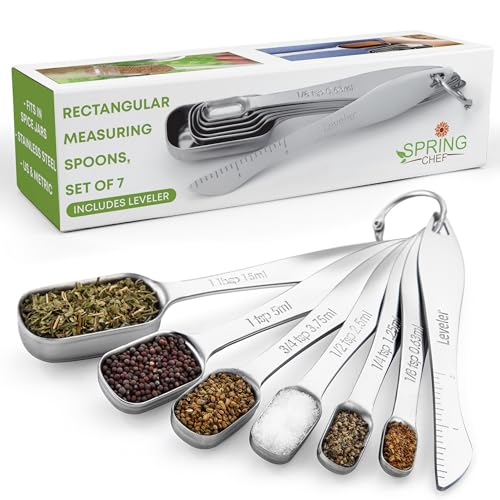
Spring Chef Nesting Stainless Steel Measuring Spoons Set of 7 with Leveler
Badge: Best with Leveler for Small Measures
Strengths
- The included leveler makes small dry measures repeatable, which is where repeatability is hardest.
- Rectangular bowls and long handles stated to fit in spice jars, so small measures are scooped, not poured.
- Nesting storage keeps the small spoons together and findable.
Trade-offs
- The verified listing does not enumerate each spoon size; confirm the smallest size on the listing’s size chart.
- Rectangular bowls take a few uses to feel natural.
- Spoons only: no cups are included.
Mini spec box
- Material: stainless steel
- Pieces: 7 spoons, plus leveler
- Design: rectangular bowls, long handles, nesting
- Use: dry and liquid ingredients
Control is this set’s contribution to the gauge question. A small spoon filled heaped and the same spoon filled levelled are, functionally, two different gauges, and the leveler collapses them into one: scoop from the jar — which the rectangular, long-handled design makes physically possible — draw the leveler across, and the measure is the measure, today and next month. For spice work, where the ingredient is potent and the spoon is small, that repeatability is the difference between a signature dish and a variable one. The nesting format adds the organisational half of gauge discipline: the small sizes stay in the set, in order, instead of migrating to the back of a drawer.
The limitation is documentation of the exact size list, which the verified information does not enumerate. A buyer whose requirement is a specific smallest size should confirm it on the product page. A buyer whose requirement is repeatable small measures from spice jars will find this set’s design answering the question they actually asked.
Best for: spice cooks who need small measures to repeat exactly / Not suited for: buyers who need a confirmed below-1/8 tsp size before ordering

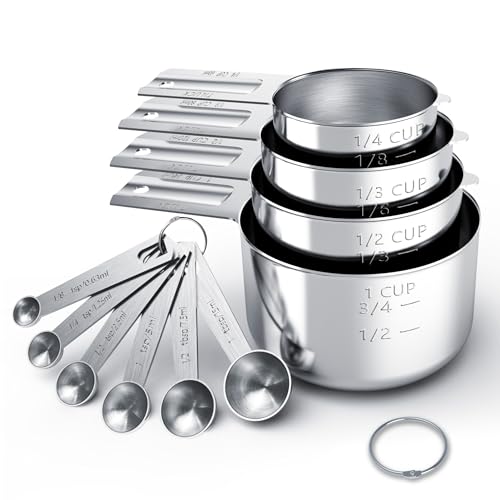
Spring Chef Stainless Steel Measuring Cups and Spoons Set of 14 with Leveler
Badge: Best Complete Gauge Bundle
Strengths
- Extends the leveler-equipped, rectangular spoon design across a fourteen-piece cups-and-spoons bundle.
- Nesting cups keep the large bundle storable as one unit.
- One technique — scoop, level, pour — governs every measure in the set.
Trade-offs
- The verified listing does not enumerate the individual spoon sizes; check the size chart.
- The largest storage commitment in this guide.
- More pieces than a small-measure specialist strictly needs.
Mini spec box
- Material: stainless steel
- Pieces: 14, cups and spoons, with leveler
- Design: nesting cups, rectangular spoons
- Use: dry and liquid ingredients
Some kitchens want the gauge question answered once, for every measure from a cup of flour to a quarter teaspoon of spice, with a single technique. This bundle is that answer: the same rectangular spoons and leveler discipline, backed by a nesting cup family, so the levelling habit learned at the small end applies at the large end too. Consistency of technique across a whole set is an underrated form of accuracy, because it removes the mental switching that causes errors when a cook moves between unrelated tools mid-recipe.
The limitations mirror its smaller sibling’s: the exact spoon sizes are not enumerated in the verified information, so confirm them on the listing, and the bundle asks for real drawer space. For a baker equipping a kitchen completely, both are acceptable costs. For a buyer whose only problem is small spoons, the seven-piece set above is the focused purchase.
Best for: bakers who want one levelled technique across all measures / Not suited for: small kitchens or small-measure-only buyers

Hudson Essentials Stainless Steel Measuring Spoons Set of 7
Badge: Best Classic Small Set
Strengths
- Seven spoons in a classic format, shaped to fit in spice jars per the listing.
- Covers dry and liquid small measuring in stainless steel.
- No accessories to lose: the gauge is the spoons themselves.
Trade-offs
- The verified listing does not enumerate the individual sizes or claim a smallest specialty size.
- No leveler is stated.
- The classic range is aimed at everyday measures rather than the precision zone.
Mini spec box
- Material: stainless steel
- Pieces: 7 spoons
- Design: fits in spice jars, per listing
- Use: dry or liquid ingredients
The classic set represents the baseline gauge most home cooking grew up with: the standard run of spoons, jar-friendly shaping, steel construction, and nothing else. For cooks whose small measuring is the everyday kind — salt, spices for a family meal, baking powder for a standard bake — that baseline is genuinely sufficient, and its simplicity is a form of reliability: there is no system to learn and no accessory whose loss degrades the set. Its place in this guide is to mark the line between everyday small measuring and precision small measuring, so buyers can locate their own cooking honestly on one side or the other.
The limitation, on this page’s terms, is that the precision zone is not its territory, and its exact sizes are not enumerated in the verified information. If your cooking lives in the everyday zone, that is no limitation at all. If it reaches below the quarter teaspoon with intent, the sets ranked around it answer better.
Best for: everyday cooks who want a classic, jar-fitting spoon set / Not suited for: precision users who need confirmed specialty small sizes
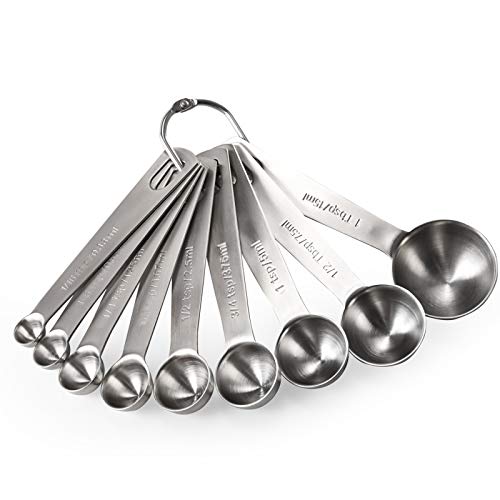
U-Taste 18/8 Stainless Steel Measuring Spoons Set of 9
Badge: Best Small-Size Range
Strengths
- The deepest confirmed gauge here: 1/16 tsp, 1/8 tsp, 1/4 tsp, 1/3 tsp, 1/2 tsp, 3/4 tsp, 1 tsp, 1/2 tbsp, and 1 tbsp.
- Intermediate sizes make scaling down clean instead of approximate.
- 18/8 stainless steel, as stated in the listing.
Trade-offs
- No leveler is stated in the verified information.
- The smallest spoons demand slow, deliberate technique to realise their accuracy.
- Spoons only: no cups are included.
Mini spec box
- Material: 18/8 stainless steel
- Pieces: 9 spoons
- Sizes: 1/16 tsp to 1 tbsp, as listed above
- Use: dry and liquid ingredients
On pure gauge — the question this page is named for — this set is the strongest answer in the guide, and its spec box is the reason. Nine enumerated sizes, reaching a sixteenth of a teaspoon, with the two intermediates that scaling cooks pray for, means there is almost no small quantity in home cooking that this set asks you to estimate. Quartered recipes, potent spices, concentrated flavourings, and powder routines all land on a real spoon. The 18/8 steel designation supports the range with a material that will hold those tiny bowls true through years of washing. Readers who measure sticky small quantities will also recognise the release problem this range meets in our guide to the Best Measuring Spoons For Peanut Butter, where bowl behaviour at small sizes is the whole story.
The honest limitation is that range is not control: no leveler is stated, so the repeatability of these small measures rests on your levelling technique with a straight edge, and the smallest bowls punish haste. A meticulous cook gets the most accurate small measuring in this guide from this set. A hurried cook may get more real-world repeatability from a leveler-equipped set with a shorter range. Know which cook you are.
Best for: precision users who need the deepest confirmed small range / Not suited for: cooks who want a leveler to enforce repeatability

THLHKD 13PCS Stainless Steel Measuring Cups and Spoons Set with Funnel
Badge: Best Stackable Kit
Strengths
- Thirteen stackable pieces covering cups and spoons in one tower.
- The included funnel serves the small-quantity world directly: decanting spices and powders into small containers without loss.
- Stated as dishwasher safe in the verified listing.
Trade-offs
- The verified listing does not enumerate the spoon sizes; the small end must be confirmed on the size chart.
- The largest footprint in this guide.
- No leveler is stated.
Mini spec box
- Material: stainless steel
- Pieces: 13, cups and spoons with funnel
- Storage: stackable
- Care: dishwasher safe, per listing
- Use: dry and liquid ingredients
This kit approaches small measuring from the supply side. The funnel is its tell: kitchens that measure small quantities constantly also decant constantly — bulk spices into working jars, powders into daily containers — and every decant done without a funnel loses some of the ingredient and all of the tidiness. Paired with a stackable cups-and-spoons tower, the kit suits a pantry-driven cook who buys in bulk and measures in grams-and-spoons at the counter. Its gauge documentation, however, is the weakest fit for this page’s question: sizes are not enumerated in the verified information, so a precision buyer must do the size-chart check before treating it as a small-measure answer.
Best for: bulk-buying cooks who decant and measure in one pantry routine / Not suited for: precision buyers who need enumerated small sizes up front
Comparison Table
| Pick | Badge | Confirmed small end | Leveler | Pieces | Link |
|---|---|---|---|---|---|
| THLHKD 6Pcs | Best for Clear Markings | 1/8 tsp, sizes enumerated | Not stated | 6 spoons | Check on Amazon |
| Spring Chef Set of 7 | Best with Leveler | Check size chart | Yes | 7 spoons | Check on Amazon |
| Spring Chef Set of 14 | Best Complete Gauge Bundle | Check size chart | Yes | 14, cups and spoons | Check on Amazon |
| Hudson Essentials Set of 7 | Best Classic Small Set | Check size chart | Not stated | 7 spoons | Check on Amazon |
| U-Taste Set of 9 | Best Small-Size Range | 1/16 tsp, sizes enumerated | Not stated | 9 spoons | Check on Amazon |
| THLHKD 13PCS | Best Stackable Kit | Check size chart | Not stated | 13, cups and spoons | Check on Amazon |
How to Choose a Spoon Set by Its Size Gauge
Begin by writing down the smallest quantity you measure on purpose. Not the smallest you can imagine — the smallest your real cooking, baking, or powder routine actually uses in a month. If that quantity is a quarter teaspoon, most sets here serve you and legibility should lead your choice. If it is an eighth, your shortlist narrows to sets that confirm it. If it is smaller, or if you halve and quarter recipes often enough that intermediates matter weekly, the enumerated nine-size range in this guide is effectively your answer, and the remaining decision is whether to add levelling discipline through technique or through a second, leveler-equipped set.
Next, audit legibility as a physical act. You will read these markings standing up, in kitchen light, often with one hand occupied. Markings that are a stated feature of the set, in the THLHKD six-piece’s case, deserve real weight, because the maker has at least aimed at the problem. Where markings are not described, assume they are ordinary and decide whether ordinary is enough for your eyes and your light. Then audit control: if your small measures have been inconsistent, the missing ingredient is usually levelling, and a leveler-equipped set will improve your results more than an extra size will. Coverage, legibility, control — in that order, matched to your own failure history — is the whole method of this page, and it generalises to any set you meet elsewhere, including the ones ranked for all-round use in our guide to the Best Measuring Spoons Ever.
How to Measure Tiny Quantities Accurately
Technique scales down with the spoon, and the smaller the measure, the more the technique is the measure. Work over the container, so what falls returns. Scoop, then level in one straight pass — a leveler where the set provides one, a straight edge where it does not — and resist tapping the spoon to settle it, which packs fine powders and silently enlarges the dose. For the smallest spoons, fill and level twice into a small dish rather than directly into a pot when the ingredient is potent: the dish lets you see the quantity whole, judge it, and correct it before it disappears into the food. Measure potent ingredients first, before hands are wet or floury, and in a fixed order every time, because routine is what turns a fiddly procedure into a reliable one.
Care for small spoons is mostly about not losing the gauge you bought. The smallest pieces vanish into canisters, coffee tins, and the folds of a drying rack more than any other kitchen tool. Wash them in the main bowl rather than under a running tap, dry them as part of the set, and return them to the set’s one home during the drying wipe, counting as you go. Troubleshooting, in the pattern small-measure users actually meet it. Problem: a dish’s seasoning varies despite the same recipe → compare heaped against levelled measures of your strongest spice for one week; the variation almost always lives there. Problem: you cannot tell two small spoons apart → wash off the oil film that dulls markings, work in better light, and if the problem persists, it is a markings problem, and a clear-markings set is the fix. Problem: a needed small size is missing from your set → you have a coverage problem, not a technique problem; no technique manufactures a sixteenth-teaspoon measure from a quarter-teaspoon spoon, so extend the range rather than refining the guess.
What the Fractions Mean at the Counter
Small sizes confuse buyers because the fractions stop behaving intuitively. A third of a teaspoon is not a standard step between a quarter and a half in most cooks’ minds, yet it is exactly the size that makes a tablespoon divide cleanly and a halved recipe measure without stacking spoons. A sixteenth sounds like pedantry until a recipe is quartered, at which point a quarter teaspoon of a potent ingredient becomes a sixteenth, and the choice is between owning that spoon and estimating a quarter of a small spoon by eye — an estimate whose error can be half the ingredient. This is the arithmetic that justifies extended ranges, and it is why community discussions of small measuring so often turn into range discussions; our reading of the Best Measuring Spoons Reddit conversation returns to the same fractions for the same reason. Gauge, in the end, is not about owning many spoons. It is about never being asked by a recipe for a quantity your tools cannot express.
A Practical Test for Markings and Bowls Before You Commit
Whether you are comparing listings or judging a set that has just arrived, a few simple checks separate a trustworthy gauge from a decorative one, and none of them requires equipment. First, the reading test: hold the two smallest spoons at arm’s length in your kitchen’s ordinary evening light and identify each without bringing it closer. If you cannot, the markings will fail you mid-recipe for the life of the set, whatever the bowl quality. Second, the water test: fill the smallest spoon with water, level it, and pour it into the next size up a counted number of times. The arithmetic of the gauge — two eighths in a quarter, two quarters in a half — should hold closely enough that the larger spoon fills as the count predicts. This is not laboratory metrology, but it catches a mis-stamped or misshapen bowl, which is the failure that actually occurs in home sets. Third, the jar test: take the spoon to your tallest, narrowest spice jar and scoop from it. If the bowl enters and levels on the way out, the set fits your kitchen’s real geometry; if it does not, you will pour, and pouring is estimating.
Run the same three checks again after a month of use. Markings that filmed over with oil will fail the reading test until they are degreased, which tells you the care routine, not the set, needs adjusting. A bowl that passed the water test on arrival and fails it later has been bent, usually in a drawer, and can often be trued gently by hand. These checks convert gauge from a claim on a listing into a property of your kitchen that you have verified yourself, and a buyer who verifies once tends to measure confidently for years, because the trust in the tools was earned rather than assumed. That confidence, more than any single size, is what this page has been selling from its first paragraph.
Why the Small Sizes Exist at All
It is worth understanding why the gauge has the shape it does, because the sizes are not arbitrary. The tablespoon-to-teaspoon ladder — three teaspoons to a tablespoon — creates the core fractions naturally, and the quarter teaspoon became standard because it is the smallest division most recipes historically needed. The sizes below and between arrived because cooking changed around them. Global spice cooking brought ingredients whose pleasant dose and overwhelming dose are an eighth of a teaspoon apart. Small-batch and scaled baking made thirds and three-quarters into working sizes rather than curiosities. Concentrated modern ingredients — potent flavour extracts, active powders, strong sweeteners — pushed the useful floor down to a sixteenth for households that measure them by spoon. A set’s gauge is therefore a map of the cooking it expects. A classic seven-piece set maps the cooking of a generation ago, competently. An extended nine-size set maps contemporary cooking, with its scaling, its spices, and its concentrates. Neither map is wrong; they describe different kitchens, and the buyer’s task is to recognise their own kitchen in one of them.
That recognition has a practical shortcut. Look at the containers in your kitchen whose contents you measure in spoons and whose flavour can ruin a dish in excess — the hot spice, the bitter powder, the salt itself. Count them. A kitchen with one such container lives comfortably in the classic gauge. A kitchen with four or five lives in the precision zone whether it bought the spoons for it or not, and it will measure those containers better, every day, with an extended range and legible markings. The gauge question, asked this way, answers itself from your own shelves rather than from any product page, which is exactly where a buying decision should come from.
Gauge in Daily Practice: Coffee, Powders, and Small Bakes
Three routines show the gauge at work. Coffee first: the dose is small, daily, and judged instantly by taste, so coffee drinkers develop strong opinions about one particular spoon and use it with a consistency scientists would envy. A set whose sizes let a drinker step the dose up or down by an eighth rather than a quarter gives that routine finer control, and the change is tasted the same morning. Powders second: protein, greens, and supplement routines measure the same quantity at the same time daily, and their entire value is repetition; here the gauge demand is a spoon that matches the routine’s quantity exactly, in a size that can be identified half-awake — legibility again, in its most literal daily form. Small bakes third: a half batch of muffins or a quarter batch of spice biscuits converts every leavening and spice quantity into the small zone, and a bake that rises properly from a sixteenth-teaspoon measure is the most persuasive advertisement an extended gauge can make.
Notice what these routines share: frequency. Small measures are not occasional measures; they are the most repeated measures in the house. That frequency is why gauge quality compounds — a slightly better small spoon is used a thousand times, while a slightly better large spoon is used a hundred — and why this guide treats the small end as the main event rather than as a footnote to a set’s tablespoon. When you compare the picks, weight your judgement by your own repetition: the size you use daily deserves more scrutiny than the size you use monthly, and the set that serves your daily size best is, for you, the best set in this guide regardless of the order printed here.
Common Buying Mistakes
The first mistake is buying a set for its tablespoon
and discovering its small end stops where your cooking starts. The second is assuming sizes that a listing never enumerated — the size-chart check exists because this mistake is common. The third is ignoring markings, then misreading near-identical tiny spoons for years. The fourth is chasing range without control: owning a sixteenth-teaspoon spoon and heaping it, which is a larger measure wearing a smaller spoon’s name. The fifth is losing the smallest pieces one by one and not noticing, because nothing in the routine counts the set. Every mistake here is a gauge mistake, and each is preventable at the reading or the routine stage.
Final Recommendation
If gauge is the question, the U-Taste 18/8 Stainless Steel Measuring Spoons Set of 9 is the deepest confirmed answer, with nine enumerated sizes from 1/16 tsp to 1 tbsp. If your errors are reading errors, choose the THLHKD 6Pcs Measuring Spoons Set for its stated clear markings and confirmed 1/8 tsp floor. If your errors are consistency errors, choose the Spring Chef Nesting Measuring Spoons Set of 7 with Leveler and let the leveler enforce the gauge. Write down your smallest real quantity before you order, and let that single number lead the decision.
Frequently Asked Questions
What does size gauge mean for measuring spoons?
It means the set’s size system as a whole: which sizes it covers from smallest to largest, which intermediate sizes it includes, and how clearly each size is marked on its spoon. A good gauge expresses every quantity your cooking asks for, in a single spoon you can identify at a glance and level repeatably.
What is the smallest size a home set should reach?
For everyday cooking, an eighth of a teaspoon covers strong spices and quartered recipes adequately. Cooks who work with concentrated powders, miniature bakes, or frequent scaling benefit from a sixteenth, which is the smallest size confirmed in this guide, in the U-Taste set of nine. Smaller than that, home practice usually moves to a precision scale rather than a spoon.
Why do intermediate sizes like 1/3 tsp and 3/4 tsp matter?
Because recipes scale through them. Halving and thirding standard quantities lands on thirds and three-quarters constantly, and a set that includes those spoons measures the result in one motion. Without them, the cook stacks smaller spoons or estimates, and scaled recipes quietly stop matching their originals.
Are clear markings really an accuracy feature?
Yes. Accuracy begins with choosing the right spoon, and at small sizes the spoons are near-identical in the hand. A marking you can read at a glance, in ordinary light, prevents the most confident error in small measuring: the wrong spoon, perfectly levelled. That is why a stated clear-markings feature earns its own badge in this guide.
Does a leveler change the gauge of a set?
It changes the effective gauge, because it makes each nominal size the same quantity every time. A spoon’s stamped size describes its levelled volume; heaped, it is a different, unknown size. A leveler therefore does not add sizes, but it guarantees the sizes the set already claims, which is why leveler-equipped sets rank strongly on a gauge-focused page.
What should I do if a listing does not enumerate its spoon sizes?
Open the size chart on the product page and read the smallest size and the intermediates explicitly. If the chart is unavailable or vague, treat the small end as unconfirmed and weigh the set on its other merits, as this guide does with the sets it flags. Never let a piece count substitute for a size list on a purchase that is entirely about sizes.
How should I store a set bought mainly for its small sizes?
In one piece, in one place, with the smallest spoons protected by the set itself rather than loose in a drawer. A useful habit is to give the set a fixed orientation — smallest at the front or the top of the bundle — so that reaching for a small size becomes a single practised motion rather than a search, and so that a missing small spoon is visible the moment the bundle is picked up, not the moment a recipe needs it. Nesting and bundled formats do this by design; for other sets, a single small container or a dedicated tray compartment achieves the same protection. The principle is that the small sizes are both the most valuable and the most losable part of the gauge, so the storage should be designed around them first and around the tablespoon — which can look after itself — last.
Do I need both a clear-markings set and an extended-range set?
Only if your cooking demands both virtues at once and no single set you can find combines them to your satisfaction. In this guide, the clearest-markings set reaches an eighth of a teaspoon, which covers most precision home cooking, while the extended-range set reaches a sixteenth without a stated markings feature. Read your own failure history honestly: if you have never misread a spoon, range is your virtue; if you have never needed a sixteenth, legibility is. Buying both sets to cover a failure you do not have is how drawers fill with excellent tools that measure nothing.
When should small measuring move from spoons to a scale?
When the quantities become smaller than the smallest spoon, when the ingredient is measured by mass in its own instructions, or when a routine demands the same precision daily and a scale removes the levelling variable entirely. Spoons and scales are partners rather than rivals: the spoon handles the fast, frequent, recipe-scale quantities, and the scale handles the exceptional ones. Most kitchens that measure seriously end up with both, using the gauge this guide describes for ninety percent of tasks and reserving the scale for the remainder, and that division is a sign of a mature measuring practice rather than of a failed spoon set.
Should I choose range or a leveler if I can only prioritise one?
Prioritise the one that matches your error. If recipes regularly ask you for sizes you do not own, range is the fix, because no technique creates a missing size. If you own the sizes but your results vary, the leveler is the fix, because your gauge exists on paper and fails in the hand. Many cooks need range first and control second, in that order, and the sets in this guide let you sequence the purchase that way: an extended range now, levelling discipline — by tool or by technique — built on top of it.
How do I keep tiny spoons from getting lost?
Treat them as a set with a census. Store them nested or bundled in one home, wash them in the washing-up bowl rather than under a running tap where a small spoon can slip away unnoticed, and count them during the drying wipe. The smallest spoons are lost at the sink and in canisters, not in drawers, so the two habits that save them are washing them visibly and never leaving one inside a container it was measuring from.
How can I check my current spoons against a recipe’s small measures?
Take three recipes you cook often, list every spoon quantity below a teaspoon that they call for, and check each against the sizes you own. Every quantity that lands between your spoons is a quantity you are currently estimating. That short list tells you exactly which sizes your next set must add, and it takes ten minutes with a pencil.