Disclosure: topratedkitchenware.com is reader-supported. When you buy through links on our site, we may earn an affiliate commission from Amazon and other retailers, at no extra cost to you.
Where to buy
The quickest route to each recommendation is below. Linked picks go straight to their Amazon listing, where you can check on Amazon for the current details before you buy. Picks labeled prose-only are discussed in full for comparison and carry no purchase link in this guide, for the honesty reasons explained in their reviews and source notes. Read the full guide ↓ for the reasoning, the comparisons and the buying advice before you decide.
- Crock-Pot Oval Manual Slow Cooker 7-Quart — Best Sized for Families
- Hamilton Beach 6 Quart Slow Cooker — Best Sized for Most Recipes
- Crock-Pot Programmable Slow Cooker 8-Quart — Best Sized for Entertaining
- Crock-Pot Programmable Slow Cooker with MyTime 7-Quart — Best Sized for Potlucks
- Cosori Rice Cooker 10 Cup with Slow Cook — Best Sized for Grain-Centered Kitchens
- Aroma Housewares ARC-150SB Digital Multicooker — Best Sized for Big Households
Searching for the best sized slow cookers usually means the first search — size — did not settle it. This guide approaches sizing from the fit side: not just how many quarts a crock holds, but how a cooker fits a household’s numbers, a week’s recipes, a counter’s footprint and a cupboard’s depth. The six verified picks span the useful range — a 6-quart recipe standard, 7-quart ovals in manual and programmable form, an 8-quart entertainer, and two cup-rated multicookers for grain-centered kitchens — and all six are linked, because the question here is not whether they slow cook, but which sized machine belongs in which kitchen.
Fit has a way of humbling headline capacity. A cooker can hold eight quarts and still be wrongly sized for a couple, just as a compact multicooker can be perfectly sized for a rice-first household of five. Throughout this guide, capacities are translated into the units that decide real purchases: servings eaten, chickens fitted, containers filled, shelves cleared.
The structure follows the series pattern — picks first, then the choosing guide, a practical how-to for cooking to your cooker’s size, and straight answers to the sizing questions readers ask most — so by the final recommendation you can name your size in a sentence and defend it.
Key Takeaways
- Right-sized means your typical dinner fills the crock half to two-thirds — that single test settles most purchases.
- The 6-quart is the recipe ecosystem’s native size; 7-quart ovals add bird and roast room; 8 quarts is entertaining infrastructure.
- Cup-rated multicookers are sized by grain output and fit grain-centered households better than their numbers suggest.
- Footprint and storage are part of size: measure the cupboard before the crock chooses for you.
- When two sizes both fit, choose by menu shape — oval for roasts, deep and round for soups and grains.
In this guide
Quick Picks
All six verified picks for best sized slow cookers at a glance. Linked picks carry a purchase link; prose-only picks are labeled and explained in their full reviews below.
| Pick | Badge | Capacity / Role (verified) | Link |
|---|---|---|---|
| Crock-Pot Oval Manual Slow Cooker 7-Quart | Best Sized for Families | 7 quart, serves 8+ people (per the verified listing title) | Check on Amazon |
| Hamilton Beach 6 Quart Slow Cooker | Best Sized for Most Recipes | 6 quart | Check on Amazon |
| Crock-Pot Programmable Slow Cooker 8-Quart | Best Sized for Entertaining | 8 quart, for 10+ people (per the verified listing title) | Check on Amazon |
| Crock-Pot Programmable Slow Cooker with MyTime 7-Quart | Best Sized for Potlucks | 7 quart, feeds 9+ (per the verified listing title) | Check on Amazon |
| Cosori Rice Cooker 10 Cup with Slow Cook | Best Sized for Grain-Centered Kitchens | 10 cup uncooked / 20 cup cooked (per the verified listing title) | Check on Amazon |
| Aroma Housewares ARC-150SB Digital Multicooker | Best Sized for Big Households | 20 cup cooked / 10 cup uncooked (per the verified listing title) | Check on Amazon |
How These Picks Were Chosen
Verification followed the series standard: every pick was checked against its Amazon listing through the Creators API on 2026-11-20, and capacities, serving claims and features are quoted only from those verified titles. Where makers state serving counts — eight or more, nine or more, ten or more — the guide reports them as maker claims and tests them against conservative kitchen math rather than repeating them as measurements.
Comparison focused on fit variables: typical-meal fill, whole-cut geometry, counter footprint, lift weight when full, and how each machine behaves below its ideal load. That last test eliminates more big cookers from small kitchens than any other, and it is why this guide can praise the 8-quart warmly while steering couples away from it.
Badges are fit statements — best sized for families, for recipes, for entertaining, for potlucks — because for this keyword the product is the size as much as the machine.
The 6 Best sized slow cookers

Crock-Pot Oval Manual Slow Cooker 7-Quart
Badge: Best Sized for Families
Strengths
- Manual High, Low and Warm settings — nothing to program, nothing to fail
- Oval stoneware shape fits whole chickens and roasts the way recipes expect
- Removable crock goes to the table and into the sink or dishwasher routine easily
Trade-offs
- No timer, so the switch to Warm happens when you make it happen
- Seven quarts is more cooker than small households need for everyday meals
- Manual models reward cooks who are home near the end of the cooking window
Key specs (from the verified listing)
- Capacity: 7 quart, serves 8+ people (per the verified listing title)
- Settings: High, Low and Warm
- Crock: removable oval stoneware
- Finish: stainless steel
The oval manual Crock-Pot is the archetype — the machine the word slow cooker still brings to mind. A removable oval stoneware crock, a stainless steel housing and a control that offers High, Low and Warm: that is the entire interface, and generations of recipes were written against exactly this tool. The 7-quart capacity, which the maker rates for eight or more people, swallows a whole chicken or a generous pork shoulder with room for the vegetables around it, and the oval footprint is why — long cuts lie flat instead of curling up the sides of a round pot.
Manual control is a philosophy as much as a feature set. There is no countdown to mis-set and no electronics to age out; the cook decides, and the machine obeys. Stoneware holds heat evenly and keeps food warm at the table after the base is switched off, and because the crock lifts out, leftovers can be served, stored and reheated with less decanting. What you give up is automation: nobody flips this cooker to Warm at hour eight if the house is empty, so recipe choice and timing stay the cook’s responsibility.
As a fit story, the manual 7-quart oval is the family all-rounder: sized for a chicken plus vegetables, a shoulder plus sauce, a stew plus tomorrow — the meals family life actually rotates — in the oval shape those meals prefer.
The honest limitation is absence of a timer. Households whose days are long and unpredictable often end up overcooking delicate dishes in manual machines, and for them a programmable model is not a luxury but the difference between dinner and a salvage operation.
Best for: families who cook whole chickens, roasts and stews on a predictable schedule / Not suited for: households away all day who need an automatic switch to Warm

Hamilton Beach 6 Quart Slow Cooker
Badge: Best Sized for Most Recipes
Strengths
- Three settings keep operation genuinely simple — there is almost nothing to learn
- Stoneware crock and glass lid are both dishwasher-safe, so cleanup is not a project
- The 6-quart size is the most recipe-compatible capacity in this guide
Trade-offs
- No programmable timer, so it will not switch itself to Warm on a schedule
- No locking lid mentioned in the verified listing, which makes transport less secure
- Manual control means long workdays need a recipe timed to the settings, not to your return hour
Key specs (from the verified listing)
- Capacity: 6 quart
- Cooking settings: 3 settings (per the verified listing title)
- Crock: dishwasher-safe stoneware
- Lid: glass
- Finish: silver
- Model: 33665G (per the verified listing title)
The Hamilton Beach is the slow cooker reduced to its essentials: a stoneware crock, a glass lid and three cooking settings. That restraint is exactly its appeal. There is no menu to scroll, no program to set incorrectly and no app between you and dinner. You load the crock, turn the control, and the machine does the one job it was built for. For households that cook the same rotation of soups, stews, pulled meats and bean dishes, that simplicity is not a compromise — it is the feature.
The 6-quart stoneware crock is the size most American slow-cooker recipes are written for, which matters more than any electronic extra. Recipes assume a vessel that is half to two-thirds full, and a 6-quart crock hits that window for a family chicken, a mid-size pork shoulder or a double batch of chili. The crock and lid both go in the dishwasher according to the verified listing, and stoneware moves from cooker base to table without looking out of place, which quietly encourages serving from the crock instead of dirtying another dish.
As a fit story, the Hamilton Beach is sized to the literature: most recipes were portioned for a cooker like this, so owners spend their effort on seasoning instead of scaling — the least friction a sized purchase can offer.
The honest limitation is timing discipline: with no programmable countdown in the verified feature set, a recipe that finishes at hour six will sit cooking until you get home at hour nine unless you choose recipes built for longer, gentler windows or use the Warm setting thoughtfully within safe limits.
Best for: home cooks who want the standard size and the simplest possible operation / Not suited for: cooks who need a programmable timer to finish dinner unattended
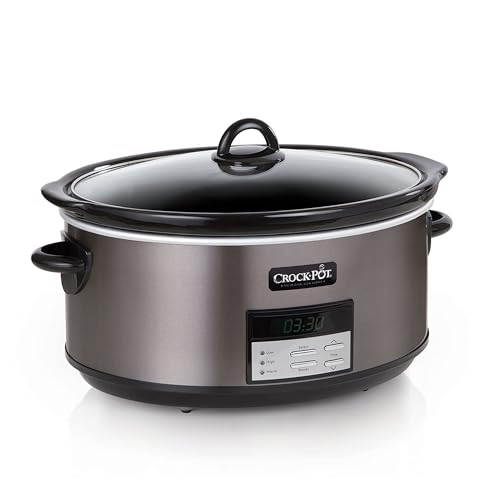
Crock-Pot Programmable Slow Cooker 8-Quart
Badge: Best Sized for Entertaining
Strengths
- The largest capacity in this guide — built for crowds, batch cooking and big roasts
- Digital timer up to 20 hours with an automatic switch to Warm
- Dishwasher-safe stoneware pot and lid keep cleanup proportionate to the size
Trade-offs
- An 8-quart crock is heavy when full and demands real counter and cupboard space
- Small meals underfill it, and underfilled slow cookers cook faster and less evenly
- Black stainless shows fingerprints more readily than plain finishes
Key specs (from the verified listing)
- Capacity: 8 quart, for 10+ people (per the verified listing title)
- Timer: digital, up to 20 hours
- Warm: auto warm setting
- Pot and lid: dishwasher-safe stoneware pot and lid
- Finish: black stainless steel
This is the big-batch end of the slow-cooker spectrum. An 8-quart stoneware pot rated by the maker for gatherings of ten or more changes what slow cooking is for: not just weeknight dinner, but the holiday ham, the game-day chili, the double batch of soup destined for the freezer. The verified listing pairs that capacity with a digital timer that runs up to 20 hours and then shifts to an auto warm setting, which is the combination large-format cooking actually needs, because big roasts and dense stews run long.
The black stainless finish gives the machine a more finished, appliance-grade look than the basic white or silver crocks of a generation ago, which matters for a cooker this size because it will live on the counter rather than in a cupboard for many owners. Both the stoneware pot and the lid are dishwasher-safe per the listing, a detail that sounds minor until you are facing an 8-quart pot crusted with baked-on beans. In daily use the experience is straightforward: set the time, set the level, and let the timer handle the transition to Warm.
As a fit story, the 8-quart is sized for the calendar’s big days and the freezer’s empty weeks; households that host or batch will feel it as capacity, and households that do neither will feel it as furniture.
The honest limitation is proportion: for a household of one or two cooking modest meals, this cooker is simply too much vessel. Food spread thin across an oversized crock cooks differently, storage is a genuine puzzle in small kitchens, and the full pot is a serious lift.
Best for: crowd cooks, batch cookers and holiday hosts / Not suited for: small households cooking small nightly meals
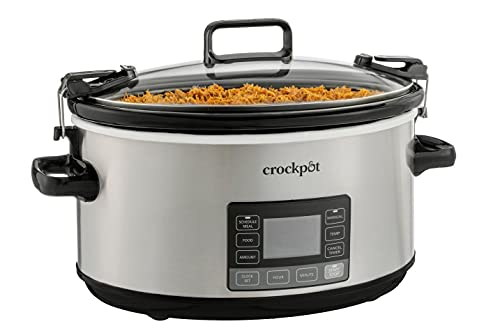
Crock-Pot Programmable Slow Cooker with MyTime 7-Quart
Badge: Best Sized for Potlucks
Strengths
- MyTime technology adjusts cooking toward your chosen mealtime, per the verified listing
- Locking Cook & Carry lid makes potlucks and transport realistic
- Seven quarts feeds nine or more, per the maker — family and gathering scale
Trade-offs
- Self-adjusting cooking asks you to trust the machine’s judgment over a fixed recipe time
- Locking lids must be unlatched for serving and for steam release at the table
- More electronics than a manual cooker, with more to learn on day one
Key specs (from the verified listing)
- Capacity: 7 quart, feeds 9+ (per the verified listing title)
- Technology: MyTime, which adjusts cooking (per the verified listing title)
- Lid: Cook & Carry locking lid
- Finish: stainless steel
The MyTime Crock-Pot tries to solve the oldest slow-cooker problem: recipes end when they end, but dinner happens when the family gets home. Its namesake technology, as the verified listing describes it, adjusts cooking toward the mealtime you set, rather than running a fixed countdown and hoping. For households whose evenings slide by an hour in either direction, that flexibility is more valuable than any extra setting, because it attacks the real failure mode of slow cooking — food that peaked at five and is tired by seven.
The second headline is the Cook & Carry locking lid. Slow cookers are natural potluck machines trapped by sloshing lids; a lid that locks for transport turns the 7-quart crock — rated by the maker to feed nine or more — into something you can actually take to the gathering it was sized for. The stainless steel finish and programmable format keep it firmly in the modern camp. In exchange you accept a machine that makes decisions: cooks who think in exact recipe hours sometimes find an adjusting cooker harder to predict, and the first few meals are partly an exercise in learning how it interprets your schedule.
As a fit story, the MyTime’s size includes its destination: a locking lid turns seven quarts into a dish that can be sized for a potluck across town, not just a table across the room.
The honest limitation is that intelligence cuts both ways. If you prefer a cooker that does exactly what a dial says and nothing more, the MyTime’s adjustments will feel like interference, and a manual model will make you happier for less complexity.
Best for: households with unpredictable evenings and potlucks to transport / Not suited for: cooks who want a machine that never adjusts anything on its own

Cosori Rice Cooker 10 Cup with Slow Cook
Badge: Best Sized for Grain-Centered Kitchens
Strengths
- Fuzzy-logic control adjusts cooking in a way fixed timers cannot
- Slow cook is one of many verified functions, alongside sauté and steaming
- Ceramic-coated inner pot and a stainless steel steamer basket are both listed features
Trade-offs
- A rice-cooker vessel is tall and round, not the wide oval shape roasts and whole chickens prefer
- Eighteen functions mean menus and decisions — the opposite of a one-dial appliance
- Ceramic coatings reward gentle utensils and hand care more than stoneware does
Key specs (from the verified listing)
- Capacity: 10 cup uncooked / 20 cup cooked (per the verified listing title)
- Control: fuzzy logic
- Functions: 18-in-1, including sauté and slow cook
- Inner pot: ceramic coating, non-stick
- Keep warm and delay timer: 24H (per the verified listing title)
- Accessory: stainless steel steamer basket
The Cosori arrives in this guide from a different direction: it is a fuzzy-logic rice cooker whose verified function list includes slow cooking, sautéing and steaming among its 18-in-1 programs. That breadth is the argument for it. A kitchen that cooks rice several times a week and slow cooks occasionally may rationally prefer one intelligent machine to two single-purpose ones, and the ceramic-coated inner pot plus stainless steel steamer basket in the listing make the multi-function claim concrete rather than decorative.
Fuzzy logic is the technical heart of the machine: instead of blasting at one fixed power until a timer ends, the cooker senses and adjusts through the cycle, which is how it handles grains so well and how its slow-cook program aims for steadier results than a basic on-off element. The 24-hour keep warm and delay timer listed in the title suit planned cooking — load in the morning, eat in the evening. The shape, though, remains a rice cooker’s shape: deep and round, excellent for soups, curries, steel-cut oats and braises that are mostly liquid, less natural for a flat roast or a whole bird.
As a fit story, the Cosori is sized around grains: its cup capacity describes a household that eats rice daily and slow cooks soups and curries in the same deep pot — a fit that quart-first shoppers underestimate.
The honest limitation is identity: if slow cooking is your main event and you cook roasts and large cuts often, a dedicated oval stoneware crock serves that food better, and eighteen programs will feel like clutter rather than capability.
Best for: grain-centered households that will use many functions weekly / Not suited for: roast-first cooks who want a wide oval crock and one-dial operation

Aroma Housewares ARC-150SB Digital Multicooker
Badge: Best Sized for Big Households
Strengths
- Three verified roles in one machine: rice cooker, slow cooker and food steamer
- The largest cooked-grain capacity in this guide, suited to big households
- Stainless steel exterior wipes clean and suits most kitchens
Trade-offs
- Rice-led design means a round, deep pot rather than an oval stoneware crock
- Digital multi-mode controls are more involved than a manual dial
- At full grain capacity it is a large appliance to store
Key specs (from the verified listing)
- Capacity: 20 cup cooked / 10 cup uncooked (per the verified listing title)
- Roles: digital rice cooker, slow cooker and food steamer (per the verified listing title)
- Exterior: stainless steel
- Model: ARC-150SB
- Color: black
Aroma built its name on rice cookers, and the ARC-150SB stretches that platform into three verified roles: digital rice cooker, slow cooker and food steamer. The capacity headline — 20 cups cooked from 10 cups uncooked — tells you who this machine courts: large families, meal preppers and anyone whose gatherings run on rice. As a slow cooker it handles the saucy, liquid-based end of the repertoire — soups, curries, beans, pulled chicken in sauce — with the convenience of a digital control panel shared across its modes.
The stainless steel exterior is practical as much as visual: it shrugs off the splashes and steam of a working kitchen and wipes down in seconds. Where the Aroma differs most from the Crock-Pot and Hamilton Beach stoneware machines is the cooking vessel and the cooking feel. A rice-led pot is deep rather than wide, so ingredients stack instead of spreading, and browning or arranging large cuts is not its natural act. Owners who think of it as a grain-and-stew station tend to love it; owners who expected an oval roaster tend to drift back to stoneware.
As a fit story, the Aroma is sized for abundance at the grain station: twenty cups cooked feeds a crowd’s rice single-handedly, and its slow-cook role scales to stew duty for the same gatherings.
The honest limitation is the same shape story: whole chickens, racks and flat roasts sit awkwardly in a deep round pot, so if your slow cooking centers on large whole cuts, a dedicated oval crock remains the better tool.
Best for: large, rice-centered households that also steam and slow cook / Not suited for: cooks whose slow cooking centers on large whole cuts
Comparison Table
| Pick | Badge | Capacity / Role (verified) | Control style | Link |
|---|---|---|---|---|
| Crock-Pot Oval Manual Slow Cooker 7-Quart | Best Sized for Families | 7 quart, serves 8+ people (per the verified listing title) | Manual High / Low / Warm | Check on Amazon |
| Hamilton Beach 6 Quart Slow Cooker | Best Sized for Most Recipes | 6 quart | 3 settings, manual-style | Check on Amazon |
| Crock-Pot Programmable Slow Cooker 8-Quart | Best Sized for Entertaining | 8 quart, for 10+ people (per the verified listing title) | Digital timer up to 20 hours, auto warm | Check on Amazon |
| Crock-Pot Programmable Slow Cooker with MyTime 7-Quart | Best Sized for Potlucks | 7 quart, feeds 9+ (per the verified listing title) | Programmable, MyTime adjusts cooking | Check on Amazon |
| Cosori Rice Cooker 10 Cup with Slow Cook | Best Sized for Grain-Centered Kitchens | 10 cup uncooked / 20 cup cooked (per the verified listing title) | Fuzzy logic, 18-in-1 programs | Check on Amazon |
| Aroma Housewares ARC-150SB Digital Multicooker | Best Sized for Big Households | 20 cup cooked / 10 cup uncooked (per the verified listing title) | Digital multi-mode | Check on Amazon |
How to Choose a Right-Sized Slow Cooker
Start with the typical Tuesday
List the last five dinners you would slow cook and their volumes. That list — not Thanksgiving — is your sizing document. Most households discover a tight cluster: a stew for four, a chicken, a pot of beans. The cooker whose fill window that cluster lands in is your size. The shorthand shelf survey Best Slkw Cookers works the same problem from the whole-category side, and Best Slow Cookers 6 Quart goes deep on the standard size most Tuesdays point to.
Translate makers’ servings with a cook’s skepticism
Serving claims in the verified titles run generous — eight, nine, ten or more people — because they imagine stew ladled as a course, not a mountain. A hearty-appetite household should discount them; a household of light eaters and children can trust them more. Either way, servings are a starting estimate, and the fill test on your own recipes is the verdict.
Fit the food’s shape, then the kitchen’s shape
Whole chickens, racks and long roasts vote oval; soups, beans and grains are shape-agnostic and thrive in deep round pots. After the food votes, the kitchen vetoes: an 8-quart crock needs roughly a large-mixer footprint and a cupboard shelf that accepts its height with the lid on. Measure both spaces with the tape you own, not the optimism you feel. Readers at the compact end can cross-check Best Slow Cookers 4 Quart and value options in Best Slow Cookers Affordable.
Plan for the household you are becoming
Sizes serve life stages. New babies argue for batch capacity; teenagers argue for more of everything; empty nests argue for stepping down without sentimentality. A right-sized purchase acknowledges the next three years, not the last ten — and a cooker that no longer fits is a gift to a younger household waiting to happen.
How to Cook to Your Cooker’s Size
A right-sized cooker still needs size-aware technique. These habits keep every class in this guide cooking in its sweet spot.
- Pre-portion proteins to the crock: choose roasts and chickens that leave headroom for vegetables and liquid instead of packing the vessel to the lid.
- Batch in the big cookers on purpose: when the 8-quart comes out, cook double and freeze half in flat, labeled containers — capacity used deliberately is capacity justified.
- Scale seasonings sub-linearly: doubling a recipe rarely wants double the salt or spice at the start; season, cook, then correct at the end.
- Use the small-batch insert trick in large crocks: an oven-safe dish set inside, surrounded by the recipe’s liquid or water as the maker allows, lets a big cooker cook a small meal evenly.
- Rotate the menu to the machine: grains and soups in the multicookers on weeknights, roasts in the ovals on weekends — playing each size to its shape keeps all of them earning their shelf.
- Record your fills: a note on the recipe card — filled two-thirds, perfect at seven hours on Low — turns sizing from theory into your kitchen’s data.
Troubleshooting
Problem: everything finishes early and dry The meal is small for the vessel. Cook bigger batches, use an insert dish, or accept that the household has outgrown — or undergrown — its cooker and resize at the next purchase.
Problem: sauces overflow the rim The vessel is small for the menu. Respect the two-thirds ceiling, especially with beans and grains that swell, and let the next size up handle that recipe.
Problem: the cooker lives on the counter because it fits nowhere else A storage failure, not a cooking one. If it cannot be stored, its effective size includes permanent counter rent — factor that honestly when replacing it.
Sized for one, sized for two: the small-household playbook
Small households face the fill window from below: most family recipes overfill their needs while underfilling a family crock. The playbook is deliberate batching — cook the family-size recipe in the 6-quart, eat tonight, portion the rest — or choosing dishes that freeze gracefully so a full crock is an asset. Soups, beans, braises and curries all freeze like they were designed for it, because they were.
The multicookers complicate the playbook pleasantly: a grain-centered couple may find the Cosori’s deep pot, run at soup scale, fits their week better than any stoneware in this guide. Fit is personal, and the numbers are servants, not masters. For the testing lens on these trade-offs, see Best Slow Cookers Americas Test Kitchen.
When to own two sizes
Some kitchens honestly need two cookers: a standard for the week and a large for the calendar’s peaks, or a standard plus a compact for sides and oats. Two sized machines beat one compromise that is wrong in both directions — too big for Tuesday, too small for the holiday — provided storage allows and both genuinely rotate.
The test is usage, not enthusiasm: if the second size would cook monthly or more, it earns its shelf. If it would cook twice a year, borrow, rent the occasion with a roasting pan, or let the standard size run two shifts. Readers furnishing a second setup for a cabin or an RV kitchen often start from Best Slow Cookers At Walmart for the in-store size comparison.
Sizing for the way Americans actually cook: five scenarios
Scenario one, the weeknight family rotation: soups, stews, a chicken, a pot of beans, each feeding four to six with a leftover portion or two. This is 6- to 7-quart territory, and both the Hamilton Beach and the manual Crock-Pot in this guide were sized by exactly this life. Scenario two, the Sunday batch ritual: a double stew, a shoulder, a week of lunches portioned into containers. The batch ritual pushes toward 7 and 8 quarts, because its unit of measure is the freezer container, not the dinner plate.
Scenario three, the entertainer’s calendar: chili for a dozen, a ham for the holiday, dips kept warm for a grazing table. Entertaining sizes a cooker by its biggest recurring gathering, and the 8-quart earns its shelf here without apology. Scenario four, the grain-centered kitchen: rice most nights, curries and soups in the same pot, steamed sides above. Here the cup-rated multicookers fit better than their numbers suggest, because their size was always about grain output. Scenario five, the traveling dish: the potluck signature that must arrive hot across town — the MyTime’s locking lid makes its 7 quarts a size that includes a destination.
Most households are a blend — a rotation with occasional batch days, a gathering twice a season. Blends size by their dominant scenario and borrow or double-shift for the exceptions, which is why the middle of this guide’s ladder is so heavily populated: 6 and 7 quarts are where American slow cooking actually lives, and the picks there are correspondingly strong.
The geometry lesson: why two 7-quart cookers are not the same size
This guide contains two 7-quart Crock-Pots, and they are not interchangeable — a fact that teaches the whole sizing doctrine in miniature. Both hold the same volume of stew. But one is a manual oval built around a dial and a stoneware crock; the other wraps the same class of vessel in programmable, self-adjusting controls and a locking lid. The first is sized for a household’s table; the second is sized for a household’s schedule and its potluck circuit. Capacity is the beginning of fit, never the end of it.
The same lesson runs down the ladder. The 6-quart Hamilton Beach and a hypothetical 6-quart smart cooker would share a number and share almost nothing else. The multicookers share this guide with stoneware machines many times their stew volume because fit includes menu shape. When you shop, interrogate every size claim with three follow-ups: what shape, what controls, what carry? The answers, not the number, predict your satisfaction in month six.
That is also why this guide reports makers’ serving claims as claims. A serving is not a unit; it is a serving — of a course, to an appetite, in a household. Your household’s servings are knowable from your own table in a way no box can know them, and the fill test on your own recipes remains the final sizing instrument, superior to every number printed anywhere, including the careful ones in this guide.
The sized kitchen audit: measuring your way to the right crock
Begin the audit at the cupboard, tape in hand. Record the shelf’s clear height, width and depth where a cooker would live, and the counter corner’s dimensions if it will live out. Then audit the sink: a large crock must fit under the faucet or accept filling by jug, and it must fit in the sink or dishwasher for washing — the 8-quart class fails more kitchens at the sink than at the shelf. Finally audit the path: the route from cooker to sink to table, walked mentally with a full, hot, heavy vessel. A size that fails any station of that audit is the wrong size no matter how beautifully it cooks.
Continue the audit at the recipe file. Pull the ten dishes you would actually slow cook and estimate each one’s loaded volume — protein, vegetables, liquid — as honestly as you can. The cluster’s center is your capacity; its extremes are your exceptions, to be handled by scaling, splitting or borrowing. Most households discover their cluster sits within a quart of the 6- to 7-quart band, which is why that band dominates this guide — but the audit, not the average, is what you are buying for.
Finish the audit at the calendar. Count the gatherings, batch days and potlucks of a typical quarter. If they number in the monthly range, they earn a vote for size or for a second machine; if they are annual, they earn a plan, not a purchase. Then buy, once, with the audit’s three documents — cupboard, recipes, calendar — in agreement. A cooker bought that way tends to be the last one bought for a decade, which is the most economical and the most satisfying outcome a sizing guide can produce.
What to do when your size is discontinued, cracked or outgrown
Stoneware crocks crack, product lines turn over, and households change size — the sized purchase eventually meets its sequel. When a crock cracks, check the maker’s replacement ecosystem before replacing the whole machine; the major lines in this guide have long supported replacement vessels, and a new crock on a sound base is the economical, low-waste sequel. Handle a cracked crock as retired, not as wounded: a vessel that weeps under heat has finished its service, however sentimental the attachment.
When the household outgrows its size — in either direction — the sequel purchase should rerun the audit from the buying guide rather than defaulting to the same number out of loyalty. The family that needed 6 quarts in one decade may need 8 in the next, or 4, and the cooker that no longer fits deserves an honorable transfer: to a younger household starting out, to the second home whose gatherings it matches, to the neighbor whose borrowed-size problem it solves permanently. Sized right twice is not a failure of the first purchase; it is the biography of a household, told in crocks.
And when a beloved model is simply discontinued, its verified facts remain your spec sheet: capacity, shape, control style, vessel material. Shop the sequel by those four coordinates rather than by brand nostalgia, and the replacement — whatever badge it wears — will feel like a continuation rather than a compromise.
One last sizing instrument: the borrow test
Before any sized purchase, there is a free experiment available to most households: borrow the size you think you need. A neighbor’s 7-quart, a relative’s 8-quart, cooked in for one real week, will teach your hands and your cupboard more than any specification — how the fill window feels with your recipes, how the lift feels with your arms, how the footprint feels in your kitchen’s actual geography. Slow cookers are lent more readily than almost any appliance, because their owners understand exactly what the borrower is trying to learn.
If the borrowed week delights, buy that size with confidence. If it teaches a correction — smaller, larger, different shape — the lesson cost nothing but a thank-you and a returned crock, washed, ideally with a stew still in it. The borrow test is the sizing doctrine’s final form: fit is physical, and physical questions deserve physical answers.
Common Buying Mistakes
- Sizing by the biggest meal of the year and living with the consequences at every ordinary meal.
- Trusting serving counts without translating them into your household’s appetites and leftover habits.
- Forgetting that grains and beans swell — a two-thirds fill of dry ingredients can become a lid-lifting overflow.
- Measuring capacity and ignoring footprint, then discovering the cupboard veto after delivery.
- Keeping a cooker that no longer fits the household out of loyalty, while cooking badly in it weekly.
Final Recommendation
Most families should land on the manual 7-quart oval — check on Amazon — sized for chickens, roasts and stews with leftovers. Recipe followers who want zero scaling friction should choose the 6-quart Hamilton Beach — check on Amazon — and hosts should commit to the 8-quart Crock-Pot — check on Amazon — sized for the gatherings that define their calendar.
Grain-centered and traveling households have their own right answers in the Aroma, Cosori and MyTime reviews above. However you land, land by fit — and for the shorthand version of this whole shelf, readers can browse Best Slkw Cookers next.
Frequently Asked Questions
What does right-sized actually mean for a slow cooker?
That your typical meal fills it half to two-thirds, its shape matches your menu’s geometry, and it stores where you planned. A cooker can be excellent and wrongly sized for you at the same time.
Should couples buy a 6-quart or smaller?
If they batch cook and freeze, the 6-quart is right and economical of effort. If they cook small fresh meals nightly, a smaller class suits better — fill behavior beats headline capacity.
How many people does a 7-quart slow cooker feed?
The makers of the 7-quart picks here claim eight or more and nine or more respectively. Hearty appetites should plan more conservatively; as a main course for a crowd, seven quarts comfortably covers a family plus guests.
Are multicookers a good substitute size-wise?
For soups, curries and grain-centered menus, yes — their deep pots work at family scale. For roasts and whole birds, oval stoneware of similar volume fits the food better.
Can a slow cooker be too big for a recipe?
Yes. Underfilled crocks cook faster at the edges and can dry food out. Scale the recipe up, use an insert dish, or choose a smaller cooker for that dish.
When is owning two sizes worth it?
When both would cook at least monthly — typically a standard for weeknights plus a large for gatherings or batch days. Otherwise one right-sized cooker, run in two shifts on rare big days, is the better economics.


