Disclosure: topratedkitchenware.com is reader-supported. When you buy through links on our site, we may earn an affiliate commission from Amazon and other retailers, at no extra cost to you.
Where to buy
The quickest route to each recommendation is below. Linked picks go straight to their Amazon listing, where you can check on Amazon for the current details before you buy. Picks labeled prose-only are discussed in full for comparison and carry no purchase link in this guide, for the honesty reasons explained in their reviews and source notes. Read the full guide ↓ for the reasoning, the comparisons and the buying advice before you decide.
- Hamilton Beach 6 Quart Slow Cooker — Best Overall
- Crock-Pot Oval Manual Slow Cooker 7-Quart — Best Classic Crock
- Crock-Pot Programmable Slow Cooker 8-Quart — Best for Crowds
- Crock-Pot Programmable Slow Cooker with MyTime 7-Quart — Best Programmable
- Aroma Housewares ARC-150SB Digital Multicooker — Best Multi-Role
- Aroma ARC-363-1NGB Rice Cooker and Multicooker — Best Small Rice and Steam Pick (prose-only, no purchase link — see its review for why)
The best slkw cookers — the shorthand, typo-born search that lands thousands of shoppers on the slow-cooker shelf every month — are simply the best slow cookers, found through a compressed keyboard slip. This guide treats the query with respect rather than pedantry: if you typed slkw, you want a slow cooker that suits your household, and the six verified picks below are the shelf’s representative machines, from a three-setting Hamilton Beach to an 8-quart programmable Crock-Pot. Five carry purchase links. One — a compact Aroma whose verified roles are rice, steaming and multicooking, with no slow-cook function named — is reviewed prose-only, because a guide earns trust by linking only what it can verify.
That one exclusion is worth pausing on, because it is the difference between a guide and a pile of links. Multicooker is a generous word, and slow cooking hides inside many machines’ menus — but when a listing names its roles and slow cooking is not among them, honesty requires the prose-only label. Its larger Aroma sibling in this same guide does name a slow-cooker role, and it is linked accordingly. Verification, not brand, draws the line.
The rest of the guide is the full slow-cooker curriculum in this series’ four layers: how the picks were chosen, a buying guide that translates quarts and settings into household terms, a practical how-to for first meals and weekly habits, and answers to the questions slkw searchers ask once the spelling stops mattering and dinner starts.
Key Takeaways
- Slkw is slow cooker by another spelling — the machines, sizes and rules are the same shelf.
- Five of six verified picks slow cook by name and are linked; the compact Aroma names no slow-cook role and is prose-only.
- Six quarts is the default size; seven and eight serve roasts, birds and crowds.
- Manual dials, basic timers and self-adjusting programs form a complexity ladder — climb only as high as your schedule needs.
- Fill half to two-thirds, keep the lid down, and let texture — not the clock — call doneness.
In this guide
Quick Picks
All six verified picks for best slkw cookers at a glance. Linked picks carry a purchase link; prose-only picks are labeled and explained in their full reviews below.
| Pick | Badge | Capacity / Role (verified) | Link |
|---|---|---|---|
| Hamilton Beach 6 Quart Slow Cooker | Best Overall | 6 quart | Check on Amazon |
| Crock-Pot Oval Manual Slow Cooker 7-Quart | Best Classic Crock | 7 quart, serves 8+ people (per the verified listing title) | Check on Amazon |
| Crock-Pot Programmable Slow Cooker 8-Quart | Best for Crowds | 8 quart, for 10+ people (per the verified listing title) | Check on Amazon |
| Crock-Pot Programmable Slow Cooker with MyTime 7-Quart | Best Programmable | 7 quart, feeds 9+ (per the verified listing title) | Check on Amazon |
| Aroma Housewares ARC-150SB Digital Multicooker | Best Multi-Role | 20 cup cooked / 10 cup uncooked (per the verified listing title) | Check on Amazon |
| Aroma ARC-363-1NGB Rice Cooker and Multicooker | Best Small Rice and Steam Pick | 3 cups uncooked / 6 cups cooked, 2-6 cups (per the verified listing title) | Prose-only — see review |
How These Picks Were Chosen
Every pick was verified against its Amazon listing through the Creators API on 2026-11-20, and the guide quotes capacities, settings and roles only from those verified titles. The verification pass is what separated the linked five from the prose-only one: each linked pick’s title names a slow-cooker identity or a slow-cook function outright, while the Aroma ARC-363-1NGB’s title names rice, steamer and multicooker roles and stops there.
Comparison weighed the variables that decide satisfaction after the spelling is forgotten: capacity against household, shape against menu, control style against temperament, and crock handling against the daily cook-serve-wash loop. No hands-on testing is claimed; this is research-led guidance, labeled as such, built from verified data and the durable patterns of the category.
Badges distribute the honors across the shelf’s real niches — overall, classic, crowds, programmable, multi-role — so a reader arriving from a two-letter typo can still leave with a deliberate choice.
The 6 Best slkw cookers

Hamilton Beach 6 Quart Slow Cooker
Badge: Best Overall
Strengths
- Three settings keep operation genuinely simple — there is almost nothing to learn
- Stoneware crock and glass lid are both dishwasher-safe, so cleanup is not a project
- The 6-quart size is the most recipe-compatible capacity in this guide
Trade-offs
- No programmable timer, so it will not switch itself to Warm on a schedule
- No locking lid mentioned in the verified listing, which makes transport less secure
- Manual control means long workdays need a recipe timed to the settings, not to your return hour
Key specs (from the verified listing)
- Capacity: 6 quart
- Cooking settings: 3 settings (per the verified listing title)
- Crock: dishwasher-safe stoneware
- Lid: glass
- Finish: silver
- Model: 33665G (per the verified listing title)
The Hamilton Beach is the slow cooker reduced to its essentials: a stoneware crock, a glass lid and three cooking settings. That restraint is exactly its appeal. There is no menu to scroll, no program to set incorrectly and no app between you and dinner. You load the crock, turn the control, and the machine does the one job it was built for. For households that cook the same rotation of soups, stews, pulled meats and bean dishes, that simplicity is not a compromise — it is the feature.
The 6-quart stoneware crock is the size most American slow-cooker recipes are written for, which matters more than any electronic extra. Recipes assume a vessel that is half to two-thirds full, and a 6-quart crock hits that window for a family chicken, a mid-size pork shoulder or a double batch of chili. The crock and lid both go in the dishwasher according to the verified listing, and stoneware moves from cooker base to table without looking out of place, which quietly encourages serving from the crock instead of dirtying another dish.
For the slkw searcher, the Hamilton Beach is the safest landing: the category’s standard size, three settings and a dishwasher-safe crock — the slow cooker in its most legible form, requiring no translation at all.
The honest limitation is timing discipline: with no programmable countdown in the verified feature set, a recipe that finishes at hour six will sit cooking until you get home at hour nine unless you choose recipes built for longer, gentler windows or use the Warm setting thoughtfully within safe limits.
Best for: home cooks who want the standard size and the simplest possible operation / Not suited for: cooks who need a programmable timer to finish dinner unattended

Crock-Pot Oval Manual Slow Cooker 7-Quart
Badge: Best Classic Crock
Strengths
- Manual High, Low and Warm settings — nothing to program, nothing to fail
- Oval stoneware shape fits whole chickens and roasts the way recipes expect
- Removable crock goes to the table and into the sink or dishwasher routine easily
Trade-offs
- No timer, so the switch to Warm happens when you make it happen
- Seven quarts is more cooker than small households need for everyday meals
- Manual models reward cooks who are home near the end of the cooking window
Key specs (from the verified listing)
- Capacity: 7 quart, serves 8+ people (per the verified listing title)
- Settings: High, Low and Warm
- Crock: removable oval stoneware
- Finish: stainless steel
The oval manual Crock-Pot is the archetype — the machine the word slow cooker still brings to mind. A removable oval stoneware crock, a stainless steel housing and a control that offers High, Low and Warm: that is the entire interface, and generations of recipes were written against exactly this tool. The 7-quart capacity, which the maker rates for eight or more people, swallows a whole chicken or a generous pork shoulder with room for the vegetables around it, and the oval footprint is why — long cuts lie flat instead of curling up the sides of a round pot.
Manual control is a philosophy as much as a feature set. There is no countdown to mis-set and no electronics to age out; the cook decides, and the machine obeys. Stoneware holds heat evenly and keeps food warm at the table after the base is switched off, and because the crock lifts out, leftovers can be served, stored and reheated with less decanting. What you give up is automation: nobody flips this cooker to Warm at hour eight if the house is empty, so recipe choice and timing stay the cook’s responsibility.
For the slkw searcher, the manual Crock-Pot is the original article — the oval stoneware machine the abbreviation’s full word was invented around, at family scale with a control a child could operate.
The honest limitation is absence of a timer. Households whose days are long and unpredictable often end up overcooking delicate dishes in manual machines, and for them a programmable model is not a luxury but the difference between dinner and a salvage operation.
Best for: families who cook whole chickens, roasts and stews on a predictable schedule / Not suited for: households away all day who need an automatic switch to Warm
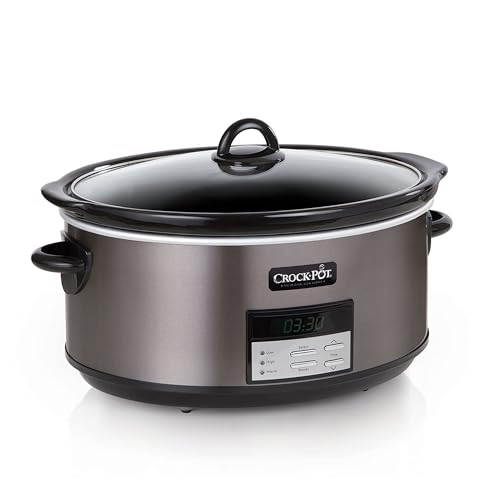
Crock-Pot Programmable Slow Cooker 8-Quart
Badge: Best for Crowds
Strengths
- The largest capacity in this guide — built for crowds, batch cooking and big roasts
- Digital timer up to 20 hours with an automatic switch to Warm
- Dishwasher-safe stoneware pot and lid keep cleanup proportionate to the size
Trade-offs
- An 8-quart crock is heavy when full and demands real counter and cupboard space
- Small meals underfill it, and underfilled slow cookers cook faster and less evenly
- Black stainless shows fingerprints more readily than plain finishes
Key specs (from the verified listing)
- Capacity: 8 quart, for 10+ people (per the verified listing title)
- Timer: digital, up to 20 hours
- Warm: auto warm setting
- Pot and lid: dishwasher-safe stoneware pot and lid
- Finish: black stainless steel
This is the big-batch end of the slow-cooker spectrum. An 8-quart stoneware pot rated by the maker for gatherings of ten or more changes what slow cooking is for: not just weeknight dinner, but the holiday ham, the game-day chili, the double batch of soup destined for the freezer. The verified listing pairs that capacity with a digital timer that runs up to 20 hours and then shifts to an auto warm setting, which is the combination large-format cooking actually needs, because big roasts and dense stews run long.
The black stainless finish gives the machine a more finished, appliance-grade look than the basic white or silver crocks of a generation ago, which matters for a cooker this size because it will live on the counter rather than in a cupboard for many owners. Both the stoneware pot and the lid are dishwasher-safe per the listing, a detail that sounds minor until you are facing an 8-quart pot crusted with baked-on beans. In daily use the experience is straightforward: set the time, set the level, and let the timer handle the transition to Warm.
For the slkw searcher feeding a crowd, the 8-quart programmable is the shelf’s big answer, with a timer long enough for the longest braises and an auto warm landing when they finish.
The honest limitation is proportion: for a household of one or two cooking modest meals, this cooker is simply too much vessel. Food spread thin across an oversized crock cooks differently, storage is a genuine puzzle in small kitchens, and the full pot is a serious lift.
Best for: crowd cooks, batch cookers and holiday hosts / Not suited for: small households cooking small nightly meals
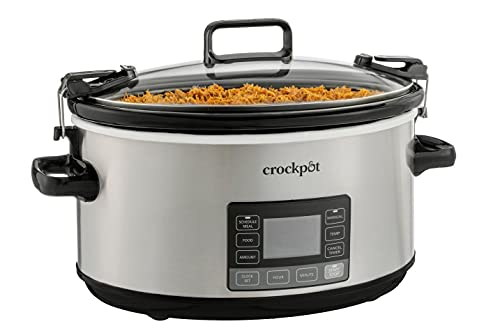
Crock-Pot Programmable Slow Cooker with MyTime 7-Quart
Badge: Best Programmable
Strengths
- MyTime technology adjusts cooking toward your chosen mealtime, per the verified listing
- Locking Cook & Carry lid makes potlucks and transport realistic
- Seven quarts feeds nine or more, per the maker — family and gathering scale
Trade-offs
- Self-adjusting cooking asks you to trust the machine’s judgment over a fixed recipe time
- Locking lids must be unlatched for serving and for steam release at the table
- More electronics than a manual cooker, with more to learn on day one
Key specs (from the verified listing)
- Capacity: 7 quart, feeds 9+ (per the verified listing title)
- Technology: MyTime, which adjusts cooking (per the verified listing title)
- Lid: Cook & Carry locking lid
- Finish: stainless steel
The MyTime Crock-Pot tries to solve the oldest slow-cooker problem: recipes end when they end, but dinner happens when the family gets home. Its namesake technology, as the verified listing describes it, adjusts cooking toward the mealtime you set, rather than running a fixed countdown and hoping. For households whose evenings slide by an hour in either direction, that flexibility is more valuable than any extra setting, because it attacks the real failure mode of slow cooking — food that peaked at five and is tired by seven.
The second headline is the Cook & Carry locking lid. Slow cookers are natural potluck machines trapped by sloshing lids; a lid that locks for transport turns the 7-quart crock — rated by the maker to feed nine or more — into something you can actually take to the gathering it was sized for. The stainless steel finish and programmable format keep it firmly in the modern camp. In exchange you accept a machine that makes decisions: cooks who think in exact recipe hours sometimes find an adjusting cooker harder to predict, and the first few meals are partly an exercise in learning how it interprets your schedule.
For the slkw searcher whose evenings are unpredictable, the MyTime model is the programmable peak of this guide: it adjusts toward your mealtime and locks its lid for the trip to wherever dinner is happening.
The honest limitation is that intelligence cuts both ways. If you prefer a cooker that does exactly what a dial says and nothing more, the MyTime’s adjustments will feel like interference, and a manual model will make you happier for less complexity.
Best for: households with unpredictable evenings and potlucks to transport / Not suited for: cooks who want a machine that never adjusts anything on its own

Aroma Housewares ARC-150SB Digital Multicooker
Badge: Best Multi-Role
Strengths
- Three verified roles in one machine: rice cooker, slow cooker and food steamer
- The largest cooked-grain capacity in this guide, suited to big households
- Stainless steel exterior wipes clean and suits most kitchens
Trade-offs
- Rice-led design means a round, deep pot rather than an oval stoneware crock
- Digital multi-mode controls are more involved than a manual dial
- At full grain capacity it is a large appliance to store
Key specs (from the verified listing)
- Capacity: 20 cup cooked / 10 cup uncooked (per the verified listing title)
- Roles: digital rice cooker, slow cooker and food steamer (per the verified listing title)
- Exterior: stainless steel
- Model: ARC-150SB
- Color: black
Aroma built its name on rice cookers, and the ARC-150SB stretches that platform into three verified roles: digital rice cooker, slow cooker and food steamer. The capacity headline — 20 cups cooked from 10 cups uncooked — tells you who this machine courts: large families, meal preppers and anyone whose gatherings run on rice. As a slow cooker it handles the saucy, liquid-based end of the repertoire — soups, curries, beans, pulled chicken in sauce — with the convenience of a digital control panel shared across its modes.
The stainless steel exterior is practical as much as visual: it shrugs off the splashes and steam of a working kitchen and wipes down in seconds. Where the Aroma differs most from the Crock-Pot and Hamilton Beach stoneware machines is the cooking vessel and the cooking feel. A rice-led pot is deep rather than wide, so ingredients stack instead of spreading, and browning or arranging large cuts is not its natural act. Owners who think of it as a grain-and-stew station tend to love it; owners who expected an oval roaster tend to drift back to stoneware.
For the slkw searcher whose kitchen is grain-first, the Aroma is the linked multi-role route: a verified slow-cooker role inside a rice-led machine that also steams, at twenty-cup cooked scale.
The honest limitation is the same shape story: whole chickens, racks and flat roasts sit awkwardly in a deep round pot, so if your slow cooking centers on large whole cuts, a dedicated oval crock remains the better tool.
Best for: large, rice-centered households that also steam and slow cook / Not suited for: cooks whose slow cooking centers on large whole cuts
Aroma ARC-363-1NGB Rice Cooker and Multicooker
Badge: Best Small Rice and Steam Pick
Prose-only pick: reviewed in full below, with no purchase link and no photo, for the reason stated in this review and in the source notes.
Strengths
- Compact rice, steamer and multicooker roles in one small machine
- 6-cup cooked scale suits singles and couples
- Black finish hides cooking stains better than white
Trade-offs
- No slow-cook function is named in the verified listing title
- Small capacity will not serve family-size slow-cooked meals
- A rice-led pot shape, not a stoneware crock shape
Key specs (from the verified listing)
- Capacity: 3 cups uncooked / 6 cups cooked, 2-6 cups (per the verified listing title)
- Roles: rice cooker, steamer and multicooker (per the verified listing title)
- Model: ARC-363-1NGB
- Color: black
This Aroma is a compact rice cooker, steamer and multicooker — and it is presented prose-only in this guide because its verified listing title never names a slow-cook function. In a guide whose subject is slow cookers, that distinction is the whole game: multicooker is a broad word, and a machine earns a slow-cooker link here only when slow cooking is among its verified roles, as it is for its larger Aroma sibling elsewhere in this guide.
Judged on its own verified terms, the ARC-363-1NGB is a sensible small machine: 3 cups uncooked, 6 cups cooked, black finish, built for the rice-plus-steamed-something pattern that feeds one or two people well. Readers who landed on this guide while actually shopping for a small rice cooker may find it genuinely relevant, which is why it is reviewed rather than silently dropped. Readers who need slow cooking should stay with the linked picks, whose slow-cook roles are verified in their titles.
For the slkw searcher, this compact Aroma is the guide’s honesty exhibit: a perfectly decent small rice cooker and steamer that is not, by its own verified title, a slow cooker — reviewed so the distinction is visible, linked nowhere so it cannot mislead.
The honest limitation is categorical: without a verified slow-cook function, it cannot be recommended as a slow cooker, however capable a small rice cooker and steamer it may be.
Best for: one or two people who want compact rice and steaming / Not suited for: anyone who needs a verified slow-cook function
Comparison Table
| Pick | Badge | Capacity / Role (verified) | Control style | Link |
|---|---|---|---|---|
| Hamilton Beach 6 Quart Slow Cooker | Best Overall | 6 quart | 3 settings, manual-style | Check on Amazon |
| Crock-Pot Oval Manual Slow Cooker 7-Quart | Best Classic Crock | 7 quart, serves 8+ people (per the verified listing title) | Manual High / Low / Warm | Check on Amazon |
| Crock-Pot Programmable Slow Cooker 8-Quart | Best for Crowds | 8 quart, for 10+ people (per the verified listing title) | Digital timer up to 20 hours, auto warm | Check on Amazon |
| Crock-Pot Programmable Slow Cooker with MyTime 7-Quart | Best Programmable | 7 quart, feeds 9+ (per the verified listing title) | Programmable, MyTime adjusts cooking | Check on Amazon |
| Aroma Housewares ARC-150SB Digital Multicooker | Best Multi-Role | 20 cup cooked / 10 cup uncooked (per the verified listing title) | Digital multi-mode | Check on Amazon |
| Aroma ARC-363-1NGB Rice Cooker and Multicooker | Best Small Rice and Steam Pick | 3 cups uncooked / 6 cups cooked, 2-6 cups (per the verified listing title) | Simple multicooker control | Prose-only |
How to Choose a Slow Cooker (However You Spell It)
Size first, because size is forever
Features can be ignored; capacity cannot. Six quarts serves most families and matches most recipes. Seven quarts in an oval fits whole chickens and hosts. Eight quarts is for crowds and batch days. The two Aromas translate differently — cup capacities describe grain output, and their slow cooking suits soups and saucy dishes. Choose by your typical meal’s volume and shape, and consult Best Slow Cookers 6 Quart if the standard size is your landing zone, or Best Slow Cookers 4 Quart for the compact end.
Controls: dial, timer or intelligence
The complexity ladder in this guide runs from the manual Crock-Pot’s dial, through the big Crock-Pot’s set-and-hold timer, to the MyTime’s self-adjusting program. Each rung solves a real problem — simplicity, absence, unpredictability — and adds a real cost in learning or trust. Buy the rung your schedule needs and no higher; unused intelligence still has to be cleaned around. The value angle on the same ladder is covered in Best Slow Cookers Affordable.
Vessel and lid decide daily happiness
Removable stoneware crocks serve, store and wash gracefully; glass lids let you monitor without lifting; locking lids — the MyTime’s verified Cook & Carry — make transport a plan instead of a gamble. Multicooker pots are lighter and deeper, better for grains and soups than for roasts. Handle the daily loop in your imagination before buying: the cooker you enjoy washing is the cooker you will use.
Read listings like a verifier
This guide’s prose-only pick teaches the master skill: believe the role list, not the category page. If slow cooking matters, find it named — slow cooker, slow cook function — in the product’s own title or specification. The same discipline serves readers comparing test-led recommendations in Best Slow Cookers Americas Test Kitchen or shelf stock in Best Slow Cookers At Walmart.
How to Slow Cook Well: The Slkw Starter Curriculum
However the search was spelled, the cooking obeys the same rules. This starter routine covers the first stew and the habits that follow.
- Assemble in the morning order: roots and dense vegetables at the bottom, protein above, liquid to partly cover — slow cookers need less added liquid than stovetop recipes suggest.
- Set Low for the long day, High for the short one, and write down what you chose; your own notes become your cooker’s manual within a month.
- Keep the lid sealed. Every lift costs heat and time; the glass lid is your window and the steam is doing work you cannot see.
- Add dairy, fresh herbs and quick vegetables near the end, where their texture and brightness survive the long cook.
- Judge doneness by tenderness and temperature, shred or slice in the crock’s juices, and let the dish rest briefly before serving.
- Cool and store leftovers promptly in shallow containers; the crock returns to the sink, washed warm, ready for the next round.
Troubleshooting
Problem: dinner is late because the recipe was optimistic Switch to High for the remaining stretch and choose sturdier recipes for full workdays; note the correction on the recipe for next time.
Problem: flavors taste flat after long cooking Long heat mellows seasoning. Salt in layers, finish with acid or fresh herbs, and brown proteins first when the dish is simple enough to need the depth.
Problem: the crock is stained or carries last week’s curry ghost A paste of baking soda and patience, or a long soak, handles most stoneware ghosts; avoid thermal shock by letting the crock warm toward room temperature before hot water.
A field guide to slow-cooker vocabulary
The slkw searcher meets a shelf full of dialect: crock, cooker, multicooker, programmable, fuzzy. Translated: a crock is the stoneware vessel and, by extension, the machine around it; programmable means a timer governs the cook and the switch to Warm; multicooker means several appliances share one housing, and slow cooking may or may not be among them — verify, as this guide did; fuzzy logic belongs to rice-led machines that sense and adjust.
Vocabulary is not trivia — it is how shoppers avoid the one wrong purchase this guide flagged. A household that learns to read role lists buys once. Readers building that fluency can continue to Best Slow Cookers Australia for how the same shelf is described in another market’s English.
The week a slow cooker earns its counter
Monday: a bean soup that improves by Tuesday. Wednesday: a chicken that becomes Thursday’s sandwiches and Friday’s stock. Sunday: a shoulder that anchors lunches. This is the rhythm the linked picks were chosen to serve — unglamorous, economical and quietly delicious — and it explains why a three-setting machine can out-earn a smart one in real kitchens: the rhythm needs reliability, not features.
The multicooker picks extend the rhythm to grains: rice nights and steamed sides interleave with stew nights, and one counter footprint covers both. Households designing their own rhythm should size the anchor machine first — the sizing guides linked in the buying section exist for exactly that decision.
From typo to table: setting up a slow-cooker routine that sticks
Most slow cookers fail their households not in the cooking but in the routine: bought in enthusiasm, used for two heroic Sundays, then exiled to a cupboard whose door becomes a psychological barrier. The households that keep cooking share three unglamorous traits. The cooker lives within arm’s reach of the prep area, not in storage. Two or three foundation recipes are memorized — not collected, memorized — so a cook can start one without opening anything. And the shopping list has a slow-cooker section, so the ingredients for those recipes are simply always around.
The picks in this guide were chosen with that routine in mind. The manual machines ask so little that a tired cook still says yes to them. The programmable models protect the routine against the household’s worst days, when the cook’s return time is a rumor. The multicooker extends the routine across the grain station, so rice nights and stew nights reinforce one habit instead of competing. Features matter, but they matter in service of the routine; a feature that does not protect a Tuesday is decoration.
Give a new routine a month of grace. The first cooks are calibration — your machine’s pace, your household’s salt, your recipes’ true yields — and calibration looks like failure only if you expected mastery on day one. By week four, the notes on your recipe cards have quietly become the most useful cookbook you own, written in the only kitchen it will ever be used in.
Slow cooking and food safety, spelled out plainly
However the category is spelled, its safety rules are exact. Start with thawed ingredients for long cooks, because a frozen center can linger too long at lukewarm temperatures on the way up; small frozen items in soups are the forgiving exception, not the model. Fill the crock at least half full so the food mass heats through properly, and keep the lid closed so the heat you are counting on stays in the vessel. A kitchen thermometer is the referee for poultry and large roasts — tenderness suggests doneness, temperature confirms it.
The Warm setting deserves its plain statement: it holds cooked food at serving temperature for a short window, and it is not a refrigerator, a reheating plan or an all-day storage mode. When the meal is done being served, leftovers move to shallow containers and into the refrigerator promptly, where they cool evenly. Reheating leftovers should bring them back to a full, steaming heat — the slow cooker itself is a poor reheater for large, dense portions, and a saucepan or oven serves that job better.
None of this is cause for anxiety; slow cookers have fed families safely for generations precisely because the method — moist heat, closed vessel, long steady climb — is sound when its few rules are kept. Keep them, and the slkw search that brought you here ends the way it should: with dinner, on time, tasting like you planned it days ago, because in a sense you did.
The slow cooker in the wider kitchen: what it replaces, what it befriends
A slow cooker earns its counter in an ecosystem. It replaces the oven for long braises — freeing the oven for bread, roasts and the holiday’s second act — and it replaces the stovetop for beans and stocks that would otherwise demand a watched pot. It befriends the rice cooker, its counter neighbor in so many of the kitchens this guide serves: stew in one, rice in the other, dinner assembled from two machines that each did one thing patiently. The multicooker picks in this guide collapse that friendship into a single housing, which is their charm and their compromise in one sentence.
It also befriends the freezer, its silent partner. Slow cooking’s batch economics only complete when the surplus has somewhere honored to go — containers, labels, a rotation the household actually eats. Kitchens that master the cooker-freezer partnership find their weeknight cooking shrinking to finishing touches: a sauce, a salad, a grain. Kitchens that skip the partnership cook the same heroic Sunday stew and then face the same empty Wednesday, wondering why the appliance did not change their life.
What the slow cooker does not replace is worth naming too: the skillet’s sear, the oven’s roast crust, the pressure cooker’s speed. A mature kitchen assigns each tool its physics and stops asking any of them to be the others. The slkw searcher who arrived for one machine may leave, if this guide has done its work, with something better than a machine — a small, clear map of which tool does what, and a crock already chosen to do its part.
Slow cooking through the seasons: a calendar for the crock
Winter is the slow cooker’s high season and needs no advocacy: braises, bean pots, mulled drinks held warm through long evenings — the linked picks could run daily and some households let them. Spring lightens the repertoire rather than ending it: lemon-and-herb chickens, barley soups, beans destined for salads. The cookers that retire in spring usually do so from habit, not from any failure of the food, and households that keep one light dish in weekly rotation keep the routine — and the machine’s counter place — alive for the seasons that need it most.
Summer is the counterintuitive case this guide makes gladly: a slow cooker heats a crock, not a kitchen, and on the hottest weeks it produces pulled pork, baked beans and fruit butters while the oven stays dark and the house stays livable. Autumn, finally, is the coronation — squash, roots, game-day chili, the freezer restocked against winter — and the season when most households in this category’s long history have bought their machines, usually after one October stew too many attempted in the wrong vessel.
The calendar’s lesson is that a slow cooker is not a seasonal appliance with an off-season; it is a year-round method whose menu rotates. Buyers weighing the purchase in any month should picture all four seasons of their own table — the machine that serves the year, at the size the year requires, is the one that will still be cooking when the next slkw search, in some future kitchen, is typed by someone else entirely.
What to cook first, second and tenth: a starter canon
First: a bean soup, because beans forgive everything except impatience and report the machine’s evenness honestly. Second: a pork shoulder with a simple rub, because it demonstrates the method’s central miracle — a cheap cut, a long wait, a table that applauds — and because its leftovers teach the freezer partnership in one stroke. Third through ninth: your own household’s candidates, one a week, each noted on its card. The canon is personal by design; a starter list from a guide can only point at the shape of it.
Tenth: repeat the first soup. The comparison between the first and tenth cook — same recipe, same machine, a cook transformed by nine weeks of notes — is the most encouraging measurement in home cooking, and it is available only to households that kept the notes and resisted upgrading the machine mid-lesson. The canon’s point was never the recipes. It was the cook they were quietly training, one patient dinner at a time.
Keep the canon short enough to memorize and sturdy enough to repeat across seasons, changing the finishes with the market: the same bean soup that warms January brightens in April with greens and lemon, and the same shoulder that anchors a winter Sunday becomes summer sandwiches with a different sauce and a cold slaw. A canon that flexes this way never bores the household, and a household that is never bored keeps cooking, which is, once again, the entire point of the machine and of this guide.
Common Buying Mistakes
- Assuming multicooker automatically means slow cooker. One pick in this very guide proves otherwise — check the role list.
- Oversizing for a crowd that comes twice a year, then underfilling the crock two hundred ordinary nights.
- Treating Warm as a cooking setting or an all-day storage mode.
- Lifting the lid to admire progress and taxing the meal an extra half hour each time.
- Judging a first recipe by the clock instead of tenderness, then blaming the machine for a recipe’s optimism.
Final Recommendation
Start the shortlist with the Hamilton Beach — check on Amazon — the standard size with the simplest controls. Traditionalists should take the manual oval Crock-Pot — check on Amazon — and schedule-driven households the MyTime programmable — check on Amazon — each linked because each slow cooks by name and by design.
And keep the prose-only Aroma in mind as the guide’s parting lesson: the best purchase is a verified one. Spelling brought you here; verification should take you to checkout.
Frequently Asked Questions
What does slkw mean in slow cookers?
It is a compressed, typo-style search for slow cookers — the same category, the same machines. This guide answers it with the standard slow-cooker shelf, verified pick by pick.
Is a multicooker the same as a slow cooker?
Not automatically. Some multicookers include a verified slow-cook function — the larger Aroma here does — and some do not, like the compact Aroma reviewed prose-only in this guide. The product’s own role list is the authority.
What size slow cooker should a first-time buyer choose?
Six quarts for most households: it matches the recipe literature and family meals. Size up to seven or eight for roasts, birds and crowds; size down only if small meals are truly the routine.
Manual or programmable — which is better?
Manual is simpler and nearly indestructible in concept; programmable adds a timer and an automatic Warm switch for absent cooks. Better depends on whether your days are predictable, not on the price of the panel.
Can a rice cooker replace a slow cooker?
Only when it carries a real slow-cook function and your menu leans to soups, curries and grains. For roasts and whole cuts, an oval stoneware crock remains the right shape.
How long can slow-cooked food sit on Warm?
Treat Warm as a short bridge between done and served — a couple of hours at most — then serve or refrigerate. It holds temperature; it does not stop time.


