Disclosure: topratedkitchenware.com is reader-supported. When you buy through links on our site, we may earn an affiliate commission from Amazon and other retailers, at no extra cost to you.
Where to buy
The quickest route to each recommendation for the best slow cookers australia households can buy is below. Linked picks go straight to their Amazon listing, where you can check on Amazon for the current details, the seller and the delivery terms before you buy. Australian shoppers should read the import notes in this guide before ordering any US-market appliance, because voltage, plugs and warranty cover differ across the Pacific. Read the full guide ↓ for the reasoning, the comparisons and the buying advice before you decide.
- Hamilton Beach 6 Quart Slow Cooker (33665G) — Best Overall
- Crock-Pot Programmable Slow Cooker 8-Quart, Black Stainless — Best for Big Batches
- Cosori Rice Cooker 10 Cup with Slow Cook — Most Versatile
- Aroma Housewares 20 Cup Digital Rice Cooker and Slow Cooker (ARC-150SB) — Best for Large Families
- Crock-Pot Oval Manual Slow Cooker 7-Quart — Best Classic Stoneware
- Crock-Pot Programmable Slow Cooker 7-Quart with MyTime — Best for Transport
Shopping for the best slow cookers australia households can actually buy, import and use with confidence takes a little more care than the same search in the United States. The machines themselves travel well — a stoneware crock braises lamb shanks in Brisbane exactly as it does in Boston — but the practical details around them do not. Australia runs on a different voltage and plug standard, capacities are labelled in quarts rather than litres, and a warranty written for the US market may mean very little once the box lands in Sydney or Perth. This guide keeps all of that in plain view while still answering the core question: which slow cookers are worth your money, your bench space and your Sunday afternoon.
The six picks below cover the full shape of the modern category. There are classic manual stoneware machines with a simple dial, programmable models that count down and switch to warm on their own, and two rice-led multicookers whose verified listings include a genuine slow-cook function. Sizes run from six quarts (about 5.7 litres) up to eight quarts (about 7.6 litres), which in Australian terms means everything from a family of four to a footy-club fundraiser batch of pulled pork. Every pick was verified through the Amazon Creators API, and the capacities, functions and finishes quoted here come from those listings rather than from memory.
One honesty note before the badges. These are US-market models sold through Amazon’s US store, so an Australian buyer is importing, not buying locally. That can still be the right call — the range is wider and some models never get an official local release — but it changes the checklist. Confirm the voltage on the listing, budget for a proper solution to the plug difference rather than a travel adaptor for a heating appliance, and weigh freight and returns against the local price of a comparable machine. The sections after the reviews walk through each of those decisions in detail, and readers comparing neighbouring markets will also find our notes on Best Slow Cookers Canada useful, because Canadian shoppers face a milder version of the same import maths.
Key Takeaways
- Six quarts (about 5.7 litres) is the family sweet spot; seven to eight quarts suit batch cooking, big roasts and entertaining.
- Check voltage and plug compatibility before importing any US appliance into Australia — this matters more than any feature on the box.
- Programmable models with an automatic warm setting suit working households that cannot be home when the cooking finishes.
- The Cosori and Aroma picks are rice-led multicookers with a verified slow-cook function; their round bowls behave differently from an oval stoneware crock.
- A manual dial model is the simplest, most repairable-feeling option and the easiest to run for a decade.
- Stoneware crocks and glass lids that go in the dishwasher make the difference between a cooker you use weekly and one that lives in a cupboard.
In this guide
Quick Picks
Six machines, six distinct jobs. The badges below are used consistently through the detailed reviews, so you can move between this summary and the full sections without translating between two sets of labels.
| Pick | Badge | Best for | Link |
|---|---|---|---|
| Hamilton Beach 6 Quart Slow Cooker (33665G) | Best Overall | The straightforward family size with three settings and dishwasher-safe parts | Check on Amazon |
| Crock-Pot Programmable Slow Cooker 8-Quart, Black Stainless | Best for Big Batches | The largest crock here, with a long digital timer and automatic warm for crowds | Check on Amazon |
| Cosori Rice Cooker 10 Cup with Slow Cook | Most Versatile | An 18-in-1 machine where slow cooking sits alongside rice, sauté and steaming | Check on Amazon |
| Aroma Housewares 20 Cup Digital Rice Cooker and Slow Cooker (ARC-150SB) | Best for Large Families | Big cooked capacity for households that cook rice and slow dishes in volume | Check on Amazon |
| Crock-Pot Oval Manual Slow Cooker 7-Quart | Best Classic Stoneware | The traditional oval crock shape for roasts and whole birds, run by a simple dial | Check on Amazon |
| Crock-Pot Programmable Slow Cooker 7-Quart with MyTime | Best for Transport | A locking Cook & Carry lid and scheduling that works back from your mealtime | Check on Amazon |
How These Picks Were Chosen
This is a research-led guide, and it does not claim hands-on testing that did not happen. Picks were drawn from a verified product pool checked through the Amazon Creators API, which confirmed each product’s identity, brand, capacity, listed functions and image. Products were then compared on the criteria that decide long-term satisfaction with this appliance type: capacity against household size, control style against daily routine, crock material against cleaning tolerance, and format against the actual meaning of the keyword. That last test shaped this guide in a specific way. Because the keyword is geographic, each pick also had to make sense as an import: a machine so obscure that parts, lids and warranty support would be a dead end for an Australian owner scored poorly, while mainstream models from Hamilton Beach and Crock-Pot, brands with long product histories, scored well.
Specifications in the mini spec boxes come only from the verified listings. If a detail such as wattage or exact dimensions was not in the listing data provided, it is not printed here as fact. Where general advice is given — for example, how Australian and US electrical standards differ — it is framed as a check to run on the listing rather than as a claim about a specific unit, because individual model revisions can differ. Two of the six picks are multicookers rather than dedicated slow cookers. They are included because their verified titles list a slow-cook function or a slow cooker role, and their reviews say plainly where the round-bowl format helps and where a classic crock does the job better. Readers who want the wider buying picture beyond the Australian angle can cross-check with our general guide to the Best Slow Cookers Buy decision, which covers the same category from a pure purchase-intent angle.
Finally, a word on what was left out. Small two-to-four-quart machines, the size many singles and couples start with, are not in this verified pool, and rather than invent listings this guide covers the six-to-eight-quart range honestly and explains in the buying guide how to scale recipes down. Premium sear-first models with stovetop-safe inserts are likewise discussed as a format to consider, not smuggled in as picks.
The 6 Best Slow Cookers Australia Households Can Buy
Each review follows the same pattern: what the machine is, where it is strong, where it honestly falls short, the verified specifications, and who in Australia should buy it — or skip it.

Hamilton Beach 6 Quart Slow Cooker (33665G)
Badge: Best Overall
Strengths
- Three clear cooking settings cover the way most families actually slow cook, with no menu to learn.
- The stoneware crock and glass lid are dishwasher-safe, which keeps weeknight cleanup to a rinse and a rack.
- Six quarts, roughly 5.7 litres, is the most useful single size for Australian family dinners and leftovers.
Trade-offs
- Manual control means no countdown timer and no automatic switch to warm when cooking ends.
- The round-leaning family format is less natural for a long leg of lamb than an oval crock.
- As a US-market model, voltage and plug checks are on the buyer before it goes near an Australian power point.
At a glance
- Capacity: 6 quart
- Controls: 3 cooking settings
- Crock and lid: dishwasher-safe stoneware crock and glass lid
- Finish: Silver
- Model: 33665G
Start with the machine that asks the least of you. The Hamilton Beach 33665G is a traditional slow cooker in the best sense: a stoneware crock, a glass lid, three cooking settings and nothing else standing between you and dinner. For Australian households, that simplicity has a particular appeal. There is no app, no firmware and no control board full of features you will never touch, which means fewer things to go wrong over a long service life and a learning curve measured in minutes for anyone in the house, including grandparents and teenagers.
In the kitchen it handles the core Australian repertoire without fuss: lamb shank braises that would otherwise occupy the oven for hours, beef curries, silverside, soups and the kind of pulled pork that starts at breakfast and finishes when everyone gets home. Six quarts filled to the recommended level — roughly half to two-thirds full for even cooking — feeds a family dinner with tomorrow’s lunch left over. The glass lid lets you check a braise without lifting and losing heat, and when the meal is done the crock and lid go straight into the dishwasher, which is exactly where a weeknight appliance earns its keep.
The honest limitation is scheduling. A manual cooker cooks until you turn it off or it sits at its setting, so a recipe that finishes at four in the afternoon while you are stuck in traffic will keep cooking past its best. Experienced owners work around this with recipes that tolerate a window — braises and soups forgive an extra hour far better than chicken breast or pasta-based dishes — but if your household routine is unpredictable, the programmable picks below solve the problem properly. As an import, also confirm the electrical details on the listing before ordering, as with every pick in this guide.
Best for: Australian families who want one dependable, simple cooker for weekly braises and soups / Not suited for: cooks who need the machine to stop or hold warm on a timer while they are out.
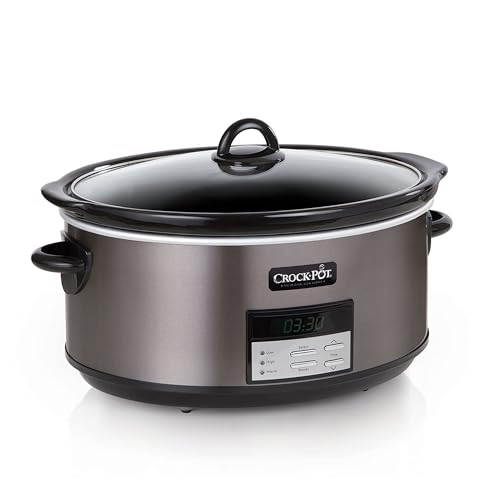
Crock-Pot Programmable Slow Cooker 8-Quart, Black Stainless
Badge: Best for Big Batches
Strengths
- Eight-quart capacity rated for more than ten people makes it the batch-cooking and entertaining pick.
- A digital timer running up to 20 hours covers genuinely long, low cooks without supervision anxiety.
- Automatic warm setting holds food safely after the cook ends, and the lid and stoneware pot are dishwasher-safe.
Trade-offs
- The largest footprint and heaviest crock here; it needs real bench and cupboard space.
- Small households will rarely fill it enough for ideal slow-cooking performance.
- Black stainless shows fingerprints more readily than a plain finish.
At a glance
- Capacity: 8-quart, for 10+ people
- Controls: digital timer up to 20 hours, auto warm setting
- Crock and lid: dishwasher-safe lid and stoneware pot
- Finish: Black stainless steel
When the cooking is for a crowd, capacity stops being a specification and becomes the whole decision. This eight-quart Crock-Pot is the biggest machine in the guide, sized for more than ten people, and it is built for the Australian occasions that actually demand that scale: a whole batch of meatballs for a school fete, a double recipe of beef rendang for the freezer, Christmas-in-July for the extended family, or a sporting club soup day. The black stainless finish also looks the part on an open-plan bench where the cooker will sit in view of guests.
The programmable side is what separates it from a big manual crock. A digital timer that runs up to 20 hours handles the longest legitimate slow cooks — think large, tough cuts given a full day at low — and when the timer ends the machine shifts to warm automatically rather than leaving dinner to drift. That combination, size plus scheduling, is why this is the pick for households that cook ahead: fill it on a Sunday, portion the results, and the week’s dinners are largely solved. The stoneware pot and lid both go in the dishwasher, which matters a great deal when the pot in question is this large and heavy with sauce residue.
The trade-off is everyday practicality for smaller homes. Slow cookers perform best when reasonably full, and an eight-quart crock cooking a two-person stew spreads the food thin and can overcook the edges. It is also a substantial object to store; measure the cupboard before you fall in love with the capacity. Buy it because you regularly cook at scale, not because bigger sounded safer.
Best for: large families, batch cooks and anyone who entertains at home regularly / Not suited for: singles and couples cooking small fresh meals most nights.

Cosori Rice Cooker 10 Cup with Slow Cook
Badge: Most Versatile
Strengths
- A verified 18-in-1 function list that includes sauté and slow cook, so browning and braising can happen in one pot.
- Fuzzy logic control and a ceramic-coated inner pot aim for even, hands-off results across grains and slow dishes.
- Delay timer and long keep-warm suit households that set dinner up in the morning.
Trade-offs
- It is a rice cooker first; the round bowl does not cradle a leg of lamb or a whole chicken like an oval crock.
- Slow-cook capacity is expressed in rice cups, which takes translation for stew-style cooking.
- More electronics and modes than a dedicated cooker, so there is more to learn and more to fail over time.
At a glance
- Capacity: 10 cup uncooked, 20 cup cooked (rice measure)
- Functions: 18-in-1, including sauté and slow cook
- Control: fuzzy logic, 24-hour keep warm and delay timer
- Inner pot: ceramic coating, non-stick
- Included: stainless steel steamer basket
- Colour: Black
The Cosori is the pick for the Australian kitchen that cannot justify a bench full of single-job appliances. Its verified listing describes an 18-in-1 machine built around fuzzy logic control, and slow cook is one of the named functions — not a workaround, a designed mode. Around that core it adds sauté, which matters more than any other extra: browning onions, spices and meat in the same pot before the long cook is the single biggest flavour upgrade in slow cooking, and a stoneware crock simply cannot do it.
Day to day, this is the machine for rice-eating households that also braise. Congee on the slow setting overnight, a curry ticking away while the rice function handles the accompaniment on another night, steamed vegetables in the included stainless basket — the repertoire fits Australian home cooking, where rice is a several-times-a-week staple in many homes. The ceramic-coated inner pot releases food easily and wipes clean fast, and the delay timer plus long keep-warm window mean a meal can be set up before work and be waiting, held safely, at dinner time.
Be clear-eyed about the format, though. Slow cooking in a round, deep rice bowl suits soups, curries, porridges and shredded meats beautifully, but a large roast sits awkwardly and the top-to-bottom heat pattern differs from a wide crock. If your slow cooking is mostly big-format roasts, the oval Crock-Pots in this guide are the honest better tool. If it is mostly saucy, spoonable dishes alongside rice, this is arguably the smartest single purchase here.
Best for: smaller kitchens and rice-eating households that want one machine for grains, steaming and slow dishes / Not suited for: cooks whose slow cooking centres on large whole roasts.

Aroma Housewares 20 Cup Digital Rice Cooker and Slow Cooker (ARC-150SB)
Badge: Best for Large Families
Strengths
- Twenty-cup cooked capacity handles genuinely large households and gatherings.
- Three verified roles in one unit — digital rice cooker, slow cooker and food steamer.
- Digital controls are more precise to set than a dial for repeat recipes.
Trade-offs
- Like the Cosori, it is rice-led, so slow cooking happens in a round pot rather than an oval crock.
- Its capacity is oversized for one or two people cooking fresh each night.
- Stainless exterior needs a wipe to stay free of water marks and fingerprints.
At a glance
- Capacity: 20 cup cooked (10 cup uncooked)
- Functions: digital rice cooker, slow cooker, food steamer
- Exterior: stainless steel
- Model: ARC-150SB
- Colour: Black
Aroma has built rice cookers for decades, and the ARC-150SB applies that experience to the big-family end of the market. Its verified title lists three jobs — digital rice cooker, slow cooker and food steamer — at a 20-cup cooked capacity, which in practical terms means the household that cooks for six at dinner and twelve when relatives visit. For Australian multigenerational homes, and for anyone whose week includes a large Sunday cook-up, that headroom is the point of the machine.
The slow cooker role suits the saucy end of the repertoire: curries, lentil dishes, soups and pulled meats, where the round pot is no handicap at all. Digital controls make repeat cooking easier to standardise — the same setting, the same timing, the same result — and the steamer role earns its keep for dumplings, vegetables and fish alongside the main dish. The stainless steel exterior wipes down quickly and looks tidy on the bench, which matters for a machine this size because it will probably live on the bench.
The limitations mirror the other multicooker here. Whole roasts and large poultry are crock-shaped jobs, and this is not a crock. Small households will also find the capacity more burden than benefit, since slow cooking a small volume in a large pot gives uneven results. Choose it when your cooking genuinely runs large and rice is a regular event; otherwise the dedicated six-quart Hamilton Beach is the leaner answer.
Best for: big households that cook rice often and slow cook in large, saucy batches / Not suited for: small households or roast-centred slow cooking.

Crock-Pot Oval Manual Slow Cooker 7-Quart
Badge: Best Classic Stoneware
Strengths
- Oval stoneware is the natural shape for legs of lamb, whole chickens and long roasts.
- Simple high, low and warm settings with a dial anyone can operate without instructions.
- Removable stoneware moves from cooker to table to fridge without decanting.
Trade-offs
- No timer, so the cook ends when you say so in person, not when the machine decides.
- Seven quarts is a lot of cooker for small meals, and the full crock is heavy to lift.
- Manual models ask the cook to plan recipes around their own schedule.
At a glance
- Capacity: 7-quart, serves 8+ people
- Controls: high and low cook settings, warm setting
- Crock: removable oval stoneware
- Finish: Stainless steel
If the phrase slow cooker conjures one image, it is this: an oval stoneware crock in a stainless housing, a dial on the front, and a leg of lamb inside. The seven-quart Crock-Pot manual model is the traditional format kept current, and for Australian cooking its shape is the argument. Legs and shoulders are long; whole chickens are oval; a rolled roast sits in an oval crock with the cooking liquid distributed the way recipes assume. Round pots make those jobs awkward, and this machine simply does not have that problem.
The control scheme is a dial with high, low and warm, and that is a feature, not an omission, for the right owner. There is nothing to program and nothing to reset after a blackout beyond turning the dial again. The removable stoneware doubles as a serving dish and a fridge container for leftovers, and at seven quarts — about 6.6 litres — it covers the family-plus-guests zone that Australian households hit constantly through winter. Owners comparing evaluation styles may enjoy seeing how this classic format fares under the test criteria discussed in our Best Slow Cookers Consumer Reports style breakdown, where temperature steadiness matters more than feature lists.
Plan around the one real gap: no timer. A manual cooker rewards households where someone is home to switch it to warm, and recipes chosen for forgiving windows. If your weekdays are long and unpredictable, buy the programmable version of this idea instead — it is the next review. If your slow cooking is a weekend ritual, this is the most satisfying machine in the guide to use.
Best for: traditional cooks who slow cook roasts and whole birds, mostly when someone is home / Not suited for: set-and-forget weekday cooking with nobody home to switch it off.
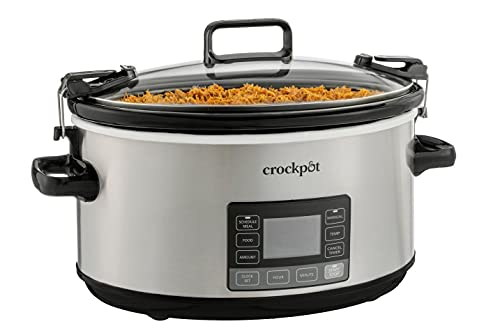
Crock-Pot Programmable Slow Cooker 7-Quart with MyTime
Badge: Best for Transport
Strengths
- MyTime technology adjusts the cooking cycle to be ready at the mealtime you set, rather than a fixed duration.
- Cook & Carry locking lid seals the crock for transport to parties, family lunches and picnics.
- Seven quarts feeds nine or more, the sweet spot for entertaining without going oversized.
Trade-offs
- The locking lid is for carrying, not for cooking with extra pressure or seal benefits at home.
- Scheduling features add setup steps that dial-model owners never think about.
- Like all picks here, it is a US-market unit, so Australian buyers must verify electrical compatibility first.
At a glance
- Capacity: 7-quart, feeds 9+
- Controls: programmable, MyTime technology adjusts cooking
- Lid: Cook & Carry locking lid
- Finish: Stainless steel
Two ideas make this Crock-Pot different. The first is MyTime: instead of telling the cooker how long to cook, you tell it when dinner is, and the technology adjusts the cooking cycle to land the food ready at that mealtime. For Australian households juggling school runs, sport training and variable commutes, that inversion is genuinely useful, because the schedule that slips is yours, not the recipe’s. The second idea is the Cook & Carry locking lid, which clamps the crock shut so a full cooker can ride in the car to a family lunch, a bring-a-plate night or a caravan holiday without painting the boot with sauce.
At seven quarts feeding nine or more, it sits in the entertaining heartland, and the programmable control means a dish can finish and hold while you are still on the road home. The stainless finish matches most Australian kitchens, and the overall package is the most logistics-friendly in this guide: cook at home, lock, carry, serve from the crock. Test-kitchen style thinkers will recognise the priorities here — the criteria explored in our Best Slow Cookers Cooks Illustrated angle piece, where scheduling accuracy and lid design get as much attention as the cooking itself.
The caveats are modest. The locking lid earns its place on the road, not on the bench, and owners should still follow the maker’s guidance about cooking with the lid unlatched if the listing directs it. The scheduling also rewards a minute of setup thought each time, which dial loyalists will find fussy. Neither point dents the core case: this is the pick for people whose slow cooking leaves the house.
Best for: entertainers and busy families who transport food and need dinner ready at a set time / Not suited for: cooks who want the absolute simplest dial-only machine.
Comparison Table
The table below lines the six picks up on the attributes an Australian buyer can verify from the listings. Use it to shortlist, then read the full review of your favourite before deciding.
| Pick | Capacity | Controls | Standout feature | Link |
|---|---|---|---|---|
| Hamilton Beach 6 Quart Slow Cooker (33665G) | 6 quart | 3 settings, manual | Dishwasher-safe stoneware and lid | Check on Amazon |
| Crock-Pot Programmable Slow Cooker 8-Quart, Black Stainless | 8-quart, 10+ people | Digital timer to 20 hours, auto warm | Largest capacity in the guide | Check on Amazon |
| Cosori Rice Cooker 10 Cup with Slow Cook | 10 cup uncooked rice measure | Fuzzy logic, delay timer | 18-in-1 with sauté and slow cook | Check on Amazon |
| Aroma Housewares 20 Cup Digital Rice Cooker and Slow Cooker (ARC-150SB) | 20 cup cooked | Digital | Rice cooker, slow cooker and steamer in one | Check on Amazon |
| Crock-Pot Oval Manual Slow Cooker 7-Quart | 7-quart, 8+ people | High, low and warm dial | Oval stoneware for roasts | Check on Amazon |
| Crock-Pot Programmable Slow Cooker 7-Quart with MyTime | 7-quart, 9+ people | Programmable, MyTime | Locking Cook & Carry lid | Check on Amazon |
How to Choose a Slow Cooker in Australia
Start with the electrical question, not the features
Australia uses 230–240 volt power with Type I plugs; the United States uses a lower voltage and different plugs. A US-market slow cooker imported without checking this can be damaged, dangerous or simply dead on arrival, and plugging a heating appliance into a cheap travel adaptor is not a safe workaround. Before ordering, read the listing for its voltage specification, look for dual-voltage marking, and if the machine is single-voltage US spec, factor a properly rated converter into the true cost — or choose a locally sold equivalent instead. This single check decides whether an import is a bargain or a paperweight, and it is why this guide raises it before capacity or controls.
Convert the capacity into litres and people
US slow cookers are sized in quarts. One quart is a little under a litre, so the six, seven and eight-quart machines here hold roughly 5.7, 6.6 and 7.6 litres. As a working rule, allow about a quart per person for a main dish with leftovers: six quarts for a family of four to six, seven for regular guests, eight for batch cooking and events. Remember the fill rule as well — slow cookers cook best half to two-thirds full — so buy for the load you will actually cook, not the biggest number on the shelf. Rice-led machines quote capacity in cups of rice, which measures the grain pot, not a stew; treat the Cosori and Aroma capacities as large-family indicators rather than direct crock equivalents.
Manual dial or programmable control
A manual dial is simple, durable and entirely dependent on your presence. A programmable machine adds a countdown and an automatic warm switch, which suits long workdays; the MyTime model goes further and schedules backwards from dinnertime. Households where someone is home most days can save money and complexity with the dial. Households where the cooker runs unattended for a full workday should treat programmability as a safety and quality feature, not a luxury, because food held too long at cooking temperature deteriorates and food left cooling is worse.
Crock shape and material
Oval stoneware fits roasts and whole birds and doubles as a serving dish; it is heavy and can crack if shocked by sudden temperature changes, so let it adjust before adding cold liquid to a hot crock. Round multicooker pots are lighter, often non-stick or ceramic-coated, and clean faster, but they suit saucy dishes better than large joints. Glass lids let you watch without lifting; locking lids are for transport. None of these is universally better — the right answer is the shape of the food you cook most.
How to Use and Care for Your Slow Cooker
Good slow cooking is mostly sequencing. Brown meat and bloom spices first where the recipe and the pot allow it — in a skillet for crock models, or with the sauté function on the Cosori — because the slow cooker itself will not create those flavours. Layer dense vegetables at the bottom near the heat, add meat on top, keep the lid closed, and resist lifting it: every peek releases the accumulated heat and extends the cook. Add dairy, fresh herbs and quick-cooking vegetables near the end so they keep their character.
- Prepare ingredients the night before where possible, refrigerating them in the crock or a container so the morning setup takes minutes.
- Fill the crock between half and two-thirds full, and trim large cuts so they sit in the liquid rather than above it.
- Choose low for long, unattended cooks and high for shorter ones; when a recipe gives both, the low version usually tastes better.
- Hold finished food on warm for serving, but refrigerate leftovers promptly in shallow containers rather than leaving them in the crock.
- Wash stoneware and lids once cooled; most picks here are dishwasher-safe, but hand washing extends the life of any crock.
Troubleshooting
Problem: the sauce is thin and watery at the end → what to do: slow cookers trap moisture, so reduce the liquid next time, and for this batch, simmer the sauce briefly in a pan or stir through a small cornflour slurry and give it a short burst on high with the lid ajar.
Problem: meat is tender but tastes flat → what to do: the dish needed browning or acid; next time sear first and finish with a splash of vinegar or lemon, and check the seasoning only at the end, since long cooking mutes salt perception early.
Problem: vegetables are mushy while the meat is perfect → what to do: cut root vegetables larger, add delicate vegetables in the last hour, and place the longest-cooking items at the bottom where the heat is strongest.
Slow Cooking Through the Australian Year
The Australian calendar gives the slow cooker two distinct seasons of glory. Through the southern winter, it is the obvious tool for the heavy repertoire: osso buco, lamb shanks, beef cheeks and the long curries that perfume a house for a day. Through summer, its value flips — a slow cooker does the work of an oven without heating the kitchen like one, which on a forty-degree afternoon is not a minor benefit. Pulled meats for salads and rolls, poached chicken for sandwiches and a big pot of beans for the week all come off the bench appliance while the oven stays cold and the air-conditioning stays ahead.
Regional cooking maps onto the picks naturally. The oval crock handles a leg of lamb for a Sunday roast household; the multicookers suit the rice-centred cooking common in many Australian cities; the eight-quart programmable model is the one that feeds a junior sports club or a shearing shed crew. Thinking about your calendar — winter braises, summer no-oven cooking, and the two or three big gatherings a year — usually identifies the right pick faster than any feature list. Shoppers who like to see the long view of the category can also browse our take on the Best Slow Cookers Ever conversation, which looks at which designs have lasted and why.
Importing Versus Buying Locally
There are honest arguments both ways. Importing from the US range gives access to models, sizes and scheduling features that never receive an Australian release, and for a confident buyer who verifies voltage and accepts freight times, it can be the only way to get a specific machine like the MyTime Crock-Pot. Buying locally gives a compliant plug, local warranty handling and a retailer who answers the phone in your time zone. The mistake is drifting into an import accidentally — ordering on price alone and discovering the compromises at the door. Decide deliberately, run the electrical check first, and either route can end with the right cooker on the bench.
Using American Recipes in an Australian Kitchen
Most slow cooker recipes an Australian owner will find are written for the US market, and a small amount of translation makes them work first time. Temperatures are the easy part: slow cookers are labelled low, high and warm on both sides of the Pacific, so no conversion is needed at the dial. Volumes need more care. An American cup is a fraction smaller than the Australian metric cup, and a US tablespoon is smaller than the Australian one, so for liquid-heavy recipes it is worth measuring by the millilitre marks in the crock rather than by counting cups from a translated recipe. When a recipe is built around quarts, remember the guide above: six quarts is about 5.7 litres, so a recipe written for a six-quart cooker maps directly onto the family picks here.
Ingredient names shift as well. What US recipes call bell peppers are capsicums, cilantro is coriander leaf, and a recipe’s call for a specific cut such as chuck or brisket translates cleanly at any Australian butcher, who will usually suggest the local equivalent for long cooking without being asked. Canned goods differ in size between the two markets, so treat tin quantities as approximate and judge by the fill line in the crock instead. None of this is difficult, but the cooks who get caught out are the ones who assume the two systems are identical. A single practice run with a forgiving recipe — a soup or a pulled meat — calibrates your machine, your measurements and your timing together, and after that the imported recipe library is fully open to you.
Common Buying Mistakes
- Ignoring voltage and plugs. The costliest error for Australian buyers; verify the electrical specification before anything else.
- Buying the biggest size by default. An under-filled large crock cooks unevenly; match capacity to your real household load.
- Paying for programming you will not use — or skipping it when you need it. Match the control style to whether someone is home at finishing time.
- Judging a multicooker as a crock. Round rice-led pots are excellent at saucy dishes and poor at whole roasts; buy the format for your food.
- Lifting the lid to check. A buying mistake only in spirit: owners who peek constantly conclude their cooker is slow, when the heat loss is self-inflicted.
Final Recommendation
For most Australian households, start with the Hamilton Beach 6 Quart Slow Cooker: the size is right, the controls could not be simpler, and dishwasher-safe stoneware keeps it in weekly use. If your cooking regularly runs to crowds and freezer batches, step up to the Crock-Pot Programmable 8-Quart, whose timer and automatic warm make big cooks manageable on a workday schedule. If your bench space is tight and rice is a staple, the Cosori Rice Cooker 10 Cup earns its place by doing several jobs in one footprint. Whichever you choose, run the voltage and plug check before ordering — in Australia, that ten-minute check is the difference between a bargain and a box in the garage.
Frequently Asked Questions
Can I use a US slow cooker in Australia?
Only after verifying the electrical specification on the listing. Australia uses a higher voltage and a different plug type from the United States, so a US-only model needs a properly rated conversion solution and should never be run through a lightweight travel adaptor. If the listing does not clearly confirm compatibility, treat that as your answer and look at a locally compliant equivalent instead.
What size slow cooker does an Australian family need?
For most families of four to six, six quarts — about 5.7 litres — is the sweet spot, cooking a main dish with leftovers while still filling the crock properly. Move to seven or eight quarts if you entertain often, batch cook for the freezer, or regularly cook whole chickens and large roasts.
How many litres is a 7-quart slow cooker?
Roughly 6.6 litres. A US quart is slightly smaller than a litre, so six quarts is about 5.7 litres and eight quarts about 7.6 litres. Recipes written in litres translate directly; just keep the crock between half and two-thirds full.
Is a programmable slow cooker worth it over a manual one?
If the cooker will regularly finish while nobody is home, yes — the countdown and automatic warm setting protect both quality and food safety. If someone is usually around at finishing time, a manual dial does the same cooking for less money and with less to go wrong.
Can a rice cooker with a slow-cook function replace a slow cooker?
For soups, curries, porridges and shredded meats, largely yes, and you gain rice and steaming functions in the same footprint. For whole roasts and large poultry, the oval stoneware crock remains the better tool because of its shape. Many households find the multicooker covers ninety percent of their slow cooking; roast-centred cooks should buy the crock.
Why does my slow cooker seem slower than recipes suggest?
Usually the lid. Every lift releases the built-up heat and adds recovery time. Fill level matters too: an under-filled crock can run hot and fast at the edges, while an overfilled one heats sluggishly. Cook with the lid closed, fill between half and two-thirds, and give a new machine two or three cooks before judging its pace.


