Disclosure: topratedkitchenware.com is reader-supported. When you buy through links on our site, we may earn an affiliate commission from Amazon and other retailers, at no extra cost to you.
Where to buy
The quickest route to each recommendation for the best slow cookers canada households can buy is below. Linked picks go straight to their Amazon listing, where you can check on Amazon for the current details, the seller and the delivery terms before you buy. Canadian shoppers should read the cross-border notes in this guide, because ordering a US listing from Canada involves shipping, currency and warranty considerations that a domestic order does not. Read the full guide ↓ for the reasoning, the comparisons and the buying advice before you decide.
- Crock-Pot Oval Manual Slow Cooker 7-Quart — Best Overall
- Crock-Pot Programmable Slow Cooker 7-Quart with MyTime — Best Programmable
- Hamilton Beach 6 Quart Slow Cooker (33665G) — Best Simple Pick
- Crock-Pot Programmable Slow Cooker 8-Quart, Black Stainless — Best for Big Gatherings
- Cosori Rice Cooker 10 Cup with Slow Cook — Most Versatile
- Aroma Housewares 20 Cup Digital Rice Cooker and Slow Cooker (ARC-150SB) — Best Multitasker
Finding the best slow cookers canada households can buy with confidence is a simpler electrical story than most import shopping, and a trickier retail one. The good news first: Canada and the United States share the same household voltage and plug standard, so a US-market slow cooker plugs into a Canadian kitchen outlet and runs as designed, with none of the converter worries that complicate buying appliances from Europe or Australia. The trickier part is everything around the machine — whether a given model is stocked domestically or ships across the border, what the landed cost looks like after currency and delivery, and how warranty service works when the seller sits in another country. This guide weighs all of that alongside the cooking itself.
The six picks below were verified through the Amazon Creators API, and they cover the shapes Canadian slow cooking actually takes. There are oval stoneware crocks for Sunday roasts and holiday birds, programmable models that finish dinner while you are still at the arena or on the late train, an eight-quart batch machine for tournament chilis and freezer days, and two rice-led multicookers whose verified listings include a genuine slow-cook function for households where rice, soups and curries rotate through the week. Sizes run from six to eight quarts, which suits the way Canadians actually use these machines through a long winter: big, warming, make-ahead food.
A word on seasons, because it shapes the recommendation. In Canada a slow cooker is not a novelty gadget; from roughly October to April it is core infrastructure. It is the appliance that turns a pork shoulder into pulled pork while the snow falls, that keeps a pea soup or a beef stew ready across the staggered arrivals of a family coming home from work, school and practice, and that does it without heating the whole kitchen in July either, when it earns a second life at the cottage. Buy for that calendar — capacity for winter batches, scheduling for busy weekdays, transport if the cooker travels to family gatherings — and the choice below becomes straightforward. Readers weighing the feature sets in the abstract can also consult our Best Slow Cookers Features comparison alongside this market guide.
Key Takeaways
- US slow cookers run on Canadian power without conversion — the same voltage and plugs — so the checks that matter are shipping, currency and warranty, not electricity.
- Seven quarts is the Canadian family sweet spot for roasts and whole birds; eight quarts serves batch cooking and big gatherings.
- Programmable models with automatic warm suit households scattered across work, school and arena schedules.
- The MyTime model’s locking lid makes it the pick for food that travels to family dinners and potlucks.
- The Cosori and Aroma picks are rice-led multicookers with a verified slow-cook function; their round pots suit soups and curries, not whole roasts.
- Compare the landed cost of a US listing against domestic availability before ordering across the border.
In this guide
Quick Picks
Six machines, six distinct jobs. The badges below are used consistently through the detailed reviews, so you can move between this summary and the full sections without translating between two sets of labels.
| Pick | Badge | Best for | Link |
|---|---|---|---|
| Crock-Pot Oval Manual Slow Cooker 7-Quart | Best Overall | The classic oval crock for roasts and whole birds, run by a simple dial | Check on Amazon |
| Crock-Pot Programmable Slow Cooker 7-Quart with MyTime | Best Programmable | Scheduling that works back from your mealtime, with a locking lid for transport | Check on Amazon |
| Hamilton Beach 6 Quart Slow Cooker (33665G) | Best Simple Pick | Three settings, dishwasher-safe parts and the right size for smaller households | Check on Amazon |
| Crock-Pot Programmable Slow Cooker 8-Quart, Black Stainless | Best for Big Gatherings | The largest capacity here, with a long timer for batch and event cooking | Check on Amazon |
| Cosori Rice Cooker 10 Cup with Slow Cook | Most Versatile | An 18-in-1 machine where slow cooking sits alongside rice, sauté and steaming | Check on Amazon |
| Aroma Housewares 20 Cup Digital Rice Cooker and Slow Cooker (ARC-150SB) | Best Multitasker | Large cooked capacity for big households that cook rice and slow dishes in volume | Check on Amazon |
How These Picks Were Chosen
This is a research-led guide, and it does not claim hands-on testing that did not happen. Picks were drawn from a verified product pool checked through the Amazon Creators API, which confirmed each product’s identity, brand, capacity, listed functions and image. Products were compared on the criteria that decide satisfaction with this appliance type: capacity against household size, control style against daily routine, crock format against the food a household actually cooks, and — because the keyword is geographic — the model’s practicality for a Canadian owner. Mainstream models from established brands scored well on that last test, because parts, replacement crocks and product information remain easy to find years later, whichever side of the border the original order crossed.
Specifications in the mini spec boxes come only from the verified listings; if a detail was not in the listing data provided, it is not printed here as fact. Market guidance — how cross-border shipping, currency conversion and warranty handling usually work — is framed as general advice to verify at the listing, because the exact terms depend on the seller and can change. Prices are not printed in this guide at all, deliberately, and for Canadian buyers that discipline matters double: a US listing’s figure is not your landed cost until shipping and conversion are counted, so the only honest instruction is to check the final total at checkout against the domestic alternative. Readers interested in how independent evaluators approach this category can cross-reference the criteria in our Best Slow Cookers Consumer Reports style analysis.
Two of the six picks are multicookers rather than dedicated slow cookers. They are included because their verified titles list a slow-cook function or a slow cooker role, and their reviews state plainly where the round-bowl format helps a Canadian kitchen and where a classic oval crock does the job better.
The 6 Best Slow Cookers Canada Households Can Buy
Each review follows the same pattern: what the machine is, where it is strong, where it honestly falls short, the verified specifications, and who in Canada should buy it — or skip it.

Crock-Pot Oval Manual Slow Cooker 7-Quart
Badge: Best Overall
Strengths
- Oval stoneware is the natural shape for the roasts, whole chickens and holiday birds at the centre of Canadian family cooking.
- High, low and warm on a simple dial — nothing to program, nothing electronic to fail through years of winters.
- Removable stoneware goes from cooker to table to fridge, which suits make-ahead weekend cooking.
Trade-offs
- No timer, so a person has to be home to end the cook or move it to warm.
- Seven quarts is generous for a household of two cooking fresh each night.
- The full stoneware crock is heavy, especially filled, and needs two hands and respect.
At a glance
- Capacity: 7-quart, serves 8+ people
- Controls: high and low cook settings, warm setting
- Crock: removable oval stoneware
- Finish: Stainless steel
Start with the machine that matches the Canadian canon. The seven-quart oval Crock-Pot is the traditional format: a heavy stoneware crock in a stainless housing, a dial with high, low and warm, and a shape that accepts the food this country slow cooks most — pot roasts, pork shoulders, whole chickens and the occasional small turkey breast when the oven is spoken for. In a Canadian winter this is the cooker that starts on a Sunday morning and anchors the week’s eating: dinner that night, sandwiches from the leftovers, soup from what remains.
The manual control deserves defence rather than apology. A dial cannot crash, does not care about a power flicker during a storm beyond needing a glance, and will very likely outlast every electronic appliance bought the same year. For households where someone is home through the day, or where the slow cooking happens on weekends, that simplicity is the whole point. The removable stoneware supports the rhythm too: cook in it, serve from it, refrigerate the leftovers in it, and wash it when it is empty rather than decanting between vessels.
Its limit is the weekday pattern. If the house empties at eight and refills at six, a cooker that needs a human hand at the end of the cook will either overcook dinner or demand recipes chosen for forgiveness. That household should buy the programmable version of this same idea, reviewed next. But as the default Canadian family cooker — the one that will still be braising in a decade — this is the guide’s first recommendation, and the test criteria discussed in our Best Slow Cookers Cooks Illustrated angle piece, which prize even heat and sensible design, point the same way.
Best for: Canadian families whose slow cooking centres on roasts and weekend make-aheads / Not suited for: households needing the cooker to finish unattended on a timer.
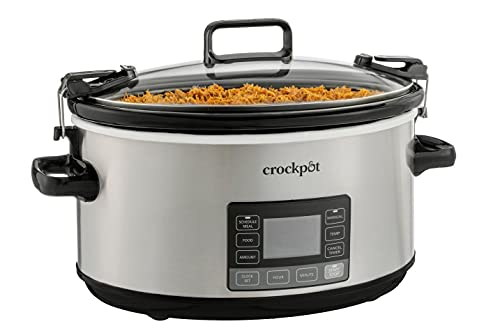
Crock-Pot Programmable Slow Cooker 7-Quart with MyTime
Badge: Best Programmable
Strengths
- MyTime technology adjusts the cooking cycle to be ready at the mealtime you set, ideal for unpredictable Canadian family schedules.
- Cook & Carry locking lid seals a full crock for the drive to family dinners, team wind-ups and cottage weekends.
- Seven quarts feeding nine or more covers the family-plus-guests zone without eight-quart bulk.
Trade-offs
- Scheduling features add a setup step to every cook, which dial loyalists will find unnecessary.
- The locking lid is a transport benefit, not a cooking improvement at home.
- Programmable electronics are a longer-term failure risk than a dial, as with all models of this type.
At a glance
- Capacity: 7-quart, feeds 9+
- Controls: programmable, MyTime technology adjusts cooking
- Lid: Cook & Carry locking lid
- Finish: Stainless steel
Canadian family schedules are a special kind of chaos: two jobs, school, a practice across town and a game across the city, all converging on a dinner hour that moves daily. This Crock-Pot is built for exactly that. Its MyTime technology inverts the usual programming — instead of setting a cook duration, you set the mealtime and the machine adjusts the cooking cycle to be ready then — which means a stew can be loaded before the morning rush and land correctly whether dinner happens at five-thirty or seven.
The Cook & Carry locking lid is the second half of the case, and it is a distinctly Canadian virtue. So much of this country’s slow cooking travels: the chili going to the rink canteen fundraiser, the meatballs heading to a family dinner across town, the pulled pork riding to the cottage. A lid that clamps the crock shut turns those trips from a gamble into a routine. At seven quarts the capacity feeds nine or more, so the same machine handles the travelling dish and the home crowd without asking a household to own two cookers.
Be honest about whether you will use the scheduling. A household with a metronome routine gains little over the manual model and takes on the extra setup each time. But for the family whose dinner hour genuinely floats, this is the pick that removes the daily negotiation between the recipe and the calendar — and in February, when everyone comes home cold and hungry at slightly different times, that is worth a great deal.
Best for: busy Canadian families with shifting mealtimes and food that travels / Not suited for: routine-schedule households that would never set the scheduler.

Hamilton Beach 6 Quart Slow Cooker (33665G)
Badge: Best Simple Pick
Strengths
- Six quarts suits smaller Canadian households, condo kitchens and cottage duty where seven or eight quarts would sit under-filled.
- Three cooking settings with dishwasher-safe stoneware and lid keep both the learning curve and the cleanup minimal.
- A clearly identified mainstream model (33665G), easy to match exactly at the listing.
Trade-offs
- Manual only: no countdown, no automatic warm when the cook ends.
- Less natural for very large roasts than the oval seven-quart crocks.
- Keen entertainers will find the capacity a ceiling.
At a glance
- Capacity: 6 quart
- Controls: 3 cooking settings
- Crock and lid: dishwasher-safe stoneware crock and glass lid
- Finish: Silver
- Model: 33665G
Not every Canadian kitchen is a farmhouse, and not every slow cooker needs to feed a hockey team. The Hamilton Beach 33665G is the six-quart answer for the households in between: couples who batch a soup on Sunday, small families in condos where storage is measured in centimetres, and cottage owners who want a second, simpler cooker for the lake. Three cooking settings, a stoneware crock and a glass lid — the specification is short because the job is well understood.
In use it covers the core repertoire without drama: stews, curries, pulled meats, baked beans and the long braises that make a small home smell wonderful through a cold afternoon. The glass lid lets you check progress without lifting and losing heat, and both crock and lid go in the dishwasher, which is precisely the feature that decides whether a small household uses a cooker weekly or lets it drift to the back of the cupboard. Smaller households thinking about sizing will find the fuller discussion in our Best Slow Cookers For 2 People guide, which works through the fill-level maths for compact cooking in detail.
The trade-off is the same one every manual model carries: the cook ends when a person ends it. For the households this pick targets — home-centred, weekend-led, or cooking in smaller batches with shorter times — that rarely bites. Buy it as the right-sized, right-priced-in-its-tier default, and it will quietly do a decade of winters.
Best for: smaller households, condo kitchens and cottages wanting simple, right-sized slow cooking / Not suited for: large gatherings or unattended timed weekday cooking.
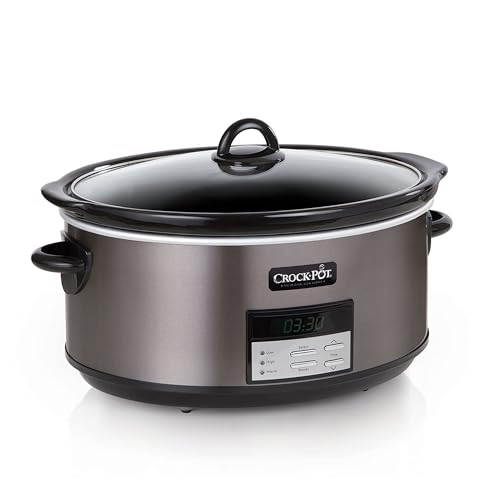
Crock-Pot Programmable Slow Cooker 8-Quart, Black Stainless
Badge: Best for Big Gatherings
Strengths
- Eight-quart capacity rated for more than ten people is built for tournament chilis, holiday overflow and freezer days.
- Digital timer up to 20 hours with automatic warm keeps the biggest cooks hands-off and safe.
- Dishwasher-safe lid and stoneware pot make the cleanup after a full batch manageable.
Trade-offs
- The largest footprint and heaviest crock in the guide; it needs real storage.
- Small households will under-fill it and get uneven results.
- Black stainless shows fingerprints and asks for a wipe to look its best.
At a glance
- Capacity: 8-quart, for 10+ people
- Controls: digital timer up to 20 hours, auto warm setting
- Crock and lid: dishwasher-safe lid and stoneware pot
- Finish: Black stainless steel
Some Canadian cooking is simply big: the chili that feeds a dressing room, the tourtière filling for a family that still makes them by the dozen, the harvest supper, the freezer-filling Sunday that sets up a month of weeknights. This eight-quart Crock-Pot is the machine in the guide sized for that cooking, rated for more than ten people, and its controls match the ambition — a digital timer running up to 20 hours for the longest low cooks, and an automatic warm setting that holds the finished batch safely through an event’s shifting schedule.
The programmable side matters more at this scale than any other. A full eight-quart crock represents a serious investment of ingredients, and the timer-plus-warm combination protects it: the cook ends on time even if the game goes to overtime, and the food waits at serving temperature instead of sliding past its best. The black stainless finish also suits the machine’s likely life on display in an open kitchen rather than hidden in a cupboard, and the dishwasher-safe crock and lid keep the aftermath of a ten-person batch from becoming the argument against ever doing it again.
Apply the usual discipline. This cooker earns its storage space only in a household whose calendar genuinely includes the crowds. Bought aspirationally by a quiet couple, it becomes a very large reminder that capacity is not a virtue by itself. Bought by the family that hosts, batches and feeds the neighbourhood, it is the most useful machine here.
Best for: big Canadian families, community cooks and freezer-batch households / Not suited for: small households cooking fresh in small quantities.

Cosori Rice Cooker 10 Cup with Slow Cook
Badge: Most Versatile
Strengths
- A verified 18-in-1 function list including sauté and slow cook covers the multicultural repertoire of a Canadian city kitchen in one machine.
- Fuzzy logic control with delay timer and long keep-warm suits set-up-in-the-morning households.
- Ceramic-coated inner pot cleans easily and the stainless steamer basket is included.
Trade-offs
- A rice cooker first: the round bowl does not cradle whole roasts or large poultry like an oval crock.
- Capacity is stated in rice cups, which needs translating for stew-style cooking.
- The most electronics of any pick here, with the learning curve that implies.
At a glance
- Capacity: 10 cup uncooked, 20 cup cooked (rice measure)
- Functions: 18-in-1, including sauté and slow cook
- Control: fuzzy logic, 24-hour keep warm and delay timer
- Inner pot: ceramic coating, non-stick
- Included: stainless steel steamer basket
- Colour: Black
Canadian home cooking is gloriously plural — a week can run from butter chicken to congee to a French-Canadian pea soup without leaving the same kitchen — and the Cosori is the pick built for that reality. Its verified listing describes an 18-in-1 machine on fuzzy logic control, with slow cook as a named function and sauté beside it, so the onions, spices and meat can be browned in the same pot that then braises them. For condo kitchens in Toronto or Vancouver where every appliance must justify its footprint twice, that consolidation is the argument.
The slow-cook mode suits the spoonable end of the repertoire beautifully: curries that improve over hours, overnight congee, soups and shredded meats. The delay timer and long keep-warm window let a household stage dinner before the commute and find it held properly at the end of the day, and the ceramic-coated pot releases the sticky, starchy dishes that make stoneware owners reach for the soaking sink. Steaming in the included basket rounds out weeknight cooking — vegetables, dumplings and fish alongside the main event.
The boundary is geometry. If your slow cooking is built around whole roasts and birds, buy an oval crock and do not ask a round rice bowl to pretend. If it is built around saucy, grain-friendly dishes, this is the most capable single purchase in the guide, and the one most likely to be used on nights that are not slow-cooker nights at all.
Best for: diverse, rice-friendly repertoires in space-conscious Canadian kitchens / Not suited for: roast-and-whole-bird centred slow cooking.

Aroma Housewares 20 Cup Digital Rice Cooker and Slow Cooker (ARC-150SB)
Badge: Best Multitasker
Strengths
- Twenty-cup cooked capacity serves the largest households and extended-family gatherings.
- Three verified roles — digital rice cooker, slow cooker and food steamer — in one unit.
- Digital controls make the family’s repeat recipes easy to reproduce exactly.
Trade-offs
- Rice-led format shares the round-pot limits for roasts.
- Oversized for one or two people; big pots cook small loads unevenly.
- Fewer scheduling specifics are listed than on the programmable Crock-Pots, so verify timer details at the listing.
At a glance
- Capacity: 20 cup cooked (10 cup uncooked)
- Functions: digital rice cooker, slow cooker, food steamer
- Exterior: stainless steel
- Model: ARC-150SB
- Colour: Black
The Aroma ARC-150SB is the multicooker scaled for the big Canadian household: the multigenerational home, the family that hosts the extended clan through the holidays, the kitchen where rice appears daily and in quantity. Its verified title lists a digital rice cooker, slow cooker and food steamer at a 20-cup cooked capacity, and that combination — real volume across three everyday jobs — is its whole case.
In slow-cook mode it handles the saucy repertoire at family scale: curries, lentil dishes, soups and pulled meats, with digital controls that make the household’s standard recipes repeatable by any family member, not just the one who invented them. The steamer role earns its place during big meals, when vegetables and dumplings can cook alongside rather than queuing for a burner, and the stainless steel exterior tolerates the constant wiping that a hard-working family appliance receives. Aroma’s long history in this category also makes it a steadier long-term ownership bet than an unknown badge on the same functions.
Size is the caveat, as it is for every large machine. A 20-cup pot asked to slow cook dinner for two will spread the food thin and cook it unevenly, and the household that has recently downsized should take the six-quart Hamilton Beach instead. For the household still cooking at full strength, this is the multitasker that keeps up — a judgement that echoes the long-view thinking in our Best Slow Cookers Ever piece, where sustained usefulness beats novelty every time.
Best for: large and multigenerational households cooking rice and slow dishes in volume / Not suited for: small households or roast-centred cooking.
Comparison Table
Line the six picks up on the attributes a Canadian buyer can verify from the listings. Use the table to shortlist, then read the full review of your favourite before deciding.
| Pick | Capacity | Controls | Standout feature | Link |
|---|---|---|---|---|
| Crock-Pot Oval Manual Slow Cooker 7-Quart | 7-quart, 8+ people | High, low and warm dial | Oval stoneware for roasts | Check on Amazon |
| Crock-Pot Programmable Slow Cooker 7-Quart with MyTime | 7-quart, 9+ people | Programmable, MyTime | Locking Cook & Carry lid | Check on Amazon |
| Hamilton Beach 6 Quart Slow Cooker (33665G) | 6 quart | 3 settings, manual | Dishwasher-safe stoneware and lid | Check on Amazon |
| Crock-Pot Programmable Slow Cooker 8-Quart, Black Stainless | 8-quart, 10+ people | Digital timer to 20 hours, auto warm | Largest capacity in the guide | Check on Amazon |
| Cosori Rice Cooker 10 Cup with Slow Cook | 10 cup uncooked rice measure | Fuzzy logic, delay timer | 18-in-1 with sauté and slow cook | Check on Amazon |
| Aroma Housewares 20 Cup Digital Rice Cooker and Slow Cooker (ARC-150SB) | 20 cup cooked | Digital | Rice cooker, slow cooker and steamer in one | Check on Amazon |
How to Choose a Slow Cooker in Canada
Do the border maths before the feature maths
Because Canada shares plugs and voltage with the United States, the machine itself needs no adaptation — the decision is commercial. For any US listing, work out the landed cost: the item price converted to Canadian dollars, plus shipping, plus any import charges the checkout shows, and compare that total with the same or closest model available domestically. Sometimes the US route wins, especially for models with no Canadian distribution; sometimes a modest headline saving evaporates entirely. Also weigh the warranty route: a defect handled by a domestic retailer is a trip across town, while a cross-border warranty can mean shipping a heavy stoneware appliance internationally. None of this argues against importing — it argues for importing with the full number in view.
Size for winter, not for July
Canadians use slow cookers most heavily in the cold months, when batch cooking and big warming dishes dominate, so size for that season: roughly a quart per person for a main dish with leftovers, half to two-thirds full in practice. Six quarts covers smaller households, seven is the family standard that also fits whole birds, and eight is for the households that cook for events and freezers. If the cooker will also live a second life at a cottage, add transport to the checklist — a locking lid, as on the MyTime model, is worth real money on gravel roads.
Match controls to the household’s day
A manual dial is the durable, simple choice for homes where someone is around at finishing time. Programmable control with automatic warm is the right purchase when the cooker routinely finishes into an empty house — a common Canadian pattern with commuting and activities — because it protects both the food and the schedule. Mealtime scheduling, as on the MyTime Crock-Pot, is the premium form of the same idea for households whose dinner hour genuinely moves.
Crock or multicooker pot
Choose the oval stoneware format if roasts, whole poultry and traditional braises anchor your cooking; choose a rice-led multicooker if grains, steaming and saucy dishes dominate and bench space is scarce. The formats are both legitimate; the mistake is buying one while cooking like the other.
How to Use and Care for Your Slow Cooker
Load the machine the way slow cooking rewards: dense root vegetables at the bottom near the heat, meat on top, liquid enough to cradle rather than drown, and the lid left closed. Brown meat and bloom spices first for depth — in a skillet for the crock models, or with the Cosori’s sauté function — and add dairy, fresh herbs and delicate vegetables near the end. In winter, take advantage of the format’s make-ahead nature: assemble the night before, refrigerate, and start the cook in the morning.
- Fill the crock between half and two-thirds full, and trim large cuts so they sit in the liquid.
- Choose low for long unattended cooks; reserve high for shorter, supervised ones.
- Hold finished food on warm for serving, then refrigerate leftovers promptly in shallow containers.
- Let stoneware cool before washing to avoid thermal shock, and never place a hot crock on a cold stone counter.
- Store the cooker with the lid slightly ajar or inverted with a cloth between lid and crock to keep it fresh.
Troubleshooting
Problem: a winter power flicker stopped a programmable cook mid-cycle → what to do: check how long the power was out; if the food sat cooling for an extended period, discard it rather than reheating, and for future storm-season cooks favour recipes and models whose restart behaviour you have verified in the manual.
Problem: the sauce is thin and watery → what to do: slow cookers trap moisture, so reduce liquid next time; for this batch, lift the lid for the final stretch on high or finish the sauce briefly in a pan.
Problem: the crock is hard to clean after a cheesy or sugary dish → what to do: soak in warm water before washing, avoid abrasive scouring on stoneware glaze and ceramic coatings, and line the crock for the stickiest recipes next time.
Slow Cooking Through the Canadian Year
The Canadian slow cooker earns its counter space in two acts. Act one is winter: pea soup, beef stew, maple-baked beans, pulled pork and the long braises that make a house feel defended against February. This is when capacity and warm-holding matter most, because winter eating is staggered eating — skiers, shift workers and hockey families arriving in waves, all expecting the pot to be ready. Act two is summer at the cottage, where the same machine cooks without heating a small kitchen, feeds a dock’s worth of visitors from one pot, and turns the day’s catch or the farm-stand vegetables into dinner while everyone stays outside. A cooker chosen with both acts in mind — right-sized, schedulable, and transportable if it travels — is the one that never gets relegated to the basement shelf.
Measurements, Manuals and Recipes in a Metric Country
Canada officially cooks in metric and practically cooks in both systems at once, and slow cookers sit right on that seam. The machines in this guide are sized in quarts, which Canadian cooks handle comfortably because a quart is close to a litre — six quarts is roughly 5.7 litres, seven roughly 6.6 and eight roughly 7.6 — so a recipe written in litres needs no real translation, just the fill rule: half to two-thirds full. Where a recipe gives an oven temperature for a hybrid method, your oven’s Celsius dial handles it; the slow cooker itself only asks you to choose low, high or warm, in either language.
Product documentation follows the same bilingual pattern. Appliances sold through Canadian channels normally ship with English and French documentation, while a unit ordered from a US listing may arrive with English-only materials. For a dial slow cooker that hardly matters — the controls are three words long — but for a programmable or multicooker model, check the listing or the maker’s site for the manual in your preferred language before ordering, and download it while the model is current. It is a two-minute task at purchase time and an annoying one three winters later when you finally want the delay-timer instructions.
Where Each Pick Travels: Cottage, Arena and the Holiday Circuit
Canadian slow cookers lead unusually mobile lives, and it is worth matching the pick to the itinerary. The cottage cooker wants simplicity and toughness: the manual Hamilton Beach and the oval Crock-Pot shrug off rough roads, generator-adjacent power and a season in a cold cupboard, and neither asks anyone to remember a programming sequence at the lake. The travelling-to-dinner cooker wants the MyTime model’s locking lid, because the difference between a sealed crock and a hopeful one is measured in car upholstery. The arena and community-hall cooker wants the eight-quart Crock-Pot’s capacity and warm-holding, sized for a crowd and patient about serving times. And the stay-at-home multicookers, the Cosori and the Aroma, travel least well and earn their place by never needing to: they are the fixed centre of a busy home kitchen’s week.
Thinking about the itinerary also settles the one-versus-two question many Canadian households eventually face. A large programmable cooker at home plus a simple six-quart at the cottage is a common and sensible end state, and buying the simple second machine deliberately — right-sized, dial-controlled, dishwasher-friendly — beats promoting the good cooker to a life of gravel roads. Buy for the map your cooking actually travels, and each machine will be in the right kitchen when the weather turns.
Regional Classics That Suit the Crock
Part of choosing the right machine is picturing the dishes it will actually cook, and Canada’s regional classics map neatly onto the picks. The slow cooker is a natural home for habitant-style pea soup, which wants hours of gentle heat to break down split peas around a ham hock — a job for the oval Crock-Pot or the eight-quart batch model when the recipe doubles for the freezer. Cipaille and tourtière fillings, layered and long-cooked, reward the same steady stoneware treatment and the capacity to feed the family gatherings those dishes exist for. Maple-baked beans are practically a slow-cooker manifesto: an all-day, low-temperature cook that a programmable model can run through a workday and hold warm into the evening.
On the coasts and in the cities the repertoire widens rather than changes technique. Chowders need the gentle end of the heat range and a cook who adds the dairy late, which any of these machines handles; the multicookers come forward when the week turns to curries, dals and congee, where their sauté and rice functions join the slow mode in a single pot. The point of the survey is not the recipes themselves but the fit: households whose classics are oven-adjacent and roast-centred should buy crock-shaped capacity, and households whose classics are soupy, beany and grain-friendly can let a multicooker carry the week. Picture your three most-loved winter dishes, and the shortlist usually writes itself.
Winter Storms, Outages and the Slow Cooker
Canadian ownership includes one scenario southern buyers rarely plan for: the winter outage. A slow cooker caught mid-cook by a power cut holds its heat for a while thanks to the stoneware’s mass, but food that sits cooling through the temperature danger zone for an extended period should be discarded rather than rescued, however good it smells. The practical habits are simple. In storm season, favour cooks you can finish before the weather arrives or start after it passes; if the power flickers briefly and the food is still steaming hot, most households sensibly carry on, but a long outage ends the dish. Programmable models add a wrinkle worth checking in the manual — how the unit behaves when power returns — because a cooker that restarts a programme on its own is making a food-safety decision on your behalf. Know your machine’s behaviour before February asks the question.
Common Buying Mistakes
- Comparing headline prices across the border. The US figure is not the landed cost; convert, add shipping and charges, then compare.
- Assuming the electrical side needs work. It does not — Canada and the US share voltage and plugs — so spend the checking effort on seller and warranty instead.
- Buying July-sized for a February life. Size for the winter batches and gatherings that dominate Canadian slow cooking.
- Skipping programmability in a commuting household. If dinner regularly finishes into an empty house, the timer and warm switch are the purchase, not an extra.
- Asking a round multicooker pot to roast. Match the format to the food: oval crocks for roasts, multicookers for the saucy, grain-friendly repertoire.
Final Recommendation
For most Canadian families, start with the Crock-Pot Oval Manual 7-Quart: the shape fits the country’s cooking, the dial will outlast trends, and the size covers family dinners and guests alike. If your household’s dinner hour moves daily and your food travels, the Crock-Pot Programmable 7-Quart with MyTime is the upgrade that earns its premium every week. Smaller households should take the Hamilton Beach 6 Quart and enjoy the simplest version of the same idea. Whichever you choose, do the landed-cost comparison before ordering across the border — in Canada, that is the ten minutes that separates a smart buy from an expensive lesson.
Frequently Asked Questions
Can I plug a US slow cooker into a Canadian outlet?
Yes. Canada and the United States use the same household voltage and plug standard, so a US-market slow cooker runs in a Canadian kitchen without a converter or adaptor. The checks that matter for a cross-border purchase are shipping, currency conversion and warranty handling, not electricity.
Is it better to buy from a US or Canadian listing?
Whichever gives the better landed outcome for the exact model you want. Add conversion, shipping and any import charges to the US figure and compare it with domestic availability, and weigh how a warranty claim would be handled in each case. Some models in this guide have limited Canadian distribution, which is when the US route earns its keep.
What size slow cooker suits a Canadian family?
Seven quarts is the family standard — big enough for roasts, whole chickens and winter batches with leftovers, while still filling properly for everyday meals. Six quarts suits smaller households, and eight quarts is for batch cooking, events and freezer days.
Why do programmable models matter more in Canada?
Because winter family life is staggered. Work, school and activities spread a household’s arrivals across hours, and a cooker that finishes on schedule and holds food warm safely bridges that gap in a way a manual dial cannot.
Can a rice cooker with a slow-cook function replace a slow cooker?
For soups, curries, porridges and shredded meats, largely yes, and you gain rice and steaming in the same footprint. For whole roasts and large poultry, the oval stoneware crock remains the better tool because of its shape. Match the format to the dishes your household cooks most.
How should I store a slow cooker between seasons?
Clean and fully dry the crock and lid, store the lid inverted or slightly ajar with a cloth protecting the rim, and keep the cord loosely coiled rather than tightly wrapped. A cooker stored dry and unsealed smells fresh and is ready the moment the first cold weekend arrives.


