Disclosure: topratedkitchenware.com is reader-supported. When you buy through links on our site, we may earn an affiliate commission from Amazon and other retailers, at no extra cost to you.
Where to buy
The quickest route to each pick on this best slow cookers consumer reports style shortlist is below. Linked picks go straight to their Amazon listing, where you can check on Amazon for the current details before you buy. Read the full guide ↓ first if you want to understand how independent test criteria apply to these machines, because this guide’s whole point is that a recommendation is only as good as the method behind it.
- Cosori Rice Cooker 10 Cup with Slow Cook — Most Versatile
- Aroma Housewares 20 Cup Digital Rice Cooker and Slow Cooker (ARC-150SB) — Best Multitasker
- Crock-Pot Oval Manual Slow Cooker 7-Quart — Best Classic Manual
- Crock-Pot Programmable Slow Cooker 7-Quart with MyTime — Best Programmable
- Hamilton Beach 6 Quart Slow Cooker (33665G) — Best Simple Pick
- Crock-Pot Programmable Slow Cooker 8-Quart, Black Stainless — Best for Large Households
Searches for the best slow cookers consumer reports style testing would endorse are really searches for a method. Shoppers who type that phrase are not asking for another opinion list; they are asking what happens when slow cookers are measured instead of admired — when a probe thermometer, a standardised recipe and a stopwatch replace adjectives. This guide is written in that spirit. It explains the criteria independent consumer testing applies to this category, shows how to read any published evaluation critically, and then assesses six verified picks against those criteria using only what their listings actually establish. One boundary is stated up front and held throughout: this guide does not reproduce or invent any publication’s scores for these models. Where a pick has not been through a specific lab programme that we can cite, we say what the criteria would look for and what the verified specification can and cannot tell you.
That honesty matters because slow cookers are unusually testable appliances. Unlike a chef’s knife, where judgement is partly tactile, a slow cooker succeeds or fails on measurable things: does it bring food through the temperature danger zone promptly, does it hold a steady cooking temperature without boiling a low cook dry, does it cook evenly from edge to centre, and can a normal person clean it without resentment? The six picks below — four dedicated crock-style machines from Crock-Pot and Hamilton Beach, plus two rice-led multicookers from Cosori and Aroma whose verified listings include a slow-cook function — give those criteria plenty to bite on, from a 20-hour digital timer to a fuzzy-logic control system to the simplest dial in the category.
Read the criteria section even if you skip everything else. Once you know what a laboratory measures and why, every review you ever read — including the detailed reviews in this guide — becomes easier to weigh, and the marketing claims that surround this category lose their power. Readers who want the companion test-kitchen perspective can then move to our Best Slow Cookers Cooks Illustrated angle piece, which applies a cook’s criteria rather than a lab’s to the same category.
Key Takeaways
- Independent testing of slow cookers centres on temperature behaviour: how fast food heats, how steadily it holds, and how safely it keeps warm.
- A listing cannot prove temperature performance; it can only establish capacity, controls and construction, so treat spec-based judgements as provisional.
- Programmable models with automatic warm answer the safety-and-timing criteria that manual dials leave to the cook.
- The Cosori and Aroma picks are rice-led multicookers with a verified slow-cook function; lab criteria judge their slow mode, not their badge.
- Cleaning design — dishwasher-safe crocks, lids and pots — is a scored criterion in serious evaluations, not a convenience footnote.
- Read any published rating by its method: what was cooked, how temperature was measured, and whether capacity claims were verified.
In this guide
Quick Picks
Six machines, six distinct profiles against the test criteria. The badges below are used consistently through the detailed reviews, so you can move between this summary and the full sections without translating between two sets of labels.
| Pick | Badge | Best for | Link |
|---|---|---|---|
| Cosori Rice Cooker 10 Cup with Slow Cook | Most Versatile | Sensor-driven control and a sauté-plus-slow-cook pairing inside an 18-in-1 machine | Check on Amazon |
| Aroma Housewares 20 Cup Digital Rice Cooker and Slow Cooker (ARC-150SB) | Best Multitasker | Large cooked capacity across rice, slow cooking and steaming roles | Check on Amazon |
| Crock-Pot Oval Manual Slow Cooker 7-Quart | Best Classic Manual | The traditional stoneware format that lab tests use as the category baseline | Check on Amazon |
| Crock-Pot Programmable Slow Cooker 7-Quart with MyTime | Best Programmable | Mealtime scheduling and a locking lid, the strongest control story among the crocks | Check on Amazon |
| Hamilton Beach 6 Quart Slow Cooker (33665G) | Best Simple Pick | Three settings and dishwasher-safe parts — the low-complexity control case | Check on Amazon |
| Crock-Pot Programmable Slow Cooker 8-Quart, Black Stainless | Best for Large Households | The largest capacity here, with a 20-hour timer and automatic warm | Check on Amazon |
How These Picks Were Chosen
This is a research-led guide, and it does not claim hands-on testing that did not happen — a disclosure that matters doubly in an article about testing. Picks were drawn from a verified product pool checked through the Amazon Creators API, which confirmed each product’s identity, brand, capacity, listed functions and image. The assessment framework then mirrors what independent consumer laboratories measure in this category: temperature rise and stability, evenness of cooking, control accuracy and clarity, warm-holding behaviour, capacity honesty, and ease of cleaning. Against each criterion, this guide distinguishes carefully between what the verified specification establishes — a timer’s range, a crock’s material, a control type — and what only bench testing could establish, such as the exact temperature curve of a given unit on its low setting.
That distinction is the article’s spine, and it is the same distinction a careful reader should apply to any evaluation, including famous ones. A lab result describes the sample tested, on the day tested, under a stated method; a listing describes what the maker claims the product is. Neither is worthless and neither is complete. Specifications in the mini spec boxes below come only from the verified listings, and no rating, score or ranking from any publication is quoted or implied for any pick, because none was supplied in the verified data. What this guide can legitimately do — and does — is show which design choices tend to perform well under lab criteria and which questions remain open until a probe answers them. The feature-by-feature view in our Best Slow Cookers Features breakdown complements this method-first approach.
Two of the six picks are multicookers rather than dedicated slow cookers, included because their verified titles list a slow-cook function or a slow cooker role. Under lab logic that is no obstacle: a test programme judges the slow-cook mode’s behaviour, not the appliance’s primary identity, and their reviews below are written to that standard.
What Independent Testing Actually Measures in a Slow Cooker
Temperature rise and the safety window
The first thing a serious test measures is how quickly the cooker brings a standard load of food up through the temperature range where bacteria multiply fastest. A slow cooker is supposed to be gentle, not sluggish: the food should pass steadily upward to a simmer-adjacent cooking temperature and stay there. Testers verify this with probes in the food itself, on both low and high settings, because a machine that dawdles on low is not being traditional — it is being unsafe. When you read any evaluation, look for this measurement before any comment about flavour; it is the criterion with consequences.
Holding steady without boiling dry
The second measurement is stability over hours. A good low setting holds a gentle, even heat that tenderises without reducing the cooking liquid to a glaze or splitting sauces; a poor one cycles wildly, surging and sagging, or runs so hot on low that low and high become nearly the same setting. Laboratories track the curve across a full cook, which is why their verdicts sometimes surprise owners: a machine can feel fine at hour one and be quietly boiling at hour six. Control design is the visible clue a buyer gets — sensor-driven systems like the Cosori’s fuzzy logic exist precisely to smooth this curve, while a simple dial relies on the thermal mass of heavy stoneware to do the smoothing instead.
Evenness, capacity honesty and cleaning
Test programmes also cook identical loads and compare edge to centre, because crocks heat from the sides and an uneven machine scorches a ring while the middle lags. They verify capacity by filling, since a stated quart figure is only useful if the usable volume near the brim matches it — which is why this guide repeats the working rule that slow cookers perform best half to two-thirds full. And they score cleaning as a first-class criterion: whether the crock, lid and pot are dishwasher-safe, whether the lid rim traps food, and whether the exterior wipes clean. On that criterion the verified listings here speak directly: dishwasher-safe stoneware and lids are listed for the Hamilton Beach and the eight-quart Crock-Pot, and the Cosori’s ceramic-coated pot is designed for easy release.
The 6 Best Slow Cookers Consumer Reports Style Criteria Would Shortlist
Each review applies the framework above to one pick: what its verified specification establishes, which criteria its design answers well, which questions only bench testing could settle, and who should buy it on that basis.

Cosori Rice Cooker 10 Cup with Slow Cook
Badge: Most Versatile
Strengths
- Fuzzy logic control is a sensor-driven design, the type best placed to hold the steady temperatures lab criteria reward.
- Sauté plus slow cook in one pot answers the flavour-development step that crocks must outsource to a skillet.
- Delay timer and long keep-warm address the scheduling and holding criteria directly.
Trade-offs
- Its slow-cook performance would be judged as one mode among eighteen; a dedicated test of that mode matters more than the brand’s rice reputation.
- The round bowl shape raises the evenness question for large solid items, which suit oval crocks better.
- Capacity in rice cups makes the capacity-honesty check harder for stew cooking.
At a glance
- Capacity: 10 cup uncooked, 20 cup cooked (rice measure)
- Functions: 18-in-1, including sauté and slow cook
- Control: fuzzy logic, 24-hour keep warm and delay timer
- Inner pot: ceramic coating, non-stick
- Included: stainless steel steamer basket
- Colour: Black
Under lab criteria, the Cosori is the most interesting machine in this guide, because its design attacks the temperature-stability criterion head-on. Fuzzy logic control means the machine senses and adjusts rather than simply cycling a heating element against a fixed thermostat, and in principle that produces the smoother holding curve testers reward. Its verified listing also names the two scheduling features that map to the holding criteria — a delay timer and a long keep-warm window — so a cook can be staged and then held in a controlled way rather than drifting.
The flavour criterion cuts in its favour too. Test kitchens consistently treat browning as a real variable in slow-cooked dishes, and the Cosori’s sauté function performs that step in the same vessel, which no stoneware crock in this guide can do. The ceramic-coated pot speaks to the cleaning criterion, releasing starchy and sticky loads that make plain pots a chore. If a laboratory tested only one machine here for control sophistication, this would be the nomination.
The open questions are equally clear. A multicooker’s slow mode lives in a round, deep bowl, so the evenness criterion for large solid items — a whole roast, a large bird — remains a crock’s home ground, and the rice-cup capacity measure means a buyer must translate before trusting the size. None of that disqualifies it; it defines the test you would run. For households whose slow cooking is saucy and grain-friendly, the Cosori’s design answers the most criteria on paper, and the professional-cook perspective in our Best Slow Cookers For Chefs piece reaches a similar conclusion from the opposite direction.
Best for: buyers who value controlled temperatures and one-pot browning in a versatile machine / Not suited for: cooks who need an oval crock for whole roasts.

Aroma Housewares 20 Cup Digital Rice Cooker and Slow Cooker (ARC-150SB)
Badge: Best Multitasker
Strengths
- Digital control offers set-and-repeat precision that supports consistent results across identical test loads.
- Twenty-cup cooked capacity passes the capacity criterion for genuinely large households.
- Three verified roles — rice cooker, slow cooker, steamer — mean one appliance faces three categories of test.
Trade-offs
- The listing provided does not detail timer or warm behaviour, so the scheduling criteria cannot be assessed from the specification alone.
- Round-pot format shares the shape limits for roasts.
- Large capacity invites under-filling in small households, which undermines the evenness criterion in practice.
At a glance
- Capacity: 20 cup cooked (10 cup uncooked)
- Functions: digital rice cooker, slow cooker, food steamer
- Exterior: stainless steel
- Model: ARC-150SB
- Colour: Black
The Aroma ARC-150SB is the pick that teaches the most important lesson in this guide: what a specification cannot tell you. Its verified title establishes a great deal — a digital rice cooker, slow cooker and food steamer at a 20-cup cooked capacity, in a stainless steel exterior, from a brand with a long history in the category — and that is enough to place it confidently as the large-household multitasker. Digital control supports the repeatability criterion, because identical settings produce identical programmes, and the capacity is honestly aimed at the families who will actually fill it.
But the scheduling and holding criteria — how its timer behaves, how its warm setting performs over hours — are not detailed in the verified listing data provided for this guide, and a method-led review has to leave those boxes unticked rather than assume them. That is not a criticism of the machine; it is the correct scientific posture, and it is exactly how a reader should treat any review, including glowing ones, that pronounces on behaviour the writer could not have observed. Check the listing and the maker’s documentation for the timer and warm details before buying if those criteria drive your decision.
What can be said on the evidence is that the format suits the saucy, high-volume repertoire — curries, soups, lentils, pulled meats — and that a household cooking at this scale with rice in regular rotation gets three tested categories of appliance in one footprint. Buy it for verified capacity and versatility, and verify the scheduling details yourself at the point of purchase.
Best for: large households wanting verified capacity across rice, steaming and slow cooking / Not suited for: buyers who need confirmed advanced scheduling from the specification alone.

Crock-Pot Oval Manual Slow Cooker 7-Quart
Badge: Best Classic Manual
Strengths
- Heavy stoneware is the thermal-mass answer to the stability criterion: slow to heat, slow to swing.
- Oval format is the shape test recipes for roasts and whole birds are written around.
- A dial control has the fewest components to drift or fail, which supports long-term consistency of results.
Trade-offs
- No timer or automatic warm, so the holding criterion depends entirely on the cook’s presence.
- Manual settings give the tester — and the owner — no programme to verify beyond the dial positions.
- Seven quarts under-filled cooks unevenly, as with any large crock.
At a glance
- Capacity: 7-quart, serves 8+ people
- Controls: high and low cook settings, warm setting
- Crock: removable oval stoneware
- Finish: Stainless steel
Every test programme needs a baseline, and in this category the baseline looks like this: a seven-quart oval stoneware crock with a manual dial. The design’s answer to the stability criterion is physics rather than electronics. Stoneware’s thermal mass smooths the heating element’s cycles into a gentle, even warmth, which is why the format has survived decades of testing fashions. Its removable crock also scores on the serving and cleaning criteria in the unglamorous way that matters — it goes to the table, holds the leftovers and washes without a control panel to protect.
The criteria it cannot answer are the scheduling ones. With high, low and warm under manual control, the machine’s holding behaviour after the cook is whatever the cook does when they get home. A laboratory would record that as a limitation of the category, not a defect of this unit, and a buyer should do the same: if your household is home at finishing time, the missing timer is a missing cost, not a missing feature. If it is not, the programmable picks below exist precisely to close that gap.
As a purchase, this remains the reference design against which the others are variations — the machine a test would use to explain what a slow cooker is. Households that cook traditionally and are present for their dinners will find its simplicity reads, under the criteria, as a string of adequate-to-strong answers with one clearly labelled gap.
Best for: traditional cooks who want the proven baseline format and are home at finishing time / Not suited for: unattended timed cooking.
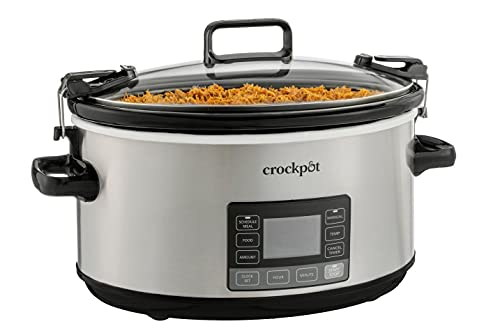
Crock-Pot Programmable Slow Cooker 7-Quart with MyTime
Badge: Best Programmable
Strengths
- MyTime scheduling directly addresses the timing criterion: food ready at a set mealtime, then held.
- Programmable control makes identical test loads genuinely repeatable, cook after cook.
- Locking Cook & Carry lid adds a transport seal that standard lids do not offer.
Trade-offs
- Scheduling accuracy is a claim only bench testing of the cycle could fully verify; the specification establishes the feature, not its precision.
- More electronics than the manual models, with the long-term reliability questions that follow.
- The locking lid’s benefit is in transit, not in cooking performance at home.
At a glance
- Capacity: 7-quart, feeds 9+
- Controls: programmable, MyTime technology adjusts cooking
- Lid: Cook & Carry locking lid
- Finish: Stainless steel
If the manual Crock-Pot is the baseline, this is the control experiment: the same seven-quart class, with the scheduling variable added. MyTime technology adjusts the cooking cycle to be ready at the mealtime you set, which under the criteria is a direct attempt at the hardest problem in slow cooking — landing a long, gentle process on a human schedule. A test programme would probe exactly how the machine modulates heat to hit the target, and a buyer cannot verify that precision from a listing; what the listing does establish is that the feature exists, that the capacity feeds nine or more, and that the format is a full-size crock rather than a compromise appliance.
The supporting criteria line up well. Programmable control means a set programme repeats identically, which is the foundation of consistent results. The Cook & Carry locking lid answers a criterion most labs underweight and most owners do not: whether the cooker can move a full load without spilling, which for potluck and family-gathering households is a weekly reality rather than an edge case. The stainless format keeps it bench-appropriate between events.
The honest caveat is the standing one for electronics: more systems, more to age. A household that will use the scheduling weekly is buying a solution; a household that eats at the same time daily is buying a feature to admire. Under the criteria, this is the strongest control story among the dedicated crocks in this guide.
Best for: households whose mealtimes move and who transport food regularly / Not suited for: fixed-routine households that would never programme it.

Hamilton Beach 6 Quart Slow Cooker (33665G)
Badge: Best Simple Pick
Strengths
- Dishwasher-safe stoneware crock and glass lid give it the cleanest cleaning-criterion answer among the manual models.
- Six quarts is the size test recipes are most often written for, which makes published guidance easiest to apply.
- Three settings keep the control variable simple enough that results are highly repeatable.
Trade-offs
- Manual control leaves timing and warm-holding to the cook, as with the other dial model.
- Smaller capacity caps its usefulness for large roasts and gatherings.
- No browning capability in the pot, so the flavour step needs a skillet.
At a glance
- Capacity: 6 quart
- Controls: 3 cooking settings
- Crock and lid: dishwasher-safe stoneware crock and glass lid
- Finish: Silver
- Model: 33665G
The Hamilton Beach 33665G is the control case for simplicity, and under lab criteria simplicity scores better than its reputation suggests. Its three settings remove operator error from the experiment — there is almost no way to set this machine wrong — and its six-quart size matches the capacity most published test recipes and guidance assume, which means an owner following established advice is working with the reference volume rather than scaling. The glass lid supports the no-peek discipline testers preach, since progress can be checked without breaking the seal and dumping the heat the machine has accumulated.
Its clearest criterion win is cleaning. The verified listing states the stoneware crock and glass lid are dishwasher-safe, and in long-term ownership studies of any appliance, the ease of cleaning predicts frequency of use better than almost any performance figure. A cooker that is painless to wash gets used weekly; a cooker that is not becomes a cupboard monument with excellent specifications. On that practical axis, this modest machine outperforms more ambitious rivals.
The gaps are the manual gaps: no countdown, no automatic warm, and a capacity that will not stretch to a crowd. Within its brief — the right-sized, low-complexity family cooker — it answers the criteria as well as anything here, and it is the pick this guide would hand to a first-time owner who asked what the tests would tell them to buy.
Best for: first-time owners and smaller households wanting the reference size with easy cleaning / Not suited for: large gatherings or unattended timed cooking.
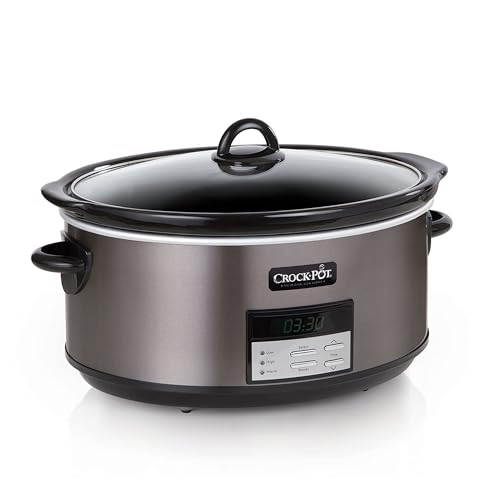
Crock-Pot Programmable Slow Cooker 8-Quart, Black Stainless
Badge: Best for Large Households
Strengths
- A digital timer up to 20 hours is the longest scheduling range here, answering the timing criterion for genuinely long cooks.
- Automatic warm covers the holding criterion at the scale where it matters most — a full batch is a big investment to protect.
- Dishwasher-safe lid and stoneware pot keep the cleaning criterion proportionate to the capacity.
Trade-offs
- Evenness is hardest to achieve at this volume; the capacity criterion cuts both ways.
- Under-filled, it will not deliver the performance its specification promises.
- The largest footprint and heaviest crock in the guide.
At a glance
- Capacity: 8-quart, for 10+ people
- Controls: digital timer up to 20 hours, auto warm setting
- Crock and lid: dishwasher-safe lid and stoneware pot
- Finish: Black stainless steel
Scale is this Crock-Pot’s criterion story. Eight quarts rated for more than ten people makes it the capacity leader, and its control set is built to manage that scale responsibly: a digital timer that runs up to 20 hours — long enough for the biggest, toughest cuts given a full low cook — and an automatic warm setting that takes over when the programme ends. Under the holding criterion, that automatic switch matters more here than anywhere else in the guide, because the cost of a ruined cook scales with the batch.
A laboratory would also watch this machine hardest on evenness. Large volumes heated from the sides are where edge-to-centre differences show up, and the honest buyer guidance follows from the physics rather than from any verdict: fill it properly, give large loads the time the programme allows, and do not judge an eight-quart machine by a two-person stew cooked in it. Used at its intended scale, the design answers capacity, scheduling, holding and cleaning — the dishwasher-safe crock and lid are confirmed in the listing — as completely as any pick here.
For the household that cooks at this scale weekly — batch days, big families, regular events — this is the criteria-complete purchase. For everyone else it is a reminder that in test terms, the best machine is the one whose tested conditions match your kitchen, and a smaller crock tested at its proper fill will outperform this one tested at yours if yours is a household of two. That sizing logic is worked through fully in our Best Slow Cookers For 2 People guide.
Best for: large households and batch cooks needing capacity with scheduling and holding covered / Not suited for: small households that cannot fill it.
Comparison Table
The table lines the picks up on the verifiable attributes behind the criteria. Temperature behaviour itself is not tabulated, because no verified measurement of it was supplied — that absence is the honest state of the evidence.
| Pick | Capacity | Controls | Criterion it answers best | Link |
|---|---|---|---|---|
| Cosori Rice Cooker 10 Cup with Slow Cook | 10 cup uncooked rice measure | Fuzzy logic, delay timer | Temperature control design and browning | Check on Amazon |
| Aroma Housewares 20 Cup Digital Rice Cooker and Slow Cooker (ARC-150SB) | 20 cup cooked | Digital | Capacity and repeatability | Check on Amazon |
| Crock-Pot Oval Manual Slow Cooker 7-Quart | 7-quart, 8+ people | High, low and warm dial | Thermal stability through stoneware mass | Check on Amazon |
| Crock-Pot Programmable Slow Cooker 7-Quart with MyTime | 7-quart, 9+ people | Programmable, MyTime | Scheduling to a mealtime | Check on Amazon |
| Hamilton Beach 6 Quart Slow Cooker (33665G) | 6 quart | 3 settings, manual | Cleaning and simplicity | Check on Amazon |
| Crock-Pot Programmable Slow Cooker 8-Quart, Black Stainless | 8-quart, 10+ people | Digital timer to 20 hours, auto warm | Capacity with holding covered | Check on Amazon |
How to Choose Using the Test Criteria
Rank the criteria by your kitchen, not by the brochure
The criteria are universal; their weights are personal. A household that cooks unattended all day should weight scheduling and warm-holding first and buy programmable. A household that cooks on weekends should weight format and cleaning first and can buy the manual baseline with a clear conscience. A household whose food is mostly saucy and grain-based should weight control sophistication and browning — the multicooker case. Write your own weighting before reading any ranking, including this one, and the rankings become tools instead of instructions.
Interrogate capacity claims
Convert every capacity into your reality: quarts for crocks, cups for rice-led machines, and people only as a rough translation. Then apply the fill rule — half to two-thirds full for the performance the criteria assume. A cooker you cannot fill to that band will not deliver its tested behaviour in your kitchen whatever its laboratory pedigree, which is why the right-sized Hamilton Beach can be the criteria-correct purchase for a small household over a larger, more decorated rival.
Treat cleaning as a performance feature
Serious evaluations score cleaning because it predicts use. Confirm from the listing whether the crock, pot and lid are dishwasher-safe, whether the lid design traps food at the rim, and whether the exterior finish shows every fingerprint. The picks here mostly answer well — dishwasher-safe parts on the Hamilton Beach and the eight-quart Crock-Pot, an easy-release ceramic-coated pot on the Cosori — and that should count in their favour in any criteria-led decision.
How to Use and Care for Your Slow Cooker
Criteria-led ownership means cooking in the conditions the machine was designed for. Fill between half and two-thirds, keep the lid closed so the temperature curve the maker engineered is the one your food experiences, and brown first where the recipe’s flavour depends on it — in the Cosori’s sauté mode or a skillet for the crocks. Add dairy and delicate ingredients late, hold finished food on warm only for serving windows, and refrigerate leftovers promptly.
- Run a first cook with a forgiving recipe and a full, correct fill to learn your individual machine’s pace.
- Note your machine’s behaviour — whether your low runs gentle or eager — and adjust recipe times to your unit, as testers do to theirs.
- Let stoneware cool before washing, and avoid thermal shock from cold water on a hot crock.
- Keep the lid seal and rim clean; residue there is the commonest cause of a poor seal and a slow heat-up.
- Store the crock dry with the lid inverted or ajar on a cloth.
Troubleshooting
Problem: food on low is still firm after the recipe’s full time → what to do: suspect fill level and lid discipline first; an overfilled crock or a frequently lifted lid slows the temperature rise materially, and only after ruling those out should you conclude the unit runs cool.
Problem: the low setting boils the edges of a sauce → what to do: your unit runs hot on low, a known variation between individual machines; cook saucy dishes with slightly more liquid, choose the warm-adjacent recipes carefully, and note the behaviour in your recipe margins for next time.
Problem: condensation drips onto the counter from the lid rim → what to do: check the lid seating and rim cleanliness; a clean, correctly seated lid contains the condensate, while a warped or food-fouled rim will weep steadily.
How to Read Any Published Rating Without Being Mislead
Finish with the skill this keyword really asks for. When you meet a rating anywhere, ask four questions. What exactly was cooked, and does it resemble your food? How was temperature measured — in the food, or guessed from the dial? Was the sample bought anonymously at retail, which is the practice that keeps results honest, or supplied by a maker? And are the scores built from measurements or from impressions wearing a lab coat? A publication that answers those questions in its method section has earned its conclusions; one that hides the method is selling certainty it does not have. Apply the same four questions to this guide and it passes on the only terms it claims: verified specifications, stated criteria, and no invented numbers. The long view of which designs keep satisfying those criteria year after year is traced in our Best Slow Cookers Ever retrospective.
Energy Use and the Running-Cost Criterion
Test programmes increasingly log energy consumption alongside cooking results, and slow cookers are the flattering end of that table. A crock drawing modest power for many hours typically uses less energy than an oven drawing heavy power for fewer, because the oven heats a large empty cavity and the room around it while the crock heats a small, sealed, insulated load. The practical consequence for buyers is that the slow cooker is rarely the appliance to economise by shrinking: the difference between sizes is minor next to the difference between cooking methods. Where energy does enter the decision is in the comparison against the alternatives — a long oven braise, a stovetop simmer that needs watching, a takeaway — and on that comparison the slow cooker, any of the six here, is the efficient citizen of the kitchen. Owners who cook in batches amplify the advantage, since one eight-quart cook that yields four meals spends its energy once.
What a Test Cannot Tell You
For all their rigour, laboratory criteria have edges, and a method-led buyer should know where they are. A test cannot tell you whether a control panel’s logic will annoy you personally every Tuesday for a decade; whether a crock’s weight will trouble your wrists as the years pass; whether a machine’s footprint suits the one cupboard you actually have; or whether your family’s recipes, with your ingredients and your fill habits, match the standardised load the lab cooked. It also cannot fully price time: a manual cooker that demands your presence is cheap in currency and expensive in schedule, and the exchange rate between those is set by your life, not by a score. This is why the strongest evaluations pair measurements with structured judgement, and why this guide pairs criteria with household patterns. Use the numbers to eliminate the unsuitable, then use honest self-knowledge to choose among the survivors — that division of labour is the real consumer skill the keyword points at.
Sample Variation: Why Your Unit Is Not the Tested Unit
One more concept separates careful readers from disappointed ones: sample variation. A laboratory tests a small number of units — sometimes one — and individual slow cookers of the same model can run measurably warmer or cooler than each other within normal manufacturing tolerance. That is why experienced evaluators describe behaviour in ranges and why owner reports of the same model can honestly disagree about whether low is gentle or eager. The buying implication is not despair; it is calibration. Whatever you purchase from this guide, spend its first two or three cooks learning your own unit’s personality with forgiving recipes, note whether its low runs calm or keen, and adjust your recipe times to the machine in your kitchen rather than to the machine in anyone’s test. The criteria tell you which designs deserve that calibration effort; the calibration itself is yours, and it is the step that turns a well-chosen cooker into a well-understood one.
Common Buying Mistakes
- Treating a score as a fact about your kitchen. A rating describes a sample, a method and a test menu; your fill levels and recipes are different variables.
- Believing a specification proves performance. A timer’s range is verifiable from a listing; a temperature curve is not, and honest guides say so.
- Ignoring the cleaning criterion. The machine that is easy to wash is the machine that gets used, whatever its other scores.
- Buying capacity you cannot fill. Tested performance assumes proper fill; an under-filled large crock fails its own criteria at home.
- Confusing features with control. A long function list is not temperature stability; judge the control system, not the menu count.
Final Recommendation
Judged strictly by the criteria, the most complete design here is the Cosori Rice Cooker 10 Cup, whose sensor-driven control, sauté function and scheduling answer the widest set of test questions on paper — with the standing caveat that its round bowl cedes the roast category to the crocks. The most proven answer is the Aroma ARC-150SB for large households that need verified capacity across three jobs, and the baseline done right is the Crock-Pot Oval Manual 7-Quart for cooks who are home to run it. Choose by weighting the criteria to your kitchen, and you will have bought the way a laboratory would advise: by method, not by adjective.
Frequently Asked Questions
What do independent testers measure first in a slow cooker?
Temperature behaviour: how promptly a standard load of food rises through the range where bacteria thrive, and how steadily the cooker then holds its cooking temperature on each setting. Flavour, features and appearance are assessed after those safety-and-consistency measurements, not before.
Can I trust a slow cooker’s stated capacity?
Treat it as a maximum vessel size rather than a working volume. Slow cookers perform best half to two-thirds full, so a seven-quart crock’s everyday working load is smaller than the headline suggests. Rice-led machines quote capacity in cups of rice, which measures grain volume and needs translating for stews.
Do programmable slow cookers cook better than manual ones?
Not inherently. The cooking itself — gentle, enclosed heat — is the same; programmability changes who manages time and warm-holding. Test criteria reward that management where households need it, but a manual crock in an attended kitchen loses nothing on the cooking itself.
Why do different publications rank the same category differently?
Because they weight criteria differently and test different menus. One programme may prize temperature stability above all; another may weight capacity, cleaning or scheduling more heavily. That is why the method matters more than the medal: match a publication’s weighting to your own kitchen before adopting its ranking.
Is a multicooker’s slow-cook mode as good as a dedicated slow cooker?
For soups, curries, porridges and shredded meats, a well-controlled slow mode performs the same job, and sensor-driven models may hold temperatures very steadily. For whole roasts and large poultry, the dedicated oval crock’s shape and thermal mass remain the better-tested format.
What is the most overlooked criterion when buying?
Cleaning. Evaluations score it because it predicts whether the appliance gets used weekly or abandoned. Dishwasher-safe crocks, lids and pots, and coatings that release starchy food, do more for long-term satisfaction than most headline features.


