Disclosure: topratedkitchenware.com is reader-supported. When you buy through links on our site, we may earn an affiliate commission from Amazon and other retailers, at no extra cost to you.
Where to buy
“Sleeping quilts” in this guide means what most people searching the phrase want: quilts to sleep under, at home, judged by how they sleep rather than how they photograph. All six verified picks are genuine bedding quilts, and all six carry links. If you arrived looking for a backpacking sleeping quilt — the pad-strap, temperature-figured kind — this is a different product family, and the guide says so openly in its own section below rather than letting you discover it at checkout.
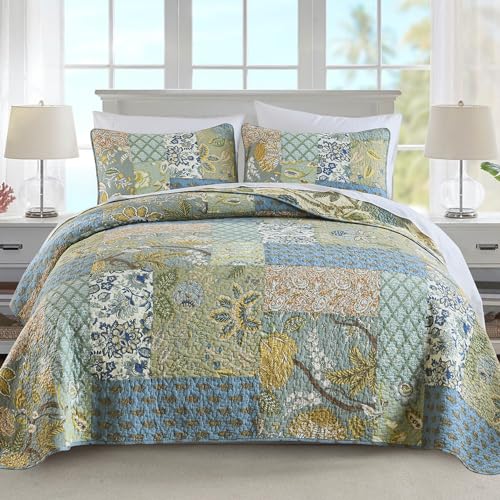
- NEWLAKE Quilt Set, Queen, 100% Cotton Patchwork, Green Bohemian — a breathable, lightweight cotton quilt that regulates temperature the way hot sleepers need.
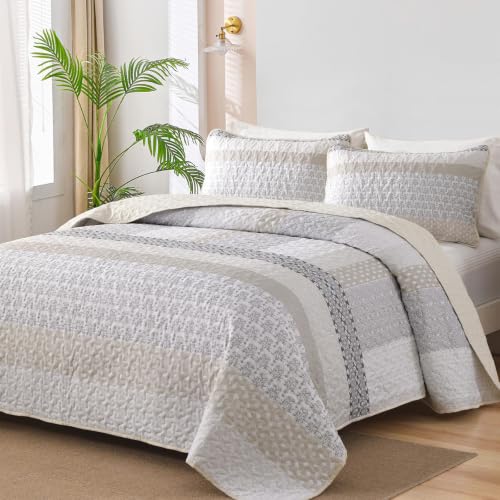
- WONGS BEDDING Boho Striped Quilt Set, Queen, 96 x 90 Inches — an ultra-soft, lightweight reversible quilt with the generous width restless sleepers and couples need.
- Secgo King Size Quilt Set, 100% Cotton, Sage, 96 x 108 Inches — cotton breathability at true king scale, with length to spare for tall sleepers.
- Tritard 3 Piece Coastal Quilt Set, Full/Queen, Blue, 90 x 96 Inches — a lightweight summer-weight quilt for humid nights and warm rooms.
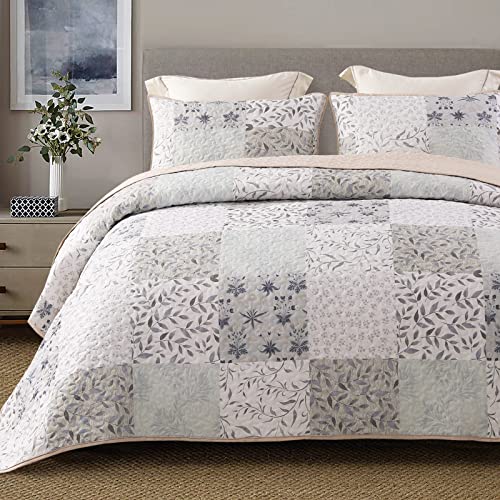
- Exclusivo Mezcla Reversible Boho Quilt, King, Gray — a light king quilt that gives two sleepers room to each keep their side.
- Yard Wizard 100% Cotton Quilt Set, Queen, Embroidered Cross Design — a cotton quilt with a textured embroidered face for sleepers who like a layer with presence.
Read the full guide ↓
The best sleeping quilts pass a test no showroom can run: the 3 a.m. test. At 3 a.m. nobody cares about the pattern. What matters is whether the layer is too warm, too cold, too slippery, too short, or tangled around one sleeper while the other lies uncovered. This guide ranks six verified bedding quilts by the attributes that decide that moment — breathability, weight, dimensions, drape and how the quilt behaves between two sleepers — using only facts the listings themselves state, plus established knowledge of how cotton and synthetic fabrics handle heat and moisture overnight. Every pick is a true quilt set with shams, because a sleeping quilt still has to make the bed in the morning; but the ranking order here is a sleep ranking, not a décor ranking, and it differs from our other quilt guides for exactly that reason. Couples, hot sleepers, tall sleepers and humid-climate readers each get a named pick and the reasoning behind it.
Key Takeaways
- Sleep quality in a quilt is mostly temperature management: the two 100% cotton picks (NEWLAKE, Secgo) breathe best; the lightweight synthetics (WONGS BEDDING, Exclusivo Mezcla, Tritard) win on low weight and easy care.
- Length is a sleep feature. The Secgo’s 108-inch king length and the Tritard’s 96-inch Full/Queen length stop the shoulder-versus-feet trade-off that wakes tall sleepers.
- Width is a couples feature: the WONGS set’s 96-inch queen width and the two king quilts give each sleeper a defensible side.
- Lightweight quilts are the right primary layer for warm rooms and the right top layer over a blanket for cold ones — one purchase, two seasons of sleep.
- None of these is a backpacking sleeping quilt; they are mattress-sized bedding without temperature figures, and this guide does not invent figures for them.
- Your sheet and mattress protector decide as much about night temperature as the quilt does — audit the whole stack before blaming the top layer.
In this guide
Quick Picks
| Pick | Badge | Size | Fabric | Pieces | Link |
|---|---|---|---|---|---|
| NEWLAKE Cotton Patchwork Quilt Set | Best for Hot Sleepers | Queen | 100% cotton | 3 | Check on Amazon |
| WONGS BEDDING Boho Striped Quilt Set | Best for Couples | Queen, 96 x 90 in | Polyester | 3 | Check on Amazon |
| Secgo Cotton Patchwork Quilt Set | Best King for Sleep | King, 96 x 108 in | 100% cotton | 3 | Check on Amazon |
| Tritard Coastal Quilt Set | Best for Humid Nights | Full/Queen, 90 x 96 in | Not stated in listing title | 3 | Check on Amazon |
| Exclusivo Mezcla Boho Quilt | Best Light King | King | Not stated in listing title | 3 | Check on Amazon |
| Yard Wizard Embroidered Cotton Quilt Set | Best Textured Cotton | Queen, 96 x 90 in | 100% cotton | 3 | Check on Amazon |
Two badges here are about bodies, not beds: hot sleepers and couples cause more quilt dissatisfaction than any pattern choice, so they get the top slots. Décor-led readers will find the same products ranked by looks in our other quilt guides; this page is unapologetically about the night.
How These Picks Were Chosen
This is a research-led guide with no hands-on testing claims. We verified all six products through the Creators API against their manufacturer listings and ranked them on sleep-relevant attributes: fabric and its known overnight behaviour (cotton absorbs and breathes; synthetics are light, slick and quick-drying), stated weight class (four of the six listings say “lightweight” outright), dimensions translated into sleeper terms (width per person, length after pull-up), and construction (all six are true stitched quilts in sets with shams — no blankets or comforters were admitted to this ranking, because a sleeping-quilt guide that pads itself with substitutes fails its readers at 3 a.m.).
We also declined to publish warmth numbers. Home quilts carry no standardised temperature rating, and any guide assigning one is decorating a guess. What can be stated truthfully is comparative and mechanical: cotton breathes better than polyester; a thinner layer traps less air; a longer quilt stays on a tall sleeper; a wider quilt ends the couples’ tug-of-war. Those comparisons, applied pick by pick, produced the order below. Where a listing leaves a fact unstated — two fabrics here — the spec boxes say so, because a reader choosing a sleep layer deserves to know which claims are verified and which are vibes.
The 6 Best Sleeping Quilts, Reviewed in Detail

NEWLAKE Quilt Set, Queen — 100% Cotton Patchwork, Green Bohemian
Badge: Best for Hot Sleepers
Strengths
- 100% cotton, sold as lightweight and breathable for all seasons — the fabric-and-weight combination that genuinely sleeps coolest in this pool.
- Cotton absorbs a little moisture instead of leaving it on the skin, which is the difference between “warm” and “clammy” at 3 a.m.
- Reversible patchwork set with two shams: the sleep layer still makes a finished bed by day.
Trade-offs
- Cotton dries slowly; in a humid home without a good dryer, laundry day needs planning.
- Cotton wrinkles more than the synthetics here.
- Queen sizing in this listing; king sleepers should take the Secgo, its cotton sibling at king scale.
Mini spec box
- Size: Queen
- Set: Quilt plus 2 pillow shams
- Fabric: 100% cotton
- Design: Patchwork, green bohemian, reversible
- Weight class: Lightweight and breathable, all seasons
Hot sleepers should start here, because the NEWLAKE is the only pick whose cool-sleeping case rests on both halves of the physics: a breathable natural fibre and a lightweight build. Cotton’s overnight behaviour is the benchmark synthetics imitate — it lets heat and moisture vapour move, it never feels slick against warm skin, and it softens into the kind of familiar comfort people sleep best under. The patchwork bohemian design is almost incidental to the sleep case, though the reversible face is a genuine bonus for the bed’s daytime life. The honest limitation is logistical, not thermal: cotton’s slow drying, and a queen-only listing. If you run hot and sleep on a queen, this is the quilt in the pool most likely to still be on the bed — rather than kicked to the floor — at dawn.
Best for: hot sleepers on queen beds / Not suited for: households needing fast-dry bedding

WONGS BEDDING Beige Quilt Set, Queen — Boho Striped Patchwork Bedspread
Badge: Best for Couples
Strengths
- 96 inches of width on a queen — roughly 18 inches of spare quilt per side, which is the physical end of most cover disputes.
- Ultra-soft, lightweight polyester: present enough to feel covered, light enough not to trap a couple’s combined body heat the way a comforter does.
- Reversible design and quick-drying easy care suit the higher laundry turnover of a shared primary bed.
Trade-offs
- Polyester breathes less than cotton; a hot sleeper sharing with a cold sleeper may still want the cotton NEWLAKE plus a personal throw on the cold side.
- The boho striped beige palette is a specific look.
- Lightweight means winter layering for cold houses — the quilt alone is a three-season layer.
Mini spec box
- Size: Queen, 96 x 90 inches
- Set: 3 pieces — quilt plus 2 pillow shams
- Fabric: Polyester
- Design: Boho striped patchwork, reversible
- Weight class: Lightweight, all-season positioning
Couples do not need a warmer quilt; they need a wider one. Most shared-bed quilt failures are geometry failures — not enough width for two adults to each turn over inside their own territory — and the WONGS set’s 96-inch queen cut is the pool’s most direct answer short of buying a king quilt for a queen bed. Its lightweight polyester build keeps the shared pocket of air from overheating the way a comforter would with two bodies under it, and the ultra-soft face is the kind of surface nobody objects to. The trade-off is fibre: polyester will never breathe like the NEWLAKE’s cotton, so mixed-thermostat couples should use the system in this guide’s how-to section — shared light quilt, personal throw for the colder partner. As a complete package of width, weight and easy care, this is the couples’ pick.
Best for: couples on queen beds / Not suited for: solo hot sleepers who prioritise natural fibre

Secgo King Size Quilt Set — 100% Cotton Patchwork, Sage Green
Badge: Best King for Sleep
Strengths
- 100% cotton at 96 by 108 inches — breathability plus the pool’s longest cut, so tall sleepers keep covered feet and shoulders simultaneously.
- King width gives two sleepers genuine territory; the nightly migration of covers slows dramatically at this size.
- Reversible sage patchwork: calm colours are not a sleep technology, but a visually quiet bed is part of a wind-down routine for many people.
Trade-offs
- A king cotton quilt is the pool’s biggest wash load, and it dries slowly; compact machines need not apply.
- Cotton wrinkles across a king expanse show more.
- The traditional sage palette will not suit stark modern rooms.
Mini spec box
- Size: King, 96 x 108 inches
- Set: Quilt plus 2 pillow shams
- Fabric: 100% cotton
- Design: Patchwork, reversible, sage green
- Weight class: Lightweight
The Secgo is what happens when the NEWLAKE’s sleep logic is scaled to a king: cotton breathability, a lightweight build, and dimensions that respect how people actually sleep. The 108-inch length is the headline for tall sleepers — most quilt complaints from anyone over six feet are length complaints in disguise — and the width gives a couple the full king promise instead of a wide queen’s compromise. Cotton at this scale also manages the king bed’s larger warm-air pocket better than a synthetic face would. The cost is pure logistics: this is a serious piece of laundry, heavy when wet and slow to dry, and households should choose it with their machines in mind. If the machines can cope, this is the best pure sleeping quilt in the pool for a king bed — the standard the décor-first king picks have to answer to.
Best for: king beds, tall sleepers and cotton loyalists / Not suited for: small-washer households

Tritard 3 Piece Coastal Quilt Set, Full/Queen — Blue Nautical Bedspread
Badge: Best for Humid Nights
Strengths
- Lightweight, reversible, and positioned by its own listing as a summer layer — the humid-night specialist of the pool.
- 90 by 96 inches: the extra length anchors a light quilt that would otherwise migrate on restless, warm nights.
- Coastal design that belongs in the beach houses and warm-climate rooms where humid sleeping is the norm.
Trade-offs
- Fabric is not stated in the listing title, so its cooling case rests on weight class rather than a verified fibre.
- The nautical theme commits the room.
- Full/Queen compromise sizing gives queens less side drop than the WONGS set.
Mini spec box
- Size: Full/Queen, 90 x 96 inches
- Set: 3 pieces — quilt plus 2 shams
- Design: Coastal/nautical, blue, reversible
- Weight class: Lightweight, all-season positioning with a summer emphasis
Humidity defeats bedding differently from heat: the air cannot take more moisture, fabrics feel damp against skin, and sleepers wake sticky under layers that would be fine in a dry climate. The Tritard’s answer is minimalism — a light, reversible quilt with nothing spare to hold damp — plus length, because a humid night is a restless night and restless nights move quilts. In a coastal bedroom, a Gulf-state guest room or any bed near water, it is the most purpose-fit sleeper in this pool. Its evidence is thinner than the cotton picks’ — no fibre is stated in the title — and its theme is total. Buy it for the climate it was designed for and it will feel like the only honest layer in the house; buy it for a dry, landlocked winter and you have misread its brief.
Best for: humid climates and coastal homes / Not suited for: cold, dry winters as a sole layer

Exclusivo Mezcla Reversible Boho Quilt, King — Gray Floral Patchwork
Badge: Best Light King
Strengths
- King coverage in a soft, lightweight build — the easiest king quilt here to live with nightly, from bed-making to laundry.
- Reversible gray floral patchwork: a decorative face that does not cost sleep comfort to achieve.
- Flat, layer-friendly profile: in winter it rides over a blanket without the bulk fight at the foot of the bed.
Trade-offs
- Fabric unstated in the title — sleepers choosing by fibre should check the listing or take the cotton Secgo.
- Printed rather than pieced patchwork.
- Boho styling is a room commitment.
Mini spec box
- Size: King
- Set: 1 quilt plus 2 pillow shams
- Design: Printed floral patchwork, reversible, gray
- Weight class: Lightweight, all-season
The Exclusivo Mezcla is the king quilt for sleepers who want the bed to look like something and sleep like nothing much at all — in the good sense. Its light weight disappears overnight, its king width keeps two sleepers supplied, and its flat profile makes it the best winter layering citizen in the pool: slide a blanket underneath in January and the system works without bulk. Against the Secgo it loses the fibre argument — cotton, verified, beats unstated — and wins the handling argument, because a lighter king quilt is simply easier to wash, dry and remake across years of nights. Choose the Secgo for breathability, this one for effortlessness, and either with confidence that the size is honest. Readers comparing king coverage across the whole category will find the tape-measure treatment in Best Quilts Online a useful companion.
Best for: king beds wanting light, decorative, low-effort bedding / Not suited for: fibre-first buyers

Yard Wizard 100% Cotton Quilt Set, Queen — Embroidered Cross Design
Badge: Best Textured Cotton
Strengths
- 100% cotton breathability with an embroidered surface — the texture gives the layer a slight stand-off from the skin that flat quilts lack.
- Full 96 by 90 inch queen cut with two precisely sized 20 by 26 inch shams.
- A quilt with presence: sleepers who dislike the “barely there” feel of the lightest synthetics get a layer they can feel.
Trade-offs
- Embroidery needs a gentle wash cycle and separation from zippers and hooks.
- The cross design is a traditional statement, not a neutral.
- Cotton’s slow drying applies.
Mini spec box
- Size: Queen, quilt 96 x 90 inches
- Set: 3 pieces — quilt plus 2 shams at 20 x 26 inches
- Fabric: 100% cotton
- Design: Embroidered cross
Some sleepers sleep worst under the lightest layers: a quilt that feels like nothing can feel like exposure, and they wake to pull it up and check it is still there. The Yard Wizard answers that psychology with texture and substance — cotton’s breathability in a quilt whose embroidered face you can feel, at full queen dimensions. It is the traditionalist’s sleeping quilt: natural fibre, crafted surface, calm presence. The care and style caveats are real but small, and for the sleeper it suits, no slick synthetic in this pool will substitute. It closes the list as the character pick — the one bought with the heart and justified, honestly, by the cotton underneath the embroidery.
Best for: traditional sleepers who like a layer with presence / Not suited for: minimalist rooms or harsh laundry routines
Comparison Table
| Quilt | Size | Fabric (as listed) | Sleep strength | Pieces | Link |
|---|---|---|---|---|---|
| NEWLAKE Patchwork | Queen | 100% cotton | Breathability | 3 | Check on Amazon |
| WONGS BEDDING Boho Striped | Queen 96 x 90 | Polyester | Couples’ width | 3 | Check on Amazon |
| Secgo Patchwork | King 96 x 108 | 100% cotton | Length + breathability | 3 | Check on Amazon |
| Tritard Coastal | Full/Queen 90 x 96 | Not stated | Humid nights | 3 | Check on Amazon |
| Exclusivo Mezcla Boho | King | Not stated | Light handling | 3 | Check on Amazon |
| Yard Wizard Embroidered | Queen 96 x 90 | 100% cotton | Texture + presence | 3 | Check on Amazon |
Match the “sleep strength” column to your actual complaint — heat, a partner, height, humidity, effort or feel — and the table chooses for you. Most quilt dissatisfaction is a mismatch between the sleeper’s problem and the quilt’s strength, not a defective quilt.
How to Choose a Quilt You Will Actually Sleep Well Under
Diagnose your wake-ups first. If you wake hot, the fix is breathability and less trapped air: cotton quilts (NEWLAKE, Secgo, Yard Wizard) over breathable sheets, and an audit of the mattress protector beneath. If you wake cold at the edges — shoulders, feet — the fix is usually dimensions: more length (Secgo, Tritard) and enough width that turning over does not uncover you. If you wake because your partner’s movements strip your side, the fix is width or separate layers: the WONGS width on a queen, a king quilt’s territory, or the two-throw system below. If you wake in a humid room feeling damp, the fix is the thinnest layer and airflow, the Tritard’s brief. Buying a quilt before naming the wake-up is how good quilts get blamed for sheet, protector and geometry problems.
Then audit the stack. From the skin out, your night is: sleepwear, top sheet (or none), quilt, and whatever the room adds. Each layer’s breathability multiplies or cancels the others. A cotton quilt over a synthetic sheet and a waterproof protector sleeps like a synthetic system; the same quilt over cotton sheets on a breathable protector sleeps like cotton. Spend your second dollar on the sheet before your first dollar on a second quilt.
Choose weight by season system, not by tonight. A lightweight quilt plus a blanket is two products that cover three seasons; a mid-weight comforter is one product that is wrong at both ends. Every pick here is lightweight-leaning for that reason. Cold sleepers should not read “lightweight” as “not for me” — read it as “the top half of my winter system, and all of my summer one.”
How to Sleep Better Under a Quilt: Setup, Layering and Care
- Make the bed with the quilt centred by drop — equal overhang both sides — so the night starts fair for both sleepers.
- Use the fold-down: turn the top third of the quilt back over itself at bedtime setup; it keeps the sheet line fresh and gives hot sleepers an easy escape hatch mid-night.
- For mixed-thermostat couples, layer a personal throw on the colder side only, over the shared quilt. The bed still looks unified; the temperatures do not have to be.
- Feet first on cold nights: fold the quilt’s foot under the mattress end or add the throw at the foot — cold feet delay sleep more than a cool torso.
- Air the quilt every morning by folding it to the foot of the bed for an hour before making it; overnight moisture leaves, and the quilt stays fresher between washes.
- Wash monthly for a primary sleeping quilt (more if you sleep without a top sheet), gentle cycle, dried completely; rotate head-to-foot at each wash.
Troubleshooting. Problem: you wake with the quilt on the floor → it is too small, too slick against the sheet, or both; add a cotton sheet as a friction layer and size up at replacement — length is the usual culprit. Problem: one side of the bed is always uncovered by morning → the quilt is being migrated by a restless partner; move to the widest cut your bed accepts (the 96-inch WONGS on queen, a king set on king) or split into a shared quilt plus individual throws. Problem: the quilt sleeps hotter than expected → strip the stack down: remove the top sheet, check for a waterproof protector, and only then conclude the quilt is at fault; in our experience of the category, the protector is the most common hidden cause. Problem: the quilt bunches inside its own drape after washing → it was dried incompletely or washed overloaded; rewash in a larger drum and dry fully, shaking it out halfway.
Sleeping Quilts for Beds Are Not Sleeping Quilts for Backpacks
The phrase “sleeping quilt” names two unrelated products, and this guide would be negligent not to separate them, because the confusion is expensive in both directions. A backpacking sleeping quilt is an open-backed insulation piece sized to a sleeping pad, sold with a temperature figure and a fill weight, built from technical fabrics to be carried on a human back. A home sleeping quilt — everything ranked here — is a full bedding set sized to a mattress, sold with shams, built for a bed’s width, a couple’s movements and a washing machine. Neither substitutes for the other: the backpacking piece would be a narrow, strange bed covering, and a cotton patchwork bedspread in a damp campsite would be heavy, cold and miserable. If your search began with a trail in mind, you want the category covered by guides to Best Sleeping Bag Quilts and their kin, with temperature figures and pad straps — not this page. If your search began with a bedroom, everything above is yours, and the trail vocabulary stops here. What the two families share is only a philosophy worth borrowing: insulation should match conditions, and excess layer is its own discomfort.
Sleeping Quilts by Sleeper Type
Back sleepers need the least from a quilt — even coverage and a weight that rests rather than presses — and almost any pick here serves them; choose by fabric preference and spend the savings on the pillow. Side sleepers bunch quilts into the curve of the body, which consumes width and length simultaneously; they should favour the wider, longer cuts (WONGS on queen, Secgo on king) and avoid quilts that end exactly at the mattress edge, because a side sleeper’s quilt travels with every turn. Stomach sleepers often sleep half out of the covers by morning and do best with the lightest layers — the Tritard or Exclusivo class — arranged diagonally, foot out, without the arrangement looking like a defeat.
Restless sleepers and blanket-kickers are a dimensions problem wearing a behaviour costume. A quilt that ends up on the floor is usually a quilt that was too small to survive movement, or too slick against the sheet to hold its place. The fixes in order: a cotton sheet as a friction layer, a longer quilt (the 96-inch Tritard, the 108-inch Secgo), a wider quilt, and only then any thought of tucking, which restless sleepers defeat anyway. Night-sweat and hot-flush sleepers need the full breathable stack — cotton quilt (NEWLAKE or Secgo), cotton sheets, breathable protector — plus the half-cover technique from the how-to section: quilt over the legs, sheet or nothing over the torso, adjusted without waking fully. A single product cannot solve a hormonal thermostat, but the wrong stack can absolutely make it worse, and auditing the stack is free.
Children transitioning to a real bed sleep best under a quilt light enough to move themselves — a child who cannot pull their own covers up will call for help at 2 a.m. instead — with the rest of the household’s quilts judged by the same independence test for older relatives. Older sleepers similarly benefit from the lightweight end of this pool: a quilt that can be lifted, shaken and remade by the person sleeping under it is a safety feature as much as a comfort one, and the king-size versions (Exclusivo, Secgo) extend that independence to the largest beds. Allergy-conscious sleepers should note what this guide can and cannot say: none of these listings makes medical claims, and neither do we; the practical advice is washable, frequently laundered bedding — which favours the easy-care synthetics and the hot-wash-tolerant cottons alike — and a protector chosen for breathability so the washability is not wasted.
The Quilt and the Room: Temperature, Light and Noise
A sleeping quilt does not work alone; it works in a room, and three room factors decide whether the right quilt feels right. Temperature is the obvious one, but the operative number is the room’s temperature at 3 a.m., not at bedtime — houses cool overnight, which is why a quilt that feels perfect at 10 p.m. can feel thin at 3 a.m. and why layering systems beat single perfect layers. If your room swings widely, the lightweight quilt plus a folded blanket at the foot is not a compromise; it is the engineered answer, letting you add the second layer half-asleep without remaking anything.
Light is the underestimated factor. A quilt’s colour and pattern are the last thing you see at night and the first thing you see in the morning, and visually loud bedding in a bright room can genuinely work against a wind-down routine; the Secgo’s sage calm and the Exclusivo’s gray discipline are sleep features in that sense, whatever the décor guides say. Noise is the smallest factor and still real: stiff, crinkly fabrics announce every turn to a light-sleeping partner, while soft cotton and washed microfiber move quietly — one more reason the pool’s soft-handled picks rank as they do for couples. None of these factors appears on a listing, which is why this guide exists in prose rather than as a specification table: sleep is a system of body, bedding and room, and the quilt is the layer where all three meet.
Building a Year-Round Sleep System Around One Quilt
The most satisfied quilt owners we see in this category’s feedback patterns do not own the warmest quilt or the lightest one; they own a system, and the quilt is its constant. The system has four parts. The base is a breathable mattress protector — chosen deliberately, because it is the layer most likely to sabotage everything above it. The sheet is cotton or another breathable weave, washed weekly, doing more thermal work than it gets credit for. The quilt — any of the six here — is the year-round top layer and the bed’s face. The variable is a single blanket, stored folded at the foot or in the closet, deployed under the quilt for the coldest stretch and removed when it passes. Total moving parts: four, of which only one changes with the seasons.
Contrast the alternative most households drift into: a heavy winter comforter and a thin summer blanket, swapped twice a year, each wrong for the shoulder months between, the off-season one consuming closet space and the swap itself postponed until the first miserable night forces it. The quilt system wins on every axis that matters at 3 a.m. — the adjustment is adding or removing one blanket, the bed always looks finished, and the quilt you chose for its fabric and dimensions is the layer your skin actually meets in every month. If you buy one thing from this guide, buy the quilt as the system’s constant: cotton if you sleep warm (NEWLAKE, Secgo), wide if you share (WONGS), long if you are tall (Secgo, Tritard), light if you launder often (Exclusivo) — then spend the smaller second sum on the blanket and protector that complete it. Sleep quality is rarely a single product’s achievement; it is a stack of unglamorous correct decisions, and the quilt is simply the most visible one.
Common Buying Mistakes
- Buying by pattern for a sleep problem. Décor decides how the quilt looks at noon; fabric, weight and dimensions decide how it feels at 3 a.m. Rank your criteria by the hour you will judge them.
- Ignoring the layers beneath. A waterproof protector or synthetic sheet can make the best cotton quilt sleep hot. Audit the stack before replacing the top.
- Undersizing for couples. A standard queen quilt shared by two adults is a nightly negotiation. Width — the WONGS’ 96 inches, or a king set — is the peace treaty.
- Expecting a temperature figure. Home quilts do not have honest ones. Choose by fibre, weight class and your room’s reality instead of a number nobody measured.
- Confusing home and backpacking quilts. Shams and mattress sizing mean bedroom; pad straps and temperature figures mean trail. Order from the wrong family and both trips — to bed or to camp — suffer.
- Skipping the top sheet decision. Sheet or no sheet changes a quilt’s warmth and wash frequency materially. Decide deliberately rather than discovering your preference after the purchase.
Sleeping Quilts in Guest Rooms and Shared Housing
Two living situations deserve their own word before we close. In guest rooms, the sleeping quilt’s job is to suit a stranger’s thermostat without instructions: choose the middle of this pool — a lightweight quilt like the WONGS or NEWLAKE — and stage the adjustment tools visibly, a folded blanket at the foot and the quilt’s own fold-down turned back in welcome. Guests will not open closets hunting for layers, but they will use what the bed itself offers, and a guest who slept well is the entire return on a guest room’s existence. In shared housing and multi-generational homes, the quilt is personal territory in a way other bedding is not: it is the layer each person chooses, washes and keeps. Households buying for several bedrooms at once should resist the bulk-buy of a single design; the pool’s spread exists so the hot sleeper, the traditionalist and the couple can each get their strength. Buy per sleeper, not per house, and mark the shams by room before the first shared laundry day mixes the sets — a small administrative act that prevents years of low-grade bedding confusion. Sleep is the most individual thing a household does together; the quilts should be chosen that way too.
One last practical note: give any new sleeping quilt two full weeks before judging it. Sleepers adapt to a new layer’s weight and surface over several nights, laundry softens most fabrics across the first washes, and a quilt condemned on night one is often the same quilt praised on night twelve. Judge it by the second week’s wake-ups — their frequency, their cause, and whether the quilt was still on the bed at dawn — and you will have run the only test that ever really mattered in this category. Sleep, after all, is the one product feature no listing can photograph, which is precisely why this guide weighted it above every other claim.
Final Recommendation
Hot sleepers on a queen bed: buy the NEWLAKE Cotton Patchwork Quilt Set and audit your sheets and protector to match its breathability. Couples: buy the WONGS BEDDING Boho Striped Set for its width, and add a one-sided throw if your thermostats disagree. King sleepers and tall sleepers: the Secgo Cotton King Set, whose 108 inches of length and cotton face make it the pool’s most complete sleeping quilt. Humid rooms take the Tritard; light-handling king households take the Exclusivo Mezcla; traditionalists who want to feel their quilt take the Yard Wizard. Every one of these is a lightweight-leaning layer, so pair your choice with a blanket for winter and you own a system, not a season. For the celebrated names beyond this pool, our all-time list at Best Quilts Ever is the next read; for natural-fibre alternatives, see Best Linen Quilts.
When to Replace a Sleeping Quilt
A sleeping quilt rarely dies dramatically; it fades out of service through small failures that each cost a little sleep. Replace it when the stitching lines have broken in several places and the fill has begun to migrate into lumps that washing no longer redistributes — lumpy insulation means uneven warmth, and uneven warmth means wakeful nights. Replace it when the fabric has thinned at the top edge, where hands pull it up nightly; that wear line is structural, not cosmetic, and it will tear in the wash eventually. Replace it when it no longer fits the bed it serves — a mattress upgrade to a thicker profile can strand a previously perfect quilt exactly the way the king guide’s drop maths describes — and when its warmth class no longer matches a changed room, a changed climate or a changed sleeper. What you should not do is replace a sound quilt for a pattern’s sake alone while the old one’s sleep performance is intact: demote it to the guest bed or the sofa system first, where its remaining years are still valuable, and let the new quilt earn the primary bed on sleep merits. When you do replace, buy against the wake-up you actually have — heat, cold edges, a partner, humidity — using this guide’s diagnosis order. A quilt chosen against a named problem tends to solve it; a quilt chosen against a photograph tends to become next year’s replacement question.
Frequently Asked Questions
What is the best quilt type for hot sleepers?
A lightweight 100% cotton quilt over breathable sheets — in this pool, the NEWLAKE in queen and the Secgo in king. Cotton breathes and absorbs rather than sealing heat in. Also check the mattress protector: waterproof models trap heat regardless of the quilt above them.
Are sleeping quilts warmer than blankets?
Generally yes, slightly: a quilt’s stitched three-layer construction traps a thin, even layer of air across the whole surface, while a single blanket insulates only by its material’s thickness. The difference is modest — quilts win on evenness and staying in place as much as on warmth.
How do couples stop fighting over a shared quilt?
Width first: choose the widest cut the bed accepts (96 inches on a queen, a true king set on a king). If one partner is a restless puller, add individual throws over a shared light quilt so each sleeper has a layer that cannot be stolen.
Can a lightweight quilt work in winter?
Yes, as the top of a system: blanket underneath, quilt on top. The blanket insulates; the quilt keeps the bed finished and adds a little trapped air. All six picks here are built for that layering role, which is why none of them is a heavy winter piece on its own.
What size quilt does a tall sleeper need?
More length than the label suggests. A 90-inch quilt on an 80-inch mattress leaves little pull-up reserve; the Tritard’s 96 inches and the Secgo’s 108 inches are the pool’s tall-sleeper cuts. When in doubt, size by length before pattern.
Is a sleeping quilt the same as a backpacking quilt?
No. The products here are bedding sets for mattresses, with shams and no temperature figures. Backpacking quilts are pad-sized, rated insulation pieces for the trail. The shared name is a search-engine accident; the products, prices and purposes are entirely different.
Should you use a top sheet with a sleeping quilt?
It is a genuine choice. With a sheet, the quilt stays cleaner longer and the warmth is a touch lower; without one, the quilt is your skin layer — softer against you, washed more often. Cotton quilts like the NEWLAKE and Secgo reward the no-sheet style; busy households may prefer the sheet’s laundry economics.