Disclosure: topratedkitchenware.com is reader-supported. When you buy through links on our site, we may earn an affiliate commission from Amazon and other retailers, at no extra cost to you.
Where to buy
The best small microwaves for countertops are judged here as countertop citizens first: footprint, vent clearance, door swing and the discipline of the 0.7 to 0.9 cu ft band. Four picks sit inside the band and are linked; the two 1.2 cu ft sensor models are reviewed prose-only as the references that show what a bigger counter buys.
- TOSHIBA Countertop Microwave Oven, 1.2 Cu.Ft, 1000W, Stainless Steel (prose-only — no link; the review explains why)
- Chefman Countertop Microwave Oven, 0.7 Cu.Ft, 700 Watts, Black — Best Minimum Footprint
- BLACK+DECKER Countertop Microwave Oven, 0.9 Cu.Ft, 900W, Stainless Steel — Best Door Action
- TOSHIBA Microwave Oven, 0.9 Cu.Ft, 900W, Black Stainless Steel — Best All-Rounder
- TOSHIBA Countertop Microwave Oven, 1.2 Cu.Ft, 1000W, Black (prose-only — no link; the review explains why)
- COMFEE’ Countertop Microwave Oven, 0.7 Cu.Ft, 700W, Black — Best for the Smallest Counters
Read the full guide ↓ for how each pick performs, where each one compromises, and which households each one actually suits.
A countertop brief is a space brief, and the best small microwaves for countertops are the ones that respect the surface they sit on. This guide links the four picks inside the 0.7 to 0.9 cu ft band and reviews the two 1.2 cu ft models prose-only, because countertop honesty means showing the bigger machines without pretending they belong on a small counter. Apartment readers will recognise the same band logic in Best Small Microwaves For Apartments, where the rental version of this problem is worked through.
Countertop space is the kitchen’s scarcest resource. It is where shopping lands, boards live, and every other appliance campaigns for a permanent home. A microwave earns its square footage only if its footprint is proportionate to its use, and for one- and two-person cooking that proportion lands inside the small band. The four linked picks span that band from the true minimum at 0.7 cu ft to the generous top at 0.9, in two wattage classes and two control philosophies.
The countertop details that decide satisfaction are unglamorous: whether the door opens without sweeping the worktop, whether the vents can breathe against a wall of tiles, whether the stated turntable takes your actual plates. The reviews below keep those questions in front, and the buying guide turns them into a measuring routine you can run with a tape and your own dinner plate.
Key Takeaways
- Four linked picks inside the 0.7-0.9 cu ft band; both 1.2 cu ft sensor models are prose-only references.
- Footprint plus vent clearance, not cavity size alone, is the true countertop cost of a microwave.
- A stated turntable diameter is the most useful countertop-era specification: measure your plates against it.
- Two wattage classes serve the band: 700 watts for minimum size, 900 watts for packaged-meal pace.
- Door swing is countertop planning — picture the open door before the box arrives.
In this guide
Quick Picks
The short version follows. Linked picks are the countertop answers at four sizes and styles within the band; the prose-only pair, clearly marked, are the sensor references for readers with counters that can grow.
| Pick | Badge | Best for | Amazon |
|---|---|---|---|
| TOSHIBA Countertop Microwave Oven, 1.2 Cu.Ft, 1000W, Stainless Steel | Prose-Only Sensor Reference | Stainless kitchens stepping up to sensor cooking | Prose-only — no link, see review |
| Chefman Countertop Microwave Oven, 0.7 Cu.Ft, 700 Watts, Black | Best Minimum Footprint | Dorms and small flats wanting full controls at minimum size | Check on Amazon |
| BLACK+DECKER Countertop Microwave Oven, 0.9 Cu.Ft, 900W, Stainless Steel | Best Door Action | Mainstream small kitchens and users who prefer a push-button door | Check on Amazon |
| TOSHIBA Microwave Oven, 0.9 Cu.Ft, 900W, Black Stainless Steel | Best All-Rounder | Apartment kitchens wanting 900 watts with a mute function | Check on Amazon |
| TOSHIBA Countertop Microwave Oven, 1.2 Cu.Ft, 1000W, Black | Prose-Only Sensor Reference | Sensor-cooking fans who have the counter for a family size | Prose-only — no link, see review |
| COMFEE’ Countertop Microwave Oven, 0.7 Cu.Ft, 700W, Black | Best for the Smallest Counters | Dorm rooms, offices and the smallest studio kitchens | Check on Amazon |
How These Picks Were Chosen
This guide was built from a verified pool: every linked product name, ASIN and image traces to a live Amazon listing checked through the Creators API, so nothing here rests on a copied roundup or a remembered model number. Picks were then read against the keyword’s own brief first, and for small-microwave briefs that means the size band was applied before anything else: models whose stated capacity falls inside 0.7 to 0.9 cu ft are linked, and larger models in the pool are reviewed prose-only as clearly labelled size references, with no link and no image.
Within the band, the ordering weighed the things that decide daily satisfaction: wattage against the cooking times packaged food assumes, door action, the honesty of the stated turntable size, mute and eco features for shared homes, and how much control depth survives at small sizes. Where a listing states a figure, the review uses it; where it does not, the review says so.
One honesty note applies to every pick: this is research-led guidance, not a laboratory test programme. No reheating trials are invented and no hands-on claims are made. What the guide does is read specifications closely, separate what a listing actually promises from what it merely implies, and flag the compromises that small cavities always carry.
The 6 Best Small Microwaves for Countertops
TOSHIBA Countertop Microwave Oven, 1.2 Cu.Ft, 1000W, Stainless Steel
Badge: Prose-Only Sensor Reference
Strengths
- The same humidity-sensor, twelve-menu specification as its black sibling, in the stainless finish most kitchens are matching
- Family capacity with sensor cooking is the combination that ends undercooked-centre reheats
- Mute and ECO modes keep a family-size machine considerate in a small home
Trade-offs
- At 1.2 cu ft it is above the small band and is reviewed here prose-only, with no link or image
- Stainless shows fingerprints and needs a wipe-down habit
- Its footprint, not its cooking, is the disqualifier for small counters
| Capacity | 1.2 cu ft |
| Power | 1000W |
| Sensor | Smart humidity sensor |
| Menus | 12 auto menus |
| Modes | Mute function, ECO mode, easy clean interior |
| Finish | Stainless steel |
This Toshiba is the stainless steel version of the pool’s 1.2 cu ft sensor model: 1000 watts, a smart humidity sensor, twelve auto menus, mute, ECO mode and an easy clean interior. Finish is its only material difference from the black listing, and finish is a legitimate deciding factor when a microwave sits at eye level all day. In these small-microwave guides both 1.2 cu ft Toshibas serve as references above the band, useful because their sensor specification sets the benchmark that smaller, simpler models are compared against.
The stainless Toshiba 1.2 opens this guide as its sensor reference: a smart humidity sensor, twelve auto menus and family capacity, reviewed prose-only because 1.2 cu ft sits above the countertop band this brief defends. On a large counter it would be a headline pick; on the small counters this keyword serves, it is the benchmark that defines the trade.
Read it for its specification rather than its size. The sensor and menu depth show what the linked small picks are not attempting, and a countertop buyer who cooks varied reheats daily is the one reader who should weigh stepping up to it.
Best for: Stainless kitchens stepping up to sensor cooking / Not suited for: Small-band briefs; it is a size reference here

Chefman Countertop Microwave Oven, 0.7 Cu.Ft, 700 Watts, Black
Badge: Best Minimum Footprint
Strengths
- The full Chefman control set, ten power levels and six presets, at the smallest 0.7 cu ft size in the pool
- A mute button at this size is rare and valuable in dorms and shared flats
- One-touch express cook keeps the daily reheat to a single press
Trade-offs
- 700 watts is the slowest heating class here; add time to packaged instructions written for stronger ovens
- A 0.7 cu ft cavity suits mugs, bowls and single plates only
- Express presets encourage skipping standing time, which food texture notices
| Capacity | 0.7 cu ft |
| Power | 700 watts |
| Power levels | 10 |
| Presets | 6 cooking presets with one-touch express cook |
| Safety | Child safety lock |
| Modes | Mute button |
The Chefman 0.7 is a 700 watt countertop microwave with ten power levels, six cooking presets with one-touch express cook, a child safety lock and a mute button, in the smallest cavity class in this pool. Its proposition is control at minimum size: where many 0.7 cu ft models strip the controls down, this one keeps a full ten-level range and a real preset set, then adds the mute button that shared living demands. The trade is physics, not features: 700 watts simply takes longer, and the review says so wherever it matters.
The Chefman 0.7 is the countertop minimalist’s pick: the smallest cavity class in the pool with a full ten power levels, six presets, express cook and a mute button kept intact. Many minimum-size machines strip the controls to justify the size; this one keeps the control set and lets the physics of 700 watts be its only compromise.
On the counter it behaves like a citizen: a footprint that leaves the board and kettle their homes, and a mute that keeps it polite in open-plan spaces. Solo cooks and small households will feel the size as a virtue every day except the day a family dish appears.
Best for: Dorms and small flats wanting full controls at minimum size / Not suited for: Impatient cooks or family-size dishes
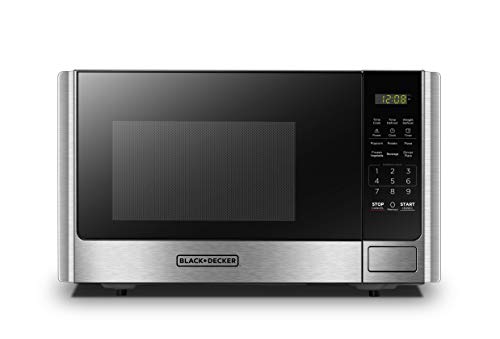
BLACK+DECKER Countertop Microwave Oven, 0.9 Cu.Ft, 900W, Stainless Steel
Badge: Best Door Action
Strengths
- 900 watts at the top of the small band with a push-button door, the easiest door action for one-handed and older users
- Ten power levels and six auto cook presets cover defrosting through reheating without guesswork
- Stainless steel finish in a widely recognised brand, sized for real counters
Trade-offs
- 0.9 cu ft remains a small cavity; check your largest everyday plate before buying
- No mute function is stated in the listing, unlike several rivals here
- Stainless needs regular wiping in a busy kitchen
| Capacity | 0.9 cu ft |
| Power | 900W |
| Power levels | 10 |
| Door | Push-button door |
| Presets | 6 auto cook presets |
| Safety | Child safety lock |
| Finish | Stainless steel |
The BLACK+DECKER 0.9 is a 900 watt stainless steel countertop microwave with ten power levels, a push-button door, a child safety lock and six auto cook presets. It is the mainstream small-band pick: a familiar brand, honest wattage and the door action that suits the widest range of hands. The push-button door is worth more than its single line in the specification, because it opens with an elbow or a knuckle while the other hand holds the hot dish, a small daily kindness that pull handles do not offer.
The BLACK+DECKER 0.9 brings the countertop detail that matters hourly: a push-button door that opens with a knuckle or an elbow while the other hand holds the dish. At 900 watts with ten power levels and six presets it is also the mainstream full-strength option inside the band, in a stainless finish that suits most counters it will sit on.
Its countertop cost is the band’s top end, so measure with clearance included. Households whose plates are full-size and whose cooking is nightly will find this the natural centre of the guide.
Best for: Mainstream small kitchens and users who prefer a push-button door / Not suited for: Buyers who need a mute function or family capacity

TOSHIBA Microwave Oven, 0.9 Cu.Ft, 900W, Black Stainless Steel
Badge: Best All-Rounder
Strengths
- 900 watts at the top of the small band, with a mute function that apartment and dorm neighbours appreciate
- The 10.6-inch removable turntable is stated in the listing, so plate fit can be checked before buying
- LED interior lighting makes doneness checks easy without opening the door
Trade-offs
- Black stainless steel is a specific finish commitment that should match the kitchen around it
- Six auto menus is a moderate preset count; cooks who live by presets have deeper menus in larger models
- 0.9 cu ft still will not take a large rectangular casserole
| Capacity | 0.9 cu ft |
| Power | 900W |
| Menus | 6 auto menus |
| Modes | Mute function |
| Lighting | LED lighting |
| Turntable | 10.6-inch removable turntable |
| Safety | Child lock |
The Toshiba 0.9 is a 900 watt microwave in black stainless steel with six auto menus, a mute function, a child lock, LED lighting and a stated 10.6-inch removable turntable, positioned by its listing for apartment use. The stated turntable size is the quietly useful detail: a buyer can measure their everyday plate against 10.6 inches at home and know the answer before ordering. With mute for thin walls and 900 watts for honest cooking times, it is the apartment-shaped version of the small band’s upper end.
The Toshiba 0.9 is the balanced countertop pick: 900 watts, a mute function, LED lighting and a stated 10.6-inch removable turntable, in black stainless steel. The stated turntable is the countertop-era detail to prize, because it converts the fit question from a guess into a measurement you can make at home tonight.
Against the BLACK+DECKER it trades the push-button door for the mute and the measured turntable; against the 0.7 picks it trades footprint for power and plate room. Most countertop buyers will land on one of these two 0.9 models, and either landing is defensible.
Best for: Apartment kitchens wanting 900 watts with a mute function / Not suited for: Buyers needing family-size capacity
TOSHIBA Countertop Microwave Oven, 1.2 Cu.Ft, 1000W, Black
Badge: Prose-Only Sensor Reference
Strengths
- A smart humidity sensor with twelve auto menus is the deepest sensor-cooking specification in this pool
- The 12.4-inch turntable takes full dinner plates and medium casseroles
- Mute and ECO modes plus an easy clean interior show attention to daily ownership, not just cooking
Trade-offs
- At 1.2 cu ft it is above the small band, so it appears in these guides as a prose-only reference with no link or image
- Sensor cooking rewards trust; cooks who prefer manual times may ignore its headline feature
- Black finish and family footprint both argue against tight counters
| Capacity | 1.2 cu ft |
| Power | 1000W |
| Sensor | Smart humidity sensor |
| Menus | 12 auto menus |
| Turntable | 12.4-inch removable turntable |
| Modes | Mute function, ECO mode, easy clean interior |
The Toshiba 1.2 in black is a 1000 watt countertop microwave with a smart humidity sensor, twelve auto menus, a mute function, ECO mode, an easy clean interior and a 12.4-inch removable turntable. It is the sensor-cooking reference in these guides: the model whose specification shows what humidity sensing and a deep menu set do at family size. Its capacity places it above the small band, so it is reviewed without a link or image, as the comparison that helps a sensor-curious buyer decide whether to stay small and manual or step up.
The black Toshiba 1.2 is the second sensor reference, mechanically the stainless model’s sibling: humidity sensor, twelve menus, mute and ECO modes, easy clean interior, a 12.4-inch turntable. It is prose-only for the same reason — capacity above the band — and its black finish is the only real difference between the two references.
Its stated turntable size is worth a countertop reader’s attention even unlinked: 12.4 inches is what family plates ask for, and comparing it with the 10.6-inch figure in the linked Toshiba shows exactly what the band boundary costs and saves.
Best for: Sensor-cooking fans who have the counter for a family size / Not suited for: Small-band briefs; it is the sensor reference here

COMFEE’ Countertop Microwave Oven, 0.7 Cu.Ft, 700W, Black
Badge: Best for the Smallest Counters
Strengths
- The smallest footprint in these microwave guides: 0.7 cu ft is the size that fits dorm shelves and office corners larger models cannot
- Sound on/off plus an ECO mode answer the two shared-space complaints, beeping and standby draw
- The listing names dorm, apartment and office outright, which is exactly the brief it is built for
Trade-offs
- 700 watts heats more slowly than the 900 and 1000 watt picks; packaged-meal times printed for stronger ovens need adjusting
- A 0.7 cu ft cavity takes a mug, a bowl and a standard dinner plate, not a family casserole
- One-touch simplicity means fewer programmed cooking stages than the larger picks
| Capacity | 0.7 cu ft |
| Power | 700W |
| Modes | ECO mode, sound on/off |
| Controls | One-touch buttons |
| Safety | Child safety lock |
| Named uses | Dorm, apartment, office |
The COMFEE’ is a 0.7 cu ft, 700 watt countertop microwave in black with an ECO mode, sound on/off control, one-touch buttons and a child safety lock, and its listing names its homes plainly: dorm, apartment, office. That honesty about scale is its recommendation. It does not pretend to cook for a family; it reheats a student’s noodles, an office lunch and a studio flat’s ready meal inside a footprint that fits where those people actually live. The mute option matters more than it sounds in a shared room at midnight.
The COMFEE’ closes the linked set at the true minimum: 0.7 cu ft, 700 watts, ECO mode, sound on/off and one-touch buttons, with a listing that names dorm, apartment and office. On a counter that also hosts a kettle, a board and a coffee maker, this is the microwave that does not start an argument about territory.
Choose it when the counter is the constraint and the cooking is reheating-scale. Its limits are the honest ones of its class — pace and plate size — and within those limits it is the most completely considered small package in the pool.
Best for: Dorm rooms, offices and the smallest studio kitchens / Not suited for: Families or anyone reheating large dishes

Comparison Table
Read the linked rows as countertop candidates and the prose-only rows as the sensor benchmark. The turntable and footprint figures, where listings state them, are the comparison that matters most for this brief.
| Pick | Badge | Standout trait | Watch out for | Amazon |
|---|---|---|---|---|
| TOSHIBA Countertop Microwave Oven, 1.2 Cu.Ft, 1000W, Stainless Steel | Prose-Only Sensor Reference | 1.2 cu ft, humidity sensor, stainless (reference) | Above the small band; stainless shows marks | Prose-only |
| Chefman Countertop Microwave Oven, 0.7 Cu.Ft, 700 Watts, Black | Best Minimum Footprint | 0.7 cu ft, 700W, 10 power levels, mute button | Slowest heating class; smallest cavity | Check on Amazon |
| BLACK+DECKER Countertop Microwave Oven, 0.9 Cu.Ft, 900W, Stainless Steel | Best Door Action | 0.9 cu ft, 900W, push-button door, stainless | No mute function stated in listing | Check on Amazon |
| TOSHIBA Microwave Oven, 0.9 Cu.Ft, 900W, Black Stainless Steel | Best All-Rounder | 0.9 cu ft, 900W, mute, 10.6-inch turntable | Finish is black stainless; check plate size | Check on Amazon |
| TOSHIBA Countertop Microwave Oven, 1.2 Cu.Ft, 1000W, Black | Prose-Only Sensor Reference | 1.2 cu ft, humidity sensor, 12 menus (reference) | Above the 0.7-0.9 cu ft small band | Prose-only |
| COMFEE’ Countertop Microwave Oven, 0.7 Cu.Ft, 700W, Black | Best for the Smallest Counters | 0.7 cu ft, 700W, mute and ECO mode | Slowest heating class here; smallest cavity | Check on Amazon |
How to Choose the Best Small Microwaves for Countertops
Measure like a countertop owner, in three numbers: the width of the space, the depth with the plug and vent clearance behind the machine, and the height under any wall cupboard with room above for heat to escape. A microwave that fits its box dimensions but not its clearance will cook unevenly and age badly, so the clearance is part of the measurement, not an afterthought. Dorm readers running the same routine on a shelf will find it in Best Small Microwaves For Dorm.
Let your plates arbitrate capacity. The stated turntable diameters in this pool — 10.6 inches inside the band, 12.4 inches in the references — turn the fit question into arithmetic. Measure your everyday plate and your largest regular bowl; if they clear the smaller turntable with room to rotate, the band serves you, and if they do not, no feature list will rescue the purchase.
Choose the wattage class by your menu. A countertop that mostly reheats and makes drinks can live at 700 watts and keep the smallest footprint; a countertop that cooks packaged meals nightly should pay the small size premium for 900 watts and keep printed times honest. The countertop mistake is buying the class your neighbour needed rather than the one your own cooking describes.
Plan the door before the delivery. Picture the machine in place and the door open: does it block the path to the fridge, sweep the chopping board’s territory, or hang over the counter edge? Push-button and handle doors make different claims on that space. Readers furnishing a first kitchen will find the same door logic at the centre of Best Small Microwaves First, where every centimetre is argued over.
How to Place and Maintain a Countertop Microwave
Countertop ownership is a placement discipline. The steps below cover the siting, the first calibration cooks and the small maintenance habits that keep a small machine cooking evenly for years.
- Site the machine on its final surface with the manufacturer’s clearance at the sides, back and top, and check the surface is level and heat-tolerant.
- Route the cable to its outlet without tension and without trapping it behind the machine where heat and weight work on it.
- Open and close the door through its full swing and confirm nothing on the counter has to move for the machine to be used.
- Run the mug-of-water test, then one familiar packaged meal at printed times, to calibrate your sense of the machine’s wattage class.
- Wipe the cavity and door seals weekly with a soft cloth and mild cleaner; small cavities concentrate splashes and odours faster than large ones.
- Keep the vents visibly clear as the counter fills up around the machine over the following months — creep is the usual cause of a hot-running oven.
Maintained this way, a countertop microwave becomes fixed infrastructure rather than a guest on the surface. Ease-of-use questions for older households are handled as their own brief in Best Small Microwaves For Seniors, where the same machines are ranked by door action and control clarity.
Troubleshooting
Problem: The oven runs hot and cooks unevenly after a few months → check the vents first; counters accumulate neighbours, and a machine that has been gradually surrounded loses the clearance it was installed with.
Problem: The turntable plate rattles or stalls → reseat the plate and its ring, and check for a crumb or a warped container catching the cavity floor; a plate that cannot rotate cannot cook evenly.
Problem: The door needs a slam to latch → clean the latch area and door seals of dried splashes before assuming a fault; countertop machines live where the cooking mess happens.
The Countertop Budget: What a Microwave Really Costs in Space
A microwave’s true countertop cost is its footprint plus its breathing room plus the territory its open door commands, and by that honest accounting the small band is cheaper than it looks and family machines are dearer. The linked picks in this guide were ranked with that full accounting in view. A 0.7 cu ft machine that leaves the board down permanently may serve a cooking household better than a larger oven that forces the board into a cupboard, because the board is used daily too.
This is also why the guide resists the bigger-is-safer instinct. Unused cavity is not future-proofing; it is counter surrendered every day for a dish that appears twice a year. Buy the band that fits the cooking you do weekly, and let the rare banquet be solved with the oven, a borrowed dish or a sequence of smaller vessels.
Sensor Cooking, Seen From the Countertop
The two prose-only references in this guide carry the pool’s sensor technology, and their presence frames a genuine question: is humidity sensing worth leaving the band for? Sensor cooking judges steam from the food and ends the cycle on evidence rather than on a guessed time, which flatters exactly the varied reheating that busy households do. The fullest treatment of that question lives in Best Small Microwaves With Sensor Cook, where sensor models are the brief rather than the reference.
From the countertop, the answer is proportional. If your counter can host a 1.2 cu ft machine without surrendering its workspace, the sensor class earns its footprint. If it cannot, the linked 900 watt picks with honest presets will reheat predictably with a stir and a standing time, and your counter stays a counter. Technology should be bought with space you have, not space you wish for.
Clearance is the specification nobody measures and everybody should. A countertop microwave needs breathing room around its vents, typically a few inches at the sides and back and more above, and a small kitchen tempts owners to push the machine flush into a corner where it then runs hot and cooks unevenly. Measure the space with the clearance included, not just the machine’s own width, and remember the door swing: a small microwave on a narrow counter can leave its open door hanging over the edge.
Turntable size decides what actually fits, more honestly than the cavity figure does. Manufacturers quote capacity in cubic feet, but your life is lived in plates: measure your everyday dinner plate and your largest regular bowl, and compare them with the stated turntable diameter where a listing gives one. A plate that only fits at an angle will not rotate, and a dish that cannot rotate heats unevenly no matter how good the oven’s power delivery is.
Wattage differences are easy to live with once you know the pattern. Packaged food times are usually written for the stronger ovens in these guides; in a 700 watt model the same meal simply needs longer, and the standing time at the end matters more, not less, because gentler power leaves bigger temperature differences for resting to even out. Stirring or turning food halfway, where the food allows it, closes most of the gap between a small oven’s result and a large one’s.
The door is a daily-use decision disguised as a detail. Push-button doors open with a knuckle or an elbow while the other hand holds a hot dish, and they suit children, older users and anyone carrying a bowl of soup. Handle doors feel sturdier to some hands and give a positive pull, but they need a free hand and a little counter clearance in front. In a small kitchen the door also decides whether the open machine blocks a walkway, which is worth picturing before the box arrives.
Defrosting is where power levels earn their keep. Full power cooks the edges of frozen food while the centre is still icy; a low level, patience and a turn halfway produce the even thaw that makes the next cooking step predictable. Every pick in these guides offers multiple power levels or an auto defrost, and the honest difference between them is how much of that judgement they automate. Sensor models judge steam and stop on their own; manual models ask you to learn your own portions, which regular cooks do quickly.
A small microwave still needs a stable, level home. Overhanging a counter edge, sitting on a wobbling shelf or sharing a circuit with a kettle and a toaster oven are the three arrangements that cause trouble, from tipping risks to tripped breakers. Small ovens draw less than large ones, but a dorm or office circuit is often shared with everything else in the room. Give the machine its own solid surface and, where the building allows it, its own outlet, and it will repay you with uneventful years.
A word on reheating quality, since it is the task these machines perform most. Microwaves heat unevenly by nature, and the household techniques that close the gap cost nothing: spread food in a ring rather than a mound, stir or turn halfway where the food allows, cover with a vented lid or plate to hold steam, and always honour the standing time, during which the temperature evens out and finishes the work. A smaller cavity actually helps here, because portions are smaller and the distance from edge to centre is shorter. The most powerful machine in this pool cannot beat a stirred, rested dish from a modest one.
Interior size is quoted in cubic feet, but the dimension that governs daily life is the cavity’s width at plate level. Two machines with the same stated capacity can differ in usable width because of door frames, control housings and turntable motors. That is why the stated turntable diameters quoted in this guide matter, and why the oldest advice in the category remains the best: take your own plate’s measurement to the listing, not the listing’s number to your hopes. A plate that fits and rotates is the whole game.
Energy use in this class is modest but not imaginary. Standby draw is the quiet cost, which is why ECO modes appear across these listings; cooking draw is the visible one, and smaller wattage classes simply sip more slowly rather than dramatically less overall. For shared housing and shared bills, the considerate pattern is the same as everywhere in this guide: the right size for the household, the ECO mode switched on, and the mute set before it is needed.
Cleaning a small microwave is a five-minute job that owners postpone for months, and the postponement is what makes it a chore. Steam is the tool: a bowl of water heated until the cavity steams loosens everything, after which a soft cloth does the rest. Removable turntables wash at the sink. Door seals deserve the same cloth, because a seal fouled with dried splashes is where odours live and where latching problems begin. None of the picks in this guide needs chemicals stronger than washing-up liquid and patience.
Think about where the machine will live in a year, not just tonight. Counters accumulate: a coffee maker arrives, a knife block migrates, a fruit bowl claims its corner. The small band’s deepest virtue is that its machines can be re-sited as the kitchen evolves — onto a shelf, into a utility corner, off to a relative’s first flat — without a van or a fitter. A machine that can move with your life is worth more than a marginal feature, and every linked pick in this guide keeps that option open.
The last consideration is honesty about the household’s trajectory. If a baby, a partner or a parent is about to join the home, today’s perfect small machine may be next year’s bottleneck, and the prose-only references in this guide exist to price that future openly. Buy for the household you have, with eyes open about the one you expect, and let the references — not a sales pitch — tell you what the next size up would add.
Noise deserves one more honest paragraph, because it is the specification that never appears on a box. A microwave’s sounds are its fan, its turntable motor, its door latch and its beeper, and in a small home all four are heard from every room. The listings in this guide cannot publish a decibel figure they do not state, so this guide ranks by the controls that manage noise instead: mute buttons and sound settings that silence the beeper, which is the sound neighbours actually complain about. The fan you learn to ignore within a week; the midnight beep is forever, unless the machine lets you switch it off.
Consider the control panel’s lighting and layout as a daily interface, not a styling exercise. A panel that groups the everyday functions together and keeps the exotic ones at the edges teaches itself within a week. A panel that alphabetises or scatters them demands the manual forever. The listings in this pool describe their control sets in words — power levels, presets, express buttons — and the pattern to favour is the one where your three real tasks are each a single, findable press in the dark, at dawn, with a mug in the other hand.
There is a quiet argument for buying the machine your household can clean without resentment. Smooth interiors, removable turntables and doors that open wide enough for a cloth are the features that decide whether the weekly wipe happens or gets postponed into a monthly excavation. Several picks in this guide state easy-clean or removable details in their listings, and in small machines, which concentrate splashes in a tighter space, those details compound in value over the years of ownership.
Replacement thinking belongs in a first purchase too. Small microwaves are among the most replaced appliances in the home, not because they fail often but because households change size around them. A machine bought honestly for today’s household can be handed on whole — to a student, a relative, an office — when the household outgrows it. That second life is part of the value of the small band, and it is one more reason to buy the size that fits now rather than a size bought out of anxiety about later.
Lastly, trust the boring evidence of your own kitchen over any ranking, including this one. Your plate diameter, your counter’s spare inches, your building’s wiring and your household’s noise tolerance are facts; a guide’s ordering is an argument built from listings. Where the two disagree, the facts win, and the reviews in this guide are written to hand you the measurements — turntable sizes, wattage classes, door actions — that let your own facts decide.
Common Buying Mistakes
Countertop mistakes are spatial before they are culinary. The tape measure prevents more of them than any review can.
- Measuring the machine and not its clearance, then wondering why it runs hot against the tiles.
- Letting the cavity figure choose, instead of measuring your own plates against the stated turntable.
- Buying family capacity for a counter that then cannot hold a chopping board.
- Ignoring the open door’s territory until it sweeps the worktop or blocks the walkway.
- Choosing 700 watts for nightly packaged meals and blaming small microwaves generally.
- Allowing the counter to creep around the machine until its vents are walled in by jars and appliances.
Every item on that list is a space decision made by default instead of by measurement. Make them deliberately and the small band rewards you daily.
Final Recommendation
Most countertop buyers should choose between the two linked 0.9 cu ft models: the Toshiba for its mute, lighting and stated turntable, or the BLACK+DECKER for its push-button door and mainstream strength. Drop to the Chefman or COMFEE’ at 0.7 cu ft when the counter is the binding constraint and the cooking is reheating-scale. The prose-only Toshiba pair stands as the sensor benchmark: if your counter can honestly grow, you have read exactly what growing buys.
Start your shortlist with Chefman Countertop Microwave Oven, 0.7 Cu.Ft, 700 Watts, Black, BLACK+DECKER Countertop Microwave Oven, 0.9 Cu.Ft, 900W, Stainless Steel and TOSHIBA Microwave Oven, 0.9 Cu.Ft, 900W, Black Stainless Steel — the linked picks that cover the widest range of readers in this guide — then use the detailed reviews above to narrow to the one that fits your cooking, your counter and your daily routine.
Frequently Asked Questions
How much clearance does a countertop microwave need?
Follow the manufacturer’s figures, which typically ask for a few inches at the sides and back and more above for heat to escape. The clearance is part of the machine’s real footprint, so measure your space with it included before choosing a size.
What turntable size do I need for dinner plates?
Measure your plate. Standard dinner plates sit near the top of what a 10.6-inch turntable carries comfortably; larger plates and medium casseroles are what the 12.4-inch reference models exist for. Rotation room matters as much as raw fit.
Is a 0.7 cu ft microwave big enough for a countertop kitchen?
For mugs, bowls, single plates and one-person meals, yes, and it leaves the counter usable for everything else. Households cooking for two nightly usually prefer the 0.9 cu ft top of the band.
Countertop or over-the-range: which suits a small kitchen?
This guide covers countertop models, which need no installation and move when you do. Over-the-range machines free the counter but demand fitting, venting and a suitable cabinet run — a different project with a different budget.
Why are the sensor models in this guide not linked?
Because both state 1.2 cu ft, above the 0.7 to 0.9 small band this programme applies to small-microwave briefs. They are reviewed fully and honestly as references, without links or images, so the countertop recommendation stays clean.
Does wattage change countertop choice?
Indirectly: 900 watt models sit at the band’s larger end, and 700 watt models at its smallest. Choose the class by your cooking pace, then confirm the footprint that comes with it still fits your measured space.


