Disclosure: topratedkitchenware.com is reader-supported. When you buy through links on our site, we may earn an affiliate commission from Amazon and other retailers, at no extra cost to you.
Where to buy
All six models below are verified portable camping toilets, and all six carry Amazon links. The pool spans one cassette toilet with a detachable tank, three folding or retractable designs, a steel-frame commode with a published load capacity, and a simple bucket portable — the full working range of small camping sanitation.
- Kohree Portable RV Toilet, 5.8 Gallon — Check on Amazon for the current configuration and availability
- Hapoon XL Portable Folding Camping Toilet
- Drive Medical Folding Bedside Commode
- Zinyeme Portable Toilet for Camping
- Ann Katy Upgrade XL Portable Toilet for Adults
- imodomio Retractable Portable Toilet
Read the full guide ↓ for the ranking logic, the honest limitations of every pick, and the siting and disposal routines that make a camping toilet a good neighbour.
The best small portable camping toilets are judged by a stricter standard than their size suggests. A camping toilet lives outdoors: it stands on grass, gravel and tent porch groundsheets, it is used in the dark by people in sleeping clothes, it travels in a car already full of camping, and at the end of the trip its waste must go somewhere proper. Small is therefore not a style — it is the discipline of a product that earns its packed space against the tent, the stove and the coolbox, every single trip.
This guide reviews six verified designs across the category’s real spectrum. At one end sits a cassette toilet with a 5.8-gallon detachable tank, behaving almost like a plumbed fixture for campers staying put. In the middle sit the folding and retractable designs that collapse for the car and open into real seats at the pitch. At the far end sit a rigid steel commode for users who need published strength, and bucket portables whose entire virtue is readiness. Campers setting up inside a tent porch should read the siting advice here together with the dedicated research behind Best Tent Camping Portable Toilets, and anyone whose camping is really trailer touring will find the storage logic continued under Best Toilets For Travel Trailers.
Every pick was checked against the verified pool for this category on 2026-11-20, and every pick carries an Amazon link so you can check the latest price on Amazon. Spec boxes use only details from the verified listing titles; capacities and load figures appear only where a title publishes them. No prices, star ratings or review counts appear anywhere in this guide.
Key Takeaways
- The Kohree cassette toilet leads for campers who stay in one place: a 5.8-gallon detachable, leak-proof-titled waste tank with a level indicator gives the longest, calmest emptying rhythm in the pool.
- The Hapoon XL and Ann Katy XL are the family folders — extra-large lidded seats that fold for the car and serve adults and kids.
- The imodomio retractable is the packed-size specialist, with adjustable height in a body designed to collapse for camping, car, boat, beach and tent use.
- The Drive Medical commode is the strength pick, the only title here publishing a load figure — up to 350 pounds — on a folding powder-coated frame with an included bucket.
- The Zinyeme bucket portable is the always-ready generalist for tent, boat, beach, car and home emergency duty.
In this guide
Quick Picks
| Pick | Badge | Type | Link |
|---|---|---|---|
| Kohree Portable RV Toilet, 5.8 Gallon | Best Overall | Cassette, detachable waste tank | Check on Amazon |
| Hapoon XL Portable Folding Camping Toilet | Best Folding Family Pick | Folding, with lid | Check on Amazon |
| Drive Medical Folding Bedside Commode | Best Weight Capacity | Folding commode, bucket included | Check on Amazon |
| Zinyeme Portable Toilet for Camping | Best Simple All-Rounder | Bucket-style portable commode | Check on Amazon |
| Ann Katy Upgrade XL Portable Toilet | Best XL Travel Pick | Extra-large, lightweight and compact | Check on Amazon |
| imodomio Retractable Portable Toilet | Best Pack-Down Design | Retractable, adjustable height | Check on Amazon |
One cassette, four folding or frame designs and a bucket: the ranking inside each pattern matters less than choosing the pattern your trips describe. That sentence is the guide in miniature, and everything after it — the reviews, the arithmetic, the routines — exists to help you name your pattern correctly the first time, rather than after a long season of patiently making the wrong design behave as if it were the right one.
How These Picks Were Chosen
This is a research-led guide; no hands-on testing is claimed. Candidates were assessed from their verified listing titles — waste system, stated capacity, adjustability, included components and stated applications — and screened for genuine camping service. A qualifying toilet must pack into a family car without heroics, set up on outdoor ground without tools or plumbing, contain its waste in a sealed or sealable form, and be sized for real adults or honestly labelled for the users it suits. All six met the standard and are linked. The ranking then weighs the qualities camping actually tests: emptying rhythm on a real stay, packed discipline in a real boot, seat honesty for the users named, and the presence or absence of published figures where figures matter. Where a title is silent — on load capacity for most of this pool — the review says so and adjusts what the pick is recommended for, rather than filling the silence with invention.
The 6 Best Small Portable Camping Toilets, Reviewed Honestly
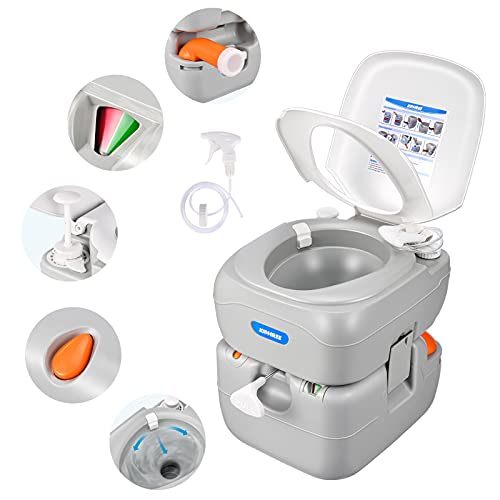
Kohree Portable RV Toilet, 5.8 Gallon
Badge: Best Overall
Strengths
- A proper cassette system in a portable body: 5.8-gallon detachable waste tank, titled leak-proof, with a level indicator to make emptying a plan rather than a surprise.
- The largest stated waste capacity in this pool, which is the specification that sets the rhythm of a whole camping stay.
- Titled across camping, RV travel, boat, home and indoor-outdoor use — a fixture-grade pattern, not a novelty.
Trade-offs
- It packs as a rigid block; folding designs beat it for boot gymnastics.
- A full tank is a heavy carry, so the indicator’s warning — not the brim — should set the emptying schedule.
- Cassette rinsing at a disposal point is a learned chore, less instant than a bag system’s seal-and-carry.
Mini spec box
- Brand: Kohree
- Waste tank: 5.8 gallon, detachable
- Sealing: leak-proof as titled
- Monitoring: waste level indicator
- Stated application: camping, RV travel, boat, home use, trips
The Kohree leads this guide because camping, more than any other portable-toilet setting, rewards a settled rhythm. On a pitch for a week, sanitation stops being an event and becomes a routine — and routines are built on capacity and predictability. The 5.8-gallon tank is the pool’s largest stated figure, and the level indicator converts that capacity into information: you can see the emptying day coming, choose a quiet hour for it, and carry the tank at a weight you selected rather than one the brim selected for you. That is fixture behaviour in a portable body, and it is why base-camp and family campers gravitate to cassette designs despite their bulk.
The costs are the pattern’s own. The body does not fold, so the boot must be planned around a rigid block — predictable, at least, and stackable with soft kit around it. The emptying chore involves a disposal point and a rinse, which campsites provide and wild pitches do not; on land without a disposal point, the bag systems discussed in the wider category research are the correct tool, and this guide will not pretend the cassette crosses over. Judged on the ground it is built for — the serviced pitch, the long stay, the family base — the Kohree is the most complete small camping toilet in the pool.
Best for: week-long pitches, family base camps and campers who want a fixture-like rhythm / Not suited for: wild camping without disposal points, or boots with no room for a rigid block
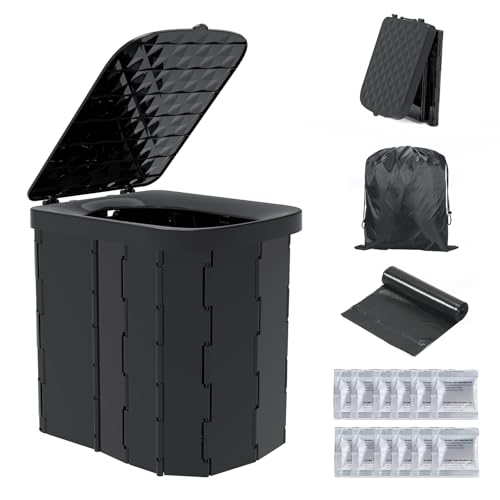
Hapoon XL Portable Folding Camping Toilet
Badge: Best Folding Family Pick
Strengths
- XL seat format with a lid, folding flat for travel — family-sized in use, luggage-like in transit.
- Lightweight as titled, for adults and kids, positioned squarely for camping and car use.
- The lid makes it a better porch citizen: closed between uses, usable as a low camp surface, tidier to carry.
Trade-offs
- No sealed tank: it works with bags or liners, so disposal follows the bag rules of wherever you camp.
- No load capacity or dimension figures in the title; the review judges the pattern, not a spec sheet.
- XL generosity in the seat means a larger folded footprint than the retractable designs.
Mini spec box
- Brand: Hapoon
- Design: XL portable folding toilet with lid
- Weight character: lightweight as titled
- Users: adults and kids as titled
- Stated application: camping, car toilet, outdoor portable bathroom
The Hapoon is what most families picture when they decide to buy a camping toilet: a real seat, big enough for an adult, kind enough for a child, with a lid that closes the subject between uses, that folds away when the car is loaded. Its XL claim should be read as seated room, and seated room is the quality that decides whether a camping toilet gets used willingly at night or avoided until the walk to the block seems preferable. A toilet the family avoids has failed regardless of its packed size.
Within the folding family, its trade is explicit: a bigger seat in exchange for a bigger folded shape than the retractable imodomio below, and a bag-based waste routine in exchange for the Kohree’s tank. Neither trade is a flaw; they are the design’s chosen ground. Pair it with a disciplined bag routine and a privacy tent, site it on level ground, and the Hapoon covers the centre of camping life — the serviced site, the family weekend, the festival field — with the fewest arguments of any pick here. That breadth of ordinary competence is a genuine distinction in a category full of specialists.
Best for: families wanting a roomy, lidded folding toilet for general camping / Not suited for: wild campers needing sealed carry-out beyond bags, or minimalists counting every packed inch

Drive Medical Folding Bedside Commode
Badge: Best Weight Capacity
Strengths
- Publishes what the rest of the pool omits: support for up to 350 pounds, on a durable powder-coated folding frame.
- Adjustable height, so the seat can be set for the user’s body and the ground it stands on.
- Includes its 7.5-quart bucket — a complete, rigid, confidence-giving system out of the box.
Trade-offs
- A bedside commode by design heritage, with medical styling; it will not be mistaken for camp gear.
- The 7.5-quart bucket is small — a primary user’s toilet or a night toilet, not a family’s main facility.
- Folding furniture dimensions, not luggage dimensions; plan its car space honestly.
Mini spec box
- Brand: Drive Medical
- Load: supports up to 350 lb as titled
- Frame: powder-coated, folding, adjustable height
- Bucket: 7.5 qt bucket included
- Pattern: 3-in-1 toilet solution as titled
Some buying decisions in this category are about a person, not a trip. A camper who is large, or unsteady, or recovering, or simply older, needs a toilet whose strength is a published fact and whose frame does not flex — and in this pool exactly one product publishes the fact. The Drive Medical commode’s 350-pound titled capacity and rigid powder-coated frame make it the responsible recommendation for those users at a campsite exactly as at a bedside, because ground does not become kinder to a weak frame just because it is grass. Its adjustable height completes the safety picture, letting the seat be set where the user’s feet plant firmly.
The guide is equally clear about what it is not. It is not the family workhorse — the bucket is too small — and it is not the packer’s friend, folding like the furniture it is. It is a specialist whose specialism is trust, and for the camper whose trip depends on that trust, no amount of camp styling on a lesser frame is a substitute. Expedition and river parties reached the same conclusion long ago about strong, simple sanitation, as the research behind Best River Toilets shows; the commode brings that philosophy to the drive-to pitch.
Best for: larger campers and anyone with mobility needs who requires a published capacity and a rigid frame / Not suited for: family main-toilet duty, or campers minimising packed volume
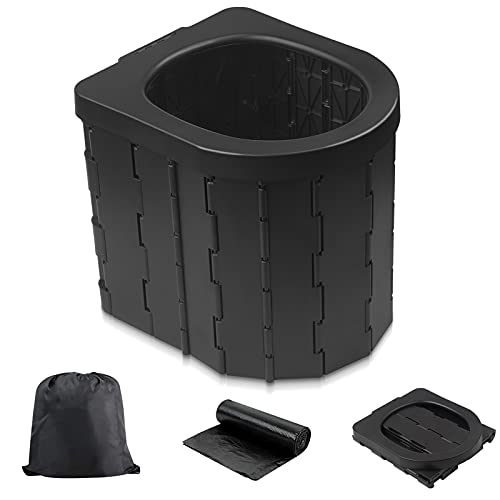
Zinyeme Portable Toilet for Camping
Badge: Best Simple All-Rounder
Strengths
- The bucket pattern in its purest form: nothing to assemble, configure or prime — line it, use it, seal it, rinse it.
- Titled for an exceptional range of settings — tent, boat, beach, car, hiking, backpack trips, traffic jams and home — because the pattern genuinely travels.
- Pairs with bags and liners for sealed carry-out disposal wherever the rules allow bagged waste.
Trade-offs
- No capacity, load or dimension figures in the title; buyers needing published numbers have the Kohree and Drive Medical as their evidence-based options.
- The simplest seat in the pool — serviceable, not luxurious — so long-stay comfort ranks below the cassette and XL designs.
- No lid or gel system is claimed in the title; the user’s routine supplies the refinements.
Mini spec box
- Brand: Zinyeme
- Design: portable commode bucket toilet
- Users: adults as titled
- Stated application: camping, tent, boat, beach, car, hiking, trips, home
The Zinyeme is the pool’s insurance policy: the toilet that lives in the car or the garage and is simply there — for the tent trip, the beach day with no facilities, the boat outing, the festival, the long drive’s worst hour. Its specification silence is noted in this review rather than papered over, because that is the deal this pattern offers: in exchange for published figures, you get a design with almost nothing in it that can break, jam or be forgotten at home. Readiness is its feature, and readiness is underrated until the moment it is the only feature that matters.
As a main camping toilet for a long stay, it is outclassed by the Kohree’s tank and the XL folders’ seats, and the review says so. As the second toilet — the night bucket in the tent porch, the children’s emergency option, the just-in-case in the boot — it may be the most-used pick in the guide across a year of ordinary life. Buy it for the role it is honest about, line it properly, and it will repay the small space it takes many times over.
Best for: car-boot readiness, second-toilet duty and general outdoor use across many settings / Not suited for: long-stay main facility duty, or buyers who need published specifications

Ann Katy Upgrade XL Portable Toilet for Adults
Badge: Best XL Travel Pick
Strengths
- Extra-large seat format in a body titled as lightweight and compact — the XL promise without the XL penalty.
- A lid included in the pattern, for hygiene between uses and tidier carrying.
- Titled across hiking, beach, boat, emergency and RV use as well as camping — a travel tool, not a single-setting one.
Trade-offs
- Like the other folders, it is a bag-or-liner pattern with no sealed tank and no published load figure.
- Its breadth of stated settings means it is a generalist; the cassette still wins long stays and the retractable still wins packed size.
- XL in the seat still means a real folded footprint; measure the boot before assuming.
Mini spec box
- Brand: Ann Katy
- Design: upgrade XL portable toilet, extra-large camping toilet
- Weight character: lightweight and compact as titled
- Seat: with lid as titled
- Users: adults and kids as titled
- Stated application: camping, hiking, beach, boat, emergency, RV
The Ann Katy and the Hapoon are cousins — both XL folders with lids aimed at families — and the honest service a guide can do is to name the small ground on which they differ rather than invent a gulf. The Ann Katy’s title leans toward travel breadth: hiking, beach, boat and emergency settings share its billing with camping, and its “lightweight and compact” pairing is the claim a car-based traveller reads first. The Hapoon’s title leans toward the campsite itself. In the hand, either serves a family weekend well; the choice between them is a coin weighted by which journey — the packed car or the pitched camp — you want the design to have been optimised for.
Its limitations repeat the folder family’s: bags or liners carry the waste, no figures are published for load, and long stays expose the absence of a tank. None of that prevents it from being the right answer for the largest group of buyers in this category — families who camp a handful of times a year, travel by car, and want a seat nobody in the tent complains about. For that group the XL format is not a luxury; children grow, adults vary, and a seat that fits everyone ends the nightly negotiation about who uses the toilet and who walks to the block.
Best for: travelling families who want an XL lidded seat in a lightweight, compact folder / Not suited for: long-stay campers needing a tank, or users requiring a published load capacity

imodomio Retractable Portable Toilet
Badge: Best Pack-Down Design
Strengths
- Retractable body with adjustable height: the design that takes packed size most seriously in this pool.
- Titled for camping, car, travel, boat, beach, tent and emergency use — the full portable itinerary.
- Height adjustability serves children and adults from the same unit across a family’s whole camping life.
Trade-offs
- A retractable mechanism has joints and locks that want a pre-trip check and a careful first set-up.
- No published load capacity in the title; strength-first buyers have exactly one evidence-based option in this pool, and it is the commode.
- Bag-or-liner waste handling, with the disposal rules that follow from it.
Mini spec box
- Brand: imodomio
- Design: retractable portable toilet, camping toilet
- Height: adjustable height
- Stated application: camping, car, travel, boat, beach, tent, emergency use
The imodomio closes the pool with the packer’s argument in its purest form. Camping kit expands to fill every vehicle, and the toilet is usually the bulkiest single item in the sanitation corner; a body that retracts to a fraction of its working height changes the packing conversation entirely, freeing the boot’s awkward corners for the things that cannot fold. The adjustable height then returns the favour at the pitch, letting the same unit serve a small child and a tall adult across one weekend — a flexibility the fixed designs cannot imitate.
The mechanism is the price, and the review prices it honestly: joints to check, locks to confirm, a first set-up best done in daylight at home. Campers who maintain that tiny discipline get the pool’s best packed size; campers who will not should choose a folder or a bucket and accept the bulk. Either way the decision is about the owner’s habits, not the product’s worth — which is exactly where a good guide should leave it. Shorter users comparing seat heights across categories will also find the height discussion continued under Best Short Height Toilets, where low fixtures are the whole subject.
Best for: campers for whom packed size is the binding constraint, and families wanting one adjustable toilet for all ages / Not suited for: users needing a published load capacity, or anyone who will skip the pre-trip mechanism check
Comparison Table
| Pick | Waste system | Packing pattern | Published figure | Best use | Link |
|---|---|---|---|---|---|
| Kohree Portable Toilet | Detachable cassette tank | Rigid compact block | 5.8-gallon tank, level indicator | Long stays, base camp | Check on Amazon |
| Hapoon XL Folding | Bag or liner with frame | Folding, with lid | XL seat format | Family general camping | Check on Amazon |
| Drive Medical Commode | Bucket, 7.5 qt included | Folding steel frame | Supports up to 350 lb | Strength and mobility needs | Check on Amazon |
| Zinyeme Portable Toilet | Bucket, bag-lined | Simple bucket format | None in title | All-round readiness | Check on Amazon |
| Ann Katy XL | Bag or liner with frame | Lightweight, compact folder | XL seat format | Travelling families | Check on Amazon |
| imodomio Retractable | Bag or liner with frame | Retractable | Adjustable height | Tightest packing | Check on Amazon |
Six designs, three waste philosophies. The camper who chooses the philosophy first will find the ranking inside it almost settles itself. Cassette for the settled stay, folding frames for the travelling family, bucket and commode for readiness and strength — and across all three, the same disciplines of sealing, siting and honest capacity arithmetic decide whether the chosen toilet is remembered fondly or not at all, which for a toilet is the highest available praise.
How to Choose a Small Portable Camping Toilet
Stay length and site services come first
A serviced pitch with a disposal point rewards the cassette: capacity, a level indicator and a weekly rhythm. A short stay anywhere rewards bags and folders: no rinsing, no tank, nothing to maintain between trips. Land with neither services nor bag acceptance demands full carry-out planning, which should be settled before the toilet is chosen, not after. Read your typical trip honestly — nights, users, facilities — and let it pick the waste system; the product choice that follows is then a shortlist of two or three, not a catalogue.
Packed size is a system, not a dimension
The toilet travels with the tent, the kitchen and the luggage, and it travels home again in whatever state the trip left it. Retractable and folding designs earn their complexity here; the cassette earns its bulk back in use. Measure the real travelling space — the boot corner, the trailer locker, the van cupboard — and prefer the design whose packed form fits that space without evicting something else essential. A toilet that only fits on the way out, when the food boxes are full, will not fit on the way home, when they are empty but the tank is not.
Seats, heights and the people actually coming
List the users before the features. Children argue for adjustable height or a low, stable seat. Larger or unsteady users argue for the one published capacity in this pool and the rigid frame behind it. Tall adults argue for XL seats and against the most compact folders. The generalist middle — the XL folders — serves the mixed family best, which is why two of them sit in this pool’s centre. Paper belongs in this section too: quick-dissolving paper keeps every system here easier to empty, and the dedicated comparisons under Best Toilet Paper For Portable Toilets treat that choice with the seriousness it deserves.
Ground, weather and the porch
Camping toilets stand on the ground the pitch provides. Frames with positive locks and a level stance behave on grass and gravel; any design rocks on a slope until it is re-sited, so site selection is part of the product experience. Rain argues for a lidded design under a porch or privacy tent; wind argues for the same shelter. None of the six here needs power, plumbing or a level concrete pad — that is the category’s founding promise — but all of them repay a flat, sheltered, close-to-the-tent siting with a completely different night-time experience.
How to Set Up, Use and Clean a Camping Toilet
At home, before the first trip: assemble or unfold the toilet once in daylight, confirm every lock and hinge, test cassette seals with clean water, and pack the consumables kit — bags or liners, gloves, hand cleaning, and quick-dissolving paper — as one unit that lives with the toilet. At the pitch: choose level ground inside a privacy tent or screened porch corner, downwind of the cooking area and a respectful distance from water and neighbours, following the site or land rules where they exist. Set the toilet, check its stance with a deliberate sit, and place a low light where the night path needs it.
In use, the routine is sealing and lids: bags sealed promptly, lids closed always, the consumables kit restocked in the evening rather than discovered empty at dawn. The cassette’s routine adds the indicator watch and a planned emptying at a proper disposal point, carried at the weight you chose by emptying on the warning. At the trip’s end, clean as if the next trip were tomorrow: cassettes rinsed and dried with seals clean, buckets washed and fully dried, frames wiped and mechanisms checked. Store dry, ventilated and complete with its kit, so the next departure is a lift-and-go rather than a search.
Troubleshooting, in the pattern that matters at camp:
- Problem: the toilet rocks in use → re-site on level ground before blaming the frame; most instability at camp is topography wearing a product’s name.
- Problem: odour around a bag-based set-up → a bag was sealed late or the lid left open; tighten the routine and keep a spare-bag discipline so sealing is never rationed.
- Problem: the cassette smells before the indicator warns → the seal needs rinsing or the previous emptying was incomplete; rinse the seal, empty fully, and let the indicator set the schedule thereafter.
Festival and Event Camping: A Different Rhythm
Festival fields compress camping’s sanitation problem: thousands of people, facilities that peak twice a day, and a strong case for a toilet of your own at the tent. The folding and bag designs dominate this setting for good reasons — they pack into a car already carrying a festival’s worth of gear, they ask nothing of the site’s infrastructure, and their waste leaves sealed. The cassette is the heavyweight option here, justified only for long events with a known disposal point. The commode serves the accessibility need that festival camping otherwise serves badly, and its presence in a family camp can be the difference between a member attending and staying home. Whatever the design, festival etiquette is the serviced-site etiquette intensified: seal promptly, keep the porch tidy, and carry waste out as invisibly as it was produced. The wider camping category behind Best Toilets For Camping treats the same rhythm at ordinary sites; the festival merely turns the volume up.
Where the Toilet Lives at the Pitch
Every camping toilet has two addresses: the space it travels in and the space it works in, and the second is chosen fresh at every pitch. The working address wants four properties. Level ground, because every frame and tank in this pool assumes it. Shelter, because rain on a seat at midnight is a small misery that a porch or privacy tent abolishes entirely. Proximity, because the night walk should be short, lit and free of guy-lines. And discretion — downwind, out of sightlines, at the distance from water and neighbours that the site’s rules and ordinary courtesy both prescribe. Campers who walk the pitch once with those four properties in mind before pitching the sleeping tent almost always end with a better camp than campers who place the toilet last, in the space nobody else wanted.
The privacy tent deserves its own endorsement, because it converts the toilet from a compromise into a room. It gives the toilet its shelter and its discretion in one purchase, doubles as the camp’s changing room and shower annex, and — a benefit nobody lists — gives children a defined, safe place to go at night instead of a dark field and a torch. Paired with any pick in this guide, it is the single accessory that most changes the experience, and unlike most accessories it serves every design equally: cassette, folder, commode and bucket all become more civilised inside four light walls. If the budget forces a choice between a more elaborate toilet and a simpler toilet plus a privacy tent, this guide’s honest advice is to take the tent and the simpler toilet, and to revisit the toilet question next season with the experience of a proper room behind you.
One Toilet or Two: Planning for a Family Camp
Families eventually face the arithmetic of the single toilet at peak hour — the morning when everyone wakes at once, the evening when the children are being settled — and some solve it with a second, simpler unit. The pattern that works is a main toilet and a satellite: the cassette or XL folder as the main facility in the privacy tent, and a bucket portable like the Zinyeme as the satellite inside the sleeping tent’s porch for children and night use. The satellite’s demands are minimal — a liner, a lid discipline, a morning carry — and its benefit is disproportionate, because it removes the queue and the dark walk from the two moments of the day when both are worst.
The two-toilet camp also spreads risk. A mechanism sulking, a tank awaiting its disposal walk, a bag supply running low: with one toilet each is a small crisis, with two each is an errand. The cost is packed space, which is why the satellite should be the simplest design that serves — in this pool, the bucket — and why the pairing should be planned as a system with shared consumables, so one kit of bags, liners and paper serves both units. Campers who camp as a couple will rarely need the second unit; campers who camp as a family of five in one tent will wonder how they managed without it. As with everything in this guide, the trip you actually take — its people, its nights, its site — is the specification that matters, and the products are merely the six most honest ways this pool knows to meet it.
Common Buying Mistakes
- Buying the tank for a trip that needs bags. A cassette on a two-night wild camp is weight without reward; match the system to the stay and the site’s services.
- Assuming XL means bulky and compact means cramped. In this pool the XL folders pack respectably and the retractable seats a family. Judge packed and opened forms separately.
- Skipping the home rehearsal. First set-up at a dark pitch is the category’s classic own goal. Daylight, at home, once — that is the whole insurance premium.
- Choosing for the average user when one user has a specific need. A published load capacity exists in this pool for a reason. Where it is needed, it outranks every other row of the comparison table.
- Forgetting the return journey. The toilet packs home in a different state than it packed out. Space and sealing for the return leg are part of the purchase.
Final Recommendation
For the camper who stays put on serviced pitches, the Kohree Portable RV Toilet is the recommendation: the pool’s largest stated tank, a level indicator and a fixture-like rhythm that makes a week of camping feel civilised — Check on Amazon once your boot has room for its honest block. Families who travel lighter should choose between the Hapoon XL and the Ann Katy XL on whether the campsite or the journey matters more, pack-counters should take the imodomio retractable, and anyone buying for strength should take the Drive Medical commode without a second thought. The Zinyeme remains the readiness pick that quietly covers everything else. The best small portable camping toilets are the ones whose waste system matches the stay, whose seat matches the users and whose packed shape matches the car — and by those three matches, applied honestly and in that order, this pool has a right answer for nearly every tent, pitch and festival field in the country.
Frequently Asked Questions
What is the difference between a camp toilet and a camping toilet in these guides?
Nothing in the products and a little in the emphasis. The two searches return the same designs, so this guide weights the camping context — serviced pitches, family stays, festival fields — while its sibling weights compact camp and car use. The picks overlap because the category is genuinely one category; the advice differs because the trips do.
How do I keep a portable camping toilet from smelling?
Odour is a routine outcome, not a product lottery. Seal bags promptly, keep lids closed, empty cassettes on the indicator rather than past it, rinse seals and tanks at each emptying, and site the toilet downwind in a ventilated shelter. A toilet maintained on that routine is less noticeable than a busy site block; a toilet neglected on any routine will announce itself whatever its badge.
Can these toilets be used inside a tent?
Inside a tent’s porch or a dedicated privacy tent, yes — that is a standard arrangement, and several picks here are titled for tent use. Inside the sleeping compartment itself is poor practice for ventilation and spill reasons. Site it in the porch on level ground, keep the sealing routine tight, and the arrangement is comfortable and hygienic for the whole camp.
Which pick is best for a camper with mobility needs?
The Drive Medical commode, and the reason is evidence: it is the only pick whose title publishes a load capacity, up to 350 pounds, on a rigid folding frame with adjustable height. Those are the properties that make a seat trustworthy for a user who cannot risk a flexing frame. Its bucket is small, so plan it as a primary user’s toilet with frequent emptying rather than a family facility.
Do I need special paper for a portable camping toilet?
Quick-dissolving paper is strongly advised for every system in this pool: it keeps buckets rinsable, bags compact and cassette tanks emptying cleanly. Ordinary household paper is engineered for municipal sewers and lingers in small waste systems. The dedicated paper comparisons linked from this guide work through the options in detail.
How long do folding and retractable toilets last?
Their life is decided at the joints. Frames that are opened fully, locked positively, kept clean at the hinges and stored dry serve for many seasons; frames forced half-open on slopes and stored damp in a garage corner age quickly. The pre-trip check this guide recommends — open, lock, sit, once at home — is also the longevity programme. There is very little else in these designs to wear out.
What should I pack alongside a portable camping toilet?
Pack the toilet as a system, not an object. The kit that should travel with any pick in this guide contains its consumables — bags or liners in numbers beyond the estimate, or the cassette’s rinse supplies — plus gloves for the disposal routine, hand cleaning for afterwards, quick-dissolving paper, a small brush, and a low light for the night path. Add a privacy tent if the camp does not already carry one, and a stable step if children will use a taller seat. Packed that way, the toilet arrives as a working facility; packed as a bare object, it arrives as the beginning of a shopping list at the nearest town. The difference costs one bag’s worth of space and decides the first night’s entire experience.
Is a cassette toilet worth it for short trips?
Usually not, and the reason is rhythm rather than quality. A cassette toilet’s virtues — capacity, a level indicator, a fixture-like seat — are stay-length virtues: they compound across a week and barely register across a weekend, while its costs — the rigid packed block, the disposal-point rinse — are paid in full on every trip however short. For one to three nights, the folding and bag designs in this pool deliver the same sanitation with a fraction of the ceremony, and they store smaller between trips as well. The cassette becomes the right answer at the point where the stay is long enough for a daily bag routine to become the greater burden, and most campers can name that point from their own calendar: it is the trip measured in weeks, or the seasonal pitch, or the family base camp that returns to the same field all summer. Buy for the trips that dominate your year, and let the exceptional trip adapt.


