Disclosure: topratedkitchenware.com is reader-supported. When you buy through links on our site, we may earn an affiliate commission from Amazon and other retailers, at no extra cost to you.
Where to buy
All six picks below carry Amazon links, and all six were chosen with a first-year smoker in mind. The list deliberately mixes the two beginner-friendly fuel types — four electric cabinets that heat with an element and smoke with chips, and two pellet grills that automate a real wood fire — because the right first smoker depends less on fuel ideology than on how much supervision you want to give and take. Use the links to check current prices and the newest listing details, and read the beginner notes in each review before you decide; in this guide, the badge under each name tells you exactly which kind of beginner that machine suits.
- EAST OAK 30-Inch Outdoor Electric Smoker, Matte Black — Best Overall for Beginners
- EAST OAK 30-Inch Outdoor Electric Smoker, Polar Night — Best With a Built-In Probe
- Pit Boss 700 Carbon Series Wood Pellet Grill and Smoker — Best Pellet Grill for Beginners
- Masterbuilt 30-Inch Electric Vertical Smoker with Analog Control MB20070210 — Best Analog Start
- Royal Gourmet SE2805 28-Inch Electric Smoker — Best Compact Start
- Traeger Pro 22 Wood Pellet Grill and Smoker — Most Versatile
Read the full guide ↓
If you searched for the best smokers for begineers, the spelling may be improvised but the question is one of the best in barbecue: what should a first smoker actually be? Beginners do not need the largest cabinet or the richest feature list. They need a machine whose mistakes are forgiving, whose routine can be learned in two or three cooks, and whose feedback — a temperature that holds, a probe that reports, a timer that minds the schedule — teaches them what good smoking looks like while they are still forming their habits. A first smoker is a teacher as much as an appliance, and the wrong teacher (a finicky fire, an unmarked dial on a huge cabinet, a fuel system that interrupts hourly) can convince a perfectly capable cook that smoking is not for them.
The six picks below are ranked as teachers. Electric cabinets dominate the list because their lesson plan is the gentlest: the element holds the heat, the chips make the smoke, and the beginner’s whole job reduces to seasoning, loading, and learning patience. The two pellet grills earn their places for the beginner who already knows they want real wood combustion and grilling range — pellet automation makes fire nearly as forgiving as an element, at the cost of fuel storage and ash. What none of these machines will do is rescue a cook who skips the fundamentals, so this guide pairs every review with the beginner routine itself: what to cook first, what to ignore, and which beginner mistakes are actually the machine’s fault. Readers shopping from Australia will find the same beginner questions with local power and supply notes in Best Smokers For Beginners Australia.
Key Takeaways
- For a first smoker, supervision design beats size: timers, probes, and side chip loaders teach good habits by making the right routine the easy routine.
- The EAST OAK Matte Black leads for beginners overall — digital 12-hour timer, side loader, 725 sq in, and wheels — with its Polar Night sibling the pick when a built-in probe matters most.
- Electric cabinets are the gentlest start; pellet grills are the right start for beginners who want grilling and combustion flavor from day one.
- Analog models (the Masterbuilt MB20070210 and the Royal Gourmet SE2805) teach the craft most directly and forgive the least — choose them if you enjoy learning by hand.
- Your first three cooks matter more than your first machine: forgiving cuts, a thermometer habit, and a simple log will teach you faster than any upgrade.
- No pick here requires exotic skills or accessories to start; every one can produce a successful first cook with chips or pellets, a probe mindset, and patience.
In this guide
Quick Picks
| Pick | Badge | Why it stands out for beginners | Link |
|---|---|---|---|
| EAST OAK 30-Inch Outdoor Electric Smoker, Matte Black | Best Overall for Beginners | A digital 12-hour timer minds the schedule, a side chip loader feeds smoke without opening the door, and 725 sq in leaves room to grow. | Check on Amazon |
| EAST OAK 30-Inch Outdoor Electric Smoker, Polar Night | Best With a Built-In Probe | The built-in meat probe teaches the core beginner skill — cooking to temperature — from the very first session. | Check on Amazon |
| Pit Boss 700 Carbon Series Wood Pellet Grill and Smoker | Best Pellet Grill for Beginners | LCD digital control, a meat probe, 718 sq in, and a stated 180°F to 500°F range — pellet fire with training wheels built in. | Check on Amazon |
| Masterbuilt 30-Inch Electric Vertical Smoker with Analog Control MB20070210 | Best Analog Start | One dial, chrome racks, 535 sq in — the direct, unmediated way to learn how a smoker behaves. | Check on Amazon |
| Royal Gourmet SE2805 28-Inch Electric Smoker | Best Compact Start | A stated 1350W element, analog adjustable heat, and three grates in a 28-inch cabinet — the smallest, simplest start in the guide. | Check on Amazon |
| Traeger Pro 22 Wood Pellet Grill and Smoker | Most Versatile | Six-in-one cooking with an 18 lb hopper and a probe — the beginner machine that also grills, bakes, and roasts as skills grow. | Check on Amazon |
How These Picks Were Chosen
Beginner suitability was scored on the things that decide a first year. First, feedback quality: does the machine tell the cook what is happening — through a probe, a timer, a digital readout, a window — or does it leave the beginner guessing? Second, interruption count: how often does the design force the door open or the cook to intervene, since every intervention is a chance for a beginner’s cook to wobble? Third, routine complexity: the number of systems a new owner must learn at once, from chip trays to augers. Fourth, forgiveness: how the machine behaves when the beginner inevitably runs a cook long, loads too many chips, or starts late. Capacity and headline features were considered last, because a first smoker that is outgrown in year three has done its job, while a first smoker abandoned in month two has failed at any size.
The specifications cited are only those the verified listings state; where a model does not publish a detail, the review works without it rather than inventing it. No prices or ratings are printed, and no hands-on testing is claimed — this is a research-led comparison, and its beginner advice is drawn from the documented behavior of these designs and the consistent patterns in owner feedback about first-year smoking. The wood-fuel side of the beginner decision is developed further in Best Smokers For Beginners Wood, which is the natural next read for anyone leaning pellet.
The 6 Best Smokers for Begineers

EAST OAK 30-Inch Outdoor Electric Smoker, Matte Black
Badge: Best Overall for Beginners
Strengths
- The digital 12-hour timer is a beginner’s best friend: the cook’s schedule lives in the machine, not in a head full of new information.
- The side chip loader, rated for up to six times longer on a single load, removes the most common beginner interruption — opening the door to feed smoke.
- 725 sq in gives a beginner room to make small mistakes in loading and still have the cook come out fine, plus easy-rolling wheels for storage.
Trade-offs
- No built-in probe or viewing window is stated, so a thermometer purchase belongs in the first order alongside it.
- It is a full-size cabinet; a beginner with a tiny patio should measure before falling for the feature list.
- The timer manages duration, not doneness — the beginner still has to learn the probe habit the timer cannot teach.
Mini spec box
- Fuel: electric element with wood chips
- Cooking area: 725 sq in
- Timer: digital 12-hour timer
- Chip loading: side chip loader, up to 6x longer on a single load
- Mobility: easy-rolling wheels
- Finish: Matte Black
The Matte Black EAST OAK is our overall beginner pick because its design quietly enforces the three habits that separate successful first years from frustrating ones. Habit one: plan the cook’s duration in advance — the 12-hour digital timer makes you state it, in numbers, before the food goes in. Habit two: keep the door shut — the side loader means the smoke never asks you to break that rule. Habit three: give the machine a stable, level, out-of-the-way home — the wheels make repositioning easy enough that you will actually do it. A beginner does not need to be told these habits in an article when the appliance’s own layout keeps suggesting them.
The capacity deserves a beginner-specific reading. 725 sq in sounds like a lot for a first smoker, and it is — deliberately. New cooks load unevenly, crowd pans, and misjudge how much food a rack holds; a cabinet with surplus room forgives all of that, and it means the machine survives the beginner’s second year, when the cooks get ambitious, instead of being replaced by it. Its one genuine homework item is the probe: none is stated as built in, and since cooking to temperature is the master skill of smoking, pair this cabinet with a thermometer from day one and treat the two as a single purchase. Do that, and this is the first smoker we would hand to a friend who asked the begineers question and meant it.
Best for: beginners who want the machine to manage schedule and smoke while they learn the craft / Not suited for: tiny patios and anyone unwilling to buy a thermometer
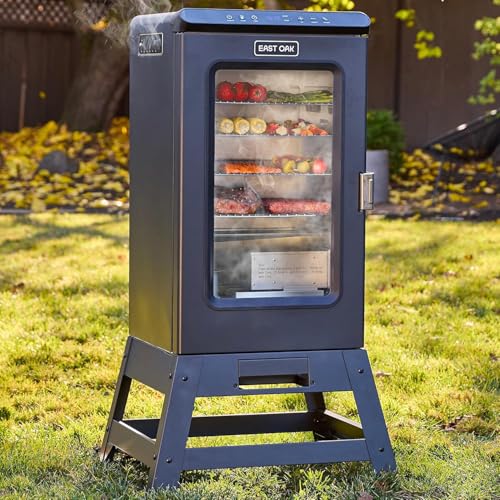
EAST OAK 30-Inch Outdoor Electric Smoker, Polar Night
Badge: Best With a Built-In Probe
Strengths
- The built-in meat probe is the single most educational feature a beginner can own: every cook becomes a lesson in cooking to temperature, not to time.
- The side chip loader is rated for up to six times longer uninterrupted smoke, keeping the door — and the beginner’s temptations — closed.
- 725 sq in and a mobility stand give the same forgiving capacity and working height as its sibling, in the Polar Night finish.
Trade-offs
- No digital timer is stated, so the schedule lives with the cook rather than the cabinet.
- The mobility stand adds assembly and storage parts compared with a ground-sitting cabinet.
- No viewing window is stated; feedback is the probe’s numbers, which is excellent training but less fun to watch.
Mini spec box
- Fuel: electric element with wood chips
- Cooking area: 725 sq in
- Chip loading: side chip loader, up to 6x longer uninterrupted smoke
- Probe: built-in meat probe
- Stand: mobility stand included
- Finish: Polar Night
If the Matte Black teaches scheduling, the Polar Night teaches measurement — and measurement is the deeper skill. Almost every beginner failure in smoking traces back to judging doneness by time, color, or hope, and the built-in probe attacks that failure at its root: from the first cook, the food itself reports when it is ready, and the beginner watches a shoulder stall, push through, and arrive, building the intuition that no article can install. Pair that with the side loader’s door discipline and the same generous 725 sq in, and you have a first smoker whose feedback loop is complete: set the temperature, load the chips from outside, and learn by watching numbers behave.
Choosing between the two EAST OAK cabinets is the beginner’s first real equipment decision, and it is a pleasant one: timer or probe, schedule or measurement. Our honest lean for a true first-timer is the probe, because timers can be approximated by any clock in the house while an integrated probe lives exactly where the lesson happens — which is why this model sits second here only on the strength of its sibling’s all-round package, not on any deficiency. The stand, meanwhile, quietly improves the beginner’s ergonomics: loading at height, with both hands free and the door at working level, makes the first cooks feel manageable rather than athletic. For the methodical beginner who likes data, this is the teacher.
Best for: methodical beginners who want to learn cooking-to-temperature from the first session / Not suited for: cooks who want the cabinet to run the schedule for them

Pit Boss 700 Carbon Series Wood Pellet Grill and Smoker
Badge: Best Pellet Grill for Beginners
Strengths
- LCD digital control automates the pellet fire — the beginner sets a temperature and the auger does the fire-tending that makes traditional smoking hard.
- An included meat probe and a stated 180°F to 500°F range cover the beginner’s whole first curriculum, from low smoking to weeknight grilling.
- 718 sq in is family-scale room to learn in, with space for the main and the sides in one session.
Trade-offs
- Pellet ownership adds systems a beginner must learn together: hopper, auger, ash, and dry fuel storage.
- The 13.5 lb hopper needs a check before the longest cooks — a small routine, but a new one.
- It is the largest footprint among the beginner-friendly picks here; measure the patio first.
Mini spec box
- Fuel: wood pellets
- Cooking space: 718 sq in
- Temperature range: 180°F to 500°F
- Controller: LCD digital controller
- Hopper: 13.5 lb
- Probe: meat probe included
Some beginners know two things about themselves: they want real wood fire flavor, and they want to grill on the same machine they smoke on. For them, the electric cabinets — however gentle — are the wrong school, and the Pit Boss 700 Carbon is the right one. Its educational design is the pellet controller: the beginner’s oldest enemy, fire management, is automated away, leaving the same learnable core as the electric picks — temperature discipline, probe reading, patience — wrapped around genuine combustion. The included probe and the wide stated range mean the first year’s menu is unrestricted: low and slow on Saturday, grilled on Tuesday, all supervised by the same readout.
The beginner homework is fuel logistics, and it should be faced before purchase rather than discovered after. Pellets need a dry home, the hopper needs a glance before long cooks, and ash needs periodic clearing — a five-minute routine that pellet owners fold into their habits quickly, but a routine nonetheless. Beginners who accept that trade get the most versatile teacher in this guide, and one with a high ceiling: the 700 will not be outgrown when the brisket era arrives, a claim we make for it in the long-cook context of Best Smokers For Briskets as well. Choose it if your beginner heart is set on fire; the automation makes that a reasonable choice rather than an ambitious one.
Best for: beginners who want real pellet fire and grilling range with automated control / Not suited for: anyone who wants zero fuel logistics in their first year
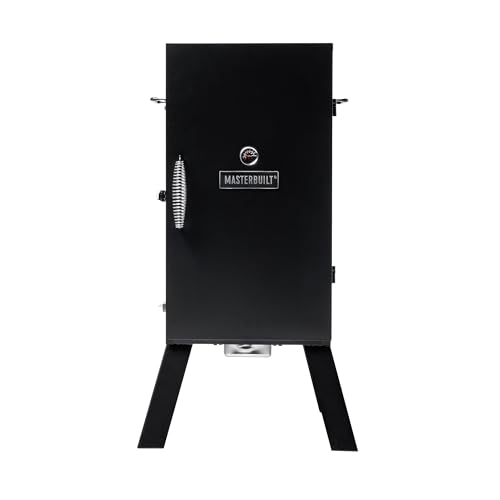
Masterbuilt 30-Inch Electric Vertical Smoker with Analog Control MB20070210
Badge: Best Analog Start
Strengths
- One analog dial teaches the unmediated truth of smoking: how a cabinet heats, holds, and responds — knowledge that transfers to every smoker you will ever own.
- Nothing digital to fail, update, or wash out in sunlight; the control system is a knob and an element.
- 535 sq in across chrome racks is a right-sized classroom — big enough for real cooks, small enough that mistakes stay inexpensive.
Trade-offs
- Analog temperature control wanders more than digital; the beginner supplies the supervision the electronics would have.
- No probe, loader, window, or timer is stated — every feedback channel is one the cook brings.
- The learning curve is real: the first cooks demand attention that the digital picks would have absorbed.
Mini spec box
- Fuel: electric element with wood chips
- Cooking area: 535 sq in
- Control: analog temperature control
- Racks: chrome smoking racks
- Form: 30-inch vertical, black, model MB20070210
The analog Masterbuilt is the beginner pick for a particular temperament: the learner who wants to understand, not just to operate. Digital smokers teach outcomes; this one teaches causes. With a dial and an element, the beginner learns how long their cabinet takes to preheat, how a door opening shows up in the temperature ten minutes later, how chip loads translate into smoke density — the actual physics of the craft, learned at the pace of one variable at a time. Graduates of this school tend to become the cooks other people ask for advice, because nothing about any future smoker will surprise them.
The cost of the education is attention, and beginners should choose it with open eyes. There is no probe to report, no loader to spare the door, no timer to remember the schedule — the cook is all of those systems, which is either the point or the problem depending on the cook. Pair it with a good thermometer (non-negotiable at this supervision level) and a notebook, and keep the first cooks small and forgiving. For the hands-on learner, the MB20070210 is the cheapest tuition in this guide in everything except time; for the busy beginner, it is the one pick we would gently steer elsewhere. Both judgments are compliments to how honestly it does its job.
Best for: hands-on learners who want to understand smoking from first principles / Not suited for: busy beginners who need the machine to supervise itself

Royal Gourmet SE2805 28-Inch Electric Smoker
Badge: Best Compact Start
Strengths
- The smallest start in the guide: a 28-inch vertical cabinet with three cooking grates that fits the patios and budgets of genuine first-timers.
- The listing states its 1350W element plainly, so a beginner can plan the electrical side without guesswork.
- Analog adjustable heat keeps the control lesson to a single dial, like its Masterbuilt counterpart.
Trade-offs
- 454 sq in is the least cooking area here — the first smoker most likely to be outgrown if the hobby takes off.
- No built-in probe is stated; the thermometer advice applies in full.
- Analog supervision, again: simple to learn, present-tense to operate.
Mini spec box
- Fuel: electric element with wood chips
- Power: 1350W
- Cooking area: 454 sq in
- Control: analog temperature control, adjustable heat
- Grates: 3 cooking grates
- Form: 28-inch vertical, black
The SE2805 is the beginner pick for the cook who is not yet sure smoking is their hobby — and that uncertainty is respectable, because the correct response to it is a small, simple, honest machine rather than a flagship bought on enthusiasm. Its classroom is compact: three grates, 454 sq in, a dial, and a clearly stated 1350W element. Everything a beginner needs to learn — preheat behavior, chip rhythm, probe discipline with their own thermometer, the patience of a low cook — is present, and nothing they do not yet need is in the way. If the hobby ignites, this cabinet becomes the second smoker, the cabin smoker, or the gift that starts somebody else; small smokers have long second lives.
Its limits are the honest price of the format. The capacity ceiling arrives quickly for anyone cooking for a crowd, and analog control asks the same attendance as the Masterbuilt above. But notice what the beginner gets in exchange: the lowest-commitment route in this guide to real, wood-chip smoked food, in a cabinet that stores in a corner and runs on a dial. For apartment-adjacent patios, first homes, and the smoker-curious, that is a genuinely well-aimed product. Start here if your question is “will I even like this?” — the SE2805 is designed to answer it cheaply in every currency except the food, which it answers well.
Best for: the smoker-curious who want the smallest, simplest real start / Not suited for: crowd cooks and anyone certain they want digital control

Traeger Pro 22 Wood Pellet Grill and Smoker
Badge: Most Versatile
Strengths
- Six-in-one versatility — grill, smoke, bake, roast, braise, BBQ — means the beginner’s one machine follows their curiosity in every direction.
- The 18 lb hopper is the most forgiving fuel supply among the pellet picks, stretching the interval between beginner refill mistakes.
- A meat probe is included, keeping the master skill — cooking to temperature — instrumented from day one.
Trade-offs
- The stated 450°F maximum is a ceiling to know if high-heat grilling ambitions grow.
- Pellet logistics apply in full: bags, dry storage, ash, and an auger system to keep clean.
- 572 sq in is mid-sized; the beginner who becomes the neighborhood’s brisket source will eventually want more room.
Mini spec box
- Fuel: wood pellets
- Cooking area: 572 sq in
- Hopper: 18 lb
- Maximum temperature: 450°F
- Probe: meat probe included
- Functions: grill, smoke, bake, roast, braise, BBQ
The Pro 22 is the beginner pick for the household buying one outdoor appliance and intending it to do everything. Its beginner logic is breadth with a safety net: the pellet controller automates the fire, the probe instruments the food, the big hopper forgives the fuel checks a beginner forgets, and the six cooking functions mean the machine stays central to the household’s cooking while the beginner figures out which of those functions they actually love. A dedicated smoker can be outgrown by indifference; a six-in-one machine gets used on weeknights while the smoking skill develops on weekends, and use is what turns beginners into cooks.
The trade-offs are the pellet category’s standing ones, plus a stated temperature ceiling of 450°F that matters only to the sear-ambitious. Against the Pit Boss 700 above, the choice for a beginner is fine-grained: the 700 offers more stated area and a wider range, the Pro 22 offers the larger hopper and the broader function list, and either will teach the craft kindly. What we would not do is buy the Pro 22 as a pure smoker and ignore its versatility, or buy it for a nameplate without checking that its size fits the patio. Bought for the right reasons — one machine, every method, automated fire — it is the beginner purchase least likely to be replaced for any reason other than success. Its portability-adjacent size also makes it a useful reference point for readers eyeing Best Smokers For Catering ambitions down the road, though that is a graduation conversation, not a beginner one.
Best for: beginners buying one appliance to grill, smoke, bake, and roast with automated fire / Not suited for: purists who want a dedicated smoker only
Comparison Table
| Pick | Fuel | Stated cooking area | Control | Beginner-relevant feature | Link |
|---|---|---|---|---|---|
| EAST OAK Matte Black | Electric + chips | 725 sq in | Digital with 12-hour timer | Side loader, wheels — schedule managed for you | Check on Amazon |
| EAST OAK Polar Night | Electric + chips | 725 sq in | Electric cabinet control with built-in probe | Probe teaches cooking to temperature | Check on Amazon |
| Pit Boss 700 Carbon | Wood pellet | 718 sq in | LCD digital | Probe included, 180°F to 500°F range | Check on Amazon |
| Masterbuilt MB20070210 | Electric + chips | 535 sq in | Analog | Single-dial craft education | Check on Amazon |
| Royal Gourmet SE2805 | Electric + chips | 454 sq in | Analog, 1350W | Smallest, simplest start | Check on Amazon |
| Traeger Pro 22 | Wood pellet | 572 sq in | Pellet controller with probe | Six-in-one versatility, 18 lb hopper | Check on Amazon |
How to Choose Your First Smoker
Choose by supervision before anything else, because supervision is what a beginner actually buys. Ask how you want a cook to feel. If you want the machine to hold the schedule and the smoke while you learn the food, the digital EAST OAK cabinets are your school — timer in one, probe in the other, loaders in both. If you want to be present and learn by hand, the analog pair will teach you faster and demand more. If you want fire flavor and a grill in the same purchase, the pellet pair automates the hard part and adds fuel chores. There is no wrong answer among the six; there is only a mismatch between the afternoon you want and the machine you bought, and mismatches are what beginner guides exist to prevent.
Size comes second, and the beginner’s rule is counterintuitive: buy a little more room than your first cooks need. The surplus forgives loading mistakes, accommodates the second-year ambitions, and delays the replacement purchase past the point where you know what you actually want. Fuel logistics come third: an outlet and a bag of chips, or a hopper and a dry corner for pellet bags — walk your actual space and confirm the routine fits it. Everything else — finishes, stands, wheels — is preference, and preference is allowed to decide among equals. If your first year might also involve cooking away from home, Best Smokers For Camping sketches the portable end of the craft, though our advice is to learn at home first, where the variables sit still.
Your First Three Cooks: A Beginner’s Curriculum
Cook one: a pork shoulder, the most forgiving student meal in barbecue. Season it simply, preheat the cabinet fully, load chips or confirm the hopper, insert the probe, and close the door. Your only jobs are to keep the door shut, watch the probe teach you about the stall — the long plateau where the temperature stops rising and beginners panic — and pull the meat on temperature and tenderness rather than the clock. Rest it, shred it, and write down three numbers: how long preheat took, when the stall happened, and the total time. That page is the start of your log, and your log is the real beginner equipment.
Cook two: whole chickens or ribs — something shorter that teaches smoke dosage. This is the cook where you learn your machine’s chip rhythm: how much smoke the first load makes, when it fades, how the loader or tray refreshes it. Keep the load of chips modest; the beginner’s instinct to add more is the most common flavor mistake in the craft, and thin, steady smoke beats billowing smoke on food every time. Cook three: repeat cook one, deliberately, changing exactly one thing — a different rub, a different chip wood, a different finishing step — and compare against your log. That controlled comparison is the moment a beginner becomes a cook with a method.
Care and troubleshooting, beginner edition. Keep the machine cool, unplugged or off, and dry when you clean it; racks and trays wash easily while fresh and stubbornly a week later. Problem: the temperature will not settle → you are opening the door to look; use the probe, window, or timer, and give the machine fifteen undisturbed minutes before concluding anything. Problem: the food tastes harsh or bitter → the smoke was too heavy for too long; halve the chip load next time and make sure smoke is established early rather than piled on late. Problem: a pellet grill behaves erratically → the pellets are damp or the hopper ran low mid-cook; store fuel dry, check the hopper before every long cook, and clear ash on the manual’s schedule. Each problem has a beginner-shaped cause and a five-minute fix, which is the most encouraging sentence in this guide.
The Beginner Mistakes That Are Not Your Fault — And the Ones That Are
Some first-year frustrations are design problems wearing your name. A cabinet with no loader really does force door openings; an analog dial really does wander; a small hopper really does run dry on the longest cook. The picks in this guide were ranked partly on how few of those traps they set. But the classic beginner mistakes are portable across every machine: cooking by the clock instead of the probe, judging smoke by how dramatic it looks rather than how the food tastes, changing five variables between cooks and learning nothing, and — the quietest one — never writing anything down. The log is unfashionable and decisive. Cooks who keep one improve at roughly twice the rate of cooks who rely on memory, because memory edits and paper does not. Start the log on cook one, keep it in the kitchen drawer, and let it make you the experienced friend that the next beginner asks.
Setting Up Your First Smoker Without Tears
The unboxing deserves the same calm as the cooking. Assemble on a flat surface with the manual open and every part laid out before the first fastener turns; smokers are simple machines, but they are assembled from many panels, and the beginner who inventories first rarely meets the missing-bolt moment at dusk. Position the finished cabinet where it will actually live — level, with the manufacturer’s clearances, near the outlet it will use — and run the empty seasoning cycle the manual prescribes before any food is involved. Treat that first empty run as a free lesson: watch the preheat time, note how the control responds, learn where the readout settles, and observe how the chips begin to smoke. Every one of those observations will be load-bearing knowledge on cook one.
While the cabinet seasons, assemble the beginner’s supporting kit from what you already own plus the few genuine necessities. The necessities are short: a thermometer if your model states no built-in probe, a pair of heat-resistant gloves for racks and trays, a spray bottle if your recipes call for spritzing, and the notebook that becomes your log. Everything else in the barbecue accessory universe — specialty racks, branded tools, a dozen rubs — can wait until your log tells you which of them your cooking actually wants. Beginners overspend on accessories for the same reason they overload chips: enthusiasm outrunning information. The three-cook curriculum generates the information; let the purchases follow it, and your first year will be cheaper, calmer, and considerably tastier than the average.
How Long the Beginner Phase Actually Lasts
Less time than the internet implies. The mechanics of smoking — preheat, load, probe, patience, rest — are learned in the first three cooks this guide prescribes. What takes longer is judgment: knowing your cabinet’s personality in wind and cold, calibrating smoke dosage to your household’s taste, building the small library of cooks you can produce without thinking. That judgment arrives across a season, not a weekend, and it arrives at the same speed on every machine in this guide — which is why the beginner phase should be spent on a smoker whose routine you enjoy, rather than on one bought as a disposable stepping stone. Several picks here, the EAST OAK cabinets and the Pit Boss 700 in particular, are not stepping stones at all; they are keepers that happen to teach kindly. The analog compacts play the other honest role: inexpensive tuition with a long second life. Either way, the beginner who starts this spring is, by the following spring, simply a smoker cook — and the machine that got them there deserves more credit than the upgrade conversation usually gives it. Keep the log going through that whole first year, because the entries from your uncertain early cooks become, by the second season, the most useful cookbook you own: written for your machine, your patio, and your household’s taste, in your own hand. That is the quiet promise underneath every pick in this guide — not that the machine makes you a cook overnight, but that the right machine makes the year of becoming one feel like a pleasure instead of an examination.
Common Buying Mistakes
- Buying the biggest smoker first. Capacity is the easiest specification to overbuy and the least useful to a beginner. Supervision design teaches; square inches mostly wait.
- Choosing analog romance or digital comfort against your temperament. The busy beginner with an analog dial, and the tinkerer bored by automation, are both mismatches this guide’s badges exist to prevent.
- Skipping the thermometer on no-probe models. Half the picks here state no built-in probe. Cooking to temperature is the craft; instrument it from the first cook.
- Judging the hobby by the first cook. The first cook is tuition, not a verdict. Judge by the third, when the machine’s routine and yours have met.
- Overloading chips for more smoke flavor. Heavy smoke is the beginner flavor error. Modest loads, established early, win every comparison.
- Forgetting fuel logistics. Chips need a cupboard; pellets need a dry corner and a hopper check. Confirm your space supports the routine before the machine arrives.
Final Recommendation
For most beginners, start with the EAST OAK Matte Black: its timer, side loader, capacity, and wheels make the correct routine the default routine, which is the kindest thing a first smoker can do. If you learn best from numbers, choose the EAST OAK Polar Night and its built-in probe instead; if your heart is set on fire and grilling, the Pit Boss 700 Carbon automates the fire while you learn everything else. The analog pair are for the hands-on learners, and the Traeger is for the one-appliance household. Whichever you pick, run the three-cook curriculum in this guide before judging anything — by the end of it, the spelling of “begineers” will be the only beginner thing left about your smoking. Gentle cooks like Best Smokers For Cheese make excellent fourth and fifth lessons once the fundamentals hold.
Frequently Asked Questions
What is the easiest type of smoker for a complete beginner?
An electric cabinet, for most people. The element holds the temperature, the chips make the smoke, and the beginner’s attention goes to the food and the probe instead of to fire management. Pellet grills are a close second because their controllers automate the fire; analog electric models are simple in design but ask the cook to supply the supervision personally.
Should a beginner buy analog or digital control?
Digital if your time is scarce or your confidence is new — it holds temperature for you and pairs with timers and probes. Analog if you enjoy process and want to understand the craft from the inside — it teaches more per cook and forgives less. Both produce excellent food; they produce different afternoons, and the right choice is the afternoon you will actually repeat weekly.
How big should a first smoker be?
A little bigger than your first cooks. The 710–725 sq in cabinets in this guide forgive loading mistakes and survive the second year’s ambitions, while the 454–535 sq in analog models suit smaller households and tighter spaces honestly. Avoid buying for the largest gathering you can imagine; buy for the cooking you will do monthly, with a margin.
What should I cook first?
A pork shoulder. It is the most forgiving cut in barbecue — tolerant of temperature wander, happy with simple seasoning, and judged by a probe and a rest rather than split-second timing. Follow it with chickens or ribs to learn smoke dosage, then repeat the shoulder changing one variable. That three-cook sequence teaches more than a month of reading.
Do I need a separate thermometer?
If your pick states a built-in probe — the EAST OAK Polar Night and both pellet grills here — you are instrumented from day one. If it does not — the Matte Black EAST OAK and both analog models — yes, buy one with the smoker. Cooking to internal temperature is the central skill of the craft, and no beginner should try to learn it by guessing.
How much smoke is the right amount?
Less than your instinct says. A modest load of chips, established early while the food’s surface is cool, flavors a cook thoroughly; heavy, billowing smoke is the classic beginner error and reads as harshness on the plate. On pellet grills the controller handles dosage for you — one more reason they suit beginners who want fire without the learning curve arriving all at once.
When will I outgrow a beginner smoker?
Later than you fear, if you bought supervision and a margin of capacity. Most first smokers in this guide’s upper half serve happily for years; the analog compacts are the ones a successful hobby tends to supplement first — usually by becoming the second cabinet rather than being discarded. Outgrowing a smoker through success is the good outcome, and it is the one this guide is trying to arrange for you.


