Disclosure: topratedkitchenware.com is reader-supported. When you buy through links on our site, we may earn an affiliate commission from Amazon and other retailers, at no extra cost to you.
Where to buy
The six sinks below are the verified picks behind this guide to the best ss kitchen sinks scratching — that is, how stainless steel sinks actually behave when real life drags pans, grit and cutlery across them, and which models wear that life most gracefully. Each name links to its Amazon listing, where you can check the latest price on Amazon, confirm gauge and finish, and read the newest owner feedback, paying special attention to the long-term finish reports. Start with the thickest steel in the group: Check on Amazon.
- SANYCASA 30 Inch Undermount Kitchen Sink, 11 Gauge Stainless Steel Workstation
- KRAUS KHU100-30 30 Inch 16 Gauge Undermount Kitchen Sink
- cozhao 30 Inch Undermount Kitchen Sink, 18 Gauge 304 Stainless Steel
- MAYESAR 28 Inch Undermount Kitchen Sink, 16 Gauge, Brushed Finish
- KRAUS KWU110-32 32 Inch Undermount Workstation Sink with Ledge
- KRAUS KHU100-32 32 Inch 16 Gauge Undermount Kitchen Sink
Read the full guide ↓
Every stainless steel sink scratches. That sentence, printed plainly at the top, is the most useful thing this guide can tell you, because the search for the best ss kitchen sinks scratching usually begins with a hope — that somewhere there is a stainless sink that does not — and ends, months after purchase, with a disappointed owner photographing hairlines in a new bowl. There is no such sink, at any tier, and there never has been: stainless steel is softer than the cast iron, stoneware, grit and pan rivets that cross it daily. What separates the good ownership experience from the bad one is not scratch immunity but scratch behaviour — how visibly a finish shows the first marks, how gracefully they blend into the even patina that every working sink develops, and how much of the process you can control with a grid, a habit and ten minutes of blending once a year.
This guide compares six verified stainless sinks through that exact lens. We look at finish types (brushed hides, satin balances, handmade shows and tells), at the gauge myth (thickness fights dents, not scratches — the surface hardness barely changes), and at construction details like corner radius and ledges that decide where scratches concentrate. Along the way you will get the full maintenance playbook: prevention that actually works, repair that genuinely blends, and the point at which a “scratched” sink is simply a mature one. Households that cook hard enough to make this their first question will also want our heavy-use research in Best Stainless Kitchen Sinks For Heavy Use, which reaches its shortlist by the same durability-first logic.
Key Takeaways
- All stainless steel scratches; the buying decision is about how the scratches look and blend, not whether they happen.
- Finish is the main variable: brushed finishes (the MAYESAR) hide fine scratching inside their grain; satin finishes balance hiding and sheen.
- Gauge fights dents, not scratches — an 11 gauge sink’s surface marks like any other, though the SANYCASA’s mass prevents the flex that makes marks deeper.
- A bottom grid is the single most effective scratch intervention: it keeps pans, grit and cutlery off the floor entirely.
- Fine scratches blend into a uniform patina within the first year; the “scratched” phase owners fear is temporary.
- Deep gouges are different from hairlines — prevention matters most for heavy cast iron dragged, not placed, across the bowl.
- Judge a stainless finish at its first birthday, not its first month — the settling process needs a full season of use to show its real result.
In this guide
Quick Picks
| Pick | Badge | Why it stands out | |
|---|---|---|---|
| SANYCASA 30 Inch Workstation Sink | Best for Scratch-Prone Homes | 30 inch, 11 gauge (3mm) steel — no flex under pans, ledge keeps work off the floor | Check on Amazon |
| KRAUS KHU100-30 | Best Easy-Patina Finish | 30 inch, 16 gauge TRU16, rounded corners that blend wear evenly, NoiseDefend pads | Check on Amazon |
| cozhao 30 Inch Undermount Sink | Best Value | 30 inch, 18 gauge 304 stainless, handmade modern bowl, drain assembly included | Check on Amazon |
| MAYESAR 28 Inch Undermount Sink | Best Scratch-Hiding Finish | 28 x 18 inch, 16 gauge, brushed finish that absorbs fine scratches into its grain | Check on Amazon |
| KRAUS KWU110-32 | Best Workstation for Wear | 32 inch, 16 gauge TRU16, integrated ledge keeps prep and pans above the bowl floor | Check on Amazon |
| KRAUS KHU100-32 | Best Large Easy-Care | 32 inch, 16 gauge TRU16, rounded corners, channel grooves, NoiseDefend pads | Check on Amazon |
How These Picks Were Chosen
This guide is research-led, built from the verified Amazon Creators API pool — every ASIN, title, gauge and finish claim here comes from that data, checked on the date in the sources file. For a scratching-focused keyword, screening meant reading the specifications for the properties that govern wear: finish type where stated, gauge as a proxy for floor rigidity, corner design, and whether the sink’s format (a workstation ledge, an included or natural grid pairing) keeps work off the bowl floor. We then read owner feedback in aggregate with a specific question — not “did it scratch?” (the answer is always yes) but “how did the owner feel about the finish after a year?”, which is where the finishes in this list earn their reputations.
Two myths were excluded from the judging. First, no pick was credited with scratch resistance it cannot have: steel hardness varies little across these products, and any guide implying a tier of stainless that shrugs off cast iron is selling fiction. Second, gauge was scored for what it actually does — resist the flex and denting that turn surface contact into deep scoring — not as a scratch shield. What remains is an honest ladder: finishes that hide, constructions that protect, and one ledge design that reroutes the work entirely. The broader stainless field behind this shortlist is surveyed in our Best Stainless Kitchen Sinks roundup.
Best SS Kitchen Sinks Scratching — The 6 Picks Reviewed
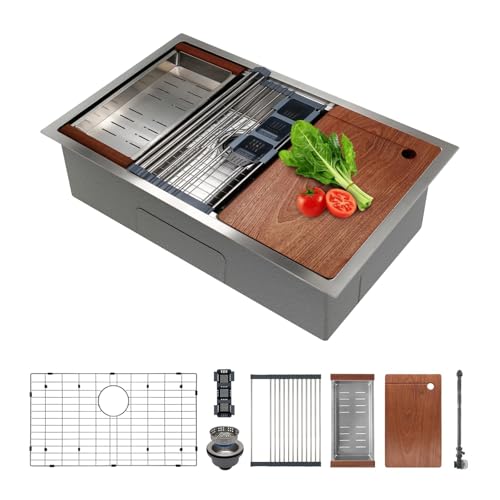
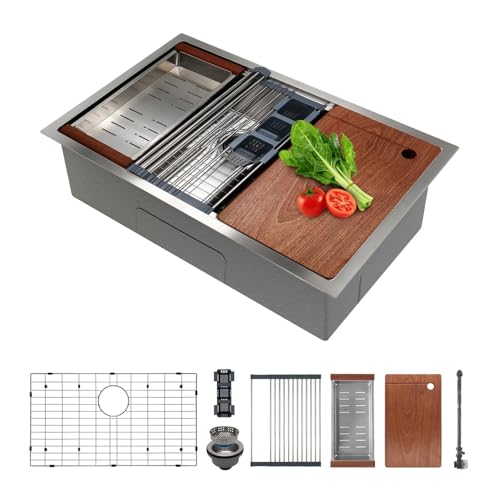
SANYCASA 30 Inch Undermount Kitchen Sink — 11 Gauge Workstation
Badge: Best for Scratch-Prone Homes
Strengths
- 11 gauge (3mm) steel does not flex under a landing pan — and flex is what turns contact into deep scores.
- The integrated ledge moves chopping, draining and staging above the bowl floor, sparing the most-scratched surface in any sink.
- Massive construction shrugs off the dents that often accompany scratch damage in thinner bowls.
Trade-offs
- Its surface still hairlines like all stainless — thickness is not hardness, and buyers must not expect immunity.
- Heavy to install; support must be planned.
- The ledge’s rails themselves take wear and will show their own working patina.
Mini spec box
- Size: 30 inch width, undermount
- Material / gauge: stainless steel, 11 gauge (3mm)
- Bowl: single bowl, integrated ledge workstation
- Drain: Superior Drain design (per manufacturer title)
The SANYCASA tops a scratching guide for a subtle reason worth understanding, because it corrects the category’s favourite misconception. Thick steel is not harder steel — drag a cast-iron skillet across this bowl and it will mark, exactly as it marks an 18 gauge bowl. What 11 gauge (3mm) construction changes is everything around the scratch: the floor does not flex away and rebound under the pan, so contact stays shallow instead of digging; the bowl never dents, so scratches never gather in the hollows of deformation; and the integrated ledge lifts the daily traffic — boards, colanders, draining racks — off the floor entirely, onto rails designed to take that wear as a working surface. The floor of this sink simply lives a quieter life than any other in the guide.
In a household whose cooking is heavy and daily, that adds up to the best long-term cosmetic outcome available in steel: a bowl whose most visible surface is protected by architecture, not by hope. The ledge accessories ride on rails that are meant to be worked on, and their honest wear reads as the patina of a tool rather than damage to a finish. Owners of this class of sink describe the same arc as all stainless owners — early vigilance, first hairlines, then acceptance — except that their floor reaches the settled stage with visibly less drama stored in it.
The candour points are weight and expectation. This is a heavy object needing proper undermount support and a two-person install, and it must not be bought under the illusion that 3mm steel cannot be scratched — it can, on day one, by a determined skillet. Buy it for what it truly is: the sink whose design gives scratches the fewest opportunities and the shallowest landings in the category.
Best for: heavy-use households that want the best long-term finish outcome in stainless / Not suited for: anyone expecting a literally scratch-proof sink — that product does not exist

KRAUS KHU100-30 — 30 Inch 16 Gauge TRU16 Undermount Sink
Badge: Best Easy-Patina Finish
Strengths
- Rounded corners distribute wear evenly — no tight corner lines where scratches and grime concentrate.
- 16 gauge floor is rigid enough to keep pan contact shallow; NoiseDefend pads included.
- The classic satin-style finish settles into a uniform patina that owners consistently describe as easy to live with.
Trade-offs
- No grid bundled — buy one on day one; it is this design’s natural partner.
- Satin finishes show the early hairlines honestly before the patina blends them.
- No ledge; all work happens on the floor the grid protects.
Mini spec box
- Size: 30 inch width, undermount
- Material / gauge: TRU16 stainless steel, 16 gauge
- Bowl: single bowl, rounded corners
- Features: channel grooves for draining, NoiseDefend soundproofing pads
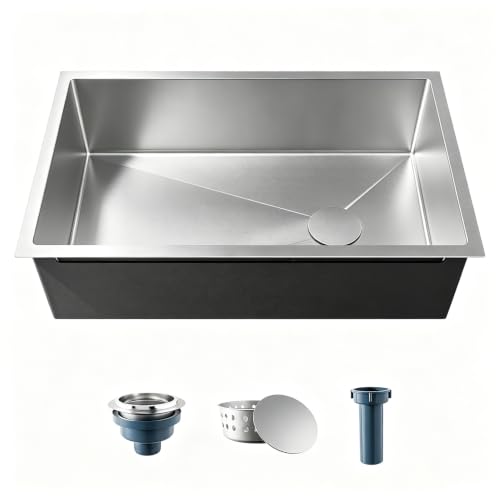
The KHU100-30 is the sink that teaches owners the patina lesson fastest, and kindest. Its rounded corners — the detail that defines the model — mean wear never concentrates along a crease or a tight radius; the fine scratches of the first months spread across broad, gently curved surfaces where they catch light evenly and read, very quickly, as a single soft sheen rather than as damage. The channel grooves help more than they appear to: water and grit move toward the drain instead of being ground across the floor by the next pan, which quietly reduces the most common scratch mechanism in any sink — abrasive particles trapped under sliding cookware.
Sixteen gauge TRU16 steel keeps the floor honest under load, so contacts stay in hairline territory, and the standard 30 inch size means the grid you should absolutely buy for it is a common, easy purchase. With the grid in place, this sink’s ownership story becomes almost boring: an early month of noticing every new line, a blending by the end of the first season, and then years of a surface that looks like what it is — a well-kept working bowl. In the aggregate feedback for this long-running design, finish complaints are conspicuous by their scarcity once owners pass the settling period.
Choose it if you want the classic ss experience with the gentlest cosmetic learning curve, and choose the MAYESAR below if a brushed finish’s camouflage appeals even more. Either way, the KHU100-30’s real scratch feature is philosophical: it was designed, corner to corner, to age in public without embarrassment.
Best for: mainstream households wanting the easiest patina journey in a classic stainless sink / Not suited for: buyers who will not use a grid, or who want a workstation ledge

cozhao 30 Inch Undermount Kitchen Sink — 18 Gauge 304 Stainless Steel
Badge: Best Value
Strengths
- Proper 304 stainless at the value tier — the alloy that keeps the surface chemically stable as it wears.
- Handmade modern styling; the crisp floor takes a grid beautifully.
- Drain assembly included, keeping the total (with grid) honestly calculable.
Trade-offs
- 18 gauge flex means pan contacts can score slightly deeper than in 16 gauge bowls — the grid matters most here.
- Handmade corners hold a scratch line visibly until blended.
- The bright early finish shows the first hairlines clearly; patience required through the settling months.
Mini spec box
- Size: 30 inch width, undermount
- Material / gauge: 304 stainless steel, 18 gauge
- Bowl: single bowl, handmade modern design
- Included: drain assembly
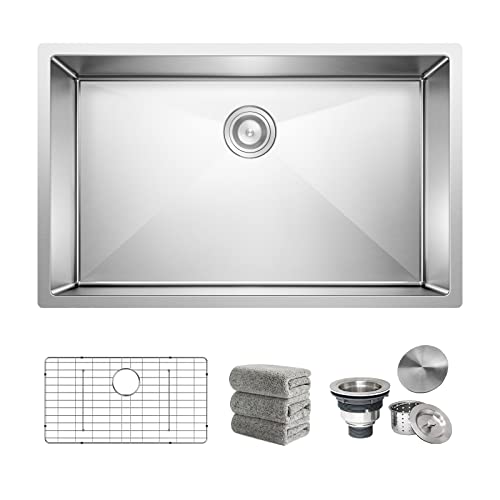
A value sink in a scratching guide must be judged by a stricter honesty: the cozhao’s 18 gauge steel is the most flexible floor in this list, and flexible floors are where sliding pans dig their lines a fraction deeper. That is the whole of the bad news, and it is entirely manageable — but it makes this the one pick where the bottom grid graduates from recommendation to requirement. With a grid spreading every load and lifting cookware off the steel, the cozhao’s wear story converges on its heavier rivals’ within a season, at a total outlay that still respects the value brief that brought you here.
What the money does buy, even before the grid, is the right alloy. The verified title’s 304 specification means the surface chemistry is the genuine article: scratches in 304 stainless expose fresh metal that re-forms its protective chromium oxide layer, which is why these marks stay cosmetic rather than becoming corrosion sites. In a cheap sink of unstated grade, a deep scratch can be the start of a rust story; in this one, it is only ever a line. That distinction — cosmetic versus corrosive — is the real quality line in this category, and the cozhao is on the right side of it.
For lighter-use kitchens — couples, first homes, careful cooks — the settling process is quick and the long-term look entirely respectable, especially in the handmade format whose tailored lines suit the flush modern kitchens it usually joins. Heavy cast-iron households should read its trade-offs as a signpost to the 16 gauge picks, not as a flaw in an honestly specified sink.
Best for: value-led buyers who will run a grid from day one / Not suited for: grid-refusing heavy-use households, where 16 gauge is the wiser spend

MAYESAR 28 Inch Undermount Kitchen Sink — 16 Gauge, Brushed Finish
Badge: Best Scratch-Hiding Finish
Strengths
- Brushed finish is the great camouflage: fine scratches disappear into the directional grain instead of announcing themselves.
- 16 gauge steel in a compact 28 x 18 inch footprint — substance without the size.
- Round corners and 9 inch depth: even wear, contained splashing, easy wiping.
Trade-offs
- Brushed surfaces show water spotting more readily between wipes.
- Deep scores still show — camouflage works on hairlines, not gouges.
- Compact bowl: the largest pans rest at an angle.
Mini spec box
- Size: 28 x 18 inch, undermount
- Material / gauge: stainless steel, 16 gauge
- Bowl: single bowl, 9 inch deep, handmade
- Finish: brushed, round corner design
If your scratch anxiety is specifically visual — you do not mind that the sink works for a living, you mind seeing the evidence — the MAYESAR’s brushed finish is the cleverest answer in this guide. Brushing cuts a fine directional grain into the steel, and that grain performs a quiet optical trick: new hairline scratches, which overwhelmingly run in the same directions as daily use, land inside an existing texture of lines and simply vanish into it. Where a satin bowl displays its first month of scratches like a diary, a brushed bowl files them under “finish” from the start. Owners of brushed sinks consistently report the lowest cosmetic stress in the category, and it is not because their sinks scratch less — it is because theirs confess less.
The sink beneath the finish is the right partner for it: full 16 gauge steel so contacts stay shallow, round corners so wear spreads evenly instead of lining up in creases, and a 9 inch depth that keeps the action — and the splashing grit that causes half of all scratching — contained low in the bowl. At 28 x 18 inches it also brings this finish strategy to the smaller cabinets the 30 inch picks cannot serve, which matters because compact kitchens previously had to choose between size and every other virtue.
The trade is the familiar brushed one: water spots show between wipes, so this is a finish for households that wipe as they go. And camouflage has limits — a dragged skillet’s deep score will read on brushed steel as on any other, which is why the grid advice in this guide applies here with undiminished force. Within those honest bounds, the MAYESAR is the finish-first pick: the sink most likely to look, in year three, the way you hoped a sink would.
Best for: appearance-conscious owners in standard or compact cabinets who want wear to stay invisible / Not suited for: households that never wipe down, or anyone expecting gouge-proof steel

KRAUS KWU110-32 — 32 Inch Undermount Workstation Sink
Badge: Best Workstation for Wear
Strengths
- Integrated ledge keeps the cutting board and roll-up rack — and the work they do — above the bowl floor.
- 16 gauge TRU16 steel with NoiseDefend pads; the included accessories arrive fitted to the system.
- 32 inch capacity for the biggest pans, which are precisely the ones that scratch worst.
Trade-offs
- Needs a wide cabinet, typically 36 inch class.
- Ledge rails accumulate their own honest wear lines over time.
- The floor is still steel: a grid remains wise for soaking loads of heavy cookware.
Mini spec box
- Size: 32 inch width, undermount
- Material / gauge: TRU16 stainless steel, 16 gauge
- Bowl: single bowl with integrated ledge
- Included: cutting board and roll-up drying rack; NoiseDefend soundproofing
The KWU110-32 applies the workstation idea to the scratching problem at family scale. Its integrated ledge carries the included cutting board and roll-up rack across the bowl, which reroutes the two most abrasive daily activities — board work with gritty produce, and draining racks loaded with cutlery and pans — off the floor and onto rails built to receive them. In a 32 inch sink, whose broad floor would otherwise be the largest scratch canvas in the kitchen, that rerouting is worth more than any finish. The floor is left to its gentlest job, holding water and soaking loads, and it ages accordingly.
The steel underneath is the full KRAUS recipe: 16 gauge TRU16 for a floor that does not flex under the big pans this size exists to wash, and NoiseDefend padding so the large bowl’s acoustics stay civilised while it works. The included accessories matter to the wear story in a way buyers miss: a board and rack made for this ledge sit dead stable, and stability is scratch prevention — it is the sliding, skating contact, not the resting one, that engraves steel. Third-party accessories balanced on a rim cannot promise the same stillness.
As with the SANYCASA, keep expectations calibrated: the rails will show their service, the floor will hairline where loads land, and a grid under a soaking roaster is still the professional move. But as a system for a big, busy kitchen that wants its sink to look composed in year five, the workstation architecture is the strongest idea in this guide — prevention by design rather than by vigilance. Compare the plain-bowled alternative in the same steel directly below, and in the wider field through our Best Stainless Sinks For Kitchen 32 survey.
Best for: large, busy kitchens that want prevention built into the sink’s architecture / Not suited for: narrow cabinets, or minimalists who want nothing in the bowl

KRAUS KHU100-32 — 32 Inch 16 Gauge Undermount Sink
Badge: Best Large Easy-Care
Strengths
- Rounded corners across a big bowl: wear spreads evenly, cleaning stays one-wipe simple.
- Channel grooves flush grit toward the drain instead of letting it grind under pans.
- 16 gauge TRU16 steel with NoiseDefend pads — the proven recipe at full width.
Trade-offs
- No ledge or bundled grid; the wide floor wants a grid from day one.
- Wide-cabinet requirement, as with all 32 inch undermounts.
- A large satin floor shows the settling period’s hairlines honestly before they blend.
Mini spec box
- Size: 32 inch width, undermount
- Material / gauge: TRU16 stainless steel, 16 gauge
- Bowl: single bowl, rounded corners
- Features: channel grooves for draining, NoiseDefend soundproofing pads
The KHU100-32 is the plain-bowl answer at the size where scratch management matters most, and its weapons are geometry and drainage. A 32 inch floor collects more grit, more pans and more sliding contact than any other in this guide; the rounded corners ensure none of that wear pools into visible lines at the edges, and the channel grooves pressed into the floor give the abrasive particles — the sand-like residue from produce, the grit from pan bottoms — a path out with the water instead of a career being ground in circles under the next load. It is unglamorous engineering with a directly cosmetic payoff, visible in how evenly these bowls age compared with flat, grooveless rivals.
The rest is the proven recipe at full width: 16 gauge TRU16 steel that keeps big-pan contact shallow, NoiseDefend pads for the acoustics of a large hollow bowl, and a single uninterrupted space that takes the family’s largest cookware flat. Add the grid this listing leaves to you — at 32 inches it is close to mandatory equipment — and the ownership pattern matches the KHU100-30’s: an honest settling season, then a uniform working sheen that asks nothing but a wipe.
Choose it over the workstation model when your prep lives on the counter and the sink’s job is purely washing at scale; choose the KWU110-32 when you want the bowl itself to join the prep line and share the wear. Either way the steel, the gauge and the patina journey are the same — which is to say, the manageable, well-documented centre of stainless ownership.
Best for: large households wanting maximum plain bowl with the easiest long-term care / Not suited for: anyone who will skip the grid, or cabinets below the wide minimum
Comparison Table
| Pick | Size | Material / gauge | Scratch strategy | |
|---|---|---|---|---|
| SANYCASA Workstation 30 | 30 inch | Stainless, 11 gauge (3mm) | No flex + ledge keeps work off the floor | Check on Amazon |
| KRAUS KHU100-30 | 30 inch | Stainless TRU16, 16 gauge | Rounded corners, even patina, grooves flush grit | Check on Amazon |
| cozhao Undermount 30 | 30 inch | 304 stainless, 18 gauge | Right alloy + grid discipline | Check on Amazon |
| MAYESAR Undermount 28 | 28 x 18 inch | Stainless, 16 gauge | Brushed finish camouflages hairlines | Check on Amazon |
| KRAUS KWU110-32 | 32 inch | Stainless TRU16, 16 gauge | Workstation ledge reroutes abrasive work | Check on Amazon |
| KRAUS KHU100-32 | 32 inch | Stainless TRU16, 16 gauge | Grooves + corners spread and shed wear | Check on Amazon |
How to Choose an SS Sink When Scratching Is Your Concern
Reorder the usual priorities. Finish comes first in this specific decision: brushed if you want scratches to disappear into grain, satin if you want an even sheen that blends them over a season, and either over any mirror-bright finish, which displays every line at full contrast and should be avoided by anyone who has read this far. Construction comes second: a workstation ledge if your prep can live over the bowl, rounded corners if it cannot, and drainage grooves wherever offered, because grit management is scratch management. Gauge comes third and in its true role — rigidity that keeps contacts shallow — with 16 gauge the sensible floor and anything lighter demanding a grid without exception.
Then be honest about your household’s two scratch variables: cookware and habits. Cast iron, stoneware and steel bakeware are the engravers; glass and plastic barely register. A household of careful placers can run a satin 18 gauge sink happily for years, while a household of cheerful draggers will mark 11 gauge steel by spring — the picks differ less than the hands do. The grid decision cuts across everything: it is the only intervention that reduces scratching itself rather than its visibility, and at the cost of a modest accessory it outperforms a tier of sink upgrades. Budget it with the sink, in the same cart, every time. And say the quiet part in the family meeting before installation day: the sink will mark, the marks will blend, and nobody is to apologise to it or for it — a working kitchen’s sink is allowed to look worked in, and this one will do so far more gracefully than most sinks on the entire market can manage today.
Finally, calibrate the goal. The achievable summit is not a pristine sink but a composed one: an even, soft patina that reads as quality and use, maintained by an annual blend and daily habits that cost nothing. Owners who aim there are satisfied for decades. Owners who aim at showroom permanence fight their own sink weekly — usually while standing in front of a bowl that every guest thinks looks great. The wider context for these choices, including the misspelt doorway to the same material, is in our Best Stainles Steel Kitchen Sinks guide.
How to Prevent, Blend and Live With Scratches
Prevention, in order of effect. (1) Fit a bottom grid and keep it in — it removes pan-to-steel contact from daily life almost entirely. (2) Rinse grit off pan bottoms and produce before they enter the bowl; most hairlines are grit scratches, not pan scratches. (3) Lift heavy cookware in and out; never drag cast iron across the floor or rim. (4) Keep a soft mat or the grid under glassware and stoneware loads. (5) Never use the bowl as a cutting surface, and keep steel wool out of the house’s sink routine entirely.
Blending, the honest repair. Fine scratches cannot be removed, but they can be blended into the grain until they disappear as individual lines. Work with a non-woven abrasive pad (the fine, maroon or grey grades sold for stainless), a little water or a drop of oil as lubricant, and strokes that follow the existing grain direction exactly — never across it, never in circles. Feather each pass beyond the mark, wipe, and check in raking light. Ten patient minutes once or twice a year returns a working bowl to a uniform sheen. Stainless care kits bundle the right pads for exactly this ritual.
Troubleshooting. Problem: one deep score stands out from the patina → blend its edges with the pad method above; deep lines soften rather than vanish, and a grid prevents the sequel. Problem: scratches seem to appear in circles → something with grit is being rotated in the bowl, usually a pan being twisted while washing; lift-and-turn instead. Problem: the finish looks patchy after blending → the strokes crossed the grain somewhere; re-blend the whole panel in one consistent direction and the uniformity returns.
Scratches, Dents and Stains: Knowing Which Damage Is Which
Owners lump three different events under “my sink is ruined,” and they have different causes, cures and preventions — separating them ends most sink anxiety. Scratches are surface lines in the finish: cosmetic, inevitable, blendable, and no threat to the sink’s life. Dents are geometry: the steel itself has deformed, which happens under point impacts in lighter gauges and is the damage that gauge actually prevents; a dented floor pools water and collects scratches in its hollow, which is why the two are confused. Stains are chemistry: water spots (mineral, wipe away), heat tint, and the rust-coloured freckles that are almost always contamination from other steel left wet in the bowl, lifting off with a baking-soda paste because they were never the sink’s own metal failing.
Read your bowl with those categories and the response is always clear. Lines: blend or ignore, both honourable. A hollow that holds water: that was an impact, and it argues for the grid and for 16 gauge at replacement time. Colour that wipes or pastes away: housekeeping, not damage. The sink that owners describe as “scratched to death” in reviews is, on inspection, almost always a normally patina’d bowl photographed in harsh light during its first season — the same bowl that, a year later, its owner no longer sees at all. Stainless does not stay new; it becomes seasoned, and seasoned is a destination, not a decline. Our undermount survey in Best Stainless Kitchen Undermount Sinks shows the same ageing pattern across every format the material is sold in.
The First Year: A Patina Timeline for New Stainless Owners
Knowing what a stainless sink’s first year actually looks like, month by month, prevents nearly all of this category’s disappointment, because the disappointment is almost always a scheduling error — owners judge a process at week three that finishes at month nine. The first fortnight is the showroom hangover: the bowl is at its brightest and least forgiving, every contact leaves a visible autograph, and new owners wipe, inspect and worry at a rate no fixture can sustain. This is the phase the grid earns its keep most visibly, and the phase in which the sink should simply be used, not audited.
Months two to four are the untidy adolescence. Hairlines multiply and begin, unevenly, to cross-hatch; one corner may look more worked than another; a photograph taken now, in hard light, is the source of most of the internet’s “my sink is ruined” posts. What is actually happening is accumulation toward uniformity — the surface is collecting the fine, multidirectional texture that will shortly read as a single finish. Owners who blend once, gently and with the grain, around the end of this phase usually accelerate the truce considerably. Months five to nine are the settling: new marks stop announcing themselves because the background texture now matches them, the sheen evens out under normal cleaning, and the sink crosses the line from “new and marked” to “seasoned” in the eyes of everyone who uses it, including, at last, its owner.
By the end of the first year the bowl has the finish it will keep for decades: a soft, even, working lustre that shrugs off new lines by absorbing them on arrival. This is the state commercial kitchens live in permanently and the state designers mean when they call stainless timeless. The practical moral is not patience as a virtue but patience as information — do not warranty-claim, do not replace, and do not regret a sink in its adolescence. Judge it at its first birthday, with the grid in and one honest blend behind it, and you will be judging the sink you actually bought.
Common Buying Mistakes
- Shopping for a scratch-proof stainless sink. It does not exist at any tier; shop instead for finish behaviour, rigidity and a grid.
- Believing thicker means scratch-proof. Gauge buys dent resistance and shallow contact, not surface hardness — the SANYCASA earns its place for design reasons, not immunity.
- Choosing a mirror finish for a working kitchen. Maximum contrast displays every hairline; brushed and satin finishes are the practitioner’s choice.
- Skipping the grid to save money. The grid prevents more scratching than any sink upgrade at many times its price.
- Scrubbing across the grain to “remove” a scratch. Cross-grain strokes create a visible patch; blending always follows the grain.
- Judging the sink in its first month. The settling patina is a season-long process; early hairlines are the beginning of the finish, not the end of it.
Final Recommendation
If scratching is your deciding concern, buy the system, not just the sink: the SANYCASA 30 Inch Workstation Sink gives you the architecture that prevents the most wear — a floor that never flexes and a ledge that keeps work off it — and it is this guide’s first choice for hard-use homes. For the easiest cosmetic journey in a classic bowl, the KRAUS KHU100-30 blends its patina more gracefully than any rival, and the MAYESAR’s brushed finish hides the evidence best of all for appearance-first buyers. Whichever pick you take, put the grid in the same order, rinse the grit, lift the iron — and then let the patina do what it has done in a million kitchens: turn a showroom surface into a seasoned one that looks better, not worse, for having worked.
Frequently Asked Questions
Do all stainless steel kitchen sinks scratch?
Yes — every one, at every tier and thickness. Stainless steel is softer than cast iron, stoneware, pan rivets and the mineral grit that arrives on produce and pan bottoms, so fine lines are a certainty of ownership. What varies is how visible they are (finish), how deep they run (gauge and habits) and how evenly they blend (corner design and time). Any product promising a scratch-proof stainless sink is promising something metallurgy does not allow.
Does a thicker gauge sink scratch less?
Not on the surface — hardness barely changes with thickness, so a dragged skillet marks 11 gauge and 18 gauge alike. Thickness helps indirectly: a rigid floor does not flex under a landing pan, so contacts stay shallow instead of scoring, and it never dents, so scratches never gather in hollows. Buy gauge for dents and depth of marks; buy finish and a grid for the marks themselves.
Which finish hides scratches best?
Brushed, as the MAYESAR in this guide demonstrates: its directional grain absorbs fine lines into the existing texture, so wear is camouflaged from the first week. Satin finishes show the early hairlines more honestly, then blend them into an even sheen over a season. Mirror finishes are the worst choice for a working kitchen — maximum contrast, every line displayed.
Can scratches be removed from a stainless sink?
They can be blended, which in practice looks like removal for fine lines: a fine non-woven abrasive pad, worked wet and strictly with the grain, feathers the mark into the surrounding finish until it disappears as an individual line. Deep scores soften but may remain faintly visible. What you must never do is scrub across the grain or in circles — that trades one scratch for a visible patch.
How do I stop my new sink scratching so fast?
Fit the bottom grid before the first wash-up, rinse grit off everything entering the bowl, lift heavy pans instead of dragging them, and keep steel wool away from the sink entirely. Those four habits address nearly all early scratching. The lines that remain are the patina forming — normal, expected, and the reason a year-old working sink looks uniformly seasoned rather than damaged.
Are scratches in a stainless sink a hygiene or rust problem?
No. In proper grades like the 304 named in this guide, a scratch exposes fresh steel that immediately re-forms its protective oxide layer; the mark is cosmetic only. The rust-coloured spots owners sometimes fear are surface contamination from other steel objects left wet in the bowl, and they lift off with a baking-soda paste. Scratches do not harbour more bacteria than the surrounding surface in any way that normal washing does not address.
When is a scratched sink actually worn out?
Almost never on scratches alone. Stainless sinks retire for dents that pool water, for corrosion from chemical abuse in poor grades, or because the kitchen around them is remodelled — not because their finish matured. A blended, patina’d bowl in a good grade and gauge is a sink in its prime, and owners who understand the patina process typically keep theirs for decades without a cosmetic regret.
Do bottom grids really prevent scratching, or just hide it?
They genuinely prevent the majority of it. Most bowl-floor scratches come from cookware — its weight, its grit, its sliding — and a grid removes that contact class almost entirely, replacing steel-on-steel with steel-on-grid at points designed for it. What remains is wall and rim contact from loading and unloading, which good habits cover. Owners sometimes worry the grid itself will mark the floor beneath it; quality grids rest on protective feet, and any faint witness lines under a long-serving grid blend with the same pad method described in this guide. It is the highest-value accessory in stainless ownership, full stop.