Disclosure: topratedkitchenware.com is reader-supported. When you buy through links on our site, we may earn an affiliate commission from Amazon and other retailers, at no extra cost to you.
Where to buy
All six verified stainless sinks are linked below, so you can check the latest price on Amazon and confirm dimensions, gauge and included parts for the shortlist in this guide to the best stainless steel kitchen sinks. The range runs from a compact 28-inch bowl to 32-inch workstations, with every pick stainless, single-bowl and undermount.
- SANYCASA 30 Inch Undermount Workstation Sink
- KRAUS KHU100-30 30 Inch Undermount Sink
- cozhao 30 Inch Undermount Sink
- MAYESAR 28 Inch Undermount Sink
- KRAUS KWU110-32 32 Inch Workstation Sink
- KRAUS KHU100-32 32 Inch Undermount Sink
Read the full guide ↓ for the detailed reviews, the honest limitations of every pick, and the measuring and installation checks that decide whether a sink succeeds in your kitchen.
The best stainless steel kitchen sinks have held their position against every challenger material for a simple reason: no other sink surface takes this much daily punishment, asks this little ceremony in return, and suits this many kitchens. Steel does not chip like enamel, stain like composites can, or demand the gentleness that fireclay’s glaze quietly requires. It dents if you abuse it, scratches if you scour it, and otherwise just works — for decades, at every size and budget class a kitchen can present.
This guide is the general shortlist: six verified stainless undermount sinks spanning the decisions a real buyer faces. A thick-gauge workstation and a 32-inch workstation for prep-heavy kitchens; the category’s reference 16-gauge bowl as the balanced default; a handmade model that states its 304 grade in writing; a compact 16-gauge sink with a stated 9-inch depth for smaller cabinets; and a plain 32-inch bowl for washing at scale. Every pick is linked, every spec comes from verified listing data, and every review names its honest limitation.
Around the reviews you will find the complete framework: how to read gauge and grade, how to size a bowl to a cabinet and a tray, how undermount fitting works, and the mistakes that separate a thirty-year sink from a three-year regret. Specialists can go deeper from here — the value cut is at Best Stainless Steel Kitchen Sinks Discount — but for most kitchens, this page is the decision.
Key Takeaways
- All six picks are stainless, single-bowl undermounts — the differences are gauge, size, and workflow features, not eligibility.
- The balanced default is the KHU100-30: 16-gauge TRU16 steel, grooved floor, rounded corners, sound pads, standard size.
- Workstation ledges are the one feature that changes how a sink is used; two picks here build on them.
- Grade transparency varies: one pick states 304 steel in its title; confirm alloy on the listing for the others.
- Compact kitchens keep full steel class here — the 28-inch MAYESAR is 16-gauge with a stated 9-inch depth.
- Measure cabinet interior and largest tray before choosing a width class; returns on fitted sinks are nobody’s friend.
In this guide
Quick Picks
| Pick | Badge | Why it earns its place | Listing |
|---|---|---|---|
| SANYCASA 30 Inch Undermount Workstation Sink | Best Workstation Pick | 11-gauge (3mm) workstation — the thickest, most prep-capable steel in the guide. | Check on Amazon |
| KRAUS KHU100-30 30 Inch Undermount Sink | Best Overall | The reference formula in 16-gauge TRU16: drainage, quiet, easy cleaning, standard fit. | Check on Amazon |
| cozhao 30 Inch Undermount Sink | Best Stated-Grade Pick | Handmade modern bowl with 304 grade stated in the title and drain included. | Check on Amazon |
| MAYESAR 28 Inch Undermount Sink | Best Compact Pick | Compact 16-gauge depth: 28 inches wide, a stated 9 inches deep. | Check on Amazon |
| KRAUS KWU110-32 32 Inch Workstation Sink | Best Large Workstation | 32-inch workstation with ledge, board and rack included, in TRU16 steel. | Check on Amazon |
| KRAUS KHU100-32 32 Inch Undermount Sink | Best Large Plain Bowl | 32-inch plain bowl: maximum washing volume, grooved floor, rounded corners. | Check on Amazon |
How These Picks Were Chosen
The pool was verified product by product against live Amazon listing data through the site’s Creators API pipeline — brand, model, material, gauge, mount and dimensions from each listing itself — and only verified details appear in this article’s spec boxes. Where a listing does not state a figure, the guide does not invent it; where it states something valuable, like a 304 grade, the guide makes sure you notice.
Ranking weighed the virtues in the order daily life does: steel substance first (gauge and documented alloy), then drainage and sound, then size coverage across real cabinets, then the features that change workflow — ledges, grids, included parts. The result deliberately spans the category rather than crowding one size: a household with a narrow cabinet and a household with a 36-inch run should both find their sink here, which is what a general guide owes its readers.
The 6 best stainless steel kitchen sinks, reviewed one by one
Six stainless undermounts, six distinct answers: workstations, the balanced reference, the stated-grade handmade, the compact deep bowl, and the two 32-inch flagships.
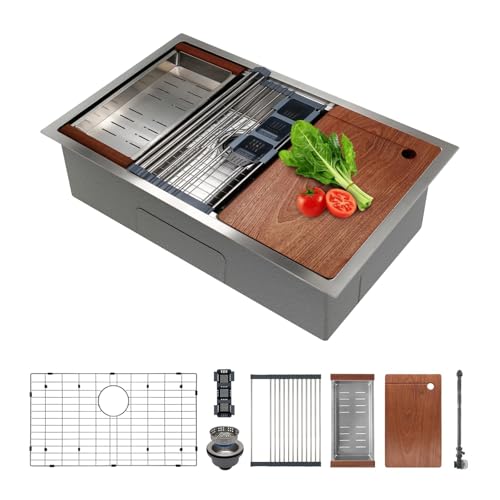
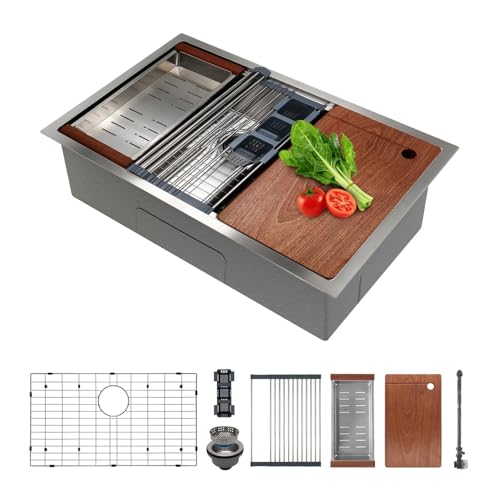
SANYCASA 30 Inch Undermount Workstation Sink
Badge: Best Workstation Pick
Strengths
- 11-gauge (3mm) steel is dramatically thicker than the usual 16–18 gauge — the dent-resistance headline of this group.
- The integrated ledge turns the bowl into a workstation for boards, racks and colanders.
- A 30-inch footprint fits the standard sink cabinet while still taking large pans.
Trade-offs
- Very thick steel is heavy; check cabinet support and plan the lift with help.
- Workstation ledges reward owners who use ledge accessories and merely collect crumbs for those who do not.
- The ledge narrows the open bowl slightly compared with a plain 30-inch bowl.
Key specs (from the verified listing title only)
- Overall size: 30 inches (from listing title)
- Mount: undermount
- Steel gauge: 11 gauge (3mm) stainless steel — the thickest in this group
- Bowl: single bowl
- Workstation: integrated ledge for accessories
- Drain: described as a superior-drain design
Start with the outlier: 11-gauge steel, 3mm thick, formed into a 30-inch workstation with an integrated ledge. In hand — in imagination, in specification — this is a different class of object from ordinary sinks: effectively dent-proof in domestic service, silent by sheer mass, and built to anchor a prep workflow where the board rides the ledge and waste falls straight into the bowl. For serious cooks it reframes what a sink is.
The costs are weight, intention and the ledge’s discipline: the cabinet must be planned for it, and the ledge must be used or it merely narrows the bowl. Buy it as the centrepiece it is, not as an ordinary sink with extras, and it will justify itself daily.
Fitting this pick is a small project in itself — the weight deserves two people and a planned support — but owners consistently describe the result the same way: the sink stops being an appliance and becomes part of the kitchen’s structure. That permanence is the workstation flagship’s real product, and it is why it leads this guide’s range despite asking the most of its buyer.
Best for: Heavy-use and workstation fans who want the thickest steel in a standard cabinet size. / Not suited for: Anyone who wants the widest possible open bowl, or a featherweight install.
Check on Amazon to confirm the current configuration, included parts and delivery options for the SANYCASA 30 Inch Undermount Workstation Sink.

KRAUS KHU100-30 30 Inch Undermount Sink
Badge: Best Overall
Strengths
- 16-gauge TRU16 steel is the proven heavy-duty class from an established sink maker.
- Channel grooves keep the bowl floor draining instead of puddling.
- Rounded corners and NoiseDefend pads make it the easy-cleaning, quiet-running formula in this group.
Trade-offs
- A bowl-first design: confirm exactly which drain and accessory parts are in the box before install day.
- Thirty inches suits standard cabinets, but batch cooks may still want the 32-inch class.
- Rounded corners soften the crisp, architectural look some modern kitchens aim for.
Key specs (from the verified listing title only)
- Overall size: 30 inches (from listing title)
- Mount: undermount
- Steel gauge: 16 gauge TRU16 stainless steel
- Corners: rounded corners for easy cleaning
- Drainage: channel grooves in the bowl floor
- Sound: NoiseDefend pads
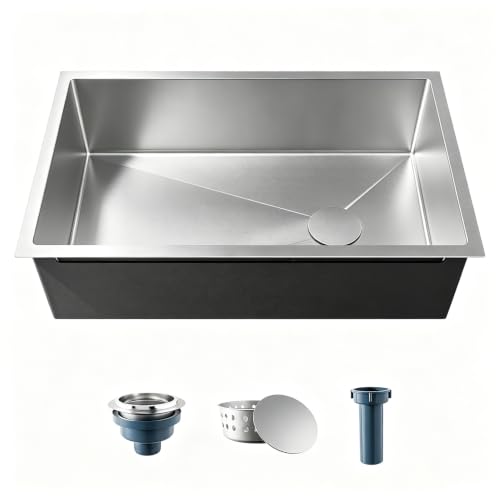
Every category has a reference product, and in stainless sinks it looks like this: 16-gauge TRU16 steel, channel grooves pressing the floor toward the drain, rounded corners that clean in a wipe, and sound pads that keep the bowl’s voice down. The KHU100-30 is not the biggest, thickest or cleverest sink in this guide — it is the most completely judged one, sized for the standard cabinet and specified for the standard decade of family use.
Its limitations are the absence of theatre: no ledge, no bundle, no record-breaking number. Households that want a feature should look at its neighbours. Households that want the sink decision simply, durably right should start — and probably finish — here.
A decade-scale thought on the reference pick: its parts and pattern are the category’s most standard, which quietly means the easiest long-term ownership — drain standards, accessory fits and maker support all follow the mainstream. Exotic sinks age into orphanhood; reference designs age into infrastructure. For a sealed-under-stone component, infrastructure is the compliment that matters.
Best for: Most households: the balanced 30-inch, 16-gauge undermount from a specialist brand. / Not suited for: Anyone needing a workstation ledge built in, or the absolute widest bowl.
Check on Amazon to confirm the current configuration, included parts and delivery options for the KRAUS KHU100-30 30 Inch Undermount Sink.

cozhao 30 Inch Undermount Sink
Badge: Best Stated-Grade Pick
Strengths
- The title states 304 stainless steel outright — the food-grade alloy most buyers are actually shopping for.
- Handmade construction gives the straighter walls and tighter corners of the modern square-bowl look.
- A drain assembly is included, so the basic install parts are in the box.
Trade-offs
- 18-gauge steel is the thinner class here; it will show heavy use sooner than 16-gauge bowls.
- Handmade corners hold a little more grime than fully rounded corners and need a brush, not just a wipe.
- A newer brand name means a shorter track record than the established makers in this group.
Key specs (from the verified listing title only)
- Overall size: 30 inches (from listing title)
- Mount: undermount
- Steel: 18 gauge, 304 stainless steel (grade stated in title)
- Bowl: single bowl
- Construction: handmade, modern styling
- Included: drain assembly
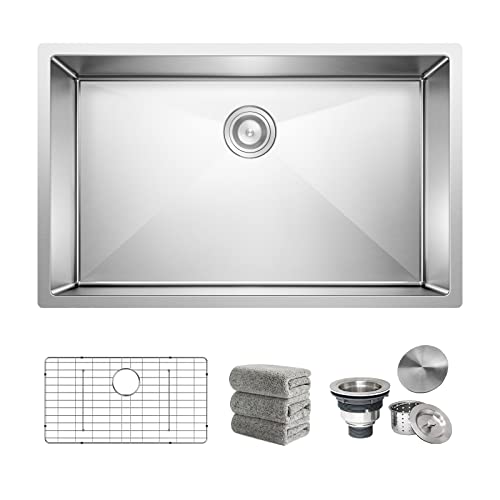
The cozhao’s distinction is documentary as much as physical: its title states 304 stainless steel, the grade most buyers want, where rivals leave alloy unstated. Around that honesty sits a handmade modern bowl — straight walls, tight corners, a drain assembly included — that delivers the current squared aesthetic at the standard 30-inch size.
Eighteen-gauge steel is its known compromise, flexing and denting more readily than the 16-gauge picks, and handmade corners ask for a brush. For design-led kitchens that cook with reasonable care and value a stated alloy, it is a well-aimed sink. The alloy question itself is unpacked in the factory-side research at Best Stainless Steel Kitchen Sinks Factory.
The handmade profile has one more daily consequence worth knowing: straight walls meet the counter cut-out in a crisp shadow line that shows dust and crumbs honestly. Owners who love the look accept the wipe; owners who prioritise invisibility choose rounded bowls. Aesthetic honesty, like alloy honesty, is this pick’s theme throughout.
Best for: Buyers who want the steel grade stated in writing and a modern handmade look at 30 inches. / Not suited for: The hardest heavy-use kitchens, where 16-gauge or thicker steel is the safer bet.
Check on Amazon to confirm the current configuration, included parts and delivery options for the cozhao 30 Inch Undermount Sink.

MAYESAR 28 Inch Undermount Sink
Badge: Best Compact Pick
Strengths
- 16-gauge steel in a compact 28-inch footprint — the heavy-duty spec without the wide-cabinet demand.
- The stated 9-inch bowl depth is properly deep for soaking trays and hiding dishes.
- Handmade build with round corners balances the modern look against easy wiping.
Trade-offs
- At 28 inches it is the narrowest bowl here; the largest sheet pans may sit at an angle.
- Brushed finishes show fingerprints and water marks between cleans.
- Compact bowls fill fast in big households that cook in batches.
Key specs (from the verified listing title only)
- Overall size: 28 x 18 inches (from listing title)
- Mount: undermount
- Steel gauge: 16 gauge stainless steel
- Bowl: single bowl, 9 inches deep (depth stated in title)
- Construction: handmade, brushed finish, round corners
Compact sinks are where categories quietly cheat — thinner steel, shallower bowls, apologetic everything. The MAYESAR refuses: 16-gauge steel and a stated 9-inch depth in a 28-inch handmade footprint, with a brushed finish and softened corners. It is the small sink specified like a big one, and smaller kitchens will feel that respect every day.
Width remains width: the largest trays may angle, and busy family wash-ups fill it quickly. Measure your biggest pan honestly, and if it fits — or nearly — this is the compact pick that asks for no excuses.
Small-kitchen owners should note the stacking dividend of depth: at a stated 9 inches, this bowl takes the tall stockpot that wider shallow bowls refuse, which in a compact kitchen — where the pot cannot simply live elsewhere — is a genuine capacity argument. Depth is the small kitchen’s width, bought vertically.
Best for: Smaller kitchens and narrower cabinets that refuse to give up 16-gauge steel and real depth. / Not suited for: Households that routinely wash the largest roasting pans and trays flat.
Check on Amazon to confirm the current configuration, included parts and delivery options for the MAYESAR 28 Inch Undermount Sink.

KRAUS KWU110-32 32 Inch Workstation Sink
Badge: Best Large Workstation
Strengths
- A true 32-inch workstation: the ledge, cutting board and roll-up rack are included, not upsells.
- 16-gauge TRU16 steel gives the workstation a bowl that can take daily heavy use.
- NoiseDefend soundproofing keeps a big steel bowl from sounding like a drum.
Trade-offs
- The 32-inch width needs a wide cabinet — confirm the interior measurement first.
- Ledge accessories earn their keep only if you actually prep over the sink.
- More included parts means more pieces to store when they are not on the ledge.
Key specs (from the verified listing title only)
- Overall size: 32 inches (from listing title)
- Mount: undermount
- Steel gauge: 16 gauge TRU16 stainless steel
- Workstation: integrated ledge; cutting board and roll-up rack included
- Sound: NoiseDefend soundproofing
The big workstation: a true 32 inches of TRU16 steel with the ledge, the cutting board and the roll-up rack all in the box, and sound treatment to keep the large bowl civilised. It converts counter-scarce kitchens by moving prep over the sink, and its bowl still swallows the trays and stockpots that justify the width in the first place.
It demands the wide cabinet and the prep habit in equal measure. Given both, it is the most capable sink in this guide; lacking either, its own sibling below — same steel, plain bowl — is the wiser buy. Capability you use is value; capability you store is clutter.
The workstation’s social consequence surprises owners: cooking migrates toward the sink. Prep, draining, defrosting and even serving arrange themselves along the ledge, and the counter clears for everything else. Kitchens reorganise around their most capable surface, and this sink is engineered to be exactly that.
Best for: 32-inch shoppers who prep at the sink and want the workstation kit included. / Not suited for: Minimalists who want a plain open bowl, or cabinets narrower than the 32-inch class.
Check on Amazon to confirm the current configuration, included parts and delivery options for the KRAUS KWU110-32 32 Inch Workstation Sink.

KRAUS KHU100-32 32 Inch Undermount Sink
Badge: Best Large Plain Bowl
Strengths
- The classic Kraus formula at a true 32 inches: TRU16 steel, grooves, rounded corners, sound pads.
- Channel grooves and rounded corners make this the easiest 32-inch bowl here to keep clean.
- A plain open bowl with no ledge maximises usable washing volume.
Trade-offs
- No workstation ledge or included prep accessories — it is a bowl, done properly.
- Needs the same wide cabinet as any 32-inch undermount.
- Confirm included drain parts before planning the install.
Key specs (from the verified listing title only)
- Overall size: 32 inches (from listing title)
- Mount: undermount
- Steel gauge: 16 gauge TRU16 stainless steel
- Corners: rounded corners for easy cleaning
- Drainage: channel grooves in the bowl floor
- Sound: NoiseDefend pads
The plain 32-inch bowl, done by the specialist: TRU16 steel, grooved floor, rounded corners, sound pads, and nothing between you and the maximum washing volume this guide offers. Roasting days, preserving days, party days — the loads that defeat standard bowls are simply this sink’s normal Tuesday.
No ledge, no bundle, no included theatre: the value is volume, drainage and steel, in the wide-cabinet class. If your kitchen’s sink work is washing at scale, this is the most honest tool here — and the range perspective on it continues in Best Stainless Steel Kitchen Sinks Pricelist.
There is an acoustic footnote to the plain wide bowl: sound pads matter most precisely where there is no ledge or accessory mass to damp the steel, so their presence here is not a spec-sheet courtesy but the difference between a bowl and a drum at 32 inches. Run the tap in the showroom if you can; this one was designed for that test.
Best for: 32-inch shoppers who want a plain, easy-clean, heavy-gauge bowl from a specialist maker. / Not suited for: Anyone who wants ledge accessories included, or who has a standard narrow cabinet.
Check on Amazon to confirm the current configuration, included parts and delivery options for the KRAUS KHU100-32 32 Inch Undermount Sink.
Comparison Table
Six eligible sinks, separated by size class, steel class and workflow. Pick your cabinet row first, then your philosophy.
| Sink | Badge | Size / material / mount | What stands out | Link |
|---|---|---|---|---|
| SANYCASA 30 Inch Undermount Workstation Sink | Best Workstation Pick | 30 in / stainless steel / undermount | 11 gauge (3mm); integrated workstation ledge | Check on Amazon |
| KRAUS KHU100-30 30 Inch Undermount Sink | Best Overall | 30 in / stainless steel / undermount | 16 gauge TRU16; grooves, rounded corners, pads | Check on Amazon |
| cozhao 30 Inch Undermount Sink | Best Stated-Grade Pick | 30 in / stainless steel / undermount | 18 gauge; 304 grade stated; handmade | Check on Amazon |
| MAYESAR 28 Inch Undermount Sink | Best Compact Pick | 28 x 18 in / stainless steel / undermount | 16 gauge; stated 9-inch depth; handmade | Check on Amazon |
| KRAUS KWU110-32 32 Inch Workstation Sink | Best Large Workstation | 32 in / stainless steel / undermount | 16 gauge TRU16 workstation; board + rack included | Check on Amazon |
| KRAUS KHU100-32 32 Inch Undermount Sink | Best Large Plain Bowl | 32 in / stainless steel / undermount | 16 gauge TRU16 plain bowl; grooves, rounded corners | Check on Amazon |
How to Choose a Stainless Steel Kitchen Sink
Start with the cabinet and the tray — the two measurements that cannot be argued with. The cabinet’s clear interior sets your width class: compact runs take the 28-inch pick, standard runs the 30-inch class, wide runs open the 32-inch flagships. Then diagonal-measure your largest tray or roasting pan and check it against the bowl class you are considering. A sink is bought for the biggest thing it must swallow, not for the average plate.
Next, the steel — two questions, always. Gauge: 16 is the heavy-duty standard, 18 the lighter class, and 11-gauge the extreme represented here; lower numbers are thicker, tougher and quieter. Grade: prefer listings that state their alloy, as the cozhao states 304, and confirm on the product page where they do not. Thickness you can feel in a showroom; alloy you can only read — which is why reading is the skill. The dedicated grade guide linked in the reviews goes as deep as the subject deserves.
Then the bowl’s daily manners. Drainage grooves and a sloped floor decide whether the bowl empties or puddles; sound pads decide whether it converses or drums; corner radius decides whether cleaning is a wipe or a brush. None of these photograph well and all of them are experienced daily for decades. Rank them above finishes and features when you compare two sinks of similar steel and size.
Decide the workstation question by auditing your cooking, not your aspirations. Ledges transform prep in counter-scarce kitchens and clutter the bowls of households that never chop at the sink. The same honesty applies to bundles and grids: a bottom grid is near-universal value — it protects the floor of any bowl — while elaborate accessory ecosystems only pay rent in weekly use.
Finally, respect the fitting. Undermounts are sealed, clipped and supported beneath a counter; they reward professional or careful installation and punish improvisation for years. Budget the install, flood-test the result, and your stainless sink will do what the material promises: disappear into reliable service for the life of the kitchen. Sourcing detail lives in Best Stainless Steel Kitchen Sinks Supplier.
Budget the whole decision before you fall for any single pick: sink, any parts not in its box, the tap if its reach no longer suits, and the fitting. Stainless sinks reward buyers who cost the system, because the system’s cheapest failure — a bad seam on a great bowl — is also its most common. Decide the total you are spending, allocate the fitting its honest share, and then choose the best bowl the remainder buys from this shortlist.
And a final sizing sanity check that catches more errors than any other: cardboard. Cut a template to your candidate bowl’s footprint, lay it in the cabinet and on the counter, and live with it for a day of cooking. Cardboard has ended more wrong sink purchases than any review ever written — including, we concede with good grace, this one.
One final filter before ordering, and it is the household itself: who cooks, who washes, who drops things, who cleans. The best sink in this guide is the one whose trade-offs your household will mind least in year three — the ledge for the prep cook, the plain bowl for the washer-upper, the compact depth for the small kitchen’s daily juggle. Specifications shortlist; autobiography decides.
A closing discipline for the undecided: sleep on the shortlist, not on the specification. Fix the size class, the gauge floor and the must-haves today, while the measurements are fresh; let the final model choose itself over a day or two of imagining your own wash-up in each bowl. Indecision between six verified sinks is a luxury problem — indecision about measurements is how kitchens get hurt.
If you take one sentence from this guide to the listing page, take this one: buy the sink whose stated specifications you have read, whose size you have measured twice, and whose trade-offs you can repeat back without the page open. A purchase that survives that sentence will survive the decade. Everything else in these thousands of words is commentary on it — useful commentary, we hope, but commentary all the same.
Summary for the hurried: fit first, steel second, manners third, features last — and a grid on the floor from the first day. Follow that order through the six verified picks above and the general stainless decision, which has defeated more shoppers by abundance than by scarcity, resolves itself into a single confident order.
How to Install, Use and Keep a Stainless Sink
The standard undermount sequence, then the care routine that keeps brushed steel handsome. Neither is complicated; both are unforgiving of skipped steps.
- Dry-fit everything. Sink, drain, disposal and plumbing, checked against cabinet walls and drawers before sealant is opened.
- Clean and bead. Degrease counter underside and flange; run one continuous sealant bead around the rim.
- Lift, press, prop. Raise the bowl squarely with help and support it from below — clips and props carry the weight, sealant only seals.
- Clip in rotation, check level. Tighten evenly around the rim and confirm the bowl sits true so its drainage slope works as designed.
- Cure, plumb, flood-test. Respect the full cure time, fit drain and disposal, fill the bowl to the brim and inspect every joint.
- Use a grid from day one. Protect the bowl floor from pan abrasion while the finish is new, not after the first scratches teach you.
- Adopt the rinse-and-wipe. Rinse after acidic or salty loads, wipe along the grain, and dry the bowl when you can in hard-water areas.
Monthly, lift the grid and clean beneath it; check the seam line; and polish any early water spots before they set. Yearly, confirm clips are snug and the sealant line is intact. That is the entire maintenance contract of a stainless sink — which is, of course, the point of choosing one.
Troubleshooting: three problems owners actually meet
Problem: The bowl drums when the tap runs → confirm sound pads are fitted and the bowl is supported and evenly clipped; resonance is a mounting condition as much as a material one, and it usually yields to support.
Problem: Water spots and a cloudy film keep forming → that is mineral deposit from hard water, not failing steel — dry the bowl after use for a week to break the cycle, and clean with a mild non-abrasive cleaner along the grain.
Problem: Scratches have dulled the floor where pans slide → blend them with a non-abrasive pad stroked strictly along the grain, then fit the bottom grid so future pans slide on steel rack, not steel bowl.
Why Stainless Keeps Winning the Material Argument
Every rival material wins a category: fireclay wins stain resistance, composites win colour, copper wins theatre. Stainless wins the aggregate — toughness, hygiene, weight, repairability, size range and indifference to fashion — which is why it remains the default specification for professional kitchens and the safest long-term answer for domestic ones. Its weaknesses are known, priced and manageable: it scratches visibly, it can drum if badly mounted, and cheap thin examples dent.
The practical conclusion is not ‘always buy steel’ but ‘buy steel knowingly’: the right gauge, a documented grade, drainage and sound treatment fitted, and a grid on the floor. This guide’s six picks are simply that sentence expressed as products.
Single Bowl, and Why This Guide Does Not Apologise for It
All six picks are single bowls, and that reflects where the category has moved: one large volume swallows modern cookware — trays, boards, stockpots — that divided bowls strand across their partitions. Soaking, the classic double-bowl argument, is handled by a basin inside the bowl or by the bowl’s own depth, as the 9-inch compact pick demonstrates.
Households with a genuine two-station workflow — one side permanently soaking, one side rinsing — should hold out for a divided design in another shortlist. Everyone else gains more from undivided volume, which is why the modern stainless mainstream, and this guide, look the way they do. The compact expression of the same idea is at Best Stainless Steel Kitchen Sinks For Compact Kitchen.
The Undermount Era: How the Seam Changed the Sink
A generation ago the default sink sat on its rim, and the rim collected the kitchen’s evidence in a grey line no cleaner fully won. Undermounting moved the seam underneath, turned wiping-up into a single motion into the bowl, and quietly made the sink a piece of the counter’s architecture rather than an object placed on it. Every pick in this guide belongs to that era, and its installation section is written with the era’s respect: the seam is sealed, clipped and supported, or it is a problem being scheduled.
The era’s one demand is permanence of choice. A drop-in can be swapped on a whim; an undermount is a decade-scale commitment made under stone. That is the deepest reason this guide verifies so pedantically — the cost of a wrong pick is not the return postage, it is the remodel. Choose like it matters, because here it measurably does.
Accessories That Earn Their Place (and Those That Do Not)
Three accessories survive every honest audit. The bottom grid protects the bowl floor — the finish you see most — and pays for itself in the first year. The ledge system, where fitted, converts the bowl into workspace and is audited in this guide’s workstation reviews. And the humble fitted rack, draining into the bowl instead of across the counter, quietly ends the wet-counter problem in kitchens that hand-wash daily.
Beyond those three, accessory ecosystems decay into drawer stock with remarkable reliability: novelty inserts, duplicate boards, gadgets that solve annual problems. The value discipline from this site’s discount research applies — count what you will use weekly, buy exactly that, and let the rest stay in the catalogue where it photographs so well.
Stainless and the Rest of the Kitchen: Finishes That Live Together
A brushed stainless bowl is the kitchen’s most diplomatic surface: it sits comfortably under stone, quartz, timber and composite counters, beside appliances in any finish, and under taps from chrome to matte black. Its one visual habit is honesty — it shows water spots in hard-water homes and wears its working scratches as a patina rather than hiding them. Owners who choose steel are choosing that honesty, usually for decades, and the kitchens that age best are the ones whose owners made peace with it at the start.
If the showroom-perfect look is your priority, be honest with yourself now rather than disappointed at month six: steel’s beauty is the working kind, maintained by the rinse-and-wipe rhythm this guide describes. Embraced, it is the easiest beauty in the kitchen to keep. Resisted, it is a daily argument you will lose to physics.
The Sink as the Kitchen’s Longest Relationship
Consider the arithmetic of acquaintance: you will meet your sink more often than your car, your sofa and your front door combined — at breakfast, at midnight, in flour and in flood. It is the only kitchen component whose quality is assessed by your hands, wet, several times a day, for decades. Purchases with that contact frequency deserve the deliberation this guide has spent on them.
That is also why the category’s wisdom is so consistent across every guide on this site: honest steel, verified specifications, drainage and sound attended to, a fitting done properly once. There is no trick to a great sink. There is only the refusal to buy a bad one — and you now hold six verified refusals of exactly that.
A Short History Written in Steel
The stainless sink’s century is a story of one material outlasting every fashion around it: it served the farmhouse before farmhouse was a style, the laboratory before kitchens borrowed its manners, and the professional line before home cooks knew to ask for it. Each era’s rivals — enamel, composite, ceramic, copper — took their decade in the spotlight and their place in the archive. The steel bowl simply remained in service, which is what the six picks in this guide are really selling: not novelty, but membership in the longest-running success in the kitchen.
Buy accordingly. The sink is the purchase least likely to be repeated in your kitchen’s life, and the one whose quality you will audit most often. The verified shortlist above is this site’s best current answer — measured, drained, damped and ready to be forgotten about for thirty years.
The Fitting Appointment: Getting the Most From Your Installer
One practical section remains, and it is about a conversation. When the installer arrives, three questions separate a good fitting from a great one: Will you support the bowl independently of the sealant? Will you clip in rotation and check level across the span? And will we flood-test together before the cabinet is loaded? An installer who welcomes all three is the installer this guide has been describing; one who waves them away is telling you something worth hearing before the sealant opens.
Keep the answers, the documents and the photographs together. A stainless sink’s thirty-year story begins in that single appointment, and the households who treat it as the main event — rather than as the delivery’s tail — are the ones whose sinks never become stories at all.
Common Buying Mistakes
- Choosing width from the cabinet’s label. Clear interior is the measurement; nominal size is marketing. Measure inside, twice.
- Buying gauge without grade, or grade without gauge. Thickness and alloy are separate virtues. A complete specification answers both.
- Ignoring drainage and sound for features. Grooves and pads are experienced daily for decades; the novelty feature is experienced monthly for a year.
- Sealing an undermount without support. Sealant is not structure. Props and clips carry a full bowl; skip them and the seam eventually confesses.
- Scouring across the grain. Abrasives dragged crosswise carve visible tracks. Work along the brush lines with non-abrasive cleaners.
- Skipping the grid to save a small sum. The bowl floor is the finish you see most. Protect it from the first day, not the first scratch.
Final Recommendation
The KRAUS KHU100-30 is the general recommendation: the reference formula — TRU16 steel, drainage, quiet, easy cleaning — in the size that fits the standard cabinet. Most kitchens, asked honestly, want exactly this sink, and this guide is content to say so.
Start your shortlist here: SANYCASA 30 Inch Undermount Workstation Sink, KRAUS KHU100-30 30 Inch Undermount Sink, cozhao 30 Inch Undermount Sink — Check on Amazon and Check on Amazon and Check on Amazon.
Deviate with purpose: to the SANYCASA for workstation prep and maximum steel; to the KWU110-32 for the same idea at full width; to the KHU100-32 for plain-bowl volume; to the cozhao for a stated grade and the handmade look; to the MAYESAR when the cabinet is compact but standards are not. Check the latest price on Amazon for your pick, confirm its dimensions and included parts on the listing, and fit it properly — a stainless sink bought well is a thirty-year decision made once.
Frequently Asked Questions
What gauge is best for a stainless kitchen sink?
Sixteen gauge is the heavy-duty standard most buyers should target: dent-resistant, solid-feeling and widely available. Eighteen gauge suits gentler use; the 11-gauge workstation in this guide is the extreme for near-commercial workloads.
What grade of stainless steel should I look for?
A stated grade — the food-grade 304 family is the common quality benchmark, and one pick here states it in its title. Where listings do not state grade, confirm it on the product page. The full discussion is in the grade guide linked from the reviews.
What size sink fits a standard kitchen cabinet?
The 30-inch class is the standard-cabinet default, with 28-inch bowls for compact runs and 32-inch bowls for wide ones. Always verify against your cabinet’s clear interior and the listing’s stated minimum cabinet size.
Are workstation ledges worth it?
For cooks who prep over the sink, genuinely yes — boards and racks on the ledge convert the bowl into workspace. For wash-up-only households, a plain bowl gives the same steel with more open volume and less to clean.
How long does a stainless sink last?
Decades, when the steel is honest and the fitting is sound. Sinks rarely wear out; installations fail at seams and supports. Inspect the sealant line twice a year and the question mostly answers itself.
Do stainless sinks scratch?
Yes — visibly, honestly, and mostly on the bowl floor. A bottom grid prevents the worst of it, cleaning along the grain keeps scratches blended, and most owners find the working patina preferable to the chipped or stained alternatives. Heavy-use care, priced as the value it protects, is detailed in Best Stainless Steel Kitchen Sinks Discount.
Single bowl or double bowl — which should I choose?
For most modern kitchens, a single large bowl: it swallows trays, boards and stockpots that divided bowls strand. Households with a permanent two-station routine — continuous soaking on one side — are the honest exception, and should shop a divided shortlist deliberately rather than compromise here.