Disclosure: topratedkitchenware.com is reader-supported. When you buy through links on our site, we may earn an affiliate commission from Amazon and other retailers, at no extra cost to you.
Where to buy
Short on time? Start with the best stick burner bbq smokers shortlist below. Linked picks are the ones that genuinely match this search; any pick described as prose-only is covered honestly without a sales link, so you can compare the full field before you decide. Check on Amazon for the current listing details of any linked pick.
- Oklahoma Joe’s Highland Offset Smoker — check the latest price on Amazon
- Royal Gourmet CC1830S Offset Smoker — check the latest price on Amazon
- Dyna-Glo Wide Body Vertical Offset Smoker — check the latest price on Amazon
- Oklahoma Joe’s Longhorn Offset Smoker — check the latest price on Amazon
- Realcook Charcoal Grill with Offset Smoker — check the latest price on Amazon
- Oklahoma Joe’s Highland Reverse Flow Smoker — check the latest price on Amazon
Read the full guide ↓
If you are comparing the best stick burner bbq smokers available to home cooks right now, the useful question is not which cabinet looks most impressive in a photograph. It is which one fits the way you actually cook: how often you will smoke, how much food goes in at once, where the smoker will live, and how much attention you want to give it while it works. This guide answers that question with six verified picks, clear badges, and no invented claims.
A stick burner is the original offset smoker: a firebox where you burn real wood splits, a cooking chamber that receives only heat and smoke, and a chimney that keeps the whole system drawing. There is no thermostat to hide behind. The flavour is the deepest in barbecue and the workload is the highest, and both facts come from the same source, which is you, managing a live wood fire for six, ten or fourteen hours. An honest note on this pool: the six verified picks are offset smokers listed for charcoal, which is the form in which stick-burner cooking is sold to most home buyers today. Their fireboxes accept wood splits and chunks alongside charcoal, and generations of cooks run exactly these offsets on wood-led fires. They are linked because the offset architecture is the keyword’s core; the reviews say plainly where each design sits between a charcoal grill with an offset box and a dedicated heavy stick burner.
Throughout the guide you will also find pointers to related research, including Best Offset Smokers Grills and Best Offset Smokers Under $200, because the right answer for one patio is often the neighbouring category rather than the headline one.
Key Takeaways
- For most buyers, the first-listed pick is the safest starting point among the best stick burner bbq smokers in this pool.
- Capacity figures only help when the rack layout lets you use the space; layout and access matter as much as the headline number.
- On a stick burner, clean combustion matters more than smoke volume; a small hot fire beats a large smouldering one.
- Every pick here is linked because every pick genuinely matches the keyword’s core format.
- Buy for your storage spot and your typical load, not for the largest cook you might attempt once a year.
- Cleaning and care routines decide how long any smoker stays pleasant to use; plan them before the first cook.
In this guide
Quick Picks
The six best stick burner bbq smokers compared at a glance. Badges are used consistently here and in the detailed reviews, so you can follow one pick through the whole guide.
| Pick | Badge | Why it stands out | Check |
|---|---|---|---|
| Oklahoma Joe’s Highland Offset Smoker | Best Overall | a classic horizontal offset layout with 900 square inches of cooking area | Check on Amazon |
| Royal Gourmet CC1830S Offset Smoker | Best Work Space | 783 square inches, an adjustable charcoal pan, a side door, a lid thermometer and front and side tables | Check on Amazon |
| Dyna-Glo Wide Body Vertical Offset Smoker | Best Vertical Offset | a wide-body vertical cabinet fed by an offset firebox | Check on Amazon |
| Oklahoma Joe’s Longhorn Offset Smoker | Best for Big Batches | the same proven offset layout stretched to 1060 square inches | Check on Amazon |
| Realcook Charcoal Grill with Offset Smoker | Best Grill-Smoker Combo | 800 square inches in a barrel grill and offset smoker combo aimed at backyard gatherings | Check on Amazon |
| Oklahoma Joe’s Highland Reverse Flow Smoker | Best for Even Heat | reverse flow routing and the largest cooking area here, at 1093 square inches | Check on Amazon |
How These Picks Were Chosen
This is a research-led guide, not a claim of hands-on laboratory testing. The pick pool was verified against manufacturer and retailer listing data through the Creators API on the check date recorded in the accompanying sources file. Only products in that verified pool appear here, only specifications stated in the listing data are printed, and no prices or fixed scores are quoted, because both change too often to print honestly in a guide that may be read months later.
Each pick was assessed on the same questions. Does it genuinely match the keyword, in format, fuel and construction? Is its capacity usable, given its rack layout? How does smoke reach the food, and how do you replenish it mid-cook? How do you know the food is done without sabotaging the cook? What will cleaning actually involve on a tired Sunday evening? And what is the honest limitation that a salesperson would skip? Where a pick failed the first question, it was kept for context but stripped of its link and image, which is the treatment you will see applied openly below.
Comparison shoppers may also want Best Offset Smokers Under $2000 and Best Offset Smokers Under $300, which cover adjacent formats that suit different patios and budgets.
The 6 Best Stick Burner Bbq Smokers

Oklahoma Joe’s Highland Offset Charcoal Smoker Grill
Badge: Best Overall
This model is defined by a classic horizontal offset layout with 900 square inches of cooking area. The Highland is the archetype most people picture: firebox low on one side, long cooking chamber, chimney at the far end. That geometry is what teaches real fire management, because every change at the firebox shows up minutes later as a temperature and smoke-quality change in the chamber. With 900 square inches there is room to keep a brisket away from the firebox hot spot and still fit ribs or a second cut alongside it.
Strengths
- Classic offset layout teaches genuine fire management
- 900 square inches gives real room to avoid the firebox hot spot
- Simple, repairable concept with no electronics to fail
Trade-offs
- Charcoal-listed design; running it as a pure stick burner takes practice and suitable splits
- Offset hot spot near the firebox needs rotation and placement care
- Live-fire cooking demands frequent tending on long cooks
| Format | Offset charcoal smoker grill |
|---|---|
| Cooking area | 900 square inches |
| Finish | Black |
In stick-burner terms, judge this cooker by how its firebox behaves across a long afternoon. The cook who will love it is the one who enjoys the rhythm of checking the fire, adding a split, and watching the chamber respond. Its smoke flavour ceiling is high precisely because nothing is automated. The honest limitation is symmetrical: a distracted hour shows up in the food, whether as a temperature sag that stretches the cook or as dirty smoke from a fire that was fed too much at once. Load it with dry wood, keep the coal bed alive, and it will produce the deep, unmistakable flavour that defines this style. Rush it with wet wood or oversized splits and no badge in any guide can rescue the result.
For serving, the stated cooking area translates into practical loads only when you respect airflow. Leave gaps around each cut, keep the chimney path clear, and remember that the position nearest the firebox cooks differently from the far end unless the design specifically routes heat to even that out. Rotate food on long cooks, rest everything properly before slicing, and this cooker will handle the gatherings it was built for.
Best for: households that want this format’s strengths in their most complete form / Not suited for: buyers whose main need is a different format, fuel or capacity class

Royal Gourmet CC1830S BBQ Charcoal Grill and Offset Smoker
Badge: Best Work Space
This model is defined by 783 square inches, an adjustable charcoal pan, a side door, a lid thermometer and front and side tables. The adjustable charcoal pan and side door are practical fire tools, not decoration. Raising or lowering the coal bed changes radiant heat for grilling, while the side door lets you add fuel or rake coals without lifting the main lid and dumping the chamber temperature. The front and side tables matter during a real cook too: thermometers, tongs, spray bottles and resting trays all need somewhere to go that is not the ground.
Strengths
- Front and side tables give a proper working station
- Adjustable charcoal pan and side door make fire tending easier
- Lid thermometer provides a quick at-a-glance reference
Trade-offs
- 783 square inches is the smallest area in this group
- Combo construction is a compromise versus a dedicated heavy smoker
- Lid thermometers are indicative, not a substitute for a probe at grate level
| Format | Barrel charcoal grill with offset smoker |
|---|---|
| Cooking area | 783 square inches |
| Work space | Front and side table |
| Fire control | Adjustable charcoal pan and side door |
| Monitoring | Lid thermometer |
In stick-burner terms, judge this cooker by how its firebox behaves across a long afternoon. The cook who will love it is the one who enjoys the rhythm of checking the fire, adding a split, and watching the chamber respond. Its smoke flavour ceiling is high precisely because nothing is automated. The honest limitation is symmetrical: a distracted hour shows up in the food, whether as a temperature sag that stretches the cook or as dirty smoke from a fire that was fed too much at once. Load it with dry wood, keep the coal bed alive, and it will produce the deep, unmistakable flavour that defines this style. Rush it with wet wood or oversized splits and no badge in any guide can rescue the result.
For serving, the stated cooking area translates into practical loads only when you respect airflow. Leave gaps around each cut, keep the chimney path clear, and remember that the position nearest the firebox cooks differently from the far end unless the design specifically routes heat to even that out. Rotate food on long cooks, rest everything properly before slicing, and this cooker will handle the gatherings it was built for.
Best for: cooks whose priorities match its badge / Not suited for: buyers whose main need is a different format, fuel or capacity class
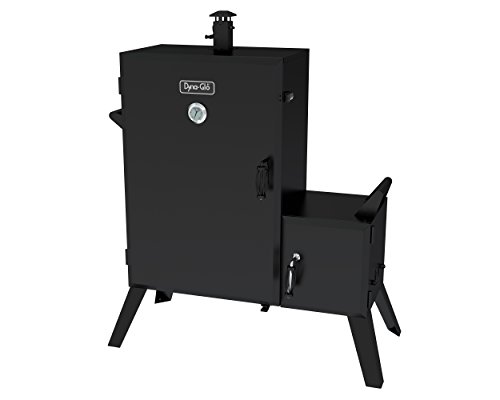
Dyna-Glo Wide Body Vertical Offset Charcoal Smoker (DGO1890BDC-D)
Badge: Best Vertical Offset
This model is defined by a wide-body vertical cabinet fed by an offset firebox. This is the shape outlier in the group, and that is its value. A vertical cabinet stacks cooking levels above one another, so the footprint on the patio stays small while capacity grows upward, and the offset firebox still keeps live fire separate from the food. Wide-body proportions mean the racks are less cramped than on narrow verticals, which helps with ribs and trays that would otherwise need cutting down.
Strengths
- Vertical cabinet delivers offset cooking on a small footprint
- Wide-body racks are less cramped than narrow uprights
- Offset firebox keeps live fire separate from food
Trade-offs
- No cooking area figure is stated in the listing to compare directly
- Vertical temperature gradient needs rack rotation on long cooks
- Charcoal listing means wood-led fires need the same careful management
| Format | Wide body vertical offset charcoal smoker |
|---|---|
| Finish | Black |
In stick-burner terms, judge this cooker by how its firebox behaves across a long afternoon. The cook who will love it is the one who enjoys the rhythm of checking the fire, adding a split, and watching the chamber respond. Its smoke flavour ceiling is high precisely because nothing is automated. The honest limitation is symmetrical: a distracted hour shows up in the food, whether as a temperature sag that stretches the cook or as dirty smoke from a fire that was fed too much at once. Load it with dry wood, keep the coal bed alive, and it will produce the deep, unmistakable flavour that defines this style. Rush it with wet wood or oversized splits and no badge in any guide can rescue the result.
For serving, the stated cooking area translates into practical loads only when you respect airflow. Leave gaps around each cut, keep the chimney path clear, and remember that the position nearest the firebox cooks differently from the far end unless the design specifically routes heat to even that out. Rotate food on long cooks, rest everything properly before slicing, and this cooker will handle the gatherings it was built for.
Best for: cooks whose priorities match its badge / Not suited for: buyers whose main need is a different format, fuel or capacity class

Oklahoma Joe’s Longhorn Offset Charcoal Smoker and Grill
Badge: Best for Big Batches
This model is defined by the same proven offset layout stretched to 1060 square inches. The Longhorn answers the Highland’s main limit, which is elbow room. At 1060 square inches, large briskets, multiple rib racks and a tray of sides stop competing for the same safe zone away from the firebox. The longer chamber also smooths the cooking geography a little: there is more distance over which the fierce heat near the firebox can moderate before it reaches the food at the chimney end.
Strengths
- 1060 square inches suits multiple large cuts at once
- Long chamber softens the firebox-end heat gradient
- Established offset design from a specialist brand
Trade-offs
- Large cooker needs more fuel and more patio space
- Long cooks still need regular fire tending
- Size is wasted on households that mostly cook one small cut
| Format | Offset charcoal smoker and grill |
|---|---|
| Cooking area | 1060 square inches |
| Finish | Black |
In stick-burner terms, judge this cooker by how its firebox behaves across a long afternoon. The cook who will love it is the one who enjoys the rhythm of checking the fire, adding a split, and watching the chamber respond. Its smoke flavour ceiling is high precisely because nothing is automated. The honest limitation is symmetrical: a distracted hour shows up in the food, whether as a temperature sag that stretches the cook or as dirty smoke from a fire that was fed too much at once. Load it with dry wood, keep the coal bed alive, and it will produce the deep, unmistakable flavour that defines this style. Rush it with wet wood or oversized splits and no badge in any guide can rescue the result.
For serving, the stated cooking area translates into practical loads only when you respect airflow. Leave gaps around each cut, keep the chimney path clear, and remember that the position nearest the firebox cooks differently from the far end unless the design specifically routes heat to even that out. Rotate food on long cooks, rest everything properly before slicing, and this cooker will handle the gatherings it was built for.
Best for: cooks whose priorities match its badge / Not suited for: buyers whose main need is a different format, fuel or capacity class

Realcook Charcoal Grill with Offset Smoker
Badge: Best Grill-Smoker Combo
This model is defined by 800 square inches in a barrel grill and offset smoker combo aimed at backyard gatherings. The Realcook pitches itself at the social end of the category: a barrel grill for direct-heat cooking when guests want burgers and sausages now, and an offset arrangement for the slower smoked centrepiece. That dual role suits households that will not fire a dedicated smoker often enough to justify a single-purpose machine, but still want genuine offset smoke for weekend projects.
Strengths
- Grill and offset smoker roles in one barrel cooker
- 800 square inches is ample for gatherings
- Straightforward concept for first-time offset owners
Trade-offs
- Lesser-known brand; inspect welds, doors and grates carefully on arrival
- Combo format trades dedicated-smoker mass for versatility
- No thermometer or work table is named in the listing
| Format | Barrel charcoal grill with offset smoker combo |
|---|---|
| Cooking area | 800 square inches |
| Stated use | Backyard parties and gatherings |
In stick-burner terms, judge this cooker by how its firebox behaves across a long afternoon. The cook who will love it is the one who enjoys the rhythm of checking the fire, adding a split, and watching the chamber respond. Its smoke flavour ceiling is high precisely because nothing is automated. The honest limitation is symmetrical: a distracted hour shows up in the food, whether as a temperature sag that stretches the cook or as dirty smoke from a fire that was fed too much at once. Load it with dry wood, keep the coal bed alive, and it will produce the deep, unmistakable flavour that defines this style. Rush it with wet wood or oversized splits and no badge in any guide can rescue the result.
For serving, the stated cooking area translates into practical loads only when you respect airflow. Leave gaps around each cut, keep the chimney path clear, and remember that the position nearest the firebox cooks differently from the far end unless the design specifically routes heat to even that out. Rotate food on long cooks, rest everything properly before slicing, and this cooker will handle the gatherings it was built for.
Best for: cooks whose priorities match its badge / Not suited for: buyers whose main need is a different format, fuel or capacity class

Oklahoma Joe’s Highland Offset Reverse Flow Smoker and Grill
Badge: Best for Even Heat
This model is defined by reverse flow routing and the largest cooking area here, at 1093 square inches. Reverse flow changes the path the heat takes. Instead of entering the chamber and heading straight for the chimney, hot air and smoke are routed along the length of the cooker and back, which is designed to even out the temperature from end to end. For cooks who have fought a hot firebox end and a cool chimney end on a conventional offset, that more even geography is the whole point, and it comes with the largest stated cooking area in this group.
Strengths
- Reverse flow design aims for a more even chamber temperature
- Largest stated cooking area in this group, at 1093 square inches
- Full-size offset layout suits loading the chamber completely
Trade-offs
- Reverse flow plates add cleaning work after fatty cooks
- Largest footprint and fuel appetite in this group
- Even-heat design still cannot remove the need to tend the fire
| Format | Offset reverse flow charcoal smoker and grill |
|---|---|
| Cooking area | 1093 square inches |
| Finish | Black |
In stick-burner terms, judge this cooker by how its firebox behaves across a long afternoon. The cook who will love it is the one who enjoys the rhythm of checking the fire, adding a split, and watching the chamber respond. Its smoke flavour ceiling is high precisely because nothing is automated. The honest limitation is symmetrical: a distracted hour shows up in the food, whether as a temperature sag that stretches the cook or as dirty smoke from a fire that was fed too much at once. Load it with dry wood, keep the coal bed alive, and it will produce the deep, unmistakable flavour that defines this style. Rush it with wet wood or oversized splits and no badge in any guide can rescue the result.
For serving, the stated cooking area translates into practical loads only when you respect airflow. Leave gaps around each cut, keep the chimney path clear, and remember that the position nearest the firebox cooks differently from the far end unless the design specifically routes heat to even that out. Rotate food on long cooks, rest everything properly before slicing, and this cooker will handle the gatherings it was built for.
Best for: cooks whose priorities match its badge / Not suited for: buyers whose main need is a different format, fuel or capacity class
Comparison Table
| Pick | Badge | Key stated feature | Status | Check |
|---|---|---|---|---|
| Oklahoma Joe’s Highland Offset Smoker | Best Overall | a classic horizontal offset layout with 900 square inches of cooking area | Linked | Check on Amazon |
| Royal Gourmet CC1830S Offset Smoker | Best Work Space | 783 square inches, an adjustable charcoal pan, a side door, a lid thermometer and front and side tables | Linked | Check on Amazon |
| Dyna-Glo Wide Body Vertical Offset Smoker | Best Vertical Offset | a wide-body vertical cabinet fed by an offset firebox | Linked | Check on Amazon |
| Oklahoma Joe’s Longhorn Offset Smoker | Best for Big Batches | the same proven offset layout stretched to 1060 square inches | Linked | Check on Amazon |
| Realcook Charcoal Grill with Offset Smoker | Best Grill-Smoker Combo | 800 square inches in a barrel grill and offset smoker combo aimed at backyard gatherings | Linked | Check on Amazon |
| Oklahoma Joe’s Highland Reverse Flow Smoker | Best for Even Heat | reverse flow routing and the largest cooking area here, at 1093 square inches | Linked | Check on Amazon |
How to Choose the Right Smoker for Your Patio
Steel and firebox practicality decide stick burner happiness more than headline area. Look for a firebox you can rake and feed without crouching into the smoke path, a chimney that draws from grate level or near it, and doors that latch with a reassuring seal, because every leak is temperature you must replace with fuel. Plan your wood supply before the cooker arrives: a stick burner household needs a dry, stacked store of splits, not a single bag bought on cook day.
Start with the load, not the appliance. Write down the three cooks you will actually do most: perhaps ribs for six, a pork shoulder for a weekend, and sausages or fish for variety. Size the smoker for the largest of those regular cooks, with a little headroom, and resist sizing for a once-a-year party that a borrowed second cooker or two batches could cover. Oversized cabinets heat more empty air, use more fuel or energy, and dominate storage space every single day to serve one exceptional afternoon.
Next, decide how much process you want. Electric cabinets trade maximum smoke intensity for repeatability and low effort. Live-fire offsets trade effort for depth of flavour and the satisfaction of a craft skill. Neither trade is a flaw; both become flaws only when they mismatch the cook. Be honest about your Sundays. A smoker that demands attention you will not give produces worse food than a simpler smoker you run happily every fortnight.
Then check the unglamorous logistics, and use Best Offset Smokers Under $400 and Best Offset Smokers Under $400 00 if your shortlist is drifting toward a different format. Measure the storage footprint, the route to the cooking spot, and the outlet or fuel store you will rely on. Confirm door swing and working clearance. Look at how racks remove, how the drip path drains, and where ash or grease ends up, because you will perform those tasks dozens of times for every once that you admire the badge on the door.
Finally, think in tiers qualitatively. Lower-cost designs in this class usually simplify controls, accessories and finish. Mid-tier designs add the monitoring and loading features that reduce door openings and guesswork. Premium designs add connectivity, capacity or construction upgrades. The right tier is the one where the added feature solves a problem you actually have, not the one with the longest feature list.
How to Run a Stick Burner: From First Split to Sliced Brisket
- Prepare dry, uniform splits and a charcoal base; untreated, seasoned wood only.
- Light a charcoal chimney, establish a lively coal bed in the firebox, and preheat the chamber with vents open.
- Stabilise at your target cooking temperature with a small, clean-burning fire before any food goes in.
- Load food with airflow gaps, position cuts according to the chamber’s heat map, and close the doors.
- Feed one split at a time before temperature falls; keep smoke thin and pale.
- Cook to internal temperature and tenderness cues, rotating food if your chamber has a hot end.
- Rest meat wrapped and insulated before slicing, and let the fire burn down safely and completely.
Problem: temperature will not stabilise → check the door seal and latch first, then confirm you are not opening the cabinet out of curiosity; every opening restarts the recovery cycle. Problem: smoke tastes bitter or acrid → the fire or chip load is smouldering rather than burning cleanly, or chips are soaked and steaming; use dry fuel, smaller additions, and better airflow. Problem: food finishes hours late → the load was colder, larger or more crowded than planned; start earlier, leave airflow gaps, and judge doneness by temperature and tenderness rather than by the schedule you hoped for.
Cleaning follows the same principle for every format: remove residue while the system is cool enough to be safe but before grease hardens into varnish. Racks respond to a soak and a stiff brush. Drip components should be emptied every cook, not every season. Exterior surfaces get a wipe and, importantly, a dry, because standing moisture is the quiet enemy of every finish and every seal.
Burning Sticks: Fire Management Is the Whole Craft
A stick burner rewards a small, hot, clean fire over a large, smouldering one. Splits should be dry, roughly uniform, and added one at a time before the temperature falls, not two at a time after it crashes. The goal is a coal bed that stays alive for the whole cook: new wood catches from the coals, flames briefly, and settles into clean combustion. Thin, pale smoke is the sign you are doing it right; thick white or grey smoke means the fire is starved or the wood is wet, and food cooked in it tastes acrid rather than smoky.
Learn your cooker’s cycle. On most home offsets a split is needed every thirty to forty-five minutes in settled weather, less often once the steel is fully heat-soaked, more often in wind and cold. Keep a log for your first few cooks: time, temperature, what you added, what the weather did. Patterns appear quickly, and the log turns guesswork into a personal manual for your exact smoker, your wood and your climate.
Wood choice is seasoning, not just fuel. Oak is the reliable base for long cooks, hickory brings a stronger bacon-like note that suits pork, fruitwoods such as apple and cherry are gentler and colour poultry and fish beautifully, and mesquite is powerful enough that most cooks use it sparingly or for short, hot cooks. Whatever you burn, it must be dry and untreated; painted, glued or pressure-treated wood has no place in a food fire.
Offset, Reverse Flow and Vertical Offset: Choosing Your Stick Burner Shape
The conventional horizontal offset, represented here by the Highland and Longhorn, is the teaching shape: simple, repairable, and honest about its hot spot near the firebox. Cooks manage that gradient by rotating food, using a water pan near the firebox end, or simply placing cuts according to how much heat they want. Reverse flow, represented by the Highland Reverse Flow, routes heat under a baffle and back across the chamber, trading a little responsiveness for a more even temperature map, which is why it suits cooks who load the chamber fully and want every rack position to behave alike.
The vertical offset, represented by the Dyna-Glo Wide Body, moves the chamber upright. The footprint shrinks, capacity stacks, and hanging becomes practical, while the firebox still sits offset at the base. It is a thoughtful shape for smaller patios, with the caveat that rack-to-rack temperature differences need the same rotation habits as any vertical cooker.
Grill-smoker combos such as the Royal Gourmet and Realcook add a direct-grilling chamber to the offset plan. Purists get a thinner, lighter cooker than a dedicated stick burner; pragmatists get one appliance that grills weeknight dinners and smokes on weekends. Decide which household you are. If nearly every fire you light will be a long smoke, weight your choice toward chamber size and heat evenness. If smoking is the monthly project and grilling is weekly, the combo designs will be used more and resented less.
Readers narrowing the field further often compare Best Offset Smokers Under $500 and Best Offset Smokers Youtube as well; both are useful reality checks against buying more, or less, smoker than the household needs.
Your First Season With a Stick Burner
Nobody masters a stick burner in a weekend, and the cooks who come to love the format treat the first season as an apprenticeship they set for themselves. Begin with forgiving, fatty cuts: pork shoulder above all, which tolerates temperature swings and rewards patience. Keep brisket, the diva of barbecue, for later in the season when your fire habits are automatic and you can read your cooker’s behaviour in wind, cold and heat.
Build your wood store during the same season, ahead of need. A stick burner household should always be seasoning next season’s wood while burning this season’s, because dry wood is the single largest flavour variable you control. Stack splits off the ground, under cover, with air moving through the pile, and keep a smaller ready stack near the cooker so a long cook never pauses while you fetch fuel from the far end of the yard in the rain.
Expect one cook to go wrong, and make it cheap. A fire fed too much wet wood, a chamber opened too often, a nap that lasted one split too long: each failure teaches something specific if you write it down while the memory is fresh. The log is not homework; it is how offset cooks have always converted mistakes into instinct. By season’s end, entries get shorter because the knowledge has moved into your hands.
Finally, maintain the cooker as the season closes. Scrape the chamber, clear ash completely because ash holds moisture against steel, oil the cooking grates lightly, and check door seals and hinges. A stick burner is a simple, repairable machine that can serve for many years, and nearly all of its ageing happens in the gaps between cooks, which is exactly where a little care does the most work.
Midway through that first season, schedule one cook whose only purpose is measurement. Fit the chamber with the food you cook most, place a probe at grate level at both ends, and record the difference between firebox end and chimney end across several hours, alongside what the lid gauge claims. Every offset has this map, and knowing yours replaces folklore with fact: you will know where the brisket belongs, where the ribs finish fastest, and how much of the chamber is truly usable at one temperature. On a reverse flow model, expect the map to be flatter and verify it anyway, because your wood, your climate and your habits are part of the system. Cooks who have measured once stop arguing with their smoker and start using its geography as a tool.
Invite scrutiny during that season, too. Serve your cooks to the people whose judgement you trust and ask the specific questions: is the smoke clean or heavy, is the bark set or soggy, is the fat rendered or waxy? Vague praise teaches nothing. Specific answers point at specific adjustments, a drier fire, a longer rest, a later wrap, and a stick burner cook improves fastest when the feedback loop is as honest as the fire management this guide keeps recommending.
The accessory list for a stick burner is short and physical. A proper poker and a small shovel for managing the coal bed, a metal bucket for ash that has somewhere safe to cool, heat gloves that protect the forearm and not just the hand, and an axe or splitter sized to your splits so fuel preparation is a ten-minute chore rather than a reason to postpone a cook. Add a grate-level thermometer probe and you own everything that matters. Notice what is absent: electronics, apps and gadgets. The stick burner tradition is deliberately manual, and its accessory kit honours that, which is part of the appeal for cooks who spend their working week in front of screens.
Keep one habit from the very first cook: photograph the fire, not just the food. A quick picture of the coal bed and the smoke colour at the chimney, taken each time you feed the firebox, builds a visual record that memory alone will blur. Comparing a great cook’s pale, thin smoke against a disappointing cook’s thick plume is the fastest diagnosis in barbecue, and it costs nothing but a second of attention.
Common Buying Mistakes
Mistake: Buying on headline capacity alone, without checking whether the rack layout fits the cuts you actually cook.
Mistake: Treating a finish or colour name as proof of a construction material; read what the listing actually claims.
Mistake: Ignoring storage. A smoker that cannot be stored cleanly and dry will deteriorate between cooks, whatever it cost.
Mistake: Opening the door constantly on early cooks, then blaming the smoker for unstable temperatures.
Mistake: Using wet, treated or oversized fuel and expecting clean smoke flavour.
Mistake: Forgetting the accessories that make the routine work: a reliable thermometer, heat-safe gloves, and a cover that fits.
Final Recommendation
For most buyers, start with the Oklahoma Joe’s Highland Offset Smoker. It earns the first position by combining the format this keyword promises with the features that make the format easy to live with, and it is the pick against which the rest of this guide should be judged.
If monitoring matters most, choose the Royal Gourmet CC1830S Offset Smoker; if working height and ergonomics matter most, choose the Dyna-Glo Wide Body Vertical Offset Smoker. Each trades a little of the first pick’s all-round balance for a clear advantage in one direction.
Choose a prose-only or later-listed pick only for the specific reason its review names: a finish, a feature or a format difference that you value more than this keyword’s core claim. That is a legitimate choice, made with open eyes. What this guide will not do is pretend the difference does not exist.
Related guides
Frequently Asked Questions
What makes the best stick burner bbq smokers different from ordinary smokers?
The keyword adds a specific promise on top of the basic format, whether that is construction, placement, shape or fuel. This guide treats that promise as an eligibility test first, and only then compares capacity, controls and convenience.
How much cooking area do I really need?
Enough for your largest regular load with airflow gaps around each item. For most households, a cabinet in the 700 square inch class handles family ribs, shoulders and batches of sausage comfortably; chronic party hosts should size up deliberately rather than hopefully.
Do I need a built-in probe or a window?
Neither is essential, and both are genuinely useful, because they let you judge a cook without opening the door. If you smoke often, features that protect temperature stability tend to matter more than headline capacity.
How often should I clean the smoker?
Empty drip and fuel residue after every cook, wash racks regularly, and wipe exterior surfaces as part of the same routine. Deep-clean when residue builds up enough to flake or smell stale when the cabinet heats.
Can these smokers be stored outdoors?
They can, with a fitted cover, a drained and level spot, and a clean, dry interior. Wheeled or lighter cabinets that can be stored under cover will generally age more gracefully.
Why are some picks prose-only in this guide?
Every pick in this particular guide matched the keyword’s core format, so every pick is linked. In guides where a pool pick differs from the keyword, it is shown prose-only instead.


