Disclosure: topratedkitchenware.com is reader-supported. When you buy through links on our site, we may earn an affiliate commission from Amazon and other retailers, at no extra cost to you.
Where to buy
Every teapot in this guide is sold through Amazon, and each link below opens the product page where you can confirm the capacity, infuser design, and heating claims in the maker’s own words before ordering. The six picks are all glass teapots with removable infusers, spanning 18.6 oz solo pots to a 1000 ml family size, and they were chosen to cover the routines most tea drinkers actually have. Read the full guide below for how to size a pot, how infusers change the cup, and which of the six belongs in your kitchen.
- Enchanti Tea Pot, One Touch Glass Teapot with Infuser, 27 oz — Check on Amazon
- Teabloom Celebration Glass Teapot & Kettle, 27 oz
- CNGLASS Glass Teapot Stovetop Safe, 20.3 oz
- DRNKNSTX Enchanted Tea Pot with Tea Infuser, 20 oz
- HIWARE Glass Teapot with Removable Infuser, 1000 ml
- PARACITY Glass Teapot Stovetop, 18.6 oz / 550 ml
Read the full guide ↓
How to use this guide in two minutes: find your routine in the Quick Picks badges — everyday, blooming, stovetop, gift, family, travel — read that one review closely and skim the rest, then use the How to Choose section to check your size and infuser before ordering. Readers with more time will get more from the brewing and materials sections, but no reader needs more than the badge, the size check, and the infuser check to make a sound purchase from this page.
A note on how this guide is organized: the six reviews are ordered by role rather than by size — the all-rounder first, then the specialist display pot, the compact stovetop pot, the gift pot, the family pot, and the travel pot — because most buyers arrive knowing their routine better than their ounces. If you already know your size, the Quick Picks and Comparison tables will route you faster; if you know only that your current setup frustrates you, read the reviews in order and notice which frustration each pot is designed to remove. Either path ends at the same shortlist, and the Final Recommendation gathers the whole argument into a single paragraph for readers in a hurry.
The best teapots are not the most expensive ones or the most beautiful ones — they are the ones whose size, infuser, and material match the way you already drink tea. This guide compares six glass teapots with removable infusers, from an 18.6 oz travel pot to a 1000 ml family brewer, and judges each on the things that decide a daily cup: whether the capacity fits your household, whether the infuser suits your leaf, whether the pot can heat its own water or needs a kettle beside it, and how honestly its maker describes all of that. Glass dominates this shortlist for a simple reason — it is flavor-neutral, it shows you the brew as it develops, and it rinses completely clean between different teas — and the guide explains where glass wins and where another material would serve you better. If your interest is specifically in brewing devices and methods, Best Teapots And Brewers goes deeper on that side; this page is the general shortlist for anyone buying a teapot now.
Key Takeaways
- The Enchanti one-touch teapot is our top general pick: a flexible 27 oz size and the simplest steeping routine in the guide.
- Size is the first decision: 18–20 oz pots serve one drinker, 27 oz serves one or two, and the 1000 ml HIWARE serves a household.
- Every pick has a removable infuser — the feature that separates a teapot from a jug, because it lets you stop the steep on time.
- Heating claims differ by maker: the HIWARE, CNGLASS, and PARACITY listings claim stovetop use, and the Teabloom Celebration adds a microwave rating; the Enchanti and DRNKNSTX are steeping pots to fill from a kettle.
- Match the infuser to your leaf: fine steel mesh for fine-cut teas, roomy glass for whole leaf and blooming teas.
- A teapot is a daily tool before it is a display object — except when display is the point, as with blooming tea, where the Teabloom Celebration is designed to be watched as much as used.
- Every heating claim in this guide is the maker’s own. When a listing does not claim stovetop use, we do not claim it either — the pot is a steeper, and a kettle is its partner.
- Capacities here are quoted exactly as the makers state them, in ounces and millilitres side by side, so the size you think you are buying is the size that arrives.
In this guide
Quick Picks
| Pick | Badge | Capacity (from maker listing) | Infuser | Link |
|---|---|---|---|---|
| Enchanti One Touch Tea Pot | Best Overall | 27 oz / 800 ml | One-touch infuser | Check on Amazon |
| Teabloom Celebration | Best for Blooming Tea | 27 oz | Removable glass infuser | Check on Amazon |
| CNGLASS Glass Teapot | Best Stovetop-Safe Pick | 20.3 oz | Removable infuser | Check on Amazon |
| DRNKNSTX Enchanted Tea Pot | Best Gift Pick | 20 oz | Infuser steeper | Check on Amazon |
| HIWARE Glass Teapot | Best Family Size | 1000 ml | Removable infuser | Check on Amazon |
| PARACITY Glass Teapot | Best for Travel | 18.6 oz / 550 ml | Removable 18/8 stainless steel infuser | Check on Amazon |
How These Picks Were Chosen
We compared maker listings for glass teapots with removable infusers and kept six that together cover the real spread of tea routines: solo, couple, family, gift, travel, and stovetop use. Every capacity, material, and heating claim in this guide comes from the maker’s own listing title — where a listing claims stovetop safety we say so, and where it is silent we present the pot as a steeping vessel and say that instead. No specifications are invented and no hands-on testing is claimed; this is a research-led guide, and each review states who the pot suits, what its design does well, and one honest limitation. We weighted everyday usability over novelty: a pot that brews a clean, correctly timed cup for its intended drinker outranks a striking pot that fights its owner. Readers comparing across price tiers will find the companion analysis in Best Teapots For All Budgets helpful next to this shortlist.
The 6 Best Teapots

Enchanti Tea Pot, One Touch Glass Teapot with Infuser, 27 oz
Badge: Best Overall
Strengths
- One-touch brewing makes ending the steep a single gesture — the step beginners most often get wrong.
- 27 oz / 800 ml is the most versatile capacity in the guide: a large solo mug or two standard cups.
- Glass body keeps the brew visible, and the set presentation makes it giftable as well as usable.
Trade-offs
- Steeping only — its listing makes no heating claim, so a kettle is part of the setup.
- The one-touch mechanism has more parts to rinse than a plain basket infuser.
- Purists who enjoy a fully manual ritual may find it more engineered than they want.
Mini spec box: Capacity 27 oz / 800 ml · Body: glass · Infuser: included, one-touch design · Positioning: loose-leaf tea maker and gift set (per maker listing).
The Enchanti takes the top spot in a general guide because it removes the most common failure in home tea making. Ask experienced drinkers what ruins a pot of tea and few say the water or the leaf; they say the timing — the steep that ran long while something else demanded attention. A one-touch brewer builds the ending of the steep into the pot itself, so the infusion separates from the leaf with one action instead of a dripping basket hunt. Around that idea sits a sensibly sized 27 oz glass body: big enough for two cups, small enough for one person’s generous mug, clear enough to judge strength by color. The maker sells it as a loose-leaf tea maker and gift set, and both halves of that description are accurate — it is the pot we would hand a bag-tea drinker to convert them, and the pot a converted drinker will still be using a year later. Its limitations are the honest kind: it does not heat water, so a kettle stands beside it, and its mechanism wants a proper rinse rather than a shake. Neither matters next to the daily win of a steep that ends when it should.
Best for: most households, and especially loose-leaf beginners / Not suited for: buyers who need the pot to heat its own water.
Teabloom Celebration Glass Teapot & Kettle, 27 oz
Badge: Best for Blooming Tea
Strengths
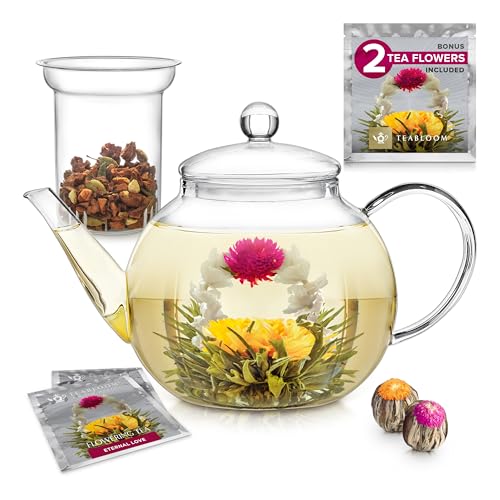
- Built for display: heat-resistant glass, a removable glass infuser, and 2 blooming teas included.
- Stovetop and microwave safe per the maker — the broadest heating claim in this guide.
- Covers loose leaf, bagged, and blooming tea, so one pot serves a mixed household.
Trade-offs
- Glass infuser filtration is coarser than steel mesh; fine-cut teas can shed particles.
- 27 oz serves one or two, not a table.
- Its talents are wasted on drinkers who never brew blooming or whole-leaf teas.
Mini spec box: Capacity 27 oz · Body: heat-resistant glass · Infuser: removable glass · Heating: stovetop and microwave safe per maker listing · Includes: 2 blooming teas.
Teabloom is the specialist in this lineup, and its specialty is the most theatrical corner of tea: the blooming tea, a hand-tied ball of leaves that opens into a flower in hot water. Everything about the Celebration serves that moment — the clear heat-resistant body, the glass infuser that never hides the bloom behind steel mesh, and the two flowering teas in the box so the first brew is the full performance. What elevates it in a general guide is that the specialty does not cost it the basics: the maker rates it for stovetop and microwave heating, and positions it for loose leaf and bagged tea as well, so it works as an ordinary daily pot on the days nobody is performing. At 27 oz it sits in the same versatile band as the Enchanti, and choosing between them is a genuine fork: the Enchanti optimizes the routine, the Teabloom optimizes the ritual. The limitation to know is filtration — fine-cut teas will leave some sediment through a glass infuser — and the audience question: if your tea life is a strong black blend every morning, buy the workhorse. If your tea life includes watching a flower open in glass, there is only one pick in this guide, and it is this one. It is also the natural centerpiece for readers exploring Best Teapots For All Tea, since its maker positions it across tea types.
Best for: blooming-tea fans and households with varied tea habits / Not suited for: fine-cut tea drinkers who want the cleanest possible cup.

CNGLASS Glass Teapot Stovetop Safe, 20.3 oz
Badge: Best Stovetop-Safe Pick
Strengths
- Maker-rated stovetop safe: heats and steeps in one compact 20.3 oz vessel.
- Clear glass with a removable infuser for loose leaf and blooming tea per the maker.
- Small volume heats quickly and the small base is easy to match to a burner.
Trade-offs
- Infuser material is not specified in the listing title, so filtration fineness is unconfirmed.
- 20.3 oz is a hard ceiling of two modest cups.
- Stovetop glass still demands moderate heat and a trivet off the burner.
Mini spec box: Capacity 20.3 oz · Body: clear glass · Infuser: removable · Heating: stovetop safe per maker listing · Teas: loose leaf and blooming per maker listing.
The CNGLASS is the guide’s minimalist: a clear 20.3 oz glass pot, a removable infuser, and a maker’s stovetop-safe rating that lets it heat its own water. In a category full of added mechanisms and themes, its appeal is subtraction — one vessel, one burner, one rinse, and tea. That simplicity lands hardest in small kitchens, studios, and offices, where a separate kettle is not a convenience but a storage problem. The compact size helps its case twice over: 20 oz of water comes to temperature quickly, and a small base is the easiest to match to a burner, which is the main safety variable when glass meets a stove. Its maker’s positioning covers loose leaf and blooming tea, and the clear body serves both. The honest gaps are a listing that does not name its infuser material — fine-cut tea drinkers should check the product page — and a capacity that will never stretch to guests. As an everyday pot for one or two people who value a clear counter, it is the most efficient design here, and the pick most likely to be used twice a day, every day.
Best for: small kitchens and minimalists who want one vessel for heating and steeping / Not suited for: groups, or buyers who need confirmed fine-mesh steel filtration.

DRNKNSTX Enchanted Tea Pot with Tea Infuser, 20 oz
Badge: Best Gift Pick
Strengths
- Enchanted, gift-first design that its maker positions as a present for tea lovers.
- 20 oz is a welcoming starter size — one large mug or two small cups.
- Glass body and infuser steeper cover the loose-leaf essentials with no learning curve.
Trade-offs
- Steeping only; no heating claim in the listing, so the recipient needs a kettle.
- Themed styling will not suit every recipient or kitchen.
- A novelty-led pot may be outgrown by a drinker who turns serious.
Mini spec box: Capacity 20 oz · Body: glass · Infuser: tea infuser / steeper included · Positioning: loose-leaf tea maker and gift for tea lovers (per maker listing).
Not every teapot is bought by its drinker, and the DRNKNSTX Enchanted Tea Pot is designed for the other transaction: the gift. Its maker calls it a magic teapot for loose-leaf diffusers and an ideal gift for tea lovers, and the design follows through — a themed 20 oz glass pot with an infuser that turns a first loose-leaf brew into a small event. The size deserves credit: 20 oz is the least intimidating capacity in this guide, enough for a generous mug, forgiving of a beginner’s dosing, and small enough to live on a desk or a bedside table. The glass shows the leaves unfurling, which is the moment that converts bag drinkers. What a gift buyer must supply is context: the pot steeps rather than heats, so the recipient needs a kettle, and a themed pot is a taste decision you are making for someone else. Choose the recipient who will smile at it, add a bag of good whole-leaf tea, and this becomes the rare kitchen gift that gets used weekly instead of shelved. For your own daily brewing, the plainer picks above are better tools; for starting someone else’s ritual, this is the one.
Best for: gift buyers and new drinkers who enjoy themed design / Not suited for: buyers who need stovetop heating or a plain, professional pot.
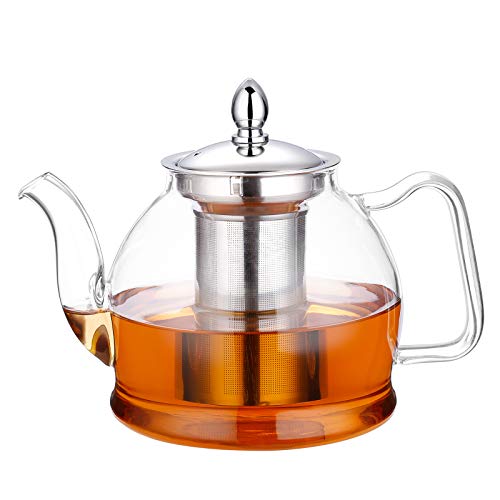
HIWARE Glass Teapot with Removable Infuser, 1000 ml
Badge: Best Family Size
Strengths
- 1000 ml capacity brews for a household in one round — the family size of this guide.
- Maker-rated stovetop safe, so the pot heats its own water at full scale.
- Removable infuser and a set-style presentation suit blooming and loose leaf teas alike.
Trade-offs
- A litre of water in glass is a heavy, two-handed pour for some drinkers.
- Oversized for solo use; small brews in a large pot steep unevenly and cool quickly.
- Needs a burner matched to its larger base for even heating.
Mini spec box: Capacity 1000 ml · Body: glass · Infuser: removable · Heating: stovetop safe per maker listing · Positioning: blooming and loose leaf tea maker set (per maker listing).
The HIWARE is the classic of this lineup: a 1000 ml glass teapot with a removable infuser, sold as a tea maker set for blooming and loose leaf tea, and rated stovetop safe by its maker. A litre is the natural family size — breakfast for three or four, an afternoon pot for two with refills — and the HIWARE’s design makes no attempt to be anything else, which is its virtue. The stovetop rating matters more at this size than any other, because heating a litre in the pot itself eliminates the heaviest transfer in tea making: a full kettle poured into a full pot. The clear body turns a family brew into a shared visual, and blooming teas in a litre of glass are genuinely a table centerpiece. The cautions are scale cautions. A full HIWARE is heavy, and drinkers with smaller hands or wrist issues should test their comfort with a litre pour before committing. Solo drinkers should not buy it aspirationally; a half-filled litre pot is the classic way to make mediocre tea and resent the pot for it. Households that actually gather around tea, though, will find this the most satisfying pot in the guide — and the anchor of the Best Teapots For Boiling Water conversation, since it heats family volumes in the vessel itself.
Best for: families and hosts brewing a full pot at once / Not suited for: solo drinkers or anyone who finds a litre pour unwieldy.

PARACITY Glass Teapot Stovetop, 18.6 oz / 550 ml
Badge: Best for Travel
Strengths
- Positioned by its maker for camping and travel — a compact 18.6 oz / 550 ml borosilicate pot.
- Removable 18/8 stainless steel infuser gives the finest filtration among the small pots here.
- Stovetop positioning suits camp stoves and small burners away from home.
Trade-offs
- Glass travels carefully: it needs padded packing and will never be as rugged as a metal pot.
- 18.6 oz is a one-drinker size, full stop.
- Borosilicate is tougher than ordinary glass, not unbreakable — treat it as glass, not gear.
Mini spec box: Capacity 18.6 oz / 550 ml · Body: borosilicate glass · Infuser: removable 18/8 stainless steel · Positioning: blooming and loose leaf tea brewer for camping and travel (per maker listing).
The PARACITY is the pool’s traveler: an 18.6 oz borosilicate glass teapot with a removable 18/8 stainless steel infuser, positioned by its maker for camping and travel. That positioning makes sense of its spec sheet. Borosilicate is the glass you would choose for a pot that faces variable conditions, the steel infuser filters finely even with the mixed teas people carry on trips, and 550 ml is a personal size that packs into a small kit and brews one proper mug wherever there is hot water — with stovetop positioning that extends to a camp burner used gently. We will be honest about the obvious: glass is not the rugged travel material, and a metal pot will always win a durability contest. The PARACITY’s claim is different — it is for travelers who stay in rentals, cabins, and car camps rather than backpacks, and who refuse to let travel mean bad tea. Packed in padding in a car kit or a cabin bag, it delivers a home-quality brew at the destination, and at home it doubles as a fine solo pot with the best small-pot filtration in this guide. A niche pick, honestly framed, and the right one for its niche.
Best for: car campers, cabin travelers, and solo drinkers who want fine filtration / Not suited for: backpackers or anyone who needs a pot that survives being dropped.
Comparison Table
| Pick | Capacity | Infuser | Heating (per maker) | Best role | Link |
|---|---|---|---|---|---|
| Enchanti One Touch | 27 oz / 800 ml | One-touch infuser | Fill with heated water | Everyday all-rounder | Check on Amazon |
| Teabloom Celebration | 27 oz | Removable glass | Stovetop & microwave safe | Blooming tea | Check on Amazon |
| CNGLASS Glass Teapot | 20.3 oz | Removable infuser | Stovetop safe | Compact one-vessel brewing | Check on Amazon |
| DRNKNSTX Enchanted | 20 oz | Infuser steeper | Fill with heated water | Gifts | Check on Amazon |
| HIWARE Glass Teapot | 1000 ml | Removable infuser | Stovetop safe | Family brewing | Check on Amazon |
| PARACITY Glass Teapot | 18.6 oz / 550 ml | Removable 18/8 steel | Stovetop positioning | Travel and solo | Check on Amazon |
How to Choose a Teapot
Choose in this order: size, infuser, heating, material. Size first, because it is the decision you live with at every brew. Work from your mug — about 12 oz for a standard mug, 16 for a large one — and your usual number of drinkers. One drinker points to 18–20 oz; one or two drinkers to 27 oz; a household to the HIWARE’s 1000 ml. Buying a size up “for guests” is the most common regret in the category, because guests are occasional and your daily brew is daily. Infuser second: fine steel mesh, like the PARACITY’s 18/8 basket, for fine-cut teas and clean cups; a roomy or glass infuser for whole-leaf and blooming teas that need space and visibility; a one-touch mechanism if ending the steep cleanly is your known weakness. Heating third: decide whether the pot must heat its own water — a real need in small or kettle-less kitchens, answered here by the HIWARE, CNGLASS, PARACITY, and Teabloom Celebration per their makers — or whether a kettle already covers that job, in which case the Enchanti and DRNKNSTX compete purely as steepers. Material last, and honestly: this guide’s glass wins on neutrality and visibility, steel wins on toughness and travel, ceramic wins on heat retention and tradition. Pick the order wrong — material first, size as an afterthought — and you get a beautiful pot in the wrong size, which is the most expensive kind of wrong.
Beyond the four headline decisions, three handling details separate pots that feel right from pots that merely look right, and you can judge all three from a product page’s photos and description. The spout should pour in a clean stream that cuts off without dribbling down the pot’s side — dribble is a geometry flaw, not a user error, and it is the single most common daily annoyance in cheap teapots. The lid should sit securely enough to stay put during a pour at full tilt, ideally with a knob that stays cool enough to hold the lid with a fingertip. And the handle should admit your fingers with the pot full, not just empty: a handle that fits a dry hand in a showroom can crowd badly against a hot glass wall when the pot carries a litre of tea. None of the six picks in this guide can be handled by us on your behalf — this is a research-led shortlist — so use the listings’ photos with these three tests in mind before you order, and favor the pot whose spout, lid, and handle look designed rather than decorated.
How to Brew a Proper Pot of Tea
- Heat fresh water — in a kettle, or in a maker-rated stovetop pot on a matched burner at moderate heat. Fresh water, heated once, tastes cleanest.
- Warm the teapot with a splash of the hot water and discard it, so the steep does not lose its heat to cold glass.
- Add leaf to the infuser: start near one teaspoon per 8 oz of water, more for large-leaf teas by volume, and adjust over your first brews rather than all at once.
- Pour at the right temperature — just off the boil for black tea, cooler for green and white teas, which scorch in boiling water.
- Steep with the lid on. Taste near the short end of your tea’s range; you can extend a steep, but you cannot rescue one that ran long.
- Remove the infuser before pouring, pour fully, and serve. Whole-leaf teas will usually give a second, lighter infusion with fresh hot water.
Troubleshooting. Problem: bitter tea → water too hot for the leaf, or the infuser stayed in; shorten the steep and cool the water for delicate teas. Problem: weak tea → too little leaf for the pot’s volume; add leaf, not time. Problem: cloudy tea with particles → your leaf is finer than your infuser; choose a steel-mesh pot like the PARACITY for that blend.
Teapot Materials Compared: Glass, Steel, Ceramic, and Cast Iron
Glass, the material of every pick in this guide, is the analyst’s choice: it adds no flavor, shows the brew’s color and the leaves’ movement, and cleans completely between teas, which matters if one pot serves a morning black and an evening green. Its costs are fragility and heat loss, both manageable at home. Stainless steel is the traveler’s and the clumsy household’s choice — nearly indestructible, heat-retentive, and opaque, so you judge the brew by time and experience rather than by eye. Ceramic holds heat beautifully and carries tradition with it, but hides the brew and can hold flavors in worn glazes. Cast iron retains heat longest of all and suits slow, ceremonial brewing, at the price of real weight. None of these is the best material in the abstract; each is best at a job. The reason glass fills this particular shortlist is that the pool’s verified picks are glass — and for the home drinker who brews a variety of teas and wants to see what they are doing, glass is a genuinely first-choice material rather than a compromise.
Matching Your Teapot to Your Tea
A teapot is never bought in the abstract — it is bought for the two or three teas you actually drink, and those teas have opinions. Black teas are the easiest citizens: they want fully boiled water, a robust steep, and almost any pot in this guide will serve them well, which is why black-tea households should simply buy on size and routine. Green teas are the critics. They scorch in boiling water and turn bitter fast, so they reward a pot whose brew you can watch — glass earns its keep here — and an infuser you can lift the second the color is right. White teas behave like greens, only more so, and drinkers of fine whites often end up valuing the small, precise pots like the PARACITY and CNGLASS over larger vessels.
Whole-leaf oolongs ask for room above all: the leaves expand dramatically, and a cramped infuser strangles the very unfurling that produces their flavor. A roomy basket or a glass infuser in a 27 oz pot suits them best. Blooming teas ask for a stage — clear glass, enough depth, nothing between the flower and the eye — which is the Teabloom Celebration’s entire design brief. Herbal blends and rooibos sit at the filtration extreme: their fine particles pass through wide infuser slots, so a steel-mesh basket is not a preference but a requirement, and the PARACITY’s 18/8 steel infuser is the safest match in this guide. Read your own tea shelf before you read any shortlist, including this one: the best teapot is the one whose infuser and size fit the leaves you own.
One Pot, Many Routines: Desk, Table, and Away
Where a teapot lives shapes which one is best as surely as what it brews. On a desk, the virtues are a small footprint, a pot that empties completely into one mug, and an infuser that lifts out without a dripping expedition — the CNGLASS and PARACITY live naturally here, and the Enchanti’s one-touch ending suits a person whose attention is genuinely elsewhere when the steep finishes. At a family table, the virtues invert: capacity, a confident pour, and a pot that looks like it belongs at the center of things — the HIWARE’s litre of glass, with a blooming tea opening inside it, is the strongest table presence in this guide. Away from home, the virtues are packability and forgiveness: the PARACITY’s borosilicate body and travel positioning suit car-based trips and cabins, while the honest advice for backpacking remains a metal pot, because no glass in this guide pretends to be expedition gear.
The mistake is buying one pot to be all three. A litre family pot on a desk is an obstacle; an 18.6 oz travel pot at a family breakfast is a relay race. Households that genuinely live in two of these worlds do better with two honest pots than one compromised one — a small daily pot and a large gathering pot cover nearly every routine between them, and each will be used at the size it was designed for. That two-pot logic is the quiet conclusion of this whole guide: the best teapots are not a single winner but a matched set of answers, and the six above were chosen so that every common routine finds its answer among them.
How Long a Teapot Should Last, and How to Make Sure Yours Does
A glass teapot’s lifespan is decided by habits, not by the calendar. The pots in this guide will serve for years under a routine that takes their material seriously: warm the pot before the brew rather than shocking cold glass with boiling water, let it cool before a cold rinse, keep it on a shelf where heavy pans cannot clip it, and store the infuser inside the pot so the set is never separated or crushed in a drawer. The most common end for a glass pot is not wear but a single knock at the spout or rim — which is why the humble decision of where the pot lives matters more than any specification on its listing.
Cleaning habits run a close second. Tea film is cosmetic until it is not: a stained pot flavors nothing, but residue dried inside a fine infuser absolutely flavors the next brew, and a one-touch mechanism with old leaf in its joints will eventually move stiffly. The five-minute weekly version of care — a warm soak with a little baking soda, a soft sponge, a thorough rinse, and full drying before storage — keeps every pot in this guide brewing as cleanly in year three as in week one. Treat the pot as a precision tool that happens to be beautiful, and it will repay you in the only currency that matters here: a reliable, repeatable cup.
Heat retention deserves one honest paragraph, because it is the argument most often used against glass and it is mostly a red herring at real-world scales. A steep lasts minutes, and a poured pot is drunk in tens of minutes; across those spans, the difference between a glass pot and a ceramic one is a few degrees by the last cup — noticeable to a careful taster, irrelevant to most breakfasts. Where retention genuinely matters is the long, slow session: a pot expected to sit through an hour of conversation, or a second cup poured long after the first. For those drinkers, a tea cosy over any pot in this guide closes most of the gap for very little money, and pre-warming the pot — step two of the brewing routine above — closes the rest of what is closable. Buy glass for its neutrality and visibility without anxiety; manage temperature with habits, not with material regret.
Common Buying Mistakes
- Buying the wrong size for your household. The daily routine should size the pot; guests can be served a second brew.
- Treating the infuser as an accessory. It is the mechanism that decides your cup. Match its mesh to your leaf before anything else.
- Assuming a glass pot can go on the stove. Only maker-rated pots can. When the listing is silent, the kettle does the heating.
- Judging by looks alone. A display pot you never use loses to a plain pot you use daily — unless display is the point, as with blooming tea.
- Using boiling water for every tea. Green and white teas scorch. Temperature discipline is a skill the pot cannot supply for you.
- Leaving leaf in the pot after pouring. The steep continues in the cup’s absence. Remove the infuser, every time.
Final Recommendation
For most buyers, the Enchanti one-touch teapot is the best teapot in this guide: the most versatile size, the simplest steeping routine, and honest glass construction. Choose the HIWARE if your household brews a litre at a time, the Teabloom Celebration if blooming tea is your ritual, the CNGLASS if you want a compact pot that heats its own water, the PARACITY if you travel or want the finest small-pot filtration, and the DRNKNSTX when the teapot is a gift. Decide your size first and your infuser second, and any of these six will serve you well. One last piece of advice costs nothing: whichever pot you choose, brew in it daily for the first week. A teapot reveals itself across a week of ordinary mornings, not in a single careful ceremony, and the routine you build in that week is the one the pot will serve for years.
Frequently Asked Questions
What is the best size for a teapot?
For one drinker, 18–20 oz. For one or two, 27 oz. For a household brewing together, around 1000 ml. The right size is the one that empties completely into your usual cups — a pot that pours fully dry brews better than a large pot habitually half-filled.
Is glass a good teapot material?
Yes, especially for home use and varied teas. Glass is flavor-neutral, lets you judge strength by color, and rinses fully clean. It needs ordinary handling care, and only glass whose maker rates it for the stovetop should ever meet a burner.
Do I need an infuser in a teapot?
For loose leaf, effectively yes. The infuser is how you stop the steep on time, and stopping on time is the difference between a sweet cup and a bitter one. All six pots in this guide include a removable infuser for exactly that reason.
Can a teapot go on the stove?
Only when the maker rates it for stovetop use. In this guide, the HIWARE, CNGLASS, and PARACITY listings claim stovetop use and the Teabloom Celebration claims stovetop and microwave use; the Enchanti and DRNKNSTX should be filled with water heated in a kettle.
How much tea leaf should I use?
Start with roughly one teaspoon of loose leaf per 8 oz of water and adjust by taste over several brews. Increase leaf for a stronger cup rather than extending the steep, because extra time extracts bitterness faster than it extracts flavor.
How do I keep a glass teapot from staining?
Rinse it warm after every use, empty the infuser while it is still warm, and soak occasionally in warm water with a little baking soda when a film appears. Glass releases tea stains far more easily than ceramic — a soft sponge is all it ever needs, and abrasives should never touch it.
What is the difference between a teapot and a tea kettle?
A kettle heats water; a teapot steeps tea. The two jobs meet in combo pots like the stovetop-rated picks in this guide, which heat and then steep in the same vessel. If your pot makes no heating claim, it is a steeping vessel and a kettle — electric or stovetop — is its necessary partner. Buying the pot first and the heating solution second is the order this guide recommends, because the pot is what shapes the flavor.
Are expensive teapots worth it?
Worth is decided by fit, not by tier. Simpler pots in this guide brew an excellent cup when the size and infuser match your tea; higher tiers buy mechanisms, presentation, and specialty talents like blooming-tea display. A modest pot used daily at the right size will make you happier than a premium pot in the wrong size — spend first on fit, then on refinement, and let your leaf budget grow before your hardware budget does.
Should my first teapot be glass?
For most beginners, yes. Glass teaches: you watch the water color, the leaves expand, and the bloom open, and within a week you have an intuitive sense of steeping that an opaque pot takes months to build. It is also the easiest material to keep flavor-clean while you experiment across tea types. The exception is the rough-and-tumble household or the frequent traveler, where a steel pot’s indifference to knocks outweighs the lesson glass teaches.