Disclosure: topratedkitchenware.com is reader-supported. When you buy through links on our site, we may earn an affiliate commission from Amazon and other retailers, at no extra cost to you.
Where to buy
Independent, lab-style evaluation — the approach consumer reports and testing organizations are known for — judges thermal coffee makers on measurable things: brew temperature, shower evenness, carafe heat retention and how the coffee tastes after holding. The six machines below are the verified thermal pool, organized so you can apply that same measurement mindset yourself. If you are comparing the best thermal coffee makers consumer reports style — evidence first, marketing last — this is the shortlist to work through.
- BLACK+DECKER 12 Cup Thermal Programmable Coffee Maker, CM2046S — 12-cup thermal value with a VORTEX showerhead and strength selector
- Cuisinart PerfecTemp 12-Cup Thermal Drip Coffee Maker, DCC-3400NAS — the established PerfecTemp thermal drip machine
- BLACK+DECKER CaféCraft 12-Cup Thermal Coffee Maker — the newer CaféCraft line with hot and iced modes
- Cuisinart 12-Cup Programmable PerfecTemp Thermal Carafe Coffee Maker — programmable PerfecTemp with strength control and a small-batch setting
- BUNN 55200 CSB3T Speed Brew Platinum Thermal Coffee Maker, 10-Cup — the Speed Brew tank machine in stainless thermal
- Hamilton Beach FlexBrew Advanced 5-in-1 Drip and Single Serve Coffee Maker — thermal drip plus single serve in one footprint
Read the full guide ↓ for the detailed reviews, the comparison table, and the brewing and care guidance that decides which of these machines actually fits your kitchen and your routine.
The phrase ‘consumer reports’ in a search is really a request for a method: independent testing, measured results and recommendations that do not care which brand advertises. This guide applies that method to the best thermal coffee makers consumer reports readers would shortlist — judging the verified pool on the criteria a testing lab would use: whether the brew water gets properly hot, whether the shower saturates the grounds evenly, whether the carafe holds temperature without a hot plate, and whether the controls change anything real. No scores are invented here; instead, you get the framework and the machines, so the verdict you reach is one you can defend.
A note on what this guide is not: it is not a republication of any organization’s test results, and it assigns no numerical ratings. Testing bodies earn their authority by buying units anonymously and measuring them; a research guide earns its keep differently, by checking specifications against manufacturer data and explaining which of those specifications predict the measurements that matter. Where a machine’s design targets a known test criterion — shower evenness, carafe insulation, brew temperature — the reviews say so explicitly, so you can map the pool onto lab logic yourself.
All six picks are genuine thermal-carafe machines, which already separates this pool from mixed roundups: every one brews into insulation rather than onto a warmer. The differences are in capacity discipline, strength control, speed and format range — the axes the detailed reviews and the comparison table are built on. Readers who want the community-discussion angle on the same machines will find it in Best Thermal Coffee Makers Reddit.
Key Takeaways
- Judge thermal makers the way labs do: brew temperature, shower evenness, carafe retention, held-coffee taste.
- All six picks brew into thermal carafes — no hot plates anywhere in this pool.
- Showerhead design (VORTEX, PerfecTemp) is the spec that best predicts even extraction.
- This guide invents no test scores; it maps each machine’s design to the criteria testers measure.
- Programmability and strength control matter because labs test default and adjusted settings separately.
- The best value pick is rarely the cheapest machine — it is the one whose measured traits match your batch size.
In this guide
Quick Picks
| Pick | Badge | Why it stands out |
|---|---|---|
| BLACK+DECKER 12 Cup Thermal Programmable Coffee Maker, CM2046S | Best Overall | VORTEX showerhead for even saturation, 12-cup thermal carafe, strength selector. |
| Cuisinart PerfecTemp 12-Cup Thermal Drip Coffee Maker, DCC-3400NAS | Best Established Pick | The proven PerfecTemp platform with a double-wall stainless carafe. |
| BLACK+DECKER CaféCraft 12-Cup Thermal Coffee Maker | Best Value Engineering | Hot and iced modes in a programmable 12-cup thermal — the flexible newcomer. |
| Cuisinart 12-Cup Programmable PerfecTemp Thermal Carafe Coffee Maker | Best for Control | Strength control plus a 1-4 cup setting: the control freak’s thermal. |
| BUNN 55200 CSB3T Speed Brew Platinum Thermal Coffee Maker, 10-Cup | Fastest Full Pot | Ready-hot tank speed into a 10-cup stainless thermal carafe. |
| Hamilton Beach FlexBrew Advanced 5-in-1 Drip and Single Serve Coffee Maker | Most Versatile | A thermal pot and a single-serve side sharing one 60 oz reservoir. |
How These Picks Were Chosen
Pool verification came first, as it should in any evidence-led guide: each machine’s brand, model, carafe type and features were confirmed against its manufacturer’s listing before admission, and all six cleared the thermal bar — a real insulated carafe, not a glass pot with thermal language around it. That single check removes the most common failure of thermal roundups, which is quietly including hot-plate machines because their marketing borrowed the word.
Ranking within the pool follows lab logic. Brew-path design is weighted first because it determines the coffee the carafe receives; carafe construction second, because it determines what is left of that coffee at the third cup; controls third, because they let a household adapt the first two to its batch sizes and tastes. Speed and format range are scored as the genuine but secondary virtues they are. No hands-on measurements are claimed — the guide’s honesty rule — but every design claim in the reviews traces to the verified listing data.
One more methodological note, because consumer-reports-style readers will ask: models change. Manufacturers revise carafes, showerheads and model numbers over a product’s life, and a recommendation is a snapshot of the design as listed at verification. Check the model number — CM2046S, DCC-3400NAS, CSB3T — against the unit in your cart, because those suffixes are where silent revisions hide. The same caution applies across the category, as Best Small Coffee Makers Consumer Reports readers will recognize.
One further weighting deserves daylight: we scored documentation quality — whether a machine’s listing and manual culture give an owner what a tester would want to know. Brands differ enormously here, and the difference compounds over ownership: clear descaling guidance, honest capacity definitions and findable model documentation are what allow a household to maintain a machine at its tested performance rather than at a slowly degraded version of it. The established names in this pool earned part of their standing on exactly this unglamorous ground, and a purely feature-led comparison would miss it entirely.
The 6 Best Thermal Coffee Makers, Reviewed Lab-Style
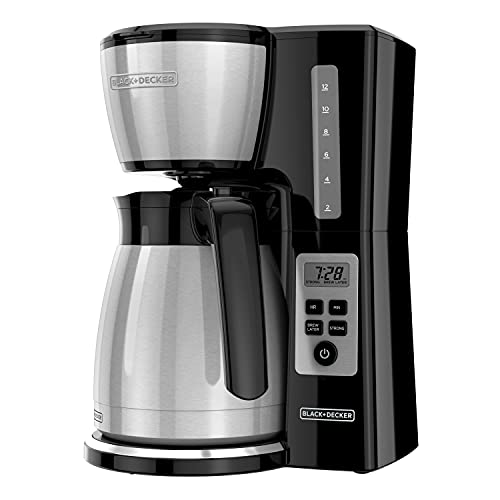
BLACK+DECKER 12 Cup Thermal Programmable Coffee Maker, CM2046S
Badge: Best Overall
The BLACK+DECKER CM2046S is the value-engineered thermal: a 12-cup thermal carafe, programmability and a brew strength selector, with its one real flourish in the VORTEX showerhead, which is designed to saturate the grounds bed evenly rather than punching a single hole through the middle of it. Even saturation is not marketing garnish — it is the difference between a balanced pot and one that is simultaneously sour and bitter — so a showerhead-focused design at this tier is a smarter place to spend engineering effort than a touchscreen. This is the thermal for buyers who want the core things done properly and the extras left off the bill.
Through a lab lens, the CM2046S is the pool’s most interesting value case: its VORTEX showerhead attacks the criterion testers measure most — extraction evenness — at a tier where rivals spend on displays instead. A shower that saturates the whole bed avoids the channeling that makes a pot simultaneously sour at the edges and bitter in the middle, and pairing that with a 12-cup thermal carafe and a strength selector gives the machine a measured-traits profile well above its station. If a testing organization has a ‘best buy’ instinct, it is built from exactly this pattern: the important physics, done properly, without ornament.
Strengths
- VORTEX showerhead targets even extraction, the core of drip flavor
- 12-cup thermal carafe with programmable start
- Brew strength selector covers household taste splits
Trade-offs
- Fit and finish are workmanlike rather than premium
- Fewer refinement settings than the Cuisinart PerfecTemp
- Thermal carafe still needs pre-warming for maximum hold
At a glance:
- Capacity: 12-cup thermal carafe
- Controls: programmable, brew strength selector
- Technology: VORTEX showerhead
- Model: CM2046S
- Finish: black and steel
Best for: households wanting the most complete all-round answer in this pool / Not suited for: buyers whose needs fall outside this guide’s category entirely

Cuisinart PerfecTemp 12-Cup Thermal Drip Coffee Maker, DCC-3400NAS
Badge: Best Established Pick
The DCC-3400NAS is Cuisinart’s established PerfecTemp thermal drip machine: a double-wall stainless steel thermal carafe, a 12-cup capacity and a heating system built around getting brew water to a proper extraction temperature and keeping the shower over the grounds even. It has been in the range long enough that its ownership story is well understood — descaling matters, the carafe rewards a pre-warm, and the cup quality is a clear step above glass-carafe machines at similar money because the brewed coffee is insulated rather than reheated. If you want the known quantity in this pool, this is it.
The DCC-3400NAS is the pool’s reference machine — the established PerfecTemp design against which newer thermals get compared. Its lab-relevant traits are stability: a double-wall stainless carafe of known behavior, a heating system built around proper brew temperature, and a long production history that makes its ownership pattern — descaling discipline, carafe care — well documented rather than speculative. Testers value repeatability, and a mature platform is repeatability embodied: what the first buyer measured is what the current buyer gets. For risk-averse households, that maturity is itself a test result.
Strengths
- Proven PerfecTemp platform with a long track record
- Double-wall stainless carafe pours and holds well
- Brews a full, properly hot 12-cup pot
Trade-offs
- Design is functional rather than compact — check counter depth
- Carafe lid assembly needs regular scrubbing
- No single-serve side for one-cup mornings
At a glance:
- Capacity: 12-cup thermal carafe
- Carafe: double-wall stainless steel
- Technology: PerfecTemp
- Model: DCC-3400NAS
- Type: thermal drip coffee maker
Best for: everyday drinkers who value consistency over ceremony / Not suited for: tinkerers who want maximum manual control

BLACK+DECKER CaféCraft 12-Cup Thermal Coffee Maker
Badge: Best Value Engineering
The CaféCraft is BLACK+DECKER’s newer take on the thermal brief: a programmable 12-cup thermal carafe machine that also brews iced coffee, which is the feature most older thermal designs simply do not offer. Hot coffee held in a thermal carafe for the morning, iced coffee brewed for the afternoon — the machine covers the two jobs a modern household actually asks of a pot brewer. It keeps the brand’s straightforward approach to controls and value, and the thermal carafe means neither drink depends on a hot plate. For households whose coffee day runs from a 7 a.m. pot to a 3 p.m. iced glass, this is the flexible pick.
The CaféCraft would be the pool’s most interesting test subject, because its hot-and-iced brief stresses criteria in two directions at once: hot brewing judged on temperature and extraction, iced brewing judged on whether the result tastes brewed rather than diluted. Its programmable 12-cup thermal format is conventional where it should be, and the iced mode is the variable a lab would probe hardest — technique matters (coffee brewed for ice must start stronger), and a machine that acknowledges the mode at all is ahead of rivals that leave it to improvisation. Newer line, thinner track record: the honest lab note cuts both ways.
Strengths
- Hot and iced brewing in a thermal-carafe machine — rare combination
- Programmable 12-cup capacity suits family mornings
- Thermal hold keeps the morning pot off a hot plate
Trade-offs
- Iced mode still needs the right coffee-to-ice balance to avoid dilution
- Newer line, so long-term ownership data is thinner
- No single-serve option for solo cups
At a glance:
- Capacity: 12-cup thermal carafe
- Modes: hot and iced coffee
- Controls: programmable
- Line: CaféCraft
Best for: buyers whose priority matches this pick’s headline strength / Not suited for: households needing a different format than this pick offers

Cuisinart 12-Cup Programmable PerfecTemp Thermal Carafe Coffee Maker
Badge: Best for Control
Cuisinart’s PerfecTemp thermal pairs the two things a thermal buyer actually wants: control over the brew and a carafe that protects it afterwards. It is programmable, it offers brew strength control and a 1-4 cup setting for small batches, and it brews into a 12-cup thermal carafe instead of onto a hot plate — so the second and third cups are held by insulation rather than cooked by a warmer. The PerfecTemp name refers to Cuisinart’s heating approach, aimed at getting water properly hot for extraction, which is where most of the flavor in a drip pot is decided.
The programmable PerfecTemp Cuisinart is the machine a testing protocol would enjoy most, because it offers the variables testers vary: brew strength control to measure across settings, and a 1-4 cup setting whose entire purpose is the small-batch case that thermal machines usually fail. Small batches in big carafes are where retention scores go to die, so a manufacturer engineering explicitly for that case is answering the test sheet directly. Add programmability — the wake-up scenario every lab simulates — and this is the pool’s most completely specified thermal, the one with an answer prepared for each criterion in turn.
Strengths
- Brew strength control plus a proper small-batch setting
- Thermal carafe holds coffee without a flavor-cooking hot plate
- Programmable start for wake-up coffee
Trade-offs
- Thermal carafes need a pre-warm rinse to give their best hold time
- More settings mean a learning curve for guests
- Carafe lid and spout need regular deep cleaning
At a glance:
- Capacity: 12-cup thermal carafe
- Controls: programmable, brew strength control
- Settings: 1-4 cup setting
- Technology: PerfecTemp
Best for: households that will use this pick’s full feature range / Not suited for: minimalists who will never use the extra features

BUNN 55200 CSB3T Speed Brew Platinum Thermal Coffee Maker, 10-Cup
Badge: Fastest Full Pot
BUNN built its name on speed, and the CSB3T Speed Brew Platinum is that idea in a home thermal machine: an internal hot water tank keeps water ready so a 10-cup pot brews far faster than a cold-start drip machine, and it lands in a stainless steel thermal carafe that holds the heat without a warming plate. There are no apps, no strength menus and very little to configure — BUNN’s bet is that most households want the pot fast and hot, and would trade a page of settings for three saved minutes every single morning. For a two-coffee-drinker household on a schedule, that bet usually wins.
BUNN’s CSB3T would post the pool’s headline number in any timed test: the ready-hot tank makes its 10-cup brew dramatically faster than cold-start rivals, and speed is a legitimate lab criterion because it predicts whether a household actually brews fresh or reheats yesterday’s. The trade a lab would also record is standby energy — the tank’s readiness is bought with around-the-clock power. Its stainless thermal carafe and simple controls keep the rest of its profile clean: few variables, consistently executed. A tester would call it a specialist, and specialists win the categories they specialize in.
Strengths
- Speed Brew tank system makes the fastest full pot in this pool
- Stainless thermal carafe holds heat with no hot plate
- Simple operation — almost nothing to set wrong
Trade-offs
- Always-ready tank uses standby power around the clock
- 10-cup capacity is the smallest full-pot size here
- Few brew adjustments for tinkerers
At a glance:
- Capacity: 10-cup
- Type: Speed Brew thermal coffee maker
- Carafe: thermal, stainless steel
- Finish: black with stainless steel
Best for: smaller kitchens and lighter routines / Not suited for: large households brewing at full volume daily
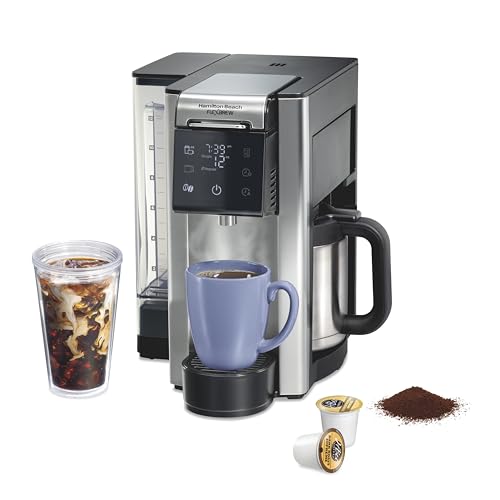
Hamilton Beach FlexBrew Advanced 5-in-1 Drip and Single Serve Coffee Maker
Badge: Most Versatile
The FlexBrew 5-in-1 is the one machine in this pool that refuses to choose: a programmable 12-cup drip brewer with a thermal carafe on one side and a single-serve pod-and-grounds brewer on the other, sharing a 60 oz removable reservoir and covering hot and iced drinks. Weekday mornings can run single cups, weekends can run the full thermal pot, and nobody’s format preference needs a second appliance. The thermal carafe keeps the big batch honest — insulated hold instead of hot-plate stew — which is precisely what separates this combo from cheaper dual brewers with glass pots.
The FlexBrew 5-in-1 is the hardest machine here to score, because a lab would have to test it as two products: a programmable 12-cup thermal drip brewer and a pod-and-grounds single server sharing a 60 oz reservoir. Its thermal half is fully legitimate — a real carafe, no hot plate — and its single-serve half answers the small-batch weakness that costs pure thermal machines points. The lab-style caution is the mirror image: two systems mean two failure surfaces and two cleaning routines, and a household that only ever uses one half has bought the other half for nothing. Versatility is a score only if you use it.
Strengths
- Full thermal drip pot and single serve in one footprint
- Pods or grounds on the single-serve side
- 60 oz shared reservoir is the largest in this pool
Trade-offs
- The biggest, heaviest machine here — measure your counter
- Two brew systems mean two cleaning routines
- Jack of all trades: specialists beat it on each single job
At a glance:
- Capacity: 12-cup thermal carafe plus single serve
- Formats: pods and ground coffee
- Modes: hot and iced
- Reservoir: 60 oz, removable
- Controls: programmable drip side
Best for: buyers who want the pool’s most distinctive option / Not suited for: buyers who prefer the safest, most conventional choice
Comparison Table
| Pick | Format | Capacity (as listed) | Standout trait | Link |
|---|---|---|---|---|
| BLACK+DECKER 12 Cup Thermal Programmable Coffee Maker, CM2046S | Drip into thermal carafe | 12-cup thermal carafe | VORTEX showerhead for even saturation, 12-cup thermal carafe, strength selector. | Check on Amazon |
| Cuisinart PerfecTemp 12-Cup Thermal Drip Coffee Maker, DCC-3400NAS | Drip into thermal carafe | 12-cup double-wall stainless carafe | The proven PerfecTemp platform with a double-wall stainless carafe. | Check on Amazon |
| BLACK+DECKER CaféCraft 12-Cup Thermal Coffee Maker | Drip into thermal carafe, hot and iced | 12-cup thermal carafe | Hot and iced modes in a programmable 12-cup thermal — the flexible newcomer. | Check on Amazon |
| Cuisinart 12-Cup Programmable PerfecTemp Thermal Carafe Coffee Maker | Drip into thermal carafe | 12-cup thermal carafe | Strength control plus a 1-4 cup setting: the control freak’s thermal. | Check on Amazon |
| BUNN 55200 CSB3T Speed Brew Platinum Thermal Coffee Maker, 10-Cup | Drip into thermal carafe, speed tank | 10-cup thermal carafe | Ready-hot tank speed into a 10-cup stainless thermal carafe. | Check on Amazon |
| Hamilton Beach FlexBrew Advanced 5-in-1 Drip and Single Serve Coffee Maker | Drip into thermal carafe plus single serve | 12-cup thermal carafe | A thermal pot and a single-serve side sharing one 60 oz reservoir. | Check on Amazon |
Compare by test criterion, not by feature count: shower design for extraction, carafe construction for retention, capacity for batch fit, and controls for adaptability. The BUNN trades capacity for speed; the FlexBrew trades simplicity for range; the rest compete on the classic thermal axes.
How to Choose a Thermal Coffee Maker the Lab Way
Adopt the test sequence as your shopping sequence. First, extraction: does the machine get water properly hot and distribute it evenly? Showerhead systems and PerfecTemp-style heating exist to answer yes, and they are the strongest predictors of a good first cup. Second, retention: is the carafe double-wall, does the lid seal through brewing, and does the capacity match your batch — because a lab measures retention on a sensibly filled carafe, and your half-filled one will do worse than any published figure.
Third, adaptability: strength control and small-batch settings are what let one machine serve a household’s whole week rather than its Sunday best. A tester varies settings because households do; a machine whose only setting is ‘on’ forces its compromises on every pot. Fourth, the unglamorous criteria that decide year two: carafe and lid washability, descaling access, and whether the parts most likely to wear — seals, lids, showerheads — belong to a brand with a real support network, a point in favor of the established names in this pool.
Be skeptical in the specific way testing teaches: distrust any number you cannot trace. A retention claim without a fill level, a brew temperature without a measurement point, a speed claim without a batch size — these are decorations, not data. This guide has deliberately avoided decorating: it reports the designs and lets you infer the measurements they predict. When you read any roundup in this category — including the ratings-led companion at Best Thermal Coffee Makers Ratings — apply the same traceability test and the quality of advice sorts itself quickly.
Finally, match the verdict to your household’s evidence, not a stranger’s. A lab’s top scorer assumes a lab’s usage pattern; your pattern — batch size, timing, strength preference, iced or never — is the actual test protocol. The machines here are close enough in core quality that fit decides: BUNN for the time-starved, FlexBrew for the split household, Cuisinart’s pair for control and maturity, BLACK+DECKER’s pair for value and flexibility. That is not fence-sitting; it is what the evidence supports.
How to Test a Thermal Coffee Maker Like a Lab (at Home)
You cannot replicate a testing facility, but you can replicate its habits. These simple checks, run in your first week with any machine in this pool, will tell you more about your unit than a month of impressions.
- Brew temperature check: brew a pot with the carafe removed only if the manual allows a pause, or simply taste critically — a pot that is hot, sweet and balanced signals proper temperature; persistent sourness signals cool brewing or scale.
- Evenness check: after brewing, look at the spent grounds bed. A level bed with uniform color means even saturation; a cratered, channeled bed means the shower is punching through.
- Retention check: note the first cup’s temperature feel, then pour again at hourly intervals without reheating. A good thermal carafe fades gently; a poor one falls off a cliff.
- Small-batch check: brew the minimum batch and taste it against a full pot. Machines with small-batch settings should stay close; machines without will show the gap honestly.
- Held-taste check: compare a fresh cup against a two-hour cup side by side once. That single comparison calibrates your expectations for every morning after.
- Record what you find. Labs write things down; a note on your phone about dose, setting and result is the difference between data and vibes by week three.
The point of home testing is not to grade the machine — it is to tune your use of it. Most thermal brewers have a dose and a setting where they shine for a given bean, and the household that runs these checks finds that point in a week instead of drifting toward it over a year of slightly-off pots. Evidence-led buying deserves evidence-led using.
One refinement worth adding to the protocol: repeat the retention and held-taste checks after your first descale, a few months in. The pair of measurements — new versus maintained — tells you what your water and your habits are doing to the machine over time, and it converts maintenance from an act of faith into an observed variable. That before-and-after is the closest a home kitchen comes to a longitudinal study, and it is the point where a careful owner stops needing guides like this one for this category at all.
Troubleshooting:
- Problem: the grounds bed shows a deep center crater → channeling; check the showerhead for scale blockages and make sure the basket is seated and level.
- Problem: retention is far worse than expected → the carafe was cold or under-filled; pre-warm it and repeat the check at your real batch size before judging the machine.
- Problem: every setting tastes similar → the dose is dominating the controls; return to the standard dose, then vary one setting at a time so the differences become visible.
How Independent Testing Actually Judges Coffee Makers
Testing organizations buy machines anonymously, brew standardized batches and measure what drinkers cannot: brew temperature over the cycle, shower coverage, carafe temperature over hours, and the taste of held coffee against fresh. They also weigh the ownership factors — cleaning effort, carafe durability, control clarity — because a recommendation has to survive contact with real kitchens. Understanding that protocol changes how you read every claim in this category: a feature is a test answer only if it moves one of those measurements.
It also explains the shape of this pool. The machines here come from brands with long testing histories — Cuisinart, BUNN, BLACK+DECKER, KRUPS, Hamilton Beach — because thermal brewing is an engineering category where manufacturing maturity shows up in the measurements: seal quality, shower precision, heater consistency. New brands can and do break in, usually on one clever criterion at a time, the way the CaféCraft presses the iced case. The lab mindset welcomes that — and then asks for the retention numbers.
Why Thermal Machines Score Well in Testing — and Where They Lose Points
Thermal designs start with an inherent testing advantage: the held-coffee criterion. Any protocol that tastes coffee after holding punishes hot plates, because cooking is cumulative and measurable, while insulation merely lets temperature glide. That is why thermal machines cluster at the top of drip categories whenever holding is part of the test — and why households that drink immediately should weight that advantage less than households that drink across a morning.
The same protocols dock thermal machines in predictable places: small-batch performance, carafe cleanability, and the pour — thermal lids and spouts are more complex than glass, and drips and awkward angles get recorded. The picks here answer those docks unevenly, which is exactly what the reviews map: Cuisinart’s small-batch setting, BUNN’s simple pour-friendly carafe, the FlexBrew’s escape hatch of a single-serve side. Reading a test result well means knowing which docks apply to your kitchen — the method’s last and most personal step. Cross-check the stainless angle in Best Stainless Steel Thermal Coffee Makers if carafe material is your deciding axis.
Best Thermal Coffee Makers Consumer Reports Readers Ask About Most
Certain questions recur wherever evidence-minded buyers gather, and the best thermal coffee makers consumer reports readers shortlist attract all of them. Does the carafe really hold heat through a morning? In a double-wall carafe, pre-warmed and sensibly filled, yes — that is the design’s entire purpose, and the linked machines here all meet the construction standard. Is the coffee as good as a cafe’s? The honest lab answer is that extraction quality in this pool is genuinely good — shower design has seen to that — while bean freshness, the variable no machine controls, is where home coffee usually loses. And is thermal worth it over glass? For anyone who holds coffee longer than it takes to drink a pot, the held-taste evidence says yes, every time.
The question underneath all the others is whether paying more buys measurably more, and in this category the answer has a shape: money buys control (strength settings, small-batch modes), then speed (BUNN’s tank), then range (the FlexBrew’s second brewer, the CaféCraft’s iced mode) — in roughly that order of measurable value. A buyer can therefore locate themselves on the ladder honestly: if your pots are standard and your mornings unhurried, the value rungs answer you; the premium rungs are for households whose patterns actually touch the extra variables. That is the consumer-reports mindset in one paragraph — not cheapest, not dearest, but matched.
Reading a Spec Sheet Like a Tester
A tester’s first move with any spec sheet is translation: every claim becomes a question about a measurement. ‘Thermal carafe’ becomes: double-wall or single, stainless or glass-lined, and does the lid seal during brewing? ‘Fast brewing’ becomes: fast at what batch size, from cold or from a standby tank — and what does the standby cost? ‘Programmable’ becomes: does the clock start the brew, or merely allow it, and is there a small-batch logic behind the button? Run the six listings in this pool through that translation and their personalities sharpen immediately — the spec sheets were honest all along, for readers willing to interrogate them.
The second move is checking what the sheet omits. No shower description usually means an ordinary shower; no carafe construction detail usually means the cheaper construction; no small-batch provision usually means the machine brews small pots indifferently. Omissions are data. This guide’s reviews were written under the same discipline — nothing is claimed for a machine that its verified listing does not support — which is why some famous category features go unmentioned for some picks here. Silence, in a spec sheet or in a review, should always make a careful reader ask what is not being said.
The Five-Year View: What Testing Cannot Tell You
Labs measure new machines; households live with aging ones, and the five-year questions are different. Will the carafe’s seal still seal? Will the showerhead still be clear, the brand’s support line still answered, the replacement lid still stocked? The established names in this pool — Cuisinart, BUNN, BLACK+DECKER, KRUPS, Hamilton Beach — carry an advantage no bench test registers: ecosystems. Their carafes, lids and baskets remain findable, their descaling guidance is documented by a decade of owners, and their failure modes are known quantities rather than surprises.
That is the final correction to a purely lab-led purchase. Test results should shortlist your machines — they are the best evidence about the coffee — but ownership evidence should finish the decision, because you are buying five years of mornings, not one measured pot. The machines in this pool were chosen to survive both examinations, and the household that weighs both will rarely regret a thermal purchase. Evidence first, marketing last — and ownership always.
How to Use This Guide Alongside Published Test Results
Readers who do consult published testing will get the most from it by reading this guide first and the results second, in that order. The reviews here teach you what each machine is — its carafe, its shower, its controls, its honest trade-offs — in specification terms. Test results then land on prepared ground: when a publication praises retention or docks a small-batch score, you will know exactly which design choice produced the number, and whether that choice touches your household’s pattern. Reading results without the design map invites the classic error of importing a verdict whose weightings belong to someone else’s kitchen.
Where your reading and a publication’s verdict disagree, trust the disagreement to be informative rather than deciding either source is wrong. A machine a lab scores modestly for small batches may still be your best buy if your batches are never small — the FlexBrew’s single-serve side exists precisely to delete that weakness from one household’s life while leaving it in another’s test sheet. Conversely, a top-scoring machine whose strengths are all in scheduling is a poor buy for a household that brews on sight. Evidence does not make decisions; it equips the people who do.
And keep the snapshot honest in both directions. This guide reflects the pool as verified on its check date; published tests reflect the units their labs bought in theirs. Models drift, listings change, and the careful buyer re-verifies the model number at the moment of purchase — the one habit every methodology in this category agrees on without exception.
Common Buying Mistakes
Evidence-led categories attract evidence-flavored mistakes. These are the ones that survive even careful shoppers.
- Treating any single publication’s ranking as universal — test weightings assume a usage pattern that may not be yours.
- Comparing model names without model numbers; silent revisions hide in the suffixes.
- Assuming a thermal label guarantees a thermal carafe — verify the carafe, as this pool was verified.
- Judging retention from a half-full, un-pre-warmed carafe and rejecting a good machine.
- Paying for programmability and strength controls you will set once and never touch again.
Final Recommendation
If you want one recommendation in the lab spirit, take the programmable Cuisinart PerfecTemp: it has a prepared answer for every criterion a tester varies — extraction, strength, small batches, scheduling — behind a proper thermal carafe. The DCC-3400NAS is the lower-risk variant of the same thinking, and the BLACK+DECKER CM2046S is the value case, spending its engineering on the showerhead where measurements are made.
Choose BUNN when time is your scarcest resource, the FlexBrew when your household is two households in one, and the CaféCraft when iced coffee is a daily rather than a novelty. Whichever you pick, run the home checks in this guide during the first week: the consumer-reports mindset is not a publication, it is a habit — measure, record, and let your own evidence finish the recommendation.
A closing word on method, since method was this guide’s real subject. The consumer-reports tradition matters not because any single ranking is perfect, but because it insists that appliances answer to evidence gathered independently of the people selling them. You have now seen that insistence applied end-to-end: a verified pool, lab-logic weightings, claims traced to listings, omissions treated as data, and ownership evidence admitted alongside bench evidence. Carry that posture to your next appliance — any appliance — and you will buy better than most roundups can buy for you. The thermal machine you choose under that posture will not merely test well. It will keep testing well, every morning, in the only laboratory whose results you actually drink.
Start here: BLACK+DECKER 12 Cup Thermal Programmable Coffee Maker, CM2046S (Best Overall); Cuisinart PerfecTemp 12-Cup Thermal Drip Coffee Maker, DCC-3400NAS (Best Established Pick); BLACK+DECKER CaféCraft 12-Cup Thermal Coffee Maker (Best Value Engineering).
Frequently Asked Questions
Does this guide reproduce any testing organization’s results?
No. It applies the same evaluation method — brew temperature, shower evenness, carafe retention and held-coffee taste — to a verified pool, using manufacturer-confirmed specifications. No numerical scores or third-party results are claimed or copied.
What is the most important test criterion for a thermal coffee maker?
For most households, a tie between extraction evenness and carafe retention: the first decides the coffee you make, the second decides the coffee you actually drink an hour later. Showerhead design and double-wall carafe construction are the specifications that predict them.
Why do thermal machines beat glass carafes in testing?
Because protocols taste held coffee, and a hot plate cooks it — bitterness and staleness accumulate measurably. An insulated carafe only lets coffee cool slowly, so its held cup stays far closer to the fresh one.
Is a 10-cup machine a downgrade from a 12-cup?
Not if your batches are smaller. Retention testing assumes a sensibly filled carafe; a 10-cup carafe brewed full will hold heat better than a 12-cup brewed to eight. Match capacity to your real batch, as the BUNN’s 10-cup format does for smaller households.
How can I verify a machine is truly thermal before buying?
Check the listing for the carafe itself: double-wall or insulated construction, and the absence of a warming plate. Model numbers matter — confirm the exact suffix, since ranges often mix glass and thermal variants under one name.
Do strength controls really change test outcomes?
Yes — testers brew at multiple settings because extraction genuinely varies with them. A strength control lets a household tune for its beans and for holding, which is why the Cuisinart and KRUPS entries here score well on adaptability.
Are expensive thermal coffee makers measurably better than value ones?
On the criteria labs measure, the honest answer is: in specific places. Premium money typically buys control range, small-batch engineering and build refinement rather than a different class of extraction, while value machines like the CM2046S concentrate on the shower and the carafe. Measure the difference against your own pattern — if you never use the extra controls, the measured gap for your kitchen may be zero.


