Disclosure: topratedkitchenware.com is reader-supported. When you buy through links on our site, we may earn an affiliate commission from Amazon and other retailers, at no extra cost to you.
Where to buy
Ratings are how most buyers meet thermal coffee makers, so this guide does two jobs: it reviews the verified thermal pool on the merits, and it teaches you to read the best thermal coffee makers ratings like an editor — what the patterns in owner feedback actually signal, and where they mislead. Five machines below are true thermal-carafe brewers and are fully linked; the sixth, a Keurig pod machine with no carafe, is prose-only and clearly marked, because a ratings guide that cannot spot a category mismatch has no business rating anything.
- BLACK+DECKER CaféCraft 12-Cup Thermal Coffee Maker — hot and iced modes over a programmable 12-cup thermal carafe
- Cuisinart 12-Cup Programmable PerfecTemp Thermal Carafe Coffee Maker — PerfecTemp control with strength settings and small-batch mode
- BUNN 55200 CSB3T Speed Brew Platinum Thermal Coffee Maker, 10-Cup — the Speed Brew tank with a stainless thermal carafe
- Hamilton Beach FlexBrew Advanced 5-in-1 Drip and Single Serve Coffee Maker — thermal drip plus single serve in one machine
- KRUPS 12-Cup Programmable Thermal Carafe Coffee Maker — three strengths behind a double-wall thermal carafe
- Keurig K-Express Single Serve Coffee Maker, Black — prose-only: a pod machine with no carafe — see the review
Read the full guide ↓ for the detailed reviews, the comparison table, and the brewing and care guidance that decides which of these machines actually fits your kitchen and your routine.
Every buyer reads ratings; few read them well. A thermal coffee maker’s owner feedback follows patterns — delight about the third cup still tasting fresh, complaints about lids, drips and carafes that need pre-warming — and those patterns are genuinely informative once you know which complaints describe the machine and which describe the category. This guide to the best thermal coffee makers ratings is built on that distinction: the reviews below assess the verified pool on design and specification, while the ratings sections explain how to weigh owner sentiment for exactly these kinds of machines, without inventing a single score.
That restraint is deliberate and worth stating: you will find no star figures or review counts in this article, because printed numbers go stale and because a rating detached from its reasons is decoration. What you will find is more durable — the specific, recurring themes that drive thermal machines’ reputations up or down, mapped to the design choices in this pool, so you can read any listing’s feedback section with x-ray eyes after finishing ours.
The pool itself is strong: five genuine thermal-carafe machines spanning value, speed, control and versatility, plus one prose-only pod machine included so the record is complete and the mismatch is educational. If your shortlist extends beyond it, the method in this guide travels with you — including to the lab-style companion shortlist at Best Thermal Coffee Makers Consumer Reports.
Key Takeaways
- Read ratings for patterns, not averages: recurring themes about lids, retention and drips are the signal.
- Five picks here are true thermal-carafe machines and are linked; the Keurig is prose-only — it has no carafe.
- Thermal machines earn their reputations on held-coffee taste, the trait owners praise most consistently.
- The commonest thermal complaints — lukewarm late cups, tricky lids — are usually technique issues: pre-warm and fill sensibly.
- This guide states no fixed scores or counts; it teaches you to evaluate them where they live, on the listing.
- A machine whose complaints cluster on cleaning is often a better buy than one whose complaints cluster on brew quality.
In this guide
Quick Picks
| Pick | Badge | Why it stands out |
|---|---|---|
| BLACK+DECKER CaféCraft 12-Cup Thermal Coffee Maker | Best Overall | Hot and iced flexibility in a programmable thermal — the pool’s most modern brief. |
| Cuisinart 12-Cup Programmable PerfecTemp Thermal Carafe Coffee Maker | Best for Control | Strength control and a small-batch setting: the adaptable PerfecTemp. |
| BUNN 55200 CSB3T Speed Brew Platinum Thermal Coffee Maker, 10-Cup | Fastest Full Pot | Speed that owners feel every morning, into a stainless thermal carafe. |
| Hamilton Beach FlexBrew Advanced 5-in-1 Drip and Single Serve Coffee Maker | Most Versatile | The pot-and-singles combination that split households rate as freedom. |
| KRUPS 12-Cup Programmable Thermal Carafe Coffee Maker | Best Strength Range | Three strengths and calm European design behind a double-wall carafe. |
| Keurig K-Express Single Serve Coffee Maker, Black | Prose-Only: No Carafe | Prose-only: a well-liked pod machine that is simply not a thermal carafe brewer. |
How These Picks Were Chosen
Verification preceded sentiment, as it must: every pick’s brand, model and carafe type were confirmed against manufacturer listing data, which is how the Keurig’s mismatch was caught and converted to prose-only coverage instead of a misleading link. Within the thermal five, ordering weighs the traits that owner feedback consistently rewards — carafe quality, extraction evenness, strength flexibility — because a ratings guide should explain the reputation, not merely repeat it.
No numerical ratings are reported in this guide, by design and by house rule. Published scores shift constantly, differ by marketplace, and — most importantly — compress hundreds of individual situations into one figure that cannot tell you whether the unhappy owners brewed half-pots into cold carafes. Instead, the reviews identify which design choices generate which kinds of feedback, so your reading of any listing’s reviews becomes diagnostic rather than impressionistic.
This is research-led guidance from verified specifications and category knowledge, not an aggregation of scraped reviews, and it claims no hands-on testing. Where owner behavior is described — pre-warming, descaling, batch sizing — it is the established practice around thermal brewing generally. Readers who want the discussion-forum flavor of owner sentiment, with names attached to opinions, will find it via Best Thermal Coffee Makers Reddit.
One further weighting deserves daylight: we scored how a machine’s design explains its own reputation. The most useful reviews in this guide are the ones where the feedback pattern and the specification point the same way — where BUNN’s speed stories trace to its tank, or the FlexBrew’s polarization traces to its two-half design — because agreement between sentiment and specification is what confidence is made of. Where a category’s praise cannot be traced to any design cause, suspicion is the correct response, and teaching that reflex may be the most durable thing this ratings guide leaves behind.
The 6 Best Thermal Coffee Makers, Reviewed With a Ratings Eye

BLACK+DECKER CaféCraft 12-Cup Thermal Coffee Maker
Badge: Best Overall
The CaféCraft is BLACK+DECKER’s newer take on the thermal brief: a programmable 12-cup thermal carafe machine that also brews iced coffee, which is the feature most older thermal designs simply do not offer. Hot coffee held in a thermal carafe for the morning, iced coffee brewed for the afternoon — the machine covers the two jobs a modern household actually asks of a pot brewer. It keeps the brand’s straightforward approach to controls and value, and the thermal carafe means neither drink depends on a hot plate. For households whose coffee day runs from a 7 a.m. pot to a 3 p.m. iced glass, this is the flexible pick.
The CaféCraft’s reputation will be built on its brief: it is the thermal machine for households whose coffee day has two seasons. Owner sentiment for hot-and-iced thermals tends to split exactly along the iced line — drinkers who use the mode call the machine indispensable, drinkers who do not call it over-featured — so read its feedback by filtering for your own pattern. On the hot side its programmable 12-cup thermal format is orthodox and sound; on the iced side, success depends on brewing strong over ice, and the reviews that complain about weak iced coffee usually confess the technique in the same paragraph. Judge it as two machines and it rates itself.
Strengths
- Hot and iced brewing in a thermal-carafe machine — rare combination
- Programmable 12-cup capacity suits family mornings
- Thermal hold keeps the morning pot off a hot plate
Trade-offs
- Iced mode still needs the right coffee-to-ice balance to avoid dilution
- Newer line, so long-term ownership data is thinner
- No single-serve option for solo cups
At a glance:
- Capacity: 12-cup thermal carafe
- Modes: hot and iced coffee
- Controls: programmable
- Line: CaféCraft
Best for: households wanting the most complete all-round answer in this pool / Not suited for: buyers whose needs fall outside this guide’s category entirely

Cuisinart 12-Cup Programmable PerfecTemp Thermal Carafe Coffee Maker
Badge: Best for Control
Cuisinart’s PerfecTemp thermal pairs the two things a thermal buyer actually wants: control over the brew and a carafe that protects it afterwards. It is programmable, it offers brew strength control and a 1-4 cup setting for small batches, and it brews into a 12-cup thermal carafe instead of onto a hot plate — so the second and third cups are held by insulation rather than cooked by a warmer. The PerfecTemp name refers to Cuisinart’s heating approach, aimed at getting water properly hot for extraction, which is where most of the flavor in a drip pot is decided.
Cuisinart’s programmable PerfecTemp is the kind of machine whose feedback clusters on control: owners who use the strength settings and the 1-4 cup mode tend to be the satisfied core, because those features answer the two situations — taste splits and small mornings — that generate complaints for lesser thermals. The ratings lesson generalizes: for feature-rich machines, satisfaction correlates with feature use, so the question is never ‘is it good’ but ‘will I touch the controls’. If your household brews one way every day, this machine’s adaptability is wasted money; if your week varies, it is the pool’s most defensible premium.
Strengths
- Brew strength control plus a proper small-batch setting
- Thermal carafe holds coffee without a flavor-cooking hot plate
- Programmable start for wake-up coffee
Trade-offs
- Thermal carafes need a pre-warm rinse to give their best hold time
- More settings mean a learning curve for guests
- Carafe lid and spout need regular deep cleaning
At a glance:
- Capacity: 12-cup thermal carafe
- Controls: programmable, brew strength control
- Settings: 1-4 cup setting
- Technology: PerfecTemp
Best for: everyday drinkers who value consistency over ceremony / Not suited for: tinkerers who want maximum manual control

BUNN 55200 CSB3T Speed Brew Platinum Thermal Coffee Maker, 10-Cup
Badge: Fastest Full Pot
BUNN built its name on speed, and the CSB3T Speed Brew Platinum is that idea in a home thermal machine: an internal hot water tank keeps water ready so a 10-cup pot brews far faster than a cold-start drip machine, and it lands in a stainless steel thermal carafe that holds the heat without a warming plate. There are no apps, no strength menus and very little to configure — BUNN’s bet is that most households want the pot fast and hot, and would trade a page of settings for three saved minutes every single morning. For a two-coffee-drinker household on a schedule, that bet usually wins.
BUNN’s feedback pattern is the most predictable in the pool: speed converts people. Owners of tank machines talk about time the way other owners talk about taste, because a pot that arrives in a fraction of the usual wait changes the morning’s emotional arithmetic. The counter-theme is equally consistent — standby energy and a 10-cup ceiling — and both themes are visible in the design before purchase, which is the mark of an honest product: its ratings argue about values, not about surprises. If your household’s scarcest resource is minutes, the CSB3T’s reputation is earned in the only currency that matters to you.
Strengths
- Speed Brew tank system makes the fastest full pot in this pool
- Stainless thermal carafe holds heat with no hot plate
- Simple operation — almost nothing to set wrong
Trade-offs
- Always-ready tank uses standby power around the clock
- 10-cup capacity is the smallest full-pot size here
- Few brew adjustments for tinkerers
At a glance:
- Capacity: 10-cup
- Type: Speed Brew thermal coffee maker
- Carafe: thermal, stainless steel
- Finish: black with stainless steel
Best for: buyers whose priority matches this pick’s headline strength / Not suited for: households needing a different format than this pick offers
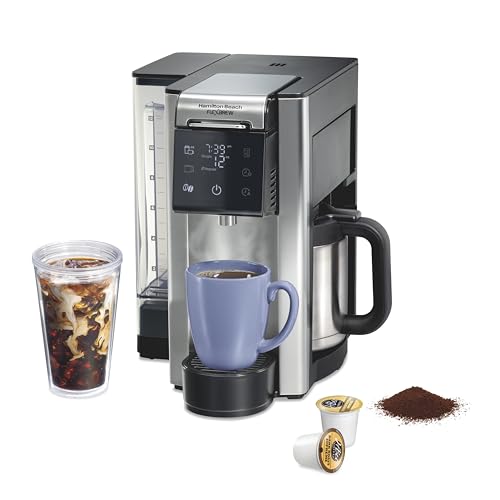
Hamilton Beach FlexBrew Advanced 5-in-1 Drip and Single Serve Coffee Maker
Badge: Most Versatile
The FlexBrew 5-in-1 is the one machine in this pool that refuses to choose: a programmable 12-cup drip brewer with a thermal carafe on one side and a single-serve pod-and-grounds brewer on the other, sharing a 60 oz removable reservoir and covering hot and iced drinks. Weekday mornings can run single cups, weekends can run the full thermal pot, and nobody’s format preference needs a second appliance. The thermal carafe keeps the big batch honest — insulated hold instead of hot-plate stew — which is precisely what separates this combo from cheaper dual brewers with glass pots.
The FlexBrew 5-in-1 collects the most polarized feedback shape in the pool, and it is structural: households that use both halves rate the machine as liberation — one footprint, every format, a thermal pot for the morning and singles for the desk hours — while households that settle into one half rate it as bulk. Both are right, which is why this review refuses a simple verdict: the machine’s rating is a function of your household’s split, knowable in advance. Ask the two-halves question honestly before buying, and you will land on the correct side of its polarized reputation every time.
Strengths
- Full thermal drip pot and single serve in one footprint
- Pods or grounds on the single-serve side
- 60 oz shared reservoir is the largest in this pool
Trade-offs
- The biggest, heaviest machine here — measure your counter
- Two brew systems mean two cleaning routines
- Jack of all trades: specialists beat it on each single job
At a glance:
- Capacity: 12-cup thermal carafe plus single serve
- Formats: pods and ground coffee
- Modes: hot and iced
- Reservoir: 60 oz, removable
- Controls: programmable drip side
Best for: households that will use this pick’s full feature range / Not suited for: minimalists who will never use the extra features

KRUPS 12-Cup Programmable Thermal Carafe Coffee Maker
Badge: Best Strength Range
The KRUPS thermal is the quiet European answer in this pool: a 12-cup double-wall thermal carafe, 24-hour programmability and three brew strengths, without the spec-sheet shouting of its rivals. Three strength settings is a genuinely useful spread — mild for the afternoon pot, strong for the Monday pot — and the double-wall carafe holds the result by insulation alone. KRUPS machines tend to be bought by people who keep appliances a long time, and the design reflects it: straightforward controls, a carafe that pours cleanly, and nothing on the front panel that exists only to look advanced.
KRUPS’s thermal tends to attract the quietest, steadiest feedback in any pool it joins: three strengths, 24-hour programming, a double-wall carafe and no theatrics. Machines like this rarely top excitement rankings and rarely generate horror stories either — their ratings accumulate from owners who wanted a pot brewed properly and held properly, and got exactly that for years. The lesson for ratings readers is to value the boring middle: a machine with few complaints about fundamentals and mild complaints about cosmetics is usually the soundest purchase in its category, and the KRUPS is this pool’s exemplar of that profile.
Strengths
- Three brew strengths cover the widest taste range in this pool
- Double-wall thermal carafe for plate-free holding
- 24-hour programming for scheduled mornings
Trade-offs
- Fewer small-batch aids than the Cuisinart entries
- Thermal carafe benefits from pre-warming on cold mornings
- Brand support network is thinner in the US than Cuisinart or BUNN
At a glance:
- Capacity: 12-cup thermal carafe
- Controls: 24-hour programmable, 3 brew strengths
- Carafe: double-wall thermal
- Strengths: 3 settings
Best for: smaller kitchens and lighter routines / Not suited for: large households brewing at full volume daily
Keurig K-Express Single Serve Coffee Maker, Black
Badge: Prose-Only: No Carafe
The black K-Express is the straightforward family-counter Keurig: three brew sizes, a 42 oz removable reservoir so one fill covers several cups, a Strong Brew button that slows the water contact for a bolder cup, and a drip tray that comes off so a travel mug fits under the spout. It makes no attempt to be a prosumer machine — there are no temperature dials and no app — but that simplicity is exactly its operating system: pod in, button pressed, coffee out, the same way every single time. For households where several people drink different roasts, that repeatability matters more than adjustability.
The black K-Express closes the list prose-only, and its presence is the guide’s final ratings lesson. As a single-serve pod machine it is a perfectly respectable product that many owners enjoy — but in a thermal carafe shortlist it is a category error, and category errors are how bad purchases happen despite good ratings: a highly rated machine of the wrong type is still the wrong machine. It carries no links and no image here, because this guide’s subject is carafes that hold pots — and a buyer whose real need is single cups should take the hint and shop single-serve shortlists, where this machine’s reservoir and Strong Brew button are virtues. Readers set on silent mornings might start with Best Thermal Coffee Makers With No Beeping for the thermal side of that niche.
Strengths
- 42 oz reservoir means several cups between refills
- Strong Brew button gives a real, noticeable strength option
- Removable tray fits travel mugs for commute mornings
Trade-offs
- Pod-only brewing unless you add a reusable filter accessory
- No temperature or timing controls to fine-tune extraction
- Single cup at a time — queues form in busy kitchens
At a glance:
- Brew sizes: 3
- Reservoir: 42 oz, removable
- Features: Strong Brew button, travel mug friendly
- Pods: works with all K-Cup pods
Best for: buyers who want the pool’s most distinctive option / Not suited for: buyers who prefer the safest, most conventional choice
Comparison Table
| Pick | Format | Capacity (as listed) | Standout trait | Link |
|---|---|---|---|---|
| BLACK+DECKER CaféCraft 12-Cup Thermal Coffee Maker | Drip into thermal carafe, hot and iced | 12-cup thermal carafe | Hot and iced flexibility in a programmable thermal — the pool’s most modern brief. | Check on Amazon |
| Cuisinart 12-Cup Programmable PerfecTemp Thermal Carafe Coffee Maker | Drip into thermal carafe | 12-cup thermal carafe | Strength control and a small-batch setting: the adaptable PerfecTemp. | Check on Amazon |
| BUNN 55200 CSB3T Speed Brew Platinum Thermal Coffee Maker, 10-Cup | Drip into thermal carafe, speed tank | 10-cup thermal carafe | Speed that owners feel every morning, into a stainless thermal carafe. | Check on Amazon |
| Hamilton Beach FlexBrew Advanced 5-in-1 Drip and Single Serve Coffee Maker | Drip into thermal carafe plus single serve | 12-cup thermal carafe | The pot-and-singles combination that split households rate as freedom. | Check on Amazon |
| KRUPS 12-Cup Programmable Thermal Carafe Coffee Maker | Drip into thermal carafe | 12-cup double-wall thermal carafe | Three strengths and calm European design behind a double-wall carafe. | Check on Amazon |
| Keurig K-Express Single Serve Coffee Maker, Black | K-Cup pod, no carafe | 42 oz reservoir | Prose-only: a well-liked pod machine that is simply not a thermal carafe brewer. | Prose-only review above |
No scores appear in this table, deliberately: compare the designs, then read live owner feedback for the two or three finalists with the pattern-reading method from this guide. The Keurig row is context only — a different category wearing this pool’s clothes, included so that no part of the verified pool goes unaccounted for in this guide.
How to Choose a Thermal Coffee Maker Using Ratings Wisely
Use ratings as a funnel, not a verdict. First pass: eliminate machines whose recurring complaints touch fundamentals — weak brewing, failed carafes, leaks — because those describe the product. Second pass: discount complaints that describe the category or the user’s technique; ‘coffee got cooler after hours’ about a thermal carafe usually means a cold start and a half batch, and ‘lid is fiddly’ appears under every thermal ever made. What survives that filtering is the machine’s true reputation, and it is remarkably consistent across marketplaces.
Weight recent and relevant feedback. Designs get silently revised, so older praise may describe a different carafe; and an owner’s situation may not be yours — a five-person household’s retention complaint says little to a two-person household that brews full and drinks promptly. The most useful reviews are the specific ones: batch size, setting, timing, bean. A short, specific complaint teaches more than a long, emotional rave, and teaching yourself to skim for specifics is the core skill this keyword is really about.
Then let specifications arbitrate the finalists. When two machines’ reputations are similarly warm, the one whose design answers your pattern wins: strength range for split-taste homes (KRUPS, Cuisinart), speed for scheduled homes (BUNN), format range for split-format homes (FlexBrew), iced range for two-season homes (CaféCraft). Ratings tell you a machine keeps its promises; only the spec sheet tells you whether its promises are the ones you need kept. The stainless-carafe axis is explored further in Best Stainless Steel Thermal Coffee Makers.
A last caution about chasing the top of any chart: the highest-rated machine in a category is often the one with the narrowest, happiest niche, while the broadly suitable machine carries a broader, slightly cooler consensus. Households are not niches — they are coalitions of drinkers — so a machine like the programmable Cuisinart, engineered to satisfy several patterns at once, can be the right buy even when a specialist out-scores it. Read for fit, and the numbers become what they should be: a servant, not a master.
How to Read Coffee Maker Ratings Like an Editor
This five-step pass takes ten minutes on any listing and will outperform an hour of star-staring. It is the method behind this guide’s reviews, offered so you can apply it to machines beyond this pool.
- Sort feedback by recency first and skim the newest stretch: has anything changed — a revised carafe, a new complaint pattern, a quiet improvement?
- Hunt for repeated specifics: the same lid, drip, retention or strength detail mentioned by unconnected owners is a fact about the machine.
- Translate complaints before weighing them: separate ‘the machine failed at its job’ from ‘the job was misunderstood’ — cold carafe, half batch, wrong category.
- Check the praise for your pattern: are the happy owners brewing your batch size, your strength, your schedule? Their verdict transfers; others’ may not.
- Verify the variant: confirm the model number in the reviews matches the model in your cart, because thermal and glass variants often share one listing’s reputation.
- Decide from the pattern, then stop reading. Ratings have diminishing returns; past the pattern, more reviews mostly add anxiety, not information.
Notice what this method never does: it never averages feelings into a number and obeys it. Editors read for evidence, and the evidence in owner feedback is real — it is just encoded in stories rather than scores. A buyer who learns to decode it owns an advantage that no chart can give them, on this category and every other one in the kitchen.
One refinement to the method: rerun it on your own purchase after a month of ownership. Read your machine’s newest feedback with your experience fresh, and notice which patterns you can now confirm, which you can explain, and which have simply never appeared in your kitchen. That closing of the loop — from stranger’s pattern to personal evidence — is the moment ratings literacy becomes judgment, and it will serve you in every category long after this particular carafe has been chosen.
Troubleshooting:
- Problem: two finalists have near-identical reputations → stop reading reviews and arbitrate by specification: carafe capacity against your batch, strength range against your household’s tastes.
- Problem: a machine you like has a cluster of lukewarm complaints → check whether the complainants pre-warm or brew full; if the pattern is technique, the machine is fine and the lesson is free.
- Problem: glowing feedback but all of it old → the design may have been revised; weight the newest stretch of reviews and verify the current model number before buying.
What Owner Ratings Reveal About Thermal Carafes Specifically
Thermal feedback has a signature shape. The praise concentrates on one experience — the later cup that still tastes like coffee — described with unusual emotion, because it contradicts years of hot-plate disappointment. The complaints concentrate on the carafe as an object: lids that pour awkwardly, spouts that dribble, interiors that hold yesterday’s flavor. Almost nothing in thermal feedback concerns electronics, because there is little to fail — which is itself a finding: this category’s longevity reputation is structural, not lucky.
Read with that shape in mind and the pool sorts quickly. Machines whose feedback argues about lids and pours (an ergonomic argument) are fundamentally sound; machines whose feedback argues about temperature and taste (a brewing argument) deserve suspicion. In this pool, the established designs — Cuisinart, BUNN, KRUPS — carry the ergonomic argument, while the newer and combo designs add format questions on top. None of that requires a single star to interpret, which is rather the point of this guide.
Ratings, Lab Tests and Your Kitchen: Triangulating the Truth
Owner ratings and lab tests are two instruments measuring different things: ratings capture satisfaction across thousands of uncontrolled kitchens, tests capture performance in one controlled one. The wise buyer triangulates — using tests for the physics (temperature, evenness, retention) and ratings for the living-with-it (lids, cleaning, reliability over years). A machine strong on both instruments, like the established thermals in this pool, is as close to a sure thing as appliances get.
Where the instruments disagree, ask why before choosing a side. A lab favorite with grumbling owners often has an ownership friction the bench cannot feel; an owner favorite with modest measurements often has a routine virtue — speed, simplicity — that benches undervalue. The BUNN in this pool is the classic second case: its numbers are good, but its reputation is better, because minutes saved compound in a way no single measurement captures. Triangulation is not indecision; it is how adults buy machines.
Best Thermal Coffee Makers Ratings: How to Spot a Pattern Worth Trusting
Not all patterns in the best thermal coffee makers ratings deserve equal trust, and learning the difference is a transferable skill. A trustworthy pattern is specific, repeated and independent: unconnected owners, across months, describing the same concrete behavior — a lid that pours cleanly, a carafe still hot at the third hour, a strength setting that visibly changes the cup. An untrustworthy pattern is vague and synchronized: bursts of similar superlatives, complaints that could belong to any product, praise that names features the machine does not have. The first kind is the crowd doing measurement by accident; the second is noise wearing the crowd’s clothes.
Apply that test to this pool and the reputations sort themselves with unusual clarity. The Cuisinart entries attract the specific pattern — settings named, batch sizes mentioned, mornings described. The BUNN attracts it too, in the vocabulary of time. The combo and newcomer machines attract a mixture, which is normal for designs still accumulating their ownership history, and the correct response is not suspicion but weighting: trust the specific, discount the vague, and let the specification arbitrate what remains. That is the entire method of this guide, and it works on any listing you will ever open.
Why Thermal Machines Rarely Crash in Reputation
Some categories are reputation roller-coasters — brilliant launches, reliability cliffs, abandoned apps. Thermal drip brewing is the opposite: a mature technology with few moving frontiers, where this year’s machines differ from last decade’s in refinement rather than in kind. That maturity shows in the feedback shape: complaints age slowly, praise stays relevant for years, and a well-chosen thermal’s reputation at purchase is a fair preview of its reputation at disposal. Buyers exhausted by categories that reinvent themselves annually often land here with relief.
The stability has a mechanical root. A thermal brewer is a heater, a shower, a basket and an insulated vessel; there is little to obsolesce and less to break in novel ways. Its enemies are the old ones — scale, oils, seals — and all three are managed by the owner rather than suffered by them. When you read thermal feedback, you are therefore reading something close to a pure signal about design quality, uncontaminated by software lifecycles. Few categories offer a ratings reader that courtesy, and it is worth pausing to appreciate it before the next purchase in a noisier aisle.
From Ratings to a Decision: A Worked Example
Watch the method work on a typical split household. Ratings first: the FlexBrew’s polarized pattern says the machine delights dual-format homes and burdens single-format ones — so the household asks itself the two-halves question and answers honestly that weekends are pots and weekdays are singles. Pattern confirmed as relevant. Translation next: the ‘bulky’ complaints describe counter space, which the household measures and accepts. Specification last: the 60 oz reservoir, the thermal carafe and the programmable drip side match the household’s stated pattern point for point. Decision made — without a single average ever being obeyed.
Run the same household past the BUNN and the method shows its other face: the speed pattern is glowing and specific, but the household’s mornings are unhurried, so the pattern, while trustworthy, is irrelevant; the 10-cup ceiling, meanwhile, collides with their weekend pots. A great machine, correctly declined. That is what ratings literacy actually buys — not better machines, but better matches — and it is available to any buyer willing to read patterns instead of worshipping numbers. Your household’s worked example will differ in every detail and follow the same three steps.
A Note on Review Cultures: Marketplaces, Forums and Friends
Ratings live in cultures, and each culture colors what it reports. Marketplace reviews skew toward the transactional — delivery, first impressions, early failures — because they are written at the start of ownership. Forum discussions skew toward the technical and the long-term, because their writers stayed to talk. Friends and family skew toward the diplomatic. The same Cuisinart can therefore wear three different reputations in three different rooms, all of them honestly earned. The ratings-literate buyer samples across cultures deliberately: marketplace patterns for early failure modes, forums for year-three behavior, and this guide’s design analysis to explain why both say what they say.
Thermal machines benefit from that cross-sampling more than most, because their ownership story is long and their early story is short — there is little to unbox-review beyond a first pot, while the carafe’s real verdict arrives across a winter of mornings. Weight the cultures accordingly: a thermal with modest early buzz and warm long-term forum regard is showing you its true shape, and the reverse pattern — launch excitement, cooling forums — is the one to interrogate. Time is the ingredient ratings cannot fake, and in this category time is also, not coincidentally, the thing the product itself is built to manage.
Friends deserve a final word, because their advice is the most trusted and the least transferable. A friend’s beloved BUNN is beloved inside a schedule, a household size and a taste that may share nothing with yours. Accept the data point — the machine kept its promises to someone — and decline the conclusion until your own pattern confirms it. That courtesy, extended in both directions, is what ratings were always supposed to be: other people’s experience, offered as evidence, awaiting your verdict.
Common Buying Mistakes
Ratings-driven buying fails in ways that have nothing to do with the machines. These are the errors this guide was written to retire.
- Obeying an average score without reading a single review — the pattern is the information, not the number.
- Buying a highly rated machine of the wrong category, as the prose-only Keurig in this pool demonstrates.
- Weighting the loudest reviews — extreme experiences are overrepresented in every feedback pool.
- Ignoring variant drift: praising or blaming a model for a different model’s carafe.
- Reading ratings once, at purchase, and never again — your own first-week experience is also data; use the return window if the pattern you read appears in your kitchen.
Final Recommendation
For a single recommendation that respects both instruments: the programmable Cuisinart PerfecTemp, whose design answers the lab criteria and whose feature set answers the owner patterns — strength for the taste split, small-batch mode for the quiet mornings, a proper carafe for the long ones. The KRUPS is the calm alternative, the BUNN the sprinter, the FlexBrew the coalition government, and the CaféCraft the two-season modernizer.
And take the method with you: verify the category, read for patterns, translate the complaints, arbitrate by specification. Do that, and the best thermal coffee makers ratings stop being weather you endure and become what they always should have been — evidence you use. The Keurig stays prose-only as the standing reminder: the first rating that matters is whether the machine is the right kind of machine at all.
A closing word on trust, since ratings are finally about nothing else. Every source in this category wants something: marketplaces want transactions, brands want loyalty, publications want authority, and this guide wants you to finish it more skeptical and better equipped than you started. Judge each by whether its incentives survive contact with your kitchen. The thermal machines reviewed here have survived years of that contact in thousands of kitchens, and their patterns — specific, repeated, independent — are as trustworthy as consumer evidence gets. Read them well, match them to your own pattern, and then do the most ratings-literate thing of all: brew, taste, and let your own morning cast the deciding vote.
Start here: BLACK+DECKER CaféCraft 12-Cup Thermal Coffee Maker (Best Overall); Cuisinart 12-Cup Programmable PerfecTemp Thermal Carafe Coffee Maker (Best for Control); BUNN 55200 CSB3T Speed Brew Platinum Thermal Coffee Maker, 10-Cup (Fastest Full Pot).
Frequently Asked Questions
Why does this guide contain no star ratings or review counts?
Because fixed numbers go stale, differ between marketplaces and hide the reasons that make them useful. Instead, the guide identifies the recurring themes that drive thermal machines’ reputations and maps them to each design, so you can evaluate live ratings on any listing with better judgment.
How should I read owner reviews for a thermal carafe machine?
Look for repeated specifics rather than averages: mentions of retention, lid and pour behavior, and cleaning tell you about the machine; complaints about lukewarm coffee often trace to cold carafes and half batches, which are technique, not defects.
Are highly rated machines always the best choice?
No — a top rating can reflect a narrow, delighted niche rather than broad suitability, and a highly rated machine of the wrong category is still wrong. Match the machine’s promises to your household’s pattern first, then let ratings confirm it keeps those promises.
Why is a Keurig included if it has no thermal carafe?
It arrived with the verified pool, so it is reviewed transparently as prose-only context — and as a useful lesson that category fit comes before reputation. It carries no purchase links in this guide.
What complaints about thermal carafes should I take seriously?
Leaks, failed seals, carafes that lose heat quickly even when full and pre-warmed, and brew-quality problems like weak or uneven extraction. Drips, lid quirks and the need to pre-warm are near-universal category traits rather than individual red flags.
Do ratings change over a model’s life?
Yes — manufacturers revise components silently, and a model’s feedback mixes production runs. Weight recent reviews more heavily and confirm the exact model number, since a suffix often marks the revision.
Should I wait for a newer model with better ratings?
Rarely, in this category. Thermal drip design is mature, so newer usually means restyled or re-featured rather than fundamentally better, and an established model carries the advantage of a long, readable track record. Buy the machine whose pattern fits now; the carafe you need this winter will not be improved by next year’s suffix.


