Disclosure: topratedkitchenware.com is reader-supported. When you buy through links on our site, we may earn an affiliate commission from Amazon and other retailers, at no extra cost to you.
Where to buy
This guide answers the search for best toasters consumer reports in the only honest way available to us: by explaining how laboratory-style consumer testing actually evaluates toasters, and then applying those published criteria to a verified shortlist. One boundary must be stated before anything else. This site is not Consumer Reports, we do not have access to that organisation’s test results for these models, and no pick below is described as tested, scored, rated, or recommended by them, because inventing such a claim would be a fabrication. What we can do, and what this page does thoroughly, is teach you the criteria that serious test programmes use, evenness, consistency, speed, ease of use, and safety, show you how much of each criterion can be judged from a product’s verified specification, and be explicit about the part that only a laboratory can settle. The six picks are verified through Amazon’s Creators API data, every specification comes from the product’s own title, and our links go to the Amazon listings so you can check the latest price and full specification for the exact model.
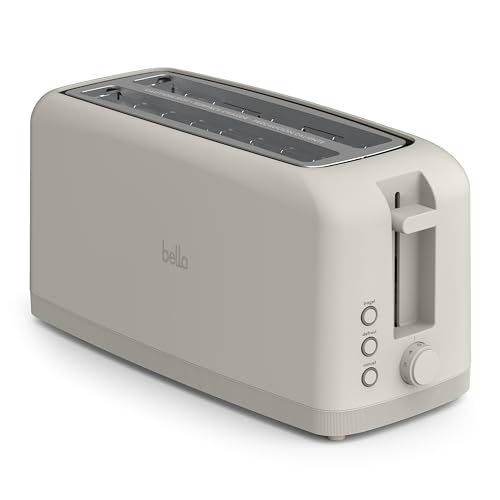
- bella Fits-Anywhere Slim Toaster, 4 Slice Extra Long & Wide Slot, Oatmilk
- BLACK+DECKER 2-Slice Toaster with Extra-Wide Slots
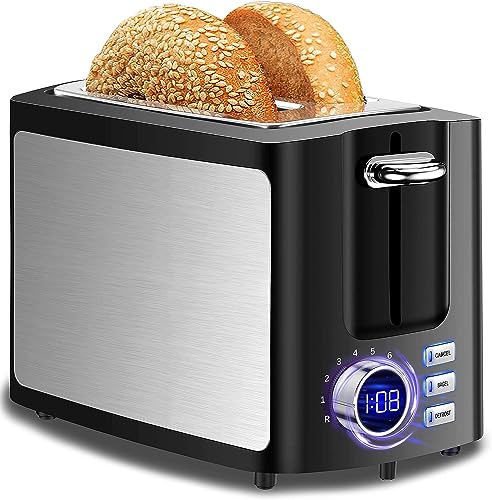
- Hommater 2 Slice Wide Slot Smart Toaster with LCD Countdown
- Amazon Basics 2 Slice Toaster, 900W, Black & Silver
- Elite Gourmet 2-Slice Cool-Touch Toaster, ECT1027B
- Hamilton Beach Extra-Wide Slot 2 Slice Toaster, 22634
Read the full guide ↓ for the test-criteria briefing, the per-model reviews judged against those criteria as far as specifications allow, and a clear account of what no specification can tell you.
Shoppers type best toasters consumer reports because they want an authority to end the argument. Laboratory consumer testing earns that authority in a specific way: it buys products at retail rather than accepting samples, it runs the same breads through the same cycles under the same conditions, it measures outcomes instead of collecting impressions, and it publishes a method other people can inspect. A toaster programme typically scores how evenly a full load browns, whether the same setting repeats its result slice after slice and batch after batch, how a machine handles the awkward cases, frozen bread, single slices, bagels, how long cycles take, how hot the exterior becomes, how easily small items are retrieved, and how manageable the crumb situation is after repeated use. Those are excellent criteria, better than any individual’s anecdotes, including ours. They are also, for the six models in this guide, results we do not possess and will not simulate. So this page takes the more useful path. It explains each criterion in enough depth that you can run a home version of it during your first week with any toaster, it maps each criterion onto the verified specifications of the six picks so you can see which designs are built to do well on it, and it marks, criterion by criterion, the line where specification ends and only measurement can speak. The picks themselves were verified on 2026-11-20 against their Creators API titles: one stated four-slice machine, the bella; two picks with stated model numbers, the Elite Gourmet ECT1027B and the Hamilton Beach 22634; the fullest stated control set, the Hommater, with countdown, nine shades, and reheat; the most completely specified baseline, the Amazon Basics; and the familiar replacement buy, the BLACK+DECKER. Readers who want the test-kitchen variant of this method, where the emphasis falls on cooking performance with specific foods, can continue to our companion explainer on Best Toasters Cooks Illustrated after this page.
Key Takeaways
- This guide does not report Consumer Reports scores, because we do not have them; it teaches the criteria such programmes use and applies them honestly to verified specifications.
- The core laboratory criteria for toasters are browning evenness, repeat consistency, handling of frozen and single slices, cycle speed, exterior temperature, retrieval, and cleaning.
- Specifications can predict some criteria, such as retrieval, where a stated lift lever or Toast Boost exists, and cleaning, where a stated tray exists. Evenness and consistency can only be measured, never read off a title.
- All six picks are verified by title; the bella alone states four-slice capacity, and two picks state model numbers for exact identification.
- You can run a fair home version of the key tests in your first week: same loaf, same setting, repeated cycles, frozen and fresh, and a note of the results.
- Any source that attaches a laboratory’s name or scores to products without showing its method and its data should be treated as marketing, not testing.
In this guide
Quick Picks
| Pick | Badge | Stated capacity | Standout stated feature | Link |
|---|---|---|---|---|
| bella Fits-Anywhere Slim Toaster | Best for Families | 4 Slice | Extra long and wide slot, slim body | Check on Amazon |
| BLACK+DECKER 2-Slice Toaster | Best Extra-Lift Pick | 2-Slice | Extra lift lever, bagel mode, 7 shades | Check on Amazon |
| Hommater 2 Slice Smart Toaster | Best Smart Display | 2 Slice | LCD countdown timer, 9 shades, reheat | Check on Amazon |
| Amazon Basics 2 Slice Toaster | Best Stated-Spec Pick | 2 Slice | Stated 900W, cord wrap, crumb tray | Check on Amazon |
| Elite Gourmet ECT1027B | Best Cool-Touch Pick | 2-Slice | Cool-touch body, 1.25-inch extra-wide slots | Check on Amazon |
| Hamilton Beach 22634 | Best All-Rounder | 2 Slice | Toast Boost, auto shutoff, model number stated | Check on Amazon |
The badges in this guide are assigned by criterion coverage, not by imagined test scores. Best All-Rounder goes to the Hamilton Beach because its stated title addresses the widest spread of laboratory criteria at once: retrieval through Toast Boost, the frozen case through a stated defrost button, safety through a stated auto shutoff, and cleaning through a slide-out tray. Best Cool-Touch goes to the Elite Gourmet because exterior temperature is a scored criterion in serious programmes and it is the only pick whose title makes a claim about it. Best Stated-Spec goes to the Amazon Basics because a test programme’s first step, knowing exactly what the product claims to be, is easiest with the one title that states everything including its wattage. Read the reviews below in that spirit: each one separates what the specification supports from what only measurement could confirm, in plain sight, for every pick including our favourites.
How These Picks Were Chosen
The pool was verified through Amazon’s Creators API, and selection used stated specifications weighed against the published logic of laboratory consumer testing. We asked, for each design, which test criteria its title gives evidence about. Retrieval evidence: a stated extra lift lever on the BLACK+DECKER, a stated Toast Boost on the Hamilton Beach. Frozen-case evidence: a stated defrost function on the Hommater, the Amazon Basics, and the Hamilton Beach. Exterior-temperature evidence: a stated cool-touch body on the Elite Gourmet. Cleaning evidence: a stated removable tray on the BLACK+DECKER and Amazon Basics, a stated slide-out tray on the Hamilton Beach. Timing evidence: a stated countdown display on the Hommater, the only pick that tells its user where a cycle stands. Capacity evidence: a stated slice count on all six, four on the bella and two on the rest. We then did the thing that distinguishes this guide from the content it critiques: we listed what the evidence cannot cover. Browning evenness across a full load, repeat consistency at one setting, single-slice behaviour, and absolute cycle speed are properties of individual machines under test conditions; no title states them and we claim none of them for any pick. This is a research-led guide informed by test methodology, not a test. Its promise is that every sentence about these products is either traceable to a verified title or clearly labelled as a criterion you can measure yourself, and that promise is kept in every section below, including the recommendation.
The 6 Best Toasters, Judged the Laboratory Way as Far as Specs Allow
Badges match the Quick Picks table. Each review uses only stated specifications, separates the testable from the stated, names one honest limitation, and ends with a plain verdict and a link.

bella Fits-Anywhere Slim Toaster, 4 Slice
Badge: Best for Families
Strengths
- Only stated four-slice capacity in the pool, the full-load case a test programme weighs heavily.
- Slim long-slot format, a distinct design whose evenness across the slot is a genuinely interesting test question.
- Extra long and wide slot suits the full test battery of breads, from sandwich slices to long artisan cuts.
Trade-offs
- No shade count, defrost, or bagel function stated in the title, so several test criteria have no specification evidence at all.
- No model number stated.
- Long-slot evenness, end to end, is exactly the kind of claim only measurement can settle, and we settle nothing.
Mini spec box: Capacity as stated: 4 Slice. Slot: extra long and wide. Body: Fits-Anywhere slim. Finish stated: Oatmilk.
A laboratory would find the bella the most interesting machine in this pool, because its format poses the sharpest questions. A single extra long slot holding four slices asks whether browning stays even from the centre of the slot to its ends, whether four slices at once match the result of two, and how the machine handles one long artisan slice occupying the whole chamber. Those are measurable questions with real answers, and this guide does not have them; what it has is the design’s stated facts, four slices, slim body, long and wide slot, and the household arithmetic that makes the format worth testing in the first place. The home version of the laboratory’s full-load test is easy to run in week one: four slices of the same loaf, one cycle, laid out in order on the counter and compared end to end. If your unit passes your eye, the format has proven itself where it matters, in your kitchen. The specification silence on controls remains the pick’s honest limitation: confirm shade and function details on the current listing before buying, because a test programme would list those controls before it ever plugged the machine in.
Best for: families who will run the full-load home test and value capacity in a slim body / Not suited for: shoppers who need stated defrost or shade details in the title
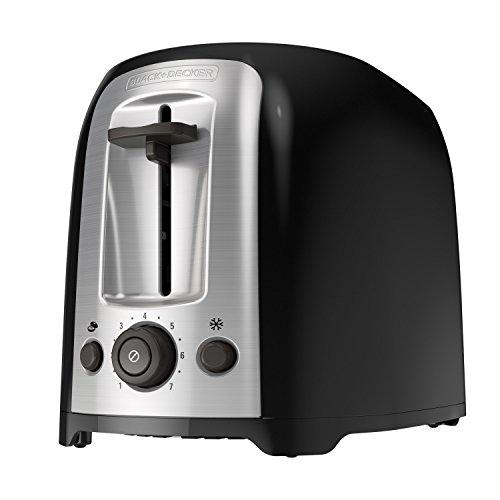
BLACK+DECKER 2-Slice Toaster with Extra-Wide Slots
Badge: Best Extra-Lift Pick
Strengths
- Extra lift lever stated, direct specification evidence on the retrieval criterion.
- Seven shade settings and a bagel mode stated, covering the preference and bagel criteria.
- Removable crumb tray stated, evidence on the cleaning criterion.
Trade-offs
- No defrost function stated, so the frozen-bread criterion has no specification support.
- No model number stated.
- Evenness and consistency, the headline laboratory criteria, remain unmeasured here as everywhere in this guide.
Mini spec box: Capacity as stated: 2-Slice. Slots: extra-wide. Shades: 7 settings. Functions stated: bagel mode, extra lift lever. Crumb tray: removable.
Judged by criterion coverage, the BLACK+DECKER presents a tidy evidence file: retrieval answered by the lever, bagels answered by width plus a stated mode, cleaning answered by the removable tray, preference range answered by seven shades. A test programme would still need its instruments for the two criteria that decide most rankings, evenness across the load and consistency across repeats, and this guide will not guess at either. What a shopper can do is weight the evidence that exists. The lever is not a triviality in laboratory terms; retrieval is scored because small items are where toasters fail their users physically, and a stated mechanical solution is the strongest pre-purchase signal available on that criterion. The missing defrost is the counterweight, and in a test battery that includes frozen slices as a standard case, a machine without a stated defrost cycle starts that case at a disadvantage it must overcome on the standard setting. Fresh-bread households can discount that entirely. Frozen-bread households should treat it as the deciding fact and look at the three picks that state the function.
Best for: households that value retrieval, bagel handling, and easy cleaning evidence / Not suited for: freezer-first households needing stated defrost
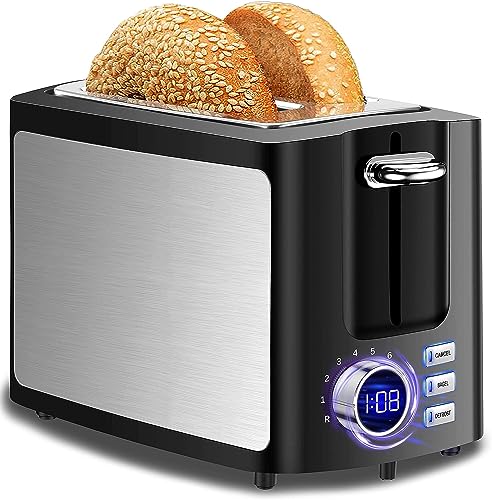
Hommater 2 Slice Wide Slot Smart Toaster
Badge: Best Smart Display
Strengths
- LCD countdown timer stated, the only pick giving the user cycle information a laboratory otherwise needs instruments to discuss.
- Nine shade settings stated, the widest preference range, relevant to the consistency criterion because fine steps make repeat settings more precise.
- Bagel, defrost, cancel, and reheat functions all stated, covering the frozen and interrupted cases in the standard test battery.
Trade-offs
- No model number stated.
- No crumb tray detail stated in the title, leaving the cleaning criterion without specification evidence.
- Two-slice capacity, so the full-load case is a pair, not a family round.
Mini spec box: Capacity as stated: 2 Slice. Slots: wide slot. Shades: 9 settings. Display: LCD digital countdown timer. Functions stated: Bagel, Defrost, Cancel, Reheat.
The Hommater is the pick a test engineer would enjoy interviewing. Its countdown display externalises the one variable home users usually guess, time remaining, and its nine stated shades give the consistency criterion its best specification-side support in the pool, because consistency is partly a property of how precisely a user can return to a setting, and finer steps with a digital timer make that return more exact. The stated reheat function addresses a case most test batteries underweight and real life does not: the interrupted cycle. None of this converts into a score, and this guide issues none. It converts into a shortlist argument: if your household’s toasting is timed, varied, and often frozen, this design’s stated evidence covers more of the standard criteria than any other two-slice pick here except the Hamilton Beach, which counters with retrieval and shutoff evidence of its own. The cleaning gap is the honest counterweight; a title that says nothing about its crumb arrangement leaves the shopper to check the listing, exactly as a test programme’s intake form would demand the detail before testing began.
Best for: timed, varied, freezer-using two-slice households / Not suited for: families needing four slices, or shoppers who want tray details stated in the title

Amazon Basics 2 Slice Toaster, 900W
Badge: Best Stated-Spec Pick
Strengths
- Only pick stating power in the title, 900W, the kind of hard figure test programmes record before anything else.
- Defrost, cancel, and bagel buttons stated, covering the frozen and bagel cases.
- Removable crumb tray and cord wrap stated, evidence on cleaning and storage criteria.
Trade-offs
- Six browning settings is the pool’s joint-narrowest preference range.
- Two-slice capacity.
- A stated wattage invites comparison but does not by itself prove speed or evenness, which remain measurement questions.
Mini spec box: Capacity as stated: 2 Slice. Slots: extra wide, for bagels. Power as stated: 900W. Browning settings: 6. Functions stated: Defrost, Cancel, Bagel. Extras: removable crumb tray, cord wrap. Colour stated: Black & Silver.
Every test programme begins with an intake sheet, and the Amazon Basics is the only pick here that fills its own in. The stated 900W matters to a laboratory-minded reader for a precise reason: power is the input variable behind cycle speed, and a manufacturer willing to state it in the title gives the shopper the one performance-adjacent number that can be compared across products without a stopwatch. The discipline is to know what the number cannot say. Wattage does not state evenness, does not state consistency, and does not guarantee a fast cycle, because element design and slot geometry share the credit or the blame. What the Basics offers, beyond the figure, is the complete everyday evidence file: defrost for the frozen case, bagel buttons for the bagel case, a tray for the cleaning criterion, and a cord wrap for the storage reality of small kitchens. As the pool’s baseline it performs one more service for the laboratory-minded shopper: it is the control against which the other five picks’ evidence files can be audited, line by line, in the comparison table below.
Best for: specification-led shoppers and anyone equipping a kitchen without drama / Not suited for: households wanting a wide shade range or a display

Elite Gourmet 2-Slice Cool-Touch Toaster, ECT1027B
Badge: Best Cool-Touch Pick
Strengths
- Cool-touch body stated, the only specification evidence in the pool on the exterior-temperature criterion.
- Slot width stated precisely at 1.25 inches, a measurable intake figure.
- Model number ECT1027B stated, exactly the identifier a test report would use.
Trade-offs
- No defrost or reheat function stated, leaving the frozen case without specification support.
- Black only, as stated.
- Cool-touch is a design claim about the exterior; its degree in use is a measurement, and we report the claim, not a temperature.
Mini spec box: Capacity as stated: 2-Slice. Slot width as stated: 1.25-inch extra-wide. Shades: 6. Functions stated: Cancel, bagels and thick bread. Colour stated: Black. Model: ECT1027B.
Exterior temperature is one of the few laboratory criteria where a title in this pool speaks at all, and the Elite Gourmet is the speaker. Serious test programmes measure how hot a toaster’s surfaces become because the result is a safety and usability fact, not a comfort preference, and a manufacturer that designs for a cool-touch body and states it in the title is making a claim a laboratory could verify and a household will feel daily. This guide reports the claim at exactly its evidentiary weight: stated, plausible as a design goal, and unmeasured by us. The rest of the evidence file is similarly concrete, a slot width given as a number rather than an adjective and a model number given in full, the two habits of specification honesty that make a product testable in principle. The frozen case is the file’s gap, as with the BLACK+DECKER, and the same household logic decides its weight. For a family kitchen where the exterior criterion and the identification criterion lead, this is the pool’s most report-ready pick.
Best for: families weighting exterior safety and exact identification / Not suited for: freezer-first households needing stated defrost
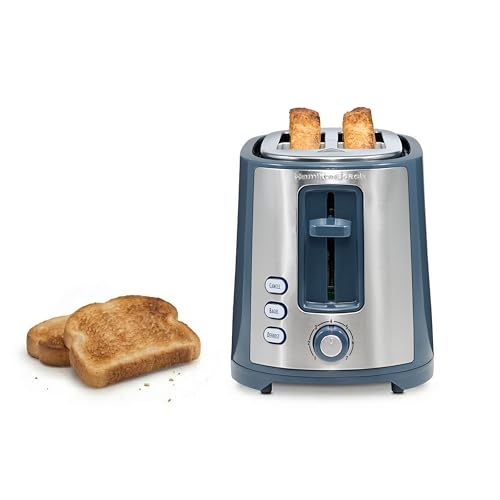
Hamilton Beach Extra-Wide Slot 2 Slice Toaster, 22634
Badge: Best All-Rounder
Strengths
- Toast Boost stated, evidence on the retrieval criterion.
- Auto shutoff stated, evidence on the safety criterion that laboratories score and shoppers forget.
- Defrost button, seven shades, slide-out crumb tray, and model number 22634 all stated, the widest criterion coverage in the pool.
Trade-offs
- Kitchen Makeover Blue is a finish a test report would ignore and a household must live with.
- Two-slice capacity.
- Criterion coverage is not a score: evenness and consistency remain unmeasured, here as everywhere in this guide.
Mini spec box: Capacity as stated: 2 Slice. Slots: extra-wide slot. Shades: 7. Functions stated: Bagel, Defrost, Toast Boost, auto shutoff. Crumb tray: slide-out. Colour stated: Kitchen Makeover Blue. Model: 22634.
If a test programme scored specification coverage alone, the Hamilton Beach would top this pool, and it is worth understanding both why that is true and why it is not a test result. Criterion by criterion, its title supplies evidence: retrieval, frozen case, safety shutoff, cleaning, preference range, and exact identification through the model number. No other pick covers as many of the standard criteria before a single slice is toasted. But the criteria that dominate real laboratory rankings, evenness and repeat consistency, are precisely the ones no title can evidence, and a machine with a thinner file could, in a laboratory, out-brown this one. The honest consumer conclusion is two-layered: on everything that can be known before purchase, this design is the pool’s most complete; on everything that can only be known by measurement, it stands in the same honest uncertainty as its five companions, to be resolved by your own first-week home tests. That is not a weakness of this guide. It is the guide’s thesis, demonstrated on its strongest pick. The exterior-temperature angle of the safety criterion is explored further in our dedicated guide to Best Toasters Don T Get Hot On Outside.
Best for: households wanting the widest pre-purchase evidence across the standard criteria / Not suited for: four-slice families and neutral-finish kitchens
Comparison Table
| Pick | Capacity | Retrieval evidence | Defrost stated | Cleaning evidence | Amazon |
|---|---|---|---|---|---|
| bella Fits-Anywhere Slim | 4 Slice | Not stated | Not stated | Not stated | Check on Amazon |
| BLACK+DECKER 2-Slice | 2-Slice | Extra lift lever | Not stated | Removable tray | Check on Amazon |
| Hommater Smart Toaster | 2 Slice | Not stated | Yes | Not stated | Check on Amazon |
| Amazon Basics 2 Slice | 2 Slice | Not stated | Yes | Removable tray | Check on Amazon |
| Elite Gourmet ECT1027B | 2-Slice | Not stated | Not stated | Not stated | Check on Amazon |
| Hamilton Beach 22634 | 2 Slice | Toast Boost | Yes | Slide-out tray | Check on Amazon |
This table is deliberately organised by evidence rather than by features, because that is the laboratory habit this guide exists to teach. A cell that says “not stated” is not an accusation; it is an accurate report that the verified title is silent, and silence is information a shopper is entitled to before money moves. The two criteria that decide most real test rankings, evenness and consistency, have no column here at all, because no honest column could be filled from specifications. Their absence from the table is the most truthful thing in it.
How to Choose a Toaster Using Test Criteria
Turn the laboratory’s criteria into a household checklist, in the order a test programme would respect. Evenness first in principle, last in practice: since you cannot measure a shop’s display models, you manage evenness risk instead, by choosing designs whose geometry suits your bread, wide slots for thick cuts, a long slot for long slices, and by planning the first-week home test described below while the return window is open. Consistency is managed the same way: fine, repeatable settings help, which is the specification-side case for the Hommater’s nine stated shades and digital countdown, and your home test will tell you the rest within three mornings. The frozen case is decidable today: if frozen bread is routine, require a stated defrost function, which admits the Hommater, the Amazon Basics, and the Hamilton Beach on evidence. Retrieval is decidable today: small-item households should require a stated lift lever or Toast Boost. Exterior temperature is decidable as a claim: the Elite Gourmet states the pool’s only cool-touch design. Cleaning is decidable today: a stated removable or slide-out tray beats an unstated arrangement for any household that will toast daily. Capacity is decidable today and outranks every criterion for families: four stated slices in the bella or two in the rest. Notice what this checklist achieves. Every decidable question is decided from verified titles in minutes, and the two undecidable ones are converted into a dated home test with a return window behind it. That is exactly how a careful institution would buy a toaster if it had to buy like a household, and it is available to any shopper who reads titles the way this guide does. For the performance-with-real-foods angle that test kitchens add to this framework, see our explainer on Best Toasters Cooks Illustrated.
How to Use, Clean, and Look After Your Toaster: The Home Test Protocol
Your first week with any of these machines can be a small, honest test programme, and running it is the best use of a return window ever devised. Day one, the evenness check: toast a full load of your regular loaf at a middle setting, lay the slices in order, and compare them face to face and end to end; photograph them if you want the laboratory feeling, because a photograph is data your memory cannot edit later. Day two, the consistency check: repeat the identical cycle with the identical bread and setting, and compare against day one’s result, remembering the two physical effects that are not faults, a cold first cycle runs pale and a hot back-to-back cycle runs dark. Day three, the awkward cases: one single slice alone, one frozen slice, using the defrost cycle where one is stated, and one bagel, cut side to the centre elements under the bagel mode where stated. Note retrieval on the smallest item you own, with the stated lift feature where fitted and wooden tongs as the standing backup; metal in a plugged-in toaster fails every safety protocol ever written. Through the week, run the cleaning protocol as the laboratories do, by accumulation: empty the crumb tray, where one is stated, after the test days and judge the chore honestly, because a tray that annoys in week one will be neglected in month six, and shake out tray-less models unplugged and cool over a bin. Three problems the protocol commonly surfaces, with their standard responses. Problem: the load browns darker at one end → check slice centring and crumb lodged against an element before concluding anything about the machine. Problem: frozen slices emerge dry at the edges → use the stated defrost cycle rather than a longer standard cycle, which dries before it crisps. Problem: results drift darker across a family run → the elements are heat-soaked; step the setting down after the first round, as every experienced tester does. A machine that passes your week on your bread has earned its place by the only evidence that was ever going to matter to your household, and a machine that fails has failed inside the window where failure is free.
What a Real Test Report Would Add, and How to Read One
It is worth ending the method discussion by naming what this guide cannot give you, because knowing the shape of missing information is a consumer skill. A genuine laboratory report on these six models would add measured browning maps for full and partial loads, repeat-cycle variance at a fixed setting, timed cycles for standard and frozen bread, surface temperatures after back-to-back use, and durability observations across many cycles, all gathered on retail-bought units under a published method. If you consult such a report, from Consumer Reports or any other testing organisation, read it the way this guide has taught: check that the exact model numbers match the products you are considering, because reports age and ranges change; check which criteria drive the headline ranking, because a programme that weights speed heavily and evenness lightly will crown a different winner than your household would; and check the spread, not just the order, because a ranking in which the top several models cluster closely is telling you that any of them will serve, while a ranking with one runaway leader is telling you something stronger. Beware, finally, of the secondary market in borrowed authority: roundups that print a famous testing name beside products that organisation never evaluated, scores with no method behind them, and verdicts that cannot say which unit, bought where, produced them. The defence is the habit this whole page has practised, asking of every claim the laboratory question: measured how, on which exact product, and where is the method? Claims that survive the question are rare and valuable. Claims that dissolve under it were never information, and a shopper who can tell the difference no longer needs any single authority, which is, in the end, the most consumer-report outcome of all. The bagel-specific criteria inside the standard battery get their own treatment in our guide to Best Toasters For Bagels.
The Criteria, One by One: What Each Really Tests
Because the criteria do the heavy lifting in any serious programme, each deserves a plain-language definition before you rely on it. Evenness asks whether every part of every slice reaches a similar colour in the same cycle: the corners against the centre, the top against the bottom, the first slot against the last. It is the criterion most sensitive to bread shape, which is why programmes standardise the loaf, and why your home version must standardise yours. Consistency asks a different question: whether the machine gives the same answer to the same request repeatedly, the same setting on the same bread on different days and in different slots. A toaster can be even and inconsistent, perfect within a cycle and wandering between them, or consistent and uneven, reliably producing the same lopsided result, and the two failures feel different at the table, which is why programmes score them separately. The frozen case tests energy and judgement together: a frozen slice must thaw through before its surfaces can crisp, and a good defrost cycle sequences those phases instead of simply extending a standard one. The single-slice case tests geometry: one slice in a two-slot machine sits closer to one set of elements, and some designs compensate while others scorch one face. The bagel case tests discrimination: the cut face wants direct heat and the crust wants gentle warmth, and a stated bagel mode claims to deliver exactly that split. Exterior temperature tests the machine as a household object among hands and sleeves. Retrieval tests the last ten seconds of every cycle, where small items either rise to meet you, by lever or boost, or send you looking for tongs. Cleaning tests the month, not the morning: how much crumb the machine sheds into its tray, how completely that tray empties, and whether the design encourages the habit or defeats it. Hold those definitions and any test report, including the home report you are about to write in your first week, becomes readable at sight.
Why Programmes Buy at Retail, and Why You Should Care
The least glamorous sentence in any testing methodology is the most important: units are purchased at retail. It means the machine on the test bench is the machine a shopper would receive, drawn from the same production and the same boxes, not a sample prepared by a manufacturer who knew where it was going. For the reader of this guide, that principle has a direct translation. The unit that arrives at your home is also a retail unit, with the same honest variability as a laboratory’s sample, which is why your first-week protocol is not a formality: it is the same act the laboratory performs, at a sample size of one, on the only unit whose performance will ever affect your breakfast. It also explains why this guide refuses to borrow outcomes. A result measured on a retail unit of a different model, a different year, or a different market variant is not evidence about the unit in your cart, and treating it as such is the quiet fraud at the centre of most roundup content. What transfers legitimately is method, and method is what this page has given you in full: criteria defined, specifications audited, gaps named, and a dated home test with a return window standing behind it. That is not a lesser version of a laboratory report. It is the laboratory idea, correctly scaled to a purchase one household makes once in several years.
Common Buying Mistakes
The first mistake in this corner of the market is believing a borrowed badge: assuming a product was laboratory-tested or recommended by a famous organisation because a sales page placed the words nearby. If a claim does not name the exact model and the test behind it, it is decoration. The second is treating specification coverage as a test score, the mirror error this guide has been careful to avoid on its own strongest pick. Third, ignoring the undecidable criteria entirely, buying on features alone and never running the first-week home tests while a return is still simple. Fourth, matching the wrong product to a real report: model ranges change, and a result for one variant says nothing certain about its sibling. Fifth, overweighting speed, the criterion sales pages love, against evenness and consistency, the criteria your breakfast will actually judge. Sixth, skipping the cleaning criterion until the tray, or its absence, has taught it to you. Each mistake is a place where evidence was available, or honestly unavailable, and the shopper proceeded as if neither were true.
Final Recommendation
On pre-purchase evidence, the strongest file in this pool belongs to the bella Fits-Anywhere Slim Toaster for families, on its stated four slices, and among two-slice designs to the BLACK+DECKER 2-Slice Toaster for its retrieval, bagel, and cleaning evidence, and the Hommater Smart Toaster for its timing and frozen-case evidence. None of those is a laboratory verdict, and this guide offers none. Check the latest price on Amazon for the pick whose evidence file matches your household, then run the home test protocol in your first week and let your own measurements have the final word. That sequence, verified specification first, honest measurement second, is the whole of the consumer-testing tradition, practised at kitchen scale.
Frequently Asked Questions
Do higher wattages mean better test results?
Not by themselves. Wattage is an input, and test criteria measure outputs: evenness, consistency, and time. A higher-powered machine can toast faster and still brown unevenly, and a modestly powered one can be beautifully even. That is why the one stated wattage in this pool, the Amazon Basics at 900W, is reported here as an intake fact for comparison, never as a performance claim.
Has Consumer Reports tested these exact toasters?
We do not know, and this guide does not claim otherwise. Testing organisations revise their programmes and model ranges change, so any claim about a specific model’s status with a specific organisation must be checked in that organisation’s own current publications. What this guide provides is the criteria such programmes use and an honest application of them to verified specifications.
What do laboratory tests measure on a toaster?
Typically, browning evenness across a full load, consistency of results at the same setting across repeated cycles, performance on frozen bread, single slices, and bagels, cycle time, exterior surface temperatures, ease of retrieving small items, and ease of cleaning, including crumb management. Programmes differ in weighting, which is why reading the method matters as much as reading the ranking.
Can I judge evenness from a product’s specifications?
No. Evenness is an outcome of element design, geometry, and the individual unit, and it can only be measured by toasting under controlled conditions. Specifications can tell you whether a design’s format suits your bread, and your own first-week full-load test can tell you how your unit performs on your loaf, which is the version of the answer your household actually needs.
Why does this guide give no scores?
Because a score implies measurement, and we have not measured these machines in a laboratory. Assigning numbers anyway would be fabrication, however professional it looked. Instead, the guide separates what specifications prove from what only testing can prove, and gives you a home protocol for the second category while your return window is open.
Which pick has the best evidence for safety?
Two picks state safety-relevant designs: the Elite Gourmet, with the pool’s only stated cool-touch body, addressing exterior temperature, and the Hamilton Beach, with a stated auto shutoff, addressing the forgotten or jammed cycle. They protect against different events, and a household with children may reasonably value the first while a rushed household values the second.
How do I run a fair consistency test at home?
Use the same loaf, the same setting, and the same time of day across three mornings, and compare the results side by side, allowing for the known effects: the first cycle of the day runs paler and back-to-back cycles run darker. Judge the spread across days rather than any single slice, because consistency is a property of the pattern, not of one piece of toast.
Should a laboratory ranking override this guide’s shortlist?
If a current report from a testing organisation you trust covers the exact model numbers you are considering, its measurements deserve real weight on the criteria specifications cannot settle, especially evenness and consistency. Combine it with this guide’s specification evidence on capacity, features, and identification, and check that the ranked model is the same variant sold to you. Authority and literacy together beat either alone. For the longest-service perspective on the category, see our guide to Best Toasters Ever.