Disclosure: topratedkitchenware.com is reader-supported. When you buy through links on our site, we may earn an affiliate commission from Amazon and other retailers, at no extra cost to you.
Where to buy
Every toilet in this guide is sold through Amazon, where you can verify the exact configuration on offer before ordering. This guide is organised around a question readers ask constantly: what would the best toilets by consumer reports style of evaluation look for, applied to the models actually on sale now? The honest answer starts with a disclaimer this guide will repeat: it reproduces no Consumer Reports results, invents no scores, and claims no affiliation. What it does is apply the testing tradition’s public criteria, bulk clearing, bowl cleaning, and water use, to what each listing itself states. All six models are linked, because the keyword specifies an evaluation lens rather than a physical attribute any of them fails. Here are the six models covered in full:
- HOROW 17 Inch Extra Tall Toilet — Check on Amazon
- Garvee Two-Piece Elongated Toilet
- IDEALHOUSE ADA Compliant 17 Inch Elongated Toilet
- American Standard Cadet PRO Right Height Toilet
- HOROW T0338W One Piece Toilet
- DeerValley Compact One Piece Toilet
Read the full guide ↓ for the detailed reviews, the comparison table, and the buying guidance behind this shortlist.
Shoppers who search for the best toilets by consumer reports are usually not looking for a brand endorsement. They are looking for a method: toilets judged by what a test can measure, clearing power, bowl cleaning, and water consumed, rather than by marketing language. That instinct is sound, and this guide honours it in the only honest way available to it. It does not reproduce the organisation’s proprietary results and it assigns no scores. Instead, it evaluates six current toilets against testing-style criteria using only the evidence each listing itself publishes, and it tells you plainly which picks document their performance and which merely describe it.
The distinction matters more in this category than most. Two of the six picks below publish a bulk-clearing figure at the top of the MaP scale; the other four ask to be taken on adjectives. A testing tradition exists to close exactly that gap. Readers who want the general shortlist first can cross-check against Best Toilets Consumer Reports, and readers comparing raw specifications side by side will find Best Toilets Comparison useful alongside this page. What follows is the criteria-first version: what would be measured, what each listing states, and what remains unverified for each pick.
Key Takeaways
- This guide applies testing-style criteria, bulk clearing, bowl cleaning, and water use, to listing-stated evidence only; it reproduces no Consumer Reports scores or results.
- Two picks publish a MAP 1000g clearing figure, the top band of the bulk-removal scale; the other four state no clearing figure at all.
- Water use spans the full modern range in this group, from dual-flush models with a reduced 1.1 GPF setting to a traditional full-volume 1.6 GPF design.
- Two listings pair comfort-height wording with a stated 15-inch figure; by testing logic, the measured figure is the specification.
- The HOROW T0338W carries the most complete documented specification in the group: stated height, dual flush, skirted body, and a published clearing figure.
In this guide
Quick Picks
| Pick | Badge | Why it stands out | Listing |
|---|---|---|---|
| HOROW 17 Inch Extra Tall Toilet | Best Documented Clearing | A stated MAP 1000g clearing figure, the top band of that bulk-removal scale, gives shoppers a published number to compare instead of an adjective | Check on Amazon |
| Garvee Two-Piece Elongated Toilet | Best Standard-Height Value | cUPC certification is stated in the listing, a concrete compliance detail many value listings omit | Check on Amazon |
| IDEALHOUSE ADA Compliant 17 Inch Elongated Toilet | Best Checklist Specification | States both the ADA positioning and the 17-inch figure in the listing, so the accessibility claim can be checked rather than assumed | Check on Amazon |
| American Standard Cadet PRO Right Height Toilet | Best Traditional Full-Volume | Right Height is American Standard’s chair-height class, so it delivers the easier sit-and-stand geometry in a traditional package | Check on Amazon |
| HOROW T0338W One Piece Toilet | Best Overall Specification | Combines a stated MAP 1000g clearing figure with dual-flush water control, the strongest documented specification set in this guide | Check on Amazon |
| DeerValley Compact One Piece Toilet | Best for Small Bathrooms | Explicitly designed for small bathrooms, with a compact skirted footprint that leaves more usable floor space around it | Check on Amazon |
How These Picks Were Chosen
The method here mirrors the testing tradition’s discipline without borrowing its data. Each listing was read for measurable claims only: stated seat height, stated flush volumes, stated rough-in, and any published clearing figure. Claims were then sorted into three piles: documented, stated but unquantified, and absent. Picks were ranked by how they perform across the criteria a test would apply, with documentation quality itself treated as evidence, because a manufacturer that publishes a clearing figure has accepted a standard a competitor can be measured against. This is desk research based on listings and category knowledge; no laboratory testing was performed and none is implied. The result is a ranking a sceptical reader can audit line by line, which is the entire point of the tradition the keyword invokes. The companion shortlist written directly under this lens, Best Toilets Consumer Reports, applies the same criteria in a different pick order and is worth reading alongside this one.
The 6 best toilets by consumer reports picks, reviewed in full
Each review below is organised around the same three test questions: how completely does it clear, how well does the bowl stay clean, and how much water does it use to do it? Where a listing answers with a number, the number is quoted. Where it answers with an adjective, that is reported too, because the difference is the finding.

HOROW 17 Inch Extra Tall Toilet
Badge: Best Documented Clearing
Strengths
- A stated MAP 1000g clearing figure, the top band of that bulk-removal scale, gives shoppers a published number to compare instead of an adjective
- Stated 17-inch ADA chair height suits taller users and households planning for easier sit-and-stand movement
- Single-flush 1.28 GPF operation is simple for guests and children to use correctly every time
Trade-offs
- Single flush means no reduced-volume option for liquid waste, unlike the dual-flush picks in this guide
- The listing does not state a rough-in figure, so the flange distance must be confirmed on the product page before ordering
- Two-piece styling is traditional rather than streamlined, with the usual seam to clean
| Configuration | Two-piece |
| Bowl shape | Elongated, extra tall bowl |
| Stated height | 17 inches, ADA chair height |
| Flush | Single flush, 1.28 GPF |
| Clearing figure stated | MAP 1000g |
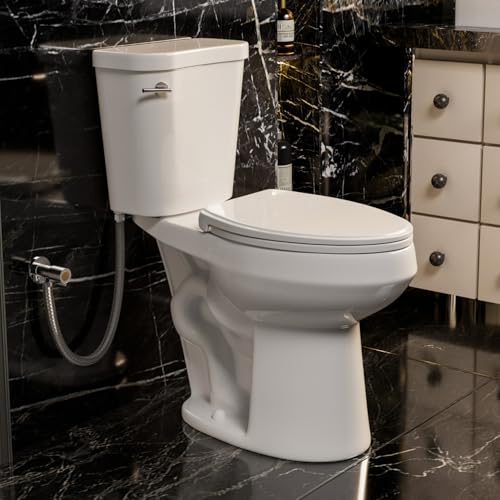
HOROW built this model around two stated numbers: a 17-inch chair height and a MAP 1000g bulk-clearing figure. The first places it in the accessible height class the listing itself calls ADA chair height, aimed at tall people and seniors. The second is the more unusual claim, because most listings describe flushing power in adjectives while this one publishes a test-style figure at the top of the MaP scale, the industry bulk-removal benchmark. A single-flush 1.28 GPF mechanism keeps operation foolproof, which households with guests, renters, or children often value more than the marginal water savings of a dual-flush button. What the listing does not state matters too: no rough-in dimension is given in the title, so a careful buyer confirms that detail on the product page and against the bathroom’s flange measurement before committing. Treat it as a height-and-clearing specialist whose paperwork needs one extra check. On the evidence its listing publishes, its testing-style case rests on a stated 17-inch chair height with a published MAP 1000g clearing figure.
Best for: readers who want the best documented clearing option in this guide, matched to the fit and limits described above. / Not suited for: households whose measurements or priorities contradict the stated specifications in this review.
Check on Amazon for the current listing, the exact configuration on offer, and the included parts for the HOROW 17 Inch Extra Tall Toilet.

Garvee Two-Piece Elongated Toilet
Badge: Best Standard-Height Value
Strengths
- cUPC certification is stated in the listing, a concrete compliance detail many value listings omit
- A locking soft-close seat is designed to resist the sideways shifting that loosens ordinary seats over time
- Side push-button flush and a standard 12-inch rough-in keep both operation and installation familiar
Trade-offs
- The stated 15-inch figure is a standard height, lower than the 17-inch class the listing’s comfort wording suggests, so shorter rather than taller users are its natural fit
- A PP (polypropylene) seat is lighter and more flexible than the resin or ceramic-look seats on premium picks
- The Garvee name has a shorter track record in this category than the legacy brands in this guide
| Configuration | Two-piece, ceramic |
| Bowl shape | Elongated |
| Stated height | 15 inches (listing pairs the figure with comfort-height wording) |
| Flush | Side push flush, 1.28 GPF |
| Rough-in | 12 inch |
| Certification stated | cUPC certified |
| Seat | Locking PP soft-close seat |
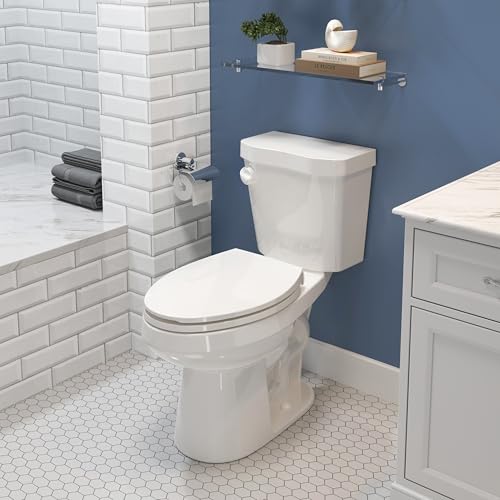
Read carefully, this Garvee is a standard-height toilet with several thoughtful details rather than the tall toilet its comfort wording might suggest: the listing itself states 15 inches, and this guide takes the stated figure over the stated adjective. At that height it suits shorter adults and households where a chair-height bowl would leave feet dangling. Around that honest core, the details are genuinely useful: a locking soft-close seat that resists lateral shift, a side push flush that is easy to reach, a water-saving 1.28 GPF rating, a standard 12-inch rough-in, and cUPC certification stated outright, which simplifies the code conversation in both United States and Canadian installations. It is a sensible value-tier two-piece for a bathroom that does not need extra height, bought with eyes open about which specification is doing the work. On the evidence its listing publishes, its testing-style case rests on a stated 15-inch height, cUPC certification, and a locking soft-close seat.
Best for: readers who want the best standard-height value option in this guide, matched to the fit and limits described above. / Not suited for: households whose measurements or priorities contradict the stated specifications in this review.
Check on Amazon for the current listing, the exact configuration on offer, and the included parts for the Garvee Two-Piece Elongated Toilet.

IDEALHOUSE ADA Compliant 17 Inch Elongated Toilet
Badge: Best Checklist Specification
Strengths
- States both the ADA positioning and the 17-inch figure in the listing, so the accessibility claim can be checked rather than assumed
- A siphonic jet flush at 1.28 GPF pairs a familiar, well-understood mechanism with modern water efficiency
- Standard 12-inch rough-in and two-piece format make it a straightforward replacement for most existing toilets
Trade-offs
- No published bulk-clearing figure is stated in the listing, unlike the HOROW picks that state a MAP figure
- Two-piece porcelain styling is functional rather than decorative, with an exposed trapway outline to dust
- The brand competes on value and specification rather than on a long-established name
| Configuration | Two-piece, ceramic / porcelain |
| Bowl shape | Elongated |
| Stated height | 17 inches, ADA compliant, comfort height |
| Flush | Siphonic jet, 1.28 GPF |
| Rough-in | 12 inch |
| Seat | Soft-close seat included |
This IDEALHOUSE model is the checklist toilet of the group: nearly everything a careful shopper wants to verify is stated in its own listing. The height is given as a number, 17 inches, and paired with an explicit ADA-compliant positioning and comfort-height description. The flush is a siphonic jet at an efficient 1.28 GPF. The rough-in is the standard 12 inches. The seat is soft-close and included. That completeness makes it easy to recommend to a buyer who wants the accessible-height specification without paying a premium-tier price for a legacy badge, and easy to fit into a typical bathroom renovation because nothing about its footprint is unusual. Its limits are equally plain: the listing publishes no bulk-clearing score, so clearing confidence rests on the siphonic design rather than a stated figure, and the two-piece silhouette is the traditional one, seams and all. For many households that trade is exactly right. On the evidence its listing publishes, its testing-style case rests on a stated 17-inch ADA-positioned height with a siphonic jet flush.
Best for: readers who want the best checklist specification option in this guide, matched to the fit and limits described above. / Not suited for: households whose measurements or priorities contradict the stated specifications in this review.
Check on Amazon for the current listing, the exact configuration on offer, and the included parts for the IDEALHOUSE ADA Compliant 17 Inch Elongated Toilet.

American Standard Cadet PRO Right Height Toilet
Badge: Best Traditional Full-Volume
Strengths
- Right Height is American Standard’s chair-height class, so it delivers the easier sit-and-stand geometry in a traditional package
- A full 1.6 GPF flush volume, the most water per flush in this guide, suits older drain lines that were designed around higher volumes
- Backed by one of the longest-established plumbing brands, with the parts familiarity that plumbers tend to appreciate
Trade-offs
- At 1.6 GPF it uses more water per flush than the 1.28 GPF majority here, which shows up on the water bill over years of use
- The listing states no seat in its title, so confirm whether a seat is included or budget for one separately
- It states no rough-in figure in its title, which must be confirmed before ordering
| Configuration | Two-piece |
| Bowl shape | Elongated |
| Height class | Right Height |
| Flush volume | 1.6 GPF |
| Colour | White |
The Cadet PRO is the traditionalist’s entry in this guide: a two-piece, elongated, Right Height toilet from American Standard flushing at the full 1.6 gallons that was the North American standard for decades. That volume is its defining trade-off. In an older home whose drain lines were sized and sloped for higher-volume flushes, the extra water can be a practical advantage, and some plumbers still prefer it for problem lines. In a water-conscious household it is simply the thirstiest pick here, and the difference compounds across thousands of flushes. Right Height gives it the chair-height geometry shared by the accessible picks in this guide, though the listing names the class rather than a figure in inches. The title also names no seat and no rough-in, two confirmations a buyer should make on the product page. Bought knowingly, it is a durable, familiar, plumber-friendly choice; bought casually, its omissions are where surprises live. On the evidence its listing publishes, its testing-style case rests on a Right Height chair-height class at the full 1.6 GPF volume.
Best for: readers who want the best traditional full-volume option in this guide, matched to the fit and limits described above. / Not suited for: households whose measurements or priorities contradict the stated specifications in this review.
Check on Amazon for the current listing, the exact configuration on offer, and the included parts for the American Standard Cadet PRO Right Height Toilet.
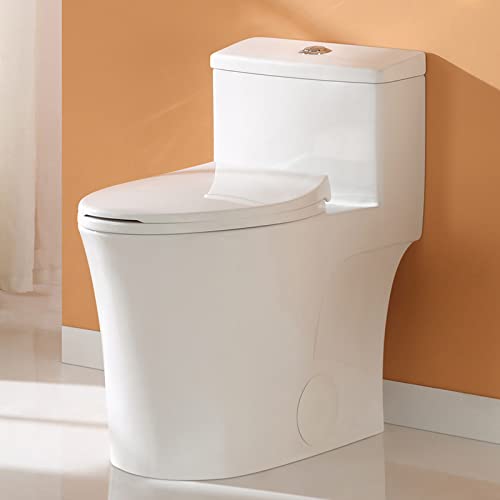
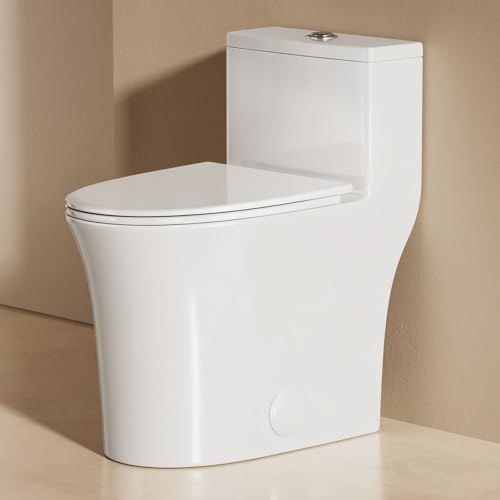
HOROW T0338W One Piece Toilet
Badge: Best Overall Specification
Strengths
- Combines a stated MAP 1000g clearing figure with dual-flush water control, the strongest documented specification set in this guide
- Skirted one-piece body hides the trapway, so the sides wipe clean in seconds and gather no dust in the contours
- A stated 17.3-inch ADA chair height, the most precise height figure stated by any pick here
Trade-offs
- One-piece construction is heavier to move and position than a two-piece, so installation is a two-person job
- The full-volume 1.6 GPF side of its dual flush matches the thirstiest picks here when used for every flush
- Compact skirted styling suits modern bathrooms and can look out of place in a strictly traditional one
| Configuration | One-piece, compact skirted |
| Bowl shape | Elongated |
| Stated height | 17.3 inches, ADA chair height |
| Flush | Dual flush 1.1 / 1.6 GPF |
| Clearing figure stated | MAP 1000g |
| Rough-in | 12 inch |
If one pick in this guide reads like it was specified by an engineer, it is this HOROW. The listing states an ADA chair height of 17.3 inches, a dual flush split between a reduced 1.1 GPF and a full 1.6 GPF, and a MAP 1000g bulk-clearing figure at the top of that scale. The body is a compact, fully skirted one-piece, which removes the exposed trapway contours that collect dust on traditional designs and makes the weekly wipe-down noticeably quicker. That combination, documented clearing plus water choice plus easy-clean form, is rare at any tier. The honest costs are physical and aesthetic: a one-piece toilet is a single heavy lift onto the flange bolts, best done by two people, and the smooth modern silhouette is a deliberate style statement. For a primary bathroom renovation that wants accessibility, efficiency, and documentation in one fixture, this is the specification to beat. On the evidence its listing publishes, its testing-style case rests on a stated 17.3-inch ADA chair height, dual flush, and a MAP 1000g figure in a skirted one-piece body.
Best for: readers who want the best overall specification option in this guide, matched to the fit and limits described above. / Not suited for: households whose measurements or priorities contradict the stated specifications in this review.
Check on Amazon for the current listing, the exact configuration on offer, and the included parts for the HOROW T0338W One Piece Toilet.

DeerValley Compact One Piece Toilet
Badge: Best for Small Bathrooms
Strengths
- Explicitly designed for small bathrooms, with a compact skirted footprint that leaves more usable floor space around it
- Standard seat height suits shorter users and households that find chair-height bowls uncomfortable
- Dual flush gives a genuine reduced-volume option while the skirted body keeps cleaning simple
Trade-offs
- Standard height is the wrong direction for users who specifically need chair-height sit-and-stand assistance
- The listing states no bowl shape and no bulk-clearing figure, so two common comparison points must be confirmed on the product page
- Compact proportions can feel small for larger adults despite the space savings
| Configuration | One-piece, compact skirted |
| Height class | Standard seat height |
| Intended space | Small bathroom |
| Flush | Dual flush 1.1 / 1.6 GPF, described as powerful and quiet |
| Rough-in | 12 inch |
DeerValley aimed this one-piece squarely at the small-bathroom problem, and its listing is honest about the recipe: a compact footprint, a skirted body, a standard seat height, and a dual flush rated at 1.1 and 1.6 GPF and described as powerful and quiet. Standard height is a feature here, not a shortcoming, because the small bathrooms it targets often serve children, shorter adults, and guest suites where a tall bowl is a nuisance. The skirted sides earn their keep in tight rooms most of all, since there is no room to manoeuvre a brush around exposed trapway contours. Two gaps in the listing deserve a buyer’s attention: no bowl shape is stated, and no clearing figure is published, so both should be confirmed on the product page if they matter to the decision. As a space-first, quiet, water-flexible compact, it fills a niche none of the tall picks in this guide can. On the evidence its listing publishes, its testing-style case rests on a compact skirted one-piece format at standard height with dual flush.
Best for: readers who want the best for small bathrooms option in this guide, matched to the fit and limits described above. / Not suited for: households whose measurements or priorities contradict the stated specifications in this review.
Check on Amazon for the current listing, the exact configuration on offer, and the included parts for the DeerValley Compact One Piece Toilet.
Comparison Table
| Pick | Stated height | Flush | Rough-in | Listing |
|---|---|---|---|---|
| HOROW 17 Inch Extra Tall Toilet | 17 inches, ADA chair height | Single flush, 1.28 GPF | Not stated in listing | Check on Amazon |
| Garvee Two-Piece Elongated Toilet | 15 inches (listing pairs the figure with comfort-height wording) | Side push flush, 1.28 GPF | 12 inch | Check on Amazon |
| IDEALHOUSE ADA Compliant 17 Inch Elongated Toilet | 17 inches, ADA compliant, comfort height | Siphonic jet, 1.28 GPF | 12 inch | Check on Amazon |
| American Standard Cadet PRO Right Height Toilet | Right Height | 1.6 GPF | Not stated in listing | Check on Amazon |
| HOROW T0338W One Piece Toilet | 17.3 inches, ADA chair height | Dual flush 1.1 / 1.6 GPF | 12 inch | Check on Amazon |
| DeerValley Compact One Piece Toilet | Standard seat height | Dual flush 1.1 / 1.6 GPF, described as powerful and quiet | 12 inch | Check on Amazon |
Every cell in this table comes from the pick’s own listing title; where a listing states nothing, the table says so rather than estimating. Heights stated as a class name are shown as the class name, so the grade of evidence stays visible.
How to Choose the Right Toilet for Your Bathroom
Start with fit, because no feature compensates for a toilet that does not match the room. The rough-in measurement, from the finished wall to the centre of the flange bolts, is 12 inches in most homes and 10 inches in a stubborn minority of older ones. Every pick in this guide states its rough-in or, in a few cases, pointedly does not, and the unstated ones belong on a confirmation list rather than in a cart. While the tape measure is out, note the water supply position and the space either side of the flange; skirted and one-piece designs can be less forgiving of a supply stop that sits exactly where the bowl wants to be.
Height comes next, and the vocabulary needs translating before it can be compared. Comfort Height, Chair Height, Right Height, and Universal Height are four manufacturers’ names for the same idea: a bowl height in the region of 17 to 19 inches that mimics sitting on a dining chair. Standard height is roughly 15 inches. Listings in this guide state heights three different ways, as a number, as a class name, and occasionally as a number that contradicts the class name beside it, and the number is the one to trust every time. Match the height to the household’s actual users, including the shortest regular user, whose comfort is the easiest to overlook.
Water use is a long-term decision disguised as a specification. A dual-flush toilet used correctly, reduced flush for liquid waste and full flush for solid waste, can cut a household’s toilet water meaningfully across a year, while a single-flush 1.28 GPF model guarantees its efficiency without relying on anyone’s button discipline. The 1.6 GPF models in this guide are not mistakes; they are continuity products for homes and drain lines built around the older standard. What matters is choosing the volume deliberately, with the drain line’s age and the household’s habits in view, instead of inheriting it by accident.
Cleaning effort is decided by shape more than by chemistry. A skirted one-piece presents a smooth flank that a cloth can cross in one pass. An exposed-trapway two-piece presents contours, a tank seam, and bolt caps that collect dust. Bowl glazes and swirling rim washes address the inside of the bowl; the outside is pure geometry. Households that clean their own bathrooms, which is most households, should weight this factor more heavily than glossy feature lists suggest.
Close the decision with documentation. Prefer listings that state their height, volume, rough-in, and any clearing figure in plain numbers, and treat every unstated item as a question to answer on the product page before purchase. That habit, applied consistently, is worth more than any single pick in this guide.
How to Install, Use, and Maintain a New Toilet
Installation planning begins before any box is opened. Measure the rough-in, photograph the existing supply stop and flange area for reference, and confirm that everything the listing does not include, which may mean a seat, a wax ring, or bolts depending on the model, is on hand. One-piece toilets should be treated as a two-person lift from the start: they are a single heavy ceramic object that must be lowered vertically onto the flange bolts, and a helper steadying the bowl is the difference between a clean set and a smeared seal.
Work through the swap methodically. Isolate the water at the stop valve, empty the tank and bowl as fully as possible, and disconnect the supply. Remove the old fixture, plug the open flange with a rag to block sewer gas while you work, and clean the flange face completely, since old wax left in patches is a common cause of new leaks. Set the new closet bolts, place the seal on the flange or the bowl as its instructions direct, and lower the new toilet straight down without sliding it, which would displace the seal. Level the base, shim any gap so the ceramic bears evenly, and tighten the mounting nuts in small alternating steps. Connect the water, refill, and test with several flushes while watching the base, the supply joint, and the tank joint on a two-piece with a dry hand, which finds seeps that eyes miss.
Maintenance divides into the bowl, the body, and the tank. The bowl responds to frequent light cleaning far better than occasional aggressive cleaning, and the smooth glazes and skirted bodies on several picks in this guide exist to make the light version sufficient. The body wants a weekly wipe, with attention to the seat hinges and, on exposed-trapway models, the rear contours. The tank wants a yearly look inside: a flapper that has gone soft or a fill valve that runs on will waste more water than any flush-volume difference in this guide, and both are inexpensive, tool-light replacements.
Keep three troubleshooting patterns in mind. Problem: the toilet runs on intermittently or refills by itself → water is escaping past the flapper or flush seal; clean or replace the seal and check the chain or linkage for snagging before replacing larger parts. Problem: a dual-flush model clears poorly on the reduced setting → the reduced volume is meant for liquid waste, so use the full flush for solids, and confirm the buttons or handle are adjusted so each setting delivers its stated volume. Problem: the seat loosens or shifts sideways → re-tighten the seat bolts from below or above as the design allows; a locking seat design, where a listing states one, is intended to resist exactly this, and persistent movement on any seat usually means the hardware, not the porcelain, needs replacing.
How Toilet Testing Actually Works, and What It Can and Cannot Tell You
Formal toilet testing, of the kind consumer organisations run, reduces a toilet to a handful of repeatable measurements. Bulk removal is tested with standardised test media in weighed amounts, the exercise behind the MaP scores that two picks in this guide publish. Bowl cleaning is tested with standardised soiling lines and inks that show how completely the flush washes the bowl surface. Water use is simply metered. Noise, seat comfort, and long-term reliability enter through owner surveys and engineering assessment rather than the test rig. Understanding that menu tells you both what a published figure proves and what it leaves open: a top-band clearing score says nothing about how the seat feels in year three.
It also tells you how to shop when test data for a specific model is unavailable, which is most of the time. Use the stated specifications as the testable residue: a published clearing figure outranks a flushing adjective, a stated height outranks a comfort label, and a dual-flush mechanism with stated volumes outranks an efficiency slogan. The model-line context in Best Toilets Cadet 3 and the height-focused shortlist in Best Toilets Comfort Height both reward the same reading discipline. The method, more than any single result, is what the testing tradition has to teach a toilet shopper.
What to Do When the Model You Like Has No Published Test Figure
Four of the six picks in this guide publish no clearing figure, and they are not therefore bad toilets; they are undocumented ones. The practical response is a hierarchy of substitutes. First, weigh the mechanism: a siphonic jet or a swirling rim wash is a known design with predictable behaviour. Second, weigh the volume: a full 1.6 GPF flush moves more water per attempt than a reduced setting, which is physics rather than opinion. Third, weigh the trapway and glaze claims where stated, since a glazed trapway and a smooth bowl finish address the two places waste actually sticks. Fourth, read owner feedback for pattern complaints about double-flushing, which is the field symptom of weak clearing.
Households with specific needs should apply the same evidence discipline to fit rather than performance. The accessibility questions raised in Best Toilets Children Special Needs and the retail-availability questions in Best Toilets Canada are both, at bottom, requests for stated specifications over assumptions. A toilet bought on documented evidence rarely surprises its owner. A toilet bought on adjectives surprises in one direction only, and it is never the pleasant one.
Owner Experience Versus Test Results: Using Both Without Confusing Them
Test programmes measure toilets; owners live with them, and the two evidence streams answer different questions. A bulk-removal test says nothing about whether a seat hinge loosens in year two, and an owner’s five-year loyalty says nothing about how the bowl performed on a standardised soil line. The mature way to shop, and the way this guide is built, is to let each stream govern its own territory: stated and tested specifications for performance claims, ownership patterns for durability and daily-friction claims, and deep suspicion toward any source that blends the two into a single confident score.
Applied to this shortlist, the division is instructive. The documented picks, the two HOROW models with published clearing figures and the checklist-complete IDEALHOUSE, win the specification territory outright. The DeerValley adds a third kind of evidence altogether: a compact, standard-height format whose ownership case rests on fit for small rooms, a quality no clearing test measures and no laboratory ranking captures, yet one that decides real bathrooms every day. The traditional pick, the American Standard at full volume, competes in the ownership territory, where parts familiarity and plumber goodwill accumulate over decades. Neither victory cancels the other. A household that keeps a home for thirty years may rationally weight the second territory higher; a household renovating to sell may weight the first. Testing traditions exist to keep the first territory honest. Ownership exists to keep the second one real. Confuse them, and you will buy a laboratory winner that annoys you daily, or a beloved fixture that never did flush properly.
Common Buying Mistakes
Shoppers in this category make a handful of repeatable errors, and this guide’s six listings illustrate most of them. The first is assuming a famous name settles every question: even the strongest brands in this guide publish listings that omit a seat, a rough-in, or a height in inches, and the omission matters more than the badge. The second is treating dual flush as automatically superior. It saves water only when the household actually uses the reduced setting for liquid waste; in a guest bathroom where everyone presses the big button, a simple single-flush efficient model may use less in practice.
The third error is ignoring the drain line’s age. Very old homes with long, shallow-sloped runs sometimes genuinely perform better with a full-volume flush, which is why 1.6 GPF models still exist in this guide. The fourth is caulking around the entire base at installation, a tidy-looking habit that hides seal leaks until the floor is damaged; many installers leave the back of the base uncaulked for exactly this reason, where local practice allows. The fifth is skipping the dry fit. Two minutes spent setting the bowl without its seal, checking for rocking and flange alignment, prevents the most frustrating version of the job: discovering the problem with wax already compressed. Every one of these mistakes is free to avoid, which is what makes them mistakes rather than risks.
Final Recommendation
Start with the HOROW 17 Inch Extra Tall Toilet, the pick whose stated specification, a stated 17-inch chair height with a published MAP 1000g clearing figure, best matches the main question this guide set out to answer. Choose the HOROW T0338W One Piece Toilet instead if its defining strength, a stated 17.3-inch ADA chair height, dual flush, and a MAP 1000g figure in a skirted one-piece body, matches your bathroom and household more closely. Whichever finalist you choose, run the closing checklist before ordering: rough-in measured, height class settled for the household’s shortest regular user, flush volume chosen deliberately, inclusions confirmed, and any unstated specification resolved on the product page. A toilet bought that way is a twenty-year fixture that never has to be thought about again, which is the highest compliment this category offers.
Frequently Asked Questions
Does this guide contain Consumer Reports’ actual toilet ratings?
No, and it is important to be clear about that. Consumer Reports ratings are proprietary to that organisation and are not reproduced here. This guide applies the publicly understood criteria of the testing tradition, bulk clearing, bowl cleaning, and water use, to the specifications each manufacturer publishes in its own listing, and it ranks documentation quality alongside design. Readers who need the organisation’s own scores should consult that organisation directly; readers who want to shop the way a tester thinks will find the method here sufficient.
What is a MaP score, and why do only some picks have one?
MaP is a bulk-removal testing protocol that measures how many grams of standardised test media a toilet clears in a single flush, and it is the closest thing the category has to a published performance benchmark. Manufacturers choose whether to test and publish; two picks in this guide state a figure at the top band of the scale, and the rest state none. Absence of a figure is absence of evidence, not proof of poor performance, but a published top-band figure is positive evidence that the other picks simply do not offer.
What does GPF mean, and how much does it matter?
GPF is gallons per flush, the volume a toilet uses in one full flush. The modern efficiency standard is 1.28 GPF, dual-flush models split a reduced volume for liquid waste with a full volume for solids, and 1.6 GPF is the older full-volume standard that several picks in this guide still use. The difference matters across thousands of flushes a year in a busy household, both on the water bill and, for homes on septic systems, in total load on the tank. It matters less in a rarely used guest bathroom, where fit and reliability dominate.
Can I replace a toilet myself, or do I need a plumber?
Many homeowners replace a like-for-like toilet themselves, because the job involves one water connection and one floor seal rather than any pipe alteration. The realistic requirements are the strength or help to lift the fixture, care in setting the seal, and the discipline to test thoroughly for leaks. A plumber earns the fee when the flange is damaged or below floor level, when the rough-in does not match the new toilet, when the supply stop needs replacing, or when the floor around the base shows water damage that needs assessing before a new fixture goes down.
What is the difference between one-piece and two-piece toilets?
A two-piece toilet has a separate tank bolted to the bowl, which makes it lighter to carry in stages, generally easier to repair at the tank joint, and available in the widest range of styles. A one-piece toilet casts tank and bowl as a single unit, removing the seam where grime collects and giving the smooth, often skirted profiles that are quickest to clean. One-piece models are heavier to install and are a two-person lift. Neither flushes inherently better; the difference is cleaning, handling, and appearance.
What should I check on the product page before ordering?
Confirm the items this guide flags wherever a listing title leaves them unstated: the rough-in dimension, whether a seat is included and of what type, the exact seat height in inches where only a class name is given, and what installation parts come in the box. Then check the overall depth from wall to bowl front against your bathroom, particularly whether a door swing or drawer will clear it. Five minutes of confirmation prevents the most common and most avoidable return in this category.