Disclosure: topratedkitchenware.com is reader-supported. When you buy through links on our site, we may earn an affiliate commission from Amazon and other retailers, at no extra cost to you.
Where to buy
The best toilets flushers — the models people mean when they say a toilet “really flushes” — earn the title with evidence, not adjectives. Two of the six verified models below carry a published MaP 1000g bulk-removal figure, the maximum on the standardized scale. One drives its flush with a siphonic jet, one brings a full 1.6 gallons of mainstream force, and two meter their power through dual-flush systems at very different volumes. Every pick was checked against its listing data, and each links to its Amazon page so you can check the latest price on Amazon and confirm the fit your bathroom needs.
- HOROW T0338W One Piece Toilet, Dual Flush
- BayRoll One Piece Sleek Modern Toilet
- IDEALHOUSE ADA Compliant 17 Inch Elongated Toilet
- American Standard Cadet PRO Right Height Elongated Toilet
- Casta Diva Elongated One Piece Toilet
- DeerValley Compact One Piece Toilet
Read the full guide ↓
There is a specific household behind this keyword: the one with a plunger living permanently beside the toilet, where every flush is a small act of suspense. The best toilets flushers exist to retire that plunger. What separates them is not water volume — the strongest models in this guide flush at 1.28 gallons and below — but engineering: trapways shaped and glazed to keep waste moving, flush valves that release water fast enough to establish a decisive siphon, jets that fire exactly where the siphon starts, and, on the best-documented models, a published test score proving the whole system clears the maximum standardized load in a single press. This guide ranks six verified toilets on flush performance first, explains the mechanisms in plain language, and is explicit about which claims are measured, which are architectural, and which are merely adjectives wearing a uniform.
Flush strength also has a duty cycle. A toilet that flushes heroically twice a day is one thing; a toilet in a busy family or communal bathroom does it dozens of times, and consistency under repetition is its own specification — the theme our guide to the Best Toilets For A Lot Of Flushes takes up in full.
Key Takeaways
- Published MaP scores are the hardest flush evidence in any listing: the HOROW T0338W and the BayRoll both claim 1000g, the top of the scale.
- The BayRoll is the efficiency marvel — maximum published clearance at a maximum flush of just 1.28 gallons, with a 0.9-gallon light flush below it.
- Siphonic jet design (IDEALHOUSE) starts the siphon almost instantly, which is why it clears decisively at 1.28 GPF without a published score.
- The American Standard Cadet PRO represents the older school: a full 1.6 GPF of mainstream, track-record flushing force.
- Dual-flush models flush at full strength only on the full setting; households must match the button to the load to get the performance they bought.
- Every strong flusher still depends on installation and maintenance: correct tank level, clear rim jets and a healthy flapper keep factory performance alive.
In this guide
Quick Picks
| Pick | Badge | Format | Flush | Best for |
|---|---|---|---|---|
| HOROW T0338W One Piece | Best Flusher Overall | One-piece, skirted, elongated | Dual flush 1.1/1.6 GPF, MaP 1000g claim | Maximum published clearance, easy-clean body |
| BayRoll One Piece Sleek Modern | Best Flusher per Gallon | One-piece, skirted, round | Dual flush 0.9/1.28 GPF, MaP 1000g claim | Top-score clearance at the lowest volumes |
| IDEALHOUSE ADA 17 Inch Elongated | Best Siphonic Jet Flusher | Two-piece, elongated | 1.28 GPF siphonic jet | Instant siphon start, ADA height |
| American Standard Cadet PRO | Best Full-Volume Flusher | Two-piece, elongated | 1.6 GPF | Proven mainstream force, universal parts |
| Casta Diva Elongated One Piece | Best Dual-Flush Flusher | One-piece, elongated | Dual flush 1.1/1.6 GPF | High-efficiency dual flush in a one-piece body |
| DeerValley Compact One Piece | Best Quiet Flusher | One-piece, skirted, compact | Dual flush 1.1/1.6 GPF | Powerful and quiet, per its listing, for small rooms |
How These Picks Were Chosen
This guide is research-led: no toilet was flush-tested by us, and no performance figure in it is our own measurement. Models were verified against their listing data — brand, format, bowl shape, flush architecture, stated volumes, seat height, rough-in — and ranked by a strict evidence ladder. At the top sit published bulk-removal scores, because a MaP figure is a standardized, comparable measurement rather than a claim. Below that sit named architectures with a describable mechanism — the siphonic jet — and documented mainstream designs with long installed histories. At the bottom sit adjectives: “powerful,” “high efficiency,” unaccompanied by numbers. Adjective-only models are not excluded — bathrooms have more dimensions than one score — but they are ranked where their evidence puts them, and their reviews say so.
Two further filters applied. First, fit honesty: rough-ins and unstated specifications are flagged wherever they occur, because a strong flusher that cannot bolt to your flange flushes nothing. Second, whole-life performance: preference went to formats whose flush can be restored with standard parts, because the strongest flush in year one is a memory if year five’s worn flapper cannot be replaced from a local shelf. Readers outfitting a small room around one of these flushers may also want our Best Toilets For A Small Guest Bathroom guide, where these priorities meet tight dimensions.
The 6 Best Toilets Flushers Ranked by Evidence
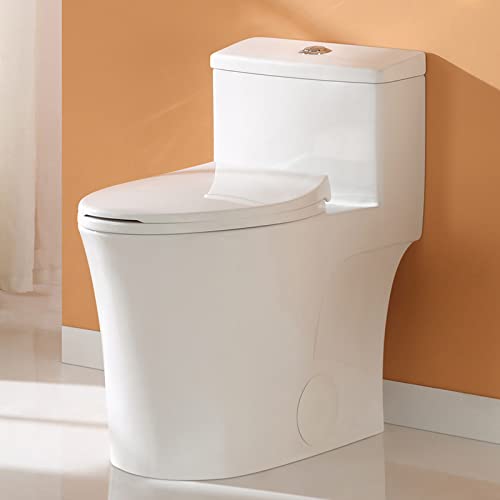
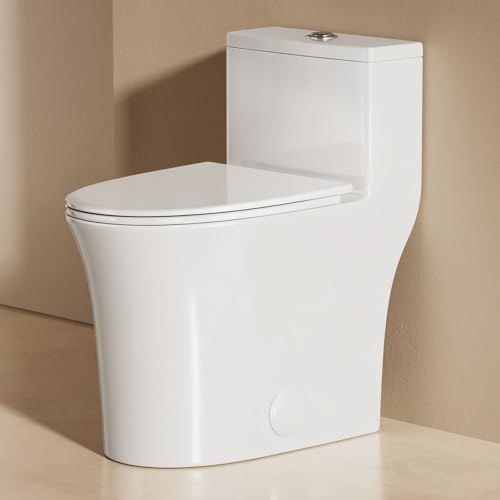
HOROW T0338W One Piece Toilet
Badge: Best Flusher Overall
Strengths
- MaP 1000g claim: the maximum standardized bulk-removal result, published in the listing for anyone to compare.
- Dual flush concentrates that power where it is needed — the full 1.6 GPF setting carries the score, the 1.1 setting handles liquids.
- Skirted one-piece body and chair height mean the strongest flusher here is also among the easiest to clean and use.
Trade-offs
- The headline performance lives on the full flush; habitual light-flush use on solids will underperform by design.
- One-piece installation needs two people and a careful set-down.
- Full-volume flushing is the thirstiest setting in this guide.
Spec box: Format: one-piece, skirted | Bowl: elongated | Flush: dual flush 1.1/1.6 GPF, MaP 1000g claim | Height: ADA chair height 17.3 inches | Rough-in: 12 inches | Color: White
Rankings need a champion whose claim can be checked, and the T0338W’s claim is printed in its own listing: a MaP 1000g flush performance figure, the ceiling of the standardized bulk-removal test, achieved by the full flush of its dual-flush system. In practical terms, that is a toilet engineered to clear the heaviest realistic load in one press — the exact failure mode that puts plungers in bathrooms. The supporting design is coherent: a one-piece body with no seam turbulence in the tank-to-bowl path, an elongated bowl, and a dual-flush valve that reserves the championship performance for the loads that need it while letting liquids leave on 1.1 gallons. Households graduating from a chronic clogger will feel the difference in the first week.
The discipline it asks in return is button honesty: press the full flush for solids, every time, and the published performance is the performance you get. Install it with a helper — one-piece ceramic is unforgiving of solo heroics — and this is the most completely evidenced flusher in the guide.
Best for: clog-weary households that want published proof of clearance / Not suited for: solo installers or habitual light-flush pressers

BayRoll One Piece Sleek Modern Toilet
Badge: Best Flusher per Gallon
Strengths
- The same MaP 1000g claim as the leader, achieved at a maximum flush of 1.28 GPF — the best power-to-water ratio in this guide.
- A 0.9 GPF light flush below it makes this the lowest-volume strong flusher here by a wide margin.
- Fully skirted compact round body with soft-close seat and chair height: the performance hides in a small, modern form.
Trade-offs
- Round bowl: less seated room than the elongated rivals, a real comfort trade for larger adults.
- Compact skirted installation leaves tight working access around the base.
- As with all dual-flush models, the top score belongs to the full setting only.
Spec box: Format: one-piece, fully skirted | Bowl: round | Flush: dual flush 0.9/1.28 GPF, MaP 1000g claim | Height: ADA chair height 17 inches | Rough-in: 12 inches | Seat: soft close
The BayRoll is the engineering story of this guide. A generation ago, a toilet flushing at 1.28 gallons maximum was presumed weak until proven otherwise; the BayRoll arrives with the proof in its listing — the same maximum MaP figure as the full-volume HOROW, delivered on roughly twenty percent less water at the top setting and a fraction of it on the light one. That combination is what modern flush engineering was for: trapway geometry and valve timing doing the work that raw volume once did. It packages the achievement in a compact, fully skirted, round-bowl body aimed at smaller bathrooms, with a soft-close seat and chair height intact — a small-room toilet that does not ask its owner to accept small-room flushing.
The trade is seated space. A round bowl in a primary bathroom will feel like the compromise it is for larger users, and this guide will not pretend the styling erases it. In the powder rooms and compact en-suites it was designed for, though, the BayRoll is close to a perfect flush-and-clean answer: maximum evidenced power, minimum water, minimum footprint.
Best for: small bathrooms that refuse to compromise on flush strength / Not suited for: larger adults wanting elongated room in a main bathroom

IDEALHOUSE ADA Compliant 17 Inch Elongated Toilet
Badge: Best Siphonic Jet Flusher
Strengths
- Siphonic jet architecture: water fires into the trapway entrance to establish the siphon immediately, the mechanism behind decisive low-volume clearance.
- Full performance at a fixed 1.28 GPF — no buttons to choose, no light setting to misuse.
- ADA 17-inch height, elongated bowl, soft-close seat and standard 12-inch rough-in complete a mainstream-performance package.
Trade-offs
- No published MaP figure in the listing data; its ranking rests on respected architecture rather than a score.
- Conventional two-piece exterior, with ordinary cleaning effort.
- A newer brand, with a shorter parts-and-support history than the legacy name below.
Spec box: Format: two-piece ceramic | Bowl: elongated | Flush: 1.28 GPF siphonic jet, water saving | Height: 17-inch ADA compliant comfort height | Rough-in: 12 inches | Seat: soft close | Finish: white porcelain, easy clean
Where the HOROW models prove power with a number, the IDEALHOUSE argues it with a mechanism — and the mechanism is a good one. In a siphonic jet toilet, a dedicated jet aims the flush’s energy directly at the trapway opening, so the siphon that pulls the bowl clear forms fast and pulls hard, instead of waiting for the bowl to fill and hope. It is the architecture that rescued low-volume flushing’s reputation, and at a fixed 1.28 GPF it delivers its full performance on every press, to every user, with no dual-flush discipline required. For households that want strong flushing as a default rather than a setting, that behavioral simplicity is worth real ranking credit.
Its ceiling is evidentiary: without a published score, this guide places it below the two MaP-claimed models, and buyers who need the number should follow that order. Buyers who understand the mechanism — and who value ADA height and a standard rough-in alongside it — are making a well-reasoned architectural bet. High-traffic households can compare its duty-cycle logic with our Best Toilets For A Church analysis.
Best for: households wanting decisive flushing with zero settings to manage / Not suited for: buyers who require a published bulk-removal score

American Standard Cadet PRO Right Height Elongated Toilet
Badge: Best Full-Volume Flusher
Strengths
- A full 1.6 GPF delivered through one of the most refined mainstream flush designs in the industry, proven across an enormous installed base.
- Every wear part is standard and stocked everywhere, so peak flush performance is restorable in one inexpensive visit, forever.
- Right Height elongated format suits the widest range of adult users.
Trade-offs
- No published MaP figure appears in the listing title data; its evidence is reputation and refinement rather than a score.
- The highest water use in this guide on every single flush.
- Rough-in and seat inclusions are not stated in the title data — confirm on the product page.
Spec box: Format: two-piece | Bowl: elongated | Flush: 1.6 GPF | Height: Right Height | Color: White | Model: 215AA004.020
The Cadet PRO flushes the old way, with the old advantage: more water, moving through a design that a major manufacturer has refined across decades and millions of installations, produces a flush with margin to spare. There is no light setting to misuse and no efficiency geometry to keep in tune; there is a full tank, a proven valve, and a track record that plumbers recite from memory. For a household whose current toilet fails weekly and whose patience for experimentation is gone, that combination — force plus familiarity — is a legitimate form of strength, and its universal parts ecosystem means the strength is maintainable for as long as the ceramic lasts.
The costs are equally plain: the most water per flush in this guide, and no published score to set against the newer models’ figures. This guide ranks it fourth on evidence while respecting exactly what it is — the flusher for buyers who trust thirty years of refinement more than a test number, a defensible position that many professionals share.
Best for: reliability-first households and anyone whose plumber will maintain it / Not suited for: water-conscious homes or score-driven buyers

Casta Diva Elongated One Piece Toilet
Badge: Best Dual-Flush Flusher
Strengths
- Dual flush 1.1/1.6 GPF in a one-piece body, described in the listing as a high efficiency flush — full power available, light flush for the rest.
- Elongated bowl and 17-inch comfort height give the flush a full-size, adult-proportioned platform.
- One-piece construction removes the tank seam from the flush path and from the cleaning routine.
Trade-offs
- No published MaP figure in the listing data — “high efficiency” describes intent, not measured clearance.
- The base is not described as fully skirted, so exterior cleaning sits mid-pack.
- One-piece weight requires a two-person installation.
Spec box: Format: one-piece | Bowl: elongated | Flush: dual flush 1.1/1.6 GPF, high efficiency | Height: 17-inch comfort chair height | Rough-in: 12 inches | Color: White
The Casta Diva brings the dual-flush format to buyers who want it in a full-size one-piece: an elongated bowl at comfort height, a light flush for the day’s majority and a full flush described by its maker as high efficiency. Its flushing brief is balance — the same maximum volume as the Cadet PRO when the load demands it, a fraction of it when it does not — delivered through a seamless body that also simplifies the cleaning half of bathroom life. For households whose loads are ordinary and whose current toilet fails only occasionally, that balance is honestly sufficient, and the one-piece form will please anyone who has cleaned around a trapway.
Its ranking is set by evidence discipline: without a published bulk-removal figure, this guide cannot place its clearance above models that publish theirs, and heavy-load households should follow that logic strictly. The Casta Diva is the flusher for normal loads and dual-flush households, and within that brief it is well specified. Families with young children — enthusiastic paper users all — should weigh the evidenced picks above for the kids’ bathroom, as our Best Toilets For A Family Of Small Children guide discusses.
Best for: dual-flush households with ordinary loads wanting one-piece form / Not suited for: heavy-load households needing published clearance proof

DeerValley Compact One Piece Toilet
Badge: Best Quiet Flusher
Strengths
- The listing pairs “powerful” with “quiet” — a flush engineered to clear without the roar, rare and valuable in small homes.
- Dual flush 1.1/1.6 GPF gives it the same maximum volume as the guide’s full-flush picks when the big setting is used.
- Skirted compact one-piece body at standard height: easy exterior cleaning in the small bathrooms it targets.
Trade-offs
- Its power claim is an adjective in the listing data, with no published score behind it — the softest evidence in this guide.
- Bowl shape is not specified in the title data; confirm on the product page.
- Standard height and compact size will not suit tall users or those needing chair height.
Spec box: Format: one-piece, skirted | Flush: dual flush 1.1/1.6 GPF, powerful and quiet per listing | Height: standard seat height | Rough-in: 12 inches | Design: compact, for small bathrooms
The DeerValley closes the ranking by optimizing a variable the others ignore: sound. A flush has an acoustic signature, and in a small home — bathroom off the bedroom, thin walls, sleeping children — a toilet that clears the bowl without a household-wide announcement is performing a real service. Its listing claims exactly that pairing, powerful and quiet, on a dual-flush platform whose full setting matches the maximum volume of the guide’s leaders, inside a skirted compact body that also happens to be the easiest exterior here to wipe down. For an en-suite or a small family bathroom, that is a coherent and attractive brief.
Evidence discipline places it last among strong company: “powerful” without a published figure cannot outrank a MaP score or a siphonic jet, and this guide says so plainly. Buy the DeerValley for quiet, compactness and easy cleaning with a full-volume flush in reserve — not as a documented clog-fighter. Buyers renovating period homes will find its standard height and compactness discussed in a kindred context in our Best Toilets For A 1920 Remodel guide.
Best for: en-suites and small homes where flush noise matters / Not suited for: documented heavy-load clearance as the top priority
Comparison Table
| Model | Format / Bowl | Flush | Height | Rough-in | Link |
|---|---|---|---|---|---|
| HOROW T0338W | One-piece skirted / elongated | Dual 1.1/1.6 GPF, MaP 1000g claim | 17.3 in chair height | 12 in | Check on Amazon |
| BayRoll | One-piece skirted / round | Dual 0.9/1.28 GPF, MaP 1000g claim | 17 in chair height | 12 in | Check on Amazon |
| IDEALHOUSE ADA | Two-piece / elongated | 1.28 GPF siphonic jet | 17 in comfort height | 12 in | Check on Amazon |
| American Standard Cadet PRO | Two-piece / elongated | 1.6 GPF | Right Height | Confirm on listing | Check on Amazon |
| Casta Diva | One-piece / elongated | Dual 1.1/1.6 GPF | 17 in comfort height | 12 in | Check on Amazon |
| DeerValley | One-piece skirted / compact | Dual 1.1/1.6 GPF | Standard height | 12 in | Check on Amazon |
How to Choose a Strong-Flushing Toilet
Read for numbers, then mechanisms, then adjectives — in that order. A published MaP figure is a measurement; a siphonic jet is a mechanism with a describable action; “powerful” is a hope. This guide’s ranking is that ladder made visible, and it generalizes to any listing you meet elsewhere. If two toilets both publish scores, prefer the one achieving its score at lower volume, because it has engineering margin the other spends water to buy — the BayRoll’s entire argument. If neither publishes, prefer the architecture you can explain to a plumber in one sentence.
Match the flush system to the household’s failure mode. Chronic clogs on heavy loads demand maximum evidenced clearance: the HOROW T0338W. Ordinary loads with water guilt demand efficiency with proof: the BayRoll. A household that cannot be trusted with two buttons demands a fixed decisive flush: the IDEALHOUSE or the Cadet PRO, depending on whether efficiency or familiarity weighs more. Noise-sensitive homes elevate the DeerValley. There is no universal strongest toilet — there is a strongest answer to a specific bathroom’s specific history, and an honest week of observing your current toilet’s failures will tell you which history is yours.
Protect the performance you buy. Strong flushing is a system state, not a permanent property: tank level, flapper health, jet cleanliness and correct installation all sit between the listing’s figure and your bathroom’s reality. Choose standard formats whose parts you can replace, install level on a sound flange, and the performance you paid for is the performance you keep.
How to Install and Maintain a Strong Flusher
Installation is the standard sequence — water off, old fixture out, flange inspected and repaired if needed, fresh wax ring, toilet set straight, hardware tightened evenly, supply connected, repeated flushes checked for leaks — with two performance-specific emphases. First, level matters to a siphon: a toilet rocking on an uneven floor disturbs both the wax seal and the water’s path, so shim until the fixture is dead still. Second, set the tank water level exactly to the manufacturer’s marked line before judging the flush; a strong design underfilled by an inch is a weak toilet wearing a strong toilet’s box.
Maintenance defends the siphon. Keep rim jets and the siphon jet clear of mineral scale — in hard-water homes this is the difference between year-one performance and year-five performance — replace flappers at the first sign of a phantom refill, and resist drop-in tank tablets that swell and degrade the rubber your flush timing depends on. Three problems dominate strong-flush ownership:
- Problem: a formerly strong flush has faded → check tank level, then flapper condition, then jet scale, in that order; one of the three is almost always responsible.
- Problem: the toilet clears but occasionally leaves paper behind → look at bowl wash and loading habits before the trapway; a single wad positioned badly defeats geometry that handles distributed loads easily.
- Problem: gurgling or slow drainage across several fixtures → the problem is downstream in the drain or vent, not the toilet; a stronger toilet will not fix a line, and a plumber should see it.
What MaP Scores Do and Do Not Tell You
Because two picks in this guide lean on MaP figures, the test deserves a plain explanation. MaP testing flushes standardized soybean-paste-and-paper loads of increasing mass and reports the largest load the toilet clears completely, in grams, under controlled conditions. A 1000g result — the scale’s ceiling, claimed by the HOROW T0338W and the BayRoll — means the toilet cleared the heaviest standard load the protocol offers. What the score does not measure is equally important: bowl wash quality, noise, splash, refill time and how the toilet behaves on the irregular loads of real life, which is why this guide weighs format, architecture and fit alongside the number rather than sorting by it blindly. Treat a MaP score as the strongest single piece of flush evidence a listing can offer — and as one piece, in a decision that also includes your rough-in, your household’s heights and your tolerance for two buttons.
Recovery Time: The Flusher Specification Nobody Lists
A strong flush is only half of heavy-use performance; the other half is how quickly the toilet is ready to do it again. Tank refill time decides whether back-to-back use — the morning rush, the party, the household of teenagers — degrades into weak second flushes from a half-filled tank. Gravity toilets refill by float and valve, and their recovery is governed by supply pressure and valve condition rather than by the flush design that earns the headlines. Households buying for throughput should therefore treat the fill valve as a performance part: a healthy, correctly adjusted valve restores full flush strength in a short, consistent interval, while an aged, scaled valve stretches recovery until the toilet feels weaker than its specification. None of the listings in this guide’s pool publishes a refill figure — an industry-wide silence this article notes rather than fills — so the practical advice is maintenance-side: at installation, time two consecutive flushes, and if the second is visibly weaker after a reasonable pause, the valve or the supply, not the bowl, is where your strong flusher is leaking its reputation.
Noise: The Flusher’s Shadow Specification
Power and noise were once the same thing — a violent flush was a loud flush — and the assumption survives in buyers who equate a quiet toilet with a timid one. Modern engineering has separated the two: siphonic systems in particular do their work with water already in the bowl, producing the characteristic smooth pull rather than a washdown roar, and refill noise is a valve characteristic, not a flush one. The DeerValley’s listing, which claims powerful and quiet in one breath, is the pool’s acknowledgment of the point. Households should read noise as a placement specification: the stronger the bathroom’s connection to sleeping spaces — en-suites, nurseries, thin-walled apartments — the more a quiet strong flush is worth, and the more a full-volume flush’s honest thunder should be weighed as a cost rather than a character reference. None of this changes the evidence ladder for clearance itself; it adds a second axis on which the strongest toilet for a hallway bathroom may not be the strongest toilet for the bedroom wall.
Pressure-Assist and the Other Power Technologies
Any honest survey of strong flushing must address the technology that is not in this pool: pressure-assist, which seals water in a vessel inside the tank and releases it under air pressure, producing the unmistakable commercial-grade blast found in many public restrooms. Its clearance is formidable, and its costs are equally characteristic — considerable noise, a proprietary vessel that is replaced rather than repaired, and a flush feel many households find violent for home use. It sits outside this guide’s verified pool, and this article makes no product claims for it; the point of raising it is calibration. The gravity designs ranked here — MaP-maximum scores, siphonic jets, refined full-volume systems — reach household-sufficient clearance without the vessel, the noise or the service model, which is why the industry’s center of gravity for homes remains gravity itself. If a plumber diagnoses your home’s problem as genuinely marginal drain conditions, pressure-assist becomes a professional conversation; for the clog-prone ordinary bathroom, the evidenced gravity picks above are the proportionate answer.
Trapways: Where Strong Flushes Are Actually Won
The trapway — the S-shaped passage cast into the bowl that carries waste to the flange — is the least visible and most decisive component in this entire guide. Its diameter sets the largest load that can pass; its smoothness sets how much friction that load meets; its geometry sets how readily the siphon forms. Two upgrades recur in strong designs. The first is glazing: a trapway finished with the same smooth glaze as the bowl’s surface lets waste slide instead of catching, which is why glazed trapways appear in clog-resistant listings across the wider market. The second is honest sizing: a generously proportioned passage, which the elongated bowls dominating this list tend to accommodate. When a listing is silent on its trapway — as several here are — the published flush score becomes even more important, because the score is the trapway’s performance measured rather than described. Shoppers comparing models beyond this guide should ask the trapway question explicitly; a seller who can answer it is selling engineering, and one who cannot is selling adjectives.
The Plunger Test: Diagnosing Your Bathroom Before You Buy
Households shopping this keyword usually own a plunger with a history, and that history is diagnostic gold if it is read properly. Note where clogs happen and what resolves them. A clog that clears with one plunge and occurs on heavy loads is a toilet at its limit — the evidenced strong flushers in this guide are its direct answer. A clog that resists plunging and recurs on ordinary loads suggests a partial obstruction already living in the trapway — a dropped object, a scale ledge — which a new toilet also answers, by replacement rather than by strength. A clog accompanied by gurgling in nearby fixtures, or one that appears in several bathrooms, indicts the drain or vent system, and no toilet purchase will acquit it. Finally, a toilet that never quite clogs but always threatens — slow swirls, rising water, anxious pauses — is usually a maintenance case: tank level, flapper timing and jet scale, correctable for the price of a pizza. Run this diagnosis honestly and the ranking above sorts itself: buy strength for the first pattern, replacement for the second, a plumber for the third, and parts for the fourth.
Strong Flushing in Small Rooms
Powder rooms and compact en-suites concentrate every flushing problem: guests meet an unfamiliar toilet, the room offers nowhere to hide a plunger gracefully, and the fixtures are often chosen small, which historically meant weak. This guide’s pool is unusually kind to that scenario — the BayRoll delivers the maximum published clearance figure in a compact skirted round body built for exactly these rooms, and the DeerValley pairs a full-volume dual flush with a compact skirted form and a quiet claim. The small-room lesson generalizes: never accept a weak flush as the price of a small footprint, because modern trapway and valve engineering has decoupled the two. Measure the room, insist on the same evidence standard as a primary bathroom, and the smallest room in the house can hold its strongest toilet.
Common Buying Mistakes
- Buying the adjective. “Powerful,” “turbo” and “high efficiency” without a figure or a mechanism are marketing, not engineering. Rank evidence, as this guide does.
- Assuming more water means more power. The joint-strongest published score in this guide is achieved at 1.28 gallons maximum. Geometry beats volume in modern designs.
- Judging a dual-flush toilet by its light setting. The light flush is for liquids. Its performance on solids is not a flaw; it is a misuse — but households must honestly decide whether they will use the system correctly.
- Ignoring the drain. Recurring clogs across multiple fixtures signal a line or vent problem that no toilet, however strong, will cure.
- Letting maintenance erase the purchase. Scaled jets and a tired flapper turn a champion flusher into an ordinary one within a few years in hard-water homes.
- Forgetting fit in the excitement. Rough-in, bowl projection and seat height still govern whether the strongest toilet can serve your bathroom at all.
Final Recommendation
For documented, maximum clearance, buy the HOROW T0338W — its published figure is the strongest evidence in this guide, and its skirted chair-height body wastes none of the advantage. For the same published clearance at strikingly lower volumes and in a compact form, buy the BayRoll. For decisive flushing with no settings to manage, the IDEALHOUSE and its siphonic jet are the pick, while the Cadet PRO serves the track-record buyer, the Casta Diva the balanced dual-flush household, and the DeerValley the quiet small home. Retire the plunger by evidence, not by adjective — and once it is retired, keep it retired with the unglamorous habits this guide repeats on purpose: correct tank level, clear jets, a healthy flapper, and a household that presses the right button for the load in front of it.
One closing observation from the whole ranking: the distance between the strongest and weakest flush in this guide is smaller than the distance between a maintained toilet and a neglected one. Every pick here, installed level with its tank at the marked line and its jets kept clear, will out-flush a neglected champion. Buy by evidence, then keep the evidence true — that is the complete method, and it is why the plunger retires in some houses and merely relocates in others.
Frequently Asked Questions
How do I keep a strong flusher strong in a hard-water home?
Treat the jets as scheduled maintenance: inspect rim jets and the siphon jet with a mirror every few months, clear scale gently with a wooden skewer, and never use metal tools on ceramic. Keep the tank level at the marked line and replace the flapper when refills turn phantom. In genuinely hard water, those habits are the difference between the toilet you bought and the toilet you will describe to guests in five years.
Should I keep a plunger even with a strong flusher?
Yes — keep a proper flange plunger and a toilet auger in the house regardless. Even the strongest toilet can meet a dropped toy, a guest’s optimism or a drain issue beyond its control, and the right tools turn those rare events into minutes instead of a service call. The goal of a strong flusher is a plunger that gathers dust, not a household without one.
What is the strongest flushing toilet I can buy for a home?
By published evidence, the models claiming a MaP 1000g bulk-removal result — the maximum on the standardized scale — lead the field, and two appear in this guide: the HOROW T0338W and the BayRoll. Between them, choose the HOROW for an elongated primary bathroom and the BayRoll for compact rooms and the lowest water volumes.
Does a higher GPF mean a stronger flush?
Not in modern designs. Water volume was the historical route to clearance, but trapway geometry, valve speed and jet placement now matter more — which is how the BayRoll matches the HOROW’s published score at a lower maximum volume, and how 1.28 GPF siphonic designs out-flush older 1.6 GPF toilets. Judge by published scores and architecture, not by gallons alone.
What is a siphonic jet, and why does it flush so well?
A siphonic jet is a dedicated outlet at the front of the bowl that fires water directly into the trapway entrance when the flush begins. By starting the siphon almost immediately, it converts the flush’s energy into pull rather than waiting for the bowl to fill, producing decisive clearance at modest volumes. The IDEALHOUSE in this guide is built on the principle.
Why does my strong toilet sometimes need a second flush?
Usually one of four reasons: the tank level has drifted low, the flapper is closing early with age, mineral scale is choking the jets, or the load was positioned where the bowl wash reaches last. All four are diagnosable in minutes and cheap to correct — check them before concluding the toilet itself is weak, because a strong design maintained poorly performs like a weak one.
Are dual-flush toilets weaker than single-flush models?
On their full setting, no — the strongest published figure in this guide belongs to a dual-flush model. On their light setting, they are deliberately gentler, because that setting exists for liquid waste. The weakness attributed to dual flush is almost always a settings mismatch, which is a household training issue rather than an engineering one.
Is a pressure-assist toilet the strongest option for a home?
By raw discharge energy, pressure-assist designs are extremely strong, which is why they dominate commercial restrooms. For homes, the trade-offs — noise, a sealed vessel that is replaced rather than repaired, and a harsher flush character — lead most households to the evidenced gravity models ranked in this guide, whose published scores reach the top of the standardized scale without those costs. None of the picks here is pressure-assist, deliberately.
How long should a strong flush take to refill?
Listings in this category rarely publish refill times, so judge by behavior: after a flush, the tank should return to its marked line promptly and consistently, and a second flush shortly afterward should feel like the first. If recovery is slow or the second flush is weak, suspect the fill valve, the supply stop or low household pressure before suspecting the toilet’s flush design.
Do strong flushers splash more?
Well-designed ones should not. Splash is a function of how water enters and fills the bowl, and the engineered systems ranked here — circulating and siphonic designs in particular — move water with control rather than chaos. A toilet that splashes noticeably is usually misadjusted (tank level too high) or poorly matched to its bowl design, not powerful in any useful sense; strength you can measure in cleared loads, not in water on the seat.
Can a stronger toilet fix a clog-prone bathroom?
If the clogs live in the toilet — a weak or worn fixture — yes, decisively; that is the scenario this guide addresses. If the clogs live in the drain line, the vent or the household’s paper habits, a stronger toilet helps at the margin but does not cure the cause. A week of observing where failures occur tells you which problem you actually have.