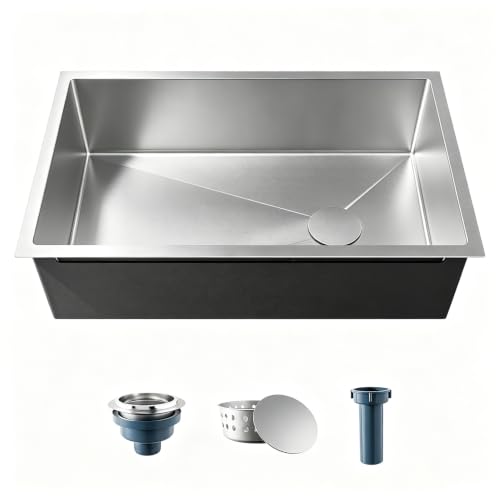
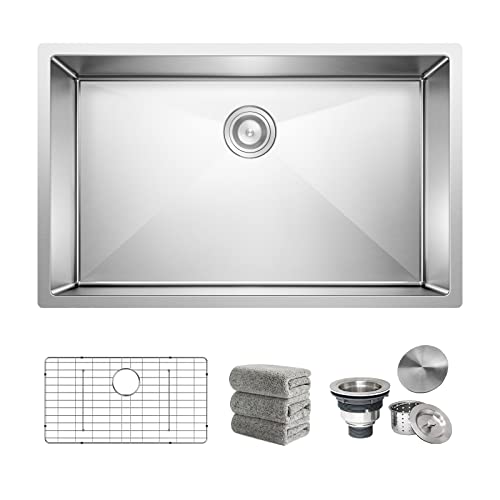
Disclosure: topratedkitchenware.com is reader-supported. When you buy through links on our site, we may earn an affiliate commission from Amazon and other retailers, at no extra cost to you.
Where to buy
Every product below was shortlisted specifically for this guide to the best type of stainless steel for kitchen sinks, using only verified listings.
This shortlist is organized as a steel lesson you can buy from: one exceptionally thick bowl, two gauges of mainstream steel, handmade and bundle variants, and sizes from 28 to 32 inches. If your remodel is comparing materials beyond steel, start with Best Type Of Material For Kitchen Sinks before you commit to an alloy.
- SANYCASA 30-Inch 11-Gauge Stainless Steel Undermount Workstation Sink — Check on Amazon
- Cozhao 30-Inch 18-Gauge 304 Stainless Steel Undermount Sink — Check on Amazon
- MAYESAR 28 x 18-Inch 16-Gauge Stainless Steel Undermount Sink — Check on Amazon
- Oxwiser 30 x 18-Inch 16-Gauge Stainless Steel Undermount Sink Set — Check on Amazon
- Delironexu 30 x 18 x 9-Inch 18-Gauge Stainless Steel Undermount Sink — Check on Amazon
- Oxwiser 32 x 18-Inch 16-Gauge Stainless Steel Undermount Sink Set — Check on Amazon
Read the full guide ↓
Choosing the best type of stainless steel for kitchen sinks comes down to two numbers and one finish: the gauge, which states thickness, the alloy grade, which states what the steel is made of, and the brushed surface that decides how the bowl ages in public. This guide explains those three properly, then shortlists six verified undermount sinks that between them cover 11, 16 and 18 gauge steel, so the explanation and the shopping list teach the same lesson.
The short answer, for readers who want it before the detail: for most kitchens the sweet spot is 16-gauge steel in the 304 alloy family, brushed, with sound padding, because it balances dent resistance, quiet and availability across every size. The picks below show where that answer bends: toward plate-thick 11-gauge steel for the hardest-used sinks, and toward honestly specified 18-gauge bowls where budget and handling matter more than armor.
A second short answer concerns what to distrust. Listings that shout about everything except the gauge and the alloy are telling you the steel is unremarkable. Every pick in this guide states its gauge in its title, and the one that names its alloy does so in the headline; that transparency is itself a quality signal, and it is the standard the wider roundups at Best Undermount Single Bowl Stainless Steel Kitchen Sinks and Best Undermount Stainless Steel Single Kitchen Sinks are worth checking against.
Key Takeaways
- Gauge runs backwards: lower number, thicker steel. 16 gauge is the mainstream sweet spot; 18 is the lighter tier; the 11-gauge pick here is plate-thick.
- Grade matters as much as gauge: 304 is the food-grade alloy to look for, and a listing that names it is giving checkable information.
- Brushed finishes forgive daily wear; mirror finishes document it.
- Sound pads change a steel sink’s character as much as a gauge step does.
- All six picks here are undermount stainless single bowls from 28 to 32 inches, so the steel comparison is apples to apples.
- Buy the steel once and correctly: a sink outlives the faucet above it.
In this guide
Quick Picks
Six linked picks spanning the gauge range, all undermount stainless. Badges repeat in the detailed reviews.
| Pick | Badge | Best for | Link |
|---|---|---|---|
| SANYCASA 30-Inch 11-Gauge Stainless Steel Undermount Workstation Sink | Thickest Steel in the Pool | Heavy daily use where dent resistance leads | Linked pick — see Where to Buy |
| Cozhao 30-Inch 18-Gauge 304 Stainless Steel Undermount Sink | Best Stated-Grade Value | Buyers who want the 304 grade stated outright | Linked pick — see Where to Buy |
| MAYESAR 28 x 18-Inch 16-Gauge Stainless Steel Undermount Sink | Best Compact 16-Gauge | Smaller cabinets that still deserve 16-gauge steel | Linked pick — see Where to Buy |
| Oxwiser 30 x 18-Inch 16-Gauge Stainless Steel Undermount Sink Set | Best Bundle at 30 Inches | One-box installs at the standard size | Linked pick — see Where to Buy |
| Delironexu 30 x 18 x 9-Inch 18-Gauge Stainless Steel Undermount Sink | Most Honest Parts List | Straightforward handmade steel with a drain kit | Linked pick — see Where to Buy |
| Oxwiser 32 x 18-Inch 16-Gauge Stainless Steel Undermount Sink Set | Best Bundle at 32 Inches | Big-pan households wanting the full bundle | Linked pick — see Where to Buy |
How These Picks Were Chosen
Selection for this guide began with the keyword itself: the steel had to be the story. We verified each listing and required the gauge to be stated in the title, because a guide about steel type cannot rest on listings that hide their material. The resulting pool is unusually clean for teaching: one 11-gauge workstation, three 16-gauge bowls in two sizes and two formats, and two 18-gauge handmade bowls, one of which names its 304 alloy outright.
This is a research-led guide, not a hands-on test report. Specifications are quoted only where a listing states them, and where a listing is silent, about an alloy grade for example, the review says so instead of assuming. That discipline matters doubly in this category, where the difference between a good and a mediocre sink is literally inside the metal.
We also weighted the ownership layer: included grids and drains, sound treatment where stated, and corner shapes you can clean. Steel type decides how a sink is built; those details decide how it lives, and the comparison at Best Top Mount Stainless Steel Kitchen Sinks shows how the same steel discussion plays out in top-mount formats for readers whose counters cannot take an undermount.
Best type of stainless steel for kitchen sinks: The Six Detailed Reviews
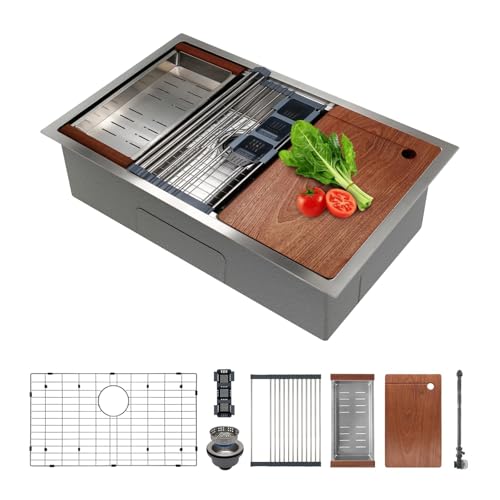
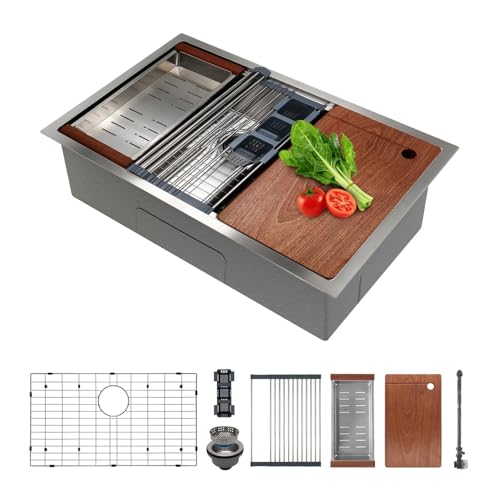
SANYCASA 30-Inch 11-Gauge Stainless Steel Undermount Workstation Sink
Badge: Thickest Steel in the Pool
Strengths
- The thickest steel in this pool by a wide margin: 11 gauge (3mm) is plate-like material that shrugs off dropped pans
- Integrated ledge turns the bowl into a workstation for boards and racks over the sink
- A 30-inch single bowl swallows sheet pans and stockpots that defeat smaller sinks
Trade-offs
- Very thick steel is heavy; confirm your cabinet and mounting hardware plan before ordering
- The workstation format rewards cooks who use ledge accessories and merely occupies others
- A single bowl means soaking and rinsing share one space
Key specs from the listing: 30-inch undermount, single bowl; 11 gauge (3mm) stainless steel per the listing; Integrated ledge; Workstation set per the listing; Superior Drain design per the listing.
The SANYCASA is the extremist of this pool, and for a guide about steel type that is exactly why it leads: its listing states 11 gauge, a full 3mm of stainless, in a 30-inch undermount workstation format. Steel this thick behaves less like sheet and more like plate; it is the pick for households whose sinks absorb dropped cast iron and daily heavy use, and who want the material itself to be the durability argument. Gauge is the first half of the steel question, and it runs backwards: the lower the number, the thicker the sheet. A 16-gauge bowl is noticeably stiffer under a heavy pot than an 18-gauge one, and the difference shows up as less flex when you set down a full stockpot, less drumming under the faucet stream, and better resistance to the small dents that accumulate around the drain. Thickness is not a luxury spec; it is the main structural fact about a steel sink.
Finish mediates between the steel and your cleaning habits. A brushed finish hides the micro-scratches of daily use by scattering light, which is why nearly every sink in this guide wears one. Polished mirror finishes look dramatic in photographs and then document every water spot and wipe mark. In hard-water homes the practical finish is the one that forgives a missed wipe-down, and that is brushed, every time.
Corners decide how a sink ages at the seams of the day. Tight, near-square handmade corners maximize flat bottom space and look architectural, but they hold residue and demand a brush; rounded corners shed water and wipe clean with a sponge at the cost of a little usable floor. Neither is wrong. The honest question is which cleaning motion you will still be making in year three, because the corner you stop cleaning is the corner that starts to discolor. In daily use, the details that decide whether a sink earns its place are unglamorous: how completely it drains, how its corners clean, and whether its size still makes sense on a tired weeknight rather than a showroom afternoon. The SANYCASA 30-Inch 11-Gauge Stainless Steel Undermount Workstation Sink handles that everyday test in line with what its listing promises, and nothing in its specification suggests a hidden catch for the jobs described in this guide.
The honest limitation to weigh is in the trade-offs above. No single sink wins on size, material and included parts at once, and this model leans toward its format’s strengths rather than covering every kitchen equally well. Buyers whose kitchens match that lean will feel the trade as a benefit; buyers on the other side of it should weigh the alternatives in this list first.
Ownership of a kitchen sink is mostly a story about water behavior. A bowl that drains fully, through grooves that lead to the drain, dries faster, smells fresher and needs less scrubbing than a bowl that puddles in its corners. Watch the first week’s drainage the way you would test a new pan’s heat, and set your expectations by what the bowl actually does, because drainage is the daily experience everything else decorates.
Best for: Heavy daily use where dent resistance leads / Not suited for: Anyone who has not checked the mounting plan for a heavy bowl

Cozhao 30-Inch 18-Gauge 304 Stainless Steel Undermount Sink
Badge: Best Stated-Grade Value
Strengths
- The listing states the steel grade outright: 304, the food-grade alloy buyers are told to look for
- Handmade construction usually means squarer corners and more usable flat bottom than pressed bowls
- Drain assembly included, so the parts list for install day is shorter
Trade-offs
- 18 gauge is the lighter end of the mainstream range; it leans on padding and installation for its feel
- A newer brand, so long-term documentation is thinner than the heritage names
- Confirm corner radius and exact dimensions against your cabinet before ordering
Key specs from the listing: 30-inch undermount, single bowl; 18 gauge stainless steel; 304 stainless steel per the listing; Handmade construction per the listing; Drain assembly included.
The cozhao is the pool’s clearest grade statement: its title names 304 stainless outright, at 18 gauge, in a handmade 30-inch undermount with the drain assembly included. It represents the lighter-gauge end of the honest listings, the sink whose case rests on a named alloy and handmade form rather than on thickness. Grade is the second half. The number that matters is the alloy family, and 304 is the mainstream food-grade answer: an austenitic stainless with enough chromium and nickel to resist the rust and staining that kitchen acids, salt and detergents provoke. A listing that states 304 outright is giving you checkable information; a listing that says only stainless steel is asking you to take the most important material fact on faith.
Sound is a steel problem with known solutions. A thin, unpadded bowl is a drum: the faucet stream, the disposal and a dropped spoon all announce themselves. Rubber pads on the underside and a sound-dampening coating change the character of the sink more than most buyers expect, and they matter most exactly where the steel is thinnest. When you compare two sinks of different gauges, compare their padding too; the comparison is steel-plus-treatment, not steel alone.
Finally, steel quality is partly a promise about the future. A well-specified bowl in 304 steel, at a sensible gauge, with a brushed finish, is close to a lifetime fixture: it does not chip, it does not crack under a hot pan, and its failure mode after decades is cosmetic. That is the context for the picks below, several of which state their gauge and alloy plainly enough to be checked, which is exactly how this category should be bought. In daily use, the details that decide whether a sink earns its place are unglamorous: how completely it drains, how its corners clean, and whether its size still makes sense on a tired weeknight rather than a showroom afternoon. The Cozhao 30-Inch 18-Gauge 304 Stainless Steel Undermount Sink handles that everyday test in line with what its listing promises, and nothing in its specification suggests a hidden catch for the jobs described in this guide.
The honest limitation to weigh is in the trade-offs above. No single sink wins on size, material and included parts at once, and this model leans toward its format’s strengths rather than covering every kitchen equally well. Buyers whose kitchens match that lean will feel the trade as a benefit; buyers on the other side of it should weigh the alternatives in this list first.
The grid question resolves itself within a month. Households that use the bottom grid stop thinking about it, which is the point: dishes sit above the wet floor, glasses stop chipping against steel, and the bowl’s finish stays unmarked. Households that remove it for a big soak and never replace it have voted with their hands. Either outcome is fine; what matters is that the choice was available, which is why included grids feature so prominently in the reviews above.
Best for: Buyers who want the 304 grade stated outright / Not suited for: Buyers who prioritize thickness over alloy paperwork

MAYESAR 28 x 18-Inch 16-Gauge Stainless Steel Undermount Sink
Badge: Best Compact 16-Gauge
Strengths
- 16-gauge steel in a compact 28-inch footprint: the thickness upgrade without the big-cabinet requirement
- A 9-inch-deep bowl contains splashes and stacks dinner dishes comfortably
- Round corners wipe clean without the residue traps of sharp zero-radius corners
Trade-offs
- 28 inches is a mid-size bowl; the largest roasting pans may need an angle to soak
- Handmade listings vary; verify the delivered dimensions against the listing before the counter is cut
- Brushed finishes show water spots in hard-water homes without a wipe-down habit
Key specs from the listing: 28 x 18 inches, undermount; 16 gauge stainless steel; 9-inch bowl depth per the listing; Handmade per the listing; Brushed finish; Round corners per the listing.
The MAYESAR puts the mainstream answer in a smaller frame: 16-gauge steel, handmade, 28 by 18 inches and 9 inches deep, with a brushed finish and round corners. For kitchens whose cabinets will not take a 30-inch bowl, it is the pick that refuses to compromise on the steel itself. Finish mediates between the steel and your cleaning habits. A brushed finish hides the micro-scratches of daily use by scattering light, which is why nearly every sink in this guide wears one. Polished mirror finishes look dramatic in photographs and then document every water spot and wipe mark. In hard-water homes the practical finish is the one that forgives a missed wipe-down, and that is brushed, every time.
Corners decide how a sink ages at the seams of the day. Tight, near-square handmade corners maximize flat bottom space and look architectural, but they hold residue and demand a brush; rounded corners shed water and wipe clean with a sponge at the cost of a little usable floor. Neither is wrong. The honest question is which cleaning motion you will still be making in year three, because the corner you stop cleaning is the corner that starts to discolor.
Gauge is the first half of the steel question, and it runs backwards: the lower the number, the thicker the sheet. A 16-gauge bowl is noticeably stiffer under a heavy pot than an 18-gauge one, and the difference shows up as less flex when you set down a full stockpot, less drumming under the faucet stream, and better resistance to the small dents that accumulate around the drain. Thickness is not a luxury spec; it is the main structural fact about a steel sink. In daily use, the details that decide whether a sink earns its place are unglamorous: how completely it drains, how its corners clean, and whether its size still makes sense on a tired weeknight rather than a showroom afternoon. The MAYESAR 28 x 18-Inch 16-Gauge Stainless Steel Undermount Sink handles that everyday test in line with what its listing promises, and nothing in its specification suggests a hidden catch for the jobs described in this guide.
The honest limitation to weigh is in the trade-offs above. No single sink wins on size, material and included parts at once, and this model leans toward its format’s strengths rather than covering every kitchen equally well. Buyers whose kitchens match that lean will feel the trade as a benefit; buyers on the other side of it should weigh the alternatives in this list first.
Cleaning steel is a technique, not a product. Wipe with the grain of the brush, rinse detergent away fully, and dry the bowl when you remember, especially in hard-water homes where mineral spots are the main cosmetic enemy. A paste of baking soda handles the dull film that builds over months. Abrasive powders and steel wool are the two shortcuts that permanently cost a steel sink its finish, at any gauge and any price tier.
Best for: Smaller cabinets that still deserve 16-gauge steel / Not suited for: Households soaking full sheet pans flat

Oxwiser 30 x 18-Inch 16-Gauge Stainless Steel Undermount Sink Set
Badge: Best Bundle at 30 Inches
Strengths
- The bundle is the story: bottom grid and drain assembly are in the box, not a second order
- 16-gauge steel at the most popular 30-inch size
- A bottom grid protects the bowl floor and lifts dishes out of standing water
Trade-offs
- Bundle value depends on using the extras; a grid you never use is storage, not a feature
- Confirm the grid size matches the bowl if you ever replace it
- Single bowl, so washing and prep share one space
Key specs from the listing: 30 x 18 inches, undermount, single bowl; 16 gauge stainless steel; 5-item bundle per the listing: sink, bottom grid, drain assembly, drain cap, towel.
The Oxwiser 30-inch set is the value engineer’s answer to the steel question: 16-gauge material, sold as a five-item bundle with the bottom grid and drain assembly in the box. The steel is the same mainstream specification as the premium picks; the bundle is what changes. Sound is a steel problem with known solutions. A thin, unpadded bowl is a drum: the faucet stream, the disposal and a dropped spoon all announce themselves. Rubber pads on the underside and a sound-dampening coating change the character of the sink more than most buyers expect, and they matter most exactly where the steel is thinnest. When you compare two sinks of different gauges, compare their padding too; the comparison is steel-plus-treatment, not steel alone.
Finally, steel quality is partly a promise about the future. A well-specified bowl in 304 steel, at a sensible gauge, with a brushed finish, is close to a lifetime fixture: it does not chip, it does not crack under a hot pan, and its failure mode after decades is cosmetic. That is the context for the picks below, several of which state their gauge and alloy plainly enough to be checked, which is exactly how this category should be bought.
Grade is the second half. The number that matters is the alloy family, and 304 is the mainstream food-grade answer: an austenitic stainless with enough chromium and nickel to resist the rust and staining that kitchen acids, salt and detergents provoke. A listing that states 304 outright is giving you checkable information; a listing that says only stainless steel is asking you to take the most important material fact on faith. In daily use, the details that decide whether a sink earns its place are unglamorous: how completely it drains, how its corners clean, and whether its size still makes sense on a tired weeknight rather than a showroom afternoon. The Oxwiser 30 x 18-Inch 16-Gauge Stainless Steel Undermount Sink Set handles that everyday test in line with what its listing promises, and nothing in its specification suggests a hidden catch for the jobs described in this guide.
The honest limitation to weigh is in the trade-offs above. No single sink wins on size, material and included parts at once, and this model leans toward its format’s strengths rather than covering every kitchen equally well. Buyers whose kitchens match that lean will feel the trade as a benefit; buyers on the other side of it should weigh the alternatives in this list first.
The undermount seam and the drain are the two inspection points worth a calendar habit. Run a finger along the seam each season and look for gaps or soft sealant; check under the sink for the slow drip that announces itself on the cabinet floor rather than at the tap. Both checks take a minute, and both catch the only failures that can actually damage a kitchen, which is a fair trade for a fixture expected to serve for decades.
Best for: One-box installs at the standard size / Not suited for: Buyers who prefer to choose grid and drain separately

Delironexu 30 x 18 x 9-Inch 18-Gauge Stainless Steel Undermount Sink
Badge: Most Honest Parts List
Strengths
- Honest parts list: the listing states plainly that the drain kit is included and additional accessories are not
- Handmade format with a full 9-inch depth for soaking and stacking
- 18-gauge steel keeps the unit lighter to handle during a one-person install
Trade-offs
- 18 gauge is the lighter mainstream tier; expect more flex and noise than 16 gauge without good padding
- No grid or accessories in the box; budget them separately if you want them
- A newer brand with thinner long-term documentation
Key specs from the listing: 30 x 18 x 9 inches, undermount, single bowl; 18 gauge stainless steel; Handmade design per the listing; Brushed finish; Drain kit included; listing states no additional accessories.
The Delironexu represents 18-gauge handmade steel with unusual honesty about its parts list: the drain kit is included and the listing says plainly that additional accessories are not. As a steel specimen it is the lighter tier, and the guide treats it that way rather than dressing it up. Corners decide how a sink ages at the seams of the day. Tight, near-square handmade corners maximize flat bottom space and look architectural, but they hold residue and demand a brush; rounded corners shed water and wipe clean with a sponge at the cost of a little usable floor. Neither is wrong. The honest question is which cleaning motion you will still be making in year three, because the corner you stop cleaning is the corner that starts to discolor.
Gauge is the first half of the steel question, and it runs backwards: the lower the number, the thicker the sheet. A 16-gauge bowl is noticeably stiffer under a heavy pot than an 18-gauge one, and the difference shows up as less flex when you set down a full stockpot, less drumming under the faucet stream, and better resistance to the small dents that accumulate around the drain. Thickness is not a luxury spec; it is the main structural fact about a steel sink.
Finish mediates between the steel and your cleaning habits. A brushed finish hides the micro-scratches of daily use by scattering light, which is why nearly every sink in this guide wears one. Polished mirror finishes look dramatic in photographs and then document every water spot and wipe mark. In hard-water homes the practical finish is the one that forgives a missed wipe-down, and that is brushed, every time. In daily use, the details that decide whether a sink earns its place are unglamorous: how completely it drains, how its corners clean, and whether its size still makes sense on a tired weeknight rather than a showroom afternoon. The Delironexu 30 x 18 x 9-Inch 18-Gauge Stainless Steel Undermount Sink handles that everyday test in line with what its listing promises, and nothing in its specification suggests a hidden catch for the jobs described in this guide.
The honest limitation to weigh is in the trade-offs above. No single sink wins on size, material and included parts at once, and this model leans toward its format’s strengths rather than covering every kitchen equally well. Buyers whose kitchens match that lean will feel the trade as a benefit; buyers on the other side of it should weigh the alternatives in this list first.
Think about the second faucet, not the first. Sinks outlive faucets, disposals and even countertops’ fashion cycles, so the sink decision should be the conservative one in any remodel: standard sizes, honest materials, a format your next faucet can still serve. The picks in this guide were weighted with that horizon in mind, because the cheapest sink is the one bought once.
Best for: Straightforward handmade steel with a drain kit / Not suited for: Anyone expecting a grid in the box

Oxwiser 32 x 18-Inch 16-Gauge Stainless Steel Undermount Sink Set
Badge: Best Bundle at 32 Inches
Strengths
- 32 inches of 16-gauge bowl: room for sheet pans laid flat, with the grid and drain in the box
- The included bottom grid protects the finish from day one
- A single wide bowl suits batch cooking and big-wash households
Trade-offs
- A 32-inch sink needs a cabinet that fits it; measure the interior, not the label on the door
- Single bowl means no separate soak side
- The bundle towel and cap are minor extras; the grid and drain carry the value
Key specs from the listing: 32 x 18 inches, undermount, single bowl; 16 gauge stainless steel; 5-item bundle per the listing: sink, bottom grid, drain assembly, drain cap, towel.
The Oxwiser 32-inch set scales the bundle formula up: 16-gauge steel across a wider bowl, grid and drain included. It closes the list because it answers the steel question and the size question together, for the big-pan households a 30-inch bowl frustrates. Finally, steel quality is partly a promise about the future. A well-specified bowl in 304 steel, at a sensible gauge, with a brushed finish, is close to a lifetime fixture: it does not chip, it does not crack under a hot pan, and its failure mode after decades is cosmetic. That is the context for the picks below, several of which state their gauge and alloy plainly enough to be checked, which is exactly how this category should be bought.
Grade is the second half. The number that matters is the alloy family, and 304 is the mainstream food-grade answer: an austenitic stainless with enough chromium and nickel to resist the rust and staining that kitchen acids, salt and detergents provoke. A listing that states 304 outright is giving you checkable information; a listing that says only stainless steel is asking you to take the most important material fact on faith.
Sound is a steel problem with known solutions. A thin, unpadded bowl is a drum: the faucet stream, the disposal and a dropped spoon all announce themselves. Rubber pads on the underside and a sound-dampening coating change the character of the sink more than most buyers expect, and they matter most exactly where the steel is thinnest. When you compare two sinks of different gauges, compare their padding too; the comparison is steel-plus-treatment, not steel alone. In daily use, the details that decide whether a sink earns its place are unglamorous: how completely it drains, how its corners clean, and whether its size still makes sense on a tired weeknight rather than a showroom afternoon. The Oxwiser 32 x 18-Inch 16-Gauge Stainless Steel Undermount Sink Set handles that everyday test in line with what its listing promises, and nothing in its specification suggests a hidden catch for the jobs described in this guide.
The honest limitation to weigh is in the trade-offs above. No single sink wins on size, material and included parts at once, and this model leans toward its format’s strengths rather than covering every kitchen equally well. Buyers whose kitchens match that lean will feel the trade as a benefit; buyers on the other side of it should weigh the alternatives in this list first.
Finally, judge the sink after the hundredth ordinary day, not the first impressive one. The questions that matter by then are small and total: does the bowl drain, does the finish forgive, does the size fit the pans you actually own, and does the sound of the place feel calm at the evening wash-up. A sink that passes those four has earned its place under the counter.
Best for: Big-pan households wanting the full bundle / Not suited for: Cabinets that cannot fit a 32-inch undermount
Comparison Table
| Pick | Badge | Key attribute | Format | Link |
|---|---|---|---|---|
| SANYCASA 30-Inch 11-Gauge Stainless Steel Undermount Workstation Sink | Thickest Steel in the Pool | 30-inch undermount, single bowl | Undermount workstation, 11 gauge | Check on Amazon |
| Cozhao 30-Inch 18-Gauge 304 Stainless Steel Undermount Sink | Best Stated-Grade Value | 30-inch undermount, single bowl | Undermount handmade, 18 gauge 304 | Check on Amazon |
| MAYESAR 28 x 18-Inch 16-Gauge Stainless Steel Undermount Sink | Best Compact 16-Gauge | 28 x 18 inches, undermount | Undermount handmade, 16 gauge, 28 in | Check on Amazon |
| Oxwiser 30 x 18-Inch 16-Gauge Stainless Steel Undermount Sink Set | Best Bundle at 30 Inches | 30 x 18 inches, undermount, single bowl | Undermount set, 16 gauge, 30 in | Check on Amazon |
| Delironexu 30 x 18 x 9-Inch 18-Gauge Stainless Steel Undermount Sink | Most Honest Parts List | 30 x 18 x 9 inches, undermount, single bowl | Undermount handmade, 18 gauge, 30 in | Check on Amazon |
| Oxwiser 32 x 18-Inch 16-Gauge Stainless Steel Undermount Sink Set | Best Bundle at 32 Inches | 32 x 18 inches, undermount, single bowl | Undermount set, 16 gauge, 32 in | Check on Amazon |
Read the gauge column first: it is the keyword of this guide, and the spread from 11 to 18 is the whole lesson in one column.
How to Choose Best type of stainless steel for kitchen sinks
Start with gauge, using the inverted scale. For a family kitchen that cooks daily, 16 gauge is the reference point: thick enough to resist dents and sound solid, common enough to appear at every size. Step up in thickness only if your use is genuinely heavy, and accept 18 gauge knowingly, for its easier handling and lower tier, ideally with sound pads named in the listing.
Then ask the grade question. Prefer listings that state 304, the standard food-grade alloy, and treat silence as a soft warning rather than a disqualification, since many sound sinks are sold with incomplete alloy paperwork. What you should not do is pay a premium for a listing that is loud about accessories and silent about both numbers.
Size the bowl to the cabinet and the pans. A 30-inch sink fits the standard base cabinet; 32 inches lays sheet pans flatter; 28 inches serves smaller kitchens without giving up depth. In every case the cabinet interior measurement governs, and the undermount mounting plan, clips or rails and a sound counter, is part of the purchase, as the single-bowl stainless roundup at Best Undermount Single Bowl Stainless Steel Kitchen Sinks also emphasizes.
Finally, price the whole install, qualitatively: sink, grid if not included, drain parts, faucet, and the fabricator’s time if the counter is being cut. A bundle pick can be the cheapest route to a complete sink even when its headline position is mid-list, and a bare premium sink can be the most expensive route to the same wash-up.
How to Install and Care for a Stainless Steel Undermount Sink
An undermount install is a half-day of careful sequencing rather than difficult work, and steel care after it is a set of small habits. The routine below follows the order professionals use.
- Dry-fit first: set the sink under the cutout, confirm the reveal you want (a small positive reveal, flush, or a slight negative reveal that hides the rim), and mark clip positions before any sealant appears.
- Confirm support: clips, rails or a frame per the maker’s instructions and your fabricator’s practice, sized for the bowl full of water, not the bowl empty.
- Run a continuous bead of the recommended sealant at the rim, lift the sink into place with help, and fix the hardware evenly, working around the rim rather than tightening one side fully first.
- Wipe the squeezed-out sealant immediately, then leave the joint undisturbed for the full curing time on the tube; this patience is the difference between a decade-long seal and a seasonal one.
- Connect drain, disposal and supply lines, fill the bowl completely, and inspect every joint from below with a dry hand before the cabinet goes back into service.
- For weekly care: rinse after use, wipe with the grain using a soft cloth and mild detergent, and dry the bowl in hard-water homes; monthly, lift the grid and clean beneath it.
Problem: Water weeps at the rim and the cabinet floor is damp → what to do: the sealant joint has failed or the sink has sagged on its hardware; dry the area fully, check clip tension and support, and reseal the rim rather than painting over the symptom.
Problem: The bowl sounds tinny and drums under the faucet → what to do: thin or unpadded steel is vibrating; adhesive sound pads on the underside, applied to a clean dry bowl, are the standard retrofit, and a bottom grid damps more than expected.
Problem: A dull grey film and water spots keep returning → what to do: mineral deposits from hard water, not damage; a baking-soda paste wiped with the grain restores the brush, and a quick dry after the last wash of the day prevents most of it.
304, 316 and the Grades You Will Actually Meet
Most buyers will meet exactly one grade name with confidence: 304, the workhorse food-grade alloy used across commercial and residential kitchens. Its chromium content builds the passive layer that makes stainless stainless, and its nickel content keeps that layer stable against kitchen acids and detergents. When a listing in this pool states 304, as the cozhao does in its title, it is answering the grade question in the most useful way available.
You may also encounter 316, the marine grade with added molybdenum for chloride resistance, positioned as a premium step for coastal or heavy-salt environments. It is a legitimate upgrade story but an uncommon one in residential sinks, and no pick in this pool claims it. The practical rule: insist on a named grade, prefer 304, and let 316 be a bonus rather than a requirement.
Handmade Versus Pressed: What the Forming Method Changes
Two of the picks here describe themselves as handmade, and the term has a specific physical meaning: the bowl is formed and welded with squarer corners and a flatter floor than a deep-drawn pressed bowl. The gains are usable space and a crisp, architectural look; the cost is corners that ask for a brush rather than a sponge, and a price of care paid weekly.
Pressed bowls round their corners by nature, which is why the Kraus-style listings in the wider market emphasize rounded corners and drainage grooves. Neither method is the quality answer by itself. Match the method to your cleaning temperament, because the sink you will still be wiping properly in year three is the better sink regardless of how it was formed, a point the maintenance notes at Best Taps For Kitchen Sinks develop for steel specifically.
Common Buying Mistakes
- Reading gauge forwards and buying 22-gauge steel believing it is the thickest.
- Paying for accessories while ignoring a listing that never states its alloy grade.
- Choosing a mirror finish for a hard-water kitchen.
- Forgetting that thicker steel is heavier steel, and skipping the mounting plan.
- Assuming sound is purely a gauge question and ignoring pads entirely.
- Measuring the cabinet door label instead of the cabinet interior.
Final Recommendation
For most kitchens, start with a 16-gauge pick: the Oxwiser 30-inch set if you want the complete bundle in one box, or the MAYESAR if your cabinet is smaller and you refuse to drop a gauge for it. Choose the SANYCASA if your sink lives a genuinely hard life and you want the thickest steel in the pool under it. Take the cozhao if a stated 304 alloy at the lighter gauge fits your budget and your handling preferences, and the Delironexu if you value an honest parts list over included extras.
Shortlist again: SANYCASA 30-Inch 11-Gauge Stainless Steel Undermount Workstation Sink; Cozhao 30-Inch 18-Gauge 304 Stainless Steel Undermount Sink; MAYESAR 28 x 18-Inch 16-Gauge Stainless Steel Undermount Sink.
Frequently Asked Questions
What is the best gauge of stainless steel for a kitchen sink?
For most households, 16 gauge: it is thick enough to resist denting, sound solid with padding, and available at every common size. Heavier cooks can step toward thicker specialty bowls like the 11-gauge pick in this guide; lighter-use kitchens can accept 18 gauge knowingly, especially with sound pads.
What does 304 stainless steel mean in a sink listing?
It names the alloy family: a food-grade stainless with the chromium and nickel balance that resists rust and staining in kitchen conditions. A listing that states 304 is giving you a checkable material fact, which is why this guide treats named grades as a quality signal.
Is thicker steel always better?
Up to the point your installation supports it, mostly: thickness buys dent resistance and quiet. Beyond the mainstream it buys weight, and the mounting plan must grow with it. The best steel is the thickest your cabinet, counter and budget support without drama.
Does gauge affect how loud a sink is?
Yes, together with padding. Thick steel vibrates less, and rubber pads damp what vibration remains. Judge the two together: a padded lighter bowl can sound calmer than a bare heavier one, which is why the reviews here note sound treatment wherever a listing states it.
How do I keep a brushed stainless sink looking right?
Wipe with the grain, rinse detergent fully, and dry the bowl when you can in hard-water areas. A baking-soda paste lifts the dull film that builds over months. Avoid steel wool and harsh abrasive powders, which scratch the brush pattern permanently.
Can stainless steel rust?
Properly specified stainless resists rust through its passive chromium layer, but that layer can be compromised by trapped iron particles, harsh chlorides left standing, or abrasive damage. Ordinary kitchen care keeps it intact for decades, which is why steel remains the default sink material.