Disclosure: topratedkitchenware.com is reader-supported. When you buy through links on our site, we may earn an affiliate commission from Amazon and other retailers, at no extra cost to you.
Where to buy
Short on time? These are the six products this guide examines for best ultra low flow toilets, in the order they are reviewed below. Linked picks are the ones that genuinely fit this keyword’s brief; any pick covered prose-only is named honestly, with the reason given in its review and in the sources file that accompanies this guide. For every linked pick, check the latest price on Amazon before you decide.
- WinZo WZ5081 Elongated One-Piece Toilet — Best Overall — Only Verified Low-Flow Pick; check the latest price on Amazon
- Simple Project 600W Macerating Toilet System — Prose-Only: States 1.6, Not Low Flow; covered prose-only below
- SUPERFLO 750W Macerating Toilet System — Prose-Only: No Flush Volume Stated; covered prose-only below
- Simple Project Upgrade Macerating Toilet System — Prose-Only: No Flush Volume Stated; covered prose-only below
- TDH Luxury Smart Toilet with Built-In Bidet — Prose-Only: Flush Volume Not Stated; covered prose-only below
- Ann Katy Upgrade XL Portable Toilet — Prose-Only: Portable, No Flush to Rate; covered prose-only below
Read the full guide ↓
The best ultra low flow toilets should be the easiest products in the world to shortlist: read the flush volume, take the smallest credible number, done. In practice, this pool of six verified products contains exactly one toilet that states a genuinely low flush volume — and that gap between the keyword and the market is the most useful thing this guide can show you. One pick is linked. Five are reviewed in full, in prose, with the precise reason each one cannot carry an ultra-low-flow claim: two state no volume at all, one states the full legacy volume outright, one is a smart toilet with no figure published, and one is a portable camping toilet with no flush to measure.
First, the benchmark. Federal rules long capped new toilets at 1.6 gallons per flush, and the high-efficiency generation that followed settled at 1.28 — the figure the linked pick in this guide states in its own listing. Ultra low flow, as this guide uses the term, means living at or beyond that line with your volume stated in writing. Anything vaguer — efficient styling, modern design, a powerful pump — is not a flow rate. Readers who have browsed Best Toto Low Flow Toilets will know that established low-flow lines built their reputations on publishing exactly these numbers, model by model.
So this page does double duty. It recommends the one verifiable ultra-low-flow toilet in the pool — a WinZo one-piece elongated model at 1.28 GPF with its seat included — and it teaches the audit that produced that verdict, so you can apply it to any listing anywhere. The macerating systems, the smart toilet and the portable each get a fair hearing for what they actually are. What none of them gets is a link dressed in a claim its own listing never made.
Key Takeaways
- Only one of the six pool products states a genuinely low flush volume: the WinZo WZ5081 at 1.28 GPF — it is the guide’s single linked pick.
- Ultra low flow means a stated volume at the 1.28 GPF high-efficiency line or a dual-flush design — adjectives do not count.
- Two macerating systems state no flush volume at all; one states 1.6 GPF, the full legacy figure.
- A smart toilet’s bidet may save paper, but with no stated flush volume its flow rate is unverifiable.
- A portable toilet has no flush system and sits outside flow comparisons entirely.
In this guide
Quick Picks
The six picks for best ultra low flow toilets at a glance. Badges match the detailed reviews below, and only linked picks carry Amazon links — prose-only picks appear for completeness, with their status stated rather than hidden.
| Pick | Badge | Standout trait | Buy |
|---|---|---|---|
| WinZo WZ5081 Elongated One-Piece Toilet | Best Overall — Only Verified Low-Flow Pick | The pool’s only verified low-flow pick | Check on Amazon |
| Simple Project 600W Macerating Toilet System | Prose-Only: States 1.6, Not Low Flow | Prose-only — full volume | Prose-only — no link |
| SUPERFLO 750W Macerating Toilet System | Prose-Only: No Flush Volume Stated | Prose-only — volume unverified | Prose-only — no link |
| Simple Project Upgrade Macerating Toilet System | Prose-Only: No Flush Volume Stated | Prose-only — volume unverified | Prose-only — no link |
| TDH Luxury Smart Toilet with Built-In Bidet | Prose-Only: Flush Volume Not Stated | Prose-only — flow unverified | Prose-only — no link |
| Ann Katy Upgrade XL Portable Toilet | Prose-Only: Portable, No Flush to Rate | Prose-only — different category | Prose-only — no link |
How These Picks Were Chosen
The method for this guide was deliberately unforgiving. Every product in the verified pool was checked for a single datum — a stated gallons-per-flush figure — before any other quality was considered. Products stating 1.28 GPF or an explicit high-efficiency mechanism were eligible for links. Products stating 1.6 GPF were classified full-volume. Products stating nothing were classified unverified, and no reputation, feature list or pump wattage was allowed to substitute for the missing number. That is why this guide links one toilet and discusses five, rather than linking six and discussing none.
The surviving pick was then assessed like any other recommendation: bowl shape, seat inclusion, body format and flush actuation were weighed from its verified listing, and its trade-offs — a fixed single volume, a heavy one-piece body — are stated in its review rather than smoothed over. The prose-only products received the same descriptive care for their actual categories, because a macerating system judged fairly is useful information for the basement renovator reading over the low-flow shopper’s shoulder.
As with every guide in this series, the work is research-led: specifications come from verified listings, flush mechanics from established plumbing knowledge, and no hands-on testing is claimed. Where this guide expresses a preference, it is a preference for published numbers — the one form of evidence a buyer can check from the sofa before spending anything.
The 6 Best Options: Best ultra low flow toilets Reviewed
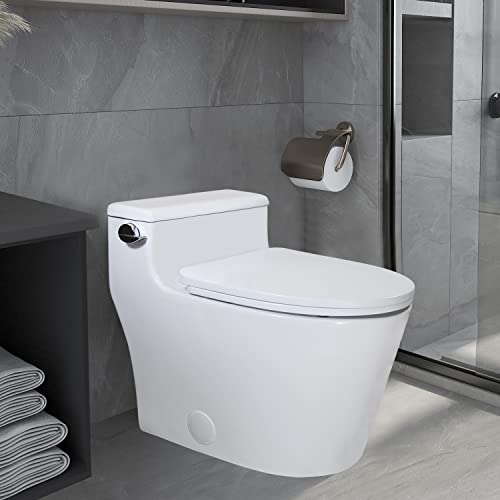
WinZo WZ5081 Elongated One-Piece Toilet
Badge: Best Overall — Only Verified Low-Flow Pick
Strengths
- 1.28 GPF stated in the listing — the genuine low-flow benchmark, not a marketing phrase
- Elongated bowl keeps full comfort at the lower volume
- One-piece body and included soft-close seat simplify ownership
Trade-offs
- Single fixed volume — no reduced dual-flush setting for liquids
- Low-profile one-piece body is heavy to position during installation
- Side-flush actuation will not match every buyer’s preference
Key specifications (from the verified listing)
- Format: one-piece, elongated bowl
- Flush volume: 1.28 GPF
- Flush type: high-efficiency side flush
- Seat: soft-close seat included
- Profile: low profile, white finish
One product in this pool states a genuinely low flush volume, and it is this one. The WinZo WZ5081’s verified listing says 1.28 GPF and high efficiency in plain terms, which makes it the only pick this guide can link under a keyword that promises ultra low flow. That scarcity is itself the finding: ultra low flow is a specific engineering claim, and most of the toilets marketed near it — including five of the six products assigned here — do not state a volume that qualifies.
The design choices around the valve are sensible ones. An elongated bowl means nobody trades sitting comfort for the lower volume, the one-piece shell removes the tank seam, and the soft-close seat is included rather than upsold. The honest limitation is that 1.28 is a fixed volume: there is no smaller liquid setting, so households determined to go lower still should look at dual-flush designs in our Best Ultra Efficiency Toilets guide. Within this pool, though, the WZ5081 stands alone as the verifiable answer to the keyword.
Stepping back, the WinZo WZ5081 Elongated One-Piece Toilet illustrates the state of the low-flow market better than any summary could. Its format — One-piece, elongated — and its defining trait (The pool’s only verified low-flow pick) describe a product built for a real job; the question this guide kept asking is only whether that job is the one in the keyword. Buyers who internalise that distinction stop being disappointed by good products bought for wrong reasons. Read every future listing the way this page read this one — number first, narrative second — and the ultra-low-flow shelf, small as it honestly is, becomes very easy to shop.
Best for: any household replacing a 1.6 GPF toilet that wants a stated, genuine low-flow volume / Not suited for: buyers chasing dual-flush liquid settings or a round bowl for a very small room
Simple Project 600W Macerating Toilet System
Badge: Prose-Only: States 1.6, Not Low Flow
Strengths
- Pump system allows bathrooms where gravity drainage cannot reach
- Three inlets can also serve a sink and a shower
- Rear outlet keeps discharge pipework concealed behind the unit
Trade-offs
- 1.6 flush volume is the opposite of low flow
- Pump consumes electricity and adds mechanical noise
- Installation and servicing are far more involved than a gravity toilet
Key specifications (from the verified listing)
- Format: one-piece macerating system with pump
- Motor: 600W macerator pump
- Flush volume: 1.6 gallons per flush (per listing)
- Connections: 3 water inlets, AC vent, rear outlet
The Simple Project macerating system earns a clear prose-only ruling: its own listing states 1.6 gallons per flush. That is the old full-volume standard, roughly a quarter more water than the linked WinZo spends, and no amount of modern styling changes the arithmetic. It is included here because it was in the verified pool and because shoppers researching low-flow options will encounter macerating systems in the same search results and deserve a straight answer about them.
That answer is about purpose. A macerator exists to put a working toilet where plumbing says none can go — below a sewer line, across a basement, in a converted garage. Judged on that mission it is a capable tool. Judged on this keyword’s mission, water volume, it fails by its own stated figure, and linking it here would misrepresent both the product and the keyword. Buy it for impossible drainage, never for low flow.
Stepping back, the Simple Project 600W Macerating Toilet System illustrates the state of the low-flow market better than any summary could. Its format — One-piece macerating, rear outlet — and its defining trait (Prose-only — full volume) describe a product built for a real job; the question this guide kept asking is only whether that job is the one in the keyword. Buyers who internalise that distinction stop being disappointed by good products bought for wrong reasons. Read every future listing the way this page read this one — number first, narrative second — and the ultra-low-flow shelf, small as it honestly is, becomes very easy to shop.
Best for: below-grade or remote bathrooms with no gravity drain / Not suited for: any buyer whose priority is reducing flush volume
SUPERFLO 750W Macerating Toilet System
Badge: Prose-Only: No Flush Volume Stated
Strengths
- Most powerful pump motor in this pool at 750 watts
- Four inlets give flexible basement bathroom layouts
- Upflush design avoids breaking concrete for a new drain
Trade-offs
- No flush volume stated, so its water use is unverifiable
- Highest pump power in the pool means the highest electrical draw
- Macerator maintenance is an ongoing ownership task
Key specifications (from the verified listing)
- Format: macerating upflush toilet system
- Motor: 750W macerator pump
- Connections: 4 water inlets for basement and garage installations
- Flush volume: not stated in the verified listing
The SUPERFLO 750W system is the heavyweight of this pool — the strongest macerator motor here, four water inlets, and a clear brief: full basement bathrooms without excavation. What its verified listing never provides is a flush volume. For a keyword built entirely on that number, silence is disqualifying for a link, however capable the machine may be at its own job. It is therefore reviewed prose-only, with its genuine strengths stated and its missing figure stated just as plainly.
Shoppers comparing macerators among themselves will weigh this unit’s 750-watt pump and inlet count against smaller systems, and that is a legitimate contest — in a macerating guide. Here the contest is gallons, and only one contestant entered it. If your project is a basement conversion, shortlist the SUPERFLO for its power; if your project is cutting water use in an ordinary bathroom, it has offered no evidence it belongs on your list.
Stepping back, the SUPERFLO 750W Macerating Toilet System illustrates the state of the low-flow market better than any summary could. Its format — Macerating upflush system — and its defining trait (Prose-only — volume unverified) describe a product built for a real job; the question this guide kept asking is only whether that job is the one in the keyword. Buyers who internalise that distinction stop being disappointed by good products bought for wrong reasons. Read every future listing the way this page read this one — number first, narrative second — and the ultra-low-flow shelf, small as it honestly is, becomes very easy to shop.
Best for: basement and garage bathrooms needing a powerful pumped system / Not suited for: low-flow shoppers, since no flush volume is stated or verifiable
Simple Project Upgrade Macerating Toilet System
Badge: Prose-Only: No Flush Volume Stated
Strengths
- 600W pump handles basement upflush duty
- Three inlets support a small ensuite layout with sink
- AC vent connection addresses the venting a basement install needs
Trade-offs
- No stated flush volume — low-flow status unverifiable
- Pump noise and maintenance come with the format
- More installation steps than its one-piece sibling systems
Key specifications (from the verified listing)
- Format: macerating toilet system with pump
- Motor: 600W macerator pump
- Connections: 3 water inlets, AC vent
- Flush volume: not stated in the verified listing
- Positioning (per listing): upflush toilet for basement use
Simple Project’s Upgrade macerating system sits in the same evidentiary position as the SUPERFLO: a competent-sounding basement machine — 600-watt pump, three inlets, AC vent — whose verified listing omits the one figure this keyword exists to compare. Without a stated gallons-per-flush number there is nothing to rank, and this guide does not fill gaps with assumptions. Prose-only is the honest outcome.
Within the macerating niche, its pitch is flexibility for a basement ensuite rather than raw pump power, and buyers building below grade may reasonably prefer that balance. But a low-flow guide must be a hard room to impress: state the volume or sit in the prose section. Households whose bathrooms drain by gravity should not be considering pumped systems for water saving in any case, since a pump spends electricity to do what a slope does for free.
Stepping back, the Simple Project Upgrade Macerating Toilet System illustrates the state of the low-flow market better than any summary could. Its format — Macerating system, 600W pump — and its defining trait (Prose-only — volume unverified) describe a product built for a real job; the question this guide kept asking is only whether that job is the one in the keyword. Buyers who internalise that distinction stop being disappointed by good products bought for wrong reasons. Read every future listing the way this page read this one — number first, narrative second — and the ultra-low-flow shelf, small as it honestly is, becomes very easy to shop.
Best for: basement ensuites wanting a mid-power macerating system with sink inlet / Not suited for: anyone who needs a verified low flush volume
TDH Luxury Smart Toilet with Built-In Bidet
Badge: Prose-Only: Flush Volume Not Stated
Strengths
- Bidet washing can reduce toilet-paper consumption meaningfully
- Heated seat and warm-air dryer are real comfort features
- Auto flush removes the forgotten flush entirely
Trade-offs
- No flush volume stated — the keyword’s core metric is missing
- Requires a nearby electrical outlet
- Smart features add purchase complexity and service questions
Key specifications (from the verified listing)
- Format: one-piece smart toilet with built-in bidet
- Features stated: warm water washing, warm air dryer, heated seat
- Controls: larger LED display, foot sensor, auto flushing on leaving the seat
- Extras: night light, multiple cleaning modes
Smart toilets are the hardest products to place in a low-flow guide, because their water story is genuinely two-sided. The TDH’s bidet washing and warm-air drying could reduce paper use, and sensor flushing is never forgotten. But the verified listing states no flush volume, and a guide about flow rates cannot certify what it cannot read. The TDH is therefore prose-only here, exactly as it was in the efficiency guide, and for exactly the same reason.
Buy it, if you buy it, as a comfort appliance: heated seat on cold mornings, hands-free operation, a night light that saves the main light at 3 a.m. Those are real virtues, discussed at length in broader rankings like Best Toilets Ranked. What they are not is a verified ultra-low flush volume, and shoppers who arrived on this keyword should hold out for the stated figure — which, in this pool, only the WinZo WZ5081 provides.
Stepping back, the TDH Luxury Smart Toilet with Built-In Bidet illustrates the state of the low-flow market better than any summary could. Its format — One-piece smart, built-in bidet — and its defining trait (Prose-only — flow unverified) describe a product built for a real job; the question this guide kept asking is only whether that job is the one in the keyword. Buyers who internalise that distinction stop being disappointed by good products bought for wrong reasons. Read every future listing the way this page read this one — number first, narrative second — and the ultra-low-flow shelf, small as it honestly is, becomes very easy to shop.
Best for: comfort-led smart bathroom projects / Not suited for: buyers who need a stated low flush volume before anything else
Ann Katy Upgrade XL Portable Toilet
Badge: Prose-Only: Portable, No Flush to Rate
Strengths
- Works with no water supply or plumbing whatsoever
- Moves between campsite, boat and vehicle as needed
- Useful emergency backup during outages and renovations
Trade-offs
- No flush system exists to rate for flow
- Waste handling and cleaning are entirely manual
- Not a plumbed bathroom fixture in any sense
Key specifications (from the verified listing)
- Format: portable toilet with lid, extra-large size
- Intended use (per listing): camping, hiking, beach, boat and emergency RV use
- Audience: adults and kids
- Design notes: lightweight and compact (per listing)
A portable toilet uses less water than any product on this page, and it still cannot win a low-flow comparison, because low flow is a property of flush systems and this product has none. The Ann Katy XL is a lidded portable potty for camping, boats, beaches and emergencies — a genuinely useful object that belongs to a different category, included here prose-only so the assigned pool is fully and honestly accounted for.
That category discipline protects buyers in both directions. Campers should compare this unit against other portables on size, stability and waste handling, not against plumbed fixtures. Bathroom remodelers should recognise it instantly as out of scope. And low-flow purists should note the real lesson: the lowest-flow toilet is the one whose stated volume you can verify, installed where a drain already exists — the WinZo at the top of this guide.
Stepping back, the Ann Katy Upgrade XL Portable Toilet illustrates the state of the low-flow market better than any summary could. Its format — Portable, lidded, XL — and its defining trait (Prose-only — different category) describe a product built for a real job; the question this guide kept asking is only whether that job is the one in the keyword. Buyers who internalise that distinction stop being disappointed by good products bought for wrong reasons. Read every future listing the way this page read this one — number first, narrative second — and the ultra-low-flow shelf, small as it honestly is, becomes very easy to shop.
Best for: camping, boating and emergency sanitation / Not suited for: bathroom installations or any flow-rate comparison
Comparison Table
| Pick | Format | Flush / system | Standout trait | Buy |
|---|---|---|---|---|
| WinZo WZ5081 Elongated One-Piece Toilet | One-piece, elongated | 1.28 GPF high-efficiency side flush | The pool’s only verified low-flow pick | Check on Amazon |
| Simple Project 600W Macerating Toilet System | One-piece macerating, rear outlet | 1.6 flush volume plus 600W pump | Prose-only — full volume | Prose-only |
| SUPERFLO 750W Macerating Toilet System | Macerating upflush system | 750W pump; flush volume not stated | Prose-only — volume unverified | Prose-only |
| Simple Project Upgrade Macerating Toilet System | Macerating system, 600W pump | Flush volume not stated | Prose-only — volume unverified | Prose-only |
| TDH Luxury Smart Toilet with Built-In Bidet | One-piece smart, built-in bidet | Flush volume not stated in listing | Prose-only — flow unverified | Prose-only |
| Ann Katy Upgrade XL Portable Toilet | Portable, lidded, XL | No flush system / no rating | Prose-only — different category | Prose-only |
How to Choose: Best ultra low flow toilets
Choosing at the ultra-low end is less about comparing six toilets than about learning to disqualify five kinds of claim. These are the tests, in the order to apply them.
Test one: find the stated flush volume
Before features, before brand, before price positioning — find the number. A listing that states 1.28 GPF has made a checkable claim. A listing that states 1.6 has told you it is a legacy-volume product in modern dress. A listing that states nothing has told you the manufacturer does not want the comparison made. Apply this test first and most low-flow shopping lists shorten themselves, exactly as this pool of six shortened to one.
Test two: decide between fixed low volume and dual flush
A fixed 1.28 GPF design like the linked WinZo spends the same frugal volume on every visit and asks nothing of the user — the right choice for guest bathrooms and forgetful households. A dual-flush design can average lower still, because most visits are liquid-only, but only when people choose the small button. Neither approach is wrong; they suit different households. What is wrong is paying for either and receiving a 1.6 mechanism, which is why test one comes first.
Test three: refuse to let other virtues impersonate low flow
Pump power, bidet functions, heated seats and portability are all real virtues in their own categories, and every prose-only product in this guide has at least one. None of them is a flow rate. The discipline of this keyword is to let each virtue be judged in its own guide — macerators in upflush guides, smart toilets in comfort guides — and to keep the low-flow title for products that publish a low volume. Our Best Ultra Efficiency Toilets guide applies the same discipline from the efficiency side.
Test four: confirm the bathroom basics still fit
A low-flow toilet must still fit your rough-in, your space and your household. Elongated bowls serve most adults best; round bowls serve small rooms; one-piece bodies clean easier and lift heavier. The linked WinZo WZ5081 covers the mainstream case — elongated, one-piece, seat included — which is part of why it survives as a recommendation and not merely as the pool’s least-bad number. Measure the rough-in from the finished wall before ordering anything.
Test five: plan for the flush you will live with
Very low volumes punish sloppy installation: a tank water level set low, a fill valve out of adjustment, or a partial-flush habit formed around an old toilet can all make a good low-flow model feel weak. Budget ten minutes at installation to set the water level to the tank’s marked line, and judge the toilet only after that check. Most low-flow disappointment stories, including many retold under Best Toilets Reddit, trace back to setup rather than design.
How to Install and Set Up an Ultra Low Flow Toilet Correctly
Low-flow toilets install like any other toilet, but their smaller margin for error makes the setup details — especially tank water level — worth real care.
- Shut off the supply valve, flush the old toilet empty, and sponge out residual water before removing it.
- Clean the flange completely and confirm it sits level with the floor; a rocking base will eventually break the seal on any toilet.
- Dry-fit the new toilet to verify rough-in and clearance before committing the wax or silicone ring.
- Seat the toilet in one straight downward motion, then tighten closet bolts alternately and gently — porcelain cracks from enthusiasm, not from care.
- Reconnect the supply, open the valve slowly, and flush several times while checking the base, supply joint and tank fittings for any moisture.
- Set the tank water level precisely to the manufacturer’s marked line; on a 1.28 GPF toilet, a low fill is the difference between a clean clear and a double flush.
- Live with the toilet for a week, then re-check bolt snugness and glance at the base once more before calling the job finished.
(‘Problem: solids occasionally need a second flush →’, ‘verify the tank water level first, then check that nothing (a dangling chain, a cleaning tablet) is obstructing the flush valve — both faults steal volume a low-flow design cannot spare.’)
(‘Problem: the bowl water level looks low →’, ‘confirm the refill tube is aimed into the overflow pipe; a misdirected refill leaves the bowl under-filled and makes every flush look weaker than it is.’)
(‘Problem: faint running sounds between flushes →’, ‘the flush seal is passing water; clean or replace it promptly, because a slow leak can quietly waste more than the low-flow design saves.’)
Why So Few Toilets Can Prove an Ultra Low Flow Claim
The five prose-only verdicts in this guide are not an accident of one product pool; they reflect how toilets are actually sold. Flush volume is a headline specification only when it flatters the product. Macerating systems headline pump wattage and inlet counts, because their buyers fear blockages and impossible drains, not water bills. Smart toilets headline seats, sensors and washing functions. Portable toilets headline weight and size. Each category leads with the number its audience rewards, and flow rate is the headline only in the high-efficiency corner of the market.
For the low-flow buyer, the practical consequence is a shopping method, not a complaint: search by the number, not by the adjectives. A stated 1.28 GPF, a stated dual-flush mechanism, a recognised high-efficiency line — these are findable, checkable things. Everything else is atmosphere. The WinZo WZ5081 earned this guide’s only link by doing the simple, unfashionable thing of printing its volume in its title, and the wider lesson of this page is to reward that behaviour wherever you find it.
Low Flow and Flush Power: The Trade-Off That Isn’t (Quite)
The persistent fear about low-flow toilets is weak clearing, and it was earned honestly by the first generation of reduced-volume designs, which simply shrank tanks and hoped. Modern high-efficiency engineering took a different route: shaped trapways, pressurised rim delivery and glazed bowls that move a smaller volume faster and more completely. That is why a stated 1.28 GPF from a deliberate design, like the linked pick here, deserves more confidence than the raw number suggests — and why this guide still insists on the number, because engineering quality is exactly what an unstated volume refuses to evidence.
Where power genuinely is the priority over volume, the honest destinations are other guides: strong-flush rankings under Best Toilets Ranked reward clearing force first, and macerating systems grind their way past the whole question for problem drains. This page’s narrower promise is that the toilet it links clears its bowl on a verified low volume — the combination, not just the number, is the recommendation.
How the 1.28 Standard Won, and What Comes Below It
The 1.28-gallon figure that anchors this guide did not arrive by fashion. When the old 1.6-gallon ceiling began to look wasteful, regulators and engineers needed a volume that saved meaningfully without repeating the weak-flush failures of the earliest low-flow attempts, and 1.28 — a clean fifth below the old standard — is where clearing performance and conservation shook hands. Manufacturers who engineered honestly for it, with shaped trapways and directed rim delivery, produced toilets that owners stopped thinking about, which is the highest achievement available to a toilet. The figure’s appearance in a listing, as on the WinZo WZ5081, is therefore a small certificate of seriousness.
Below 1.28, the frontier is dual flush rather than smaller single volumes, for a physical reason: solid waste needs a threshold of water energy to clear a trapway, and that threshold does not negotiate. Splitting the flush — a reduced volume for the liquid majority, a full efficient volume when required — respects the physics while cutting the average, which is why the lowest honest consumption figures in the industry are dual-flush averages rather than single heroic numbers. Buyers chasing the absolute floor should shop that mechanism, in guides like the efficiency companion to this one, rather than hunting for ever-smaller single volumes that physics will punish.
The market’s noise around this standard is the final lesson. For every listing that prints 1.28 in its title, several more print efficient, eco or modern while stating 1.6 or nothing — as five-sixths of this guide’s own pool demonstrates. The standard won in engineering long before it won in marketing. Shopping by the stated number is how a buyer joins the engineering outcome rather than the marketing one, and it takes less than a minute per listing to do.
It is worth understanding where the saved water actually goes in household terms. Toilets run every day, for every occupant, which is why a modest per-flush reduction outperforms almost any other single fixture change over a year. The saving is also uniquely painless: unlike shorter showers or colder washes, a well-chosen low-flow toilet asks for no behaviour change and no sacrifice anyone can feel — provided, always, that the model clears properly and the tank is set up to its marked line.
If you are replacing more than one toilet, sequence the work by use rather than by convenience. The most-used bathroom in the house delivers the fastest payback and the most honest verdict on low-flow living; live with that first installation for a month, confirm the household is happy, and then repeat the same model elsewhere. Consistency also simplifies spares — one seal type, one fill valve, one set of habits — across the whole house.
There is a temptation, having discovered that only one pick in six states a qualifying volume, to suspect the audit rather than the market. Resist it. The audit’s demand — print the number — is the mildest standard a buyer can set, and the products that failed it failed on their own listings’ evidence, several while using the vocabulary of efficiency freely. A market that rewards stated numbers will produce more of them; a market that rewards vocabulary produces the pool this guide was handed. Shopping is, among other things, a vote on which of those markets you get.
The WinZo WZ5081’s position should also be read correctly: it is not a giant-killer or a miracle, it is a competently specified high-efficiency toilet whose listing does the honest thing. That is a more useful recommendation than a spectacular one, because it is repeatable — the same audit will find the same class of product in any category the reader shops next. Low-flow buying is a skill disguised as a purchase, and this page’s real product is the skill.
One last calibration for expectations: ultra low flow will not transform a household’s finances, and any guide implying otherwise is selling. What it does is remove a permanent, silent inefficiency from the most-used fixture in the home, at no cost in comfort when the engineering is right, for the whole life of the installation. Purchased with the number verified, it is among the soundest small decisions a homeowner can make — which is a claim modest enough to be true.
Common Buying Mistakes
Trusting the phrase low flow without a stated volume. Three products in this pool use efficient-sounding language while stating 1.6 GPF or nothing at all. The number is the claim; everything else is decoration.
Buying a macerating system to save water. Macerators spend electricity to move waste where gravity cannot; at least one in this pool also states a full-volume flush. They solve drainage problems, not water bills.
Setting the tank water level by eye. On a 1.28 GPF toilet the marked fill line is part of the design. Guessing low manufactures the weak-flush complaint that gives low-flow toilets a bad name.
Judging low flow by the first flush. Give a correctly installed low-flow toilet a week of normal use before verdicts. Most early complaints trace to setup details — fill level, refill aim, chain slack — that take minutes to correct.
Forgetting that a portable is not a fixture. Portable toilets are excellent emergency and camping equipment and no substitute for a plumbed low-flow toilet in a bathroom that has a drain.
Final Recommendation
The recommendation is singular because the evidence is: the WinZo WZ5081 is the one toilet in this pool that states a genuinely low flush volume, and it pairs that 1.28 GPF figure with the elongated bowl, one-piece body and included soft-close seat that make it easy to recommend as a whole product rather than as a number with a bowl attached. If it fits your rough-in — and you should measure before ordering — it is the buy. Start with the WinZo WZ5081 Elongated One-Piece Toilet if you want the headline recommendation in this guide.
Everything else in this guide keeps its honest place. The two Simple Project macerators and the SUPERFLO belong in basement projects; the TDH belongs in comfort-led smart bathrooms; the Ann Katy belongs in a car boot or an emergency cupboard. None belongs in a low-flow shortlist, and a guide that linked them here would be selling you the keyword instead of the toilet. Buy the stated number: in this pool, that is the WZ5081.
Frequently Asked Questions
What is the lowest flush volume a normal toilet offers?
The mainstream high-efficiency benchmark is 1.28 gallons per flush, the figure stated by this guide’s linked pick. Dual-flush designs add a reduced setting below that for liquid waste, which is how the lowest average consumption is achieved in practice. Volumes are only meaningful when a listing states them — which is why five of the six products here could not be linked.
Why were the macerating toilets not considered low flow?
One states 1.6 gallons per flush outright, which is the full legacy volume, and the other two state no flush volume at all. Macerating systems are also designed around a different problem — moving waste upward or across to a distant drain with a pump — and their electricity use belongs in any honest resource comparison.
Is 1.28 GPF enough to clear the bowl reliably?
In a deliberately engineered design, yes: modern high-efficiency toilets move a smaller volume with better-directed energy and smoother bowl surfaces. Reliability does depend on correct setup, particularly the tank water level, which is why the installation section of this guide treats the fill line as part of the product.
Does a bidet toilet like the TDH count as low flow?
Its washing function may reduce paper use, but its verified listing states no flush volume, so its flow rate cannot be verified or compared. This guide classifies unstated volumes as unproven rather than assuming them in either direction.
Should I choose dual flush or a fixed 1.28 GPF toilet?
Choose dual flush if your household will reliably use the reduced setting for liquids — the average saving is real. Choose a fixed 1.28 GPF design like the WinZo WZ5081 if the bathroom serves guests or children, or if you simply want the saving to be automatic and identical on every visit.
Can I retrofit my existing toilet to ultra low flow?
Fill-reduction tricks and replacement valves exist, but they change one variable of a system engineered around another, and results vary enough that this guide does not recommend them as equivalent to a purpose-built high-efficiency toilet. If water saving is the goal, a stated-volume replacement is the dependable route.


