Disclosure: topratedkitchenware.com is reader-supported. When you buy through links on our site, we may earn an affiliate commission from Amazon and other retailers, at no extra cost to you.
Where to buy
All six of the best vacuum sealers for energyball batches below are sold through Amazon, where you can confirm the modes and box contents on the live listing before ordering — for this job, look for the words “pulse mode” first. Our top recommendation is the UPRUBE Vacuum Sealer, 95kPa, 9-in-1 with Pulse Mode and Digital Timer — Check on Amazon — with the full shortlist here:
- FoodSaver Compact Vacuum Sealer Machine, White
- FoodSaver PowerVac Compact VS0150, Vertical Storage
- ROUUO Vacuum Sealer, 95kpa with Pulse Mode and Drip Tray
- Bonsenkitchen Vacuum Sealer Machine, Silver
- Chef Preserve Compact Vacuum Sealer with 30 Reusable Bags
Read the full guide ↓ before your next batch day — the freeze-first routine below is what separates neat, grabbable portions from one fused, vacuum-crushed brick. One careful batch, sealed the way this guide describes, will teach your hands the stopping point better than any manual — and every batch after it will take minutes.
The best vacuum sealers for energyball batches have to handle the most awkward snack in the meal-prep world: small, soft, sticky, and rolled by the dozen. Energy balls — the oat, nut-butter, and dried-fruit bites that fuel gym bags and desk drawers — are usually made in weekly batches, portioned for grab-and-go eating, and stored in the fridge or freezer. Every one of those steps fights a standard vacuum sealer. The balls are soft enough to deform under full vacuum, sticky enough to fuse into a single mass when pressed together, and small enough that portioning them into individual bags eats film and patience. The best vacuum sealers for energyball duty are therefore the ones with control — pulse modes that let you stop the draw at snug, timers that repeat a gentle cycle identically across a whole batch — paired with the tray-freeze technique that firms each ball before the bag ever closes.
This guide ranks six verified machines for that exact job. Two state pulse modes in their listings and lead the list for it; one handheld system sidesteps crushing altogether for fridge portions; and the compact countertop machines serve bakers who freeze their batches rock-hard first and seal on standard cycles. We verified every claim against current listing data and invented nothing — where a machine lacks pulse control, we say so and show the technique that compensates. The same gentle-control philosophy governs our guide to Best Vacuum Sealers For Home Use for readers whose snack prep is one corner of a wider sealing life.
Key Takeaways
- Pulse mode is the headline feature for energy balls: it lets you stop the vacuum the moment the bag is snug, before soft bites deform or fuse.
- The UPRUBE is our top pick — pulse, dry, and moist modes plus a digital timer that repeats one perfect gentle cycle across an entire batch.
- Freeze-first is the master technique: tray-freeze balls until firm, then seal; frozen bites keep their shape under any machine’s full cycle.
- The ROUUO matches the UPRUBE on stated vacuum strength and adds a removable drip tray for sticky, honey-and-nut-butter sessions.
- For fridge portions eaten within days, the Chef Preserve handheld’s reusable bags portion neatly with no crushing and no film waste.
- Portion by serving, not by batch: bags of three to five balls thaw and travel better than one giant slab of good intentions.
- Sticky residue is this category’s seal-killer: a wiped bag mouth on every portion is the cheapest reliability upgrade in the entire guide, and it costs one second per bag.
- Label flavors like you mean it: frozen energy balls are visually identical across recipes, and the label — flavor, date, and any allergen note — is the only difference between a system and a guessing game.
In this guide
Quick Picks
| Pick | Badge | Standout detail from the listing | Link |
|---|---|---|---|
| FoodSaver Compact | Best for Small Kitchens | Compact white body; bags and roll included; freeze-first batches seal cleanly | Check on Amazon |
| FoodSaver PowerVac VS0150 | Best Vertical Storage | Upright storage; dry and wet food; reduced bag waste design for small portion bags | Check on Amazon |
| ROUUO Vacuum Sealer 95kpa | Best for Big Batches | 95kpa, 230W, pulse mode, removable drip tray, bag storage and cutter, 3 rolls and 10 bags | Check on Amazon |
| Bonsenkitchen Vacuum Sealer | Best Value | Multiple modes, external vacuum system, compact silver body, 5 bags included | Check on Amazon |
| UPRUBE Vacuum Sealer 95kPa | Best Overall | 9-in-1 with dry/moist/pulse modes, 12L/min, digital timer, cutter and bag storage, 10 ft roll | Check on Amazon |
| Chef Preserve Compact | Best for Fridge Portions | Handheld portable sealer with 30 reusable vacuum bags included | Check on Amazon |
How These Picks Were Chosen
This is a research-led guide. We verified each machine against its current listing data — name, stated figures, named modes, included items — and ranked for one job: sealing small, soft, sticky portions without crushing or fusing them. That job description produces a clear hierarchy of features. Pulse control ranks first, because it converts the vacuum from an all-or-nothing event into a dial the operator watches. Repeatability ranks second, because a batch is thirty bags, not three, and a digital timer or a consistent program keeps bag thirty as gentle as bag one. Session hygiene ranks third, because nut butter and honey find every crevice, and a removable drip tray or an easy-wipe channel is the difference between a machine that stays pleasant and one that gets sticky-shelved.
We also thought about the eater, not just the maker. Energy balls are eaten by hand, often mid-activity, often by people other than the cook — training partners, kids, coworkers. Packaging that opens cleanly, portions sanely, and carries a legible label is part of the product, and machines that produce consistent, inspectable seals serve that end directly. A fused brick fails the eater before it fails the cook; a neat portion bag succeeds at both ends of the process, which is the standard this ranking quietly applied throughout.
Two machines state pulse modes — the UPRUBE and the ROUUO — and they take the top two performance positions on that verifiable fact. The Chef Preserve earns its place by changing the format: reusable valve bags and a stop-anytime handheld draw make fridge portioning the gentlest process in the guide. The two FoodSaver compacts and the Bonsenkitchen are ranked as freeze-first machines: entirely effective once the balls are frozen firm, honest about needing that step. Meal-preppers sealing across categories will find the same machines re-ranked for wetter work in Best Vacuum Sealers For Marinades, where pulse control matters for the opposite reason — stopping liquid instead of protecting shape.
The 6 Best Vacuum Sealers for Energyball Batches
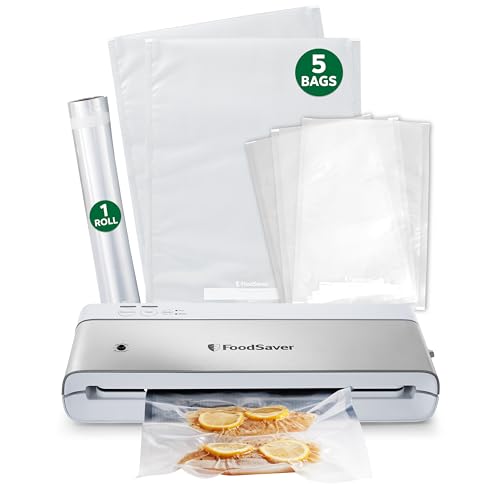
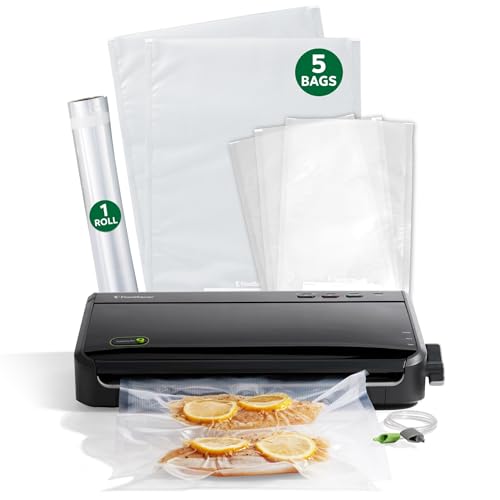
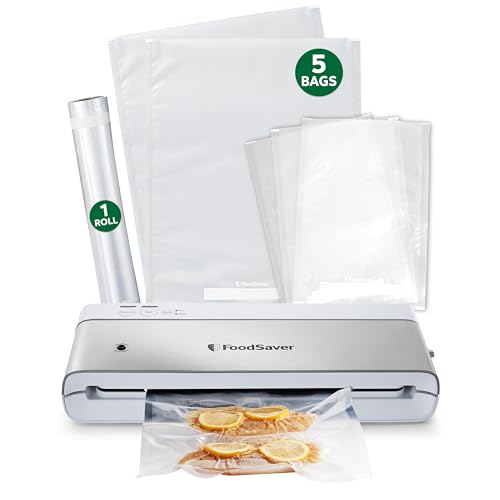
FoodSaver Compact Vacuum Sealer Machine
Badge: Best for Small Kitchens
Strengths
- Compact body that fits the small kitchens where most batch prep happens.
- Bags and a roll included — portion bags can be cut small and economical from the roll.
- A genuine welded seal for freezer batches of firm-frozen balls.
Trade-offs
- No pulse mode named in the listing: fresh, soft balls must be frozen firm before sealing.
- Compact pace on the largest batch days.
- Simpler mode set than the leaders.
Mini spec box
- Type: external countertop vacuum sealer, compact format
- Color: white
- Included: airtight bags and roll
- Uses: sous vide and airtight food storage
The Compact’s energy-ball method is a two-step: freeze the batch on a tray until every ball is firm, then seal portions on the standard cycle. Frozen oat-and-nut-butter bites are dense little hockey pucks; no home vacuum will deform them, and the Compact’s welded seal then gives those portions proper freezer life. The included roll matters for the economics — energy balls want small bags, and small bags cut from a roll cost a fraction of pre-cut sizes, with none of the slack that folds into seals.
What it asks in return is planning. The tray-freeze adds a stage to batch day, and a cook who wants to seal a soft, fresh ball gently, right now, needs a pulse machine from higher in this list. For the organized prepper — and batch cooking selects for organized people — the Compact is a sound, small, brand-backed answer whose limits are scheduled around rather than suffered.
Best for: organized batch preppers with small kitchens who freeze before sealing / Not suited for: sealing soft fresh balls without chilling
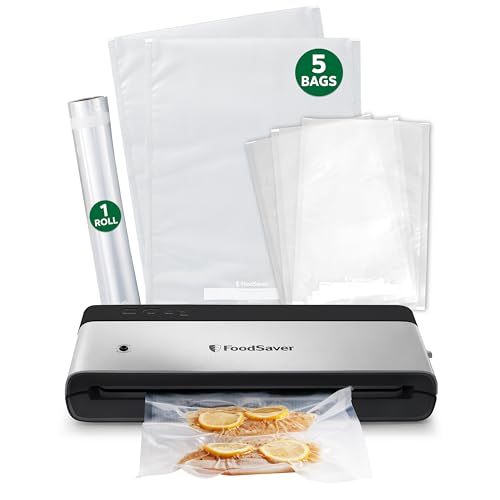
FoodSaver PowerVac Compact Vacuum Sealing Machine VS0150
Badge: Best Vertical Storage
Strengths
- Vertical storage keeps it on the counter of a prep-focused kitchen without stealing workspace.
- Designed to reduce bag waste — portion-sized bags are where waste hides, and this design fights it.
- Dry and wet food coverage handles sticky mixes’ messier cousins too.
Trade-offs
- No pulse mode named: freeze-first is the method for soft balls.
- Compact width and session pace.
- Fewer bundled extras named than the ROUUO’s kit.
Mini spec box
- Type: external countertop vacuum sealer, compact format
- Storage: vertical / upright storage
- Finish: stainless steel and black
- Food types: dry and wet food
Batch prep is a counter-space war — mixing bowls, trays of rolled balls, the cooling rack, the sealer — and the PowerVac’s upright storage is a genuine tactical advantage: it lives in a sliver of space and deploys in seconds. Its design brief of reducing bag waste also speaks directly to portion work, where the difference between a right-sized bag and a lazy oversized one is paid thirty times per batch. On firm-frozen balls its seals are the real welded thing, and its dry/wet coverage means the same machine handles the rest of the prep week’s proteins.
Like the Compact, it is a freeze-first machine for this category — no pulse is named in its listing — and its compact pace suits household batches rather than production runs. Preppers whose batches are a weekly tray or two will find it tidy and sufficient; preppers doubling recipes for a training block should look at the ROUUO’s session hardware. Either way, the freezer geometry is the same: flat, labeled, portioned bags that stack like books and surrender one serving at a time.
Best for: counter-tight preppers doing weekly freeze-first batches / Not suited for: fresh-soft sealing or production-scale runs

ROUUO Vacuum Sealer 95kpa with Pulse Mode
Badge: Best for Big Batches
Strengths
- Pulse mode: stop the draw at snug — soft balls keep their shape without a pre-freeze.
- Removable drip tray catches the sticky migration that nut-butter batches inevitably produce.
- 95kpa stated vacuum, 230W, bag storage and cutter, 3 rolls and 10 bags — a complete batch station.
Trade-offs
- Pulse control is manual: bag thirty depends on the operator’s attention holding.
- More machine than a small weekly batch requires.
- Strong full cycles will still crush unfrozen balls if the pulse is ignored.
Mini spec box
- Type: external countertop vacuum sealer
- Vacuum: 95kpa (as stated in listing)
- Power: 230W (as stated in listing)
- Modes: dry/moist, pulse mode
- Features: built-in bag storage and cutter, removable drip tray
- Included: 3 bag rolls and 10 bags
The ROUUO is the batch-day workhorse. Pulse mode is the obvious headline — on a tray of fresh balls, you draw each portion bag down until the film kisses the contents and stop, portion after portion, with the shape intact. But the drip tray is the feature batch veterans will appreciate by the second session: energy-ball mixtures smear, bags get sticky at the mouth, and residue migrates toward the machine. A tray that lifts out and rinses keeps the seal area honest from the first bag to the last, which is exactly when tired operators start producing tired seals.
The supporting kit completes the station: rolls stored in the machine, a cutter for portion-sized bags, and enough included film for real batches from day one. Its stated vacuum strength, a liability if unleashed on soft food, becomes an asset on frozen batches and dense mixtures, pulling portions tight and flat for a freezer that files rather than piles. The discipline it demands is attention — pulse is a manual skill — but for the cook making a hundred balls at a time, that attention is the craft, and the ROUUO is the tool that respects it. Hunters portioning trail snacks will recognize the same virtues in Best Vacuum Sealers For Hunters, where sticky, dense, portable food is the whole brief.
Best for: big batches, fresh-soft sealing via pulse, sticky mixtures / Not suited for: operators who want fully automatic cycles
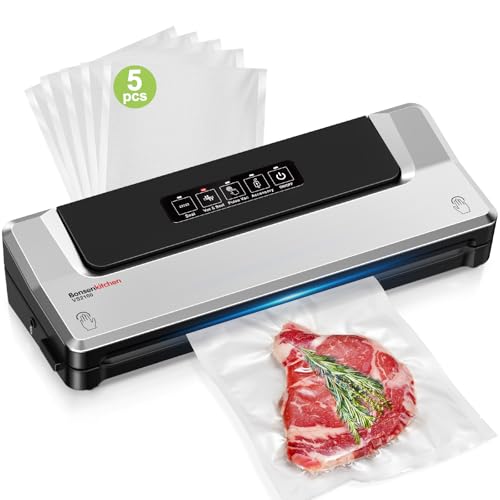
Bonsenkitchen Vacuum Sealer Machine
Badge: Best Value
Strengths
- A genuine external vacuum system at the value tier — welded portion seals without flagship money.
- Compact silver body stores in a drawer-adjacent footprint between batch days.
- Multiple modes for the wider meal-prep week around the energy-ball batch.
Trade-offs
- No pulse mode named: freeze-first is mandatory for soft balls.
- Only 5 bags included — portion work consumes film; order rolls with it.
- Compact pace on large batches.
Mini spec box
- Type: external vacuum system, compact countertop
- Modes: multiple modes for meal prep
- Finish: silver
- Included: 5 vacuum bags
- Uses: kitchen food storage and sous-vide
The Bonsenkitchen is how a prepper on a budget gets welded seals. Its contract with the energy-ball maker is simple: you supply the tray-freeze — an hour in the freezer that firms the batch — and it supplies a real external vacuum system with multiple modes, in a compact body, at the friendliest tier in this guide. Frozen balls seal without drama, portions stack flat, and the same machine covers the rest of the prep week, from chicken portions to sous-vide vegetables.
The economies show at the edges: five included bags is a tasting menu, not a batch supply, so rolls belong in the same order; and without a named pulse mode, fresh-soft sealing is off the menu. For a weekly tray of balls and a household’s ordinary sealing, those are fair trades — the money saved against the leaders buys a great deal of oats, nut butter, and film. Students, first apartments, and anyone testing whether batch prep fits their life should start exactly here.
Best for: budget batch prep with a freeze-first routine / Not suited for: fresh-soft sealing or film-free unboxing

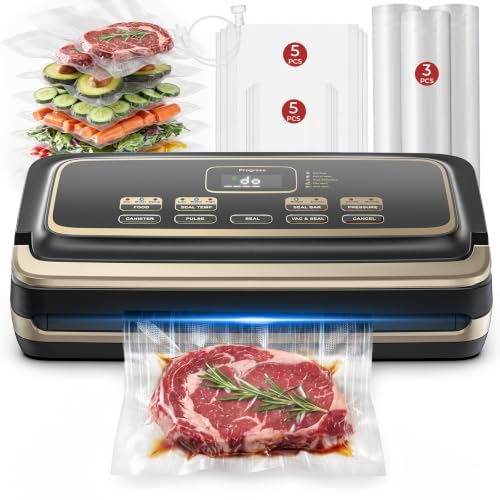
UPRUBE Vacuum Sealer, 95kPa, 9-in-1
Badge: Best Overall
Strengths
- Pulse mode plus a digital timer: find the perfect gentle cycle once, then repeat it identically across the whole batch.
- Dry and moist modes flank the pulse, covering the full prep week in one machine.
- Stated 95kPa vacuum and 12L/min speed, with cutter, bag storage, and a 10 ft roll included.
Trade-offs
- Nine functions ask for one learning session before batch day feels automatic.
- Stated power (135W) is below the ROUUO’s figure, though vacuum ratings match.
- Feature depth exceeds what a tiny weekly batch needs.
Mini spec box
- Type: external countertop vacuum sealer
- Vacuum: 95kPa (as stated in listing)
- Speed: 12L/min (as stated in listing)
- Power: 135W (as stated in listing)
- Modes: dry / moist / pulse, 9-in-1 functions
- Features: digital timer, easy-tear cutter, bag storage
- Included: 10 ft bag roll
The UPRUBE takes the top spot because energy-ball sealing is a repeatability problem, and it is the only machine here that attacks repeatability by name. Pulse mode finds the gentle stopping point for a fresh ball; the digital timer then makes that stopping point a setting rather than a judgment call, so the fortieth portion is sealed exactly like the fourth. Anyone who has watched their own technique drift across a long batch — the bags getting a little tighter, the balls a little flatter — will understand why that matters more than raw power. Add the fastest stated draw in the guide, which shortens each cycle and the batch with it, and the UPRUBE is simply the most process-complete tool for this food.
The rest of the workstation holds up: cutter and storage at the machine, a full roll included, moist mode for the week’s wetter prep. Its costs are the learning curve — nine functions is a small curriculum — and a stated wattage below the ROUUO’s, which in practice matters less than the shared 95kPa-class vacuum for this gentle work. For the committed prepper, the one who weighs portions and labels by macro, the UPRUBE is not just the best machine in this guide; it is the one designed by someone who has clearly stood where you are standing, tray in hand. Its gentle repeatability is the same quality our fish guide prizes in Best Vacuum Sealers For Fish, where the food is equally unforgiving of a heavy-handed cycle.
Best for: committed meal preppers, large consistent batches, fresh-soft sealing / Not suited for: one-button minimalists

Chef Preserve Compact Vacuum Sealer
Badge: Best for Fridge Portions
Strengths
- Stop-anytime handheld draw over reusable bags: the gentlest portioning in the guide, with zero film waste.
- Thirty reusable bags included — a whole season of snack portions in the box.
- Portable and drawer-sized: lives where the snacks are prepped and eaten.
Trade-offs
- No welded seal: freezer storage beyond the short term belongs to countertop machines.
- Portions share a bag more naturally than individual wrapping — fine for a household, less so for trading or gifting.
- Not a bulk-freezer production tool.
Mini spec box
- Type: handheld vacuum sealer
- Included: 30 reusable vacuum bags
- Format: compact, portable
Most energy balls live in the fridge and die within the week, and for that actual life cycle the Chef Preserve is arguably the smartest tool here. Portions go into reusable valve bags; the handheld draws the air down under your eye, stopping at snug; the bag opens at the gym, surrenders two balls, and reseals at home. No film is spent, no shape is crushed, and the thirty included bags mean the system is complete before the first batch is rolled. It is portioning as a habit rather than an event, which suits how snacks are actually eaten.
The boundary is the freezer. For a training block’s worth of balls stored for weeks, a welded countertop seal is the safer barrier, and the Chef Preserve makes no claim to that work. Think of it as the fridge-and-gym-bag specialist in a two-tool kitchen, or as the only tool in a small-batch, eat-them-fresh household. Either way, its economy — reusable bags, no consumable stream — is the lowest in this guide by a distance, and its gentleness is matched only by the pulse machines at several times the commitment.
Best for: fridge portions, daily snack habits, reusable-bag households / Not suited for: long freezer storage of big batches
Comparison Table
| Pick | Type | Energy-ball relevant features | Included extras | Link |
|---|---|---|---|---|
| FoodSaver Compact | External countertop, compact | Standard cycle — freeze-first method | Bags and roll | Check on Amazon |
| FoodSaver PowerVac VS0150 | External countertop, compact | Vertical storage, reduced bag waste, dry & wet | — | Check on Amazon |
| ROUUO 95kpa | External countertop | Pulse mode, drip tray, 95kpa, bag storage + cutter | 3 rolls & 10 bags | Check on Amazon |
| Bonsenkitchen | External countertop, compact | Multiple modes — freeze-first method | 5 bags | Check on Amazon |
| UPRUBE 95kPa | External countertop | Pulse + digital timer, dry/moist, 12L/min | 10 ft roll | Check on Amazon |
| Chef Preserve | Handheld | Stop-anytime draw, reusable valve bags | 30 reusable bags | Check on Amazon |
How to Choose a Vacuum Sealer for Energy Balls and Snack Prep
Start with where the balls will live. Fridge-and-week consumption points to the Chef Preserve’s reusable system or a pulse machine used gently. Freezer-and-month storage points to a welded seal — and then the question becomes whether the balls arrive at the bag frozen (any countertop machine works) or fresh (pulse required). Answer that one question honestly and half this guide selects itself.
Value repeatability over power. A batch is a repetition exercise. Timers, consistent programs, and a cutter that makes thirty identical bags are worth more, across a season of Sundays, than any vacuum figure. The strongest machine in this guide is ranked second for this category, and the reason is this paragraph.
Budget the film for portions. Small bags, many times a week: that is a real consumable stream. Rolls cut to size are the economy format; reusable bags eliminate the stream for fridge work. Price your actual portion count before choosing, because the machine is the cheap part of a year’s snack habit.
Match the machine to the batch size you actually make. A dozen balls a week is a handheld’s home turf or a compact’s light duty; a hundred balls a week is a workstation’s job, with roll storage, a cutter, and session hardware earning their space. Preppers routinely buy for the batch they aspire to rather than the one they make, and the mismatch shows up as either a struggling compact or a flagship used at a tenth of its capacity. Count last month’s balls — the real number, not the plan — and buy for the count you can defend.
Plan for sticky. Nut butters and honey migrate. A removable drip tray, an accessible channel, and the habit of wiping the bag mouth before every seal are what keep a snack machine pleasant in month six. Sticky is this category’s tax; the prepared pay it cheaply.
How to Seal Energy Balls Without Crushing or Fusing Them
- Chill the mixture before rolling. A firm mixture rolls cleaner, holds shape, and portions evenly — the batch’s quality is set here, not at the sealer.
- Tray-freeze for freezer storage. Spread rolled balls on a lined tray, freeze until firm, then portion into bags. Frozen balls cannot fuse or deform under vacuum.
- Or pulse for fresh sealing. On a pulse machine, draw each bag down slowly and stop the instant the film settles — snug, not tight. Watch the first ball in the bag; it is your gauge.
- Portion by serving. Three to five balls per bag matches how they are eaten and thaws in minutes. Leave headspace, and keep sticky residue out of the seal zone with a quick wipe or a folded bag mouth.
- Seal, inspect, label with the flavor and date. Every energy ball looks like every other at week three; the label is the recipe’s memory.
- Store flat. Portion bags freeze and stack flat, and a flat freezer is a findable freezer.
Troubleshooting. Problem: balls fused into one mass → they were sealed soft and pressed together; tray-freeze first, or pulse and stop earlier, and consider a parchment separator for very sticky recipes. Problem: bags lose vacuum → sticky residue crossed the seal; wipe the bag mouth, add headspace, and reseal in a clean section. Problem: balls taste stale early → air remained because the draw was too timid, or storage ran long; on frozen balls use the full cycle confidently, and rotate portions oldest-first.
Batch Day Workflow: From Mixing Bowl to Freezer Shelf
A smooth batch day has a shape. Mix and chill the base in the morning; roll in the early afternoon, when the mixture is firm and the kitchen is calm; tray-freeze while the kitchen resets; seal in one seated, rhythmic session with bags pre-cut and labels pre-written; freeze flat overnight; file the portions in the morning. The sealer’s part of that day is the shortest, which is exactly why the machine should be the most reliable actor in it — warmed up on a test bag, channel wiped, film loaded. Preppers who seal across categories can borrow the session discipline from the meat guides, including Best Vacuum Sealers For Meat, where the same stations-and-rhythm logic runs a much heavier workload. And when the recipe doubles for a training block or a bake sale, scale the tray-freeze before you scale anything else: freezer tray space, not sealer power, is the true bottleneck of energy-ball production.
How the Recipe Changes the Sealing
Not all energy balls seal alike, because recipes sit on a spectrum from dry and crumbly to wet and sticky, and the sealer meets a different food at each end. Dry, oat-heavy balls with little binder are the forgiving end: they hold shape under a standard cycle even unfrozen, though a gentle pulse still treats them kindly. The classic middle — oats, nut butter, honey or syrup, dried fruit — is the freeze-or-pulse territory this guide is built around. The wet end, built on fresh dates, added oils, or chocolate coatings, behaves almost like a confection: coatings crack under pressure, oils migrate toward seals, and sticky surfaces bond on contact. Those batches deserve the full ceremony — tray-freeze until genuinely hard, portion with parchment for the stickiest, seal on the full cycle only once frozen, and store them as the first-eaten portion of the freezer, since high-fat, high-sugar bites are at their best soonest.
Add-ins change the physics too. Whole nuts and cacao nibs create hard points that a descending bag presses into their softer neighbors — freeze-first turns that from a denting problem into a non-event. Protein powders dry a mixture out and make balls crumblier; crumbly balls contaminate seals with dust instead of smear, so the bag-mouth wipe becomes a bag-mouth brush. Coconut coatings shed; chocolate chips soften near a warm seal bar if the bag is loaded carelessly. None of this requires a different machine — it requires reading your own recipe the way this guide read the listings, for what it actually is rather than what the category name suggests. The cook who spends one batch learning their mixture’s sealing personality will never lose a batch to the vacuum again.
From Freezer to Gym Bag: The Portion Logistics
The point of an energy ball is the moment it is eaten — mid-afternoon, mid-ride, between meetings — and storage should be designed backwards from that moment. Freezer portions thaw in a bag in a pocket or desk drawer in the time a morning takes to unfold, which is why single servings beat family packs for this food. Keep a small rotation at the front of the freezer, oldest forward, and let the week’s eating draw it down in order. For fridge portions in reusable bags, the rhythm is even simpler: the bag lives on the same shelf, surrenders balls daily, and returns to the handheld for a five-second re-draw whenever it feels slack. Athletes in a training block will find it worth labeling portions by purpose — the pre-workout bag and the recovery bag are often different recipes wearing identical brown spheres — and households sharing a freezer should agree on whose shelf is whose before the first batch, because unlabeled, unowned snacks are community property by the second week. These are tiny logistics, but they are the difference between a batch system that runs for a year and a New Year’s resolution that ends in February.
Storing the Machine in a Prep Kitchen
A word for the machine’s own storage, since prep kitchens are crowded by definition. Countertop sealers earn a permanent spot only if the spot exists; measure before ordering, and consider the vertical-storage design if the counter is a battlefield of boards and bowls. Handhelds solve the problem by disappearing into a drawer, which is part of their genuine appeal for snack-scale work. Whichever format you choose, store it with its film: a sealer in one cupboard and its rolls in another is a small friction that batch day magnifies into annoyance, and annoyance is the first stage of disuse. Keep the channel clean, the cutter clear of sticky film scraps, and a marker tethered nearby for labels. The best-kept secret of long-running meal-prep households is not a recipe at all — it is that everything needed for the weekly batch lives within one step of the counter where the batch is made.
Common Buying Mistakes
- Sealing fresh balls on a full automatic cycle. The classic first-batch heartbreak. Pulse, or freeze first — those are the only two doors.
- Portioning the whole batch into one bag. It fuses, it thaws unevenly, and it defeats the grab-and-go purpose. Portion by serving.
- Ignoring film economics. Thirty small bags a week is a consumable habit; choose rolls or reusables before the habit chooses your budget.
- Letting sticky residue cross the seal. Wipe the bag mouth every time. Sticky seals fail silently and completely.
- Buying maximum vacuum for a soft food. In this category strength is a risk to be managed, not a benefit to be maximized.
- Skipping labels. Flavors are indistinguishable frozen. Date and name every portion or accept the mystery-snack lottery.
Gifting, Selling, and Sharing Batches
Energy balls travel socially — gym partners trade flavors, offices share batches, and small home bakers sell them at markets and through social pages. Vacuum sealing is what makes that sharing presentable and safe: a welded portion bag with the flavor and date on it looks like a product, keeps like a product, and survives a commute like one. For gifting, seal portions fresh with a pulse stop and include the ingredient list on the label — nut allergies make that label a safety feature, not a courtesy. For small-scale selling, check your local rules for home food businesses before the first sale, seal only fully chilled or frozen product for transport, and let the freezer be your warehouse: a sealed, dated, frozen inventory is the difference between a hobby that occasionally sells and a micro-business that can take an order on a Tuesday. The machines in this guide are home machines, and honest sellers will outgrow them before they outgrow the techniques — pulse judgment, tray-freezing, seal inspection — which transfer intact to any scale.
A final honesty check for the undecided: if your energy-ball habit is a single small batch eaten fresh within days, the simplest tools in this guide will delight you, and the leaders’ control systems are more than the job demands. If your habit is a freezer stocked by the hundred, buy the control and the session hardware without apology — the cost difference disappears into the first month of film and saved batches. The recipe, the rhythm, and the storage horizon decide; the machine is merely how those decisions get executed, Sunday after Sunday.
Final Recommendation
Buy the UPRUBE 95kPa Vacuum Sealer — Check on Amazon. Its pulse mode protects fresh balls, its digital timer makes the protection repeatable across a whole batch, and its dry and moist modes cover the rest of prep week without a second machine. Choose the ROUUO if your batches are bigger and stickier and you want the drip tray and the strongest stated pull; choose the Chef Preserve if your balls live in the fridge and die within the week. And whatever machine arrives, tray-freeze your first freezer batch. The technique is free, and in this category it is worth more than any specification on any box.
Frequently Asked Questions
Can you vacuum seal energy balls without freezing them first?
Yes, with the right control: a pulse-mode machine lets you stop the vacuum at snug, and a handheld lets you stop the draw by eye. On a standard automatic machine, no — the full cycle will compress and fuse fresh balls. Freeze-first is what makes automatic machines safe for this food.
How long do vacuum-sealed energy balls keep?
In the fridge, sealed portions comfortably outlast an open container by keeping air and odors away from the fats in nut butters, which are the first thing to taste stale. In the freezer, firm-frozen, welded-seal portions keep their quality for an extended stretch. Label with the date and rotate; nut-based recipes are the ones to eat first.
Why did my energy balls stick together in the bag?
They were sealed soft and the vacuum pressed them into contact, where sticky surfaces bonded. Tray-freeze before sealing, stop the pulse earlier, or slip parchment between layers for very sticky recipes. Once frozen separately, balls can share a bag indefinitely without fusing.
What portion size works best?
One serving — typically a small handful of balls — per bag. Single-serving bags thaw in minutes, travel without company, and keep the rest of the batch sealed and fresh. For family snack drawers, a slightly larger bag with a handheld reseal between raids is the practical compromise.
Do energy balls need a moist or dry mode?
Dry thinking applies: the mixture’s surface is moist and sticky rather than wet, so the enemies are residue in the seal zone and over-vacuuming, not liquid migration. Wipe the bag mouth, use pulse or a frozen ball, and the standard dry-style cycle does the rest. Save the moist mode for the week’s marinated proteins.
Should energy balls be stored in the fridge or the freezer?
Both, in sequence: the working supply in the fridge, in a gently sealed reusable or portion bag, and the reserve in the freezer, tray-frozen and welded into servings. Fridge storage keeps texture ready-to-eat for the week’s snacks; freezer storage protects the batches beyond that. Move a portion down the night before a heavy training day and the system runs itself.
Why do my sealed bags puff up after a day in the fridge?
Usually the seal was contaminated by sticky residue, or the draw stopped too early and the bag was never truly evacuated. Check the seal band for smears crossing it, and on the next batch wipe the bag mouth, add a little headspace, and let the pulse run one breath longer. If a bag puffs in the freezer instead, suspect a pinhole from a hard add-in and double-bag that recipe.
How do I keep portion bags from wasting film?
Cut bags from a roll at the smallest size that leaves proper headspace above the portion — for most servings that is a compact pouch, not a sandwich bag’s worth of film. Pre-cut a session’s bags in one pass so sizes stay consistent, and save the clean offcuts from other kitchen work for the tiniest portions. Reusable valve bags eliminate the question entirely for fridge storage, which is why the handheld earns its place in so many prep kitchens.
Do I need to add anything to keep energy balls from drying out?
No additives — the sealed bag is the protection. Drying and staleness in nut-and-oat snacks come from air exposure, which the vacuum removes and the seal keeps out. What the bag cannot fix is a recipe that started too dry; if a batch tastes parched on day one, adjust the binder next time rather than asking storage to rescue it.
What is the best way to thaw a frozen portion?
Move the bag to the fridge the night before, or let it sit at room temperature for the short time a small portion needs — small bags thaw fast, which is the point of portioning. Eat them cool for the firmest bite, or at room temperature for the softest. Avoid microwaving: it melts binders unevenly and turns a neat snack into a warm puddle wearing oats.
Are vacuum-sealed energy balls good for kids’ lunchboxes?
They are a natural fit: a sealed portion travels without leaking, stays fresh until lunch, and carries a label — which matters, because nut-based snacks and school allergy rules require clarity. Pack the portion frozen in the morning and it thaws by lunch while keeping the rest of the box cool. Check the school’s nut policy first; the sealer handles the packaging, not the permissions.
How many balls should I make in one batch?
As many as your tray-freeze space and one sealing session comfortably hold — for most kitchens that is two to four dozen. Beyond that, quality control drifts and the freezer trays become the bottleneck. Two focused batches on different days beat one heroic batch every time, and the second batch always runs faster than the first.
Can I use a vacuum sealer for other homemade snacks the same way?
Yes — the same two techniques cover the whole soft-snack family: granola bars, date bites, protein squares, and soft cookies all seal by pulse-when-fresh or freeze-first-when-batching. Sturdy dry snacks like trail mix and roasted nuts take a standard full cycle with no special handling at all.