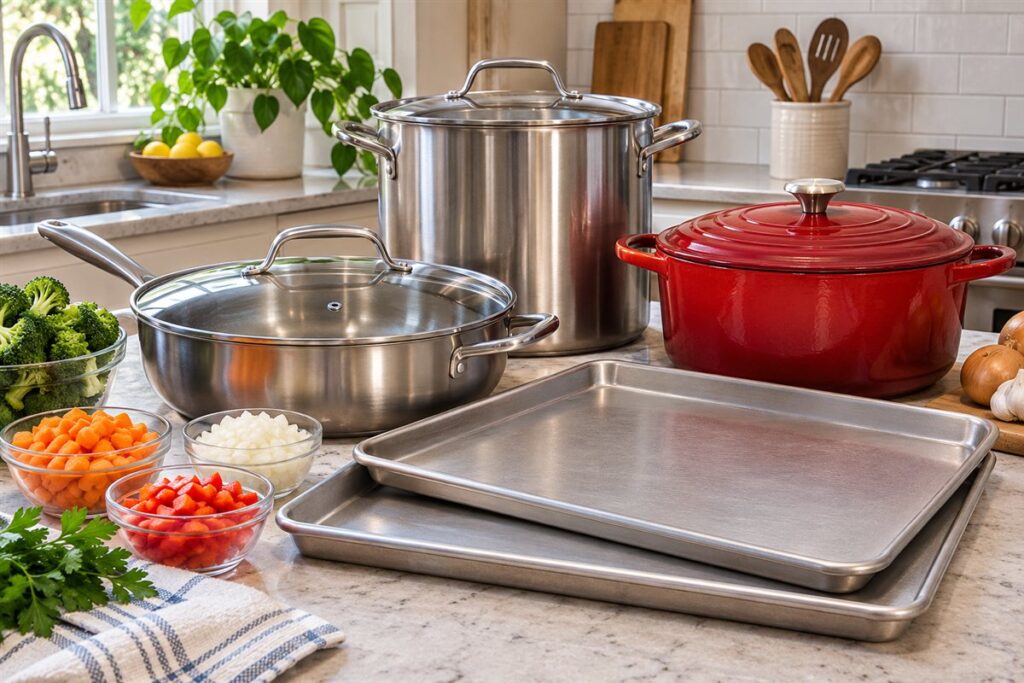
Big families do best with a few large, sturdy pieces: a tall stockpot, a wide deep skillet, a big Dutch oven and several sheet pans. Capacity, comfortable handles and storage space matter more than a long list of small items. This guide shows how to match sizes to the way you cook, with a planning walkthrough, sample dinners, common mistakes and a troubleshooting table.
Why Large Pans Help
Cooking a lot of food in a small pan crowds it, so food steams instead of browning. A wider surface lets pieces sit in a single layer, and extra depth keeps splashes inside. Large pots also hold enough soup, sauce or pasta for dinner plus leftovers.
Key Pieces and What They Do
| Piece | Typical use | What to check |
|---|---|---|
| Large stockpot | Soup, pasta, boiling batches | Comfortable two-handle grip |
| Wide, deep skillet with lid | Stir-fries, braised dishes, one-pan meals | Helper handle for lifting |
| Large Dutch oven | Stews, roasts, chili | Weight you can handle when full |
| Full sheet pans | Roasting, baking, trays of food | Fit inside your oven |
| Big roasting pan | Whole chickens, large cuts | Sturdy rack, handles |
Fit Matters at Home
Measure before you buy. A big pan must fit your oven, your sink and the burner you use. Many large pans overhang a single burner, which can cause uneven cooking, so check your stove layout.
- Check that your biggest pot clears the cabinet and fits the sink.
- Test the oven width for sheet pans with the door fully closed.
- Look for stable bases and firmly attached handles on heavily loaded pots.
Handling Heavy Cookware
- Use both hands and dry oven mitts for full pots and pans.
- Clear a landing spot on the counter before you lift anything hot.
- Fill pots only part way to leave room for bubbling and stirring.
- Keep children away from the stove while you move large pans.
- Cool soups and stews in shallow containers and follow food-safety advice for storage.
Cooking in Parallel
With a crowd, timing is the real challenge. Use the oven for one dish while the stove handles another, and keep a sheet pan of vegetables roasting while a pot of grains simmers. Having two or three large pieces ready means everything can finish at about the same time instead of waiting in turns.
Planning a Weeknight Dinner for Many, Step by Step
- Choose one main and two helpers. For example, a stew in the Dutch oven, a tray of vegetables on a sheet pan and rice or pasta in the stockpot.
- Sort the dishes by heat source. Oven dishes go in first, stovetop dishes run alongside, and anything that needs only a quick finish waits.
- Cut everything before you light the stove. Large batches take longer to prep than to cook, and having it ready prevents scorching while you chop.
- Brown in batches. A wide skillet browns best when pieces sit in a single layer with space between them. Work in rounds and move the finished pieces to a plate.
- Combine and finish. Add the browned food to the pot, deglaze the skillet and pour the liquid in so the flavor is not lost.
- Check doneness with a thermometer. For poultry, ground meat and other items covered by food-safety guidance, use the official temperatures rather than appearance.
- Cool leftovers promptly. Divide large pots into shallow containers so they cool faster, then chill them according to food-safety guidance.
Common Scenarios
Taco night for eight
One wide skillet browns the meat in batches while a sheet pan warms tortillas or roasts peppers and onions. A medium pot keeps beans warm, so everything arrives together.
Pasta for a crowd
A tall stockpot holds enough water that pasta can move freely and the pot does not drop far in temperature when it goes in. Keep the sauce in a separate pan so you can serve both when ready.
Sunday roast with sides
A roasting pan with a rack lifts the meat above its juices. Vegetables share the oven on a sheet pan, and the stockpot handles potatoes. Plan oven space ahead since two big pans may not fit side by side.
Batch cooking for the freezer
A Dutch oven or stockpot makes soup and sauce in volume. Cool them in shallow containers and label them, following food-safety guidance for freezing and reheating.
Mistakes to Avoid
- Overfilling pots. Liquid needs room to bubble, and overflow makes a mess and a burn hazard.
- Crowding the skillet. Too much food in one layer releases steam, so it stews instead of browning.
- Buying a pan that does not fit the oven. A sheet pan that blocks the door or touches the heating element cooks unevenly.
- Ignoring weight. A full Dutch oven is heavy, and a safe landing spot and two hands matter.
- Cooling a giant pot as one mass. A deep pot stays warm in the middle for a long time, which is why food-safety guidance favors shallow containers.
- Using one burner for a pan much bigger than it. The edges stay cool while the center overheats.
Quick Troubleshooting
| Symptom | Likely cause | What to try |
|---|---|---|
| Food steams instead of browning | Pan overcrowded | Cook in batches with space between pieces |
| Center burns while edges are pale | Pan larger than burner | Rotate the pan, or use a pan that fits the burner better |
| Sheet pan vegetables soggy | Pan too full or too much moisture | Spread in a single layer and use two pans |
| Stew scorches on the bottom | Heat too high or not enough liquid | Lower the heat, stir the bottom, add liquid |
| Pot takes ages to boil | Too much water or lid off | Use a lid until boiling and fill only as needed |
FAQ
Should I buy duplicates of the same pan?
Two matching skillets or sheet pans can be very useful when feeding many people, since they let you cook in parallel. They also stack neatly in a cupboard.
What size stockpot is common for family cooking?
Capacities vary by maker, so look at the quarts or liters listed and compare them to the amount you usually cook. Base it on the volume of your usual biggest batch of soup or pasta water, then leave room above it.
Is a heavy Dutch oven worth it for a big family?
It suits stews, braises and bread, but it must be lifted full. If weight is a concern, check stated weight and handle shape before choosing.
How do I keep lots of food warm until everyone sits?
Use a covered pot on low heat or a low oven, following food-safety guidance on holding temperatures. Avoid leaving food out for long stretches.
Do sheet pans need to match my oven exactly?
They should fit with a little room around the edges so air can circulate. Measure the oven interior, and remember racks and the door close in the usable space.
The Short Version
For a large household, focus on big capacity: a stockpot, a deep skillet, a Dutch oven and sheet pans. Measure your oven and cabinets first, cook in batches rather than crowding a pan, and handle heavy pieces carefully with both hands and good mitts. Cool leftovers in shallow containers and follow food-safety guidance.