Disclosure: As an Amazon Associate, topratedkitchenware.com earns from qualifying purchases. Links on this page are affiliate links; they cost you nothing extra. Prices and availability change often, so check the current Amazon listing before you buy.
A countertop oven buying guide has one job: to stop you buying the wrong oven confidently. The category looks simple from the outside — a box that toasts and bakes — and turns out to have real fault lines running through it: basic versus convection, dial versus digital, compact versus family-size, honest toaster oven versus full air fryer oven. This countertop oven buying guide walks those fault lines in the order you should decide them. First, what the appliance is and the main types on sale. Then the picks that define each tier, so the advice has concrete anchors. Then the criteria that matter, each framed as the question it really is — how much capacity, which functions, which controls, how much counter and clearance, how much cleaning — with the reasoning that turns a specification into a decision. Finally, how to prioritise by the way your household cooks, first setup and care, and the mistakes that send ovens back to the shop. Prices are described by tier throughout, never as fixed numbers, because listings move; check the current Amazon listing when you buy.
Key Takeaways
- Decide the type before the model: basic toaster oven, convection oven, air fryer oven and smart oven are different briefs.
- Capacity is your pans plus air space — measure cookware first, marketing numbers last.
- Convection is the single most valuable upgrade in the category; air fry is the second.
- Your counter must fit the oven plus the manufacturer’s ventilation clearance, on a heat-resistant surface.
- Controls are a temperament choice: dials for simplicity, digital for repeatability, guided presets for confidence.
- Cleaning design decides year-two satisfaction: removable crumb tray, wipeable interior, accessible corners.
What a Countertop Oven Does and the Main Types
At heart, a countertop oven is a small, fast, versatile oven: an insulated chamber with heating elements above and below the food, living on the counter, ready in moments. It toasts, bakes, roasts, broils and reheats, and in its modern forms it air fries, dehydrates and proofs as well. It exists because the full-size oven is oversized for most everyday jobs — slow to preheat, wasteful for a single tray, brutal in summer — and because the microwave, for all its speed, cannot brown or crisp. The types below are less a ladder of quality than a set of different answers to the question of how much oven your household needs.
One more framing helps before the types: a countertop oven should be bought the way you would buy a second oven, not the way you would buy a gadget. Gadgets are bought on features and novelty; ovens are bought on chamber, heat and controls, and judged over years of daily meals. Every section that follows applies that standard. If a claim about a model cannot be translated into what it does to your food, your counter or your cleaning routine, it is marketing, and this guide ignores it — a habit worth keeping when you leave this page and meet the listings themselves, where the translation work will be entirely yours.
The Basic Toaster Oven
The original format: radiant elements, a timer dial, toast shade control, and a chamber sized for toast, melts, reheats and small bakes. No fan, no menu, nothing to learn. Its virtues are price tier, footprint and total simplicity; its limits are uneven browning, modest capacity and a ceiling on ambition. For one or two people whose oven jobs are genuinely small, it remains not a compromise but the correct tool — a point the wider field in the best toaster ovens roundup makes across many models.
The Convection Countertop Oven
Add a fan to circulate the hot air and the appliance changes character. Browning evens out, roasting becomes a strength, cooking speeds up, and results start to resemble a real oven’s rather than a toaster’s. This is the category’s centre of gravity and the minimum specification this guide recommends for anyone who cooks — as opposed to reheats — regularly. Convection models span mid and premium tiers and every control style, and they are the baseline against which the other types are variations.
The Air Fryer Oven
Take the convection oven, strengthen the fan’s airflow, add a mesh basket or tray and an air fry program, and you have the format that has taken over the category. It crisps wings, chips and breaded foods convincingly while keeping the full oven repertoire and far more capacity than a basket fryer. For households whose cooking leans fried-and-crisp, this is the default modern choice; the crossover field is compared in the best air fryer toaster oven combos. Its honest caveat: ultimate crisping intensity still belongs to dedicated basket fryers, by a small margin.
The Smart Countertop Oven
The premium evolution: better element control for evenness, probes, guided cooking programs, app connectivity on some models, and build quality a clear step above the field. Smart here should mean measurably better cooking — steadier temperatures, smarter power distribution — before it means screens. Buyers who cook daily and bake seriously get real value from this tier; the connected end of the market is surveyed in our best smart ovens guide.
In this guide
Countertop Oven Buying Guide: Top Picks at a Glance
Six models anchor this guide — one per decision point a buyer actually faces. Tiers are given in words, because they stay true while listings change.
| Pick | Badge | Tier | In one line |
|---|---|---|---|
| Breville Smart Oven Air Fryer Pro | Best Overall | Premium | The evenness and build benchmark of the class. |
| Ninja Foodi XL Prestige Countertop Oven | Best for Families | Upper mid | Wide tray capacity and weeknight speed. |
| Cuisinart TOA-65 | Best All-Rounder | Mid | Digital control and balance at the market’s centre. |
| Instant Omni Plus | Best for Preset Cooks | Mid | Guided functions with strong air frying. |
| Hamilton Beach Countertop Oven | Best Value | Value | The basics done honestly, dials and all. |
| BLACK+DECKER Toaster Oven | Best for Small Spaces | Entry | Toast and reheats for one or two, tiny footprint. |
Each pick gets a mini-review after the criteria sections, because the criteria are what tell you which badge matters to you. The head-to-head judgements behind this table are in countertop oven reviews, and the category itself is reviewed in depth in the countertop oven review. A note on how the badges were awarded: each badge names the household the pick serves best, not a universal ranking, and several picks could honestly swap badges for particular readers — the all-rounder is also a fine family oven, the family pick is also a fine air fryer. Read the badges as signposts to the mini-reviews, where the reasoning lives, rather than as verdicts to be obeyed. A buying guide that cannot explain its own table is asking for trust it has not earned; this one would rather show its working and let you re-weight it.
How Much Capacity Do You Need?
Capacity is the criterion buyers get wrong most, in both directions, because manufacturers express it in toast slices and whole birds while households cook in pans and trays. Translate before you shop. Write down the three oven jobs you do most and the vessels they use — the casserole that serves your family, the tray your roast vegetables go on, the pizza size you actually buy. Measure those vessels. The right oven is the smallest one whose chamber accepts your largest everyday vessel with air space on every side, because air space is not pedantry: food hard against a wall or an element cooks unevenly and can scorch, and a pan that only just fits is a pan you will wrestle, hot, twice a meal.
Then think in bands. Compact ovens serve one or two people and simple jobs, and their small chambers heat fastest and waste least. Mid-size ovens — the market’s heart — serve couples and families for casseroles, trays, pizzas and batch baking, and are the default recommendation of this guide. Large and wide-format ovens serve big families, batch cooks and entertainers, and earn their footprint only when the volume is used weekly; a large chamber heating two slices of toast each morning is the category’s most common buyer’s remorse. Remember, too, that capacity you cannot reach is not capacity: in a small chamber, the top rack position sits close to the element, so tall dishes belong low, and some advertised fits assume positions that broil rather than bake. Judge by your food, in your pans, at the rack position the job needs.
A final capacity test, and the most practical one in this guide: the Sunday test. Picture the largest meal you cook in an ordinary week — not Christmas, not a party, the regular big one — and walk it through the chamber mentally, dish by dish. If it fits in one or two comfortable batches, the size is right. If it fits only by stacking, crowding or cooking in relay, either the size is wrong or that meal honestly belongs to the full oven, which is also a legitimate answer: many happy owners run exactly that split, everyday cooking on the counter and the weekly feast in the range. What you are buying is not the ability to cook everything, but the ability to cook most things without thinking about it.
Do You Need Convection and Air Frying?
Convection first, because it is the easier call: if you roast, bake or cook anything beyond toast and reheats, yes. The fan’s even heat is the difference between an oven that browns and a box that heats, and once you have cooked a tray of vegetables with it, the basic format feels unfinished. The only buyers who can skip it happily are the toast-and-reheat households already described — and even they should know that convection models reheat more evenly too.
Air frying needs one honest question: how much of your cooking is crisp food? If wings, chips, nuggets, breaded cutlets and roasted-crisp vegetables are weekly events, an air fryer oven is the right default, and its tray-format capacity will spoil you for basket fryers. If crisp food is a monthly event, a good convection oven plus a tray will cover it adequately, and the money is better spent on evenness and controls. Either way, keep the comparison honest: the dedicated basket fryer remains the crisping champion for small batches, so households whose cooking is mostly air frying in small quantities should compare both formats — our best air fryers guide covers the basket field — before assuming the oven format wins by default.
Dials or Digital Controls?
This is a temperament decision disguised as a specification. Dials are immediate, glove- and flour-friendly, operable by any guest, and effectively unbreakable in spirit; their cost is approximation — shade and temperature settings that you calibrate by experience and reproduce by eye. Digital controls are precise and repeatable: set the same temperature and time, get the same result, with countdowns, preheat signals and often an interior light as part of the package; their cost is a small learning curve and a little more distance between the cook and the machine. Guided preset systems, like the Instant approach, trade a degree of direct control for confidence — excellent for less experienced cooks, occasionally a half-step slow for instinctive ones.
There is no wrong answer, only mismatches. Baking households benefit most from digital repeatability. Households with children, grandparents or many hands cooking benefit from dial simplicity. Everyone should check three usability details whatever the style: whether the timer can be adjusted mid-cook without restarting, whether the display or markings can be read in your kitchen’s light, and whether the door and rack action feel solid — you will perform those motions thousands of times, and they are the truest predictor of whether you enjoy owning the machine.
How Much Counter and Clearance Do You Have?
Measure the counter before falling in love, and measure it the way the manual will: the oven’s footprint plus the ventilation clearance the manufacturer specifies at the sides, at the back and above. That total is the appliance’s real estate, and it is permanent — a countertop oven is not stored between uses, which is precisely its convenience and precisely its cost. Check the surface, too: it must be flat, stable and heat-resistant, because the underside and shell of a working oven get hot. Stone, tile and metal surfaces shrug this off; delicate laminates and wooden boards deserve a protective, heat-proof base or a different appliance position.
Then audit the surroundings with a safety eye. Nothing flammable belongs in the clearance zone — no paper towel holder drifting closer over the months, no curtain, no tea towel over the shoulder of the machine, no packaging or wooden utensils stored against its sides, and nothing at all stored on top, where heat concentrates. Under-cabinet placement needs the specified gap to the cabinet underside, because rising heat and steam will mark and eventually damage a cabinet that sits too close. The socket should be reachable without the cord crossing the hot shell or trailing where it can be caught. Kitchens that pass this audit can host any oven in this guide; kitchens that fail it should choose a smaller model or a different position, because no feature on any box outranks clearance. The convection-specific context is covered in our guide to the best convection ovens.
How Easy Is It to Clean?
Cleaning design is the criterion reviewers underweight and owners overweight, because it compounds: a small daily friction becomes, over years, the difference between an oven that is a pleasure and one that smokes faintly at every use. Look for a crumb tray that slides out from the front and actually catches the fall zone; an interior finish that wipes rather than scrubs — smooth coated interiors earn their keep here; racks and trays that fit your sink; and a door whose inner glass you can reach. Corners and the area around elements collect splatter in every model, so judge how accessible those areas are with the door open.
Then be honest about the routine the category demands, whoever makes your oven: crumb tray emptied often, interior wiped while cool after fatty cooks, racks washed before residue bakes hard, and no harsh abrasives or sprays on elements or coated surfaces. The full method is set out step by step in how to clean a countertop oven. If you know you will not keep a routine, weight easy-clean design even more heavily in your choice — and be aware that a neglected countertop oven is not merely grubby but a smoke and fire risk, which is the practical reason this guide treats cleaning as a buying criterion rather than a housekeeping footnote.
How Accurate, Fast and Even Is It?
Three performance qualities hide inside the word “good” in this category, and a buying guide should separate them. Accuracy is whether the chamber matches the setting: digital models generally hold their stated temperature more faithfully, while dial models may run a little hot or cool by a fixed amount that owners learn and compensate for. An inexpensive oven thermometer settles the question for your specific unit in one afternoon, and after that the number on the dial matters less than your notes. Evenness is whether the chamber cooks uniformly across the tray — the quality premium element control exists to buy, and the one that decides baking and large-batch roasting. Speed is preheat and recovery: small chambers heat in a fraction of a full oven’s time, and better-insulated models return to temperature faster after the door opens for a tray rotation.
Weight these by your cooking. Bakers should rank accuracy and evenness first and shop accordingly. Roasters and air fryers should rank evenness of airflow and tray results. Reheaters and toasters can rank speed and simplicity and save their money. What no buyer should do is chase a specification sheet’s version of these qualities; they are behaviours, not numbers, and they are exactly what the model reviews in countertop oven reviews were written to describe in words.
What About Heat, Noise and Living With It?
A countertop oven is a powerful heater in a small box, and daily life with one has a texture worth previewing. The exterior gets hot in use — the top most of all — so it is never a shelf, never a place for a resting tray of ingredients, and a surface to plan around where children are concerned. The fan is audible on convection and air fry modes: a working hum that premium models mute and value models do not hide. Cooking smells escape more readily than from a sealed range oven, which most households count as advertising at dinner time and a reason to run the extractor at lunch. Heat leaves through the vents and warms the immediate corner of the kitchen, another reason the clearance above and behind is functional rather than decorative.
None of this is a reason not to buy; all of it is a reason to buy with your eyes open and your counter planned. Households that place the oven thoughtfully — clear zone, heat-resistant surface, nothing flammable nearby, room for the door to open and trays to land — report these traits as background facts within a week. Households that wedge the oven into a cluttered corner experience the same traits as grievances. The appliance does not change; the placement does, which is why this guide keeps returning to the tape measure.
How to Prioritise by Use Case
Criteria only become a decision when they are weighted, and the weights come from your cooking. The weeknight family profile — trays, casseroles, reheats, speed — should weight capacity and preheat speed first, convection and air fry second, and forgive dial simplicity or preset guidance equally. The baker’s profile weights temperature steadiness, evenness and digital repeatability above everything, and should shop the premium and digital mid tiers first. The small-household profile — one or two people, simple jobs, premium counter space — should weight footprint and simplicity, and take the entry and compact models seriously rather than as leftovers. The second-oven profile, deputising for a good range, should weight the specific deputised jobs: reheating quality and keep-warm for entertainers, air frying for households adding crisping to their repertoire, compact size for a utility room or holiday home. Write your profile’s top two criteria down before you shop; the market’s noise mostly targets criteria you do not have.
The Picks, Reviewed in Miniature
Breville Smart Oven Air Fryer Pro — Best Overall
The premium benchmark: smart element control delivers the class’s most even cooking and its most convincing baking, the function range is the broadest here, and the build and interior finish make ownership feel a tier above. It asks premium-tier money and a large, properly cleared footprint in return. Best for: daily cooks and bakers who will use the full range. Not suited for: small counters or simple needs.
In buying terms, this is the pick for households that have already decided the category matters to them — second-oven households, keen bakers, daily cooks — and want the version with the fewest compromises. Its evenness shows in toast, its steadiness in bakes, and its finish in the weekly wipe-down. Buy it when the counter passes the clearance audit with room to spare and the budget tier is a considered choice rather than a stretch, because its virtues are the kind you appreciate for years and its size is the kind you notice every day.

Ninja Foodi XL Prestige Countertop Oven — Best for Families
A wide-chamber family engine: sheet-pan meals in one layer, fast preheats, powerful convection and air frying, presets tuned to weeknight reality. The width is the caveat — measure the counter run, with clearance, before choosing it. Best for: families and tray-meal cooks. Not suited for: narrow counters or precision bakers.
As a purchase, it makes most sense where the family meal is the unit of cooking: one tray, everybody fed, minimal washing up. Its presets genuinely reduce weeknight friction, and its air fry performance handles the foods families actually crisp. The buying check is purely physical — a long, clear counter run — plus one honest question about baking, because households that bake seriously will get more from the Breville’s steadiness than from this oven’s width.

Cuisinart TOA-65 — Best All-Rounder
The balanced mid-tier default: digital repeatability, capable air frying and roasting, family-suitable capacity in a moderate footprint, and no serious weakness anywhere. Keep the interior wiped and it will serve for years. Best for: couples and small families wanting one versatile oven. Not suited for: the largest households or buyers wanting top-tier refinement.
This is the pick this guide expects to fit the most readers, and the buying logic is portfolio logic: it is near the top of the class at almost everything and at the bottom at nothing. If your criteria list has no single dominant item — a bit of baking, a bit of air frying, plenty of reheating, family quantities — the all-rounder is not a compromise but the mathematically right answer, and its digital controls make its results the most repeatable in its tier.

Instant Omni Plus — Best for Preset Cooks
Instant’s guided philosophy in oven form: clear display, sensible presets, strong air frying and family portions, in a machine that makes less confident cooks capable quickly. Best for: Instant households and program-guided cooks. Not suited for: minimalists who prefer two dials to a function menu.
Buy it when the cooks in the house value guidance over direct control — new cooks, busy parents handing dinner to teenagers, anyone who already trusts the Instant way of working. Its air frying is a particular strength for its tier, and its display communication is clear enough that the manual can stay in the drawer. Experienced cooks who season by instinct and adjust by feel may find its program-led flow a half-step slower than the Cuisinart’s directness; that temperament check is the whole decision between them.
Hamilton Beach Countertop Oven — Best Value
The honest workhorse: convection on the models that offer it, simple dials, thoughtful door designs on some versions, and basics — toast, bakes, casseroles, reheats — done properly at a value tier. Expect a short calibration period for its dial temperatures. Best for: value-first buyers, rentals, offices, second ovens. Not suited for: precision baking or heavy air frying.
The buying case is straightforwardness itself: where the job list is short and the budget tier matters, this is the oven that spends its cost on cooking rather than on interface. It is also the natural second oven — the deputy in a utility room, the office kitchen’s workhorse, the holiday home’s only oven — because its simplicity survives irregular use and unfamiliar users. Serve the short dial apprenticeship in the first week and it asks nothing more of you.
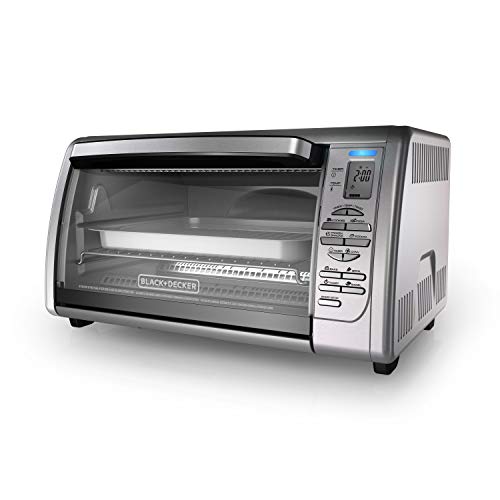
BLACK+DECKER Toaster Oven — Best for Small Spaces
The entry point, and for its brief the right tool: toast, reheats and small portions for one or two people, with zero learning curve and the smallest footprint here. Larger versions add functions and room; the classic compact is the purest expression. Best for: singles, dorms, tiny kitchens. Not suited for: family cooking or keen bakers. Buyers hovering between this and a basket fryer should also see the best air fryers that toast.
Do not let the tier talk you out of it if the brief fits. A compact toaster oven that gets used three times a day is a better purchase than a premium oven that intimidates its owner into using the microwave. The buying checks are simply that your portions genuinely fit, that toast and reheats really are the whole job list, and that the counter saved goes to something your kitchen needs more. Where all three hold, this is the guide’s easiest recommendation.
What the Tiers Actually Buy You
Because this guide prices nothing, it owes you a clear account of what moving up a tier purchases, in the currency of daily experience. The entry tier buys the format itself: toast, reheats and small bakes, simply and reliably. The value tier adds convection on the better models, more capacity and sturdier construction — the point at which the appliance becomes a cooking tool rather than a warming one. The mid tier adds digital repeatability, convincing air frying, better interior finishes and family capacity: this is where most households should expect to land, and where the category’s value concentrates. The upper mid tier adds format specialisation — the wide family tray, stronger presets, faster work. The premium tier adds evenness, steadiness, build and finish: qualities you feel in baking, in cleaning and in the machine’s tenth year as much as its first.
Read that ladder against your frequency of use and it prices itself. Daily use justifies tiers quickly, because every refinement is collected daily. Weekly use argues for the honest middle. Occasional use argues for simplicity and a small footprint, with the savings spent on ingredients. The one combination this guide warns against at every tier is paying for capacity and functions while skimping on placement: a premium oven wedged into an unsafe corner is a worse purchase than a value oven with room to breathe, every single time.
Accessories, Spares and the Second Purchase
Most countertop ovens arrive with the essentials — a baking tray, a wire rack, and on air fry models a mesh basket — and the sensible second purchases are few. A spare tray sized to the chamber doubles your throughput on batch days and gives the original a rest during washing. A small casserole or baking dish in oven-safe glass, ceramic or metal, fitted to the chamber with air space around it, extends the oven into gratins, bakes and roasts that the flat tray handles poorly. A compact oven thermometer, for owners of dial models or keen bakers, turns temperature guesswork into knowledge for very little money. Beyond those, accessory enthusiasm mostly buys clutter: the chamber is small, its geometry specific, and pans bought for a full oven rarely fit it well.
Two cautions belong here. First, measure the chamber before buying any accessory, door closed, and respect the air space rule — an accessory that touches walls or elements is worse than none. Second, treat replacement parts as a tier consideration at purchase time: established brands in this guide’s picks support their ovens with trays, racks and baskets that can be replaced when the originals wear, which quietly extends the appliance’s life. A cheap oven whose tray cannot be replaced is a disposable oven wearing a lower price tag.
First Setup and Care Essentials
Setup day sets the terms of ownership. Place the oven on its heat-resistant surface with the manufacturer’s clearance at sides, back and above; route the cord directly to a wall socket without crossing the shell; run the empty first cycle the manual recommends, in a ventilated room, to clear manufacturing residues; and cook something familiar first, so you can read the machine’s character against food you know. Register the rack positions in your mind — low for tall dishes and gentle baking, middle for everyday work, high for finishing and broiling — because position is the control owners use most and manuals explain least.
Care, in brief, is the routine this guide has repeated deliberately: clearance kept clear and nothing stored on top; flammables kept away from the shell and vents; crumb tray emptied on a rhythm; interior wiped when cool; racks and trays washed before residue hardens; fatty foods watched at high heat and never left running unattended. None of it takes more than moments at a time, and all of it together is the difference between an oven that performs like new for years and one that smokes, smells and fades early. The balanced case for and against the whole category, if you are still deciding whether to buy at all, is laid out in countertop oven pros and cons and is a countertop oven worth it.
Three Worked Shortlists
Criteria become real when they meet a kitchen, so here are three typical readers run through this guide’s logic. The first is a couple in a flat with a modest counter run, cooking trays and casseroles four nights a week, reheating at lunch, baking rarely. Their pans are mid-size, their clearance audit passes on one stretch of counter, and their dominant criteria are capacity-in-band and even reheating. The guide lands them on the mid-size convection band: the Cuisinart TOA-65 if they like setting temperatures precisely, the Instant Omni Plus if they prefer choosing a program, with the Hamilton Beach as the value alternative if the tier matters more than the interface. The second reader is a family of five in a house with a long counter, whose cooking is tray meals, wings and pizzas against a school-night clock. Capacity and speed dominate; baking barely registers. The Ninja Foodi XL Prestige is their answer, with the Breville as the alternative if a parent bakes seriously at weekends and the counter passes for the larger footprint. The third reader is a single person in a studio, cooking for one, with a counter already shared with a kettle and a board. Simplicity and footprint dominate; the BLACK+DECKER compact is the honest pick, and the money not spent buys better ingredients for a year.
Notice what none of the three shortlists did: none started from a model, a brand or a function list. Each started from meals, pans, counter and cooks, and let the criteria eliminate. That order — kitchen first, catalogue second — is the entire method of this buying guide compressed into one habit, and it works in every appliance category you will ever shop.
Mistakes to Avoid
The category’s buying mistakes are consistent enough to list. Buying by headline capacity instead of your own pans. Measuring the oven but not the clearance, then discovering the only counter run it fits is under a low cabinet. Paying for a function list — dehydrate, rotisserie, a dozen presets — that your cooking will never touch, while skimping on the evenness and controls you will use daily. Choosing a large oven for a small household’s jobs, or a compact oven for a family’s. Ignoring cleaning design and inheriting a chamber you dread opening. Placing the oven on a surface that cannot take heat, or letting its clearance zone fill with the ordinary clutter of a working kitchen. And the meta-mistake beneath them all: shopping the category before deciding which type of countertop oven your household actually needs. The step-by-step decision process in how to choose a countertop oven exists to prevent exactly that.
Countertop Oven: A Hands-On Fit Check Before You Commit
Start with the space, storage and everyday routine this {p} has to fit into. Most coverage of a countertop oven concentrates on the first week of ownership, yet the decisions that matter most tend to surface later, once the countertop oven has to earn its place in an ordinary weekday routine rather than a carefully staged first attempt. Write down the three jobs you expect it to do most often, in the order you actually do them, and judge every claim you read against that short personal list instead of against a generic ideal.
Use a short decision checklist to finish. One, does it fit the space and the storage you really have. Two, does it handle your three most common jobs without a workaround. Three, do the edge cases you listed stay manageable. Four, can every wear part be cleaned or replaced without drama. Five, would you still choose it if a friend described the same drawbacks in their own kitchen. A countertop oven that passes all five is a sound buy; one that fails two or more is a compromise you are choosing with open eyes, which is a very different thing from being surprised later.
Measure before you commit. Note the footprint, the clearance above and behind the spot where the countertop oven will live, and the route you will carry it by when it is hot, full or awkward. A countertop oven that technically fits but blocks a cupboard door, crowds a neighbouring appliance or has to be dragged across a worktop every time will quietly fall out of use, whatever its merits on paper. In the Kitchen Appliances category especially, a few centimetres of clearance and a sensible storage plan separate a daily tool from a bulky regret.
When you check listings such as Breville Smart Oven Air Fryer Pro, Ninja Foodi XL Prestige Countertop Oven and Cuisinart TOA-65 Digital AirFryer Toaster Oven, use them as worked examples: run through the same checks below on each one in turn, so the comparison stays honest and like for like rather than based on whichever listing happens to shout loudest.
Troubleshooting is easier when you expect the usual failure points. With any countertop oven, the recurring problems tend to cluster in the same places: uneven results from overloading or poor arrangement, wear showing first on the parts handled most often, and small annoyances with lids, seals, handles, controls or fittings that only appear after repeated use. Before buying, look for whether those wear parts can be cleaned properly, replaced or worked around, and whether the instructions address them directly rather than pretending they never happen.
Finally, plan the first fortnight deliberately. Use the countertop oven for one familiar job first, so you have a baseline you trust, then introduce the harder cases one at a time and note what changes. Small adjustments to arrangement, timing, quantity or preparation usually close most of the gap between disappointing first results and the performance the design is capable of. That short learning period is also the fairest test of measurement and fit: if the routine has not settled by the end of it, the mismatch is real, and it is better to know while returning or exchanging is still straightforward.
Maintenance decides how long the good results last. Set a simple rhythm: a quick wipe or rinse after each use, a deeper clean on a fixed day, and a periodic check of the parts that move, seal or bear weight. A countertop oven that needs fiddly disassembly for basic care will be cleaned less often, and performance drifts long before anything actually breaks. Prefer designs where the parts that get dirtiest are the parts that are easiest to reach, and be honest with yourself about which cleaning steps you will genuinely keep up.
Edge cases deserve a deliberate pass. Think about the odd shapes, the thicker or thinner than usual loads, the leftovers, the second helping and the guest with different preferences. A well-chosen countertop oven handles the exceptions gracefully, or at least predictably, while a poor match turns every exception into a workaround. List your two or three most common exceptions in advance and check, from the manual or the listing details, that nothing about them is ruled out by size, shape, material or care requirements.
Work through a realistic scenario, not a best case. Picture the busiest version of the job: more people to serve, less time than planned, ingredients or materials that are slightly out of the ordinary, and a clean-up waiting at the end. Ask how the countertop oven behaves at that upper edge, because a model that only shines on a small, simple load will disappoint precisely when you need it most. If the honest answer is that you would split the job into batches or fall back on an older method, factor that into the decision now rather than discovering it later.
One more check worth doing with any countertop oven is to read the care and safety instructions in full before the first use, not after the first problem. The manual for a countertop oven usually states plainly which materials, loads and cleaning methods are off limits, and most early disappointments trace back to a line in those pages that was skimmed. Five minutes with the instructions is the cheapest performance upgrade available in the whole Kitchen Appliances category.
Frequently Asked Questions
What is the best countertop oven for most people?
For most households, a mid-size convection model with air frying, from the market’s centre — the Cuisinart TOA-65 is this guide’s anchor example, with the Instant Omni Plus as the guided alternative. That specification covers the widest range of real cooking: family casseroles and trays, credible crisping, even reheating, in a footprint most counters can host with proper clearance. Move up to the premium tier if you bake seriously or cook daily and will feel the refinement; move down if your jobs are simple or your household is one or two people. Best for most is a starting point, not a verdict — your pans and your counter have the final say, and a model that fits both will outperform a theoretically better model that fits neither, every week of its life.
How is a countertop oven different from a toaster oven?
Think of the toaster oven as the ancestor and the countertop oven as the grown-up category it became. A basic toaster oven toasts and reheats with radiant heat and simple controls. A countertop oven adds convection for even cooking, a wider and more accurate temperature range, family-scale capacity and functions — air fry, roast programs, dehydrate, proof — that make it a genuine second oven. The terms blur in marketing, so shop by features rather than labels: fan or no fan, capacity in your pans, controls you like. If the box only needs to toast and reheat, the simpler name is also the right purchase.
Can a countertop oven air fry as well as a separate air fryer?
Nearly, and for many households the difference never matters. A basket fryer crisps slightly more intensely in small batches because of its compact, high-velocity airflow and shakeable basket. An air fryer oven crisps a whole tray at once, more evenly across a large batch, while also baking, roasting and reheating like an oven. If your air frying is small-batch and crunch-obsessed, the basket is the specialist tool. If it is family quantities and part of a wider cooking life, the oven format is the better buy — which is why it has become the category’s default.
What size countertop oven should I buy?
The size that fits your largest everyday pan with air space around it, and fits your counter with the manufacturer’s clearance around the oven. Compact for one or two people and simple jobs; mid-size for most couples and families; large or wide-format only if you cook at that volume weekly. Resist buying a size up for occasional entertaining — the full oven covers those days — and resist squeezing a large model into a tight counter, because clearance is a safety requirement, not a style preference. When in doubt, the mid-size band is the category’s centre for a reason.
Where should a countertop oven go in the kitchen?
On a flat, stable, heat-resistant surface, with the ventilation clearance its manual specifies at the sides, back and above, away from curtains, towels, paper and anything else flammable, with its cord reaching a wall socket without crossing the hot shell. Under-cabinet positions are fine only with the specified gap above the unit. Nothing should be stored on top of it, and the clearance zone should be defended against the slow drift of kitchen clutter for the whole life of the appliance. Placement is part of the purchase: an oven with nowhere safe to live is the wrong oven, whatever its features.
Are countertop ovens expensive to run?
For the jobs they are sized for, they are among the more economical ways to cook: a small chamber heats quickly and holds less wasted heat than a full oven, and everyday quantities finish faster. The running cost of any electric oven depends on your tariff and habits, so this guide avoids invented figures — but the structural point is reliable: matching appliance size to meal size saves energy, and the countertop oven is that match for most weeknight quantities. It also keeps heat out of the room in summer, which is a comfort saving owners mention as often as the meter. The exception proves the rule: a load so large that the countertop oven must run three batches back to back can cost more — in time certainly, and possibly in energy — than one run of the full oven. Economy follows the same law as everything else in this guide: the right size for the meal in front of you.
Related Guides
Pair this guide with countertop oven reviews for head-to-head judgements, how to choose a countertop oven for the step-by-step method, and the live roundups: the best toaster ovens, the best convection ovens and the best air fryers.
Start with the meals, then the measurements: families reheating, roasting and air frying most nights will get the most from the Breville Smart Oven Air Fryer Pro or the Ninja Foodi XL Prestige, while smaller households can save space and money with the Cuisinart TOA-65 or a compact Hamilton Beach. Confirm the footprint, the clearance above and behind, and the largest dish you genuinely cook before ordering. Chosen that way, a countertop oven stops being a spare appliance and becomes the oven you reach for first on weeknights.