Disclosure: As an Amazon Associate, topratedkitchenware.com earns from qualifying purchases. Links on this page are affiliate links; they cost you nothing extra. Prices and availability change often, so check the current Amazon listing before you buy.
This countertop oven review treats the whole modern category as its subject: the toaster oven that learned to air fry, roast, bake and dehydrate, judged as one family of appliances rather than as a single box. That framing matters, because the countertop oven is no longer the narrow toast-and-reheat gadget it once was. Today’s countertop oven is a genuine second oven — a compact convection chamber that preheats quickly, cooks a family tray of vegetables, crisps wings, bakes a small batch of cookies and still makes morning toast without waking the full-size range. Reviewed as a class, it is one of the most useful upgrades a busy kitchen can make, provided the buyer understands what it replaces, what it cannot replace, and how much counter it honestly demands. This review works through design, real cooking performance, the reference models that define each tier, and the ownership realities — heat, cleaning, clearance and counter space — that decide whether owners still love the appliance a year later.
Countertop Oven Review: Verdict and Key Takeaways
The short verdict: as a category, the countertop oven earns a strong recommendation for households that cook in small-to-medium quantities, reheat often, and resent heating a full oven for a single tray. Its central promise — oven-quality results at countertop speed and convenience — is delivered by every serious model in the class, from the entry tier to the premium tier. What separates the tiers is not whether the food cooks, but how evenly it browns, how intelligently the controls behave, how much fits inside, and how pleasant the machine is to clean and live beside. The weaknesses are equally consistent across the class: these ovens run hot on the outside, they claim real counter territory, the air fry function never quite matches a dedicated basket fryer for pure crisping, and crumb management is a permanent chore. Buy the class with open eyes on those four points and it is very hard to be disappointed.
Key Takeaways
- Format first: a countertop oven is a second oven that also toasts and air fries — judge it as an oven, not as a big toaster.
- Convection is the dividing line: fan-assisted models brown and crisp far more evenly than basic radiant models.
- Capacity claims need translation: judge by the pans and dishes you actually own, not by headline slice counts.
- Every tier cooks well; higher tiers buy evenness, smarter controls, easier cleaning and quieter, cooler operation.
- Clearance is non-negotiable: these ovens need the ventilation space the manufacturer specifies, on a heat-resistant surface, away from anything flammable.
- Crumb discipline decides long-term satisfaction: a removable crumb tray, emptied often, prevents smoke, smells and fire risk.
In this guide
What a Countertop Oven Is and Where It Fits
A countertop oven is an insulated cooking chamber, heated by elements above and below the food, sized to live permanently on a kitchen counter. The basic toaster oven is the ancestor: radiant elements, a simple timer, toast and small reheating jobs. The modern countertop oven adds a convection fan that circulates hot air for even browning, a wider temperature range, and a menu of functions — bake, roast, broil, air fry, dehydrate, proof, reheat, keep warm — that together cover most of what a full oven does on weeknights. The largest models in the class will take a family-size casserole, a tray of chicken pieces or a whole small bird; the smallest are honest two-person appliances for toast, melts and single portions.
Where it fits in a kitchen depends on what it displaces. For many households it displaces the full oven on weeknights: preheating a small chamber is faster and wastes less energy than heating a large cavity for one tray, and in warm weather it keeps far less heat in the room. It displaces the microwave for reheating anything that should stay crisp — pizza, roast potatoes, fried leftovers — because dry oven heat restores texture that microwaves destroy. It partly displaces a basket air fryer, trading a little crisping intensity for far more capacity and versatility. And in small apartments, dorms, offices, holiday homes and RVs, it may be the only oven there is, which raises the stakes on choosing capacity honestly. Readers comparing formats head-to-head will find the wider category context in the best toaster ovens roundup and our guide to the best convection ovens useful alongside this review.
One clarification prevents most disappointment: a countertop oven is not a miniature replica of a wall oven. Its elements sit closer to the food, so the top of a dish browns faster and delicate bakes need watching; its chamber loses heat quickly when the door opens; and its thermostat cycles around the set point rather than holding it with the thermal mass of a big oven. None of this stops it baking well — generations of owners bake in them daily — but it rewards cooks who learn their own machine’s habits, rotate trays, and treat the first run of any recipe as calibration.
Design, Build and Setup
Design across the class divides into three control philosophies. Dial-driven models keep the toaster oven’s simplicity: turn to a function, set temperature and time, done — intuitive for every age of cook, and quick to use with wet or floury hands. Button-and-display models add precision: exact temperatures, countdown timers, presets that set sensible defaults, and often an interior light and a screen that tells you the stage of cooking. Touch and app-connected designs sit at the premium end, adding guided cooking and probes on some models. None is objectively best; the right choice is the one the household will use without thinking, because a countertop oven earns its keep through frequency of use.
Build quality shows in the door, the racks and the interior finish. A door that closes with a solid, damped motion and seals evenly keeps heat in and browning consistent; flimsy doors leak heat at the corners and toast unevenly. Racks should slide smoothly and hold a loaded tray without sagging, and multiple rack positions matter more than most buyers expect — position decides how close food sits to the top element, which decides browning. Interior finishes range from basic galvanised metal that stains over time to smooth non-stick coatings that wipe clean; the difference is invisible on day one and obvious by month six. Exterior materials follow the tiers too: painted steel at entry level, brushed stainless at mid and premium levels, with matching differences in how hot the shell feels and how well it resists fingerprints.
Setup is simple but not thoughtless. The oven needs a flat, stable, heat-resistant surface — stone, tile, metal or a heat-proof board, never a plastic laminate you care about if the model runs hot underneath, and never a cloth or wooden board that can trap heat or scorch. Around it, the manufacturer specifies ventilation clearance at the sides, back and especially above, because the top surface and the air leaving the vents get genuinely hot; that clearance is a safety requirement, not a suggestion, and it means the honest footprint of any countertop oven is larger than its base. Nothing flammable belongs above or beside it — no paper towels, curtains, wooden utensils, tea towels or packaging — and the cord should reach the socket without crossing the hot shell or dangling where it can be pulled. Before the first cook, run the oven empty through a hot cycle as most manuals advise, to burn off manufacturing residues, and expect some new-appliance smell on that first run only.
The Reference Models in This Review
Six models define the class well enough to judge the whole category against them. Each is treated in prose here, with its tier and character described honestly; check the current Amazon listing for the configuration and price that apply when you buy.
Breville Smart Oven Air Fryer Pro
The premium reference of the class, and the model against which rivals are measured. Breville’s element control is the talking point: the oven senses where heat is needed and shifts power between elements, which in practice means toast that browns evenly edge to edge, roast vegetables that colour instead of steaming, and baking results that come closest to a full oven’s consistency. The function menu is the broadest in the class, the interior is generously sized for family trays, and the build — door action, dial feel, interior finish — is a clear step above the field. It is a premium-tier purchase and a large presence on the counter. Best for: keen cooks who will use the full function range and want the most oven-like results. Not suited for: small counters, simple needs, or buyers who want two dials and no menus.

Ninja Foodi XL Prestige Countertop Oven
Ninja’s entry in the class leans into speed and capacity: a wide chamber built for sheet-pan style meals, fast preheating, and powerful convection that crisps convincingly. The Prestige line’s appeal is family throughput — a full tray of protein and vegetables in one layer, cooked quickly, with presets tuned for the way Ninja’s audience actually cooks on weeknights. Controls are button-led and clear, and the cooking performance at the price tier is strong, particularly for roasting and air frying duties. The footprint is wide, so measure the counter run, not just the depth. Best for: families who cook tray meals and value speed. Not suited for: narrow counters or cooks who prefer dial simplicity.

Cuisinart TOA-65 Digital AirFryer Toaster Oven
The mid-tier benchmark for years, the TOA-65 pairs a digital control panel with a capable fan and a function list that covers the whole countertop brief: air fry, bake, broil, toast, warm and more. Its strengths are balance and familiarity — nothing about it is extreme, the capacity suits couples and small families, and the digital timer and temperature control are a genuine step up from dials for bakers who care about repeatability. Interiors in this tier need the usual crumb and splatter discipline to stay sweet. A dependable, well-rounded mid-tier choice. Best for: households wanting one oven that does everything competently. Not suited for: very large families or buyers wanting the quietest, coolest-running shell.

Instant Omni Plus
From the Instant Pot family, the Omni Plus brings the brand’s preset-led approach to the countertop oven: guided functions, a clear display and a chamber sized for family portions, with air frying performance that reflects the brand’s air fryer heritage. It suits households already comfortable with Instant’s way of cooking — choose a function, accept a sensible default, adjust if you like — and it handles the roast-and-crisp weeknight repertoire confidently. Build and finish are honest mid-tier, and the accessory set covers the main jobs out of the box. Best for: Instant loyalists and preset-guided cooks. Not suited for: minimalists who find function menus cluttered.
Hamilton Beach Countertop Oven
The value-tier workhorse. Hamilton Beach’s countertop ovens keep the formula simple — convection on the models that offer it, straightforward dials, a roll-top or easy-reach door design on some versions that genuinely helps in tight spaces — and they cook the basics well: toast, reheats, casseroles, tray bakes. You give up the refined browning control and premium finish of the tiers above, and temperature accuracy needs a little learning, but for the money tier the results are honest and the reliability record of the type is long. Best for: budget-conscious buyers, second ovens, offices and rentals. Not suited for: precision bakers or buyers wanting air fry intensity.
BLACK+DECKER Toaster Oven
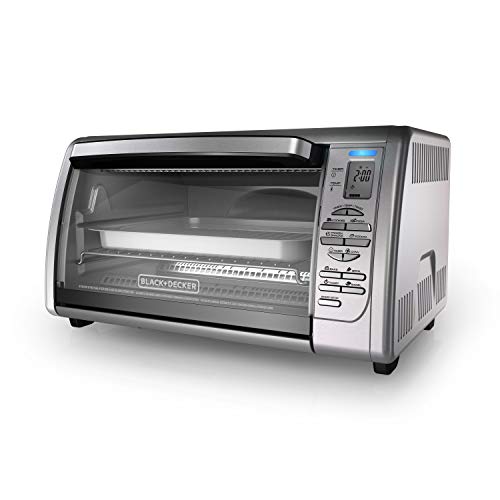
The entry point of the class, and for many households still the right answer: a compact toaster oven that toasts, reheats and bakes small portions without ceremony. BLACK+DECKER’s models are the ones found in first apartments, break rooms and grandparents’ kitchens, because the controls need no learning and the size fits where bigger ovens cannot. Convection and air fry features appear on the larger models in the range; the smallest are pure and simple toast-and-reheat machines. Evenness and capacity are the honest limitations. Best for: singles, small spaces and simple jobs. Not suited for: family cooking or anyone expecting full countertop-oven versatility. Shoppers whose needs stop at this tier can compare the wider field in the best air fryers that toast.
Performance in Real Use
Toasting and Baking
Toast is the class’s entrance exam, and convection models pass it well: the fan evens the radiant heat so slices brown across their surface rather than in stripes under the elements. Dial models ask you to learn a shade setting by trial; digital models remember better. Baking is the more revealing test. Cookies bake evenly in small batches, though the batch size is the limit — a countertop oven bakes for the household, not the bake sale. Cakes and quick breads rise properly when the pan fits with air space around it and the rack sits low; the top element’s closeness means pale batters brown early, and a loose foil shield in the final minutes is the experienced owner’s trick. Frozen pizza is a class strength — the chamber size suits it perfectly and the base crisps as a microwave never allows. Overall, baking performance separates the tiers mainly on evenness and temperature steadiness, not on whether things cook through.
Roasting and Air Frying
Roasting is where the countertop oven quietly outclasses its gadget reputation. A tray of chicken thighs, root vegetables or cauliflower in a fan oven this size browns deeply because the chamber is small, the air moves fast and the food sits close to the heat — the same physics that make it a strong air fryer. Air fry functions across the class produce genuinely crisp wings, chips and breaded foods, a step behind a dedicated basket fryer only in ultimate crunch and in the shaking-and-turning ritual that baskets handle more naturally. Capacity reverses the comparison: the oven air fries a whole tray in one layer where a basket needs batches. Households weighing that exact trade-off should read the best air fryer toaster oven combos alongside this review, and the category view in our best smart ovens guide covers the connected end of the market.
Broiling and Finishing
Broiling deserves its own note because the countertop oven’s geometry changes it. With the top element close above the food, cheese bubbles and gratins gratinée faster than in a full oven, and the margin between golden and scorched is measured in moments rather than minutes. This is a genuine advantage for the finishing jobs — melting cheese on soup croutons, crisping a casserole top, browning a tray of nachos — provided the cook treats the broiler as a watched pot and uses the door and the interior light rather than a timer and hope. Rack position is the control that matters: one notch lower tames the intensity for thicker items, one higher sharpens it for thin ones. Fatty foods under a close broiler element spit, so a tray beneath and a clean interior are part of the technique, not housekeeping trivia. Owners who master this one function find the countertop oven becomes their finishing oven of choice, the place dishes go for their last, best two minutes.
Reheating and Everyday Jobs
Day to day, the countertop oven’s most-used function may be none of its headline ones: it is the reheat. Leftover pizza returns with a crisp base and melted top; roast potatoes recrisp; a portion of lasagne heats through without the microwave’s rubbery edges; garlic bread, melts, quesadillas, nachos and baked potatoes are all natural citizens of this chamber. The keep-warm function holds a dish while the rest of dinner catches up, and gentle functions on better models proof dough and dehydrate herbs and fruit slices credibly. This everyday breadth is the real argument for the category: not one spectacular trick, but a dozen weekly jobs done better than the alternatives.
Heat, Noise and Counter Behaviour
Ownership realities, honestly stated. The exterior of a countertop oven gets hot — hottest on top, and hottest on simpler models with thinner insulation — so it is not a surface for storing anything, ever, and households with small children should plan placement with the same care as a hob. The fan is audible: a working hum on convection and air fry settings, quieter on premium models, present on all. Heat leaves through vents and warms the immediate area, which is why clearance matters and why under-cabinet placement needs the manufacturer’s specified gap to the cabinet above — heat and steam will mark or damage cabinet undersides that sit too close. None of this is a defect; it is the physics of a powerful heater in a small box, and it is entirely manageable with placement and habits.
Strengths and Trade-Offs of the Category
Strengths
- One appliance, many jobs: toast, bake, roast, broil, air fry, reheat and warm in a single chamber that is always ready on the counter.
- Speed and efficiency: a small chamber preheats quickly and cooks small-to-medium quantities without heating a full oven — faster weeknight dinners, less wasted energy, less heat in the kitchen.
- Reheating quality: dry heat restores crispness and texture that microwaves ruin, which quietly upgrades every leftover in the house.
Trade-Offs
- Counter cost: the oven and its mandatory ventilation clearance claim a serious block of counter, permanently.
- Capacity ceiling: large birds, big sheet pans and multi-rack baking still belong to the full oven; holiday cooking will not move into this box.
- Cleaning discipline: crumbs, splatter and a hot interior demand regular attention; neglected ovens smoke, smell and underperform.
How a Countertop Oven Compares
Against the full-size oven, the countertop oven wins on speed, convenience and efficiency for anything that fits, and loses on capacity, thermal steadiness and multi-rack work. Most owners end up using both: the range for the Sunday roast and batch baking, the countertop oven for everything Tuesday. Against a basket air fryer, it wins on capacity, versatility and visibility — you can watch food through the door instead of opening a drawer — and loses slightly on maximum crisping intensity and on storage, since the basket fryer is the smaller box. Against the microwave there is no contest on quality and no contest the other way on speed: they are partners, not rivals, and the households happiest with a countertop oven usually keep both. Against a basic toaster, the countertop oven is simply the grown-up version: everything the toaster does, plus a real oven’s repertoire, at the price of more counter. The dedicated comparison of the two oven formats lives in the cluster at the countertop oven buying guide, which also works through sizing in detail.
Who Should Buy a Countertop Oven, and Who Should Skip It
Buy one if your household cooks in household quantities and reheats often; if your full oven feels like overkill most nights; if you rent, live small, or are equipping a second cooking space; if you want air frying without another single-purpose appliance; or if summer cooking in a hot kitchen has become a genuine misery. The category pays for itself in use frequency: owners who cook daily rate it among their most-used appliances.
Skip it — or buy the small, simple end of the class — if your counter is genuinely tiny and already contested; if you regularly cook for crowds; if your cooking is mostly stovetop and microwave and toast is the only oven job you do, where a simple toaster oven suffices; or if you know you will not keep up with crumb and splatter cleaning, because a neglected countertop oven is a smoky, smelly liability. Before buying, run this checklist: measure the counter space including clearance, not just the base footprint; check your largest everyday pan fits the chamber of the model you favour; decide honestly whether you want dials or a display; confirm a heat-resistant surface and a sensibly placed socket; and read the ventilation requirements in the manual of the specific model before it arrives, not after. The step-by-step version of this decision is in how to choose a countertop oven, and the value question is examined head-on in is a countertop oven worth it.
Setup, Care and Maintenance Essentials
Safe ownership rests on a few habits, all of them simple. Keep the ventilation clearance the manufacturer specifies — at the sides, back and above — for the whole life of the appliance, not just on day one; counters drift, and the slow migration of a cookbook or a paper towel holder into the hot zone beside the oven is the classic accident pattern. Keep anything flammable off the top and away from the sides: no towels, paper, packaging, wooden boards or curtains within reach of the heat. Cook on the heat-resistant surface the oven was placed on, and never line the chamber floor or walls with foil unless the manual explicitly allows it, since foil can block airflow and touch elements. Never leave the oven running unattended with fatty foods at high heat, and keep a sensible eye on anything broiling — the top element is close and browning becomes burning quickly.
Cleaning is the other half of safety. Crumbs fall, grease splatters, and both become smoke and fire risk if they accumulate near elements. Empty the crumb tray often — weekly in a busy household — and always let the oven cool fully first. Wipe the interior when cool with a damp cloth and mild detergent; avoid harsh abrasives on coated interiors and never spray cleaner directly onto elements. Wash racks and trays in the sink; dried-on grease softens with a soak. Clean the door glass so you can actually see the food, and check the door seal area for trapped crumbs. The full routine, step by step, is in how to clean a countertop oven. Owners who keep these habits get an oven that performs like new for years; the balanced ledger of ownership is laid out in countertop oven pros and cons.
Temperature Accuracy, Preheat and Cooking Times
A fair question in any countertop oven review is whether the temperature on the dial or display is the temperature in the chamber. The honest answer for the class is: approximately, and better at the top of the market than the bottom. Small chambers heat fast and cycle their elements to hold a set point, so the internal temperature swings gently around the target rather than sitting dead on it. Premium models with smarter element control narrow that swing noticeably, which is one reason their baking is more consistent. Simpler models may run a little hot or a little cool relative to the dial — a fixed offset owners learn once and then compensate for automatically, the way generations of cooks learned the personality of a particular range oven. An inexpensive oven thermometer, placed in the chamber for a few test runs, tells you your own machine’s truth in an afternoon, and after that its readings are academic: you will cook by your machine’s settings, not by theory.
Preheat behaviour is one of the class’s genuine pleasures. A small, well-insulated chamber reaches baking temperature in a fraction of the time a full oven needs, and better models signal readiness clearly rather than leaving you to guess. This speed changes cooking habits: dishes that felt like a production — a tray of roast vegetables, a small batch of scones, garlic bread to go with pasta — become casual, because the oven is ready almost before the prep is done. Cooking times for familiar recipes usually track full-oven times closely once the chamber is hot, with two adjustments owners learn quickly. First, the top of the food sits closer to an element, so items brown on top sooner; lowering the rack or shielding with foil for the last stretch is routine. Second, convection shortens many cooks and deepens browning, so the first time you roast or bake with the fan, check a little earlier than the recipe suggests. Neither adjustment is a flaw; both are the normal calibration of a different oven geometry, learned in the first few cooks and automatic after that.
Accessories, Pans and What Actually Fits
Capacity is marketed in slices of toast and whole chickens, but owners live by a more practical measure: which of their existing pans fit. Most countertop ovens arrive with a baking tray, a wire rack and, on air fry models, a mesh basket or tray, and those three cover the majority of jobs. Beyond them, the useful additions are a small rimmed sheet pan sized to the chamber, a modest casserole or baking dish for gratins and bakes, and a muffin or loaf pan in the smaller formats for baking households. The test before buying any accessory is simple: measure the chamber’s usable width and depth with the door closed, leave air space on all sides of the pan, and never force a fit — a pan that touches the walls or sits against an element cooks badly and is a hazard. Handles matter more than in a big oven, because the margin around a hot pan is tighter; pans with compact or no handles behave best.
What fits, in practice, defines the class’s three size bands. Compact models handle toast, melts, single portions and small frozen items — the two-person, small-kitchen brief. Mid-size models, the heart of the market, take a family casserole, a tray of chicken pieces, a whole small chicken or a standard frozen pizza, and this is the band most households should shop in. Large models stretch to bigger birds, wider trays and entertaining quantities, and earn their footprint only in kitchens that will genuinely use the volume; an oversized chamber used for two slices of toast every morning is slower to heat and sillier than it sounds. The recurring mistake is buying by headline capacity instead of by the pans and meals you actually make — which is why the sizing walk-through in how to choose a countertop oven starts with your own cookware, not with the manufacturers’ numbers.
Energy Use and Everyday Running Character
One of the countertop oven’s quiet virtues is that it heats a small space instead of a large one. For the quantities it is designed for, that means less energy per meal than firing the full range, and far less waste heat dumped into the kitchen — a difference you feel in summer, when a full oven can make a small kitchen uninhabitable and the countertop oven merely warms its corner. Owners in hot climates and small apartments consistently cite this as the benefit they underestimated: the appliance does not just cook the dinner, it declines to cook the cook. The same smallness explains the speed advantage and the reheating quality; everything good about the category traces back to matching chamber size to meal size.
The running character is otherwise domestic and undemanding. There is fan noise on convection settings, a click and glow as elements cycle, the smell of whatever is cooking escaping a little more readily than from a sealed range — one more reason the ventilation space above and behind must stay open, since that warm, fragrant air needs somewhere to go. The oven asks for no plumbing, no installation and no special circuit in most homes, though it should have the counter and the socket to itself while running rather than sharing a strip with other hungry appliances. It is, in short, an appliance that behaves like a small oven because that is precisely what it is — and judged in this review on exactly those terms, it holds up very well.
Controls, Presets and Smart Features in Practice
Function lists are the easiest part of a countertop oven to inflate and the hardest to judge from a box, so this review judges them by use. The core functions — toast, bake, roast, broil, reheat, warm — will cover nearly everything most households cook, and every model in this review’s reference set handles them. Air fry has earned its place as a core function too, given how people actually eat. Beyond those, value thins out quickly: dehydrate is genuinely useful to gardeners and jerky makers and decorative to everyone else; proofing is a real gift to bread bakers in cold kitchens; rotisserie, where fitted, is delightful theatre that some owners use monthly and others use once. Presets follow the same rule — a pizza or cookie preset is only worth having if it sets a time and temperature you would have chosen anyway, and on better models they do exactly that, which makes them a small daily convenience rather than a gimmick.
What actually differentiates daily experience is control quality. A timer that can be adjusted mid-cook without cancelling the program, a display you can read from across the room, a light that lets you check browning without opening the door and dumping the heat, an automatic preheat signal, a toast shade setting that repeats yesterday’s result — these unglamorous details are what owners praise in month six. At the premium end, probe cooking and guided programs add real capability for meat cookery, and app control divides opinion neatly between cooks who want it and cooks who consider a remote-controlled toaster oven a solution in search of a problem. The review position is simple: buy the core functions executed well, in the control style your household prefers, and let the exotic functions be a bonus rather than the reason.
A Week of Cooking in a Countertop Oven
Abstract versatility becomes concrete across an ordinary week. Monday is a tray of chicken thighs and chopped roots, roasted with the fan while rice cooks on the hob — the full oven never wakes. Tuesday reheats Sunday’s lasagne portions, which emerge with proper edges instead of microwave slump, while garlic bread toasts on the second rack position. Wednesday is frozen pizza night for two, the class’s home fixture. Thursday air fries a batch of wings and a tray of green beans, in sequence, faster than the range would have preheated for the same job. Friday proofs pizza dough in the gentle warmth, then bakes the pizzas one at a time — the one job in the week where the chamber’s size sets the rhythm. Saturday morning is a small batch of scones, baked without heating the whole kitchen before a warm day; Saturday night is a casserole for friends, which is the full oven’s cue to re-enter, because entertaining volume is its job. Sunday toasts, reheats and keeps things warm around the roast.
That rhythm is the real finding of this review. The countertop oven does not win the week with one spectacular performance; it wins by being the right-sized oven for roughly four days out of seven, by reheating leftovers into food worth eating, and by never once feeling like too much appliance for the job in front of it. Households whose weeks look like this one will use it constantly. Households whose weeks are mostly stovetop cooking, takeaways and toast should scale down to the simple end of the class and spend the difference elsewhere.
Final Verdict
Reviewed as a category, the countertop oven is a mature, genuinely useful appliance whose best models come remarkably close to full-oven results for everyday quantities, and whose simplest models still transform toast and reheating. The tiers divide on evenness, controls, capacity and finish — not on basic competence — so the right buy is the one sized honestly for your counter and your cooking, with the control style you will enjoy using daily. Respect the clearance, keep it clean, and it will earn its counter space every single week. If this review leaves you with one test to apply in the shop, make it this: picture your three most common oven jobs, in your own pans, on your own counter, with the clearance the manual demands drawn honestly around the machine. The model that fits that picture — not the one with the longest function list or the boldest capacity claim — is the one this category’s long, satisfied ownership history says you will still be pleased with years from now. The companion piece to this review, countertop oven reviews, compares the leading models against each other in more depth.
Countertop Oven: What Long-Term Use Reveals That a First Test Misses
Start with how a {p} holds up once the novelty wears off and routines settle in. Most coverage of a countertop oven concentrates on the first week of ownership, yet the decisions that matter most tend to surface later, once the countertop oven has to earn its place in an ordinary weekday routine rather than a carefully staged first attempt. Write down the three jobs you expect it to do most often, in the order you actually do them, and judge every claim you read against that short personal list instead of against a generic ideal.
Use a short decision checklist to finish. One, does it fit the space and the storage you really have. Two, does it handle your three most common jobs without a workaround. Three, do the edge cases you listed stay manageable. Four, can every wear part be cleaned or replaced without drama. Five, would you still choose it if a friend described the same drawbacks in their own kitchen. A countertop oven that passes all five is a sound buy; one that fails two or more is a compromise you are choosing with open eyes, which is a very different thing from being surprised later.
Troubleshooting is easier when you expect the usual failure points. With any countertop oven, the recurring problems tend to cluster in the same places: uneven results from overloading or poor arrangement, wear showing first on the parts handled most often, and small annoyances with lids, seals, handles, controls or fittings that only appear after repeated use. Before buying, look for whether those wear parts can be cleaned properly, replaced or worked around, and whether the instructions address them directly rather than pretending they never happen.
Work through a realistic scenario, not a best case. Picture the busiest version of the job: more people to serve, less time than planned, ingredients or materials that are slightly out of the ordinary, and a clean-up waiting at the end. Ask how the countertop oven behaves at that upper edge, because a model that only shines on a small, simple load will disappoint precisely when you need it most. If the honest answer is that you would split the job into batches or fall back on an older method, factor that into the decision now rather than discovering it later.
Edge cases deserve a deliberate pass. Think about the odd shapes, the thicker or thinner than usual loads, the leftovers, the second helping and the guest with different preferences. A well-chosen countertop oven handles the exceptions gracefully, or at least predictably, while a poor match turns every exception into a workaround. List your two or three most common exceptions in advance and check, from the manual or the listing details, that nothing about them is ruled out by size, shape, material or care requirements.
Finally, plan the first fortnight deliberately. Use the countertop oven for one familiar job first, so you have a baseline you trust, then introduce the harder cases one at a time and note what changes. Small adjustments to arrangement, timing, quantity or preparation usually close most of the gap between disappointing first results and the performance the design is capable of. That short learning period is also the fairest test of long-term ownership: if the routine has not settled by the end of it, the mismatch is real, and it is better to know while returning or exchanging is still straightforward.
When you check listings such as Breville Smart Oven Air Fryer Pro, Ninja Foodi XL Prestige Countertop Oven and Cuisinart TOA-65 Digital AirFryer Toaster Oven, use them as worked examples: run through the same checks below on each one in turn, so the comparison stays honest and like for like rather than based on whichever listing happens to shout loudest.
Maintenance decides how long the good results last. Set a simple rhythm: a quick wipe or rinse after each use, a deeper clean on a fixed day, and a periodic check of the parts that move, seal or bear weight. A countertop oven that needs fiddly disassembly for basic care will be cleaned less often, and performance drifts long before anything actually breaks. Prefer designs where the parts that get dirtiest are the parts that are easiest to reach, and be honest with yourself about which cleaning steps you will genuinely keep up.
Measure before you commit. Note the footprint, the clearance above and behind the spot where the countertop oven will live, and the route you will carry it by when it is hot, full or awkward. A countertop oven that technically fits but blocks a cupboard door, crowds a neighbouring appliance or has to be dragged across a worktop every time will quietly fall out of use, whatever its merits on paper. In the Kitchen Appliances category especially, a few centimetres of clearance and a sensible storage plan separate a daily tool from a bulky regret.
Frequently Asked Questions
Can a countertop oven replace a full-size oven?
For many households, most of the time, yes — and for some, entirely. Anything that fits in the chamber with air space around it will bake, roast or reheat there, and small households routinely cook whole meals in one. The full oven keeps its role for large birds, big pans, multi-rack baking and holiday volume. The honest test is your own cooking: if your oven jobs are trays, casseroles, pizzas and portions, a countertop oven can carry nearly all of them; if you regularly cook at scale, treat it as a partner to the range rather than a replacement.
Is the air fry function on a countertop oven as good as a separate air fryer?
Close, and better in one respect. A dedicated basket fryer crisps slightly more intensely because the food sits in a compact, high-velocity airstream and can be shaken mid-cook. A countertop oven air fries a much larger quantity in a single layer, cooks more evenly across a tray, and lets you watch progress through the door. For wings, chips and breaded foods the results satisfy most households completely. If maximum crunch on small batches is your single priority, the basket wins; if capacity and versatility matter, the oven is the better tool — and it does everything else besides.
How much space does a countertop oven need around it?
Follow the specific model’s manual, because requirements vary, but plan for clear ventilation space on both sides and at the back, and the most generous clearance above the unit, where heat and steam escape. That space must stay clear permanently: nothing stored on top, nothing flammable beside it, and care with under-cabinet placement so heat does not damage the cabinet underside. Measure your counter including this clearance before choosing a size class — the honest footprint is the oven plus its breathing room, and it is the measurement that decides whether a large model truly fits your kitchen.
Why does my countertop oven smoke sometimes?
Almost always residue: crumbs in the tray, grease splattered near an element, or food debris left from a previous cook burning off at high heat. Fatty foods cooked close to the top element can also smoke as fat spits onto it. The cure is cleaning discipline — crumb tray emptied often, interior wiped when cool, racks washed — and the prevention is placement and attention: correct rack position, a tray under fatty foods, and not walking away from broiling. Persistent smoke from a clean oven at moderate temperatures is not normal; stop using it and have it checked rather than cooking through it.
Can you put metal pans and foil in a countertop oven?
Metal pans, yes — oven-safe metal bakeware is exactly what the chamber is designed for, sized to leave air space around the pan. Foil needs care: a loose shield over a dish to slow browning is a normal technique, but lining the oven walls, floor or crumb tray with foil can block airflow, reflect heat onto elements and is prohibited by many manufacturers, so follow your manual. Never let foil touch the heating elements. Glass and ceramic dishes are fine if oven-safe and sized to fit; avoid anything plastic or not rated for oven heat, and remember the chamber is smaller, so handles and lids need clearance too.
How long does a countertop oven last?
With ordinary care, years of daily service is the normal expectation, and the variables are the usual ones: build tier, frequency of use, and cleaning habits. The failures that end these ovens’ lives are typically mundane — a tired door spring, a failed element or control, accumulated grease damage — and most are postponed by keeping the interior clean, the crumb tray empty and the vents unobstructed. Premium models justify part of their tier in heavier construction throughout. Treat it like the real oven it is — because it is one — and it will behave like one. When a countertop oven does eventually fail, it usually announces itself honestly first: uneven browning that was not there before, a door that no longer seals, a fan that grows rough. Those are the signs to start planning a replacement rather than to keep nursing a machine whose cooking you no longer trust.
Related Guides
Continue with the countertop oven buying guide, countertop oven pros and cons, and the live category guides: the best toaster ovens, the best convection ovens and the best air fryers.