Disclosure: As an Amazon Associate, topratedkitchenware.com earns from qualifying purchases. Links on this page are affiliate links; they cost you nothing extra. Prices and availability change often, so check the current Amazon listing before you buy.
This electric tea kettle buying guide exists because an electric tea kettle is not simply a faster way to boil water. A general electric kettle boils, clicks off, and that is the whole job. A coffee gooseneck kettle trades capacity for a thin, slow spout built for pouring in circles over grounds. An electric tea kettle is defined by two different tools: temperature control matched to types of tea, and, on most models worth the name, an infuser that lets the kettle brew the tea as well as heat the water. If you drink one kind of black tea from a bag every morning, you may not need either tool. If you drink green tea on Monday, oolong on Wednesday and a herbal blend at night, the right kettle quietly fixes the most common reason home tea disappoints: water at the wrong temperature, poured at the wrong moment. This guide explains the types, the criteria that actually separate a good one from a frustrating one, and the models that represent each tier honestly, so you can match a kettle to the way you already drink tea rather than to a feature list.
Key Takeaways
- Temperature presets are the defining feature: they exist because green and white teas scorch in boiling water while black and herbal teas need a full boil.
- Decide first whether you want a kettle that only heats water for a separate pot, or one with a built-in infuser that brews in the kettle itself.
- Glass looks beautiful and brews visually but shows scale and needs gentler handling; stainless hides scale, travels better and usually lasts longer.
- Keep-warm is worth having only if you drink a second cup within the hour; otherwise it is a feature you pay for and rarely use.
- Buy the capacity for your real routine — a family pot for a household, a compact kettle for one drinker — not for the biggest gathering you host twice a year.
What an Electric Tea Kettle Does and the Main Types
At its simplest, an electric tea kettle heats water on a powered base, holds or signals a chosen temperature, and pours without a cord trailing from the jug. Around that simple core, the category splits into recognisable types, and naming them clearly is the fastest way to narrow a shortlist.
Heat-Only Temperature-Control Kettles
The first type heats water to a selected temperature and leaves the brewing to a separate teapot, mug infuser or press. This is the right shape for households that already own a beloved pot, for drinkers who brew different teas in different vessels, and for anyone who also uses precise hot water for coffee. The kettle’s whole job is accuracy and convenience: presets for the main tea families, a keep-warm hold, a clear water gauge and a clean pour. The electric kettles with temperature control category overlaps heavily here, and many of those kettles serve tea drinkers well even without a basket in the box.
Kettles With a Built-In Infuser
The second type adds a removable mesh basket or infuser core inside the kettle, so loose leaf goes in, the water heats around it, and the tea brews in the same vessel you pour from. This removes a transfer step and a second pot to wash, which is why it suits daily loose-leaf drinkers. The compromises are cleaning and capacity: the basket occupies space, needs scrubbing as its mesh slowly clogs with fine leaf and scale, and a full basket of leaves restricts water flow if you overfill it. If you mostly brew loose leaf for one or two people, this type is the heart of the category, and the electric tea makers roundup covers the more automated end of the same idea.
Automatic Tea Makers
The third type automates the steep itself. The basket lowers into heated water and lifts out when the timer ends, so the machine, not your attention, decides when the brew is done. This is a genuine convenience for strong-flavoured teas that punish an extra two minutes, and for anyone who starts a pot and walks away. It is also the most expensive, largest and most mechanically complex type, with more to clean and more to go wrong over years of daily use. Buy it for the automation, not as a default upgrade.
Glass, Stainless and Double-Wall Bodies
Cutting across all three types is the body material. Glass kettles let you watch the boil and the brew, which tea drinkers genuinely value, and they do not hold flavours from the last pot. They are also the most fragile and show every trace of scale. Stainless steel is the durable default: it hides scale, shrugs off knocks, and suits households. Double-wall stainless adds a calmer exterior and better heat retention between boils, at the cost of not seeing the water level from outside. None of these is the correct answer for everyone; the right one follows from whether you brew by eye, by routine, or by whoever else shares your kitchen.
In this guide
Top Picks at a Glance
These six models represent the tiers of this category honestly. They are presented prose-first here: check the current Amazon listing for the configuration, finish and any included infuser before you buy, because tea kettles are sold in variants that share a name.
| Pick | Badge | Tier | Why it is here |
|---|---|---|---|
| Cuisinart PerfecTemp Tea Kettle | Best Overall | Premium | Labelled tea presets and a keep-warm hold in a proven stainless design. |
| Breville Smart Tea Infuser | Best Automated | Premium | The basket lowers and lifts itself, so steep time is handled for you. |
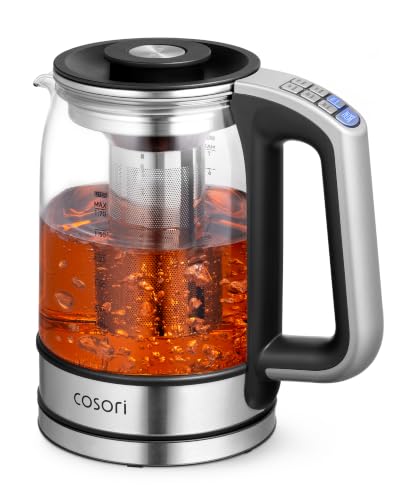
| COSORI Electric Tea Kettle with Infuser | Best Glass | Mid-range | Borosilicate glass, a stainless infuser and straightforward controls. |
| Secura Electric Tea Kettle | Best All-Steel Interior | Mid-range | Stainless where the water sits, double-wall calm on the outside. |
| Buydeem Electric Kettle | Best Compact Design | Premium | A small, handsome kettle for one or two drinkers, with tea settings. |
| Hamilton Beach Electric Tea Kettle | Best Budget Starter | Entry | The fundamentals done competently for bag drinkers and first kitchens. |
How Accurate Does the Temperature Control Need to Be?
Temperature control comes in three grades. The simplest kettles boil and stop, relying on you to wait before pouring on delicate leaf. The middle grade offers a handful of presets, usually labelled by tea type, which is the sweet spot for almost everyone: the presets encode the brewing ranges below, and pressing the green tea button is easier than remembering a number. The top grade allows degree-by-degree adjustment, which matters to drinkers who brew the same prized leaf repeatedly and fine-tune it, and to almost nobody else. What matters more than the grade is honesty: a kettle that claims a temperature should hold it steadily rather than overshooting to a boil and coasting down, and a keep-warm function should hold the set temperature rather than quietly reboiling. Judge reviews and listings by comments on steadiness, not by how many buttons the base carries.
What Temperature Does Each Tea Actually Need?
Water temperature is the whole reason this category exists, so it deserves plain numbers. These are the widely used brewing ranges taught by tea sellers and used by the preset buttons on the kettles above; treat them as starting points and adjust a few degrees at a time to your own leaf.
- Delicate and white teas: the coolest water of the main families, roughly the range a kettle labels for delicate or white tea. Water near boiling flattens their gentle flavour and can bring out a cooked taste.
- Green teas: hot but well short of boiling. Japanese greens usually want the cooler end of the green range, Chinese greens tolerate a little more heat. Boiling water on green leaf is the single most common cause of a harsh, bitter cup.
- Oolong teas: the middle ground, and the widest range, because oolongs themselves range from green-like to nearly black. Start mid-range for a lightly oxidised ball oolong and hotter for a dark, roasted one.
- Black teas and herbal infusions: full, freshly boiled water. These leaves and botanicals need the heat to extract properly, and holding back only produces a thin cup.
- French press coffee and pour over: just off the boil is the usual advice, which is why so many tea kettles include a coffee preset alongside the tea buttons.
If you only remember one rule, make it this one: the paler and more delicate the leaf, the cooler the water. A kettle with presets simply turns that rule into a button press, and a kettle without them turns it into a waiting game of boiling, resting and guessing.
Do You Need an Infuser in the Kettle?
The infuser question decides which half of the category you are shopping in. Choose a built-in infuser if you brew loose leaf most days, drink one or two cups at a time, and value one vessel to wash. Skip it if you brew in a cherished pot, make large pots for a table, or drink mostly bagged tea, where a heat-only kettle plus the teapots for loose leaf tea you already own does the same job with less cleaning. Look closely at the basket itself when you compare: fine mesh handles small-leaf teas without sediment, a wide basket lets ball oolongs open fully, and a basket that removes without dripping across the counter is worth more than a clever shape that drips. Remember too that an infuser lives in hot water and tea oils; it needs the cleaning routine described later in this guide, and a kettle whose basket is easy to remove is a kettle whose basket actually gets cleaned.
How Much Capacity Do You Really Need?
Capacity is where buyers most often overbuy. A large family kettle serves a household that drinks together and a table that hosts, but it also asks you to heat a minimum amount of water that may be double a single cup, wasting time and energy every morning. A compact kettle suits one or two drinkers beautifully and fails a family breakfast completely. Count your real servings: a mug of tea uses roughly a mug of water, a pot for four uses roughly four. Then check the minimum fill as carefully as the maximum, because the minimum is the number you live with daily. If your household contains both a solo early riser and a family breakfast, the honest answer is sometimes the mid-size kettle plus patience, not the biggest vessel on the shelf.
Glass or Steel, and Why It Changes Your Routine
Body material changes your Tuesdays, not just your counter’s looks. Glass shows the water level at a glance, shows the leaf opening, and shows scale the week it forms — which is why glass owners descale more reliably and steel owners discover scale by taste. Glass also demands a less crowded counter and a household without enthusiastic small helpers. Steel hides its interior state, tolerates being moved to a table, and pairs with double-wall construction that keeps the outside touchable and the water hot between boils. If your water is hard, steel hides the problem while glass advertises it; decide whether you want the reminder or the calm. Either way, look for an interior with as few plastic parts in contact with the water as the tier allows, a lid that opens wide enough to fill and clean by hand, and a spout that pours in a controlled stream rather than a surge.
How to Prioritise by Use Case
The Multi-Tea Household
Different teas at different hours means presets earn their keep. Prioritise labelled temperature buttons, a keep-warm hold for the second cup, and enough capacity for the biggest regular round. The Cuisinart pattern — presets in a durable steel body — exists precisely for this household.
The Loose-Leaf Solo Drinker
One drinker, good leaf, daily ritual. Prioritise a built-in infuser with fine mesh, a compact capacity with a low minimum fill, and glass if you enjoy watching the leaf. The COSORI and Buydeem patterns compete here; choose by whether you want a full pot’s view or a small design piece.
The Bagged-Tea Pragmatist
If your tea comes in bags and your mornings are fast, boiling water is nearly the whole job. Prioritise boil speed, a clean pour and a price that leaves money for better tea. The Hamilton Beach pattern is the honest fit, and the fuller argument is in is an electric tea kettle worth it.
The Forgetful Brewer
If your tea regularly steeps while you answer the door, the automated basket earns its premium. Prioritise the lift-out mechanism and strength settings over raw capacity. That is the Breville pattern, and no manual kettle fully substitutes for it.
The Picks in Detail
Cuisinart PerfecTemp Tea Kettle
The Cuisinart PerfecTemp is the reference point for this category, the kettle most other tea kettles get compared against, because it built its name on the one feature tea drinkers actually need: labelled temperature presets for different teas instead of a single rolling boil. One-touch buttons for delicate, green, white, oolong, coffee and black or herbal teas take the guesswork out of water that is too hot for the leaf in your cup. A keep-warm function holds the chosen temperature while you finish a first cup, and a removable infuser basket on many configurations lets the kettle brew as well as heat. The stainless body feels substantial, the controls are legible without a manual, and the whole machine behaves like an appliance designed by people who drink several kinds of tea in one household.
Best for: households that drink several tea types and want presets that simply work
Not suited for: solo drinkers who will never use most of the buttons
Strengths
- Labelled presets for the main tea families
- Keep-warm hold for a second cup
- Proven, substantial stainless build
Trade-offs
- Premium tier without automation
- More kettle than a bag-only drinker needs
- Presets are fixed ranges, not degree-by-degree tuning
Tier: premium. Check price on Amazon.

Breville Smart Tea Infuser
The Breville Smart Tea Infuser is the automation play in this category. Rather than simply heating water and leaving the steeping to you, it manages the brew cycle itself: the basket lowers into the water at the set temperature and lifts when the steep time ends, so a forgotten pot does not turn bitter on the counter. Presets cover the main tea families, strength settings adjust the cycle, and a keep-warm hold keeps the finished tea ready for a second cup. It is the largest commitment of counter space and budget in this group, and it earns that footprint only in households that brew loose leaf daily and genuinely want the machine to watch the clock for them.
Best for: daily loose-leaf drinkers who want the machine to manage steep time
Not suited for: small kitchens and anyone who brews once a day
Strengths
- Automatic basket lowers and lifts on schedule
- Strength settings adjust the brew cycle
- Keep-warm holds the finished tea
Trade-offs
- Largest footprint in this group
- Most parts to clean
- Premium tier pricing as a category
Tier: premium. Check price on Amazon.

COSORI Electric Tea Kettle with Infuser
The COSORI tea kettle with infuser is the glass option most buyers land on, and the glass is the point: you can watch the water approach the boil, watch the leaf open, and see at a glance how much water remains. The borosilicate body pairs with a stainless infuser that drops into the pot for loose leaf brewing, and the base carries straightforward temperature control rather than a bare on-off switch. Glass asks for gentler handling than steel and shows scale sooner, which is either a flaw or a useful reminder to descale, depending on your temperament. For tea drinkers who brew visually and drink several types, it is the balanced middle of this category.
Best for: visual brewers who want glass, an infuser and honest mid-range value
Not suited for: households where a glass vessel will be knocked around
Strengths
- You can watch water and leaf while brewing
- Stainless infuser included for loose leaf
- Straightforward temperature control
Trade-offs
- Glass needs gentler handling
- Scale shows quickly in hard water
- Smaller margin for overfilling the basket
Tier: mid-range. Check price on Amazon.

Hamilton Beach Electric Tea Kettle
The Hamilton Beach tea kettle is the honest entry point: an affordable electric kettle from a brand that has made countertop basics for decades, aimed at drinkers who want hot water fast and a simple steep without paying for automation. Expect the fundamentals done competently — quick boiling, an auto shut-off when the water is ready or the kettle runs dry, a cordless pour from a swivel base — with temperature finesse varying by configuration. It suits the tea-bag drinker, the office kitchen, and the first apartment far better than the loose-leaf perfectionist, and it is honest about that trade. As a second kettle or a starter, it makes a great deal of sense.
Best for: starter kitchens, offices and bagged-tea drinkers who want the basics done well
Not suited for: drinkers who brew delicate greens daily and need precise presets
Strengths
- Competent, quick boiling from a long-standing brand
- Auto shut-off and cordless pouring
- Entry tier that leaves budget for better tea
Trade-offs
- Temperature finesse varies by configuration
- Basic fit and finish
- Not built around loose-leaf brewing
Tier: entry. Check price on Amazon.
Secura Electric Tea Kettle
The Secura electric tea kettle built its following on construction: a stainless interior with no plastic touching the water, a double-wall body that stays calmer to the touch and holds heat longer between boils, and a cool-touch exterior that matters in busy kitchens. Tea drinkers who are particular about what their water contacts tend to shortlist it quickly. Temperature control and infuser arrangements vary across the Secura range, so the listing deserves a careful read, but the core promise is consistent: steel where the water lives, insulation where your hands live, and a kettle that feels engineered rather than decorated.
Best for: drinkers who want stainless inside and out and a calmer exterior
Not suited for: buyers who want to see the water level at a glance
Strengths
- Stainless interior with no plastic touching water
- Double-wall body holds heat and stays calmer
- Feels engineered rather than decorated
Trade-offs
- Water level is judged by gauge, not by eye
- Features vary across the range — read the listing
- Heavier than a single-wall kettle
Tier: mid-range. Check price on Amazon.

Buydeem Electric Kettle
The Buydeem electric kettle is the design-led option, a kettle bought as much for how it looks on the counter as for how it brews. The retro styling, colour finishes and compact footprint target smaller kitchens and desks, while the feature set underneath — temperature settings suited to tea, an infuser on tea-focused configurations, and a keep-warm hold — keeps it a working tea appliance rather than a ornament. It will not out-capacity the big family kettles, and it does not try to. For a single drinker or a couple who brew a pot in the morning and another in the evening, it is the kettle most likely to be left out on display instead of hidden in a cupboard.
Best for: one or two drinkers who want a compact kettle worth leaving on display
Not suited for: families brewing a full pot several times a day
Strengths
- Design-led finish in a compact footprint
- Tea-oriented settings with an infuser on tea configurations
- Keep-warm for the evening second pot
Trade-offs
- Capacity is the compromise
- Premium tier for its size
- Style-forward parts need gentle cleaning
Tier: premium. Check price on Amazon.
First Setup and Care Essentials
Before the first cup, rinse the kettle, boil a full load of plain water and discard it; that clears manufacturing residue and teaches you the controls without wasting leaf. Place the base where the cord reaches without crossing a walkway, and learn the minimum and maximum marks before your first sleepy morning. From then on, care is two habits. First, empty leftover water rather than reboiling it all day — freshly drawn water makes a livelier cup and slows scale. Second, descale on a schedule set by your water, not by the taste of the tea.
Scale is the white or grey mineral crust that hard water leaves on the element, the floor of the kettle and the mesh of the infuser. It slows the boil, flakes into cups, and makes temperature control less accurate, because the sensor is reading through an insulating layer of mineral. The fix is simple and cheap. Fill the kettle partway with equal parts water and plain white vinegar, or water with a spoonful of citric acid, bring it to a gentle heat, switch off and leave it to stand until the fizzing stops and the crust loosens. Pour the solution away, wipe any residue with a soft cloth, then boil a full kettle of fresh water and discard it — twice if the vinegar smell lingers. The infuser needs its own attention: steep it in the same warm descaling solution, then scrub the mesh gently with an old soft toothbrush, because clogged mesh slows the brew and holds the flavour of the last strong tea. How often depends on your water: monthly in a hard-water area, a few times a year where the water is soft. The fuller routine, including glass care and lid seals, is covered step by step in how to clean an electric tea kettle and the general method in how to descale an electric kettle.
An electric tea kettle is a litre or more of near-boiling water on a powered base, and it deserves the same respect as a pan on the stove. Fill between the minimum and maximum marks: below the minimum you risk boiling dry and stressing the element, above the maximum the water can surge out of the spout as it boils. Keep the kettle on its base on a stable, dry surface, route the cord so it cannot be caught by a passing sleeve, and pour slowly with the lid closed — most scalds from kettles happen during an impatient pour, not during the boil. Let the kettle cool before refilling it for a descale or a deep clean, never immerse the base or the kettle body in water, and keep the whole appliance out of the reach of small children, who see a shiny kettle at exactly their height on many counters. If a kettle ever boils dry, smells of hot plastic, or trips your electrics, unplug it and retire it rather than coaxing it along.
Mistakes to Avoid
The classic mistakes in this category are all versions of buying the wrong shape of convenience. Buying an automatic tea maker for a household that brews twice a week. Buying a compact design kettle for a family of five. Paying for degree-by-degree control when three presets cover every tea you own. Ignoring the minimum fill line and then heating triple the water you need for a year. Choosing glass for a crowded counter, or steel for a drinker who brews by eye. And the quietest mistake: buying the kettle before the tea. A modest kettle with fresh, well-stored leaf beats a premium machine brewing stale leaf every single time, so leave room in the budget for the leaves themselves. For the step-by-step version of this decision, how to choose an electric tea kettle walks the same ground as a checklist, and electric tea kettle review examines the category’s design compromises in depth.
Electric Tea Kettle Buying Guide: Reading a Listing Like a Reviewer
Listings for this category reward a sceptical reader, because the same model name often covers several configurations. One listing’s headline photograph shows an infuser that a cheaper variant omits. A finish you admired may belong to a different capacity. A preset panel in one market becomes a simple dial in another. Read any listing in a fixed order. First, the configuration: is an infuser included, and is it the fine-mesh, full-width kind or a small token basket? Second, the temperature system: how is it described — labelled tea presets, a variable dial, or merely variable temperatures in the marketing copy with boil-only hardware underneath? Third, the body: glass type, steel construction, single or double wall. Fourth, the practicalities: minimum and maximum fill, keep-warm duration in plain terms, cord length and storage, lid opening. Fifth, the maker’s own care instructions, which tell you how the brand expects the kettle to be descaled and whether the infuser is meant to be removed daily. A listing that answers all five cleanly is usually a kettle designed by people who use one; a listing that hides behind lifestyle photographs and adjectives is telling you something too.
Photographs deserve their own scepticism. Look for the photograph of the open lid, because it reveals fill access, basket width and how much plastic lives near the water. Look for the photograph of the base controls at reading distance, because a panel you cannot read at arm’s length will annoy you every morning. Look for a hand in at least one image, for scale; compact kettles photograph large and family kettles photograph small with remarkable consistency. And look for the underside or the spout filter if the listing offers it — the small removable filter behind the spout is a part you will clean monthly, and its absence in photographs sometimes means its absence in the box.
Controls, Bases and the Details That Decide Daily Satisfaction
Two kettles with identical temperature hardware can feel completely different to live with, and the difference is in the controls and base. Button panels with labelled presets are the easiest for households and guests: the knowledge is printed on the appliance. Dials are elegant and quick for a single expert user, and frustrating for everyone else in the house. Displays that show the current temperature as it climbs are genuinely useful for drinkers who pour at a chosen moment rather than at a preset, and they double as a scale early-warning system, because a kettle that climbs slowly is a kettle asking to be descaled.
The base matters more than its photograph suggests. A swivel base that lets the jug lift and return at any angle suits left-handed drinkers and awkward counters. Cord storage underneath the base keeps the worktop honest. A base that stays cool and stable when the jug is lifted at full weight is a safety feature in work clothes. Even the click and beep vocabulary of a kettle enters daily life: some households love an audible ready signal from another room, others disable every beep within a week. None of these details sells a kettle in a headline, and together they decide whether the kettle you bought is the kettle you enjoy in month six.
Your Water Is Part of the Purchase
No buying guide for kettles is complete without your tap. Hard water does not disqualify any model in this guide, but it changes which model serves you best and what ownership feels like. In a hard-water home, expect to descale monthly, expect glass to show you the crust as it forms, and expect temperature accuracy to be a maintained property rather than a permanent one. A jug filter or filtered water slows the cycle meaningfully and many committed tea households treat the filter as part of the kettle budget. In a soft-water home, descaling becomes a quarterly chore, glass stays clear for weeks, and the material choice can be made on looks and handling alone. Either way, the kettle and the water are a system; buy them as one.
What Each Tier Should Give You
Entry tier kettles should give you honest boiling, safe shut-off, a clean pour and nothing embarrassing. Judge them on those four and forgive plain materials. Mid-range kettles should add trustworthy presets, a usable infuser where fitted, and a keep-warm that holds rather than reboils; this is the tier where the category’s value concentrates, and where most households should land. Premium kettles must justify themselves with something specific — automation of the steep, degree-level control you will actually use, double-wall construction, or design you will enjoy daily — because premium water is not hotter, cooler or wetter than mid-range water. If a premium listing cannot name its specific justification in one sentence, it is a mid-range kettle in formal dress, and the buying guide’s advice is to dress your budget accordingly.
A Week of Teas Through One Kettle
Abstract criteria become concrete across a week. Monday begins with a breakfast blend at a full boil, where any kettle in this guide performs identically and the choice costs nothing. Tuesday’s green tea is the first audit: the preset earns its place or the morning exposes a boil-only mistake. Wednesday brings an oolong that wants the middle ranges and room to open, which audits the basket’s width. Thursday’s white tea is the strictest examiner of steadiness, because overshoot has nowhere to hide in so delicate a cup. Friday evening’s herbal blend returns to a full boil and reminds the household that half its drinking never needed the panel at all. The weekend adds guests, a second round under keep-warm, and a pot carried to the table, auditing capacity, hold and handling in one afternoon. A kettle chosen by the steps in this guide passes the whole week without a workaround; a kettle chosen by a photograph usually fails by Wednesday. When you compare two finalists, run them mentally through your own week, day by day, and the tie usually breaks itself.
Hosting With an Electric Tea Kettle
Guests change the audit. A kettle that serves a household of two perfectly can strand a host making tea for six in relays, and the features that matter shift: capacity and keep-warm climb, minimum fill and compact design fall. If hosting is occasional, the honest solution is a mid-size kettle plus your existing pot, filled twice without embarrassment. If hosting is weekly, size for it without apology and accept the solo-morning compromise of a higher minimum fill, or keep a small stovetop kettle for the single early cup. Hosts should also apply the guest test to controls: a panel a visitor can read is a panel that lets the host stay at the table. The kettles in this guide were all judged partly on that test, because a buying guide that ignores the social life of a kettle ignores half its working life.
If the First Kettle Disappoints: A Troubleshooting Order
When a new kettle underwhelms, diagnose before you return. Bitter delicate teas usually mean overshoot or a preset misunderstood, not a broken kettle: try the next cooler setting and judge again. Weak, thin tea usually means under-filled baskets, leaves without room, or water under temperature because the kettle was lifted off its hold too early. Slow boils in a new kettle in a hard-water flat can be scale arriving within weeks, which is the water’s verdict, not the appliance’s. A kettle that pours badly, wobbles on its base, or misses temperatures wildly on day one is a different matter — that is a return, and the checklist in this guide is your evidence that the fault is the product’s, not the match. Most disappointments in this category are mismatches, and mismatches are what the steps exist to prevent.
Seasonal Buying Notes
A kettle is a ten-season purchase pretending to be a one-season decision, so it is worth a paragraph on timing and context. Households drink more tea in winter and more iced tea in summer, and a kettle bought for one season serves the other in a different costume: the summer role is brewing double-strength batches for the jug in the refrigerator, which audits capacity and boil speed rather than delicate presets. Buy for the whole year’s drinking, not the month’s. If your household’s tea life peaks around guests and holidays, the capacity question deserves its winter answer rather than its summer one. And if a kettle will be a gift, buy the pattern that suits the recipient’s shelf rather than the giver’s enthusiasm — presets for the explorer, simplicity for the traditionalist, compact design for the small flat — because a gifted kettle that matches its household is used daily for years, and one that does not is re-gifted by spring.
The Two-Kettle Households
Some households honestly need two hot-water answers, and a buying guide should say so without treating it as failure. A large preset kettle for the family kitchen and a compact basic kettle for a desk, a studio or an elderly parent’s tray is a rational fleet, not an indulgence. So is the pairing of a tea kettle with a gooseneck kept strictly for coffee, in a house where both drinks are serious. What a household rarely needs is two kettles competing for the same job on the same counter. Decide each vessel’s post before buying either, and the fleet stays a fleet instead of becoming clutter with plugs.
A Note on Buying for Someone Else
Gifts deserve the guide’s last word, because a kettle is among the most given small appliances and among the most re-gifted when chosen carelessly. Buy for the recipient’s shelf, counter and cleaning temperament, in that order, and prefer the pattern they would choose for themselves over the pattern that impresses at unwrapping. A compact design kettle delights a new flat; a preset-led steel kettle serves a growing family; an automatic model should be gifted only to a drinker whose forgotten pots are a running household joke, because automation given to the attentive reads as a gadget rather than a rescue. Include the unglamorous accessories of ownership — a bottle of citric acid and the household’s descale date written on the card — and the gift arrives as a working system rather than a future chore. That small completeness is the difference between a kettle that becomes a household’s favourite object and one that becomes its most beautiful cupboard resident.
Electric Tea Kettle: A Hands-On Fit Check Before You Commit
Start with the space, storage and everyday routine this {p} has to fit into. Most coverage of a electric tea kettle concentrates on the first week of ownership, yet the decisions that matter most tend to surface later, once the electric tea kettle has to earn its place in an ordinary weekday routine rather than a carefully staged first attempt. Write down the three jobs you expect it to do most often, in the order you actually do them, and judge every claim you read against that short personal list instead of against a generic ideal.
Use a short decision checklist to finish. One, does it fit the space and the storage you really have. Two, does it handle your three most common jobs without a workaround. Three, do the edge cases you listed stay manageable. Four, can every wear part be cleaned or replaced without drama. Five, would you still choose it if a friend described the same drawbacks in their own kitchen. A electric tea kettle that passes all five is a sound buy; one that fails two or more is a compromise you are choosing with open eyes, which is a very different thing from being surprised later.
When you check listings such as Cuisinart PerfecTemp Tea Kettle, Breville Smart Tea Infuser and COSORI Electric Tea Kettle with Infuser, use them as worked examples: run through the same checks below on each one in turn, so the comparison stays honest and like for like rather than based on whichever listing happens to shout loudest.
Work through a realistic scenario, not a best case. Picture the busiest version of the job: more people to serve, less time than planned, ingredients or materials that are slightly out of the ordinary, and a clean-up waiting at the end. Ask how the electric tea kettle behaves at that upper edge, because a model that only shines on a small, simple load will disappoint precisely when you need it most. If the honest answer is that you would split the job into batches or fall back on an older method, factor that into the decision now rather than discovering it later.
Troubleshooting is easier when you expect the usual failure points. With any electric tea kettle, the recurring problems tend to cluster in the same places: uneven results from overloading or poor arrangement, wear showing first on the parts handled most often, and small annoyances with lids, seals, handles, controls or fittings that only appear after repeated use. Before buying, look for whether those wear parts can be cleaned properly, replaced or worked around, and whether the instructions address them directly rather than pretending they never happen.
Edge cases deserve a deliberate pass. Think about the odd shapes, the thicker or thinner than usual loads, the leftovers, the second helping and the guest with different preferences. A well-chosen electric tea kettle handles the exceptions gracefully, or at least predictably, while a poor match turns every exception into a workaround. List your two or three most common exceptions in advance and check, from the manual or the listing details, that nothing about them is ruled out by size, shape, material or care requirements.
Finally, plan the first fortnight deliberately. Use the electric tea kettle for one familiar job first, so you have a baseline you trust, then introduce the harder cases one at a time and note what changes. Small adjustments to arrangement, timing, quantity or preparation usually close most of the gap between disappointing first results and the performance the design is capable of. That short learning period is also the fairest test of measurement and fit: if the routine has not settled by the end of it, the mismatch is real, and it is better to know while returning or exchanging is still straightforward.
Measure before you commit. Note the footprint, the clearance above and behind the spot where the electric tea kettle will live, and the route you will carry it by when it is hot, full or awkward. A electric tea kettle that technically fits but blocks a cupboard door, crowds a neighbouring appliance or has to be dragged across a worktop every time will quietly fall out of use, whatever its merits on paper. In the Coffee & Tea category especially, a few centimetres of clearance and a sensible storage plan separate a daily tool from a bulky regret.
Frequently Asked Questions
What is the difference between an electric tea kettle and a regular electric kettle?
A regular electric kettle boils water and switches off. An electric tea kettle adds temperature control matched to tea types — cooler settings for green and white teas, a full boil for black and herbal — and often a built-in infuser so the kettle brews as well as heats. If you only ever drink black tea from bags, the difference barely matters. If you drink several tea families, the temperature presets are the difference between a sweet cup and a scorched one, which is why the category exists separately from the general best electric kettles field.
Do I need temperature presets if I mostly drink black tea?
Honestly, no. Black tea and herbal infusions want freshly boiled water, which any competent kettle delivers. Presets pay for themselves when green, white or oolong teas enter your week, because those leaves punish boiling water with bitterness. Many mixed households still enjoy a keep-warm hold for second cups, but if your shelf holds only black tea and bags, an entry kettle and better leaves is the smarter spend.
Can an electric tea kettle make coffee too?
It can heat water for coffee very well, especially for French press and manual methods that want water just off the boil, and many tea kettles include a coffee setting for exactly that. What it cannot do is replace a gooseneck kettle for slow pour over work, where the thin curved spout controls the pour; the pour over kettles with temperature control are shaped for that job. For press coffee and instant drinks, a tea kettle is perfectly at home.
How often should I descale an electric tea kettle?
In a hard-water area, monthly is a sensible rhythm; with soft water, a few times a year is enough. The signs are visible scale, a slower or noisier boil, white flakes in the cup, and temperature settings that seem less accurate. Descaling is a short vinegar or citric acid soak followed by fresh-water boils, and the infuser should soak and be brushed at the same time so its mesh stays open.
Is glass or stainless steel better for a tea kettle?
Neither is better outright; they suit different drinkers. Glass lets you watch the water and the leaf, does not hold flavours, and shows scale early, but it is fragile and needs a calmer counter. Stainless is durable, hides scale, travels to the table well, and in double-wall form keeps the exterior calmer and the water hotter. Choose by your household’s handling and your water, not by photographs.
What size electric tea kettle should a household buy?
Size it to your regular round of drinks, not your largest party. One or two drinkers do best with a compact kettle and a low minimum fill; a family that drinks together wants a full-size pot. Check the minimum fill line as carefully as the maximum, because heating far more water than you need, every day, is the hidden cost of an oversized kettle.