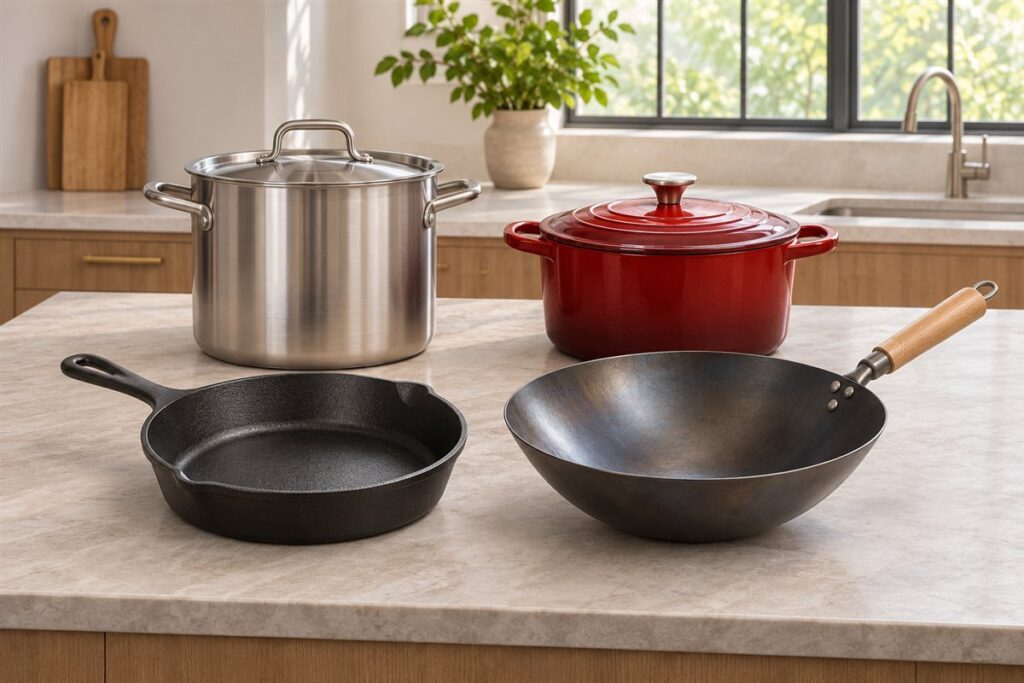
Enameled cast iron has a glass-like coating over the iron, so it needs no seasoning and handles acidic foods well. Bare cast iron is uncoated, builds a seasoned surface, and tolerates very high heat and rough use. Each excels at different jobs.
What Each Is For
Enameled pieces, often in the form of Dutch ovens and braisers, are made for slow cooking, soups, stews and bread. The smooth interior is easy to clean, and the color makes them attractive enough to serve from.
Bare cast iron suits skillets, griddles and pans that sit over a high flame or a campfire. It is the classic choice for searing and frying.
Main Differences
| Feature | Enameled | Bare |
|---|---|---|
| Seasoning | Not needed | Required |
| Acidic foods | Works well | May dull seasoning |
| Chips | Enamel can chip if struck | No coating to chip |
| Metal tools | Usually discouraged | Usually fine |
| Very high heat | Follow maker limits | Handles heat well |
| Rust risk | Low on coated areas, exposed rims may rust | Yes, if left wet |
Care Compared
- Enameled: Wash with warm soapy water and a soft sponge. Soak to loosen stuck food. Avoid sudden temperature shocks and banging the rim.
- Bare: Wash quickly, dry fully, and wipe with a thin coat of oil.
- Both: Lift rather than drag across glass cooktops, and use mitts, since handles and lids get hot.
Who Should Choose Which
Choose enameled cast iron if you braise, make tomato-based dishes, bake bread in a covered pot or prefer low maintenance. Choose bare cast iron if you sear steaks, fry, bake cornbread or want one pan that can take a beating.
A lot of cooks own an enameled Dutch oven and a bare skillet and use each where it works best. Follow the maker’s manual and safety instructions for oven limits and care.
Beyond the basics, think about fit. Enameled pots come in many sizes and shapes, from small round pots to large ovals, and their heavy lids hold in moisture during long, slow cooking. Bare skillets are often made in a single piece, so there is no coating to worry about at the rim or lid. If you cook acidic dishes such as tomato sauces, wine braises or fruit desserts often, the enameled option saves time. If you want a pan for camping or open flames, bare iron is the more flexible option.
Weight and Handling Check
Cast iron of either kind is heavy, and the weight is the first thing many buyers underestimate. A Dutch oven filled with stew, or a large skillet full of hot food, can be difficult to lift with one hand, to pour from, or to move from the oven to a counter. Before buying, think about who will lift it, how often, and over how far.
Look at the handles. Short loop handles on the sides of a pot are easier to grip with mitts than a single long handle that puts strain on your wrist. A helper handle opposite the main handle on a large skillet makes lifting safer. Check that the handles are big enough for a mitted hand, because thick oven gloves need more room than bare fingers.
If lifting is a concern, a smaller diameter or a shallower pot is often easier to manage than a larger one, even if it holds a little less. Product listings usually state the weight, so compare it rather than guessing. Always plan a clear path and a safe resting spot, such as a trivet, before you take a heavy pot off the heat.
Stovetop and Oven Compatibility
Both enameled and bare cast iron generally work on gas, electric coil and induction, because iron is magnetic, but check the product listing for the specific piece. The base should sit flat so it heats evenly and does not rock. On glass or ceramic cooktops, lift the pan instead of sliding it, since a rough base can leave marks.
For oven use, the iron itself tolerates high heat, but the limiting parts are often the lid knob, any handle material and the enamel. Some knobs are rated lower than the pot, and the maker may state a maximum temperature for the whole piece. Check the manual rather than assuming the knob will survive a hot oven.
- Check that the lid and knob share the oven rating of the pot.
- Measure your oven rack height if you plan to bake bread in a tall pot.
- Confirm broiler use is allowed before putting an enameled piece under direct heat.
Grill and open-flame use is more of a bare iron strength, but follow the maker’s guidance for each piece.
Choosing Size and Shape
Capacity is stated in quarts or liters on most listings, but the shape changes how that capacity behaves. A round pot suits soups and bread loaves. An oval suits a roast or a long piece of meat. A wide, shallow braiser gives more surface for browning, while a tall pot holds more liquid with less surface.
Think about how many people you usually feed. A smaller pot is easier to store and heat, but a pot that is too small forces you to cook in batches. A pot that is too large may spread a small amount of food thin and scorch it. For skillets, the diameter should match your burner, and the depth should suit what you cook: shallow sides help with flipping and browning, deeper sides help with frying and holding sauce.
Check the inside dimensions as well as the outside, since thick walls reduce usable space. If you want to bake in it, make sure your oven and your usual loaf or recipe fit the interior.
Budget Tiers and What Changes
Qualitatively, lower-cost cast iron pieces tend to focus on the basics: a solid body and a simple finish. Mid-range pieces often add better enamel coverage, a tighter lid fit or a smoother interior. Premium pieces may offer more color choices, heavier lids and longer warranties. These are general patterns, not guarantees, so read the specific listing.
For bare cast iron, the main differences are usually the surface finish and whether the pan arrives pre-seasoned. A rougher surface can still cook well but may take longer to build a slick seasoning. A smoother surface can feel nicer at first.
For enameled iron, look closely at the rim, the lid edge and the inside surface. Even coverage matters because exposed iron on the rim can rust and chipped enamel is hard to repair. A warranty can be worth reading, but check what it excludes. Spending more is reasonable if you will use the piece weekly, but a basic piece used with care can give long service.
Signs to Repair or Replace
Bare cast iron is forgiving. Rust spots can usually be scrubbed off and the pan reseasoned, and a sticky or flaking surface can often be stripped and rebuilt. A crack through the body, however, is a reason to retire the pan, since it can fail under heat.
Enameled pieces need a closer look. Small chips on the outside rim may be cosmetic, but chips or wear on the cooking surface can expose iron and may cause flaking into food. Many makers advise stopping use if the interior enamel is chipped or damaged. Check your manual for specific guidance.
- Dull, rough patches inside an enameled pot that do not clean off.
- Crazing, which looks like a network of fine cracks, in the interior coating.
- A lid that no longer sits flat or a warped base that rocks.
- Deep pitting or cracks in bare iron.
When in doubt, contact the maker for advice before continuing to cook in a damaged piece.
FAQ
Does enamel wear out?
It can chip or dull with impact and rough cleaning. Gentle handling keeps it looking good.
Can I use bare cast iron for stew?
You can, but long acidic simmers may strip some seasoning, so enameled pieces are usually easier.
Can I use soap on bare cast iron?
Mild dish soap is generally fine on a seasoned pan if you rinse, dry it fully and wipe on a thin coat of oil afterward. Avoid long soaks. Check the maker's care guide for their preferred routine.
Do I need to season enameled cast iron?
No, the enamel coating means the cooking surface is not seasoned. Some bare rim areas may benefit from a light wipe of oil to protect against rust, so check the manual.
Is enameled cast iron safe for induction cooktops?
Most iron-based pieces work on induction, but confirm on the product listing. Lift rather than slide the pot to avoid scratching the glass top.
Can I cook acidic food in a bare cast iron pan?
Short cooking is usually fine, but long simmers of tomatoes or wine can dull the seasoning and add a metallic taste. An enameled pot is more suited to long acidic dishes.
Why is my bare cast iron sticky?
Stickiness usually means too much oil was left on during seasoning or heating. Wipe the pan with a very thin layer and heat it as the maker advises. Repeat if needed.
Can I put cast iron in the dishwasher?
Bare cast iron should not go in the dishwasher because it can rust and lose its seasoning. Enameled pieces may be listed as dishwasher safe, but many makers still recommend hand washing to protect the finish.
The Short Version
Enameled cast iron is the low-upkeep option for braises and acidic dishes. Bare cast iron is the tougher option for searing and frying. Many kitchens benefit from owning one of each.