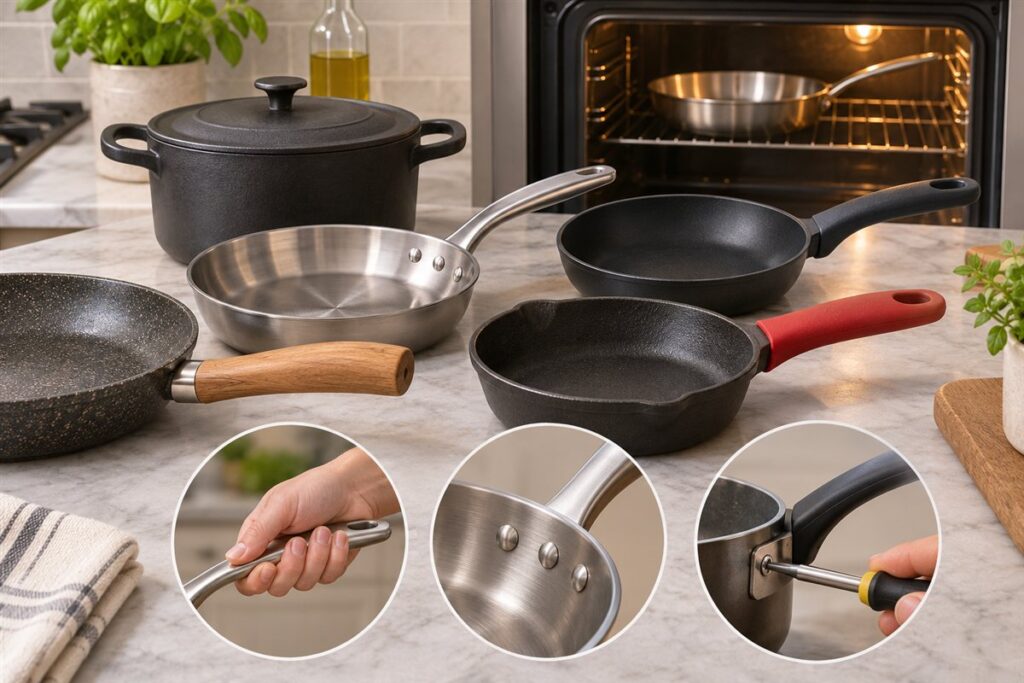
Cookware handles differ in material, shape, length and how they attach to the pan. Those differences change comfort, how warm the handle gets on the stove and whether the pan can go in the oven.
Handle Materials
- Metal: Strong and usually oven-friendly, but it can become hot during cooking, so a cloth or mitt is often needed.
- Plastic or resin: Stays cooler near heat, though oven limits are lower. Check the maker’s guide.
- Wood: Warm to hold, but often not suited to the oven or to long soaking.
- Silicone-covered: Gives a soft grip, with heat limits set by the maker.
The handle is often the limit on oven use, not the pan body, so always check the stated temperature for the whole pan.
Shape, Length and Attachment
A long handle gives leverage for tossing and keeps your hand away from heat, but it takes room on the stove and in the cupboard. A short loop handle suits heavy pots and two-handed lifting.
- Riveted: Fixed with metal fasteners for a firm hold; the rivets can trap food and need careful cleaning.
- Welded or cast: A smooth join with fewer crevices to clean.
- Screwed: May loosen with use and sometimes can be tightened.
- Helper handle: A small second grip on large pans for safer lifting.
Choosing for Your Hands
Comfort is personal. A handle that suits large hands may feel awkward in small ones. Think about the weight of the filled pan, whether you wear oven gloves while cooking, and how you hold the pan when you pour.
- Check that the handle shape fits your grip.
- Look for a gentle curve that does not dig into the palm.
- Make sure the handle does not sit over a neighbouring burner.
- Always treat any handle as potentially hot, and follow the maker’s instructions.
Care for Handles
Handles take wear that the pan body does not. Soaking can swell wood and loosen fasteners, and strong detergent or repeated dishwasher cycles may dull some finishes. Wipe handles clean, dry them promptly and keep them away from open flame at the sides of the pan.
It also helps to check fasteners now and then. A wobble is an early sign that the handle is working loose. Follow the maker’s care and repair advice, and stop using the pan if the handle is no longer firm.
Comparison
| Type | Strength | Watch for |
|---|---|---|
| Metal | Oven-friendly | Gets hot |
| Resin | Stays cooler | Lower oven limit |
| Wood | Comfortable | Moisture and heat |
FAQ
Can I put any pan with a handle in the oven?
No. Check the stated oven limit for the handle and lid as well as the pan body.
Why is my handle loose?
Screws and rivets can loosen with use. Follow the maker’s advice, and stop using a pan whose handle is not firm.
The Short Version
Handles vary in material, shape and attachment. Choose for comfort, heat behaviour and oven needs, and follow the maker’s guide.