Disclosure: As an Amazon Associate, topratedkitchenware.com earns from qualifying purchases. Links on this page are affiliate links; they cost you nothing extra. Prices and availability change often, so check the current Amazon listing before you buy.
If you are standing in the kitchen wondering how long does rice take in a rice cooker, the honest short answer is that a standard batch of white rice needs about 25 to 35 minutes from the moment you press the switch, while brown rice usually needs 45 to 60 minutes, and some whole grains take longer still. That range frustrates people because it sounds vague, yet the variation is real and it comes from the grain itself, the amount of water in the pot, the size of the batch, and the kind of cooker doing the work. A basic one-switch cooker races through a fixed cycle and relies on a thermostat, while a microcomputer model soaks, ramps, and adjusts as it goes. This guide breaks the timing down grain by grain, explains what is happening inside the pot during each phase, and shows you how to plan dinner around the clock instead of guessing at it. You will also find a small set of cookers whose timing behaviour is predictable enough to build habits around, plus fixes for the batches that finish suspiciously fast or drag on far too long.
How Long Does Rice Take in a Rice Cooker? The Short Answer by Grain
Most timing questions are really about one specific grain, so here is the practical picture first. The figures below assume a mid-size batch, roughly two to three cups of uncooked rice, cooked with the water ratios covered later in this guide, and they include the short rest at the end because rice is not truly done the second the cooker clicks off.
| Rice or grain | Typical total time | Notes |
|---|---|---|
| Long-grain white rice | 25–35 minutes | The benchmark cycle most basic cookers are built around. |
| Jasmine rice | 25–30 minutes | Slightly less water, slightly shorter cycle than standard white. |
| Basmati rice | 25–35 minutes | Benefits from a brief soak before the cycle starts. |
| Short-grain and sushi rice | 30–40 minutes | Needs a fuller rest so the surface starch settles evenly. |
| Brown rice | 45–60 minutes | The bran layer slows water absorption considerably. |
| Wild rice and blends | 50–70 minutes | Often better on a brown or multigrain setting. |
| Steel-cut oats | 35–45 minutes | Use the porridge setting if your cooker has one. |
| Quinoa | 20–30 minutes | Cooks faster than most grains; check early the first time. |
Two patterns matter more than any single number in that table. First, batch size shifts everything: a single cup of white rice in a large cooker can finish in under twenty minutes, while a pot filled near its maximum line can add ten minutes or more because there is simply more water to bring to a boil and more starch to hydrate. Second, the type of cooker matters as much as the grain. The next sections explain why, so you can predict your own pot instead of memorising a chart.
In this guide
Timing Grain by Grain: What Changes and Why
Long-grain white rice
Everyday long-grain white rice is the reference point for the whole category. The grains have been milled so the bran and germ are gone, which means water reaches the starchy centre quickly. In a basic cooker the cycle runs about twenty minutes of active cooking followed by a natural switch to warm; in a microcomputer cooker the machine adds a gentle pre-soak and a controlled ramp, stretching the total closer to half an hour but producing a more even texture from the top of the pot to the bottom. If your white rice regularly takes forty-five minutes in a simple cooker, something else is going on, and the troubleshooting section below covers the usual causes.
Jasmine and basmati
Jasmine rice cooks on roughly the same schedule as standard white rice, sometimes a few minutes faster, because the grains are slender and take up water readily. The mistake people make is using the same water level they use for generic long-grain; jasmine wants a touch less, and excess water does not just make it soft, it can stretch the cycle because the cooker has more free liquid to drive off. Basmati behaves differently again. Its long, fragile grains reward a fifteen to twenty minute soak in the pot before you start the cycle, which technically lengthens your total time but shortens the active cooking and keeps the grains separate and intact rather than broken and gummy.
Short-grain and sushi rice
Short-grain rice carries more surface starch, and that starch needs time to hydrate and then settle. Cookers with a dedicated sushi or short-grain setting build in a longer soak at the start and a longer rest at the end, which is why the total can reach forty minutes even though the grains are small. Skipping the rest is the most common reason home sushi rice feels wet on the surface and firm in the middle: the moisture has not finished redistributing. Give it the full rest, then fold and fan it rather than stirring, which smears the starch.
Brown rice
Brown rice is where expectations go wrong most often. The intact bran layer acts like a raincoat, so water penetrates slowly and the grain needs sustained heat to soften all the way through. On a white-rice setting, brown rice will often click off while the centres are still chalky, which is not a broken cooker but a mismatched program. Use the brown setting when you have one; it typically runs a longer soak and a longer, gentler cook for a total of forty-five minutes to an hour. In a basic cooker without settings, the workaround is to soak the rice in its cooking water for thirty to forty-five minutes before switching on, then let it rest a full fifteen minutes afterwards.
Wild rice, blends, and other grains
True wild rice is a grass seed rather than a rice, and its hard outer shell puts it at the long end of the range, commonly fifty to seventy minutes. Multigrain blends cook at the pace of their slowest component, which is usually the brown rice or barley in the mix. Quinoa sits at the opposite extreme and can be done in twenty minutes, which surprises people who treat it like rice and leave it sitting on warm until it turns mushy. Steel-cut oats land in the middle and foam more than grains do, so the porridge setting, which heats more gently, is as much about preventing boil-over as about timing.
Why the Type of Cooker Changes the Clock
Two cookers given identical rice and water can finish twenty minutes apart, and both can be working exactly as designed. The difference is how each machine decides the rice is done.
Basic switch cookers
The simplest cookers have one lever and no settings. A heating plate boils the water, and when the free water is absorbed and the temperature at the base of the pot climbs past the boiling point of water, a thermostat trips and drops the cooker to warm. This design is fast and blunt: roughly twenty to twenty-five minutes for white rice. Its weakness is judgement. It cannot tell brown rice from white, it struggles with very small batches because there is little water to regulate temperature, and it has no soak phase, so texture depends heavily on the ratio you chose.
Microcomputer and fuzzy-logic cookers
Microcomputer models, often marketed with fuzzy-logic language, run a programmed sequence: a soak at moderate temperature, a ramp to boiling, a controlled simmer, and a steaming finish. They monitor temperature along the way and stretch or shorten phases to match the amount of rice they sense. White rice commonly takes thirty to forty minutes in these machines, which feels slow until you compare texture across the pot. Brown rice, mixed grains, and porridge each get their own program with appropriately longer timelines. If you cook several kinds of grain each week, this is the category where timing becomes genuinely predictable, because the machine is managing the variables for you. Several of the cookers recommended later in this guide work this way, and you can compare broader options in our roundup of multi-purpose rice cookers worth considering.
Induction and pressure models
Induction cookers heat the entire pot rather than a plate beneath it, which evens out hot spots and can shave a few minutes off some cycles while improving consistency. Pressure rice cookers take the opposite approach to the slow soak: they raise the boiling point, force water into the grain faster, and can finish brown rice noticeably sooner than a conventional microcomputer model. The trade-off is a sealed lid you cannot open mid-cycle and a more involved cleaning routine. For most households the time saving is real but secondary; the texture change, plumper and slightly chewier, is the bigger difference.
The Four Phases Inside Every Cook Cycle
Understanding where the minutes go makes timing problems much easier to diagnose, because a batch that seems slow is usually just spending longer in one phase.
Phase one: warming and soaking. Better cookers hold the rice in warm water before boiling, anywhere from ten to thirty minutes depending on the program. This hydrates the outer layers so the grain cooks evenly instead of sealing a hard core inside a soft shell. Basic cookers skip this entirely, which is why a manual pre-soak improves them so much.
Phase two: the ramp to boiling. The cooker brings the pot to a full boil. A large, full pot with cold water takes measurably longer here than a small batch with warm water, which is one reason identical recipes can vary by ten minutes between households. Altitude matters too: water boils at a lower temperature in the mountains, so every subsequent phase stretches.
Phase three: absorption and steaming. Once boiling, the grains absorb water and swell while steam finishes the tops of the grains that sit above the waterline. This is the phase the thermostat in a basic cooker is watching, and the phase fuzzy-logic machines modulate most carefully. Lifting the lid here releases the steam the top layer needs, and it is the single most disruptive thing you can do to timing.
Phase four: the rest. When the cooker switches to warm, the rice is not finished; it is finishing. Ten to fifteen minutes of resting lets moisture equalise between the wetter bottom and the drier top, firms the surface of each grain, and prevents the sticky, wet layer people often blame on too much water. Count the rest in your timing whenever you plan a meal around the cooker, because serving straight from the click almost always disappoints.
Water Ratios: The Hidden Timing Lever
Water does double duty in a rice cooker. It is an ingredient, and it is also the clock: in a basic cooker the cycle literally ends when the free water is gone, and in a smart cooker the amount of water changes how long each phase runs. Too much water therefore does not just risk mushy rice, it reliably makes the batch slower. Too little water ends the cycle early and leaves hard centres, which people then try to fix by adding water and restarting, producing the worst texture of all.
As a working starting point for a cooker, long-grain white rice does well at about one part rice to one and a quarter parts water, jasmine slightly lower, basmati around one to one and a half after soaking, short-grain near one to one point one, and brown rice around one to one and three quarters. These are starting points rather than commandments because rice varies by brand, age, and how it was stored; older, drier rice drinks more. The measuring lines stamped inside most pots are calibrated for the cup that came with the cooker, which is smaller than a standard measuring cup, and mixing the two systems is the most common ratio error of all. Use the included cup for both the rice and the water lines, or ignore the lines and use consistent ratios with your own cup. If you are choosing a cooker size for the first time, our guide on choosing the right rice cooker size walks through how capacity changes both ratios and timing.
Rinsing deserves a mention here because it changes the water in the pot more than people expect. Rice carried into the cooker dripping wet can add a tablespoon or more of unmeasured water per cup, which is enough to soften a small batch and lengthen its cycle slightly. Rinse until the water runs mostly clear, then drain properly in a sieve for a minute before the rice goes into the pot. You will get the texture benefit of removing surface starch without quietly sabotaging your ratio.
There is also a quiet relationship between ratio and altitude worth knowing before you travel with a cooker or move house: at elevation, grains absorb water more slowly, so a ratio that behaved perfectly at sea level can finish with firm centres even when the cycle time looks normal. The fix is a small increase in water paired with the longer program, tested one batch at a time and recorded in the timing log described later. Cooks who split the year between two homes learn this the empirical way; the log simply makes the lesson permanent.
How to Get the Timing Right, Step by Step
Step 1: Measure with the cooker’s own cup. Fill the included cup level for each measure of rice, and match the water to the corresponding line for white rice, or use the ratios above for other grains.
Step 2: Rinse and drain. Swish the rice in several changes of water until it runs mostly clear, then drain for a full minute so surface water does not skew the ratio.
Step 3: Soak when the grain rewards it. Basmati gets fifteen to twenty minutes in its cooking water. Brown rice in a basic cooker gets thirty to forty-five. White rice needs no soak in a microcomputer cooker, which handles it internally.
Step 4: Level the surface and wipe the pot. Shake the pot gently so the rice sits flat, which keeps the top layer even, and wipe the outside of the inner pot dry so the heating plate or sensor reads temperature cleanly.
Step 5: Choose the honest setting. Brown rice on the brown setting, mixed grains on multigrain, oats on porridge. Using the white setting for everything is the root of most timing complaints.
Step 6: Start it and leave it alone. Every lid lift during cooking vents steam the top layer needs and adds minutes you cannot measure. If you need a beginner-friendly walkthrough of the whole routine, see rice cooker basics for first-time owners.
Step 7: Rest ten to fifteen minutes on warm. When the cycle ends, keep the lid closed and let the rest phase finish the job.
Step 8: Fluff with a paddle, from the bottom up. Slice down and fold rather than stirring, which breaks grains and releases starch. Serve promptly, or hold on warm for no more than a few hours for the best texture.
Troubleshooting: Too Fast, Too Slow, and Everything Between
The cooker finished in fifteen minutes and the rice is hard
An unusually short cycle almost always means the cooker believed the water was gone when it was not, or there genuinely was too little water. Check that you used the cooker’s cup rather than a standard cup for the rice while filling water to the pot lines, a mismatch that under-waters the batch. Check also that the inner pot was seated flat and its outside was dry; a tilted pot or a wet base can fool the thermostat. Very small batches in a large cooker trip early for the same reason, so cook at least the minimum the manual suggests, or add the rest of the meal’s rice and refrigerate the extra.
The cycle drags past an hour for ordinary white rice
Excess water is the first suspect, including the rinse water you did not drain. The second is a lid seal problem: steam escaping around a warped lid or a clogged vent keeps temperatures down and stretches every phase. Inspect the gasket and vent cap, and clean the condensation collector. The third suspect is the heating plate itself; a layer of burnt starch or mineral scale insulates the pot. Our walkthrough on how to clean a rice cooker properly covers the plate and vent in detail.
The bottom is scorched while the top is underdone
This split personality usually means the rice layer was uneven, the batch was too large for the cooker, or the lid was lifted mid-cycle so the top never received its steam. Level the surface before starting, respect the maximum line for your grain type, remembering that brown rice and blends expand more, and keep the lid closed until the rest is over.
Brown rice is still chalky in the centre
The bran layer needed more time or more water, full stop. Move to the brown setting, add a small amount of extra water next time, and extend the soak. If your cooker has no brown setting and the soak-plus-rest method still leaves chalky centres, the machine’s single fixed cycle is simply too short for the grain, which is a legitimate reason to upgrade to a microcomputer model rather than a technique failure on your part.
Choosing a Cooker With Timing in Mind
If you are buying a cooker and timing predictability is a priority, shop for behaviours rather than brand names. A dedicated brown-rice program matters more than any other single feature if whole grains are in your rotation, because it is the one timeline a basic machine cannot fake. A delay timer matters if your schedule is the problem, since it converts cooking time into finishing time, which is what meal planning actually needs. A quick-cook program is worth having but should rank below both, because it only accelerates the grain that was already fastest. Capacity deserves honest thought: a cooker times its best batches in the middle of its range, so a household that usually cooks two cups should not buy a ten-cup machine and expect the same precision at the bottom of its pot. Finally, consider how the cooker reports itself. Models with a countdown display in the final phase are quietly useful, because they let you time the rest of dinner to the minute; models that simply click leave you estimating, which is how the question at the heart of this guide gets asked in the first place. The four machines below were picked with exactly these behaviours in mind.
Cookers That Keep Timing Predictable
Timing is only useful if the machine delivering it behaves the same way every week. The four cookers below were chosen because their programs are well matched to the grains above, and each listing was verified before this guide was written. If you prefer to avoid nonstick coatings entirely, we keep a separate list of non-toxic rice cookers with stainless pots that takes a different approach to the same problem.
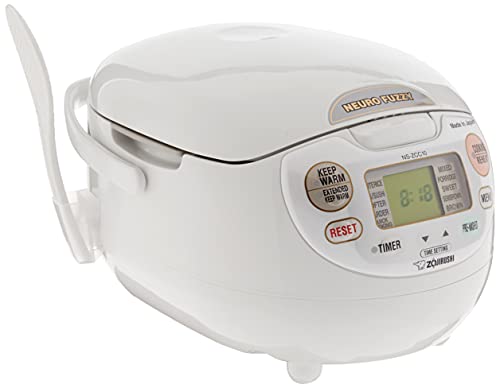
Zojirushi Neuro Fuzzy NS-ZCC10 — the timing benchmark
At a glance: Microcomputer fuzzy-logic cooker, 5.5-cup uncooked capacity, dedicated settings for white, sushi, porridge, brown, and quick cooking, with a delay timer and extended keep-warm.
The Neuro Fuzzy earns its reputation in this category by being boring in the best way: white rice lands in the mid-thirty-minute range with a soak and rest built into the program, brown rice gets a properly long cycle, and the results repeat week after week. Its quick-cooking setting exists for nights when the standard timeline does not fit, and it trades a little texture for a meaningfully shorter cycle, which is the honest way to offer speed. The spherical inner pan helps heat circulate so the top and bottom of the pot finish together.
Strengths
- Programs matched to each grain, so the timings in this guide hold true
- Excellent keep-warm that holds rice for hours without drying the edges
- Delay timer that makes morning porridge and dinner rice genuinely set-and-forget
Trade-offs
- Slower than a basic cooker for plain white rice
- Sits in the premium tier of the category
- The inner pan is hand-wash recommended to protect its coating
Best for: households that cook several grains a week and want the clock to be trustworthy. Not suited for: anyone who only cooks white rice and values raw speed above texture.

Tiger JBV-A10U — the dependable middle path
At a glance: Micom cooker, 5.5-cup uncooked capacity, four menu settings including brown rice and a synchronised cooking function with an included steaming tray.
Tiger’s JBV-A10U splits the difference between basic and high-end machines. Its cycles run a little quicker than the Zojirushi’s while still managing brown rice honestly, and the Tacook tray lets you steam vegetables or protein above the rice so the whole meal finishes on the same clock, which is a genuinely useful answer to the timing question. The inner pan has a thicker profile than budget models, which steadies temperatures during the absorption phase.
Strengths
- Balanced cycle times across white and brown settings
- Steaming tray that synchronises a full meal to one finish time
- Simple controls that are hard to set wrong
Trade-offs
- Fewer specialised programs than premium fuzzy-logic models
- Keep-warm is good rather than exceptional over very long holds
- No induction heating, so very large batches are slightly less even
Best for: families who want one cooker that handles weeknight rice and steamed extras on a single timer. Not suited for: grain enthusiasts who want a dedicated program for every blend.


Cuckoo Micom Rice Cooker — generous capacity, sensible programs
At a glance: Fuzzy-logic micom cooker, 6-cup uncooked and 12-cup cooked capacity, multiple menu modes with delay timer and keep-warm.
Cuckoo built its name on rice cookers in Korea, and this micom model brings that heritage to a mid-tier machine. The program list covers the grains most households actually rotate through, the fuzzy logic adjusts mid-cycle when a batch runs large, and the capacity suits families who cook rice in quantity for meal prep. In timing terms it behaves like the category leaders: white rice in the low-to-mid thirties, brown on a properly extended cycle.
Strengths
- Capacity that suits batch cooking and larger families
- Fuzzy-logic adjustments that keep big batches consistent
- Delay timer and keep-warm that support flexible meal planning
Trade-offs
- Footprint is larger than the 5.5-cup class
- Menu naming takes a read of the manual to learn
- Replacement inner pots are a brand-specific purchase
Best for: households cooking rice in family-size batches several times a week. Not suited for: single cooks in small kitchens, where a compact model times small batches better.

Aroma Digital Rice Cooker — the honest budget option
At a glance: Digital cooker, 4-cup uncooked and 8-cup cooked capacity, with steam, slow-cook, and oatmeal functions alongside the standard rice programs.
Aroma’s digital models are where many households start, and for white rice the timing story is simple: cycles in the mid-twenties to low thirties, with a basic brown program that runs longer and does a respectable job for the tier. It will not match a fuzzy-logic machine for edge-to-edge consistency on a full pot of brown rice, but it is predictable, and predictable is what timing questions are really about. The multi-function extras make it a reasonable small-kitchen compromise.
Strengths
- Accessible tier with straightforward, repeatable white-rice timing
- Doubles as a steamer and slow cooker in small kitchens
- Compact footprint and simple cleanup
Trade-offs
- Brown rice texture trails dedicated fuzzy-logic programs
- Smaller capacity limits batch cooking
- Keep-warm dries rice sooner than premium models
Best for: first-time cooker owners and small households cooking mostly white rice. Not suited for: daily brown-rice eaters who will notice the texture gap.

One more timing habit separates households that love their cooker from households that tolerate it: cook the rice for the meal you are actually serving, in the quantity that meal needs. Leftover rice reheats well and fries beautifully, so overproduction is not wasteful, but a pot filled to its line for a two-person dinner cooks slower, rests longer, and holds worse than a right-sized batch. When guests double the table, the big batch is worth its extra minutes; on an ordinary night, the mid-size batch is faster, better textured, and easier to judge. Matching batch to appetite is, in the end, the simplest timing optimisation of all, and it requires no new equipment, no special program, and no technique beyond deciding before you measure rather than after.
Delay Timers, Keep Warm, and Food Safety Timing
The delay timer changes the question from how long rice takes to when it will be ready, and it deserves respect because rice sitting in warm water is rice soaking, which changes texture on long delays. For delays beyond a couple of hours, brown rice and sturdy long-grain white handle the soak best; delicate jasmine can turn soft if it sits in water all day. In warm weather, long delays with the rice sitting at room temperature in water are worth avoiding on ordinary food-safety grounds; use the timer for morning porridge or a workday-length delay rather than an overnight soak in a warm kitchen, and refrigerate cooked rice promptly once the meal is over. Keep-warm is a holding pattern, not a cooking phase: most cookers hold rice pleasantly for five to eight hours, after which the edges dry and the bottom yellows. If your schedule regularly needs longer holds, cook closer to mealtime with the delay timer instead of holding longer on warm.
Planning a Meal Around the Cooker: Three Worked Timelines
Abstract numbers become useful when they meet an actual evening. Here is how the timings in this guide play out in three common situations, counting backwards from the moment food hits the table.
Weeknight white rice with a stir-fry
Stir-fries cook in minutes, so the rice is the long pole in this meal. Start the cooker first: jasmine or long-grain white in a microcomputer cooker needs roughly thirty minutes of cycle plus ten of rest, so press the button forty minutes before you want to eat, then do your chopping at leisure. In a basic cooker the same plan needs about thirty-five minutes total. Either way, the rice finishes its rest right as the wok work ends, and if the stir-fry runs late, keep-warm absorbs the delay gracefully. Working backwards like this is the whole trick: the cooker is the most predictable appliance in the meal, so anchor the schedule to it.
Brown rice for a grain-bowl dinner
Brown rice on its proper setting needs forty-five to sixty minutes plus fifteen of rest, which means the cooker should start a full hour and a quarter before serving if you want slack. That long window is an asset rather than a burden: it covers roasting vegetables, making a sauce, and dressing greens without any last-minute juggling. If your cooker has a delay timer and you set it before leaving the house, remember the soak effect discussed above; brown rice tolerates a few hours of soaking well, and many people find the texture slightly more tender for it. What you should not do is start brown rice when the rest of dinner is already under way and hope the white-rice timing applies, because that mismatch is how chalky centres happen.
Morning porridge and oats on a timer
Steel-cut oats on the porridge setting take thirty-five to forty-five minutes, which is longer than most weekday mornings allow for active cooking, so the delay timer earns its place here. Load the pot the night before with oats, water, and a pinch of salt, set the finish for wake-up time, and the cooker handles the rest. Rolled oats cook faster and can go mushy on a long hold, so steel-cut is the right grain for this routine. One caution from experience across many kitchens: dairy added the night before is a poor idea on food-safety and texture grounds alike, so cook in water and stir in milk, fruit, or nuts at the table.
Cooker Settings Decoded: What Each Program Does to the Clock
Menu names vary by brand, but the programs cluster into a handful of behaviours, and knowing which behaviour you selected explains most timing surprises.
White / regular. The default program, tuned for milled white rice with a moderate soak in smart cookers and none in basic ones. Expect the mid-range figures from the table at the start of this guide.
Quick cook. Compresses or skips the soak and shortens the steaming finish. Saves roughly a third of the cycle on white rice and costs some evenness. Best reserved for plain white rice, where the texture penalty is smallest.
Brown. Extends the soak substantially and lengthens the cooking phase so water can penetrate the bran. This is the single most valuable setting for anyone who eats brown rice weekly, because no ratio trick fully substitutes for the extra time under heat.
Mixed / multigrain. Assumes a blend whose slowest component sets the pace, so it runs long like the brown program and often adds an even longer soak. Use it for blends containing barley, beans, or wild rice.
Sushi / short-grain. Front-loads soaking and back-loads resting to manage surface starch. The total looks long for such small grains until you taste the difference the rest makes.
Porridge / congee. Heats gently and cycles to prevent the foaming and boil-over that starchy, high-water mixtures produce. Timing is moderate, but the gentleness is the point.
Steam. Not a rice program at all, but it shares the clock: vegetables typically need ten to twenty minutes above already-cooking rice, which is why trays like the one bundled with the Tiger model earlier are sized to finish with the grain rather than before it.
Keep warm and extended keep warm. A holding state, not a cooking state. Standard keep-warm maintains serving temperature; extended modes on premium machines modulate temperature to protect texture over longer holds, which is why two cookers can hold the same rice for eight hours with noticeably different results.
Rice Cooker Timing vs. Every Other Method
It helps to see the cooker in context. On the stovetop, white rice takes about eighteen minutes of simmering plus ten of rest, but demands a watched pot and a well-fitting lid, and brown rice stretches to forty-five minutes of simmering with the same attention tax. A microwave finishes small amounts of white rice in roughly fifteen to twenty minutes with a rest, though large batches cook unevenly and brown rice results are inconsistent. An electric pressure cooker is the speed champion on paper, bringing white rice to pressure and cooking it in a few minutes, yet the pressurising and natural-release phases bring the honest total close to twenty-five minutes, and brown rice lands around forty minutes all-in. The dedicated rice cooker rarely wins on raw minutes. It wins on repeatability: the same grain, the same ratio, and the same setting produce the same finish time and texture on a tired Tuesday as on a careful Sunday, and it holds the result warm while the rest of the meal sorts itself out. For most households, that reliability is the real answer to the timing question.
Altitude, Voltage, and Other Quiet Variables
A few households in every audience cook at altitude, and they deserve a direct answer: water boils at a lower temperature as elevation rises, so grains hydrate more slowly and every phase of the cycle stretches. At around five thousand feet, expect white rice to need a few extra minutes and slightly more water, and brown rice to benefit from both a longer soak and the longest program you have. Pressure rice cookers sidestep much of this because they set their own boiling point. Voltage is a smaller factor but a real one for very basic cookers used on unstable supplies, where a weak feed lengthens the ramp to boiling. Finally, the starting temperature of your water shifts the early phases: warm tap water shortens the ramp by several minutes, which is harmless for white rice but can subtly change texture on programs whose soak phase assumes cold water, one more reason manufacturers quietly recommend starting cold for consistency.
Judging Doneness When You Do Not Trust the Clock
Sometimes the real question is not how long the rice should take but whether the pot in front of you is actually done. Three checks, used together, settle it without guesswork.
Look at the surface. Finished rice has a matte, set surface with small steam vents or craters across the top and no visible pools of water. A glossy, wet sheen means free liquid remains, which calls for more time on warm with the lid closed, not a restart of the full cycle.
Test a grain from the top and one from the bottom. The top layer is the last to cook and the bottom is the first, so sampling both tells you whether the pot is underdone or merely uneven. A grain that is tender at the edges with a faintly firm centre will finish perfectly during the rest; a grain that is hard and chalky all the way through needs more water and more time, and is best steamed further with a few tablespoons of hot water sprinkled over the surface and the lid closed for another ten minutes on warm.
Watch how the paddle behaves. Properly rested rice releases from the paddle in soft clumps and leaves the bottom of the pot mostly clean. Rice that smears and sticks heavily is either over-watered or under-rested, and ten more closed minutes distinguishes the two: under-rested rice firms up noticeably, while over-watered rice stays soft no matter how long it sits.
Shaving Minutes Safely When Dinner Is Late
There will be evenings when the honest timeline does not fit, and it is better to know which shortcuts cost little than to improvise ones that cost a lot. Soaking white rice for fifteen minutes in its cooking water before switching on a basic cooker trims the active cycle and improves evenness at the same time, making it the rare shortcut with no downside beyond planning. Starting with warm water shortens the ramp phase by several minutes in any cooker. Choosing a smaller batch, or splitting a large batch so the pot is not near its maximum line, speeds both the ramp and the absorption. The quick-cook program, where fitted, is the legitimate fast lane for white rice. What does not work: cranking down the water to end the cycle sooner, which produces hard centres that no rest can fix; opening the lid repeatedly to check progress, which vents the steam doing the work; and transferring half-cooked rice to a pan to finish, which breaks grains, releases starch, and reliably produces the gluey result people blame on the cooker. If dinner is truly late, the graceful move is to let the rice be the second course of its own meal: serve the stir-fry or curry over yesterday’s properly reheated rice, and let tonight’s batch, cooked at its honest pace, become tomorrow’s fried rice, where day-old grains are not a compromise but the correct ingredient.
Keeping a Personal Timing Log
The most underrated tool in this entire subject costs nothing: a short note, kept on the cooker or in a phone, recording grain, brand, batch size, ratio, setting, total time, and a one-line verdict. Rice varies enough between brands and harvests that the first cook of a new bag is partly an experiment, and a log turns that experiment into knowledge instead of a surprise repeated every few months. Three entries per grain is usually enough to lock in your household numbers: the first cook by the book, one adjusted cook, and a confirmation. Note the failures with the same care as the successes, because the entry that says a particular brown rice needed the long program and extra water is the one that saves a dinner in six months when you have forgotten the lesson. Households that cook for someone with texture sensitivities, young children, or anyone who simply has strong opinions about rice will find the log settles arguments too: the numbers are yours, measured in your kitchen, with your water and your cooker, and they outrank any chart, including the one at the top of this guide.
And if the rice will be fried, sauced, or folded into a soup, judge the timeline by the final dish rather than the pot: slightly firmer rice, rested well and chilled, is the better starting point for all three, which means the standard cycle followed by patience beats any shortcut. Timing, in other words, is not only about the minutes inside the cooker; it is about where those minutes sit inside the meal you are building around them. Write your household’s confirmed numbers on the inside of a cupboard door if that is what it takes to use them, because a timing you have to look up is a timing you will eventually guess at, and guessing is how the whole question started.
Frequently Asked Questions
Does a rice cooker take longer than cooking rice on the stove?
Usually a little, yes. A stovetop pot of white rice can be done in about twenty minutes including a short rest, while a microcomputer cooker often takes thirty to forty. The cooker trades a few minutes for consistency and freedom: no boil-overs, no watching the pot, and a keep-warm phase that holds the result while the rest of dinner catches up. A basic switch cooker is the closest in speed to the stove.
Why does my rice cooker take 45 minutes for white rice?
The most likely reasons are a fuzzy-logic program that builds in a soak and a steaming finish, a large batch, or more water than the grain needs. Check your ratio first, especially whether rinse water was drained, then confirm you selected the regular white setting rather than a mixed or porridge program. If the time appeared suddenly, inspect the lid seal and vent for escaping steam.
Can I open the lid to check the rice?
You can, but you will pay for it in both time and texture. Opening the lid during the absorption phase vents the steam that cooks the top layer and can leave the surface underdone even after the cooker finishes. If you must check, do it once, briefly, near the very end, and add a few minutes of rest afterwards to compensate.
How long can rice stay on keep warm?
For quality, treat five to eight hours as the comfortable window for most cookers, with premium models holding texture at the longer end. Beyond that the rice dries at the edges and can develop off flavours. For safety and quality alike, refrigerate leftovers within a couple of hours of the meal and reheat them thoroughly the next day.
Does the amount of rice change the cooking time?
Yes, in both directions. Small batches finish faster and can trip a basic cooker too early, which is why minimum batch sizes exist in manuals. Full batches take longer to reach boiling and longer to absorb. As a rough guide, expect the extremes of a cooker’s capacity to shift white-rice timing by about ten minutes either way from the mid-size figures in this guide.
Is the quick-cook setting worth using?
It is worth having for genuinely rushed nights. Quick settings skip most of the soak and compress the steaming phase, which can bring white rice down toward twenty minutes in a smart cooker. The cost is texture: grains are a little firmer in the centre and less evenly cooked. Use it as an emergency tool rather than the default, and give the rice its full rest afterwards, which recovers some of the difference.