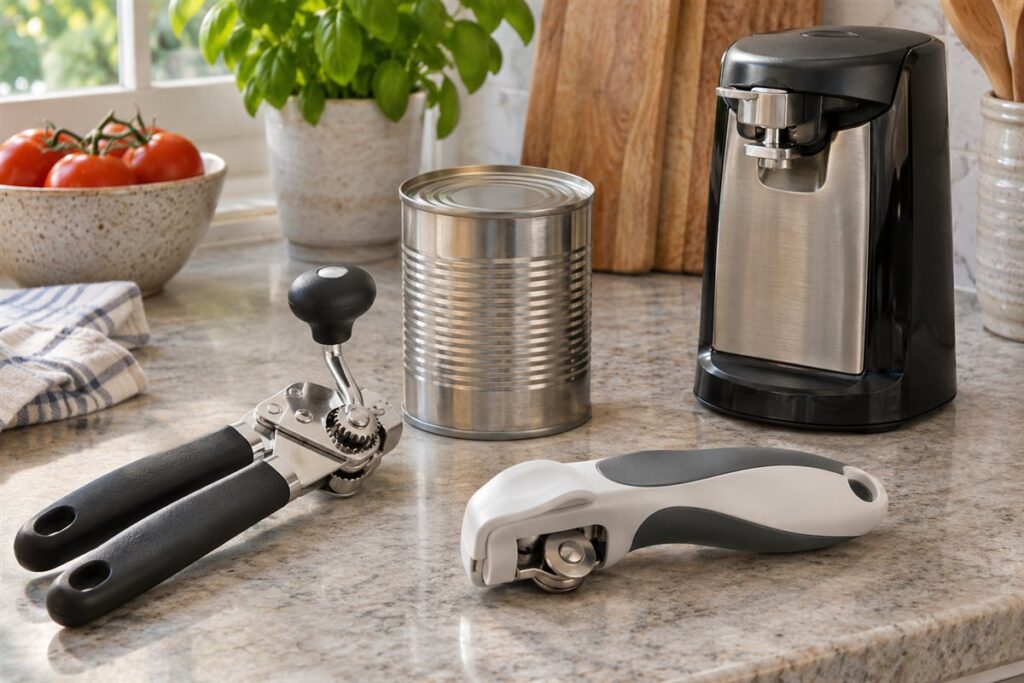
Choose a can opener by thinking about who will use it and how often. A sturdy manual opener with comfortable handles suits most kitchens, side-cutting models leave a smoother edge, and electric openers help anyone with weak hands or limited grip strength. The sections below add a walkthrough for each style, scenarios, a troubleshooting table and care advice.
Three Main Styles
Traditional manual opener
This is the familiar hand-crank tool. A cutting wheel pierces the top of the can, and you turn a knob to move it around the rim. It is compact and does not need power. Good ones have a smooth crank, wide handles and a gear that grips the can well.
Side-cutting (smooth-edge) opener
Instead of cutting the top, a side cutter slices through the seam on the side of the lid. The lid and the can edge stay smooth and less likely to scratch skin, and the lid can often be set back on the can. Technique is slightly different, so check the maker’s guide.
Electric opener
You set the can in place, press a lever and the machine turns it. It is helpful for people with arthritis or reduced hand strength, and it can be quick for lots of cans. It needs counter space and an outlet or battery.
Features to Compare
| Feature | Why it matters | What to check |
|---|---|---|
| Handle shape | Comfort and leverage | Wide, soft or textured handles |
| Crank knob | Ease of turning | Large, easy-grip knob |
| Cutting wheel | Clean cutting | Hard metal wheel and a firm gear |
| Edge result | Affects handling | Smooth edge vs standard cut |
| Cleaning | Food builds up on the wheel | Removable parts or dishwasher advice from the maker |
| Can size range | Some cans are tall or shallow | The sizes the maker lists |
Using One Properly
- Wipe the top of the can so dirt does not fall inside.
- Line up the opener with the rim, making sure the wheel and gear grip firmly.
- Turn the crank slowly and steadily.
- Stop before the lid comes fully off if you want to lift it with a magnet or fork.
- Take care with the sharp lid and the rim. Dispose of lids safely.
Lids and cut edges are sharp, so handle them carefully and follow the maker’s safety instructions.
Care and Cleaning
Food residue on the wheel is where bacteria like to hide, so wash the opener after every use, particularly after opening cans of meat or beans. Dry it thoroughly to prevent rust. A small brush helps clean the gear teeth. A worn wheel that slips on the rim is a sign it is time to replace the tool.
Electric models need slightly different care. Unplug them before cleaning, wipe the cutter area with a damp cloth, and use a small brush where residue gathers. Never immerse the motor housing in water. If the unit has a removable cutting assembly, follow the maker’s guide for taking it out and washing it. Check the cord for damage from time to time, and keep the opener on a dry, stable surface away from the edge of the counter.
Worked Example: Opening a Can with a Manual Opener, Step by Step
The motion looks simple but a few details make it smoother, whichever model you own.
- Rinse or wipe the top of the can, and give it a shake or stir after opening if the contents have settled.
- Open the handles wide, set the cutting wheel on the rim of the can and the drive gear on the outside of the rim, then squeeze the handles together until the wheel bites through the lid.
- Check that the wheel has pierced the metal, not just rested on it. If the opener slips, lift it off and reposition.
- Turn the knob in the direction shown by the maker. Keep a steady speed; jerky turns can leave sharp points.
- Near the end, slow down so the lid does not fall into the contents. Release the handles, lift the opener away and take the lid off carefully, using a fork or magnet if it is hot or slippery.
- Pour out the contents, then wash the opener’s wheel and gear straight away before food dries on.
- Store leftover food in a clean container, not in the opened can, and keep it chilled according to food-safety guidance.
Common Scenarios
Someone with arthritis or limited grip
An electric opener or a manual one with large, soft handles and a big knob may suit best. Try different handle shapes if you can, because comfort is personal.
A small household that opens a few cans a week
A good manual model is enough. Choose one that cleans easily and fits a drawer.
A kitchen that cooks from cans often
Speed and reliability matter more. An electric opener or a heavy-duty manual one saves effort, and a spare in the drawer is handy.
Camping or emergency kits
A compact manual opener with no moving parts to break, kept dry, is a sensible choice. Check that it works on the can sizes you carry.
Mistakes to Avoid
- Forcing the opener when the wheel is not engaged. It can slip and cause an injury.
- Skipping cleaning. Dried residue is hard to remove and unpleasant for the next can.
- Leaving lids in the can. They are sharp and can cut hands when you tip out contents.
- Using the opener on cans it is not designed for. Pull-tab ends, special lids and oversized cans may need different tools.
- Storing it damp. Rust on the wheel can transfer to food and weakens the cut.
Quick Troubleshooting
| Symptom | Likely cause | What to try |
|---|---|---|
| Opener slips off the rim | Dirty or worn gear, or poor alignment | Clean the gear, reposition the opener and replace it if the teeth are worn |
| Wheel will not cut | Dull or damaged wheel | Clean it and check for damage; replace if it still fails |
| Crank is stiff | Dried food in the mechanism | Wash with warm soapy water and a brush, and dry well |
| Lid falls in | Cut completely through without support | Slow down at the end and use a magnet or fork to lift the lid |
| Electric unit stops | Power issue or obstruction | Check the plug or battery, then clean the cutter as the maker advises |
Glossary
- Cutting wheel: The small disc that slices into the can.
- Drive gear: The toothed wheel that grips the rim and turns the can.
- Seam: The joint where the lid meets the can body.
- Side cutter: A blade that cuts the seam from the side to leave a smooth edge.
- Rim: The raised edge around the top of the can.
FAQ
Why does my opener keep slipping?
The cutting wheel or gear may be worn or dirty. Clean it first. If it still slips, replace the opener.
Do I need more than one opener?
Many households keep a spare manual model in a drawer in case the electric one is unavailable.
Are smooth-edge openers really safer?
They leave a smoother lid and rim, which many people find easier on their hands. The cut edge can still be sharp, so handle lids and cans carefully.
Can I put it in the dishwasher?
Some can go in, but heat and detergent can dull the finish or loosen rivets. Check the maker’s guide, and dry the opener right away either way.
What should I do with a dented or bulging can?
Follow food-safety guidance, which generally advises against using cans that are bulging or leaking. When in doubt, throw the can out rather than opening it.
The Short Version
Choose a manual opener for dependable everyday use, a side-cutting style for smoother edges, and an electric one when grip strength is a concern. Clean it often and handle lids with care.