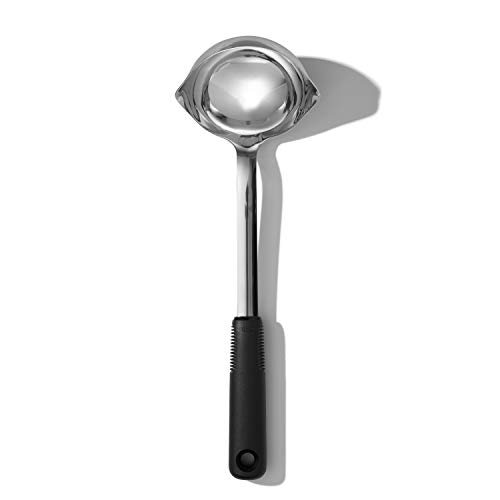
A ladle moves liquid from pot to bowl, while a skimmer lifts solids out of liquid and lets the liquid drain away. To choose well, match bowl size and handle length to your pots, and choose a material that suits your cookware. The two tools have different jobs, so compare them separately.
The Ladle: What to Check
- Bowl size: about the size of a single serving for soup, or smaller for sauces. A very large bowl is hard to pour neatly into narrow cups.
- Pouring rim: a small spout on one or both sides helps you pour cleanly.
- Handle angle: a long handle with a bend or hook keeps your hand clear of steam and lets the ladle rest on a pot edge.
- Depth of bowl: deeper bowls hold more but need taller pots.
In this guide
The Skimmer: What to Check
A skimmer has a wide, shallow head with small holes or a fine mesh. Mesh versions lift out small bits such as foam from stock, while hole versions suit larger items like dumplings or fried foods. A flatter head lets you scoop from the surface; a deeper one holds more food.
The size of the holes decides what drains and what stays. Fine mesh catches crumbs and scum but can clog with batter or breadcrumbs and takes more effort to clean. Larger holes drain quickly and are easy to rinse, but small pieces slip through. For frying, a head wide enough to lift several pieces at once saves time, while a smaller one gives better control in a narrow pan.
Material Comparison
| Material | Good for | Care notes |
|---|---|---|
| Stainless steel | Hot pots of any kind | Can scratch nonstick surfaces, so take care |
| Silicone head | Nonstick and enamel pots | Check the heat limit in the maker’s guide |
| Nylon-style plastic | Light everyday use | May soften if left against hot metal |
| Wood or bamboo | Gentle on cookware | Hand wash and dry |
Match the Tool to Your Pots
- Measure the height of your tallest pot.
- Look for handles at least a hand-span longer than that so your fingers stay out of the steam.
- Check that the head fits the narrowest pot you use.
- If you fry, use a skimmer with a long handle, and lower food into oil gently to avoid splashes.
- Always follow the maker’s guidance for hot oil and hot liquids.
A Worked Example: Stock and Fried Food in One Kitchen
Imagine a kitchen that makes weekend stock and also fries fritters in a wide pan.
- For the stock pot, choose a ladle with a bowl that holds about a single serving and a handle long enough to reach the bottom of the pot with a hand’s width to spare.
- Choose a fine mesh skimmer to lift foam from the surface as the pot heats. Dip it just under the surface and draw it across, then rinse it in a bowl of water.
- For the fritters, choose a skimmer with a flatter, wider head and larger holes so oil drains quickly.
- Rest the fried food on a rack or paper towels, as your recipe suggests, and keep the tool dry before it goes near hot oil, because water makes oil spit.
- Wash both tools soon after use and store them together so each has a place on the rail.
Common Scenarios
Making soup on a nonstick-coated pot
A silicone-headed ladle protects the coating. Check the heat limit in the maker’s guide.
Boiling dumplings or pasta
A skimmer with larger holes lifts them out and lets the water fall away.
Skimming stock
A fine mesh skimmer removes foam and bits without taking much liquid with it.
A small kitchen with few drawers
Choose tools with a hanging hole and keep them on a rail by the stove instead of in a crowded drawer.
Safe Handling With Hot Liquid and Oil
Hot soup, stock and oil call for steady habits. Keep the pot handle turned away from the front of the stove so it is not knocked. Lower food into oil slowly and close to the surface, which reduces splashes. Do not overfill a ladle or let it reach the brim, since a full bowl slops when you carry it across the kitchen. When you move a loaded skimmer, hold it level, and let it drain over the pot for a moment before lifting it away. Keep a plate or tray ready for the food you lift, so you are not holding a dripping tool while looking for a place to put it. If you are frying, follow the pan or fryer maker’s guidance on oil level and temperature, and keep children and pets away from the stove. A ladle or skimmer with a heat-resistant, non-slip handle is easier to control in these moments, so check the grip as well as the head.
Mistakes to Avoid
- Using a wet skimmer over hot oil: water on the head can cause spitting, so dry it first.
- Buying a handle too short: your hand ends up close to steam or oil.
- Using steel on coated pots: it can scratch the surface.
- Leaving plastic against a hot rim: it may soften or mark.
- Choosing mesh for battery foods: thick batter clogs fine mesh, so choose larger holes.
Storage and Everyday Care
Tools with a hanging hole or hook can live on a rail beside the stove, which keeps them close and lets them drain. Wash soon after use, because stock and sauces dry into films that are harder to remove later. Check riveted joints where the handle meets the head, since food can gather there; a small brush clears it. Follow the maker’s guide on dishwashers, as wooden handles and some coatings prefer hand washing.
Quick Troubleshooting
| Symptom | Likely cause | What to try |
|---|---|---|
| Mesh clogged with residue | Food dried in the holes | Soak, then brush from the back |
| Food slips through the holes | Holes too large | Use finer mesh for small pieces |
| Ladle tips on the pot rim | Hook shape does not fit | Use a rest beside the stove |
| Skimmer scratches the pot | Metal edge on a coated surface | Switch to a softer material |
If you are buying only one of the two, choose by the cooking you do most. A cook who makes soup and stew every week will get more use from a good ladle. A cook who boils pasta, poaches eggs or fries often will lean on a skimmer. Some tools combine the two, with a bowl and holes in the same head, but they rarely do either job as well as a dedicated tool, so think about whether the compromise suits you. Whichever you buy, check that the head sits flat in your hand and that the handle does not twist when loaded.
Handle Design and Grip Comfort
A ladle or skimmer lives in your hand during cooking, so the handle shapes how comfortable the tool feels. Look at the length, the thickness, the curve and how the handle meets the bowl or basket. A handle that is too short makes you lean over a hot pot and puts your fingers near steam. One that is too long can knock into other items in a drawer, or tip a small pot.
Thick, rounded handles are easier to hold for long stirring sessions, while thin ones can dig into the palm. Some handles have a hook or hole at the end for hanging, which is useful if you keep tools on a rail. Others have a flat top that lets the tool rest on a counter. Think about where you will store and use it.
- Check that the handle joins the bowl with a smooth transition, since gaps can trap food.
- Look for a slight bend or offset that keeps your knuckles clear of the pot rim.
- Consider whether the handle stays cool, or whether the metal conducts heat toward your hand.
- Make sure a hanging loop, if present, does not make the tool unstable on a counter.
A tool that feels balanced when you hold it a little way up from the end is usually pleasant to use. Heavy bowls with light handles can feel tippy, so give a test hold if you can.
Pouring Spout and Rim Shape for Clean Serving
Ladles differ in how they pour. Some have a rim with pouring edges on both sides, helping left-handed and right-handed cooks equally. Others have a single spout that gives a thin, directed stream. A bowl with a rounded lip and a gentle slope drips less than one with a flat rim.
If you often serve soup into narrow-necked containers, such as jars for storage, a smaller bowl with a spout fits better. For wide pots and shallow bowls, a deeper scoop moves more with each pour. A ladle that holds a little more than a single serving can let you fill a bowl in two movements without much mess.
Reaching the bottom of the pot
Check that the bowl is curved enough to sit near the bottom of your pot without the handle hitting the rim. Straight-sided pots and deep stockpots need longer handles, while shallow saucepans work with shorter ones. If the bowl sits at an awkward angle when you dip, you will probably end up spilling.
Skimmer Baskets, Mesh and Holes Compared
Skimmers come in several designs, and the type of opening shapes what the tool does best. Wide, flat baskets with large holes drain quickly and lift bulky items such as dumplings, fried chicken and large vegetables. Fine mesh baskets catch small particles like foam, bits from stock or crumbs from frying oil.
| Skimmer Style | Opening Type | Good For | Watch Out For |
|---|---|---|---|
| Wide basket, large holes | Punched openings | Dumplings, pasta, fried pieces | Small items slip through |
| Fine mesh | Woven wire | Foam, fine sediment, oil clean-up | Clogs and needs careful rinsing |
| Flat spider style | Open wire web | Lifting many pieces at once | Wire may bend if pressed hard |
| Shallow slotted | Slots | Eggs, delicate items | Limited holding capacity |
Consider the depth of the basket as well. A shallow one is easy to slide under delicate food, whereas a deeper one carries more but is harder to tip out. When you read a listing, look for the basket diameter and depth and compare them with your largest pot.
How Each Tool Behaves in Different Foods
Thinking in terms of food can simplify the choice. Thick stews and chili want a ladle with a large bowl and strong handle, since the contents are heavy. Clear broths and thin soups work with lighter ladles that pour precisely. Noodle soups benefit from a ladle with a wide rim that can capture both broth and a few noodles together.
A skimmer fits foods that you cook in liquid and want to remove without pouring out the whole pot. Boiled eggs, blanched greens, boiled dumplings and fried snacks all come out cleanly with a skimmer. In stock making, a skimmer or fine mesh removes foam as it appears and keeps the liquid clearer.
Foods that call for a different tool
Very small foods such as peas or rice grains go better with a strainer. Long pasta strands may slip off a flat skimmer, so a pasta fork or tongs could be neater. Delicate poached eggs may do best with a shallow slotted spoon.
Heat Resistance and Material Limits
Different materials tolerate heat in different ways. Stainless steel is strong and handles high heat, but its handle can warm up during long cooking. Silicone is gentle on coated pots and resists heat up to a limit set by the maker, which you should check in the product details. Nylon is lightweight and often fine for medium heat but can soften or melt if left resting against a hot pot edge. Wood and bamboo handles feel warm in the hand and are kind to cookware, though they need hand washing and occasional oiling.
Never leave plastic tools resting on a burner or against a hot pan. Follow the heat limit given by the maker, and replace any tool that shows melting, warping or cracks. Loose or damaged parts may contaminate food or fail under load.
- Stainless: durable, noisy on metal pots, may scratch coatings.
- Silicone: kind to surfaces, check the heat limit, can hold odors over time.
- Nylon: light and affordable, moderate heat only.
- Wood and bamboo: gentle, need careful drying.
Sizing the Pair for Your Cooking Habits
Match your tools to the way your household cooks. A single person who makes soup in a small saucepan needs a small ladle and a compact skimmer. A family that cooks big pots of stew and boils dumplings may want a large ladle and a wide skimmer. If you host gatherings, a longer ladle that reaches the bottom of a deep stockpot saves effort.
Consider owning two sizes of ladle if you cook both ways. Small ladles are better for sauces and gravies, while larger ones serve soup and stew. If you must choose just one, a medium ladle covers most needs.
- Measure the depth and width of your main pots.
- Check the handle length against the pot depth.
- Pick a bowl size that fills your usual serving bowl in two or three pours.
- Choose a skimmer basket that fits inside the pot with room to move.
- Look at storage drawers and hooks to confirm the tools will fit.
What to Look for in Build Quality
A well-made tool is a pleasure to use and lasts for years. Look at where the bowl joins the handle. A seamless piece of metal or a firm rivet is more reliable than a thin weld or a glued joint. Check the edges of a skimmer for smooth finishing, since rough wire ends can scratch your hand or the pot.
Weight is another sign. A tool that feels sturdy but not heavy usually has thicker metal and resists bending. Press gently on the basket of a skimmer to see if it flexes. A little spring is normal, but a basket that bends easily may deform under a load of wet food.
Dishwasher claims
Some listings say dishwasher safe, but long term, hand washing is gentler on handles and joints. Check the care instructions from the maker, and rinse mesh baskets right away so bits do not dry on.
Everyday Habits That Extend Tool Life
A few simple habits keep ladles and skimmers working well. Rest them on a spoon rest or a small plate, not on the edge of a hot burner. Avoid using them to scrape pots with hard crusts, which can bend or scratch them. Rinse promptly after use, especially after sugary, creamy or oily foods, and dry before storing so no moisture lingers in joints.
When you hang tools on a rail, keep them away from the splash zone of the stove so grease does not coat them. If you store them in a drawer, give the skimmer a spot where its basket will not be pressed flat under heavier items. Check periodically for loose rivets, wobbly handles or cracks and replace worn pieces before they fail mid-recipe.
Comparing Two Sample Kitchens
Seeing how different households choose can make your own decision easier. Imagine two kitchens with different needs and think about which choices would suit each.
A one-person apartment kitchen
Storage is limited, cooking is simple and pots are small. A compact ladle with a short handle fits a small saucepan, and a single mid-sized skimmer with a fine mesh covers foam, boiled eggs and a few dumplings. Stainless or silicone both work. The main goal is to avoid owning tools that rarely leave the drawer, so choose pieces that overlap in function.
A family kitchen with large pots
Here meals are bigger and cooking often involves stew, noodles and frying. A long-handled ladle with a generous bowl reaches the bottom of a deep pot, while a smaller second ladle handles sauces. A wide skimmer with large holes lifts dumplings and fried pieces fast, and a fine mesh skimmer keeps stock clear. Heat resistance and sturdy construction matter more because the tools work hard every week.
Why Two Similar Tools Can Feel So Different
Two ladles can look almost the same in a photo and behave very differently at the stove. Small details change the experience: the angle between handle and bowl, the depth of the bowl, the thickness of the metal and the smoothness of the rim. A bowl that is deep and narrow holds liquid with less splash, while a wide, shallow bowl pours faster but spills more easily when carried.
The same goes for skimmers. A slight bend near the basket makes it easy to slide under food in a shallow pan, while a straight handle is better for deep pots. The size of the openings also affects how fast liquid drains and how well the tool holds on to wet, slippery food. If a listing includes several photos from different angles, study them for these small clues, and compare the stated dimensions with tools you already own and like.
Quick Buying Checklist
Before you add either tool to your cart, run through a short list of practical questions. It takes a minute and prevents the common frustration of a tool that almost works.
- Does the handle length suit my tallest pot?
- Does the bowl size match my usual serving bowls?
- Is the material safe for my pots, especially any with a coating?
- What is the heat limit given by the maker?
- Does the skimmer basket fit inside my main pot with room to maneuver?
- Can I clean it easily, including any mesh?
- Where will I store it?
If most answers are yes, you have probably found a good match. If several are uncertain, check the product listing for dimensions and care notes, and compare against measurements of your own pots. Taking the time at this stage means your ladle and skimmer will feel natural every time you reach for them.
How Ladle Capacity Changes the Way You Serve
Capacity sounds like a minor detail until you are standing over a pot with guests waiting. A small ladle gives precise portions and suits tasting, serving sauce, or feeding a child, but it asks for many trips back to the pot when you are filling deep bowls. A large ladle fills a bowl in one or two pours, yet it can be awkward in a small saucepan and easy to overfill a mug or a small bowl. Many home cooks settle happily with one medium ladle for everyday soup and add a smaller one later for sauces and gravies, rather than expecting a single tool to do every job gracefully.
Think about the vessels you serve into as much as the pot you cook in. If your household eats soup from wide, shallow bowls, a ladle with a shallow cup and a pouring lip on both sides gives control. If you fill tall travel flasks, thermoses, or canning jars, a narrower cup and a longer handle keep your hand away from the rim and reduce spills. Measuring cooks sometimes like a ladle whose cup corresponds to a familiar portion, which makes serving leftovers into containers calmer, though any ladle becomes familiar with use. The practical test is simple: picture your most common serving moment and choose the size that makes that moment easy.
Skimmer Work Beyond Frying
Skimmers are often bought for frying and then discovered to be useful all week. A wide, flat skimmer lifts poached eggs, blanched vegetables, and dumplings while letting water fall away at once, which keeps delicate food from tearing the way it can when tipped through a slotted spoon. During stock making, a fine skimmer drawn slowly across the surface collects the foam and small particles that cloud the liquid, and doing this patiently in the first part of cooking is what gives a clear, clean-tasting result. The same tool retrieves whole spices, bay leaves, and bones once their flavor has done its work.
Skimmers also help with tasks that are not cooking at all in the strict sense: fishing a tea bag or a lemon slice from a jug, lifting ice from a punch bowl without watering down the drink with handfuls of melt, or retrieving a jar lid from hot water during preserving. Because the tool is flat and open, it handles flat, wide, or fragile items better than tongs, which grip from the sides and can squeeze soft food apart. If you already own a slotted spoon, a skimmer still earns its place by covering the wide and delicate jobs the spoon handles poorly.
Mesh, perforated, and wire designs in daily use
A fine mesh skimmer catches the smallest particles and gives the clearest stock, but it drains a little more slowly and needs a firm shake or tap to clear. A perforated metal skimmer, with round holes punched through a solid disc, is sturdy, drains fast, and is the easiest of the three to clean, though tiny bits of foam can slip through the holes. A wire skimmer, made from loops of wire in a basket shape, drains fastest of all and is a favorite for fried food, because oil leaves the surface quickly and the food stays crisp. Choose by the food you handle most: foam and clarity point to mesh, speed and crispness point to wire, and all-round sturdiness points to perforated metal.
Working Safely Around Hot Oil
Frying concentrates most of the risks these tools will ever meet, so a few habits are worth building deliberately. Always lower food into oil slowly, sliding it away from you so any splash travels away from your body. Keep the skimmer moving gently so pieces do not stick together or to the base of the pan, and lift food clear of the surface for a moment to let oil drain back before moving it to a tray. Water is the enemy of calm frying: food that goes in wet, or a skimmer stored damp and used straight away, can make oil spit sharply, so pat food dry and keep tools dry.
Handle length is a safety feature here, not just a comfort. Your hand should stay well back from the rim of the pan, and the handle should not conduct heat quickly to your grip. If you fry in a deep pot, a longer skimmer keeps your wrist out of the rising heat. Set up the landing zone before you start: a tray lined with paper or a rack, positioned on the side of your stronger hand, so the skimmer travels the shortest possible distance with hot food on it. These small arrangements, repeated every time, are what make frying feel controlled rather than tense.
Serving at the Table and for Guests
A ladle often travels from stove to table, and its manners there matter more than its performance at the stove. A ladle that drips down its own handle or leaves a trail across the tablecloth quickly becomes unwelcome, however well it cooks. Pouring lips on one or both sides, a cup that empties cleanly, and a handle with a hook or bend that rests on the pot rim all help. If the ladle will sit in a tureen or slow cooker during a meal, check that the lid can close over or around the handle, or plan a small plate beside the pot for the ladle to rest on between servings.
For guests who serve themselves, a medium ladle is the most forgiving choice: small enough for control, large enough to feel generous. If children will serve themselves, a shorter handle and a lighter cup reduce the chance of a spill, and a pot placed on a stable, low surface helps further. Buffet-style serving also rewards a second, smaller ladle for sauces, so the main ladle stays with the soup and flavors do not mix. These are serving details, but they decide whether a meal feels relaxed.
Cooking for Different Cuisines With the Same Pair
Different cooking traditions ask slightly different things of a ladle and skimmer, and a versatile pair covers most of them. Brothy noodle soups reward a deep-cupped ladle that can deliver broth and a few ingredients together, paired with a skimmer or strainer ladle that lifts noodles while leaving the broth behind. Hot-pot cooking, where diners cook thin slices of food in shared broth, uses small mesh skimmers constantly; each diner needs one that is light, quick to drain, and easy to clean between uses. Curries and stews ask for a ladle with a flatter cup that can scrape along the base and pick up the thicker part of the sauce, not just the liquid on top.
European-style stock and sauce work leans on the fine skimmer for clarity and on a medium ladle for patient, repeated skimming and tasting. Frying traditions, from tempura to fritters to fried snacks, lean on wire skimmers and on chopstick-friendly, nimble handling. You do not need a separate set for each cuisine. You need a ladle whose cup shape suits your most common dish, a skimmer whose drainage suits your second most common dish, and handles long enough for your deepest pot. Start there, and add specialty tools only when a dish you make often truly asks for one.
Testing a Ladle or Skimmer Before You Commit
In a shop, a minute of honest testing tells you more than a long description. Fill the ladle with water from a display sink if the shop allows, or simply mime the pour: the cup should tip smoothly without the handle twisting in your grip. Check the balance when the cup is imagined full; a tool that feels front-heavy empty will feel worse loaded. Flex the skimmer gently against your palm. A little spring is normal in wire designs, but the head should not bend away under the weight of a modest portion of food, and the joint between head and handle should not creak or shift.
From a listing, look for the details that predict the same things: the length of the handle, the diameter of the skimmer head, the depth of the ladle cup, and how the head is attached. Welded or one-piece construction generally outlasts a head held by a small screw or a thin rivet, especially in tools that will meet hot oil. Read the care notes as part of the test. A tool that must be hand-washed is not a flaw, but it should be a choice you make knowingly, not a surprise after the first meal.
Everyday Care That Prevents the Common Failures
Most ladles and skimmers fail at the joint or in the mesh, and both failures are usually slow results of small habits. Leaving a mesh skimmer soaking for hours softens stuck food, but it also gives water time to sit in seams and around welds; a shorter soak, a brush, and prompt drying serve better. Forcing a skimmer under a heavy pot in storage bends the head gradually out of true, and the tool then rocks on the surface of the oil instead of sliding under food. Store these tools hanging or in a wide drawer where the heads are not crushed, and the shape you bought is the shape you keep.
After frying, let the skimmer cool on a heat-safe surface rather than plunging it into cold water, which can stress joints and warp thin metal. Wash away oil while the tool is still warm, since cooled oil clings to mesh and hardens into a film that later washes never quite remove. If a film does build up, a soak in hot water with a little dish soap, followed by a brush worked from both sides of the mesh, restores it. Dry thoroughly before putting the tool away, especially wire and mesh designs, where droplets hide in the weave.
Choosing for Small Kitchens and Shared Drawers
Where storage is tight, the best pair is the one that overlaps the least with what you already own. If a slotted spoon already handles pasta and vegetables, your skimmer can be a fine mesh dedicated to stock and foam, which is the job nothing else in a typical drawer does well. If you own no ladle at all, one medium ladle with pouring lips is the most useful single purchase. Nesting and hanging matter too: handles with a hanging hole, kept on hooks inside a cupboard door, free an entire section of drawer and keep mesh heads from being crushed.
Shared kitchens add a different pressure: tools must be intuitive for people who did not choose them. Avoid pairs with fiddly locks, unusual mechanisms, or care rules nobody will remember. Plain, sturdy, dishwasher-tolerant tools in a visible spot get used and washed correctly by everyone. Labeling is rarely needed for something as recognizable as a ladle, but keeping the frying skimmer with the frying pan, rather than in a general drawer, quietly teaches the household which tool meets the hot oil.
More Questions Worth Asking
Why does my ladle leave most of the good ingredients behind?
Usually because the cup is being drawn across the top of the pot, where broth gathers, instead of being pushed down and along the base where vegetables, beans, and meat settle. Stir the pot once before serving, then dip the ladle deep and lift steadily. A flatter cup also helps scoop from the base of a wide pot, while a deep cup suits a tall stockpot.
How do I stop a skimmer from splashing when food goes into oil?
Hold the food just at the surface on the skimmer and slide it in slowly rather than dropping it from a height. Make sure both the food and the skimmer are dry, keep the oil at the temperature the recipe suggests rather than hotter, and do not crowd the pan, since crowding drops the temperature and then causes fierce bubbling as it recovers.
Can one tool handle both soup and frying in a tiny kitchen?
A sturdy perforated skimmer comes closest: it lifts fried food, skims foam passably, and can serve vegetables, though it cannot carry broth. If only one tool can stay, keep a ladle for soup and sauces and use tongs or a slotted spoon for frying, accepting slower draining. Most small kitchens, though, can find hanging room for both, and the pair together covers far more than either alone.
What should I do when the mesh on a skimmer starts to fray?
Stop using it for food. Loose wires can break into small pieces and are hard to spot in a finished dish. Fraying usually starts at the rim where the mesh meets the frame, so check that edge whenever you wash the tool. A skimmer with a damaged head has reached the end of its working life, and replacing it is the safe and honest course.
A ladle and a skimmer are humble tools, but they stand between you and the hottest, heaviest, most delicate moments in everyday cooking. Choose sizes that match your pots and your serving habits, favor solid joints and comfortable handles, and keep mesh clean and dry. A well-matched pair will make soups clearer, frying calmer, and serving easier for years.
One-Pot Meals and the Tools That Serve Them
One-pot cooking — soups, stews, braises, and big pans of curry — is where a ladle and skimmer spend most of their working lives together, and the pairing logic becomes concrete. During cooking, the skimmer manages the surface: foam from stocks and pulses, excess oil pooling at the edges, and stray pieces that need retrieving without disturbing the whole pot. The ladle manages depth: stirring from the base, tasting, and eventually serving. A skimmer whose head is wide enough to sweep the pot’s surface in a few passes, and a ladle whose cup can reach the base and lift the settled ingredients, cover the entire life of the dish between them.
Serving a one-pot meal at the table raises one more consideration: the pot often comes to the table, and the tools come with it. A ladle that can rest in the pot without sliding in, or hang on its rim, keeps the table cleaner and the serving calmer. If your ladle’s handle is much longer than the pot is deep, it will tip out; much shorter, and it disappears into the stew. Matching handle length to your main cooking pot, the one that makes the journey to the table most often, is a small, specific decision that pays off at every family meal.
Leftovers, Freezing, and Portioning
The ladle’s second career begins when the meal ends. Ladling leftovers into containers is neater with a cup that pours from a lip rather than spilling over its whole rim, and portioning soup into freezer containers goes faster with a ladle whose capacity you know by feel, so each container fills evenly. A skimmer helps here too, separating solids from liquid when you want to store them apart — beans from their liquor, meat from a braising liquid that will be reduced separately — a step that improves reheating more than most cooks expect.
For freezing in particular, a ladle that fits inside your containers’ mouths without catching saves the drips that otherwise coat every rim. Flat-bottomed ladle cups stand on the counter between fills without rolling, a tiny virtue that becomes obvious the first time a round cup tips a measure of hot soup. These are unglamorous jobs, done weekly in most kitchens, and tools chosen with them in mind feel helpful long after the excitement of the purchase has faded.
The Pair in a Working Week
It can help to follow the pair through an ordinary week to see whether your shortlist truly fits. On a soup night, the ladle serves and the skimmer has cleared the surface during cooking. On a frying night, the skimmer does the heavy work while the ladle rests. On a pasta night, the skimmer lifts and drains while the ladle moves cooking water where it is needed. On a leftovers night, both portion and separate quietly at the counter. A pair that covers that week without a moment of improvisation — no spoon pressed into service as a skimmer, no mug pressed into service as a ladle — is the right pair, whatever it cost and whatever it is made of.
If your week contains a scene the pair cannot cover, that scene, named precisely, is your true shopping list. It might be a deeper pot than the handles allow, a finer foam than the mesh can catch, or a heavier load than the skimmer’s joint enjoys. Buy for that scene and the pair completes itself. Buy vaguely, for a general sense of upgrade, and the drawer gains two more tools while the same scene still defeats you next week. Specificity, in this small corner of the kitchen as elsewhere, is what turns a purchase into a solution.
Materials Revisited: Choosing for Your Water and Your Habits
One more pass over materials is worthwhile, because the right choice depends on your kitchen’s water and washing habits as much as on cooking style. Stainless steel tolerates dishwashers, hard water, and decades of daily use with the least ceremony, which is why it anchors most recommendations in this guide. Nylon and silicone tools protect delicate coatings and stay quiet against pan sides, but they ask you to respect their heat limits and to accept that edges soften with age. Wooden ladles are gentle and beautiful for serving, yet they dislike soaking and can hold the flavors of strong dishes if not washed promptly.
Mesh skimmers follow the same pattern: fine stainless mesh is the durable, do-everything option, while coated or plastic-framed versions trade lifespan for gentleness on coated pans. The honest method is to name your non-negotiables first — a coated pan you protect, a dishwasher you rely on, hard water that spots everything — and let them eliminate materials before preference chooses among the survivors. A tool made of the right material for your actual kitchen will look and work better in year three than a theoretically finer tool made of the wrong one.
Finally, remember that confidence with these tools grows from repetition, not from ownership. The tenth pot of soup will be skimmed more patiently than the first, and the fiftieth serving will be poured more cleanly, because your hands will have learned the weight, the balance, and the small delays that hot liquid demands. Choose a sound pair, use it through an ordinary week without reaching for substitutes, and by the end of that week the tools will have stopped feeling new and started feeling like yours — which is the true end of every good buying decision in a kitchen.
Ready to Buy? Start Here
If this guide helped you decide what to look for, these products are a place to start.
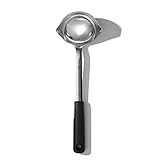
As an Amazon Associate we earn from qualifying purchases. Prices and availability are shown on Amazon.
FAQ
Can a skimmer replace a slotted spoon?
For many tasks, yes. A skimmer covers a larger area and lifts more food at once.
Do I need both tools?
If you make soups and also boil or fry foods, having both is handy.
Can I use a ladle for frying?
It is not designed for it. A skimmer drains oil, while a ladle holds it. Use the right tool and follow the maker’s guidance for hot oil.
What size ladle is best for soup?
One that holds about a single serving, so each portion takes one or two scoops. Measure the capacity with water if it is not listed.
How do I clean a fine mesh skimmer?
Rinse it right after use, then soak and use a small brush on the back of the mesh. Dry it well before storing.
The Short Version
Select a ladle with a bowl and handle that suit your pots, and a skimmer with mesh or holes for the food you lift. Match materials to your cookware and handle hot items carefully. Rinse mesh heads promptly so they do not clog.