The right ladle has a bowl size that suits your portions, a handle long enough for your tallest pot and a material that will not scratch your cookware. For most kitchens, a medium stainless steel or heat-resistant nylon or silicone ladle covers everyday soup and sauce. Here is what to compare, and how to match a ladle to the way you cook.
Bowl Size
Ladle bowls are often described in ounces or milliliters. A smaller bowl gives you control for sauces and gravy, while a larger one serves soup quickly.
- Small bowl: Gravy, sauces, dressings and portioning pancake batter.
- Medium bowl: Everyday soup and stew servings.
- Large bowl: Big pots of chili or stock for a crowd.
If a ladle does not list its capacity, measure it by filling it with water and pouring into a measuring cup. Once you know the volume, you can portion by ladle count: if one scoop is half a cup, four scoops fill a two cup measure. That makes serving consistent and helps when you scale recipes up or down.
In this guide
Handle Length and Shape
A handle that is too short lets your hand drift near steam, while one that is very long can feel awkward in a small pot. Choose a length that reaches the bottom of your deepest pot with room to spare. A hook at the end of the handle can rest the ladle on the pot rim, and a hanging hole makes storage simple.
Material Comparison
| Material | Good points | Watch for |
|---|---|---|
| Stainless steel | Durable, handles heat well | Can scratch nonstick pots, handle may warm up |
| Silicone | Gentle on coated cookware | Check the maker’s heat limit |
| Nylon | Light, gentle on coatings | May soften at high heat, check limit |
| Wood or bamboo | Warm to hold, quiet on cookware | Needs hand washing |
Features Worth Checking
- A pour spout or rim on one side for cleaner pouring.
- A deep bowl for soup and a shallow one for sauces.
- A sturdy join between bowl and handle, with no gaps that trap food.
- A comfortable grip that does not slip when wet.
- A hole in the handle for hanging.
When serving from hot pots, use caution, keep the handle away from the heat source, and follow the pot maker’s guidance.
A Step-by-Step Way to Choose
- List the dishes you serve most: soup, stew, gravy, batter, or a mix.
- Measure the height of your deepest pot and the diameter of your narrowest one.
- Select the bowl size from the list of uses above, then look at the stated capacity or measure it.
- Choose the handle length so the grip sits well above the pot rim, with a hook if you want to rest it on the edge.
- Match the material to your cookware: soft materials for coated pots, steel for uncoated ones.
- Check the maker’s guide for heat limits and washing instructions, then confirm the join between bowl and handle is solid.
Common Scenarios
Serving soup to a family
A medium bowl serves each person in one or two scoops. A pour spout reduces drips on the table.
Making gravy or sauce
A small ladle lets you add liquid a little at a time, so a sauce reaches the right thickness without overshooting.
Pouring pancake batter
A small to medium ladle with a good spout gives even rounds. Wipe the spout between batches so batter does not build up.
Cooking in a tall stockpot
Choose a long handle, and consider a deeper bowl so each scoop reaches the liquid without tipping the pot.
Ladle Styles and Special Uses
Not every ladle is shaped like a deep cup. A flat-bottomed, shallow ladle is useful for spreading sauce over pizza or crepes and for portioning batter onto a griddle, because it releases liquid in a wide, even sweep. A deep, round ladle is better for soup, since the curved bowl scoops liquid and keeps solids in the scoop. Some ladles have an offset handle that sits level with the pot rim, which stops the bowl from sliding in, and others have a hook-shaped handle for resting on the edge. A ladle with measurement marks inside the bowl can help when you follow recipes, though the marks may wear away if washed harshly, so follow the maker’s care guide. Consider also the weight: a heavy ladle full of stock can tire the wrist when serving many bowls, while a lighter one is easier to hold for long stretches.
Mistakes to Avoid
- Using a metal ladle in a coated pot: scraping can mark the coating, so choose silicone, nylon or wood unless the pot maker says otherwise.
- Leaving a plastic ladle resting on the hot rim: heat can soften or mark it. Use the hook only where the maker permits.
- Choosing too large a bowl: it is hard to portion neatly and drips on the way to the bowl.
- Ignoring the join: food collects where bowl and handle meet and can be hard to clean.
- Dishwashing wood: heat and soaking can crack it, so follow the care guide.
Storing and Caring for a Ladle
Wash the ladle after each use, paying attention to the join between the bowl and handle. Hang it from a hook or keep it in a utensil crock. Wooden ladles need hand washing, while many steel and silicone ones may go in the dishwasher if the maker allows it.
Over time, check the ladle for signs of wear: scratches on a coated surface, cracks in wood, or melted spots on nylon. Retire a ladle that sheds material. Stains on silicone from tomato sauce usually fade with washing and airing, and are a look issue only. Dry steel ladles fully to avoid water marks.
Quick Troubleshooting
| Symptom | Likely cause | What to try |
|---|---|---|
| Soup dribbles down the bowl | No spout or too full a scoop | Fill slightly less and tilt toward the spout |
| Handle gets hot | Steel handle in a hot pot | Use a ladle with a longer or insulated handle |
| Ladle tips into the pot | Hook does not match the rim | Rest it on a spoon rest instead |
| Scratches inside a nonstick pot | Metal edge | Switch to silicone, nylon or wood |
| Residue where handle joins | Gap or rivet | Use a small brush when washing |
Finally, think about the way you serve. If you ladle straight from a hot pot at the table, a ladle with a hook can rest on the pot rim and keep the bowl out of the liquid between servings. If you pour into narrow containers, such as jars or flasks, look for a smaller bowl with a tight spout. Keep a small plate or spoon rest beside the stove for the ladle to sit on, so drips land there instead of on the counter.
Doing Portion Math With a Ladle
A ladle doubles as a measuring tool once you know its capacity. Many cooks pick one without checking, then end up serving portions that vary from bowl to bowl. A quick home check solves this. Fill the ladle to a comfortable level with water, pour it into a measuring jug, and note the volume. Repeat once or twice to get a reliable figure. Write the number on a small tag or in your phone, because it lets you turn a recipe into servings. If your ladle holds around half a cup, for example, two scoops give a generous bowl of soup and three make a hearty one.
This also helps when you scale recipes. A pot of stew that makes a certain number of liters can be translated into ladles per person, which makes feeding a crowd easier. Different makers label their sizes differently, and some measure to the rim while others measure to a more realistic fill line, so trust your own jug over the listing when precision matters.
Bowl Shape: Deep, Shallow, Round or Angled
Capacity is only part of the story. A deep, narrow bowl reaches the bottom of a tall pot and keeps liquids from sloshing. A wide, shallow bowl is better for sauces and gravies because it spreads over food and releases quickly. Rounded bowls scoop smoothly from a pot with curved corners, while flatter bases sit better against a pan with a flat bottom. Some ladles have an angled or offset bowl, which makes it easier to pour into a small container without hitting the rim.
- Deep and narrow suits stockpots and tall soup pots.
- Wide and shallow suits gravy, sauces and shallow braises.
- Flat-bottomed bowls help when serving from the last inch of a pot.
- Offset bowls help when filling jars or narrow cups.
Pouring Spouts and Drip Control
A pouring spout, usually a small pinched point on the rim, helps direct liquid in a thin stream. Some ladles have two spouts so left- and right-handed cooks pour equally well. Others have a smooth round rim, which can drip when you tilt slowly. If you often fill small containers, a spout is a real benefit. If you mainly serve into wide soup bowls, a plain rim may be fine. Look at product photos to see the edge. After use, check that the spout is easy to clean, since sticky sauces can collect there.
Handle Details: Length, Hook, Grip and Angle
The handle has more jobs than it appears. It must reach into the pot without letting your hand near hot steam. It should rest comfortably in your palm while the bowl is full and heavy. Many handles end in a hook so the ladle can hang on a pot rim, but a hook only works if it matches your pot’s wall thickness, so consider this when you shop. A hole at the end of the handle allows hanging on a rail. Angled handles keep the bowl lower in the pot and keep your knuckles from bumping the rim. Thin metal handles can heat up, so look for grips of heat-resistant material if you linger in the pot.
How Material Interacts With Your Pots
| Ladle material | Good with | Things to consider |
|---|---|---|
| Stainless steel | Stockpots, enamel, stainless cookware | Can scratch delicate coatings, handle may get hot |
| Silicone | Coated and nonstick pots | Heat limit varies, may flex when full |
| Nylon-style | Coated pots, light everyday use | Can soften or stain with heat and strongly colored sauces |
| Wood or bamboo | Gentle use, slow stirring and serving | Needs hand washing, may absorb odors |
Always check the product’s stated heat limit and care instructions, because they differ between makers.
One-Piece Versus Assembled Construction
Ladles are either formed from one piece or built from a bowl attached to a handle. One-piece designs have no joint to trap food and are easy to clean. Assembled designs may use rivets, welds or screws, and the junction can collect residue if it is not smooth. A riveted joint is sturdy but needs a brush to clean around the heads. A welded joint should look smooth and continuous. Wobble or play at the joint is a sign of poor fit. If you wash by hand, almost any construction can be kept clean, but a dishwasher handles smooth joints better.
Specialty Ladles Worth Knowing About
Some ladles are designed for particular jobs. A small sauce ladle, often called a gravy or sauce spoon, gives precise pours onto plates. A slotted ladle lets liquid drain while holding solids. A batter ladle with a spout and a larger bowl helps with pancakes, waffles and muffins. A deep soup ladle with a long handle is built for big pots. Owning one of each is not necessary. Choose the specialty that matches a task you do weekly and use the general ladle for the rest.
Worked Example: Choosing for a Family Soup Night
Take a household of four who serve soup from a medium stockpot each Sunday. Measure the pot depth with a ruler, then add the length of the pot’s rim to your hand’s comfortable reach, remembering steam. A handle that reaches the bottom and leaves a few inches above the rim is a safe length. Choose a bowl large enough to serve a bowlful in two scoops. Decide on a hook so the ladle can rest on the pot between servings, and confirm it matches your pot. Pick a material that agrees with the pot interior. With those four decisions made, you have a clear shopping brief.
Left-Handed Cooks and Pouring Direction
Most single-spout ladles are shaped for right-handed pouring. If you cook left-handed, the spout may sit on the wrong side, and you end up twisting your wrist or pouring across the handle. Look for a ladle with a spout on both sides or a smooth round rim that pours evenly in any direction. Photos from several angles help here, and so do customer comments that mention left-handed use. A small difference in rim design can make a big difference in comfort if you serve every day.
Weight and Balance When the Bowl Is Full
A full ladle is heavier than it looks, especially with thick stew. A handle that is too short or too light forces your wrist to carry the load and tires your hand. A balanced ladle feels steady with the weight shared between bowl and handle. Holding a ladle in a shop is best, but online you can compare weight listings and read comments about balance. Heavier stainless ladles feel solid but can strain small hands. Lighter silicone ones are easy to lift but can flex when the bowl is full, which may spill liquid. Pick the combination that suits your grip and the thickness of what you serve.
Cleaning and Staining Tips
Most ladles clean easily, but a few habits keep them looking good. Rinse soon after use so sauces do not dry on. For tomato-based dishes, nylon and silicone may take on color, and a soak in warm soapy water usually helps. Wooden ladles should be washed by hand and dried, then kept away from long soaks. Stainless steel can develop light spotting from hard water, which a wipe with diluted vinegar and a rinse often clears, if the maker allows it. Check the hook area and the junction between bowl and handle, where residue lingers. If a plastic-type ladle becomes cracked, rough or sticky, replace it.
Storage That Protects Your Pots
Hang ladles on hooks or store them upright in a crock, with the bowl side down or up depending on how the crock is shaped. Avoid tossing them in a drawer with sharp tools, where bowls can dent and silicone can tear. If you keep nonstick pans, make sure the ladle does not rattle against their surfaces in storage. A dedicated hook near the stove puts the ladle within reach when you need it and keeps it drying in open air.
Ladles in Batch Cooking and Canning Prep
If you cook in big batches, freeze portions or fill jars, the ladle becomes a workhorse. Filling containers works best with a ladle whose bowl is narrower than the container opening, so liquid goes in without splashing the rim. A wide-mouth funnel helps with narrow jars, and it can sit beside the ladle on a tray lined with a towel to catch drips. For cooling soups before storage, ladle portions into shallow containers so they cool faster, and follow official food safety guidance for cooling and storing cooked food. A long handle keeps your hand away from steam when the pot is large and full.
Kids, Guests and Shared Serving
When children serve themselves, a short ladle with a thick handle and a small bowl is easier to control than a big one. For guests at a buffet, leave a spoon rest or a small plate beside the pot so the ladle does not slide in or drip across the table. A ladle with a hook that suits the pot rim prevents the common problem of a utensil sliding into the soup. If the pot is on a warming tray, check that the handle will not heat up too much, and prefer materials that stay comfortable to hold.
Matching Ladle Size to Pot Size
A tiny ladle in a huge pot means dozens of trips and a tired arm, while an oversized ladle in a small saucepan is clumsy and bumps the walls. A rough rule is that the bowl should fit comfortably inside the pot with room to tilt, and the handle should be long enough to reach the bottom while leaving a good length above the rim. Compare the pot’s inner diameter and depth with the ladle’s bowl width and overall length from the listing. If you own several pots, choose a ladle that works for the two you use most, and add a second size if you find yourself fighting the first.
When to Replace Your Ladle
A ladle is a simple tool, but it does wear out. Replace one when the bowl dents so that it no longer sits flat, when a joint loosens, when a silicone head tears, or when a wooden one cracks or splinters. Stained and sticky heads that no longer wash clean also deserve retirement. Buying a replacement is a good moment to think about what you disliked in the old one, whether it was handle length, weight or a missing spout, and to choose a new ladle that fixes those complaints.
Checklist Before Buying
- Measure your tallest pot and your most-used pot.
- Decide the capacity you want per scoop and check the listing.
- Match the material to your cookware.
- Look at the spout, hook and hang hole.
- Read the care and heat instructions.
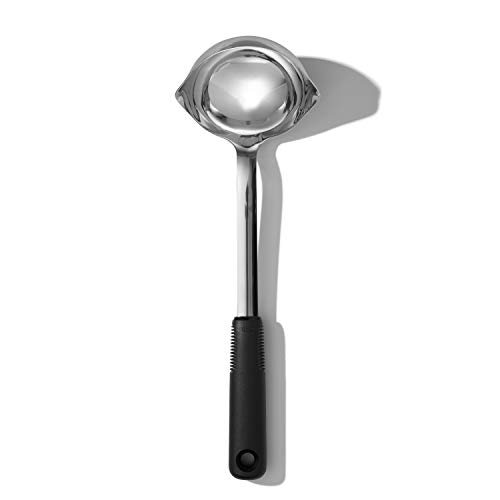
Ready to Buy? Start Here
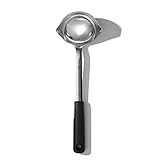
If this guide helped you decide what to look for, these products are a place to start.
As an Amazon Associate we earn from qualifying purchases. Prices and availability are shown on Amazon.
FAQ
Can I use a ladle in a nonstick pot?
Yes, but choose silicone, nylon or wood to protect the surface, unless the pot maker says metal is fine.
How many ladles do I need?
One medium ladle serves most households. A small second one helps with sauces.
How do I measure a ladle’s capacity?
Fill the bowl to the rim with water and pour it into a measuring jug. Repeat once to check, and note the result for portioning.
Why does my ladle drip?
A full bowl and a rounded rim usually cause it. Fill a little less, or choose a ladle with a pour spout so the stream is directed.
Is a one-piece steel ladle better?
A one-piece design has no join to trap food and is easy to clean, though the handle can warm up. Either design works if it is well made.
Ladling Technique: The Quiet Skills
A ladle looks foolproof, yet a few small techniques separate tidy serving from a trail of drips. Fill the bowl by sinking it below the surface and letting the liquid flow in, rather than scooping downward in a hurry, which splashes and traps air. Lift steadily, pause for a heartbeat just above the pot so the last drips fall back, and touch the underside of the bowl briefly to the pot’s rim if you need to catch a hanging drop before travelling to the bowl. Pour with the bowl tipped decisively rather than hesitantly; a timid, half-tipped ladle is the one that runs liquid down its own outside. When serving chunky soups, give the pot a gentle stir first so each scoop carries a fair share of solids rather than all broth from the top or all solids from the bottom, and dip deeper for the scoops that should carry more of the chunky ingredients. These habits take a week to become automatic and then save your tablecloth, your counter and your temper for years.
Stirring with the ladle deserves a word too. A ladle can stir, and in a soup pot it often does, but its bowl is shaped for lifting rather than sweeping the pot’s base, so for thick stews that catch on the bottom, stir with a spoon or spatula that reaches the corners, then serve with the ladle. Using each tool for its own job keeps both the stew unscorched and the serving neat.
Matching the Ladle to What Is in the Pot
Clear broths and consommés want a ladle that skims and pours cleanly, ideally with a spout, since the beauty of the dish is its clarity and an untidy pour clouds the presentation at the table. Cream soups reward a medium bowl and a smooth rim, because thick liquids cling and a spout can leave strings; a slight shake over the pot settles them. Chunky stews and chowders ask for a wide, deep bowl that can capture solids without crushing them, and a sturdy handle, because each full scoop is heavy. Dumplings, meatballs and other delicate solids floating in broth are the strongest argument for a wide, shallow bowl used gently: slide it beneath the item and lift it cradled in liquid, rather than chasing it with a deep bowl that knocks it apart. Bean soups and lentil dishes sit between categories and suit the general medium ladle this guide recommends as the household standard, which is precisely why that recommendation holds: most home pots, most weeks, are in the middle family.
Sauces and gravies, served in small amounts with precision, belong to the small ladle, and the cook who owns only a big soup ladle will fight every gravy boat and every plated sauce until they add one. The two-ladle household — one medium, one small — covers nearly everything this guide has discussed, and it is the most common destination for readers who begin with a single all-purpose ladle and cook their way outward.
Serving at the Table and at a Buffet
Where the ladle will work changes what it should be. At the stove, function rules and looks barely matter. At the table, the ladle is on display, handled by guests, and rested between servings, so a hook that truly fits the serving pot, a handle that stays cool, and a bowl that pours without dripping become social features as much as practical ones. Set the pot on a stand or trivet, place a small plate or rest for the ladle where a guest’s hand naturally falls, and choose a ladle whose handle is long enough to keep the bowl parked in the pot without the grip sliding in. For a buffet line, think about the least confident server: a slightly smaller bowl forgives enthusiasm, a two-sided spout forgives left-handedness, and a ladle that balances well when full forgives an unsteady carry to the plate. If the same ladle serves at stove and table, prioritise the table manners, because stove work forgives almost any sound ladle while table work exposes every drip.
The Ladle as a Cooking Tool, Not Just a Serving Tool
Between stove and table, a ladle does quiet cooking work that rarely gets credited. It skims: drawn lightly across the surface of a simmering stock, its rim collects foam and fat with a control a spoon cannot match, and a chilled ladle touched to the surface of a finished stock can pick up fat that has begun to set, a classic cook’s trick for clearer soups. It bastes: a cook roasting meat or simmering a braise uses the ladle to pour hot liquid over the top, keeping surfaces moist and flavours circulating. It portions cooking liquid with intent, adding stock to a risotto-style dish a ladle at a time so absorption stays ahead of addition, which is a technique built entirely around the ladle’s known volume — one more reason the portion math earlier in this guide is worth doing once. It also tests: a ladle of soup lifted and poured back shows you the soup’s body and seasoning state better than a spoonful alone, and the back of a metal ladle, like the back of a spoon, shows whether a custard or sauce coats rather than runs. None of this requires a special model. It requires only that the ladle you own is sound, clean and at hand, which is the practical heart of every section above.
Outdoor, Camping and Big-Gathering Ladles
Cooking away from your own kitchen changes the priorities. For camping and outdoor gatherings, a one-piece steel ladle earns its place: it tolerates heat, knocks and hasty washing, hangs from a branch or a line by its hole, and doubles as a sturdy stirrer over a fire pot where a silicone bowl would be at risk near flames. Weight matters less than toughness, and a long handle matters more, because fire pots sit lower and hotter than stovetop pots. For big indoor gatherings — the soup kitchen, the club supper, the family party with a stockpot on a portable burner — the priorities flip toward the servers: several medium ladles beat one large one, because two serving points halve the queue, and tired volunteers handle a medium bowl more safely than a huge one across a long evening. If you host such gatherings yearly, a second ladle bought for the purpose will serve longer and better than borrowing the household’s favourite and returning it dented.
More Ladle Questions
Why does soup run down the outside of the bowl?
Usually because the bowl was tipped too slowly, so liquid clung and crept rather than poured, or because the bowl was overfilled. Fill a little less, tip decisively toward the spout, and pause above the pot so drips fall back before you move.
Can I leave a ladle standing in the pot while food keeps warm?
Only if the material and handle tolerate the heat and the maker’s guidance allows it. A handle resting against a hot rim can heat up or soften, and a ladle left in food should be treated like any utensil in the serving dish: kept clean and used only for that dish. A spoon rest beside the pot is the safer habit.
Is a ladle with measurement marks worth it?
For cooks who portion liquids often — sauces by the spoonful, stock for grains, batter for a griddle — the marks are genuinely handy. They are a convenience rather than a necessity, and your own jug test, described earlier, gives the same knowledge for a plain ladle.
How do I stop a ladle sliding into a deep pot?
Use the hook if it fits your rim, choose a handle longer than the pot is deep, or rest the ladle across the pot on a spoon rest or a wooden spoon laid over the top. A ladle that repeatedly slides in is telling you its handle and your pot are mismatched.
Can a ladle be used for cold drinks and punches?
Yes, and a long-handled ladle with a spout is the classic punch tool. Keep a dedicated one if you serve drinks often, wash it before it returns to soup duty, and remember that acidic punches can mark some finishes if left standing, so rinse promptly.
What is the best way to clean a ladle used for oily stock?
Rinse off the worst, then wash in hot soapy water, paying attention to the join and the inside of the bowl where fat films hide. Dry fully. A ladle that still feels greasy after washing needs a second wash rather than a place back on the hook.
Freezing, Storing and Reheating With the Ladle
The ladle’s week often continues after the meal, in the quiet economy of leftovers. Portioning soup for the freezer is ladle work: known volumes turn into known portions, so a container can be labelled by scoops and defrosted by the bowlful without guesswork. Ladle into containers leaving room for expansion, cool them promptly following food safety guidance, and note that a ladle rinsed between containers keeps flavours from mingling when you freeze several dishes in one session. Reheating reverses the flow: the ladle stirs the pot as it warms, checks body and seasoning, and serves. A cook who freezes often may find a ladle with a pouring spout and a bowl sized to their storage containers becomes the most-used tool of the whole storage routine, which is a perfectly good reason to choose a second ladle by container fit rather than by pot fit.
Stock deserves its own sentence, because home stock is where ladles, skimming and storage meet. Skim as it simmers, ladle it through a strainer into containers when done, and chill promptly. The ladle that did the skimming should be washed before it does the straining if foam and fat are still on it, a small discipline that keeps the finished stock clean-tasting and clear.
Reading Ladle Listings With Care
Ladle listings are short, but they still reward a careful read. Capacity is the first trap: some makers measure to the brim, others to a sensible fill line, so compare capacities with your own jug test in mind and expect a brim measurement to serve a little less in practice. Length is the second: overall length and handle length are different numbers, and the one that decides whether your hand clears the steam is the distance from the bowl to where your grip naturally sits. Heat limits are the third: for silicone and nylon, the maker’s stated limit is a real boundary, not a suggestion, and a ladle used daily in frying-hot liquids needs a limit with room to spare. Photographs help with the rest — the join, the spout, the hook — but weigh them against the written care instructions, which tell you how the ladle expects to live. A listing that answers capacity, length, material, heat limit and washing in plain terms is a listing from a maker who expects the tool to be used, and that is the kind of ladle that tends to satisfy.
A Ladle for Every Cook in the House
Households rarely contain one pair of hands. The ladle that suits a tall adult serving from a stockpot may defeat a shorter cook, a teenager learning to serve, or a grandparent with a gentler grip. If several people serve, judge candidate ladles by the smallest competent hand among them: a grip that hand can close around, a weight that wrist can hold when the bowl is full, and a length that keeps every server’s hand clear of the steam. Thick, slightly soft grips forgive more hands than slim polished ones. This is also the argument for the two-ladle household stated earlier in practical form: a medium ladle for the main cooks and a smaller, lighter one that anyone can manage turns soup night from one person’s job into a shared, easy routine, and shared routines are the ones that survive busy years.
Guests count as cooks for an evening, too. The ladle you hand to a guest at a buffet should need no explanation: balanced, drip-resistant, with a rest waiting beside the pot. When the tools explain themselves, the host can leave the table and join the meal, which is the true finish line of every serving decision in this guide.
Soup Night, Start to Finish: A Worked Routine
Bring the threads together in one ordinary evening. The pot is a medium stockpot of vegetable soup, the ladle a medium steel one whose volume you measured long ago at two honest scoops per bowl. While the soup simmers, the ladle skims a little foam from the surface and stirs once, gently, so the vegetables distribute. Bowls are warmed if the kitchen is cold, because soup served into a cold bowl cools at the edges before it reaches the table. Serving goes scoop, pause, pour: two scoops per bowl, the bowl of the ladle touched to the rim to catch the drip, a wipe of the pot’s edge at the end so the outside stays clean. The ladle rests on its plate between servings rather than in the pot. Afterwards it is washed with attention to the join, dried, and hung by its hole where tomorrow’s cook will find it. Nothing in that routine is special, and that is the point: a well-chosen ladle disappears into the routine, and the meal, not the tool, is what everyone remembers.
If your current ladle interrupts a routine like that — dripping, sliding, tiring the wrist, scorching a hand — name the interruption precisely, because that name is your shopping brief, sharper than any general advice: a spout for the dripper, length for the slider, balance for the tiring bowl, insulation for the hot handle. The sections above translate each complaint into a feature to check, and a ladle bought against a named complaint is a ladle that will be thanked nightly.
A final note on this simplest of tools
The ladle may be the oldest tool in the kitchen, older than the fork and arguably older than the pot’s handle, and it has survived unchanged in outline because the job has never changed: move hot liquid, kindly and without waste, from a deep vessel to a waiting bowl. Everything in this guide — bowls, spouts, hooks, materials — is refinement of that single errand. Choose the refinement that fits your pots, your hands and your table, and the tool will do what it has always done, so quietly that you will only notice it on the rare evening you have to serve soup without one.
Ladles and the Rest of the Utensil Crock
A ladle does not live alone, and its neighbours explain its shape by contrast. The spoon stirs and tastes; the skimmer lifts and drains; the spatula turns and scrapes; the ladle alone is built to carry a measured volume of hot liquid through the air without spilling it. When a kitchen lacks a true ladle, cooks improvise with mugs and small jugs, and the improvisation shows in drips, burns and uneven portions. When a kitchen has three ladles and no skimmer, the reverse gaps appear at the fryer. A balanced crock holds one of each core tool, chosen with the same care this guide gives the ladle, and the cook who audits the crock once a year — replacing the tired, retiring the duplicated, adding the genuinely missing — will find that serving, stirring and lifting all become calmer at once. The ladle’s place in that family is secure and specific, and choosing it well completes the set rather than merely adding to it.
Start, then, with the crock as a whole when you shop: the ladle that completes your family’s set of tools, sized to your deepest pot and kindest to your most-used pans, is the ladle this guide has been pointing to from its first paragraph. Everything else — the spout, the hook, the measured volume — is there to make that one choice serve you longer and better.
When the Pot Is the Problem, Not the Ladle
Occasionally a cook replaces ladle after ladle and stays dissatisfied, because the true mismatch is the pot: a very wide, shallow pot makes every ladle feel clumsy, a pot with a rolled rim defeats every hook, and a pot too deep for the kitchen’s tallest cook makes serving an act of faith. Before replacing a sound ladle a second time, serve once from a different pot and notice whether the complaints follow the ladle or stay with the pot. If they stay with the pot, the honest fix may be a serving dish: transfer the soup to a tureen or a shallower pot for the table, where the household ladle suddenly behaves beautifully, and keep the deep stockpot for cooking, where depth is a virtue. Matching vessel, ladle and server as a trio, rather than blaming any one of them, is the grown-up version of the advice this guide began with, and it ends most ladle dissatisfaction for good.
Keep that trio in mind the next time a serving session feels awkward, and you will usually find the fix is smaller, cheaper and more obvious than a whole new set of tools: a rest moved, a pot swapped, a ladle finally matched to the vessel it serves from most.
Caring for the Cook: Wrists, Steam and Repetition
Serving a crowd is repetitive work, and the ladle is where the repetition lands. Alternate hands if you can, rest the ladle between servings instead of holding it suspended, and keep the pot at a height where your wrist stays neutral rather than bent back under a full bowl. Steam deserves respect on a long serving session: approach the pot from the side the steam is not blowing toward, keep sleeves clear, and let the first rush escape when a lid lifts before reaching across. These are small courtesies to your future self, and they are part of choosing well, because a ladle with a kind grip, a balanced bowl and a length that suits your stance is a ladle that protects the cook as faithfully as it serves the guests.
Serve a few hundred bowls across a season with those courtesies observed, and the difference shows in your hands as much as in the serving: less ache, fewer scalds, and a ladle that still feels like help rather than work at the last bowl of the night.
That is the standard a good ladle quietly meets, meal after meal, year after year.
Choose yours once, and choose it kindly.
The Short Version
Choose a medium ladle with a handle that suits your deepest pot. Choose steel for durability or silicone for coated cookware, and look for a pour spout and a hanging hole. Check the maker’s heat limits, and know your ladle’s volume for easy portioning.