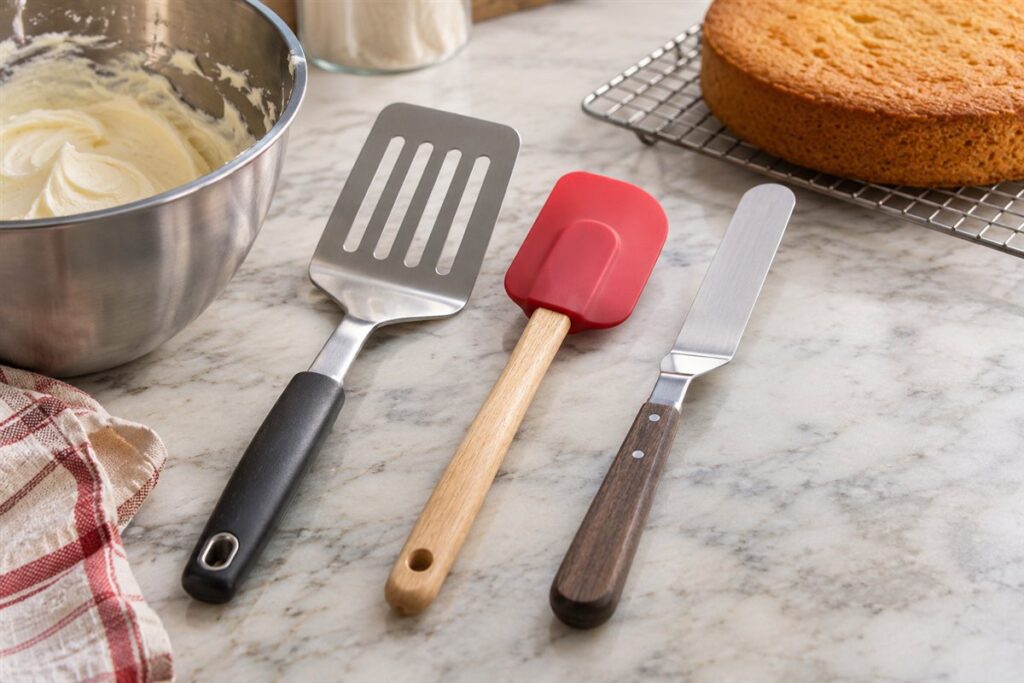
The word spatula covers several different tools. A turner flips food, a rubber or silicone scraper cleans bowls, and an offset spatula spreads icing. Knowing the difference helps you reach for the right one and protects your cookware from damage.
Turners for Flipping
A turner has a wide, flat head, sometimes with slots, used to lift and flip pancakes, burgers, fish and eggs. A thin, flexible edge slides under delicate food. A sturdier head gives you more strength for heavier items.
- Slotted turners let fat and liquid drain.
- Solid turners hold sauce and keep small items from slipping.
- Material matters: metal suits cast iron and stainless steel, while silicone or nylon suit nonstick pans.
Scraper Spatulas
These have a flexible head, often silicone, and are made to scrape bowls, fold batter and stir sauces. Look for a head that bends slightly yet holds its shape, and a handle that feels comfortable. Check the maker’s heat limit if you plan to use one in hot pans.
Offset and Icing Spatulas
An offset spatula has a narrow blade with a bend near the handle, which keeps your knuckles out of the food. Bakers use it to spread icing, lift cookies and smooth batter into a pan. A straight palette knife is similar but flat, and suits frosting a cake side.
Quick Comparison
| Type | Typical job | Good with |
|---|---|---|
| Flat turner | Flipping and lifting | Skillets, griddles |
| Fish turner | Delicate fillets | Thin, flexible edge |
| Silicone scraper | Folding and scraping | Bowls, saucepans |
| Offset spatula | Spreading and smoothing | Cakes, bars |
| Pan scraper | Cleaning and lifting stuck bits | Pans, griddles |
How to Choose
- Check what cookware you own. Nonstick pans need non-metal heads.
- Think about what you cook most: eggs, pancakes, cakes or sauces.
- Test the grip if possible, since a handle that is too thin tires your hand.
- Look for a head with a thin front edge for sliding under food.
- Read the maker’s heat limit and dishwasher notes.
Keep plastic and silicone spatulas away from direct flame and hot burner edges.
Care and Storage
- Wash by hand or as the maker allows, and dry fully.
- Replace silicone heads that are cut, torn or sticky.
- Store upright in a crock or flat in a drawer, away from sharp objects.
- Keep metal turners away from nonstick coatings.
Spatula Materials Compared
The material of the head decides what the tool can do and which pans it suits.
- Silicone: flexible, gentle on coatings and good for scraping and stirring. Heat limits vary, so check the maker’s guide.
- Nylon: stiffer than silicone and fine for nonstick, though it can soften or melt if left in a hot pan.
- Stainless steel: strong and thin, good for cast iron, griddles and stainless pans, but it can scratch coatings.
- Wood and bamboo: gentle on surfaces and comfortable, but they can stain, absorb odors and need hand washing.
Match the material to the pan. A metal turner on a nonstick surface can scratch it, while a thin silicone head may bend too much under a heavy burger. If you own several pan types, you may need more than one spatula.
Head Shape, Thickness and Edge
Details of the head shape change how a spatula behaves. A thin, beveled front edge slides under food without tearing it. A thick edge is stronger but can push food around. Wide heads support big items such as burgers and fish fillets, while narrow ones suit small pans and cramped spaces.
Flexibility is a tradeoff. A flexible head follows the curve of a pan and scrapes well but gives less lifting power. A stiff head lifts heavy food, though it can be less gentle with delicate items. Slots and holes drain liquid but may let tiny food fall through. Square corners reach into the corners of a pan, while rounded ones follow curved pans such as woks and sauciers.
Handles, Length and Balance
A spatula should feel comfortable for the whole task. Handles can be wood, plastic, silicone or metal. Metal handles may get hot if left in a pan. Longer handles keep your hand away from heat, while shorter ones give control for delicate work.
Look at how the head attaches to the handle. One-piece designs have no seam to trap food, and they are easy to clean. Two-piece designs can loosen over time, so check that they are firmly attached. A hole in the handle lets you hang the tool, and a flat handle will not roll off the counter. Balance matters as well. A tool with a heavy head and a light handle can feel awkward, so hold it if you can before buying.
Matching Spatulas to Your Cookware
Think of your spatulas and pans as a pair. Nonstick surfaces need soft heads. Cast iron and carbon steel can handle metal, and often benefit from a firm edge that scrapes up stuck bits. Stainless steel pans tolerate most spatulas, but a thin metal turner gets under food more easily.
- For woks, choose a long handle and a head shaped to follow the curve.
- For griddles, choose a wide, sturdy turner with a long handle.
- For baking dishes, a narrow, flat spatula can lift portions cleanly.
- For sauce pots, a silicone spatula with a flat edge is a good fit.
When you buy new cookware, read its care guide. It may state which utensils are safe, and following it helps the surface last.
Safety and When to Replace a Spatula
Plastic, nylon and silicone tools can degrade over time. Replace a spatula that is melted, cracked, torn or sticky. Do not rest heat-sensitive heads against a hot pan edge or burner. Wooden tools should be replaced when they develop deep cracks that can harbor bacteria.
Keep tools used with raw meat separate from those used on cooked food, or wash them well between uses. Dry them thoroughly before storing. If a metal spatula gets bent or has sharp edges, retire it. A small collection of well-chosen tools that you maintain is better than a drawer full of worn ones.
Building a Small, Useful Set
You do not need a drawer full of spatulas. A small, well-chosen set covers most tasks. Start with the jobs you do most and add tools only when you find a gap.
- Everyday cook: a flat turner, a silicone scraper and a spoon-shaped spatula for sauces.
- Baker: add an offset spatula and a bench scraper for dough and icing.
- Nonstick user: pick tools with soft heads for all pan work.
- Griddle or cast iron user: add a sturdy metal turner with a thin edge.
When buying, think about duplicates. Having two scrapers is useful if you cook while baking, since you can keep savory and sweet tasks apart. Tools in similar styles also store more neatly. Check the care instructions for each so you know which can go in the dishwasher and which need hand washing.
FAQ
How many spatulas do I need?
A flat turner and a silicone scraper cover most kitchens. Add an offset spatula if you bake.
Why do some melt?
Plastic heads can soften in heat. Choose ones the maker approves for the heat you use.
Is silicone safe for cooking?
Silicone spatulas made for cookware are widely used, but each has a stated heat limit. Check the maker's guide and avoid using one that is damaged.
Can I put a spatula in the dishwasher?
Many silicone and metal spatulas can, but wood usually should not. Look at the maker's care instructions to be sure.
What is the best spatula for scrambled eggs?
A flat-edged silicone or nylon spatula works well in nonstick pans, because it reaches the edges and folds the eggs gently.
Why does my spatula stain or smell?
Silicone and plastic can absorb color and odors from strongly colored or spiced foods. Washing soon after use helps.
Should a fish spatula be metal?
Metal fish turners are thin and flexible, which helps with delicate fillets. If you use nonstick pans, choose a version with a safe-for-coatings head.
How long should a spatula handle be?
It depends on your cookware. Longer handles keep your hand away from heat, and shorter ones offer finer control.
Can a spatula go in the oven?
Only if the maker says it is oven safe. Many handles and heads have limits lower than baking temperatures.
The Short Version
Choose a turner for flipping, a silicone scraper for bowls and sauces, and an offset spatula for spreading. Match the material to your cookware and the maker’s heat guidance.