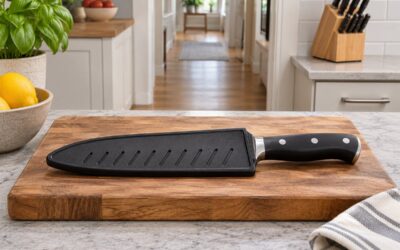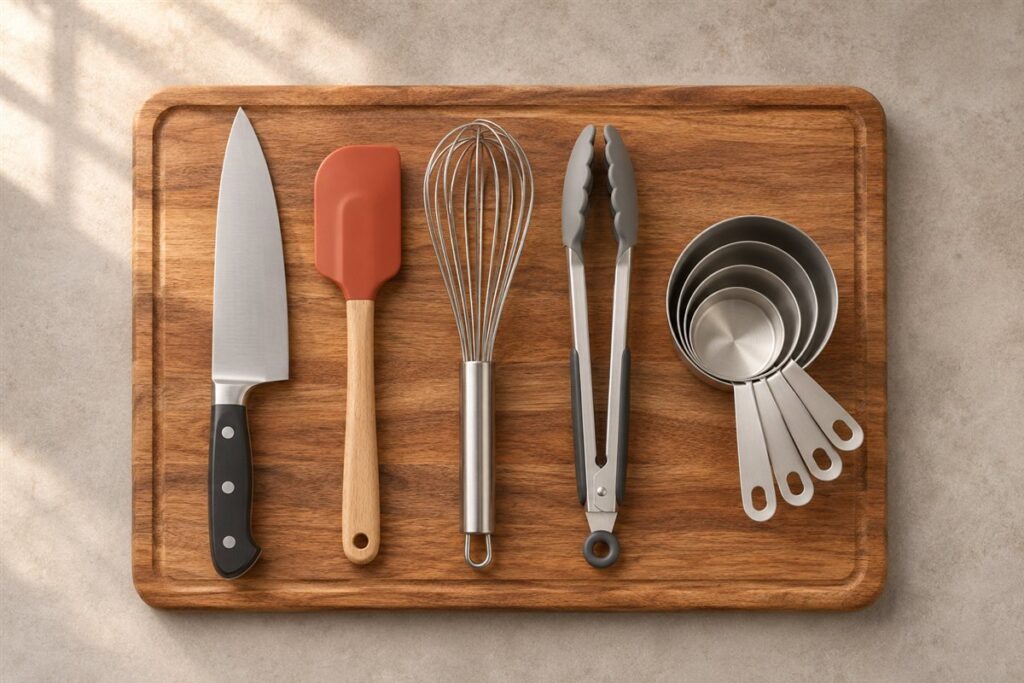
Most cooking is covered by three knives: a chef knife for general chopping, a paring knife for small detailed work and a bread knife for loaves. Other knives handle special jobs, so you can add them as your cooking grows.
The Core Three
Chef Knife
A broad, curved blade usually around 8 inches long. It slices, dices, chops herbs and cuts meat and vegetables. Example: dicing an onion or slicing cabbage.
Paring Knife
A short blade, often around 3 to 4 inches, for peeling, trimming and detail work. Example: hulling strawberries or deveining shrimp.
Bread Knife
A long blade with a toothed edge that saws through crusts without crushing the soft inside. Example: slicing a crusty loaf or a ripe tomato.
Helpful Extras
- Utility knife: A mid-size blade between a paring and a chef knife, good for sandwiches and small fruit.
- Santoku: A Japanese-style all-purpose knife with a flatter edge and a shorter blade.
- Boning knife: A thin, narrow blade that follows bones when trimming meat.
- Slicing or carving knife: A long, narrow blade for thin slices of roasts.
- Cleaver: A heavy rectangular blade for chopping through thick or tough foods.
At a Glance
| Knife | Blade Length | Best Job |
|---|---|---|
| Chef | About 6 to 10 inches | General chopping and slicing |
| Paring | About 3 to 4 inches | Peeling and detail |
| Bread | About 8 to 10 inches | Loaves and soft produce |
| Utility | About 4 to 7 inches | In-between tasks |
| Boning | About 5 to 6 inches | Trimming meat from bone |
Lengths vary by maker, so check the maker’s guide.
Using Knives Responsibly
Use a stable cutting board, keep fingers curled away from the blade and cut away from your body. Keep knives sharp and clean, store them where the edges are protected, and never try to catch a falling knife. These are general tips only, so follow the maker’s manual and safety instructions.
Edge types matter too. A plain edge is smooth and suits push cuts and slicing of most foods, while a toothed edge grips crusts and tough skins. Handle materials such as wood, plastic and composite differ in feel and care, and wood handles often prefer hand washing and drying. Full-length tangs, where the metal extends into the handle, are common in sturdier knives, though the maker’s guide will describe the build. Choose a handle that gives you a steady feel without being too thick for your hand.
Forged Versus Stamped Blades
Knives are often described as forged or stamped, which refers to how the blade is made. A forged blade is shaped from a heated piece of steel, and it often has a thicker spine and a heavier feel. A stamped blade is cut from a sheet of steel, and it tends to be lighter and thinner.
Neither type is automatically better. Forged knives can feel solid and balanced, which some cooks prefer for heavy chopping. Stamped knives are lighter, which some find less tiring for long prep. The quality of the steel, the heat treatment and the finish matter at least as much as the method. Read the product description for blade material and construction, and look for the maker’s care instructions.
Blade Steel and Keeping the Edge
Blade steel affects how a knife holds an edge and how it resists rust. Stainless steel resists rust and needs less upkeep. Carbon steel often takes a keen edge but can rust or discolor if not dried promptly. Some knives use blends designed to balance these traits. The description should tell you the type, and the maker’s guide will explain care.
- Hand wash and dry knives soon after use, unless the maker says otherwise.
- Use a honing rod regularly to realign the edge.
- Sharpen when honing no longer restores the cutting feel, using a method the maker approves.
- Cut on wood or soft plastic boards, not glass or stone, which dull edges quickly.
A dull knife is more dangerous than a sharp one because it needs more force and can slip.
Choosing a Knife for Your Hand
Comfort is personal. Hands differ in size and grip, and the same knife can feel natural to one cook and awkward to another. If possible, hold a knife before buying, and notice the balance. A knife that balances near the bolster, where the blade meets the handle, tends to feel controlled for a pinch grip.
Consider your cutting style too. Cooks who rock the blade on the board may like a more curved edge, and those who chop straight down may prefer a flatter edge. Handle shape matters. Rounded handles suit varied grips, while angular ones can lock a hand into position. Check that your knuckles clear the board when you cut. If buying online, look at the listed weight and length and compare with a knife you already like.
Storage and Safe Handling
Where you keep knives affects both safety and sharpness. Loose knives in a drawer knock together, which dulls edges and risks cut fingers. Better choices include a knife block, a magnetic strip, blade guards or an in-drawer tray.
- Mount magnetic strips securely, and place knives gently so edges do not scrape.
- Store blade-down or edge-in in a block, as the maker suggests.
- Keep knives out of reach of children.
- Carry a knife with the blade pointed down and away from your body.
Do not leave knives in a sink full of soapy water, where they are hard to see. These are general tips, so follow the maker’s guidance and local safety advice.
Knife Sets Versus Buying Individually
Sets look convenient, but they often contain knives you rarely use. Buying individually lets you invest in the knives you reach for daily, such as a chef knife, while spending less on rarely used ones. A set can still make sense if it includes the core three, a block you like and a good fit with your hands.
Before buying a set, list the knives you use and compare with what is included. Count how many are genuinely useful. If you cook often, a quality chef knife and a good paring knife can be a better use of your budget than a large block of mixed-quality pieces. You can add specialty knives later as your cooking changes. Look for warranty or care notes from the maker.
Where to Start If You Own Almost Nothing
If you are building a kitchen from scratch, begin with one good chef knife and a paring knife, and add a bread knife when you start buying loaves. These three handle most daily jobs. Spend your attention on fit and feel, not on the number of pieces.
Try to hold a knife before buying, or read the listing for weight and length. If you have small hands or little experience, a shorter chef knife may feel safer and more controlled. Think about what you cut most: if it is mainly vegetables, a flatter-edged blade may suit you, while someone who cuts a lot of meat might prefer a longer, narrower blade.
- Pick a stable cutting board at the same time as the knife.
- Buy a way to keep the edge, such as a honing rod, and learn how to use it.
- Choose storage that protects blades before the first knife arrives.
As your cooking grows, add specialty blades one at a time based on need.
FAQ
How many knives do I need?
Many cooks manage well with a chef knife, a paring knife and a bread knife.
Is a bigger knife better?
Not always. Choose a length that feels controlled in your hand and fits your board.
How often should I sharpen my knives?
It depends on use. Hone regularly, and sharpen when the knife begins to slip or crush food instead of slicing it.
Are ceramic knives a good choice?
They can stay sharp and are light, but they can chip if dropped or used on hard foods. Check the maker's guidance on what they can cut.
Can I put kitchen knives in the dishwasher?
Most makers advise against it, because heat, detergent and knocking can damage edges and handles. Check the care guide for yours.
What is the difference between a chef knife and a santoku?
A chef knife has a curved belly for rocking cuts, while a santoku has a flatter edge and a shorter blade for chopping and slicing. Both suit general prep.
Do I need a serrated knife besides the bread knife?
Not usually. A bread knife also handles tomatoes and other foods with tough skins and soft interiors.
What is a honing steel for?
It realigns the edge of a blade between sharpenings. It does not remove much metal, so it is not a replacement for sharpening.
What cutting board is best for knives?
Wood and softer plastic boards are gentler on edges than glass or stone. Choose a board large enough to work safely.
The Short Version
Learn the chef, paring and bread knives first. Add utility, boning or specialty blades once you notice a job the core three do not handle well.