When carrying a knife, hold it firmly by the handle with the point down, keep the blade close to your side with the edge turned away from your body, and watch where you are walking. Many cooks also warn others when they pass. These are general habits to follow along with your knife maker’s guidance, and they do not remove all risk.
Basic Carrying Position
Grip the handle as you would for cutting, with the blade pointing toward the floor and the flat side against your leg. Keep your arm relaxed and your elbow slightly bent so the blade does not swing outward. Avoid carrying a knife while holding something else in the same hand.
Steps for Moving a Knife
- Clear your path first. Move bags, pets and loose items out of the way.
- Lift the knife by the handle only, with a full grip.
- Point the tip downward and keep the edge facing backward or away from your body.
- Walk at a normal speed. Do not run, and do not carry a knife while looking at a phone.
- Call out “knife” or “behind you” when passing someone in a tight space.
- Set the knife down on a stable surface at your destination, rather than leaning it on something.
Better Alternatives to Carrying
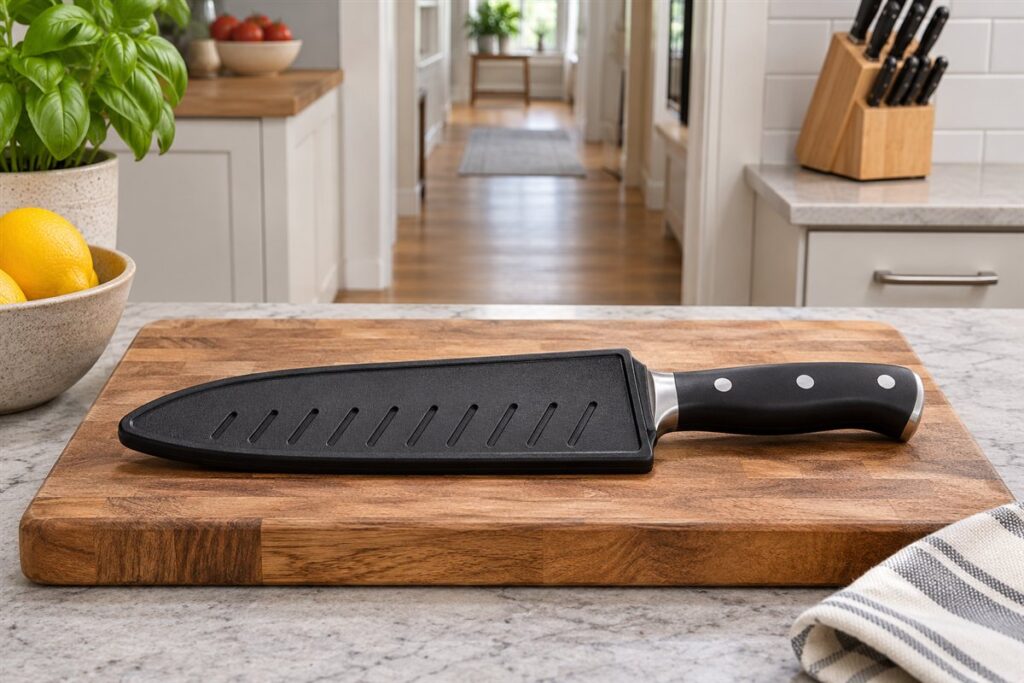
- Carry the cutting board with the knife laid flat on it, blade away from you.
- Use a knife guard or block when moving between rooms.
- Bring the food to the knife station, rather than the other way round.
- For short trips to the sink, use a safe spot beside it for washing up.
Situations and Habits
| Situation | General habit |
|---|---|
| Stairs or uneven floor | Avoid carrying an exposed blade |
| Crowded kitchen | Call out and slow down |
| Wet or greasy floor | Clean up first, or wait |
| Children or pets about | Keep blades out of reach and put them away after use |
If you drop a knife, step back and let it fall. Trying to catch it often causes injury.
Moving Several Knives
If you are taking knives to a table, another room or outdoors, use a knife roll, tray or lidded container that holds each blade separately. Cover edges with guards, and lay the knives flat with all edges facing the same way. Do not carry a load of loose knives in your arms or in a bag with other items. When washing up, wash one knife at a time, keep it visible and set it on a towel to dry rather than letting it sit in a sink of water. These routines help, but always follow your knife maker’s instructions.
FAQ
Should the blade face forward or back?
Most guidance suggests pointing the tip down and keeping the edge away from your body. Check your maker’s handling notes.
Can I carry a knife in my pocket or apron?
That is not advised. Use a sheath, guard or block for transport.
The Short Version
Hold by the handle, point down, edge away, path clear. Announce yourself in tight spaces, and use a guard or board when you can. Keep your attention on the knife until it is put away.