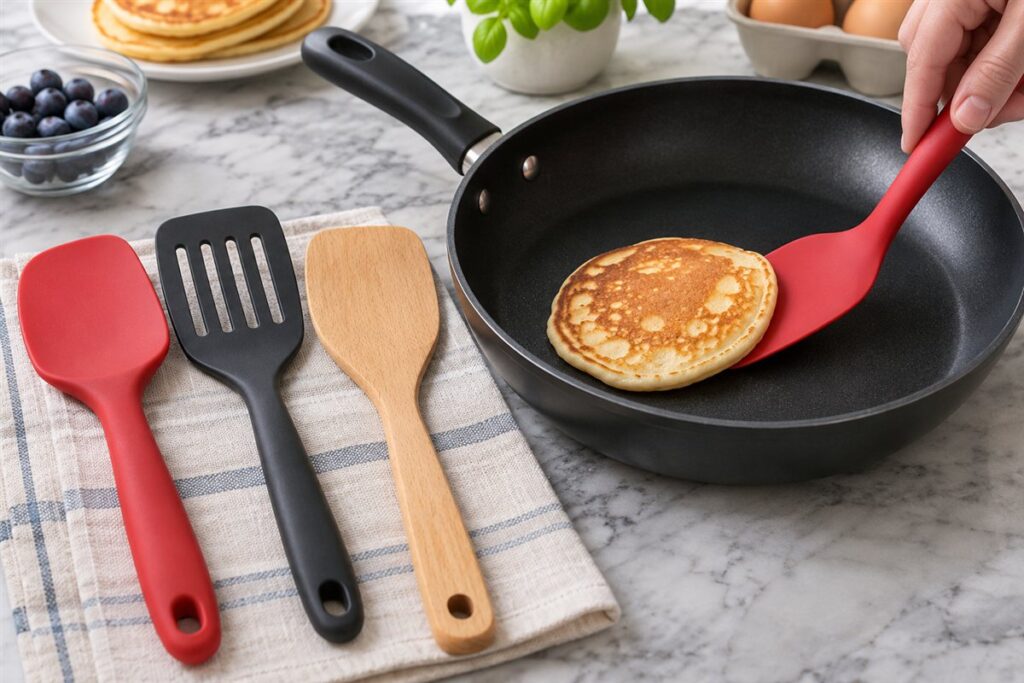
For nonstick pans, choose a spatula made of silicone, nylon or wood with a smooth, slightly flexible edge. Metal tools can scratch coatings, so most pan makers recommend softer materials. The details below help you compare your options, match a tool to each task, and look after both the spatula and the pan.
Why the Tool Matters
A nonstick coating is a thin layer on the pan. Hard or sharp tools can scrape it, and scratches may shorten the life of the pan. Pan makers generally advise using soft utensils, so check the care guide that came with yours.
Materials Compared
| Material | Strengths | Cautions |
|---|---|---|
| Silicone | Flexible, handles heat, easy to clean | Check maker’s temperature limit |
| Nylon | Firm and thin for flipping | Can soften or melt at high heat |
| Wood or bamboo | Gentle, does not heat up | Hand wash, can stain |
| Metal | Strong, thin edge | May scratch coatings, use only if the pan maker allows |
Edge and Shape
- Thin, beveled edge: Slides under eggs and fish without tearing.
- Flexible head: Follows the pan curve, but a very floppy one struggles with heavy food.
- Slotted head: Drains oil and suits fried foods.
- Wide head: Supports pancakes and burgers, a narrow one suits omelets.
The edge matters more than any other part of the tool, because it is the part that slides across the coating. A thin, even edge slips under food with little force, while a thick or uneven one pushes the food and presses harder on the surface. Run a fingertip along the edge to check that it is smooth, with no burrs, flash from molding or rough corners. Check also that the corners of the head are rounded, since sharp corners can dig in when you scrape.
Handle and Build
- Choose a handle that feels comfortable and does not twist in your hand.
- Look for a one-piece design, or a firm join with no crevices that trap food.
- Check that the handle material stays cool near heat.
- Choose a length that keeps your hand away from the pan edge.
Heat Limits in Everyday Terms
Each material has a point at which it softens, and that point is set by the maker, not by a general rule. Silicone tolerates higher temperatures than most nylon, and wood does not melt at all but can scorch if left against a hot surface. If a spatula has no stated limit, treat it with caution near high heat, and never leave any plastic-based tool resting on the pan rim or leaning on a burner. When searing at high heat, a short-lived contact with a heat-tolerant tool is fine, but a long rest is not. Matching the spatula to the way you cook saves both tools and pans.
Matching Spatula to Task
For eggs and pancakes, choose a thin turner with a slightly flexible edge. For stirring sauces and scrambling, a spoon-shaped silicone head reaches the pan corners. For fish and delicate fillets, a wide, slotted turner supports the food while draining oil. Owning two or three styles gives you the right tool without forcing one to do everything.
A Worked Walkthrough: Flipping a Delicate Fillet
- Choose a wide, thin turner with a flexible edge, and check that its heat limit suits the pan temperature.
- Let the fish cook undisturbed until it releases from the pan on its own; forcing it early tears the flesh.
- Slide the turner in at a shallow angle, with the edge nearly flat against the pan, so it travels under the food rather than into the coating.
- Support the full length of the fillet with the head, and use a second tool or your free hand with a mitt to steady it.
- Turn it in one smooth motion and lower it away from you to avoid splashing.
- When serving, lift the fish from the pan without dragging the turner across the surface.
Cook the fish to the doneness described in food safety guidance, and use a thermometer if you are unsure.
Common Scenarios
Daily eggs
A small, thin silicone turner or flexible nylon head is enough. Keep it near the stove so you do not reach for a metal tool.
Burgers and sausage
A firm, wide head supports the weight. Check that the material tolerates the heat of searing, because nylon can soften when it stays against a hot surface.
Stir-fry in a wide nonstick pan
Use a long, firm spatula or wooden paddle that tolerates heat. Avoid metal ladles and tongs with sharp ends unless the pan maker allows them.
Baking pans with a coating
The same rule applies. Use a plastic, silicone or wooden tool to lift bars and brownies out, and never cut in the pan with a knife.
Mistakes to Avoid
- Resting the spatula on the pan edge. The head can melt or deform from the hot rim, and it leaves marks on the coating.
- Scraping hard at stuck food. Use a soak and soft sponge instead, since pressure can wear the coating.
- Using a cracked or melted tool. Rough edges damage the coating and pieces can end up in food.
- Trusting every plastic tool with heat. Check the stated temperature limit, because materials vary.
- Cutting food in the pan. Knives and the edges of metal tools mark the surface.
Taking Care of Your Spatula
Wash after each use, and check whether the maker allows the dishwasher. Throw out silicone or nylon that is cracked, melted or has a torn edge, since broken pieces could end up in food. Keep spatulas away from direct flame and the edge of a hot pan. Wooden tools should be washed by hand, dried promptly and kept out of long soaks, which can crack the wood. Occasional rubbing with food-safe oil, if the maker suggests it, keeps wood from drying.
Signs It Is Time for a New One
- The edge is chipped, torn or curled so it no longer lies flat.
- The head has melted or changed shape from heat.
- The handle is loose or cracked.
- Stains and odors remain after washing.
Replacing tools in time protects both your cookware and your food. It also keeps cooking easier, because a worn edge catches on the pan and tears delicate foods.
Quick Troubleshooting
| Symptom | Likely cause | What to try |
|---|---|---|
| Food tears when flipped | Edge too thick or food not yet released | Wait for release and use a thinner edge |
| Fine scratches in the pan | Hard tools or abrasive scrubbing | Switch to soft tools and a soft sponge |
| Head curls at the tip | Heat exposure or storage pressure | Replace it and hang it for storage |
| Spatula leaves a smell | Oils absorbed by the material | Wash with hot soapy water and air dry |
| Handle gets hot | Metal core or resting on the pan | Use a heat-resistant handle and keep it clear of the rim |
FAQ
Can I use a metal spatula on a nonstick pan?
Only if the pan maker says it is fine. Most advise against it.
Is one spatula enough?
A thin, flexible turner for flipping and a spoon-shaped silicone spatula for stirring cover most uses.
Is wood or silicone better?
Both are gentle. Silicone tolerates more heat and washes easily, while wood stays cool and suits stirring. Choose by the task and the maker’s guide.
How do I know the heat limit of my spatula?
Check the packaging or the maker’s guide. If no limit is given, keep it away from very hot pans and avoid prolonged contact with the rim.
Can a scratched pan still be used?
Follow the pan maker’s advice. Many suggest replacing a pan once the coating is visibly flaking, so check the guide for your pan.
The Short Version
Choose silicone or nylon with a thin edge for nonstick pans, and wood for gentle stirring. Check the maker’s heat limit and the pan maker’s instructions, and replace tools that are damaged. Match the shape to the task so the edge, not force, does the work.