A trivet is a flat stand or mat placed under hot pots and dishes to shield your table or counter. Choose one big enough for your biggest pot, made from a material the maker says handles heat, and stable enough not to slide. The sections below show how to compare the main options, with a worked sizing example, everyday scenarios and fixes for common issues.
Common Materials
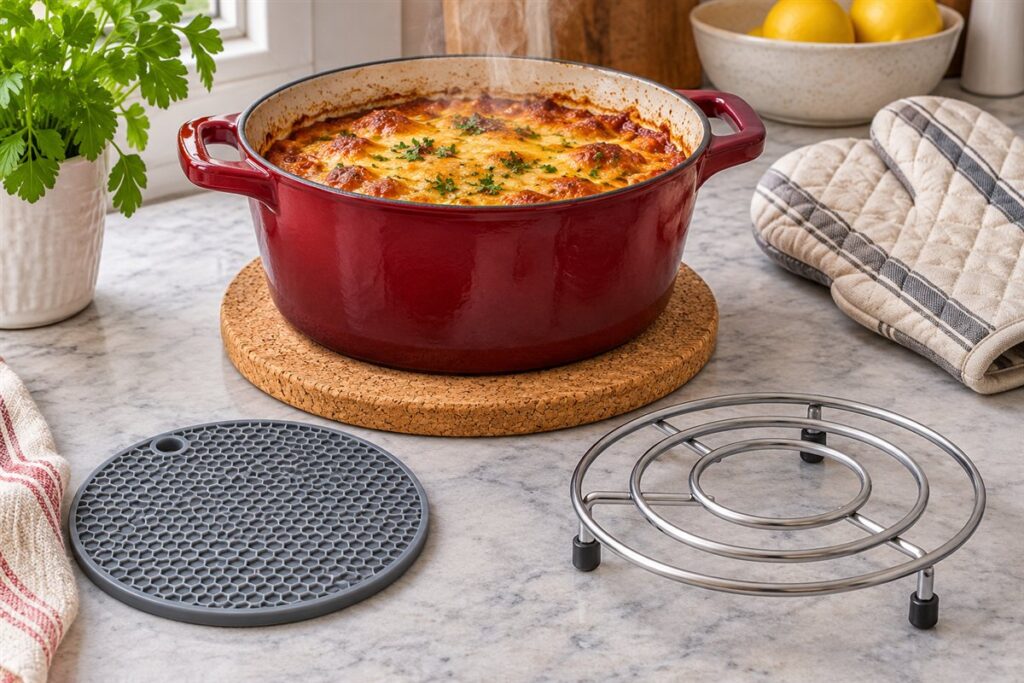
- Silicone: Flexible, non-slip and easy to rinse. Check the heat limit on the label.
- Cork: Light and natural, with a gentle grip. It can mark or crumble with heavy use.
- Wood: Warm and attractive. Suited to dry, moderate heat and hand washing.
- Metal: Sturdy, often with feet that lift the pot. Can get hot and may scratch surfaces unless it has pads.
- Stone or ceramic: Heavy and steady. Can chip, and may hold heat for a while.
In this guide
Comparison Table
| Factor | Why it matters | What to check |
|---|---|---|
| Heat handling | A trivet that cannot take the heat may scorch | The maker’s stated limit |
| Size | Large pots overhang small trivets | Measure pot base |
| Grip | Pots can slide on slick surfaces | Non-slip base or feet |
| Thickness | Thin pieces pass heat through | Solid, even build |
| Storage | Bulky trivets crowd drawers | Flat, rolled or hanging options |
| Care | Materials differ in washing needs | The maker’s guide |
Match the Trivet to the Job
- For everyday dinners, a flexible silicone trivet is easy and forgiving.
- For a table setting, wood or stone can look good under serving dishes.
- For hot casserole dishes, choose something thick and large.
- For travel or potlucks, choose a flat or folding trivet that packs well.
Also think about your surface. Natural stone and some finished woods can mark under heat, so a trivet is useful even with a quick rest.
Using a Trivet Well
- Set the trivet on a dry, flat surface.
- Use oven mitts when moving hot cookware.
- Do not use a trivet as a pot holder unless the maker says so.
- Wipe it clean after use, since spills can leave marks.
Care by Material
Silicone and metal trivets can usually be washed with warm soapy water. Wood and cork prefer a quick wipe and a thorough dry. Stone and ceramic should be washed gently to avoid chips. Whatever the material, check the maker for care directions.
Worked Example: Sizing Trivets for a Dinner Table
Take a table where you often serve a round casserole dish, a pot of rice and a skillet of vegetables. The steps below show how to choose the right set.
- Measure the base of each dish at its widest point, including any handles that rest on the surface. Write down the numbers.
- Add about an inch on each side. A trivet should be wider than the base so that heat from the rim does not reach the table, and so a nudge does not leave the pot hanging off the edge.
- Check the weight of the heaviest dish when full. A thin silicone mat can sag under a heavy casserole, and a small metal trivet can tip, so choose something broad and solid for the biggest dish.
- Consider what you set the trivet on. A polished or oiled table needs a trivet with a soft underside, such as cork backing or rubber feet.
- Read the maker’s heat limit and compare it to the dish. If a casserole comes from the oven, a trivet with a higher limit or a thick build is the safer choice.
- Decide how many you need at once. Three dishes need three places, so a set saves juggling.
- Choose a storage method: hanging loop, drawer, or flat in a cabinet. A trivet that is hard to store tends to stay in the cupboard.
Common Scenarios
Setting a hot pot on a stone counter
Stone can mark under sudden heat, so use a trivet even for a short rest. A solid piece with feet that allow air under the pot works well.
Serving from a cast iron skillet
Cast iron holds heat for a long time and is heavy. Use a thick, stable trivet with the maker’s heat limit well above your cooking temperature.
Hosting a buffet
Choose a set that matches in size and look, and make sure each piece is non-slip, since people bump tables while reaching for food.
Using a trivet on a wooden table
Choose something with soft feet or a cork base, so it does not scratch the finish, and wipe up condensation under it.
Mistakes to Avoid
- Choosing a trivet smaller than the base. Heat reaches the surface at the edges, which defeats the purpose.
- Assuming all trivets handle oven-hot dishes. Heat limits differ, and some materials scorch or soften.
- Using a damp trivet. Moisture trapped under a pot can turn to steam or mark a wooden table.
- Placing a trivet on an uneven surface. It can rock and tip a full dish.
- Skipping a wipe after use. Sauces left on cork or wood stain it and attract dust.
Quick Troubleshooting
| Symptom | Likely cause | What to try |
|---|---|---|
| Trivet slides | Smooth underside on a smooth table | Add rubber feet or choose a textured base |
| Scorch mark on the trivet | Heat above its limit | Check the limit, and use a thicker or different material |
| Cork flakes off | Age or heavy use | Replace it once it crumbles |
| Wood warps | Soaked in water | Wipe, do not soak, and dry upright |
| Metal scratches the table | No pads | Add felt or rubber pads to the feet |
Over time, look after the trivet as you would any kitchen tool. Rinse silicone and metal pieces soon after use, since sauce and grease left on them attract dust and can leave marks on your table. Check cork for crumbling and wood for cracks or warping, and retire any piece that is damaged. Stack flat trivets in a drawer with a cloth between them to prevent scratches, and hang decorative ones where they will not be knocked. If you often serve hot dishes to guests, keep a few spare trivets near the table so you are never tempted to put a pot straight onto the surface.
Glossary
- Trivet: A rest that holds a hot dish above a surface.
- Heat limit: The highest temperature the maker says the item can handle.
- Feet: Small raised supports on the underside.
- Heat transfer: The movement of heat from the pot through a material.
- Footprint: The area of table the item covers.
Thinking About Heat Before You Pick a Shape
A trivet exists to put a barrier between hot cookware and the surface beneath it. Heat moves through the trivet and into whatever lies under it, so the more time a pot spends there, the more heat transfers. A thin mat may be fine for a short pause, such as setting down a pan while you serve, but a pot that sits for half an hour can warm the surface below even through a good trivet. Think about how long your cookware will stay put.
Another point is the heat source. A pot straight from the stove, a dish from the oven and a casserole carried from a slow cooker all arrive at different temperatures and with different bases. Check the maker’s stated limits and follow them, and when information is missing, treat the trivet more cautiously than you would otherwise.
- Short pauses ask little of a trivet.
- Long resting times ask much more.
- Always follow the stated limits of the product.
- When in doubt, choose a thicker design.
Shape and Size in Real Kitchens
Round, square, rectangular and oval trivets all have their place. Round suits pots and pans with round bases. Rectangular suits baking dishes and loaf pans. Oval suits roasting dishes and serving platters. A trivet should extend a little beyond the base of what it carries, giving a margin of safety if the pot shifts. If the base overhangs, the trivet loses its protective value and can tip.
Measure your most-used cookware, including handles. Handles can overhang the edge of a trivet and rest on the table, where they may leave marks or heat the surface. Also think about storage. Flat designs slide into a drawer, while chunky ones may need a hook or a shelf. Foldable and expandable designs adapt to different pots but add parts that can loosen over time.
| Cookware | Suitable trivet shape | Key point |
|---|---|---|
| Round pot | Round or square | Extends beyond the base |
| Casserole dish | Rectangular | Covers the whole length |
| Roasting pan | Large rectangle or oval | Handles stay clear of the table |
| Kettle or teapot | Small round | Stable and non-slip |
| Skillet | Square or round | Supports the handle side |
Thickness and Weight
A thicker trivet slows heat transfer more than a thin one, and a heavier trivet stays put when you set down a pot. However, a heavy trivet can feel cumbersome to store, and a thick one can raise a pot to an awkward height at the table. Balance these points with how you serve food. If you pass dishes around, a lightweight trivet is easier to move, but make sure it does not slide when you set down a pot.
Look at the underside as well. A smooth bottom may slip on a polished table. Small feet or a grippy layer helps keep the trivet in place and can reduce scratches. Check that the feet are made of a material that will not stain or mark your surface, particularly on delicate finishes.
Surfaces That Need Extra Care
Some surfaces are more sensitive than others. Polished wood, laminate, varnished furniture and some stone tops can mark from heat, moisture or friction. Heat can leave white rings on wood finishes, and a sliding trivet can scratch. A felt or cork underside can protect delicate surfaces, but always check that it stays flat and clean.
Stone and solid-surface counters have their own rules, and makers often give specific guidance about hot cookware. Check your countertop supplier’s care instructions. Even where a surface is described as heat resistant, a trivet is an inexpensive layer of insurance. If you have a family heirloom table or a newly finished surface, treat it with extra caution and consult the maker or a professional if you are unsure.
Trivets for Serving Versus Cooking
Many trivets are made for the table, while a few are meant for the stovetop or oven. A table trivet protects a surface from a hot dish. A stovetop trivet or rack might hold a pan above a burner or support a pot in an oven. These are different jobs, and a product designed for one may not suit the other. Always read the product listing and the manual to make sure the trivet is intended for how you plan to use it.
Never place a trivet on or near an open flame unless the maker specifically allows it. For anything involving gas, electricity or built-in appliances, follow the appliance maker’s instructions and, if needed, consult a licensed professional. Use trivets only as directed, and keep flammable materials such as towels and paper away from heat sources.
Decorative Choice Without Losing Function
Trivets come in many designs, from simple metal grids to patterned tiles and woven mats. They are visible during meals, so it is natural to want one that suits your style. Pick a look you enjoy, but check that decoration does not come at the cost of stability or protection. Gaps in an open pattern may let heat or drips through. Glazed tile surfaces can be slippery. Woven designs may hold moisture or stains.
Consider matching sets for gatherings, where a row of identical trivets looks tidy and works consistently. For everyday use, mix and match as long as each performs its job. A handsome trivet that slides or leaves marks is no bargain, so function should come first.
Trivet or Hot Pad: Choosing the Right Tool
People often use the two terms interchangeably, yet they serve slightly different roles. A trivet usually sits on a table beneath a serving dish, while a hot pad or mitt is used by hand to hold hot items. Some mats work as both, but check the maker’s instructions. A flexible mat can double as a jar opener and a pot holder, while a rigid trivet cannot grip.
If you are not sure which you need, think about the problem. If you want to protect a surface, choose a trivet. If you want to move hot dishes, choose a mitt or pad. Many kitchens end up with both, and that is a sensible approach for safety and convenience.
Materials Compared by Behavior
Different materials respond to heat and use in different ways, and knowing the pattern helps you choose without memorizing product claims. Metal conducts heat readily, so a thin metal grid works mainly by lifting the pot off the surface and letting air circulate, not by blocking heat. Stone and ceramic absorb heat and release it slowly, which protects the table for a while but leaves the trivet itself hot long after the pot is gone. Cork is light, insulating and kind to surfaces, though it can crumble or char if abused. Silicone is flexible and grippy, and it is often described as heat resistant, but its limits depend on the formula, so check the product listing. Wood is a classic insulator, though it can scorch and mark with very hot cookware.
| Material | Strength | Weakness | Good for |
|---|---|---|---|
| Metal grid | Sturdy, air gap | Gets hot, may scratch | Stovetop to table moves |
| Stone or ceramic | Heavy, stable | Can crack if dropped | Formal table settings |
| Cork | Light, gentle on surfaces | Wears with heavy use | Everyday pots |
| Silicone | Flexible, easy to clean | Limits vary by product | Mixed tasks |
| Wood | Warm look, insulating | Can scorch or warp | Short pauses |
No material is perfect for every situation. Match the strengths to your most common problem, and be ready to own more than one if your cooking varies.
How to Sketch a Trivet Plan for Your Table
Instead of buying at random, take a few minutes to plan. Sketch your table or counter, mark where serving dishes usually land, and note how many you place at once. A family meal might include a main pot, a side dish and a bread basket, while a holiday meal may need many more places for hot items. Count the spots and add one extra for surprises.
Next, measure the space available. Long narrow tables leave little room for large trivets side by side, so smaller ones in a row may fit better. Round tables give you a center area that suits a larger trivet. If you often serve from the stove, think about a spot near the cooktop where a trivet can live permanently, ready for hot pots.
- Draw the table or counter and mark serving positions.
- Note the largest dish and its dimensions.
- Choose sizes and shapes that match each position.
- Add one spare for guests or unexpected dishes.
Safe Habits Around Hot Cookware
A trivet reduces surface damage, but it does not make hot cookware harmless. Keep handles turned so nobody bumps them, and make sure children and pets cannot reach hot dishes. Use oven mitts to move items, and set the dish down gently so it does not slide. Wipe spills quickly, since liquid under a trivet can create a slippery or sticky patch.
If you notice a hot pot is too large for your trivet, do not balance it. Move it to a larger surface or use two trivets side by side. Let cookware cool before moving it to storage, and give trivets time to cool before handling. For any questions about appliance safety or heat limits, rely on the maker’s instructions.
Cleaning and Storing Pointers
- Wipe spills straight away, once the trivet is cool enough to handle.
- Follow the maker’s care guidance for washing.
- Dry fully before storing to avoid mildew or rust.
- Store flat or hung up where it will not be crushed.
- Check periodically for cracks, warping or loose parts.
Replace any trivet that is cracked, warped or showing signs of damage. A damaged trivet may fail to protect your table and could become unsafe under heat.
Travel, Picnics and Outdoor Use
Trivets also earn their place away from the dining room. At a picnic table, a folding or rollable trivet protects painted wood and keeps a hot dish from sliding on an uneven surface. On a camping trip, a light mat can steady a pot on a rough table. Choose something that packs flat, wipes clean and does not hold dirt in crevices.
Outdoors, wind and uneven ground make stability more important than looks. Look for a wider base, grippy feet and a design that does not catch the breeze. Check the maker’s guidance on direct contact with a grill, fire pit or camp stove, and never assume that a kitchen trivet is made for open flame.
Handy Buying Checklist
- Measure your largest pot and choose a trivet that extends beyond its base.
- Check the maker’s stated heat limits.
- Look for non-slip feet or a grippy underside.
- Match the material to your surfaces.
- Think about storage space.
- Buy enough for gatherings.
With these points in hand, you can select a trivet that protects your surfaces, suits your cookware and fits your style without fuss.
FAQ
Can I put a hot pan straight from the oven onto any trivet?
Not always. Check the heat limit from the maker. When in doubt, use a thicker trivet or let the pan cool a little.
Do I need more than one?
A pair or set is handy for dinners with several hot dishes. One extra trivet also helps when a pan comes off the stove while another sits on the counter.
Can a trivet go in the dishwasher?
Silicone and some metal ones often can, but check the maker. Wood, cork and some stone pieces do better with a hand wash.
Is a trivet the same as a hot pad?
They overlap. A trivet usually stays on the table under a dish, while a hot pad is often used to handle or rest cookware. Some products do both, so read what the maker says.
Why does my table still get marked?
Condensation or trapped heat can mark wood even with a trivet. Choose one with air gaps under the pot, and wipe the surface if moisture collects.
The Short Version
Choose a trivet that is large enough for your pots, has a stated heat limit that fits your cooking and grips the surface. Silicone is a flexible all-rounder, and wood or stone suit table service. Wipe it after use and store it flat or hung up.
How Heat Actually Reaches Your Table
A trivet protects a surface in two ways: it puts distance between a hot base and the surface, and it gives heat somewhere to go other than straight down. A solid mat blocks direct contact but can still pass warmth through slowly, especially under a heavy pot that sits for a long meal. A raised design with feet or ridges creates a small air gap, and that moving air carries heat away, which is why raised trivets often protect delicate finishes better than a thin flat pad under the same pot. Neither design makes a surface invulnerable. A pan taken straight from a fierce burner or a very hot oven carries a great deal of stored heat, and the sensible habit is to let the hottest cookware rest briefly on the stove or on a heatproof part of the counter before it moves to the table.
Moisture matters as much as heat. Steam condenses under a hot lid and around the base of a pot, and that warm moisture can leave rings or cloudy marks on polished wood even when the temperature alone would not have caused damage. Lifting the pot slightly, wiping the base before serving, and lifting the trivet after the meal to let any trapped damp dry all reduce that risk. If your table marks easily, treat the trivet as one layer of protection and a placemat or table protector underneath as a second, rather than expecting one thin accessory to do everything.
Matching the Trivet to the Cookware You Own
Start with the pots and dishes you actually use, not the ones in a catalogue photograph. Measure the base of your largest everyday pot and your favourite serving dish, and compare those measurements with the usable surface of the trivet, not just its overall size. Handles, decorative edges and raised rims can make a trivet look larger than the flat area a pot can safely sit on. The pot should sit fully supported without rocking, and it should not overhang so far that a small knock could tip it.
Weight matters too. A full casserole or a cast iron pot is heavy, and a flimsy trivet that flexes or a folding design that is not fully opened can shift under that load. Test stability with the pot empty and cool before you trust the combination with hot food. Round pots sit happily on round, square or cross-shaped trivets as long as the contact points are even. Long dishes, such as roasting tins and oval bakers, may need two trivets placed apart or one long design, so the dish is supported near both ends rather than balanced in the middle.
Trivets for Cast Iron and Other Very Heavy Pots
Cast iron holds heat for a long time and weighs a great deal even before food goes in. Choose a sturdy trivet with a wide, stable footprint and check that any feet or pads are firmly attached, because a foot that comes loose under a heavy pot is worse than no foot at all. Avoid very thin mats for the heaviest cookware, since the combination of weight and heat can press warmth through to the surface below. After serving, remember that the trivet under cast iron may itself stay hot for some time, so move it with a cloth or glove and warn others at the table before they tidy up.
Using Trivets Around the Kitchen, Not Just at the Table
Many cooks only think of trivets at serving time, but they solve problems all over the kitchen. A trivet on the counter gives baking trays a safe landing place when your stove top is full. One beside the oven lets you set down a roasting tin while you check food or baste it, without hunting for a clear heatproof patch. Under a slow cooker, a kettle or a hot appliance, a suitable trivet can protect a counter that is not rated for prolonged warmth, though you should always follow the appliance maker’s own clearance and surface guidance first.
Trivets also help during preparation. A warm bowl of dough can rest on one while proving if the recipe calls for gentle warmth, and a hot saucepan of sauce can sit on one while you finish other elements of a meal away from the burners. Keep one or two within reach of the oven rather than stored in a distant cupboard, because protection you have to search for tends to get skipped in the busy moment when a hot tray is already in your hands. That single habit, a trivet stored where the cooking happens, prevents more damage than any particular material choice.
Serving a Meal With Several Hot Dishes
Holiday meals and family dinners are where a single trivet falls short. Several hot dishes arrive at once, space is tight, and serving spoons, elbows and passing hands all increase the chance of a knock. Plan the table before the food leaves the kitchen. Place trivets where dishes will land, leave room to set down lids, and keep a spare trivet or folded cloth ready for the extra dish that always appears. Expandable or linked designs can help under long platters, while a set of smaller trivets gives more flexibility than one large piece when dishes vary in size.
Think about the order of serving as well. The dish that stays on the table longest, such as a casserole that people return to, deserves the most protective and stable trivet. Dishes that are served and quickly removed can use simpler protection. Keep hot trivets and the dishes on them away from the edge of the table where children can reach or where a tablecloth can be pulled, and never let a tablecloth hang in a way that could drag a trivet and its pot with it. A calm layout, decided a minute early, makes the meal safer and more relaxed for everyone.
Cleaning and Care by Material
Silicone trivets are usually the easiest to live with: wash them in warm soapy water, rinse well and dry them so they do not sit damp in a drawer. If a silicone trivet picks up a lingering smell from a strongly spiced dish, a thorough wash and time in fresh air usually helps. Cork should be wiped rather than soaked, because soaking can make it swell and crumble; let it dry fully before putting it away. Wood benefits from the same treatment as other wooden kitchen items: hand wash, dry promptly, and do not leave it under a damp pot for hours.
Metal trivets can go in the dishwasher if the maker allows it, but check any rubber feet or pads first, since those parts age faster than the frame. Stone and ceramic pieces should be handled like other heavy, breakable items: wash once cool, because putting a hot stone trivet under cold water can stress the material, and check edges for chips that could scratch a table. Whatever the material, inspect your trivets now and then. A warped, cracked or wobbling trivet is no longer doing its job properly, and replacing it is cheaper than repairing a marked table or counter.
Storing Trivets So They Stay Handy
Flat trivets store in a drawer, in a vertical rack with cutting boards, or hung from a hook if the design allows it. Raised metal designs take more room and nest poorly, so a single shelf spot near the oven may suit them better. Avoid burying trivets under heavy pans, which can bend thin designs and chip stone or ceramic. If you own several, keep the two you use most at the front and let the special-occasion pieces live further back. Good storage is part of usefulness: a trivet you can reach in two seconds gets used every time, and one at the back of a crowded cupboard gets used only after the damage is done.
Common Mistakes and How to Avoid Them
The most common mistake is using a trivet that is too small, so the pot overhangs and heat reaches the surface around the edges. The second is assuming that any mat sold for kitchens is heatproof; decorative mats, thin placemats and some cork boards are not made for cookware straight from the oven. Read the maker’s heat guidance and respect it. A third mistake is placing a trivet on a wet surface or putting a wet pot on a wooden trivet and leaving it there, which traps moisture against both the table and the trivet itself.
People also forget that the trivet can become hot. A metal trivet under a heavy pot absorbs heat and can mark a surface if you slide it off the pot and straight onto bare wood, or burn fingers if it is picked up carelessly during clearing. Let trivets cool where they are, or move them with the same care you give the cookware. Finally, avoid dragging a loaded trivet across a table to reposition a dish. Lifting is safer for the surface, for the pot and for anyone whose hands are nearby.
When a Trivet Is Not Enough
Some situations call for more than a standard trivet. A dish going under a grill or into the hottest oven, then straight to a delicate table, may need to cool longer on the stove first. Very large roasting tins can need a dedicated stand or two strong trivets rather than one small mat balanced in the centre. Outdoor cooking brings its own risks, because uneven ground and wind make stability more important than appearance, so choose a wide, low, sturdy design and set it on a level surface.
There are also surfaces that deserve extra caution regardless of trivet quality. Freshly finished wood, some stone counters that are sensitive to heat or staining, and plastic or laminate surfaces can all be damaged more easily than a maker of trivets can promise to protect. In those cases, layer your protection, let cookware lose its fiercest heat before serving, and consider keeping the hottest dishes in the kitchen on a heatproof counter and serving portions from there. Knowing the limits of the tool is part of using it well.
More Questions About Trivets
Can I use a wooden cutting board as a trivet?
In a pinch, a thick, dry wooden board can protect a surface from a warm dish, but it is not ideal for very hot cookware, and heat plus moisture can warp or mark the board. A purpose-made trivet with a stated heat limit is the better everyday choice, and it keeps your boards free for food preparation.
Why does my trivet slide on the counter?
Sliding usually means the surface, the trivet feet or the pot base is greasy or damp. Clean and dry all three, check that any pads are intact, and choose a design with a gripping base if your counter is very smooth. Never rely on holding a sliding trivet steady under a full, hot pot.
Are thicker trivets always better?
Not always. Thickness helps insulation in a flat mat, but design matters as much: a thinner raised trivet with an air gap can protect better than a thick solid one. Judge by the maker’s guidance, the stability of the design and how it suits your cookware, not by thickness alone.
Can a trivet go in the oven as a rack?
Only if the maker specifically says the trivet is oven safe for that use. Many trivets are made for table and counter protection, not for oven temperatures or direct contact with heating elements. Use a proper oven rack or roasting rack for cooking tasks.
How many trivets does a home kitchen need?
Two versatile trivets cover most everyday cooking, with an extra one or a larger design helping at big meals. More important than the number is having them near the oven, in sizes that fit your largest pots and your usual serving dishes.
Buying a Trivet as a Gift or for a New Kitchen
A trivet makes a practical gift precisely because new kitchens rarely have enough of them. Someone setting up a first home usually buys pots, knives and a kettle long before they think about where a hot casserole will land, and the first scorched worktop or ringed table often teaches the lesson the hard way. If you are choosing for someone else, favour versatility over novelty. A medium-to-large trivet in a neutral material, with a clear heat rating from the maker and a stable, non-slip design, will be used weekly, while a novelty shape that only fits one small dish tends to live in a drawer. A pair is more useful than a single decorative piece, because real meals involve more than one hot dish.
For your own new kitchen, buy trivets at the same time as your first large pots, not after them. Check them against the biggest base you own, store them beside the oven from day one, and build the habit of reaching for one automatically. If you cook with housemates or family, agree on where the trivets live and put hot dishes only on trivets, never directly on shared tables or counters. Small agreements like that prevent most of the marks, burns and arguments that follow a busy shared kitchen, and they cost nothing beyond a moment of thought at the start.
Trivets With Table Style: Serving Well Without fuss
Protection does not have to look purely practical. Wood, stone and well-finished metal trivets can sit on a dining table all evening without spoiling the look of a meal, and many hosts leave an attractive trivet in place as part of the setting. The key is to choose table trivets with the same care as kitchen ones: a finish that will not transfer to the table, feet or a base that will not scratch, and enough size and stability for the dishes you serve. Felt or padded bases deserve a check before a dinner party, not during one, because a pad that has come loose can let a metal frame contact the wood directly.
Coordinate the practical details too. A trivet that matches your serving dishes in tone is pleasant, but a trivet that keeps a heavy dish steady while guests serve themselves matters far more. Place serving spoons where they will not be laid across a hot trivet edge, keep handles turned inward, and give the host a clear path to lift dishes away at the end of the meal. When the meal is over, let everything cool before stacking trivets for washing or storage, and wipe the table underneath once the trivets are lifted, because crumbs and moisture collect there during even the neatest dinner.
A Short Pre-Dinner Checklist
Before guests sit down, walk the table once with fresh eyes. Every hot dish has a trivet that fully supports it. No trivet sits on a seam, a wobbly spot or the very edge of the table. There is a spare trivet or heatproof mat in the kitchen for anything still in the oven. Cloths or gloves for moving hot dishes are within the host’s reach, not in a distant drawer. Nothing hot needs to be carried over anyone’s lap or across a crowded room. That thirty-second check, done while the kitchen is still calm, is the difference between a relaxed meal and a scramble with a roasting tin in your hands.
Protecting Counters During Everyday Cooking, Day After Day
Most surface damage does not happen at a dinner party. It happens on an ordinary Tuesday, when a tray comes out of the oven and the nearest clear space looks good enough, or when a hot lid is set down beside the stove without a thought. Building small, repeatable habits protects your kitchen far better than owning one perfect trivet. Keep a trivet permanently on the section of counter you use as a landing zone, so the safe place is also the easy place. Put hot lids on a trivet or on the stove itself rather than face down on the counter, where trapped steam and heat can leave a ring in seconds. Teach anyone who cooks in the kitchen, including teenagers learning to help, that hot things land only on trivets, the stove or a cooling rack.
Renters have an extra reason to be careful, because heat marks and stains on counters and tables can mean losing part of a deposit at the end of a tenancy. If you rent, treat every surface as delicate, layer protection under the hottest dishes, and photograph the condition of counters when you move in so existing marks are not blamed on you later. Homeowners should be just as consistent, because refinishing a counter or a dining table costs far more than a handful of good trivets and a little daily attention. The trivet is a small, inexpensive tool, but used every single time, it quietly preserves the most expensive surfaces in your home.
One Last Thought on Choosing Well
If you remember only three things, make them these. Size first: the trivet must fully support the base of your largest regular pot without wobbling or wide overhang. Heat second: trust only the maker’s stated heat guidance, and let the fiercest cookware cool a little before it leaves the stove. Habit third: keep the trivet beside the oven and use it every time, for lids and trays as well as for serving dishes, because protection that depends on remembering in a busy moment will eventually be forgotten. A trivet chosen on those three points, in any material that suits your kitchen, will do its quiet job for years, and your tables and counters will show the benefit long after the small effort of choosing has been forgotten.
Trivets and Cooling Racks: Knowing Which You Need
New cooks sometimes confuse a trivet with a wire cooling rack, and while both lift hot items off a surface, they are built for different jobs. A cooling rack is a wire grid made to let air circulate around baked goods so they cool evenly and stay crisp underneath. It is light, often not designed to carry a heavy, full pot, and its thin wires can leave marks or tip under an uneven load. A trivet is the sturdier, heat-focused tool meant to bear cookware and shield the surface below. Use the rack for cakes, biscuits and roasting tasks it is made for, and the trivet for pots, casseroles and trays at the counter and table. Owning both is normal in a busy kitchen, and using each for its proper job keeps food better and surfaces safer than forcing one tool to cover every hot landing in the room.
One more everyday use deserves a mention: a trivet under a hot drinks pot, a fondue or a heated serving bowl during a long, slow meal keeps the table safe for hours, not just minutes, which is exactly the situation where a thin improvised mat is most likely to let warmth creep through unnoticed. Check the surface underneath partway through a long meal if the dish is very hot, and add a second layer of protection if the table feels warm to the touch.