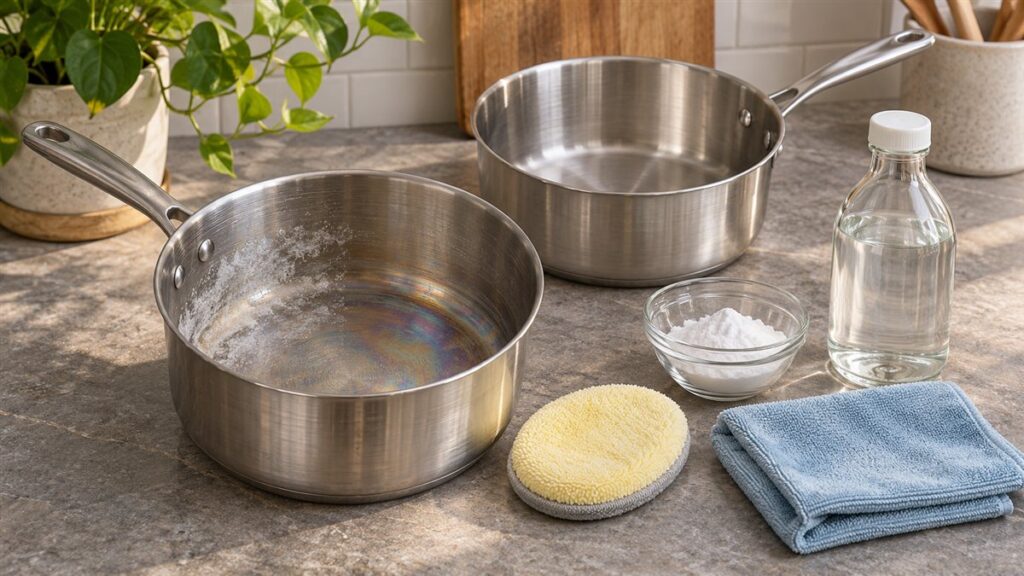
Stainless steel stays tough, but it can still show water spots, a rainbow tint, white mineral marks and burnt residue. Each problem has a mild fix, usually involving warm water, baking soda or a little vinegar. The key is to match the method to the mark.
Identify the Mark
| What you see | Likely cause | Gentle fix |
|---|---|---|
| White chalky film | Mineral deposits from hard water | Wipe with a little white vinegar, then rinse |
| Rainbow tint | Heat exposure | Vinegar or a mild stainless cleaner |
| Brown or black patches | Burnt or baked-on food | Baking soda simmer and soft scrub |
| Small dull dots | Dried water spots | Dry right away and buff with a soft cloth |
Cleaning Burnt-On Residue
- Let the pot cool, then add enough water to cover the marks.
- Stir in a tablespoon or two of baking soda.
- Bring to a gentle simmer for five to ten minutes, watching it carefully.
- Turn off the heat and let it cool.
- Scrub with a non-scratch pad, rinse and dry.
Removing Spots and Tints
For white film or rainbow marks, wipe the surface with a cloth dampened with white vinegar, or simmer a mix of water and a splash of vinegar inside the pot. Rinse thoroughly and dry. Always rub in the direction of the metal’s fine grain lines when you can, as that hides small scratches. A paste of baking soda and water works on the outside of pots, applied with a soft cloth.
What to Avoid
- Chlorine bleach, which can pit stainless steel and give off fumes.
- Steel wool on polished finishes.
- Leaving salty water to sit in the pot, which may lead to small pits.
- Mixing cleaning chemicals together.
Read the maker’s care guide for approved products and dishwasher advice.
Prevention is simpler than repair. Dry pots by hand soon after washing, so that minerals in the water do not dry into spots. Add salt to boiling water only after it is bubbling, and stir, because salt that sits on a cold base can leave small pits. Use medium heat for most cooking, since very high heat causes the rainbow tint and can brown oil onto the surface. Preheat the pan before adding oil and food, which helps prevent sticking and makes cleaning much easier later. If you cook sticky foods often, soak the pan while you eat, so that residue never has time to harden.
Cleaning products designed for stainless steel often contain mild acids or abrasives, so read the label and test on a hidden spot first. Rinse well afterward, and never mix cleaners.
Why Marks Form on Stainless Steel in the First Place
Stainless steel looks the same whether a mark is harmless or a sign of a habit worth changing, so it helps to know where each type comes from. Water spots and chalky film come from dissolved minerals. When a drop dries on the surface, the water leaves and the minerals stay behind. If your tap water is hard, you will see this more often, and it will be most obvious on a polished interior.
Rainbow tint is different. It is a thin oxide layer that appears when the metal is heated past a moderate temperature, and it tends to show up on pans that are left on a high flame while empty or nearly empty. It does not affect safety or performance, but it tells you the burner may be set higher than the cooking needs.
Brown or black patches are usually food or oil that has been baked on. Thin films of cooking oil that are heated repeatedly polymerize into a sticky, darkening layer, which is why a pan that looks clean after a quick wipe can slowly build up a stubborn coat. Dark rings around the outside base are often burnt-on splashes from the stovetop rather than damage to the metal itself.
Knowing the cause saves effort. Minerals respond to a mild acid, baked-on food responds to heat and soaking, and heat tint responds to either a mild acid or a stainless-specific cleaner. Choosing the right approach first time means less scrubbing and fewer scratches on the finish.
Dealing With Stubborn Stuck-On Food in More Detail
If the baking soda simmer does not shift a heavy layer on its first pass, do not reach for something harsher straight away. Repeat the simmer, or let the pan soak with warm soapy water for a longer stretch before you scrub. Time does a lot of the work, and a second gentle round is kinder to the surface than aggressive scraping.
A few habits make the second round more effective:
- Loosen what you can with a wooden or silicone spatula while the water is still warm, rather than a metal tool that can scratch.
- Use a non-scratch pad or a soft nylon brush. Rub along the grain lines of the metal where you can see them.
- For a burnt ring near the edge, tilt the pan so the baking soda solution covers it, or fill to a higher level.
- Rinse well after each attempt so you can see what remains and avoid leaving residue that bakes on next time.
Deglazing is a useful prevention technique. While the pan is still hot after cooking, add a small amount of liquid and scrape up the browned bits with a spoon. That fond dissolves easily at this stage and would otherwise harden as the pan cools. Be careful, because hot pans produce steam and spatter, so stand back and use dry oven mitts.
If a pan has a very thick, blackened layer, accept that it may take several sessions. Check the maker’s care guide for approved products, and stop if you notice the finish itself looking scratched or hazy, since that is a sign you are being too abrasive.
Choosing Between Home Methods and Store Cleaners
Most stains can be handled with a short list of kitchen basics, but it is useful to understand what each option does so you can pick sensibly.
- Baking soda: a mild abrasive and gentle alkali. It is helpful for burnt food and for greasy films, and it is easy to rinse away.
- White vinegar: a mild acid that dissolves mineral deposits and clears heat tint. Rinse thoroughly and dry, and avoid leaving it sitting for long periods.
- Dish soap and hot water: the first step for any oily or sticky mark, and often all that is needed for routine upkeep.
- Stainless-specific cleaning powders and creams: usually a mild abrasive combined with a mild acid. They can restore a uniform shine, but read the label for ventilation, glove and rinsing advice.
Whichever you choose, test on a small, low-visibility spot first, such as the underside of the base. Avoid combining products. Mixing cleaners, particularly anything containing bleach with an acid, can release harmful fumes, so use one product at a time and rinse fully between them.
If your pan has a different finish, such as a brushed texture, a decorative exterior or a nonstick layer on the inside, the maker may have specific rules. Follow those over general advice.
Cleaning the Outside, Base and Handles
The exterior of a pot takes more punishment than the inside, because it sits directly over the flame or element and collects grease splashes. Because the outside may be polished differently from the inside, test your method on a hidden area first.
For a dull or darkened outside, a paste of baking soda and a little water applied with a soft cloth lifts most grease. Work in small circles on the base, then wipe along the grain on the sides. Leave the paste for a few minutes on tougher areas, and then rinse and buff dry with a clean cloth.
Riveted handles collect grease where the metal meets the pan wall. A soft toothbrush and warm soapy water reach into those joints without damaging anything. Never submerge a pan with a wooden or plastic handle for long periods unless the maker says it is safe, and check whether the handle is rated for the dishwasher before using one.
On a glass or ceramic cooktop, a rough or stained base can leave marks and may scratch the surface. Keep the base clean and lift the pan rather than sliding it. If the base has warped or developed rough spots from heavy scouring, it may no longer sit flat, which affects both performance and cooktop safety.
Long-Term Care and Knowing When to Replace
A simple routine keeps stainless looking good for years. After cooking, let the pan cool a little, then wash with warm soapy water and a soft sponge. Dry it by hand rather than leaving it to air dry, which is when mineral spots form. Do an occasional vinegar wipe if you live in a hard-water area, and store pans so the interiors are not scratched by stacking, using a cloth or paper towel between them.
It is normal for a well-used pan to develop fine surface scratches and a softer, less mirror-like look. These do not make it unsafe. Cosmetic wear should not push you to replace a pan that still cooks well.
Consider replacement, or at least a close inspection, if you notice any of the following:
- Deep pitting that stays rough after cleaning, especially on the cooking surface.
- A base that rocks on a flat surface, which causes uneven heating.
- Loose or wobbling handles, since a failing handle on a hot pan is a safety risk.
- Layered bases that appear to be separating from the body.
If a pan is covered by a warranty, check the terms before throwing it away, because some makers address defects rather than cosmetic wear.
FAQ
Is a rainbow tint harmful?
It is a cosmetic change from heat and usually wipes away with vinegar.
Can I use a store cleaner?
Many people do; choose one made for stainless steel and follow the label and ventilation advice.
Is it safe to use vinegar on stainless steel regularly?
Occasional use is generally fine and is a common way to clear mineral film, but it should not sit on the metal for long. Rinse thoroughly and dry afterward, and check your maker's care guide for any limits.
Why do my pans get white spots even when I dry them?
Spots often appear if water is left on the surface for even a few minutes, or if the cloth is not fully dry. Hard water makes this more noticeable, so a final wipe with a clean, dry cloth helps.
Can I put stainless steel cookware in the dishwasher?
Many pans are labeled dishwasher safe, but detergents can dull the finish over time and may leave spots. Check the maker's guide, and consider washing by hand if you want to preserve a polished look.
Will scratches affect how the pan cooks?
Light surface scratches usually do not change cooking performance. Deep gouges or warping are more important to watch, as they can affect heating or cleaning.
What should I do if cleaning products leave a film?
Rinse again with warm water and dry with a soft cloth. If a haze remains, a wipe with diluted vinegar followed by a thorough rinse often clears it.
Is a blue or gold tint on the pan dangerous?
It is a cosmetic result of heat on the metal and is not typically a hazard. Lowering the heat for future cooking helps prevent it from returning.
The Short Version
Identify the mark, then use baking soda for burnt food and mild vinegar for film and tints. Rinse, dry and avoid harsh abrasives or bleach.