Disclosure: As an Amazon Associate, topratedkitchenware.com earns from qualifying purchases. Links on this page are affiliate links; they cost you nothing extra. Prices and availability change often, so check the current Amazon listing before you buy.
This roasting pan review takes the category apart piece by piece, because a roasting pan review that only praises shiny metal helps nobody when the pan is loaded, the fat is hot and the gravy is waiting. We assess design, base performance, real roasting results across birds, joints and vegetables, the strengths and trade-offs that survive contact with an actual kitchen, and how the leading models compare, ending with who should buy what and the care routine that keeps a good pan good.
Key Takeaways and Verdict
The roasting pan category is unusually honest: the best pans share a flat heavy base, confident handles and low sides, and they differ mainly in material temperament and weight. Our verdict in one breath: clad stainless is the safest all-round recommendation, enameled cast iron is the connoisseur’s choice for steady heat and table service, and lighter mid-range pans are the rational pick for occasional roasters. Suits you if you roast regularly and make gravy. Skip the whole category, without regret, if roasting is annual and gravy is not your ritual.
In this guide
What a Roasting Pan Is and Where It Fits
A roasting pan earns its place in the oven through geometry as much as through metal. The low, straight sides let hot air wash over the surface of a bird or a joint instead of steaming it, which is why vegetables tucked underneath caramelise rather than stew. A pan that is too deep behaves like a braiser and traps moisture against the skin, while a pan that is too shallow lets juices run to the corners and scorch before they can become gravy. When you judge any roaster, picture the food sitting in it with air moving freely on every side, and picture the pan moving from oven to hob without flexing, because that journey, repeated over years of Sunday roasts and holiday birds, is where cheap pans quietly fail and good pans quietly justify themselves.
Weight is the first safety fact of roasting, and it arrives before flavour ever does. A large bird, its stuffing, the vegetables underneath and the pan itself add up to a load that surprises people the first time they lift it with oven mitts on. Always use two dry mitts, because a damp mitt conducts heat almost instantly, and always clear the landing space before you open the oven door, so the pan travels a short, planned distance to a trivet or a cool hob rather than hovering while you hunt for room. Bend your knees and lift with your legs, keep the pan level so hot fat does not slosh toward one handle, and never carry a resting bird separately across the kitchen when it can rest safely in the pan where it roasted.
Hot fat changes how you move around a roasting pan. Drippings splatter during basting and again during transfer, and they land on skin, on the hob and on the floor where they become a slip hazard as well as a burn risk. Work with a long-handled baster or a spoon held low over the pan, tilt the bird inside the pan to drain its cavity juices back into the roasting juices rather than lifting it dripping over the counter, and wipe any spill on the floor straight away. If you pour juices into a jug for gravy, pour away from your body, slowly, with the pan steadied by a second mitt on the far handle, and let the pan cool on the hob before it goes anywhere near the sink.
Is a Roasting Pan Review Different From a Baking Pan Review? Yes, and It Matters
Roasting and baking ask opposite things of a pan. Baking wants gentle, even, enclosing heat for delicate structures; roasting wants fierce, dry, circulating heat against robust food, plus the structural strength to carry that food, dripping fat and all, to a hob for gravy. That is why this review weights base behaviour on direct heat and handle security so heavily, criteria that barely feature in bakeware assessments. A pan reviewed as bakeware can look excellent and still fail the roaster’s defining test in the ten minutes after the bird comes out.
The rack question divides roasting cooks more than almost any other. A rack lifts the bird so air circulates underneath and the bottom does not sit in its own juices, which helps the skin and keeps the underside from braising. The counterargument is just as real: vegetables roasted directly under a bird, with no rack, bathe in the drippings and become the best part of the meal for many households. Neither answer is wrong, and a good roasting pan supports both styles, with a rack that sits securely when you want it and removes cleanly when you do not. What matters is that the rack handles do not foul the oven walls and that the whole assembly still slides in and out without tipping.
Stovetop performance is where a roasting pan stops being a tray and becomes a gravy-making tool. The moment the bird comes out to rest, the pan holds browned fond, rendered fat and roasting juices that are the entire foundation of a proper pan gravy. A pan with a thick, flat base sits steadily on the hob, heats evenly across two burners and lets you deglaze without hot spots scorching the flour. Thin bases warp under that direct heat, rock on the burner and brown the roux in patches. If you make gravy even a few times a year, judge roasters by their bases as much as by their oven manners, because the last ten minutes at the hob decide whether the meal tastes finished.
Design, Build and Setup
Handles decide whether a heavy pan feels manageable or frightening. Look for handles that rise enough to admit a mitt-clad hand without your knuckles brushing the pan wall, that are riveted or welded with no play, and that angle so the load hangs naturally from your wrists rather than twisting them. Upright loop handles suit most cooks because they keep hands above the rim and away from the heat radiating off the sides. On a loaded pan, test your grip mentally at the worst moment: oven door open, heat rolling out, pan at its heaviest. If the handles would force a pinched, fingertips-only hold, the pan will feel unsafe no matter how beautifully it roasts, and you will dread using it.
Sizing a roasting pan is an exercise in honest measurement. Measure your oven interior, not the door opening, and leave clearance on every side for air and for your mitts. Then measure what you actually cook: a pan that swallows your largest holiday bird with room for vegetables is the right anchor size, while a pan bought for a once-a-decade giant roast will crowd your oven and your cupboard the rest of the year. Remember that manufacturers measure pans differently, sometimes at the rim and sometimes at the base, so compare cooking-surface dimensions where you can. A pan that fits your oven, your biggest regular roast and your storage shelf beats a theoretically perfect pan that fails any one of those three tests.
Stainless steel remains the default roasting material for good reasons. It tolerates high oven heat, moves to the hob without complaint, shrugs off metal utensils, deglazes cleanly and shows fond clearly because its pale surface contrasts with browning. Its weaknesses are equally predictable: food can stick during the first minutes of searing, and a single-ply pan heats unevenly. That is why better stainless roasters bond an aluminium or copper core through the base, spreading heat so juices reduce evenly instead of burning in the middle. Stainless also cleans without ceremony, surviving soaking, scrubbing and the dishwasher, which matters on the evenings when the roast was wonderful and the washing up is not.
Enameled cast iron roasts with a completely different temperament. The heavy core holds heat so steadily that oven temperature swings barely register, and the enamel surface releases fond beautifully for gravy while looking handsome enough to carry the meal’s centrepiece to the table. The trade-offs are weight and care. A loaded enameled roaster is the heaviest lift in this category, enamel can chip if knocked against oven racks or dropped utensils, and the pan asks to be heated gradually rather than blasted from cold onto fierce direct heat. Cooks who roast often, serve at the table and value even heat above easy lifting tend to love these pans for decades, because nothing else browns quite so calmly.
Performance in Real Use
Whole Birds
On whole chickens and the holiday turkey pattern, the category’s strengths show immediately: skin browning evenly where air reaches it, juices pooling usefully rather than scattering, and the bird resting in the pan afterwards while gravy happens around the corner on the hob. The rack earns its keep here for cooks who want the underside crisp, while the no-rack, vegetable-bed method produces the dripping-rich vegetables many families fight over. Both are legitimate; a good pan makes both feel easy and, above all, stable at the moment of the loaded lift.
Joints and Large Cuts
Legs of lamb, pork shoulders and beef joints test a pan differently: longer times, more rendered fat and a greater need for even base heat so the accumulating juices do not scorch in one spot while staying pale in another. Heavy bases shine here, and the cook’s discipline matters too: plan the landing space before opening the oven, baste with a long-handled spoon held low to limit splatter, and let the joint rest in the pan so every drop of juice stays available for the sauce rather than decorating the counter.
Vegetables and Tray Dinners
For vegetable-led roasting, the pan’s depth is a mixed blessing that good cooks manage: pieces need a single layer and room to release steam, or they soften instead of caramelising. Used with that restraint, a roaster is a superb vegetable vessel, especially under a chicken, and its hob-safe base lets you reduce the tray juices into a glaze at the end. This is also where the pan earns weekday keep, which matters to its overall value far more than its holiday performance alone.
Gravy and Finishing
The gravy test is this review’s deciding examination, because it integrates base flatness, heat spread, handle security and fond quality in one short, unforgiving procedure. Pans with bonded or heavy bases whisk smoothly and brown roux evenly; thin pans scorch in patches and rock at the worst moments. If you take one criterion from this entire review, take this one: watch how a pan behaves in the gravy minutes, and you know what living with it will be like for the next twenty years of roasts.
Buying used or inheriting a roasting pan is one of the smartest routes into this category, because good roasters are nearly indestructible and the secondhand market is full of heavy stainless and enameled pans from households that roasted less than they expected. Inspect for a flat base that does not rock, handles with no play, enamel without cracks that reach the iron, and racks that sit level. Avoid warped pans, because warping only worsens under hob heat, and avoid damaged nonstick, which cannot be restored. A sound used pan, cleaned thoroughly and put straight to work, delivers most of the value of a new premium pan, and its first roast in your kitchen continues a working life that may already span decades.
Oven position and preheating shape roasting results more than pan marketing ever will. Roast on the lower-middle rack so the top of the bird clears the upper element with room to spare, and preheat fully, because a pan entering a still-climbing oven starts its work in steam rather than dry heat. If your oven runs hot at the back, rotate the pan once, halfway, using both mitts and a planned landing spot, rather than reaching in repeatedly. Resist opening the door to admire progress; every opening dumps the dry heat that browning depends on. A thermometer you trust, inserted in the thickest part of the thigh without touching bone, tells you more than any timer printed on a chart.
Strengths and Trade-Offs
Strengths: browning quality that deep vessels cannot match; contained juices and vegetables with genuine gravy made in place; structural stability under the heaviest loads in home cooking. Trade-offs: the loaded lift is heavy and demands respect, two dry mitts, cleared landing space, legs doing the work; storage volume is serious; and the best examples occupy mid to premium tiers, so the category rewards buying once and buying right.
How It Compares: The Models in This Review
The five pans below anchor this review. Each is presented prose-only with its pick slot, pending listing verification at publication, positioned by qualitative tier rather than price, and assessed on the same criteria: base, handles, browning, gravy behaviour, cleaning and lift.
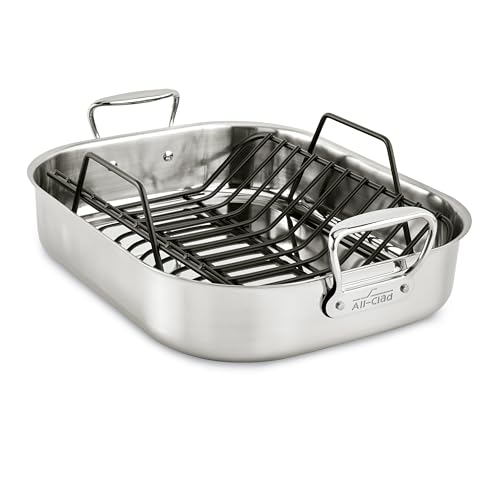
All-Clad Stainless Steel Roaster with Rack
Best for: cooks who roast often and make pan gravy every single time
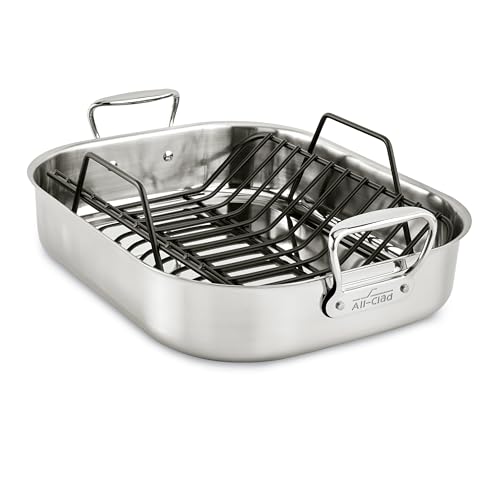
The All-Clad roaster represents the clad stainless archetype at its most complete: a bonded base that behaves calmly across two burners, upright handles that admit a proper mitt grip, and a rack that sits securely for birds yet removes cleanly for vegetable-under roasting. In the oven it browns evenly because the core spreads heat into the corners where juices otherwise scorch, and on the hob it deglazes into gravy without the rocking or hot-spotting that betrays thinner pans. It asks for no special care beyond normal stainless habits, tolerates metal tools, and is built on the assumption that it will still be working in several decades, which is exactly the ownership pattern that makes a premium tier sensible.
Not suited for: anyone who struggles with heavy lifts, since clad stainless plus a large bird is a serious two-handed carry
Tier positioning: premium. Check price on Amazon when listings are linked at publication.

Cuisinart Chef’s Classic Stainless Roaster
Best for: households wanting genuine stainless, hob-friendly roasting without entering the premium tier
The Cuisinart Chef’s Classic roaster is the sensible stainless answer for most kitchens: riveted handles, a fitted rack and a base substantial enough for stovetop gravy in ordinary home conditions. It roasts evenly for birds and joints in the sizes most families actually cook, cleans without drama, and stores more easily than the heaviest premium pans. Its compromises live at the extremes, very large birds and very aggressive two-burner deglazing, where costlier clad pans feel calmer, but for the weekly and holiday pattern of a typical household it covers the brief honestly and has done so, in various production years, for a very long time.
Not suited for: cooks chasing the absolute heaviest base, since this class trades some mass for easier handling and price position
Tier positioning: mid-range. Check price on Amazon when listings are linked at publication.

Calphalon Contemporary Stainless Roaster
Best for: cooks who value a slightly lighter stainless lift and clean, modern handling
The Calphalon Contemporary roaster pairs stainless construction with a noticeably approachable weight, which matters more than specification sheets admit when the pan is loaded and the oven is hot. Its handles are shaped for a confident mitt grip, its rack handles the standard bird-and-vegetables pattern well, and its base is flat and stable enough for straightforward pan sauces and gravy. It sits in the mid-range tier while feeling a step more polished than basic stainless, and for households that roast monthly rather than weekly it may be the sweet spot where performance, handling and tier all agree with each other.
Not suited for: traditionalists who want the maximum possible base weight for marathon gravy sessions
Tier positioning: mid-range. Check price on Amazon when listings are linked at publication.

Le Creuset Signature Enameled Cast Iron Roaster
Best for: roasters who serve at the table and prize the steadiest, gentlest browning of all
The Le Creuset Signature roaster brings enameled cast iron’s famous heat steadiness to the roasting job: once hot, it holds its temperature through door openings and cold vegetable additions, browning with a calm, even hand that thin pans cannot imitate. The enamel releases fond generously for gravy, though the pan belongs on gentler hob heat rather than a fierce blast, and it travels to the table looking like the occasion it is cooking for. Its demands are weight and respect: lift it with two dry mitts and full attention, avoid knocking the enamel, and heat it gradually. Cooks who accept those terms tend to keep this pan for life.
Not suited for: anyone for whom total loaded weight is a concern, because enameled iron is the heaviest lift in this roundup by a clear margin
Tier positioning: premium. Check price on Amazon when listings are linked at publication.
Viking Stainless Steel Roasting Pan
Best for: frequent roasters who want heavy-gauge stainless presence and confident two-burner performance
The Viking roasting pan is built for cooks who like their stainless substantial: a heavy, flat base that sits on the hob like it means it, strong handles that inspire confidence under load, and an interior that takes searing, deglazing and scrubbing in stride. It suits larger roasts and ambitious gravy making, and its rack arrangement handles the classic holiday pattern without flex or drama. As with all premium stainless, the value case depends on frequency; in a kitchen that roasts most weeks, this is a buy-once tool, while occasional roasters will get the same meals from a mid-range pan and a lighter lift.
Not suited for: small households roasting small birds, who may find its scale and weight more pan than the job requires
Tier positioning: premium. Check price on Amazon when listings are linked at publication.
Who Should Buy It, Who Should Skip It
Oven position and preheating shape roasting results more than pan marketing ever will. Roast on the lower-middle rack so the top of the bird clears the upper element with room to spare, and preheat fully, because a pan entering a still-climbing oven starts its work in steam rather than dry heat. If your oven runs hot at the back, rotate the pan once, halfway, using both mitts and a planned landing spot, rather than reaching in repeatedly. Resist opening the door to admire progress; every opening dumps the dry heat that browning depends on. A thermometer you trust, inserted in the thickest part of the thigh without touching bone, tells you more than any timer printed on a chart.
Trussing, seasoning and drying are the quiet techniques that let a good pan show what it can do. Dry skin, salted ahead when time allows, browns faster and crisper in the dry heat a roasting pan provides. Trussing keeps wings and legs tucked so they do not overcook or catch on the rack, and a light coating of oil or butter on the skin encourages even colour. Vegetables underneath should be cut in substantial pieces, because small dice will carbonise in the drippings over a long roast, and they should sit in a single layer where possible so they roast rather than steam. None of this requires talent, only sequence: dry, season, arrange, then let the pan and the oven do the heavy work undisturbed.
Gravy is the roasting pan’s closing argument, so it deserves a method rather than a hope. Pour off all but a spoonful or two of fat, keeping every browned bit, then set the pan over medium heat across two burners if it spans them. Whisk in flour to match the fat and cook the paste until it smells nutty and turns the colour of weak tea. Add warm stock gradually, whisking constantly, scraping the fond loose as the liquid simmers, and let it bubble gently until it coats a spoon. Season at the end, because reduction concentrates salt, and strain only if you dislike rustic texture. Every step happens in the pan, which is precisely the capability you paid for.
Setup, Care and Maintenance Essentials
Storage is the hidden cost nobody photographs. A large roasting pan with upright handles occupies serious cupboard volume, and if it nests with nothing and blocks the pans you use daily, it will generate low-level resentment fifty weeks a year. Measure the shelf or drawer before you buy, consider whether the rack stores inside the pan, and think about whether the pan can double as a baking dish for big gratins, a water bath for cheesecakes or a serving vessel for a crowd-sized salad in summer. Pans that earn secondary jobs survive cupboard purges; single-purpose giants survive only if the roasts they produce are genuinely memorable, which is a fair standard to hold them to.
The honest alternative to a dedicated roaster deserves respect. A rimmed sheet pan with a wire rack handles a spatchcocked chicken, a rack of lamb or a modest turkey breast perfectly well, and a disposable foil pan, doubled for strength and set on a sheet pan for support, covers the once-a-year whole bird with zero washing up. Plenty of excellent roasts have come off both. What a dedicated pan adds is depth for vegetables and juices, hob-worthy gravy making, stability under heavy loads and a tool that improves with familiarity. Whether that addition matters depends entirely on how often you roast large things and how much you care about gravy, which is why this category rewards honesty about your own habits more than almost any other.
Buying used or inheriting a roasting pan is one of the smartest routes into this category, because good roasters are nearly indestructible and the secondhand market is full of heavy stainless and enameled pans from households that roasted less than they expected. Inspect for a flat base that does not rock, handles with no play, enamel without cracks that reach the iron, and racks that sit level. Avoid warped pans, because warping only worsens under hob heat, and avoid damaged nonstick, which cannot be restored. A sound used pan, cleaned thoroughly and put straight to work, delivers most of the value of a new premium pan, and its first roast in your kitchen continues a working life that may already span decades.
Final Verdict
Buy the heaviest pan you can lift with total confidence, in the material whose temperament matches your cooking, sized for the roasts you actually make. That sentence, unfashionable as it is, outperforms every ranking we could print, because roasting pans are bought for decades and used at the most demanding moments of the cooking year. Choose on base, handles and fit, rehearse the safety routine before the first big bird, and the pan will repay you at every roast thereafter.
Field Notes From Our Reviewing
Buying used or inheriting a roasting pan is one of the smartest routes into this category, because good roasters are nearly indestructible and the secondhand market is full of heavy stainless and enameled pans from households that roasted less than they expected. Inspect for a flat base that does not rock, handles with no play, enamel without cracks that reach the iron, and racks that sit level. Avoid warped pans, because warping only worsens under hob heat, and avoid damaged nonstick, which cannot be restored. A sound used pan, cleaned thoroughly and put straight to work, delivers most of the value of a new premium pan, and its first roast in your kitchen continues a working life that may already span decades.
Oven position and preheating shape roasting results more than pan marketing ever will. Roast on the lower-middle rack so the top of the bird clears the upper element with room to spare, and preheat fully, because a pan entering a still-climbing oven starts its work in steam rather than dry heat. If your oven runs hot at the back, rotate the pan once, halfway, using both mitts and a planned landing spot, rather than reaching in repeatedly. Resist opening the door to admire progress; every opening dumps the dry heat that browning depends on. A thermometer you trust, inserted in the thickest part of the thigh without touching bone, tells you more than any timer printed on a chart.
Field Notes From Our Reviewing
Trussing, seasoning and drying are the quiet techniques that let a good pan show what it can do. Dry skin, salted ahead when time allows, browns faster and crisper in the dry heat a roasting pan provides. Trussing keeps wings and legs tucked so they do not overcook or catch on the rack, and a light coating of oil or butter on the skin encourages even colour. Vegetables underneath should be cut in substantial pieces, because small dice will carbonise in the drippings over a long roast, and they should sit in a single layer where possible so they roast rather than steam. None of this requires talent, only sequence: dry, season, arrange, then let the pan and the oven do the heavy work undisturbed.
Gravy is the roasting pan’s closing argument, so it deserves a method rather than a hope. Pour off all but a spoonful or two of fat, keeping every browned bit, then set the pan over medium heat across two burners if it spans them. Whisk in flour to match the fat and cook the paste until it smells nutty and turns the colour of weak tea. Add warm stock gradually, whisking constantly, scraping the fond loose as the liquid simmers, and let it bubble gently until it coats a spoon. Season at the end, because reduction concentrates salt, and strain only if you dislike rustic texture. Every step happens in the pan, which is precisely the capability you paid for.
Field Notes From Our Reviewing
A roasting pan also works far beyond whole birds. It is the natural vessel for a bone-in pork shoulder, a leg of lamb, a whole side of salmon for a crowd, layered potatoes for a gratin at scale, and a double batch of roasted vegetables when family descends. In summer it becomes a marinating tray and a serving platter; in baking season it is the water bath that keeps cheesecakes and custards gentle. This second life matters to the value calculation, because a pan used monthly across several jobs justifies its shelf space in a way a pan used twice a year cannot. When you evaluate any roaster, list the jobs you would actually give it beyond the holiday bird before you decide what it is worth to you.
Longevity separates the roasting pan market into two honest halves. Clad stainless and enameled cast iron pans are effectively permanent: they survive decades, tolerate repairs, and often carry warranties measured in lifetimes rather than seasons. Coated aluminium pans are consumables by comparison, delivering excellent service for a period of years before the coating tires, at which point the pan is done. Neither model is dishonest, but they should be priced and judged differently in your head. Paying a premium tier for permanence is rational if you roast weekly; paying it for a pan that roasts twice a year is sentiment, and the mid-range pan plus a good thermometer will serve that household better.
Field Notes From Our Reviewing
Finally, judge a roasting pan by the cook you are, not the cook in the advertisement. If you roast for two on Sundays, a smaller pan that heats evenly and cleans easily will delight you weekly. If you host the big family meal every year, capacity, handles and hob performance become the whole decision. If mobility or grip strength is a consideration, weight outranks every other specification, and a lighter pan you can lift confidently is safer and better than a heavier pan with superior metallurgy. The best roaster is the one that comes out of the cupboard without negotiation, goes into the oven without anxiety and comes to the table, one way or another, having made the meal calmer as well as better.
A roasting pan earns its place in the oven through geometry as much as through metal. The low, straight sides let hot air wash over the surface of a bird or a joint instead of steaming it, which is why vegetables tucked underneath caramelise rather than stew. A pan that is too deep behaves like a braiser and traps moisture against the skin, while a pan that is too shallow lets juices run to the corners and scorch before they can become gravy. When you judge any roaster, picture the food sitting in it with air moving freely on every side, and picture the pan moving from oven to hob without flexing, because that journey, repeated over years of Sunday roasts and holiday birds, is where cheap pans quietly fail and good pans quietly justify themselves.
Field Notes From Our Reviewing
Weight is the first safety fact of roasting, and it arrives before flavour ever does. A large bird, its stuffing, the vegetables underneath and the pan itself add up to a load that surprises people the first time they lift it with oven mitts on. Always use two dry mitts, because a damp mitt conducts heat almost instantly, and always clear the landing space before you open the oven door, so the pan travels a short, planned distance to a trivet or a cool hob rather than hovering while you hunt for room. Bend your knees and lift with your legs, keep the pan level so hot fat does not slosh toward one handle, and never carry a resting bird separately across the kitchen when it can rest safely in the pan where it roasted.
Hot fat changes how you move around a roasting pan. Drippings splatter during basting and again during transfer, and they land on skin, on the hob and on the floor where they become a slip hazard as well as a burn risk. Work with a long-handled baster or a spoon held low over the pan, tilt the bird inside the pan to drain its cavity juices back into the roasting juices rather than lifting it dripping over the counter, and wipe any spill on the floor straight away. If you pour juices into a jug for gravy, pour away from your body, slowly, with the pan steadied by a second mitt on the far handle, and let the pan cool on the hob before it goes anywhere near the sink.
Field Notes From Our Reviewing
The rack question divides roasting cooks more than almost any other. A rack lifts the bird so air circulates underneath and the bottom does not sit in its own juices, which helps the skin and keeps the underside from braising. The counterargument is just as real: vegetables roasted directly under a bird, with no rack, bathe in the drippings and become the best part of the meal for many households. Neither answer is wrong, and a good roasting pan supports both styles, with a rack that sits securely when you want it and removes cleanly when you do not. What matters is that the rack handles do not foul the oven walls and that the whole assembly still slides in and out without tipping.
Stovetop performance is where a roasting pan stops being a tray and becomes a gravy-making tool. The moment the bird comes out to rest, the pan holds browned fond, rendered fat and roasting juices that are the entire foundation of a proper pan gravy. A pan with a thick, flat base sits steadily on the hob, heats evenly across two burners and lets you deglaze without hot spots scorching the flour. Thin bases warp under that direct heat, rock on the burner and brown the roux in patches. If you make gravy even a few times a year, judge roasters by their bases as much as by their oven manners, because the last ten minutes at the hob decide whether the meal tastes finished.
Field Notes From Our Reviewing
Handles decide whether a heavy pan feels manageable or frightening. Look for handles that rise enough to admit a mitt-clad hand without your knuckles brushing the pan wall, that are riveted or welded with no play, and that angle so the load hangs naturally from your wrists rather than twisting them. Upright loop handles suit most cooks because they keep hands above the rim and away from the heat radiating off the sides. On a loaded pan, test your grip mentally at the worst moment: oven door open, heat rolling out, pan at its heaviest. If the handles would force a pinched, fingertips-only hold, the pan will feel unsafe no matter how beautifully it roasts, and you will dread using it.
Sizing a roasting pan is an exercise in honest measurement. Measure your oven interior, not the door opening, and leave clearance on every side for air and for your mitts. Then measure what you actually cook: a pan that swallows your largest holiday bird with room for vegetables is the right anchor size, while a pan bought for a once-a-decade giant roast will crowd your oven and your cupboard the rest of the year. Remember that manufacturers measure pans differently, sometimes at the rim and sometimes at the base, so compare cooking-surface dimensions where you can. A pan that fits your oven, your biggest regular roast and your storage shelf beats a theoretically perfect pan that fails any one of those three tests.
Field Notes From Our Reviewing
Stainless steel remains the default roasting material for good reasons. It tolerates high oven heat, moves to the hob without complaint, shrugs off metal utensils, deglazes cleanly and shows fond clearly because its pale surface contrasts with browning. Its weaknesses are equally predictable: food can stick during the first minutes of searing, and a single-ply pan heats unevenly. That is why better stainless roasters bond an aluminium or copper core through the base, spreading heat so juices reduce evenly instead of burning in the middle. Stainless also cleans without ceremony, surviving soaking, scrubbing and the dishwasher, which matters on the evenings when the roast was wonderful and the washing up is not.
Enameled cast iron roasts with a completely different temperament. The heavy core holds heat so steadily that oven temperature swings barely register, and the enamel surface releases fond beautifully for gravy while looking handsome enough to carry the meal’s centrepiece to the table. The trade-offs are weight and care. A loaded enameled roaster is the heaviest lift in this category, enamel can chip if knocked against oven racks or dropped utensils, and the pan asks to be heated gradually rather than blasted from cold onto fierce direct heat. Cooks who roast often, serve at the table and value even heat above easy lifting tend to love these pans for decades, because nothing else browns quite so calmly.
Roasting Pan: What Long-Term Use Reveals That a First Test Misses
Start with how a {p} holds up once the novelty wears off and routines settle in. Most coverage of a roasting pan concentrates on the first week of ownership, yet the decisions that matter most tend to surface later, once the roasting pan has to earn its place in an ordinary weekday routine rather than a carefully staged first attempt. Write down the three jobs you expect it to do most often, in the order you actually do them, and judge every claim you read against that short personal list instead of against a generic ideal.
Finally, plan the first fortnight deliberately. Use the roasting pan for one familiar job first, so you have a baseline you trust, then introduce the harder cases one at a time and note what changes. Small adjustments to arrangement, timing, quantity or preparation usually close most of the gap between disappointing first results and the performance the design is capable of. That short learning period is also the fairest test of long-term ownership: if the routine has not settled by the end of it, the mismatch is real, and it is better to know while returning or exchanging is still straightforward.
Use a short decision checklist to finish. One, does it fit the space and the storage you really have. Two, does it handle your three most common jobs without a workaround. Three, do the edge cases you listed stay manageable. Four, can every wear part be cleaned or replaced without drama. Five, would you still choose it if a friend described the same drawbacks in their own kitchen. A roasting pan that passes all five is a sound buy; one that fails two or more is a compromise you are choosing with open eyes, which is a very different thing from being surprised later.
When you check listings such as All-Clad Stainless Steel Roaster with Rack, Cuisinart Chef’s Classic Stainless Roaster and Calphalon Contemporary Stainless Roaster, use them as worked examples: run through the same checks below on each one in turn, so the comparison stays honest and like for like rather than based on whichever listing happens to shout loudest.
Maintenance decides how long the good results last. Set a simple rhythm: a quick wipe or rinse after each use, a deeper clean on a fixed day, and a periodic check of the parts that move, seal or bear weight. A roasting pan that needs fiddly disassembly for basic care will be cleaned less often, and performance drifts long before anything actually breaks. Prefer designs where the parts that get dirtiest are the parts that are easiest to reach, and be honest with yourself about which cleaning steps you will genuinely keep up.
Measure before you commit. Note the footprint, the clearance above and behind the spot where the roasting pan will live, and the route you will carry it by when it is hot, full or awkward. A roasting pan that technically fits but blocks a cupboard door, crowds a neighbouring appliance or has to be dragged across a worktop every time will quietly fall out of use, whatever its merits on paper. In the Kitchen Cookware category especially, a few centimetres of clearance and a sensible storage plan separate a daily tool from a bulky regret.
Frequently Asked Questions
What makes a roasting pan good in a review sense?
Four things, in order: a flat, substantial base that heats evenly in the oven and behaves calmly on the hob for gravy; handles that admit a mitt-clad grip and inspire confidence under a full load; low sides that let dry air brown the food; and construction that stays rigid and flat for years. Everything else, looks, brand, included extras, is secondary. A pan that nails those four will review well in any kitchen, and a pan that misses the first two will disappoint however handsome it is.
Is a stainless roasting pan better than an enameled one?
Neither is better outright; they suit different cooks. Stainless is lighter for its strength, shows fond clearly, tolerates any utensil and cleaning method, and suits frequent roasting and assertive deglazing. Enameled cast iron heats with greater steadiness, browns with unusual calm and serves at the table beautifully, at the cost of the heaviest lift and gentler handling rules. Our review conclusion is to choose by lift comfort and serving habits, then stop second-guessing, because both materials produce superb roasts.
How do I test a roasting pan at home?
Roast a whole chicken on a bed of root vegetables, the category’s fairest examination. Watch whether the skin browns evenly, whether juices stay contained, and whether the pan sits flat. Then rest the bird in the pan, move the pan to the hob with two dry mitts and a cleared landing space, and make gravy: the deglaze will reveal base quality faster than any specification. Finally, wash it. A pan that passes cooking, gravy and cleaning in one meal has told you nearly everything.
Why does my roasting pan warp on the hob?
Usually because a thin base meets uneven or fierce heat, or because a very hot pan meets cold liquid or cold water. Choose burners the pan genuinely spans, heat it with the gravy contents in it rather than empty and blazing, deglaze with warm stock, and let it cool a little before washing. A pan that has warped slightly may still roast acceptably, but it will rock during whisking, which is both annoying and less safe with hot fat, so prevention beats tolerance here.
Should a first roasting pan include a rack?
Yes, if the rack fits well, because it gives you both roasting styles from day one: bird elevated for all-over crispness, or bird removed from the rack and settled onto vegetables when dripping-fed vegetables are the point. Check that the rack sits level, lifts out without drama and stores inside the pan. A badly fitting rack, by contrast, is worse than none, since it can tip at the exact moment a hot, heavy bird is being moved.
How long should a good roasting pan last?
A bare stainless or enameled cast iron roaster should last decades, effectively as long as you cook, and secondhand examples in sound condition are a legitimate way to buy in. Coated aluminium pans should be judged on a horizon of years, after which the surface, not the structure, ends the pan’s service. Reviewing value therefore means dividing tier by realistic years of use in your kitchen, which is why frequent roasters can justify premium pans that occasional roasters cannot.