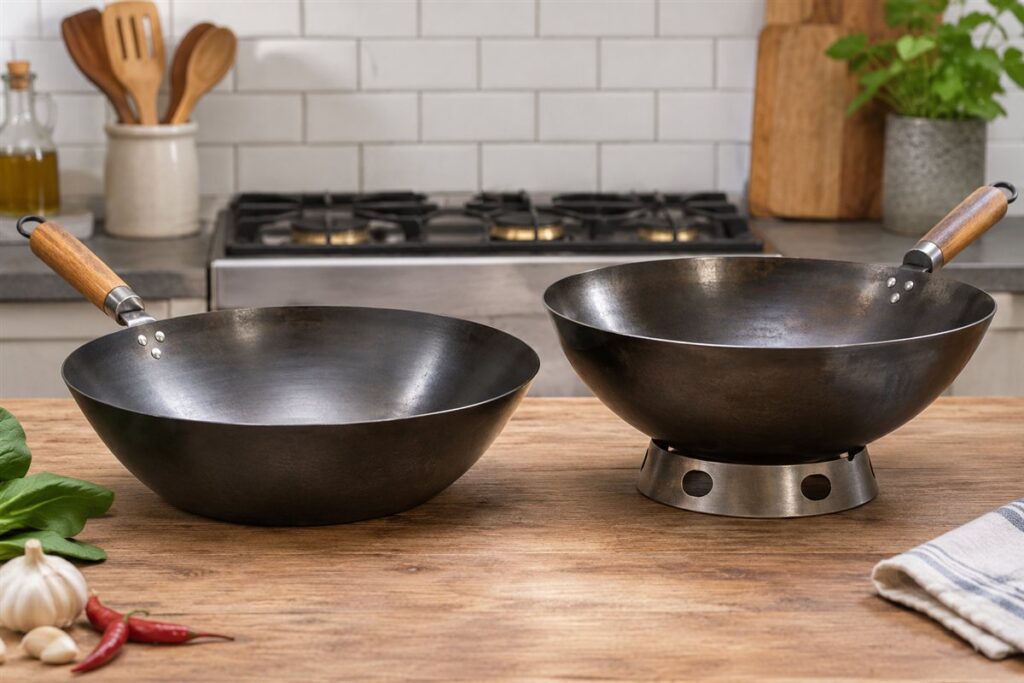
A flat bottom wok sits steadily on most home stoves, especially electric and induction, while a round bottom wok works best on a gas burner with a supporting ring. The better choice depends on your cooktop more than on your cooking skill.
How the Shapes Differ
A round bottom wok has a deep, curved bowl. Heat concentrates in the center, and food moves up the sides to cooler zones, which gives you control when stir frying. A flat bottom wok has a small flat base with sloped walls. It contacts the burner more fully, but the hottest area is smaller than the base on a strong flame.
Match the Wok to Your Stove
| Cooktop | Better Fit | Why |
|---|---|---|
| Gas with a wok ring | Round bottom | Flame wraps around the bowl |
| Gas without a ring | Flat bottom | Stable on standard grates |
| Electric coil or smooth top | Flat bottom | Needs contact with the surface |
| Induction | Flat bottom, or a specially shaped induction wok | Needs a magnetic base that touches the glass |
Never rock a round wok on a flat glass surface, and check the maker’s guide for cooktop compatibility.
Handles, Weight and Material
- Long handle: Easier to toss food and keeps your hand away from heat.
- Two loop handles: Common on traditional woks and easier to lift, but they get hot.
- Carbon steel: Light, responsive and develops seasoning over time.
- Cast iron: Heavy, holds heat well and is slow to react.
- Nonstick coated: Easy for beginners at lower heat but less suited to very high heat.
Tips for Using Either Type
- Cut all ingredients before you heat the wok, since cooking goes quickly.
- Preheat the wok until hot, then add oil with a high smoke tolerance.
- Cook in small batches so food browns rather than steams.
- Keep a lid and a splatter screen close by.
Hot oil can burn and flare. Keep the area clear, never leave the stove unattended, and follow the maker’s manual and safety instructions.
Seasoning and care depend on the material. Carbon steel and cast iron woks need seasoning, a thin baked-on oil layer, and should be dried right after washing. Nonstick woks need soft utensils and moderate heat. Stainless woks can handle metal tools but need good preheating and oil. A wok with a helper handle makes lifting easier when the pan is full, while a wok with a tall lid can double as a steamer or braising pot when paired with a rack. Choose the features that match what you cook.
Choosing Wok Size and Depth
Shape is only part of the decision. Size and depth control how much food you can cook at once, how easily you can toss it and how well the wok fits your stove and storage.
- Smaller woks: Easier to lift and store, and suitable for one or two people. They fill up quickly, so larger meals have to be cooked in batches.
- Medium woks: A common choice for households of several people. They give enough room to stir and toss without overcrowding.
- Larger woks: Handy for big batches, but heavy and awkward on small burners. They may not fit in a standard cabinet or sink.
- Deeper bowls: Keep splashes in and allow more room for tossing, and they can double for steaming, braising or shallow frying.
- Shallower woks: Easier to reach into and lighter, but food can fly out more easily.
Choose a size that matches your burner. A wok that is much larger than the heat source will have a cool outer area, which can leave food undercooked at the edges. A wok that is very small can feel cramped and encourage steaming rather than searing.
Check the capacity and the diameter as listed by the maker. Diameters are often measured across the top rim, and the cooking surface is smaller. If you share the kitchen with others, think about who will lift and clean it. A wok you can handle comfortably will get more use than a larger one that stays in the cabinet.
Handle Styles and Lifting
Handles affect safety, control and storage, and the right style depends on how you cook. A wok is often lifted, tilted and shaken, so the handle design needs attention.
- Single long handle: Gives leverage for tossing and keeps your hand away from heat. It takes more space in a cabinet and can be awkward if the wok is heavy.
- Long handle plus helper handle: A small loop opposite the main handle makes lifting a full wok easier. This is useful for larger sizes.
- Two loop handles: Traditional and good for stable lifting. They stay close to the wok and are easy to store, but they get hot and call for mitts.
- Wood, metal or heat-resistant plastic: Wood stays cooler but may need gentle care. Metal handles are durable but can get hot. Check the maker’s guidance on whether the handle is oven safe.
- Attachment: Riveted handles are usually sturdy. Check that any handle is secure and does not wobble.
If you plan to toss food a lot, a wok with a long handle is more comfortable. If you mainly stir with a spatula, loop handles or a helper handle may be enough.
Try to judge weight by reading the listing or comparing similar pieces. A wok that feels balanced when empty can feel very different when full of food and hot oil. Keep that in mind when choosing a handle style, and make sure you have a clear space and a heat-safe place to set it down.
Seasoning and Cleaning by Material
Care routines differ by material, and getting them right helps the wok last and perform. Follow the maker’s instructions for the specific product, since finishes vary.
- Carbon steel and cast iron: These develop a seasoned layer, a thin film of baked-on oil that improves release and protects against rust. Many makers recommend an initial seasoning, then maintenance after use. Wash gently, avoid long soaking and dry right away, then apply a very thin coat of oil if the maker advises it.
- Nonstick: Wash with a soft sponge, avoid metal tools and avoid extreme heat. Let it cool before washing.
- Stainless steel: Needs good preheating and enough oil to reduce sticking. Cleans easily with warm soapy water, and stubborn marks may need soaking.
- Enameled: The coating can chip if hit or overheated. Use soft tools and follow the care guide.
Rust is the main risk for seasoned metal woks. If you see rust, follow the maker’s recommended process for removal and re-seasoning, or contact their support. A wok that has been left wet for a long time may need a more thorough restoration.
Smoke and odor can occur during seasoning, so ventilate the kitchen and keep the area clear. Also avoid seasoning methods that the maker does not recommend, particularly with coated or enameled pans, since heat can damage them.
Store your wok dry, with a paper towel or cloth between it and other cookware if stacking, to protect the surface.
Safe Heat and Oil Handling
Wok cooking uses high heat, which makes it fast and flavorful, but also calls for good habits. Oil can smoke, flare or splatter, and a heavy wok can be hard to control if you rush.
- Prepare everything before you heat the wok, including sauces and chopped ingredients, so you can add them quickly.
- Choose oil with a high smoke tolerance, and use only as much as needed.
- Heat the wok until it is hot, then add oil. If the oil smokes heavily, lower the heat.
- Add ingredients in small batches to avoid cooling the wok.
- Keep wet food away from hot oil as much as possible. Pat ingredients dry, since water can spit.
- Have a lid nearby. If oil catches fire, do not use water. Turn off the heat and cover with a lid if it is safe to do so, and follow your local safety guidance.
Ventilation is worth thinking about. Run your range hood, open a window if you can and keep the area clear of items that could catch fire, such as towels and paper. Wear sleeves that will not hang over the burner, and keep children and pets away.
On gas, adjust the flame so it does not lick up the sides of a thin wok handle. On electric and induction, allow time for the wok to heat since response varies. The wok should be stable on its burner and your cooktop should be rated for the load. Always follow the maker’s manual and safety instructions.
Accessories Worth Considering
A few add-ons can improve your wok experience, though none is essential. Think about which ones solve a real problem for you before buying.
- Wok ring or stand: Holds a round-bottom wok steady on a gas burner. Check that it suits your grates and that it allows enough airflow for the flame. Do not use it on a flat glass surface unless the maker says it is suitable.
- Lid: Useful for steaming, braising and containing splatter. A domed lid fits many woks, but check that it matches your wok size.
- Spatula or ladle: A long tool with a heat-resistant handle keeps your hand away from heat. Match the tool material to the wok surface, using wood, silicone or nylon for coated pans and metal for bare steel or stainless as advised.
- Steaming rack: Sits inside the wok and lets you steam food above shallow water.
- Cooling rack or draining rack: Hooks onto the rim and holds fried food while the oil drips off.
- Splatter guard: Reduces mess when frying.
Make sure any accessory fits your wok’s diameter and depth. Rings and racks vary, and what works for one wok may not fit another. Read the listing for compatible sizes, and check how the accessory stores.
You do not need everything at once. Start with the wok and a good spatula, then add accessories as you find a need. Signs it is time to replace a wok include a warped base, a failing coating, deep rust that will not clean off and loose handles.
FAQ
Can I use a round wok on an electric stove?
Not well. It will wobble and heat unevenly, so choose a flat bottom.
What size is common?
Home woks often come in diameters around 12 to 14 inches, though makers vary.
Do I need to season a new wok?
Carbon steel and cast iron woks usually need seasoning, and the maker will typically give instructions. Nonstick and many coated woks do not need it, so check the guide for your product.
Can I use metal utensils in my wok?
On bare carbon steel, cast iron or stainless, metal tools are generally fine. On nonstick or enameled woks, use wood, silicone or nylon to protect the surface.
Why does food stick in my wok?
Common causes include a wok that is not hot enough, too little oil, wet ingredients or overcrowding. Preheat properly, pat food dry and cook in smaller batches.
Is a lid necessary?
Not for stir-frying, but it helps with steaming, braising and reducing splatter. Make sure it fits your wok before you buy.
Can I wash a carbon steel wok with soap?
Many makers say mild soap is fine if you dry the wok promptly and re-oil it if recommended. Check your wok's care instructions.
How do I stop a round-bottom wok from tipping?
Use a ring or stand designed for it on a gas burner, and make sure the grates are stable. If your stove is flat, a flat-bottom wok is a safer choice.
The Short Version
Round bottom is for gas with a ring, flat bottom is for almost everything else. Match the shape to the burner first.