Disclosure: As an Amazon Associate, topratedkitchenware.com earns from qualifying purchases. Links to Amazon on this page are affiliate links; they cost you nothing extra. Listing details such as price and availability change often, so check the current Amazon listing before you buy.
A portable water cooler solves a different problem from the tall dispensers you see in offices. It has to be carried, loaded into a trunk, set on a tailgate or tucked into a closet, and it should still pour a cup of cold water without a power cord. When people search for the best portable water coolers, they usually mean one of two things: an insulated jug with a spigot, or a small tabletop dispenser that can move from room to room. We cover both kinds here.
The list suits campers, coaches, gardeners, tradespeople, event volunteers and renters who have very little floor space. You will get a comparison table, six portable options from Igloo, Reliance and Avanti, notes on how we chose them, and practical advice on size, handles, spigots and cleaning. Remember that all details come from maker and retailer listings, so verify the exact model on the page you buy from.
In this guide
Quick Picks
- Igloo 42316 Five Gallon Seat Top Water Jug
- Igloo 11863 Yellow Five Gallon Water Jug with Cup Dispenser
- Igloo 451 Five Gallon Insulated Beverage Dispenser
- Igloo 00042051 Five Gallon Green Turf Series Dispenser
- Reliance Products Water-Pak 8820-03 Five Gallon Container
- Avanti WD30EC Table Top Water Dispenser
Quick Comparison
| Product | Best for | Main point | Link |
|---|---|---|---|
| Igloo 42316 | Sports fields and work crews | Seat top jug with cup bracket | Check on Amazon |
| Igloo 11863 | Job sites needing cup access | Yellow cooler with cup dispenser | Check on Amazon |
| Igloo 00000451 | Simple loading and carrying | Insulated 5 gallon beverage dispenser | Check on Amazon |
| Igloo 00042051 Turf | Tailgates and team events | Green Turf Series jug | Check on Amazon |
| Reliance 8820-03 | Camp kitchens and emergency kits | Stackable jug, hideaway spout | Check on Amazon |
| Avanti WD30EC | Small rooms and rentals | Tabletop plug-in dispenser | Avanti WD30EC Table Top Water Dispenser |
How These Options Were Chosen
We have not carried, filled or dropped any of these products. The list is built from manufacturer descriptions, retailer pages and published dimensions. We favored widely known brands, model codes that appear consistently across several sellers, and designs with a clear way to pour, such as a push button or hideaway spout.
Five of the six are passive jugs that use no electricity. We added one plug-in tabletop dispenser because a portable cooler for many readers means a small unit they can move between a kitchen and a bedroom, not a jug for the outdoors.
6 Best Portable Water Coolers for Travel and Home
Igloo 42316 Five Gallon Seat Top Water Jug
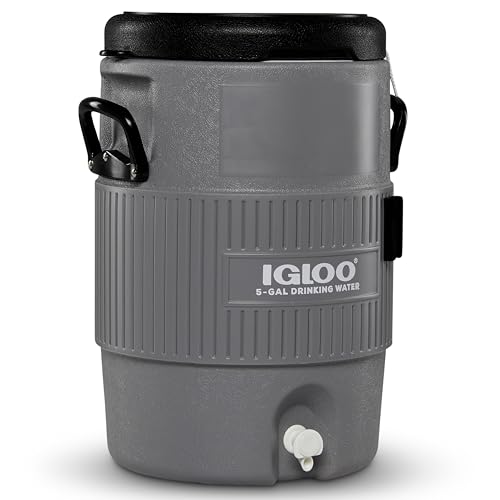
The orange seat top jug from Igloo is a recognizable sight beside sports fields and construction trailers. Retail listings describe a five gallon capacity, a lid that doubles as a seat, a recessed spigot that is angled to resist drips, and a bracket for a cup dispenser.
It is a sturdy option for anyone who needs to serve several people from one container. The angled spigot means you can fill a bottle without lifting the whole cooler, and the flat lid gives a place to sit during a break.
On the downside, a full five gallon container is heavy, so it is better for car or truck transport than for a long walk. Do not sit on it unless the maker says the lid is designed for it. Skip it for solo hikers.
Igloo 11863 Yellow Five Gallon Water Jug with Cup Dispenser
Where the orange jug is a team staple, the yellow and red model 11863 is closer to a workplace staple. The listing describes a push button spigot and a cup dispenser, which is a handy combination for crews who share one container and want to avoid passing bottles around.
Think of it as the practical choice for a garage, workshop or farm stand. The push button is easy to operate with gloves, and the plastic body is simple to wipe down. If you expect to put it in a pickup bed, add a strap to hold it steady.
The trade-off is that it is a plain jug. It will not chill water without ice, and you must add ice yourself. Look elsewhere if you want a plug-in dispenser.
Igloo 451 Five Gallon Insulated Beverage Dispenser
Listed under the code 00000451, this yellow Igloo is described by sellers as a five gallon polyethylene beverage dispenser with insulation. It sits near the simpler end of the Igloo range and attracts buyers who want a basic jug with few extras.
Because it has fewer accessories than the cup dispenser versions, it works well as a spare. Keep one in a vehicle for the days when the main cooler is being cleaned, or give it to a volunteer team that only needs a dependable spigot.
It is not the best match for people who want a built in cup holder or a seat. The tap style also differs from the push button version, so check the listing photos for what you are actually getting.
Igloo 00042051 Five Gallon Green Turf Series Dispenser
The Turf Series jug is the one with team colors in mind. The listing gives a width of about 13 inches and a height of just over 20 inches, with a built in mount for a cup dispenser. Those measurements help when you are planning space in a trunk or a locker room.
Its main appeal is appearance. Where youth teams, clubs and tailgaters want a cooler that matches their gear, the green finish does the job. The jug itself works in the same manner as the other Igloo models here.
Think about how you will move it. A full container is heavy and the body can be awkward to grip when wet. If looks do not matter, a plainer jug can cost less, so compare listings before choosing.
Reliance Products Water-Pak 8820-03 Five Gallon Container
The Reliance Water-Pak is a different type of portable container. Listings describe it as stackable, with a secondary swivel handle that helps you pour and a hideaway spout that serves as an on and off valve. It is the kind of container you see in camping aisles.
It suits storage as well as travel. You can stack several in a closet or a car, and the hideaway spout reduces the number of loose parts you must carry. For a camp kitchen it is a quiet, lightweight workhorse.
It is not insulated, so water will warm up in the sun, and it has no cup holder or seat. Choose it for hauling and storing, and pair it with a cooler bag if you want cold drinks.
Avanti WD30EC Table Top Water Dispenser
Not every portable cooler goes outdoors. The Avanti WD30EC is a compact tabletop dispenser that you can carry from the counter to a bedside table or a dorm shelf. Retailers describe it as thermoelectric, which keeps the cabinet small and calm.
It makes sense for renters and students, who often move and cannot fit a floor standing cabinet. Plug it into a household outlet and place it on a stable surface, away from direct sun.
The limit is capacity and cooling strength. It is not meant for crowds, and it needs power, so it is no use on a trail. Check the listing for the exact temperature options and bottle size before buying.
Avanti WD30EC Table Top Water Dispenser
Best for Camping Trips
The Reliance Water-Pak 8820-03 is easy to stack and pour, and does not demand much space in a packed car. Add a separate cooler for cold drinks.
Best for Team Sports
The Igloo 42316 and the Turf Series 00042051 both include a spot for cups, which speeds up a crowd at half time. Choose by color and by how you plan to carry it.
Best for Work Crews
The Igloo 11863 offers a push button spigot that works with gloves. Strap it down in a truck bed to keep it from tipping.
Best for Small Apartments
The Avanti WD30EC takes little space and moves easily. It is the only electric model on the page.
How to Choose a Portable Water Cooler
Weight is the first issue. Water weighs about eight pounds per gallon, so a full five gallon jug is roughly forty pounds before you count the container itself. If you cannot lift that comfortably, look for a smaller size, or fill the jug partway after you arrive.
The spigot comes next. A recessed push button is easy to use and less likely to break. A hideaway spout takes up less room but can be slower. Look at user comments for drips, and carry a spare spigot if the model uses a replaceable one.
Think about insulation. An insulated jug slows warming, but it does not make cold water without ice. If you want chilled drinks, plan to add ice or to fill with cold water. A non-insulated jug is lighter and often easier to clean.
Consider the cup question. Built in cup brackets are handy for groups, though many people prefer to refill bottles. Pick the model that matches how people will actually drink.
Pay attention to the opening as well. A wide fill opening makes it easy to pour in water from a tap or a bucket, and to reach inside with a brush when it is time to clean. A narrow neck is harder to scrub, so it rewards frequent rinsing. Lids that seal firmly are worth more than they seem, because a loose lid lets dust and bugs into a jug that sits at a campsite.
Finally, check the footprint. A square or tall body packs differently from a round one, so measure the trunk or closet space. Handles matter too: a wide, molded handle is far easier to grip than a thin loop.
Installation, Safety and Legal Notes
Passive jugs need no installation, but read the maker’s instructions before first use. Lift with your legs, not your back, or ask for help with a full container. Fasten it in a vehicle so it cannot roll. For the plug-in Avanti, follow the manual, use a suitable grounded outlet and leave room around the vents. If you serve water to the public at an event, check local rules for food and drink service.
Care and Troubleshooting
Empty and rinse the jug after each trip, and let it dry with the lid off. Wash the spigot and cup bracket with mild soap and warm water, following the manual.
| Issue | What to try |
|---|---|
| Spigot drips | Reseat the spigot, check the washer, replace if worn |
| Musty smell | Wash and dry fully, store with the lid ajar |
| Slow flow | Open the vent or loosen the lid slightly |
| Tipping in a vehicle | Use a strap or wedge it in a crate |
Reading a Portable Cooler Listing Closely
Portable water coolers look alike in photos, but the details on the page separate a good fit from a disappointing one. Take a minute to check a few lines before you add anything to your cart.
- Capacity: most jugs in this category hold five gallons, but a few table top units use a different bottle size. Confirm what the container holds and what the dispenser accepts.
- Dimensions and weight: a listing should give height and diameter. A full jug is heavy, so think about how you will lift and carry it.
- Insulation: insulated bodies slow temperature change, but they do not work like a refrigerator unless the listing clearly says it is powered.
- Spigot type: push button, lever and cup dispenser designs all behave differently. Look for a note about whether the spigot can be removed for cleaning.
- Lid and top: a wide opening is easier to fill and clean, while a seat top adds a sturdy lid.
- Material notes: check what the maker says about food contact, cleaning agents and temperature limits.
When a listing leaves out a detail you need, the maker’s product page or manual usually fills the gap. Customer photos can also show scale next to a person or a car trunk, which helps more than a number alone.
Comparing Insulated Jugs With a Table Top Dispenser
Two broad styles appear in this category, and each solves a different problem. The table below sets out how they tend to differ.
| Feature | Insulated jug style | Table top dispenser |
|---|---|---|
| Where it works | Outdoors, job sites, trips | Indoors on a counter or desk |
| Power | None needed | Often needs an outlet for cooling or heating |
| Movement | Easy to carry and load into a vehicle | Meant to stay in one spot |
| Cleaning | Wide opening is simple to reach by hand | Internal parts may need the maker’s guidance |
| Temperature | Holds chill with ice, within limits | May actively cool, depending on the model |
If you are loading a truck for a work crew or a car for a weekend, the jug style tends to suit better. If you want a small station in an apartment or an office, a table top unit may fit your space more neatly. Read the maker’s notes about power, bottle type and placement before you decide.
Common Mistakes With Portable Water Coolers
Most disappointments come from simple oversights, and a little planning avoids them.
Forgetting how heavy it gets
Water is heavy, and a full jug is awkward to carry upstairs or over rough ground. Fill it where it will be used, or use a trolley when you must move it.
Expecting ice-cold water without ice
An insulated body slows warming but does not create cold. Begin with chilled water or add ice if you want a cool drink for hours.
Leaving water sitting for weeks
Standing water in a closed jug can pick up odors or growth. Empty, clean and dry the cooler between uses, following the maker’s directions.
Using harsh cleaners without checking
Some chemicals can damage plastic or leave residue. Stick to the cleaning methods the maker recommends, and rinse thoroughly.
Setting it on an uneven surface
A tall, full jug on a wobbly spot can tip. Choose level ground and keep it out of the way of foot traffic.
Choosing by Situation
The same cooler does not suit every setting, so think about where you will use it most often.
For camping and road trips
Look for a sturdy handle, a lid that stays put during transport and a spigot that will not snag on a bag. A seat top is handy at a campsite.
For team sports and field days
A cup dispenser or a push button spigot lets many people serve themselves quickly. Choose a model that is stable on grass or gravel.
For work crews
Industrial style jugs often have a rugged body and an easy-clean opening. Check that the capacity matches how long the crew works between refills.
For small apartments
A compact table top unit can sit on a counter and free up floor space. Check the outlet position and the footprint before buying.
Care and Storage Notes
A little routine care keeps a cooler pleasant to use for years. Follow the maker’s instructions for washing and sanitizing, and use only recommended products. After each use, empty the jug, remove the spigot if the design allows, and let all parts dry fully before reassembling. Store the container with the lid slightly open or off so air can move through it.
For drinking water quality, follow the guidance of your local water authority or health department, and use clean water sources. Never use a jug for anything other than what the maker intends, since chemicals and fuels can leave traces that are hard to remove. If a crack, leak or persistent odor appears, replace the part or the whole unit rather than risking a failure on a trip.
A Packing Checklist Before You Leave
A cooler is only useful if it arrives ready to work. Run through a short list before loading it.
- Wash and rinse the jug, lid and spigot, then check that every part is dry and snug.
- Fill it from a clean source, leaving a little space so water does not slosh out when closing the lid.
- Add ice or chilled water if you want a cool drink on arrival.
- Pack cups, a towel and a way to catch drips under the spigot.
- Wedge the jug upright in the vehicle so that it cannot tip or roll.
At the destination, set it on firm, level ground in shade where possible. Keeping the jug out of direct sun slows warming, and the cooler will serve you better through a long day.
If several people will share the cooler, agree on who fills, cleans and stores it, so the routine does not fall on one person by default. Label the jug if it will sit in a shared space, and note the date it was last cleaned.
Frequently Asked Questions
Can a portable cooler keep water cold?
An insulated jug slows warming but needs ice or pre chilled water to deliver cold drinks.
How heavy is a full five gallon jug?
Around forty pounds for the water alone, plus the weight of the container, so plan the carry.
Do I need a power outlet?
Only for the tabletop Avanti. The jugs are passive and need no electricity.
Can I use these jugs for something besides water?
Read the listing for intended use and the care instructions before using a container for anything else.
Is a seat top jug safe to sit on?
Only if the maker says so. Check the listing and manual.
How do I stop a spigot from leaking?
Check the seal, tighten it by hand, and replace the part if it is worn.
How should I store a jug between trips?
Keep it clean and fully dry, with the lid off or loosened, in a shaded spot away from strong smells and heat. Store the spigot separately if the manual allows, so that any trapped moisture can evaporate.
Two Different Ideas of Portable in One Guide
The word portable covers two quite different products in this guide, and keeping them separate in your mind will make the reviews above easier to use. Five of the picks are insulated jugs: sealed, unpowered containers that keep water at roughly the temperature you filled them, pour through a spigot, and go anywhere a person can carry them. The sixth, the Avanti table top dispenser, is portable in the smaller sense that it can be moved between rooms and set up wherever there is a socket, but it is a small electric appliance that uses standard cooler bottles, not a vessel you take to a field.
The jug is the right tool when the water needs to travel: campsites, sports sidelines, work crews, market stalls, allotments and the boot of a car on a long drive. Its virtues are independence and toughness. There is nothing to plug in, little to break, and the insulation works in both directions, slowing warming on a hot day and slowing cooling on a cold one. Its limits are just as clear. It cannot chill warm water, it cannot heat anything, and its cold is borrowed from the water and ice you put in at the start.
The table top dispenser answers a different problem: a small apartment, a rented room, a workshop bench or a temporary setup where a floor standing cooler will not fit but chilled and heated water is still wanted. Judged as a travel item it makes no sense; judged as compact home equipment it makes a great deal. Shoppers who blur the two ideas end up disappointed in both directions, either expecting a jug to perform like an appliance or expecting an appliance to behave like a jug. Decide which problem is yours first, and the shortlist in this guide mostly chooses itself.
Cold Water Outdoors: Ice, Shade and Starting Well
An insulated jug preserves temperature; it does not create cold. That single fact, fully absorbed, transforms how well these products work for you. Start with cold water, ideally from a chilled source, and the jug’s job becomes easy: it only has to defend that cold against the day. Start with water at room temperature on a hot morning and no amount of insulation will make the afternoon drink refreshing. The jug is a vault, not a refrigerator, and it protects whatever you deposit.
Ice is the obvious reinforcement, and it works best added thoughtfully. A modest amount of ice in cold water stretches the cold through a long event, while a jug filled mostly with ice leaves too little room for actual drinking water once people are thirsty. Large pieces melt more slowly than small ones, and ice added at filling time does more good than ice added after the water has already warmed. Leave a little headroom, because a brimful jug sloshes, stresses its seal in a hot vehicle and makes the first pour awkward.
Shade is the free upgrade nobody prices. A jug standing in full sun on a sideline or a worksite is fighting the weather with one hand, while the same jug under a canopy, behind a vehicle or under a simple cover keeps its cold far longer with no other change. The colour and finish of the jug play a small part outdoors too, which is one reason the line-up above includes both a bright yellow model that is easy to spot and keep track of, and a green turf styled model that sits happily in garden and campsite settings. Treat placement as part of the product: spigot accessible, ground level, shade if you can find it, and the jug will reward you all day.
The Picks Matched to Real Outings in More Depth
For a camping weekend, the seat top Igloo earns its name in practice, not just in the listing. Camp furniture is always short, and a jug that doubles as an occasional seat or step genuinely reduces what you pack. Its spigot height works over a mug or small pan, and its shape travels well in a loaded car. The discipline it asks in return is the campsite discipline covered elsewhere in this guide: fill cold, keep it shaded, and do not leave water standing in it for days between trips.
On a sports sideline, the yellow Igloo with its cup dispenser solves the actual problem of youth and team sport, which is not water volume but water distribution. A queue of thirsty players needs quick, hygienic access, and a cup dispenser keeps that orderly in a way that passing a single bottle never does. The bright finish helps coaches and parents keep visual track of the water point, and the jug’s presence becomes part of the team’s kit, checked like the balls and the first aid bag.
For work crews, the insulated beverage dispenser style of the Igloo 451 suits a longer, hotter day, where the water point is set up once and visited constantly. Crews are hard on equipment, so the virtues that matter are a spigot that pours fast and seals positively, a lid that stays put, and a body that shrugs off being knocked and loaded daily. The green turf model, meanwhile, finds its home in gardens, outdoor events and venues where a bright industrial look would jar; it is the same practical idea wearing quieter clothes. The Reliance Water-Pak plays a different role again: as a container first, its strength is storage and transport, the full jug you carry to where water is needed and the empty one that packs away without drama, which suits overlanding, emergency stores and households that keep water in reserve. Read the individual reviews with your own outing in mind, because in this category the best jug is the one shaped like your day.
Getting It There: Filling, Carrying and Setting Up
Most portable cooler failures happen before the event starts, in the filling and the carrying. Fill at a sink or tap where you can support the jug rather than holding it at arm’s length, because a five gallon fill is heavy long before it is finished. The weight figures discussed in the questions above are not trivia; they decide whether one person can move the jug safely, whether it belongs in the footwell or the boot, and whether it should be filled at home or filled on site from a nearer source. Wherever a tap exists at the destination, travelling with the jug empty and filling on arrival is the single easiest way to make the whole category feel effortless.
In a vehicle, a full jug needs to be secured, low and unable to roll. A loose jug that tips on a bend can empty itself through a spigot that was only ever meant to resist pouring pressure, and five gallons of water inside a car is a memorable disaster. Set it on a flat surface, wedge it with the rest of the load, keep the spigot closed and, on rough journeys, check it at the first stop. At the site, the setup takes a minute and repays it all day: level ground so the jug does not lean on its seal, the spigot overhanging an edge or raised enough for a bottle or mug beneath it, and a position in the shade on the route people naturally walk, so drinking water is the easy choice rather than a special trip.
Two small habits complete the routine. Keep the lid closed between pours, since an open jug warms faster, collects dust and invites insects at outdoor events. And keep cups or bottles organised, with a clear answer to whose cup is whose, because shared water points stay pleasant exactly as long as the hygiene around them feels considered rather than improvised.
Hygiene Away From Home: During the Event and Between Trips
A water jug lives a harder hygiene life than a kitchen appliance, because it travels, sits outdoors and is handled by many people. During an event, the risks are small and manageable: hands on the spigot, cups dipped rather than poured, and dust or insects finding an open lid. Pouring rather than dipping, keeping the lid on, and giving the spigot a wipe when it has clearly been handled by muddy hands covers almost everything. At a children’s event, assigning the pouring to an adult for the youngest children keeps both the water and the queue calmer.
Between trips is where most jugs quietly go wrong, as the care sections above warn. A jug put away damp and sealed will develop exactly the stale smell its owner then blames on the plastic. The routine that prevents it is unglamorous: empty fully, wash with mild detergent and warm water, rinse until the water runs completely clear and tasteless, and dry with the lid off and the spigot open so air moves through the whole vessel. Store it that way, open and dry, in a clean place. Before the next trip, a quick rinse is then all it needs, and the first fill tastes of water rather than of storage.
If a jug has already developed a smell, patience beats strong chemicals. Repeated warm water rinses, a thorough wash worked into the spigot and lid threads, and a full day of airing open will recover most jugs that were merely stored badly. What you should not do is reach for harsh cleaners without checking they suit the material and can be rinsed completely away, since a jug that tastes of cleaner is no improvement on one that smelled of the cupboard. Prevention, as with most kit, is cheaper and pleasanter than cure.
Spigots, Seals and Lids: The Parts That Decide Everything
In a product with no motor and no electronics, the moving parts are few, and they carry the whole experience. The spigot is the first of them. A good one pours at a useful rate, shuts off cleanly without a lingering drip, and can be worked with one hand while the other holds a cup. A poor one dribbles into the mud, needs two hands and a jiggle, and slowly teaches everyone to avoid the water point. When you read the reviews above, the spigot comments deserve more weight than the colour, the styling or almost anything else, because you will operate that spigot hundreds of times for every once you think about the jug’s looks.
The lid seal is the quiet second. It keeps water in during transport, keeps dust and insects out during the event, and its condition decides whether the jug can be tipped, stacked or carried by its handle with confidence. Seals age, pick up grit and can be cross-threaded by a hurried hand, so a moment spent checking that the lid is seated evenly before lifting a full jug prevents the classic accident of this category: the lid letting go at the exact moment the jug leaves the ground. Rinse grit off threads before closing, never force a lid that resists, and replace a seal that has gone hard or nicked rather than tightening harder and hoping.
Handles and grips complete the trio. A full jug is carried by them at their full rated strain, often over uneven ground, so comfort and security in the hand matter more than elegance. Test a new jug’s carry empty, then half full, before trusting it at full weight across a field. These three parts, spigot, seal and handle, are also the parts to inspect at the start of each season, because a jug checked in spring serves all summer, while a jug discovered faulty at the campsite serves nobody.
How Much Water Is Enough: Sizing by Group
Five gallons sounds like a fixed answer, but the right amount of portable water depends on the group, the heat and the alternatives available. A small family on a day trip with other drinks available will barely dent a full jug, and carrying it full is effort without benefit; filling partway, or choosing to fill on site, keeps the load honest. A team playing through a hot afternoon, by contrast, can move through water at a pace that surprises anyone who has not watched it happen, and the same jug that looked oversized in the car park is suddenly the thing standing between the last players and a long walk to a tap.
The practical method is to think in terms of people and hours rather than gallons. Count the drinkers, assume the heat will make them drink more than they expect, and add a margin for the simple reason that running out of water is a genuine problem while carrying some home is only a minor one. Then ask whether a refill is possible where you are going. A site with a tap turns one jug into an all day supply; a site without one makes the jug the whole supply, and that changes the calculation completely. Crews and event organisers often solve this with two jugs in rotation, one in use and one full in reserve, which also allows one to be washed while the other works during multi-day events.
Remember too that not all of the jug’s contents are for drinking. Cooking, rinsing hands, washing a grazed knee and topping up a dog’s bowl all draw on the same store at outdoor events. Households that plan only for thirst find themselves rationing the other uses by mid-afternoon. A little generous planning at filling time is the mark of people who have done this before, and it is one of the easiest lessons in this whole guide to learn from reading rather than from experience.
More Questions Travellers Ask
Can I put drinks other than water in these jugs?
Many owners use insulated dispensers for diluted drinks at events, and the jug itself usually tolerates that well. The cost is in the cleaning: sweet drinks coat the interior, the spigot and the seal, and any residue left behind will flavour the next fill of plain water. If you do use a jug for mixed drinks, wash it the same day, work the spigot through with clean water several times, and consider keeping one jug for water only if your household uses it constantly.
What should I check before the first trip of the season?
Fill the jug with plain water at home and let it stand for an hour, checking the spigot, the lid seal and the base for any weep. Pour through the spigot to confirm it flows and shuts cleanly, taste the water after the jug has been rinsed, and inspect the handle and body for cracks from storage. Ten minutes of checking in the garden is worth far more than the same discovery made at a site with no tap.
Is it better to fill with ice and top up with water?
For the longest cold, yes, that order works well: ice first, then cold water into the spaces, so the whole contents start cold and the ice is distributed through the drink rather than floating as a single block at the top. Leave a little room for the lid to seat properly, and remember that as the ice melts the level rises slightly in effect, so a jug filled to the absolute brim with ice and water can weep at the seal on a warm journey.
The Avanti Table Top Dispenser, Judged on Its Own Terms
Because the Avanti WD30EC sits in a list of jugs, it risks being judged by the wrong standards, so it deserves a direct word. It is a compact electric dispenser that takes standard cooler bottles and gives a small space the hot and cold convenience of a full size machine. In a studio flat, a home office, a salon back room or a holiday let, that is a genuinely useful thing, and its portability is the honest kind that matters indoors: one person can move it between rooms, it sets up on a table or counter, and it asks only for a socket and a bottle.
Its limits follow from the same facts. It needs power, so it goes where sockets are. It uses bottles, so the household still needs a bottle routine, albeit with the lighter handling that a table top arrangement allows. And it is an appliance, with the cleaning and care that appliances need, rather than a vessel you rinse and put away. None of that counts against it when it is bought for the job it actually does. The buyers who love this style are those who wanted a cooler, lacked the floor space, and found that a table top version fitted their room and their life. The buyers who regret it are almost always those who wanted a jug and bought a small appliance by mistake. The distinction sounds obvious written down, and yet it is the most common mismatch in this corner of the market, which is why this guide keeps returning to it.
If your need is genuinely both, a jug for outings and a dispenser for home, there is no rule that says one product must do everything. Many households end up with a simple insulated jug that lives in the car or the shed and a compact dispenser that never leaves the kitchen, each doing its own job well. That combination often satisfies people more than a single compromise purchase, and it is worth considering honestly before stretching one product across two very different kinds of day.
A Note on Keeping a Reserve at Home
One quiet virtue of the container style picks in this guide is that they double as household reserve storage. A filled, sealed container of clean water, stored cool and dark and rotated as part of normal use, is a sensible cushion against a supply interruption, a plumbing repair or a boil notice in the area. The discipline is rotation: use the stored water in ordinary life, refill, and return it to the store, so the reserve is always fresh rather than a forgotten jug of uncertain age. Label the fill date on a piece of tape, keep the container off a hot floor and away from chemicals stored in the same space, and the same jug that serves summer outings quietly serves the household all year. It is not a dramatic preparation, and that is rather the point: the best reserves are the ones maintained by habit, not by anxiety.
Teaching Children to Use the Water Point
At family events the water jug quickly becomes a children’s magnet, and a little structure keeps that a pleasure rather than a puddle. Set the jug where small hands can reach the spigot without climbing, give younger children their own recognisable cup, and show them once how to hold the cup under the flow and close the tap fully. Expect the ground beneath to get wet anyway, and choose the spot with that in mind: grass or gravel forgives what a hallway floor does not. Children who can serve themselves drink more water and ask for fewer sugary alternatives, which is one of the underrated reasons these jugs earn their place at gatherings. The adult’s job shrinks to keeping the lid on, the cups sorted and the level checked, and the water point more or less runs itself from there.
Finally, buy for the outings you actually take, not the ones you imagine. A jug matched to your real weekends will be used constantly and kept with pride; a jug bought for a hypothetical expedition will sit in the shed. The picks above cover the honest range of portable water, from sideline to campsite to small apartment, and the right one is the one that sounds like your life.
Bottom Line
If you need to serve a crowd outdoors, begin with an Igloo jug such as the 42316 or 11863. For camp storage, the Reliance Water-Pak 8820-03 is the lightest touch, and the Avanti WD30EC covers small rooms. Choose by weight, spigot and where you plan to carry it, and confirm the code on the page before you order.