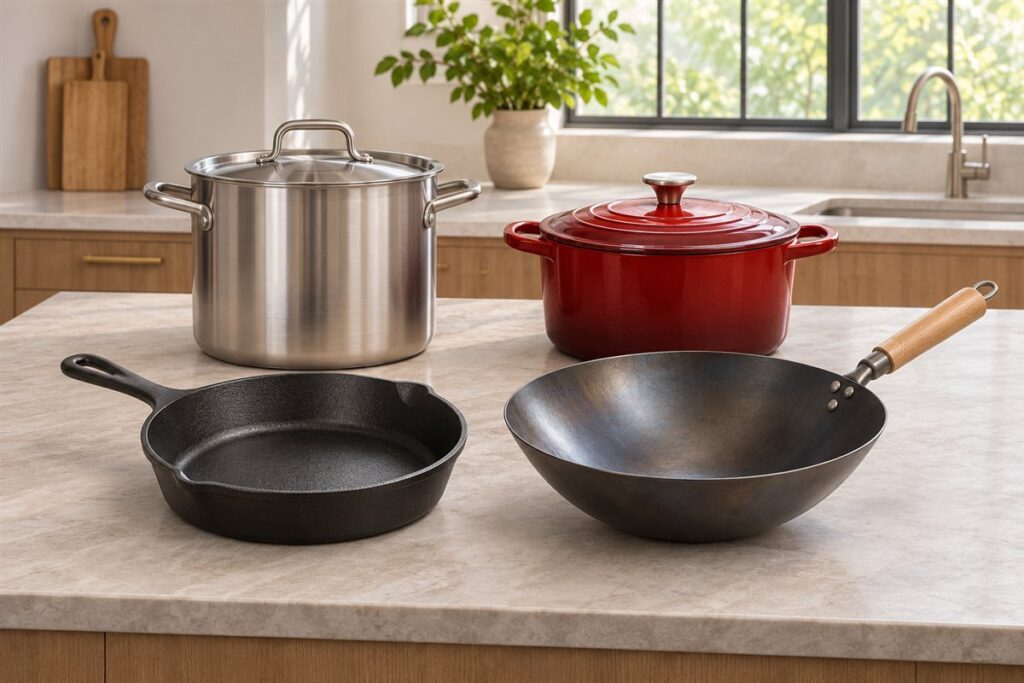
A stock pot lid should sit snugly on the rim, hold in steam and have a knob you can grip with a mitt. If you are replacing a lost lid, the key task is measuring the pot correctly. After that, you can compare glass and metal options.
Measure the Pot Correctly
- Place a ruler across the top of the pot, rim to rim.
- Measure the outside width at the widest point, including the rim.
- Note whether the rim curves outward, which can change how a lid sits.
- Compare with the lid diameter listed by the maker. Most lids are sized to cover the rim, so a lid close to the outside width usually fits best.
- If the pot has a unique shape, check the maker’s compatibility list.
Pot sizes are often labeled by volume, not width, so do not rely on quarts alone.
Glass or Metal?
| Type | Good for | Trade-off |
|---|---|---|
| Glass | Watching food without lifting the lid | Can be heavier and may crack if knocked or shocked by sudden temperature change |
| Stainless steel | Durability and oven use | You cannot see inside |
| Domed metal | Taller foods and roast pieces | Takes more storage room |
Small Details That Matter
- Steam vent: A small hole stops the lid from rattling and helps prevent boil-overs, but it lets some steam out.
- Knob: It should be large enough for a mitt and made of a material that tolerates your stove and oven. Read the maker’s temperature limit.
- Rim: A metal rim around glass protects the edge.
- Weight: A heavier lid sits firmly and keeps steam in, but is harder to lift.
Using a Lid Well
Tilt the lid away from you when you lift it so steam does not reach your hands or face. Leave it slightly ajar when simmering stock if you want to reduce the liquid. Cool a glass lid before washing to avoid sudden temperature changes.
If you cannot find the original maker’s lid, look at universal options sold for a range of diameters. These often have a stepped or flat design meant to sit on several sizes. They are handy, though a loose fit lets steam escape and can make simmering less efficient. When you shop, bring your measurements, and check the return policy in case the fit is not right. It also helps to note the pot’s brand and model number, since some makers sell replacement lids that match exactly. Store the lid where it will not be knocked, because rims and knobs are easy to chip.
Overlapping Lids Versus Inset Lids
Lids sit on a pot in one of two ways. An overlapping lid is wider than the pot opening and rests on the rim, covering it. An inset lid has a smaller, lower section that drops into the opening, with a rim that sits on top. Overlapping lids tolerate small differences in size, which is why they are common for replacements. Inset lids can seal well but depend on the exact size and shape of the pot opening.
When you replace a lid, consider which style your pot was designed for. A lid made to overlap may sit wobbly on a pot that expects an inset fit, and vice versa. Check the pot’s rim: some have a groove, a lip or a curve that guides the lid into place. If your pot has pouring spouts or a flared rim, the lid may not seat evenly, so look at the lid shape against the rim.
A lid that is slightly larger than the pot usually works, but one that is much larger can slide off or leave gaps. A lid that is smaller than the opening is a hazard and can fall into the pot. When the fit is uncertain, bring the pot to the shop if possible, or compare dimensions carefully with the product listing. Look at photos of the underside to see how the lid is shaped.
Knob and Handle Design
The knob is the part you touch most, so it deserves attention. A tall, wide knob is easier to grasp with mitts, and a flat or small knob can be fiddly. Metal knobs conduct heat, so they may become hot on the stove or in the oven. Plastic or phenolic knobs stay cooler but may have lower temperature limits, so check what the maker states before using the lid in the oven.
Look at how the knob is attached. A screw-in knob can loosen with time, so tighten it from time to time. A welded or riveted design stays firmly attached. If a knob rattles or turns, replace or tighten it before it fails. A loose knob can make lifting a hot lid dangerous.
- Choose a knob you can grip with an oven mitt.
- Check the maker’s heat limit if you plan to use the oven.
- Look for a knob that does not hold water.
- Test the lid’s balance by lifting it by the knob.
Some lids have side handles in addition to a central knob, which helps if the lid is large or heavy. A lid that tilts when lifted is awkward, so a balanced design matters.
Steam Management and Condensation
Lid design affects how steam and condensation behave. A domed lid gives more space for steam to circulate, and it directs condensation back to the sides instead of dripping from the center. A flat lid is more compact and stacks easily but may let drops fall onto food. Some lids have self-basting features, such as ridges or dimples, intended to return moisture to the pot. Whether these make a difference depends on the dish, so treat the claims as the maker’s description.
Vents help release excess steam. A vent hole can reduce boil-overs and keep the lid from rattling, but it also reduces moisture retention. For stock, a vented lid or a lid tilted slightly open lets liquid reduce gently. For braising or steaming, a tight seal keeps moisture in. Think about your usual recipes and choose accordingly.
Some lids have a silicone rim to create a tighter seal. These can help keep steam in, though the silicone must be heat-rated and cleaned regularly. Glass lids let you see the contents but can be heavy and may fog up. Metal lids block the view but are durable. If you often check on simmering stock, a glass lid may reduce lifting and heat loss, but follow the maker’s guidance on temperature changes.
Oven Use, Storage and Safety
If you plan to finish dishes in the oven, check the lid’s temperature limit and the knob material. Glass lids often have a lower limit than the pot itself, and some are not meant for the oven at all. Plastic knobs may melt or crack at high temperatures. When in doubt, ask the maker or look at the care sheet. Using a lid beyond its limit can cause cracking or shattering.
Handle hot lids with care. Lift them away from your body so steam does not reach your hands or face. Place a hot glass lid on a dry, heat-safe surface, not on a wet counter, because sudden temperature changes can cause damage. Do not rinse a hot lid under cold water. Let it cool before washing.
Storage deserves a plan. Lids are bulky and easy to lose. A lid rack, a hanging hook or a drawer divider can keep them organized. Avoid stacking glass lids directly, since they can scratch or chip. Store the lid with the pot if there is space, so you always know it fits. Check the rim for chips or cracks occasionally, as damaged glass or warped metal should be replaced.
Universal Lids and Questions to Ask
Universal lids are designed to fit several diameters, usually with a stepped or flat shape. They are practical for replacing a lost lid or for covering odd pots. The trade-offs include a looser fit, less steam retention and a design that may not suit tall, domed cooking. A universal lid can be a sensible backup, but a matched lid generally seals better.
Before buying, ask: What is the exact diameter I need? Does the lid overlap or inset? Is the pot’s rim flat, rolled or flared? What material do I prefer? Do I need oven use? Will the lid fit in my storage? Can I return it if it does not fit? The answers help you avoid a purchase that does not work.
Budget tiers affect the details. Simple lids cover the basics, while better ones offer heavier construction, sturdier knobs and better seals. A lid is not worth overspending on if you rarely use it, but if you simmer stock often, a good-fitting lid saves energy and effort. If a lid warps, cracks, loses its knob or fails to seat, replace it.
FAQ
Can one lid fit several pots?
A universal lid may cover pots of similar width, but the fit is usually less snug than a matched one.
Is it fine to use a plate as a lid?
A heatproof plate can work briefly, though it will not hold steam as well and gets very hot.
How do I know whether I need an overlapping or inset lid?
Look at how your original lid sat on the pot. If you do not have it, check the rim shape and the maker's information, or choose an overlapping lid that is a little wider than the opening.
Can I put a glass lid in the oven?
Only if the maker states it is oven-safe and gives a temperature limit. Do not assume all glass lids can be used in the oven.
Why does my lid rattle?
A lid may rattle if steam is escaping unevenly or the lid is too loose. Lower the heat, check the fit and consider a lid with a better seal.
What should I do about a loose knob?
Tighten the screw if it is accessible. If it stays loose or is cracked, replace the knob or the lid.
Is a vent hole a good feature?
It helps prevent boil-overs and rattling, but lets some steam out. It is helpful for stock but less so for dishes that need a tight seal.
Can I use foil as a lid?
Foil can serve in a pinch, but it does not seal as well, and it should be handled with care when hot. A proper lid is safer.
How should I clean a lid?
Wash it with warm soapy water, paying attention to the rim and knob. Let hot glass cool first, and follow the care sheet.
The Short Version
Measure the pot rim to rim, then choose glass for visibility or metal for durability. Check the knob, vent and maker’s heat limits.