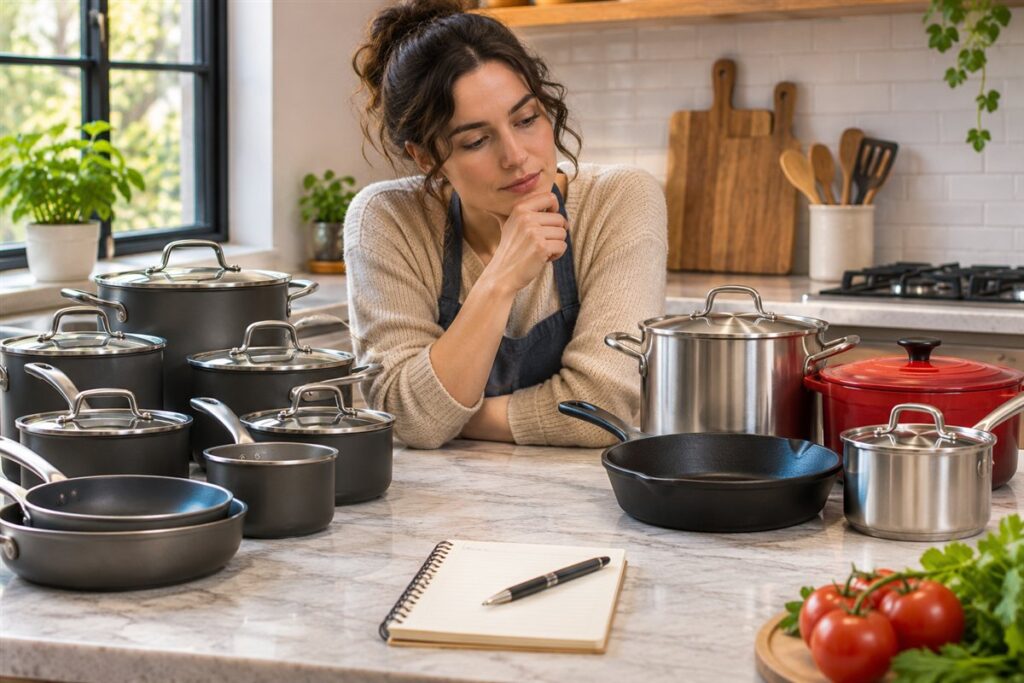
The most common cookware buying mistakes are choosing for looks instead of your stove, buying a huge set you will not use, and ignoring how a handle feels when the pan is full. Avoiding them mostly comes down to matching pans to the way you actually cook.
Mistakes About Fit
A pan has to work with your heat source. Many people buy a material their stove cannot use, or a base that sits poorly on the burner. Check the maker’s guide for the heat sources a pan supports before you commit.
- Skipping the check for induction, gas or electric coil compatibility.
- Choosing a base that is much smaller or larger than the burner.
- Forgetting that oven use depends on handle and lid materials, not just the pan body.
- Buying pans that will not fit your cupboard, dishwasher or sink.
Mistakes About Quantity and Variety
Large boxed sets look like good value, yet they often include pieces that rarely leave the cupboard. Most home cooks lean on a handful of shapes: a skillet, a saucepan, a larger pot and perhaps a sauteuse for deeper dishes.
Another trap is buying everything in one material. Different jobs suit different pans, so a mix can serve you better than a matching set. Think about what you cooked last week and buy for that.
Mistakes About Handling and Care
Weight, handle shape and lid fit matter every day. A pan that feels fine empty can be awkward when full of liquid. If you can, hold a pan in a shop, or read the maker’s weight and handle details carefully.
- Decide who will lift the pan and how often.
- Check whether the handle stays comfortable near heat, following the maker’s instructions.
- Read the care guide so you know whether hand washing is needed.
- Note which utensils the surface can tolerate.
Ignoring care instructions is a quiet mistake. A surface that needs gentle cleaning will wear faster if treated roughly, and that is hard to undo.
Quick Self-Check Table
| Question | Why it matters |
|---|---|
| Which heat source do I use? | Not every material works on every stove. |
| How many people do I cook for? | Sets the size and number of pieces. |
| Can I lift it full? | Weight and handle shape affect control. |
| How will I wash it? | Care needs vary by surface. |
FAQ
Is a full set ever a good idea?
It can be, if you are furnishing a first kitchen and the pieces match what you cook. Check each piece in the list rather than the piece count.
Should I replace all my pans at once?
Not usually. Replace the one you use most or the one that gives you trouble, and see how it goes before buying more.
The Short Version
Match pans to your stove, your meals and your hands. Buy fewer, well-suited pieces rather than a large set, and read the maker’s care guide before you buy.