A pregnancy pillow is a long, shaped body pillow meant to sit along your front and back at once. The shapes you will see are U, C and a wrap-around form, and they differ in length, fill and how much bed they take up. Lengths run from the mid 50s to about 60 inches.
The six pillows below range from a 54 inch memory foam U-shape to a 58 inch wrap-around with a firm fill. Sizes, fills and covers come from each product’s listing page. We have not used these pillows ourselves. Cooling, certification and comfort statements are the makers’ own.
As an Amazon Associate we earn from qualifying purchases. Links below are affiliate links, and they do not change the product information we give.
What to Look For
| Feature | Why it matters |
|---|---|
| Shape | U-shapes wrap both sides; wrap-arounds take less room |
| Length | Longer pillows reach from head to feet but need a wider bed |
| Fill | Polyester fiber, down alternative and memory foam feel different |
| Cover | A removable cover is easier to wash |
In this guide
Specs at a Glance
| Pillow | Size and shape | Fill | Notes |
|---|---|---|---|
| Momcozy U Shaped | U-shaped; size not stated on the page we read | 100% polyester | Maker says it can be reshaped for TV or reading |
| Chilling Home 58 in | 58 inch U-shape; grey | Polyester | Removable cover; 90-day maker return policy |
| BATTOP 57 in | 57 inch U-shape; length given as 57 to 60 in | Polyester polyfill, adjustable | Removable cover; OEKO-TEX Standard 100 per the maker |
| Frida Mom | 58 inch; one continuous wrap-around piece | Polyurethane, firm | Storage bag included; cooling fabric per the maker |
| Bedgear | 54 x 15 in; elongated U curve | Memory foam | Dual-sided removable cover |
| Sasttie 57 in | 57 x 27.5 in U-shape | 7 lb down alternative (40% silicified fiber, 60% polyester) | Microfiber removable cover |
The 6 Best Pregnancy Pillows
Top pickBest for a classic U-shape
1. Momcozy U Shaped Full Body Maternity Pillow
A U-shaped full body pillow with a 100 percent polyester build. The maker says it can be reshaped to support different spots, such as for watching TV or reading, and that it suits both side and back sleepers. The page we read did not list dimensions.
Suits: a classic U-shape. Strengths: flexible shape and polyester build. Weaknesses: no size given on the page we read. Skip it if you need to confirm the length before buying.
View Momcozy Pregnancy Pillow for Sleeping – U Shaped Full Body Maternity Pillow on Amazon
Best for a long U-shape with a washable cover
2. Chilling Home U Shaped Maternity Pillow, 58 Inch
A grey 58 inch U-shaped pillow with a polyester fill and a removable cover. The listing marks it as adjustable, compressible and washable, and the maker offers a voluntary 90-day return policy.
Suits: a long U-shape with a washable cover. Strengths: 58 inch length and a compressible build. Weaknesses: the listing text is keyword-heavy and short on detail. Skip it if you want a stated fill weight.
View Chilling Home Pregnancy Pillow, U Shaped Full Body Maternity Pillow 58 inch on Amazon
Best for a fill you can adjust
3. BATTOP U Shaped Full Body Maternity Pillow, 57 Inch
A 57 inch black U-shaped pillow with a removable cover and polyester polyfill. The maker says you can add or remove filling to suit your sleeping style, cites OEKO-TEX Standard 100 certification and gives the length as 57 to 60 inches.
Suits: a fill you can adjust. Strengths: adjustable filling and a removable cover. Weaknesses: the length is given as a range. Skip it if you want a fixed, pre-set fill.
View BATTOP Pregnancy Pillows for Sleeping- U Shaped Full Body Maternity Pillow on Amazon
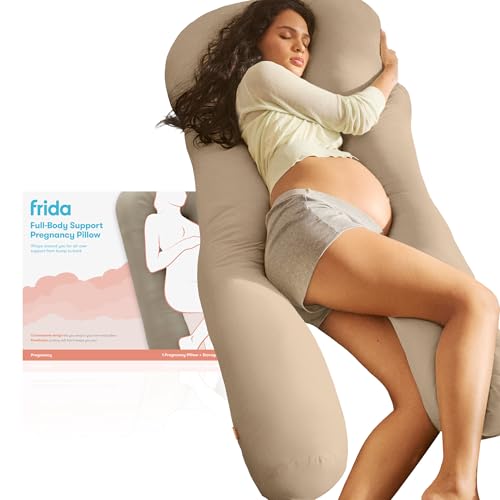
Best for a wrap-around shape
4. Frida Mom Full Body Cooling Pregnancy Pillow
A 58 inch pillow that runs from under the head to between the knees in one continuous piece, filled with polyurethane. The maker describes a firm fill that holds its shape and a cool-to-the-touch fabric, and the pillow comes with a storage bag in taupe.
Suits: a wrap-around shape. Strengths: one continuous piece and a firm fill. Weaknesses: the page we read did not list the width. Skip it if you want a soft, sink-in feel.

View Frida Full Body Support Cooling Pregnancy Pillow, Storage Bag, Taupe on Amazon
Best for a memory foam feel
5. Bedgear Full Body Pillow, U-Shaped, 54 x 15
A 54 by 15 inch pillow with an elongated U curve and a memory foam fill. The cover is dual-sided, with an airflow fabric on one face and a cooling fabric on the other, and it is removable and washable.
Suits: a memory foam feel. Strengths: a two-sided cover and a compact footprint. Weaknesses: the shortest pillow here. Skip it if you want a full 57 inch or longer wrap.
View Bedgear Full Body Pillow – U-Shaped Design Ideal for Multiple Sleeping Positions on Amazon
Best for a plush, heavy fill
6. Sasttie Cooling Pregnancy Pillow, 57 Inch
A 57 by 27.5 inch U-shaped pillow with a microfiber cover and about 7 pounds of down-alternative filling, a blend of 40 percent silicified fiber and 60 percent polyester. The cover is removable.
Suits: a plush, heavy fill. Strengths: a stated fill weight and blend. Weaknesses: a wide 27.5 inch span. Skip it if you share a smaller bed.
View Sasttie Cooling Pregnancy Pillows for Sleeping, 57” Full Body Pillow on Amazon
Care and Setup
- Check the care tag before washing the cover or pillow.
- Fluff the fill regularly to keep its shape.
- Measure your bed width against the pillow’s span.
- Use a spare pillowcase or cover if you want one to rotate.
Mistakes to Avoid
- Buying without checking the length and width.
- Ignoring how much of the bed a U-shape takes.
- Assuming every fill feels the same.
- Treating maker claims as proven facts.
Matching the Shape to How You Sleep
Most people choose a pregnancy pillow by name, but the shape should follow your usual sleep position. If you tend to roll between your left and right side during the night, a U-shaped pillow is the most forgiving, because it supports you on both sides and you do not have to wake up and move the pillow each time you turn. The curve that sits behind your back stops you from rolling flat, while the front section holds up your belly and sits between your knees.
If you only sleep on one side, or you share a bed and need the space, a single-piece wrap-around or a C-shape is usually enough. It supports the belly and knees on one side and can be flipped or repositioned if you change sides. The trade-off is that you give up the back support on the opposite side.
Think about where you feel strain. Lower back ache is often eased by a pillow that fills the gap behind you. Hip pressure is eased by a pillow that keeps your top knee lifted and level with your hip. Heartburn or breathlessness sometimes leads people to want a bit of upper body lift, so look at whether the head end of the pillow is thick enough to prop you slightly, or whether you will need a second pillow.
Finally, consider how your needs may change. The bump grows, and a pillow that felt generous in the second trimester can feel different in the third. A pillow that can be reshaped, or that has a soft, moldable fill, tends to adapt better than a rigid one. Your midwife or doctor can advise on sleeping positions that suit your pregnancy, and the pillow should support that advice rather than replace it.
How Fill Types Compare in Feel and Upkeep
The fill decides almost everything about how a pregnancy pillow feels at 3 a.m., so it is worth understanding the three common types. Polyester fiber, often sold as polyfill, is light and soft and can be fluffed back into shape. It is easy to adjust, and some pillows let you add or remove fill. The downside is that loose fiber can clump or flatten with heavy use, so it needs regular shaking out.
Down-alternative fill is made of finer synthetic fibers, sometimes blended, and aims for a plush, cushiony feel. It usually weighs more, which gives a substantial pillow but also makes it heavier to move around the bed and to wash. Check the listing for the stated fill weight and the blend rather than assuming softness from the name.
Memory foam and other polyurethane foams feel firmer and hold their shape. They give a stable, consistent support under the belly and between the knees, and they do not clump. They can feel too firm for people who like to sink in, and some foams hold more warmth against the body, so check how the cover is built.
Ask yourself which problem you are solving. If you want a pillow that stays put and does not need daily plumping, a firmer fill makes sense. If you want a soft cradle that you can mold to your body, a fiber fill is the better match. Whichever you choose, look at whether the fill is enclosed in a removable cover and whether the maker states a way to wash the pillow itself, since not every fill can go in a machine.
Fitting a Pillow Into a Shared Bed
Full-length pillows are bulky, and the most common regret is discovering that the pillow takes more than half the mattress. Before ordering, measure your mattress width and subtract the pillow’s stated span. A U-shape that is wide at the open end can push into your partner’s side, while a narrower wrap-around leaves more room. The listing dimensions are the only reliable guide, so look for width as well as length.
Think about the open end of a U-shape. Some people sleep inside the curve with the open end toward the foot of the bed, which keeps the pillow compact. Others sleep with the open end at the head. Test which way leaves more room for your partner, and remember the pillow will compress somewhat under your weight.
A smaller bed changes the equation. On a double or full-size mattress, a very wide pillow may be impractical, and a shorter or more compact design can be the better trade. If you and your partner have different sleep schedules, check whether the pillow is easy to slide out of the way without waking anyone, because a heavy, rigid pillow is harder to move.
Also think about the sheets. A bulky pillow tends to drag fitted sheets and top sheets sideways, so some people prefer a duvet that stays on their side. If your partner sleeps hot, a thick pillow between you can trap heat, so a breathable cover helps both of you.
Choosing for Hot Sleepers
Many people feel warmer during pregnancy, and a large pillow pressed along your whole body adds to it. If you run warm, the cover fabric and the fill both matter. Breathable weaves, thinner knits and covers that wick moisture generally feel cooler against the skin than thick plush fabrics. Some makers describe cooling fabrics, but those are the makers’ own claims, so read the description closely and treat them as a feature to compare rather than a guarantee.
Fill affects heat too. Dense foam tends to hold body warmth more than loose fiber, which has air between the strands. On the other hand, a pillow with a lot of loose fill can feel warm if it is packed tightly. A pillow with an adjustable fill lets you remove some material to reduce bulk.
A removable cover is practical for another reason, because night sweats can leave a pillow feeling damp. Being able to wash the cover often keeps it fresh, and having a second cover to rotate means you are never left without one. A cover with a zipper that closes fully is easier to live with than one that gapes.
If the cooling fabric is on one side only, check which side faces you. Dual-sided covers let you flip between a smoother face and a more textured one depending on the season. Finally, consider the room: a fan, lighter bedding and a cotton pillowcase under the pillow can help more than any single product feature.
Using It After Birth and Knowing When to Replace It
A good pregnancy pillow often stays useful after delivery. Many parents use the curve for propping up while feeding a baby, as a back rest for sitting up in bed, or as a lounging pillow for reading. A pillow that can be reshaped suits this best, while a firm, fixed shape may be more awkward to reposition. Do not assume a body pillow is designed as a baby sleep aid. Follow current safe sleep guidance for infants and keep large pillows out of an infant’s sleep space.
Plan for storage if you will not use it. Wash and dry the cover and pillow fully according to the care label, then store it in a breathable bag or a cover. Compressible pillows can be squashed for storage, but leaving fill compressed for a long time may leave it flat, so fluff it before reuse. A storage bag, where one is included, makes this easier.
Signs that it is time to replace the pillow include permanent flat spots that fluffing does not fix, lumps that do not shake out, persistent odors after washing, a cover that is torn or has a broken zipper, and visible stains that do not wash out. If you wake with new aches and the pillow no longer holds your belly or knees up, the fill has probably broken down.
If you only use a pillow for a few months, durability may matter less than comfort and washability. If you plan to use it for several pregnancies or as an everyday body pillow, look for sturdy stitching and a fill that recovers its shape.
Questions to Bring to Your Midwife or Doctor
A pillow is a comfort aid, not a treatment, and it should never replace advice from the people caring for you. Before you buy anything, it is worth noting down a few questions for your next appointment. They can tell you what to expect, and what to avoid, based on your own situation.
- Which positions are recommended for me at this stage of pregnancy?
- Is there anything about my situation that makes certain pillow shapes unsuitable?
- Whom should I contact if discomfort gets worse rather than better?
- Are there materials or fills I should avoid because of allergies or sensitivities?
Your care team can also answer questions about bedding and bed arrangements that no product page can. If you share a bed with a partner, a toddler or a pet, bring that up too, because the layout matters.
It can help to write answers down during the visit, since details are easy to forget afterwards. Bring a partner or friend if you like, and ask for any guidance in writing so you can refer back to it when you are comparing products at home.
When a listing makes claims about back relief or better comfort, treat them as marketing language and not as medical statements. Follow official guidance from your health service and your clinician. A comfortable pillow can be a pleasant extra, but your own comfort and your clinician’s advice come first.
Decoding the Dimensions and Materials on a Listing
Pillow listings pack a lot of numbers into a small space, and they are easy to misread. The length quoted is usually the longest straight measurement, which is not always the same as the usable support along your body. A U-shaped design may list its overall span, while the inner curve is what actually wraps around you.
Look for the outer width and the height when the pillow is fully filled, and compare them with your mattress width. A bulky pillow on a narrow bed leaves little room for anyone else, and a flat one on a wide bed may not feel supportive.
| Listing line | What it tells you |
|---|---|
| Overall length | The longest span, not always the support length |
| Fill type | How the pillow feels and how it holds shape |
| Cover fabric | Texture, warmth and how it washes |
| Care label | Whether the cover, the fill or both are washable |
| Zipper | Whether the cover comes off for cleaning |
Material descriptions are best read alongside the care label. Always follow the maker’s washing guidance, since a wrong cycle can ruin the fill. If the page is vague about what is inside, ask the seller before ordering rather than assuming.
Pregnancy Pillow FAQ
What is the difference between U-shaped and wrap-around?
A U-shape curves around both sides of you. A wrap-around, like the Frida, is one continuous piece that runs along one side.
Can I use one as a regular body pillow?
Yes, all six are full-length body pillows. Check the size to be sure it fits your bed.
When should I start using a pregnancy pillow?
There is no fixed week. Many people start when lying flat or on their side becomes uncomfortable, often as the bump grows or hips and back begin to ache. If you are unsure, ask your midwife or doctor about sleeping positions.
Does a longer pillow always give more support?
Not necessarily. Length helps if you want support from head to feet, but a long pillow takes more bed space and can be awkward to move. Match the length to your height and the width of your bed.
Can I wash the whole pillow, or only the cover?
It depends on the fill and the maker's care label. Many covers are removable and machine washable, while the inner pillow may need gentler handling or spot cleaning. Always check the label before washing.
How do I stop the pillow from flattening?
Fluff and shake it out each morning, and rotate or turn it from time to time. Foam fills hold shape better than loose fiber, so a firmer fill needs less plumping.
Is a pregnancy pillow safe to use with a baby in the bed?
Large, soft pillows should be kept away from infants. Follow current safe sleep guidance from your pediatric provider and keep the baby in their own sleep space.
What if I get too warm with a full-length pillow?
Look for a breathable removable cover, consider a fill with more air in it, and use lighter bedding. A cover you can wash often also helps keep the pillow fresh.
Can a pregnancy pillow help with back pain?
Some people find that filling the gap behind the back and keeping the knees aligned eases pressure. It is a comfort aid and not a treatment, so talk to a healthcare provider about persistent pain.
The Short Version
For a classic U, the Momcozy. For a long 58 inch U, the Chilling Home. For adjustable fill, the BATTOP. For a wrap-around, the Frida. For memory foam, the Bedgear. For a stated fill weight, the Sasttie.
Related Guides
- 6 Best Corner Desks for Two Monitors: L-Shaped Picks (2026)
- 6 Best Body Pillows: Long, Adjustable and H-Shape (2026)
- How to Prepare a Shaped Cake Pan According to Its Finish
- How to Choose a Vegetable Peeler: Y-Shaped, Swivel or Straight
- 6 Best Dog Ramps: Folding Car Ramps by Length (2026)
Comfort, Support and Sleep Positions in More Depth
Comfort note: this section offers general information only and is not medical advice. If pain, numbness, swelling, or sleep problems persist, or if you have been given specific guidance about sleep position, follow your clinician advice and raise the pillow choice at your next appointment. A pillow can make a recommended position easier to hold through the night, but it cannot replace assessment when symptoms change. Treat any new or worsening symptom as a reason to seek care promptly rather than as a problem to solve by shopping for a different shape or a firmer fill.
Side sleeping is commonly recommended later in pregnancy, and the practical challenge is staying comfortable there for hours. Support works as a system: the head pillow sets neck alignment, a section between the knees keeps hips level, support under the bump reduces the pulling feeling, and a length behind the back discourages rolling flat. When one element is missing, the body compensates, and the compensation is usually what aches by morning. Adjust one element at a time over several nights, because the first night in a new arrangement often feels strange even when the arrangement is actually helping.
Heat and restlessness deserve equal attention. A large pillow adds insulation, so breathable covers, lighter nightwear, and a cooler room often matter as much as the fill itself. If you wake to rearrange the pillow repeatedly, note what moved: a section that slips away needs repositioning support, while a section that feels bulky may need to be folded or placed further from your body. Small adjustments, tested patiently, usually beat replacing the whole pillow. Partners also sleep better when the arrangement is settled early in the evening rather than rebuilt in the middle of the night.
Deeper Guidance for Everyday Use
Think about cleaning before you think about performance. The best-performing item in a test kitchen can become a burden at home if it needs soaking, special cleaners, or careful drying after every use. Ask how food residue behaves on the surface, whether corners trap grease, and whether the item can air-dry safely or needs immediate towelling. A slightly less impressive tool that washes quickly and stores neatly often serves a household better over years than a demanding one that is used reluctantly. Honest reflection about your washing habits saves both money and frustration.
Storage shapes daily life in ways buyers rarely consider. Measure the cupboard, drawer, or shelf where the item will live, including the height needed to lift it out without scraping neighbouring pieces. Crowded storage leads to chipped edges, bent rims, and scratched surfaces, and it discourages putting things away properly. If space is tight, favour stackable shapes, protective layers between pieces, and items that serve two jobs well instead of one job perfectly. A kitchen that is easy to tidy is a kitchen where tools stay in good condition for far longer.
Safety habits deserve a section of their own because most accidents happen during familiar routines rather than ambitious projects. Keep handles turned away from the edge of the stove, dry your hands before lifting anything heavy or hot, and give yourself a clear landing space before you start. Children and pets change the calculation again, since a low drawer or an open oven door becomes a hazard at their height. Building these checks into your routine takes seconds, yet it prevents the burns, cuts, and spills that no purchase can undo after the fact.
Durability is best judged by construction rather than by promises. Look at joints, seams, and the places where two materials meet, because those junctions fail first under heat, moisture, and repeated washing. A single well-made piece usually outlasts several thin ones, and it behaves more predictably while you work. Weight alone is not proof of quality, but flimsy flexing, loose fittings, and uneven finishes are reliable warnings. When a listing is vague about construction, treat that silence as information and look for a maker who describes materials plainly.
Heat control is a skill that good equipment supports but never replaces. Preheat gradually, listen for the change in sound as food begins to sizzle, and adjust the burner before the pan gets away from you rather than after. Crowding a surface drops the temperature and produces steaming instead of browning, so working in smaller batches often gives a better result with the same equipment. Resting food briefly before serving lets juices settle and temperatures even out. These small timing decisions influence the finished dish more than most upgrades, and they cost nothing to practise.
Water quality quietly affects both cooking and cleaning. Hard water leaves pale mineral marks on dark surfaces and can dull a finish over time, while soft water makes detergents foam more and rinse differently. If spots keep returning, drying with a soft cloth straight after washing usually helps more than stronger cleaners. A brief wipe is gentler than repeated scrubbing, and it keeps finishes looking even. When you descale kettles or machines, follow the maker guidance for your model rather than a generic routine, since seals and coatings vary and harsh treatment can shorten their life.
Avoiding Common Pitfalls Over Time
Good technique begins with preparation. Lay out ingredients, tools, and a cloth before heat or water is involved, and read the full set of instructions once from start to finish. That pause prevents the mid-task scramble that leads to overcooking, spills, and forgotten steps. Clear as you go whenever there is a natural break, because a tidy bench is easier to keep safe and a sink that never overflows is easier to face at the end. Experienced cooks are not faster because they rush; they are faster because they rarely have to stop and fix an avoidable problem.
When something goes wrong, change one variable at a time. If food sticks, browns unevenly, or cleans up badly, adjust temperature, timing, or quantity before blaming the equipment. Keeping brief notes after a disappointing result turns guesswork into learning, especially when the same dish is made again within a few weeks. Photographs help too, since memory softens details. Over a season, those notes reveal patterns about your stove, your water, and your habits that no general guide can predict, and they make the next purchase far better informed.
Sharing a kitchen calls for simple agreements. Decide where shared tools live, how they are washed, and what happens when something is damaged. Labelling shelves sounds fussy until three people search for the same item during a busy evening. Agreeing that delicate pieces are washed by hand, or that a particular board is kept for raw proteins, protects both the equipment and the relationships around it. Write the agreements down for the first month, then let habit take over once everyone follows the same routine without thinking about it.
Seasonal cooking changes what you need. Summer brings salads, grilled food, and quick meals that favour light tools and easy washing, while winter leans toward soups, roasts, and baking that reward heavier, oven-safe pieces. Reviewing your equipment twice a year, once before each shift, helps you notice wear early and plan replacements calmly instead of urgently. It is also the right moment to sharpen, oil, descale, or deep-clean the pieces that carry the next season, so they start that period in their best condition rather than their worst.
Children learning to cook need tools sized for confidence. Supervised tasks such as stirring cool mixtures, washing vegetables, tearing herbs, and spreading fillings build skill without exposing small hands to heat or sharp edges too soon. A stable step, a clear workspace, and unhurried timing matter more than special equipment. As confidence grows, introduce one new responsibility at a time and keep the earlier safety rules unchanged. The goal is a calm kitchen where a young cook learns that care and patience are part of cooking, not obstacles placed in front of it.
Cooking for guests rewards planning over improvisation. Choose dishes you have made before, prepare cold elements early, and keep the final hour for tasks that truly need last-minute attention. Borrowed or rarely used equipment should be washed and tested a day ahead, not discovered to be damaged as guests arrive. A short written running order, even on a scrap of paper, frees your attention for conversation. Guests remember a relaxed host far longer than an ambitious menu, so protect your calm as carefully as you protect the food itself.
Questions Worth Asking Before You Decide
Budget decisions work best when they follow use rather than fashion. Spend first where your hands spend the most time: the pan, knife, board, or appliance you use daily deserves the careful choice, while rarely used specialty items can be simpler. Borrowing a specialty tool from a friend, or making a dish once with a substitute, often shows whether the dedicated version is truly needed. Keeping a short wish list with the reason for each item prevents impulse buying and makes sales periods useful instead of distracting, because you already know what gap each purchase must fill.
Reading product information critically is a learnable skill. Separate measurable facts, such as dimensions, materials, and stated heat limits, from descriptive language that promises a feeling. Check whether the measurements include handles and lids, whether care instructions match your habits, and whether replacement parts are available. Photographs can flatter scale, so compare the stated size with a ruler on your own counter. When two listings describe the same item differently, trust the maker documentation over a marketplace summary, and keep a copy of the care guide where you can find it later.
Maintenance is easiest when it is attached to an existing habit. Wipe, dry, sharpen, or inspect while the kettle boils or while the oven cools, and small jobs stop accumulating into a discouraging project. Keep the few supplies you actually use within reach of the sink, and store harsher cleaners separately so they are chosen deliberately rather than by convenience. A monthly five-minute inspection for looseness, rust, warping, or worn seals catches problems while they are still cheap and simple to fix, long before they become replacements.
Environmental choices in the kitchen are mostly about longevity. An item repaired, sharpened, reseasoned, or fitted with a fresh seal stays in service and out of landfill. When replacement is genuinely needed, passing a usable item to a new home is better than discarding it, and choosing a design with replaceable parts extends the next item life as well. Avoid buying duplicates out of uncertainty; a careful inventory of what you own prevents the third version of a tool you already had. Thoughtful keeping is quieter than dramatic decluttering, and it works better.
Accessibility deserves attention in every kitchen, not only in adapted ones. Good lighting over the work surface, tools that open without force, and frequently used items stored between knee and shoulder height reduce strain for everyone. Non-slip mats under boards, clear labels, and handles with visible contrast help tired eyes and tired hands at the end of a long day. If someone in the household has changing needs, review the layout together rather than guessing, because the person doing the task knows exactly where effort and discomfort appear.
Extra Frequently Asked Questions
How long should I expect a good choice to last with ordinary home use?
With ordinary home use and the care routine described in this guide, a sound choice should serve for years rather than months, with only small maintenance along the way. Longevity depends far more on daily handling, washing, and storage than on any single feature, so the habits in the earlier sections are the real guarantee.
What is the simplest routine that keeps things working well?
The simplest effective routine is the short one you will actually repeat: use the item as intended, clean it promptly in the gentlest way that works, dry it fully, and store it where it will not knock against other pieces. Attached to an existing habit, such as tidying while a kettle boils, this takes moments and prevents nearly all of the wear described in this guide.
How do I know when adjustment is better than replacement?
Adjustment is better when the item is sound but the fit, setting, or technique is slightly off, which shows up as inconsistent results rather than visible damage. Replacement is better when you find looseness, warping, deep damage, or a surface that no longer cleans properly. When in doubt, try the careful adjustment first and judge it over several ordinary uses before deciding.
What should I check first when results disappoint?
Check the basics in order: whether the item suits the task, whether it was prepared and used as the maker directs, and whether cleaning or maintenance has slipped. Most disappointments trace back to one of those three, and each is cheaper to fix than a new purchase. Only when all three check out is the item itself the likely problem.
Keep returning to the evidence of your own kitchen as you apply this guidance. Recipes, households, water, stoves, and hands all differ, so a recommendation that suits a neighbour may need small changes to suit you. Make one change at a time, live with it through several ordinary meals, and keep what clearly helps. That patient, observant approach turns general advice into personal knowledge, and personal knowledge is what makes every later decision quicker, cheaper, and more satisfying for everyone who cooks and eats in your home.
Keep returning to the evidence of your own kitchen as you apply this guidance. Recipes, households, water, stoves, and hands all differ, so a recommendation that suits a neighbour may need small changes to suit you. Make one change at a time, live with it through several ordinary meals, and keep what clearly helps. That patient, observant approach turns general advice into personal knowledge, and personal knowledge is what makes every later decision quicker, cheaper, and more satisfying for everyone who cooks and eats in your home.
Keep returning to the evidence of your own kitchen as you apply this guidance. Recipes, households, water, stoves, and hands all differ, so a recommendation that suits a neighbour may need small changes to suit you. Make one change at a time, live with it through several ordinary meals, and keep what clearly helps. That patient, observant approach turns general advice into personal knowledge, and personal knowledge is what makes every later decision quicker, cheaper, and more satisfying for everyone who cooks and eats in your home.
Keep returning to the evidence of your own kitchen as you apply this guidance. Recipes, households, water, stoves, and hands all differ, so a recommendation that suits a neighbour may need small changes to suit you. Make one change at a time, live with it through several ordinary meals, and keep what clearly helps. That patient, observant approach turns general advice into personal knowledge, and personal knowledge is what makes every later decision quicker, cheaper, and more satisfying for everyone who cooks and eats in your home.
Keep returning to the evidence of your own kitchen as you apply this guidance. Recipes, households, water, stoves, and hands all differ, so a recommendation that suits a neighbour may need small changes to suit you. Make one change at a time, live with it through several ordinary meals, and keep what clearly helps. That patient, observant approach turns general advice into personal knowledge, and personal knowledge is what makes every later decision quicker, cheaper, and more satisfying for everyone who cooks and eats in your home.
Keep returning to the evidence of your own kitchen as you apply this guidance. Recipes, households, water, stoves, and hands all differ, so a recommendation that suits a neighbour may need small changes to suit you. Make one change at a time, live with it through several ordinary meals, and keep what clearly helps. That patient, observant approach turns general advice into personal knowledge, and personal knowledge is what makes every later decision quicker, cheaper, and more satisfying for everyone who cooks and eats in your home.
Keep returning to the evidence of your own kitchen as you apply this guidance. Recipes, households, water, stoves, and hands all differ, so a recommendation that suits a neighbour may need small changes to suit you. Make one change at a time, live with it through several ordinary meals, and keep what clearly helps. That patient, observant approach turns general advice into personal knowledge, and personal knowledge is what makes every later decision quicker, cheaper, and more satisfying for everyone who cooks and eats in your home.
Keep returning to the evidence of your own kitchen as you apply this guidance. Recipes, households, water, stoves, and hands all differ, so a recommendation that suits a neighbour may need small changes to suit you. Make one change at a time, live with it through several ordinary meals, and keep what clearly helps. That patient, observant approach turns general advice into personal knowledge, and personal knowledge is what makes every later decision quicker, cheaper, and more satisfying for everyone who cooks and eats in your home.
Keep returning to the evidence of your own kitchen as you apply this guidance. Recipes, households, water, stoves, and hands all differ, so a recommendation that suits a neighbour may need small changes to suit you. Make one change at a time, live with it through several ordinary meals, and keep what clearly helps. That patient, observant approach turns general advice into personal knowledge, and personal knowledge is what makes every later decision quicker, cheaper, and more satisfying for everyone who cooks and eats in your home.
Keep returning to the evidence of your own kitchen as you apply this guidance. Recipes, households, water, stoves, and hands all differ, so a recommendation that suits a neighbour may need small changes to suit you. Make one change at a time, live with it through several ordinary meals, and keep what clearly helps. That patient, observant approach turns general advice into personal knowledge, and personal knowledge is what makes every later decision quicker, cheaper, and more satisfying for everyone who cooks and eats in your home.
Keep returning to the evidence of your own kitchen as you apply this guidance. Recipes, households, water, stoves, and hands all differ, so a recommendation that suits a neighbour may need small changes to suit you. Make one change at a time, live with it through several ordinary meals, and keep what clearly helps. That patient, observant approach turns general advice into personal knowledge, and personal knowledge is what makes every later decision quicker, cheaper, and more satisfying for everyone who cooks and eats in your home.
Keep returning to the evidence of your own kitchen as you apply this guidance. Recipes, households, water, stoves, and hands all differ, so a recommendation that suits a neighbour may need small changes to suit you. Make one change at a time, live with it through several ordinary meals, and keep what clearly helps. That patient, observant approach turns general advice into personal knowledge, and personal knowledge is what makes every later decision quicker, cheaper, and more satisfying for everyone who cooks and eats in your home.
Keep returning to the evidence of your own kitchen as you apply this guidance. Recipes, households, water, stoves, and hands all differ, so a recommendation that suits a neighbour may need small changes to suit you. Make one change at a time, live with it through several ordinary meals, and keep what clearly helps. That patient, observant approach turns general advice into personal knowledge, and personal knowledge is what makes every later decision quicker, cheaper, and more satisfying for everyone who cooks and eats in your home.